REVIEW 4 major objections 5 minor 84 references
Identifying Merger-Driven Long Gamma-Ray Bursts based on Machine Learning
T0 review · 4 major / 5 minor · reviewed 2026-08-07 · deepseek-v4-flash
Pith's one-line read Long gamma-ray bursts from binary mergers can be identified from prompt emission alone, the paper claims: on 29 three-episode Fermi bursts, machine learning on 12 parameters separates eight merger-born Type IL candidates — six of them…
desk verdict Six new merger-long GRB candidates make a useful probe, but the method's instability and eyeballed sample keep the classification conditional. read the letter →
The pith
A machine-rendered reading of the paper's core claim, the machinery that carries it, and where it could break.
The reading
What carries the argument
The load-bearing object is the three-episode prompt-emission morphology and its reduction to a 12-parameter vector: $T_{100}$ for precursor, main, extended, and whole emission; the two quiescent waiting times $T_{\rm wt1}$ and $T_{\rm wt2}$; the minimum variability timescales $T_{\rm MVT,PE}$ and $T_{\rm MVT,ME}$; spectral lags $\tau_{42}$ for main and whole emission; and peak energies $E_{\rm p,ME}$ and $E_{\rm p,WE}$. Bayesian-block segmentation (false-positive rate 0.05) identifies the episodes, and two nonlinear dimension-reduction maps (t-SNE and UMAP) project the standardized, log-transformed vectors into planes where GMM, HDBSCAN, and spectral clustering all recover the same two clusters. The physical anchor is the $E_{\rm p,z}$–$E_{\rm iso}$ correlation, which independently places the candidates' main emission on the Type I side.
What would settle it
A decisive check is archival and future deep optical/infrared follow-up of the six candidates: a kilonova (or its absence) in, say, GRB 090831 or GRB 180605A would confirm (or refute) their merger origin. A second, model-free check is to redo the search with a fully algorithmic episode detector applied to all 3,883 Fermi/GBM bursts and see whether the two clusters and the short $T_{100,\rm PE}$–short $T_{\rm wt1}$–short $T_{\rm MVT,PE}$ trait reappear without human screening.
Extended reading notes
Core claim
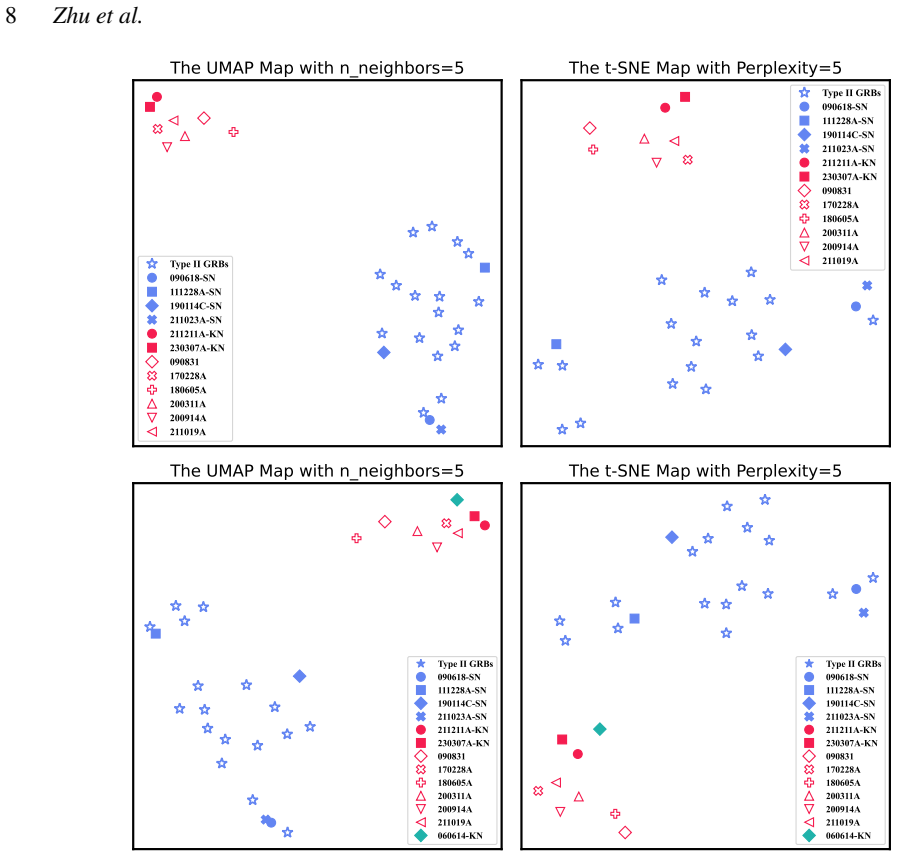
In this paper's own terms: the three-episode structure (precursor emission, main emission, extended emission with intervening quiescent episodes) is not just a curiosity but a handle on progenitor identity. On a sample of 29 three-episode GRBs drawn from 3883 Fermi/GBM bursts, the authors build a 12-parameter feature set — durations of the four emission episodes, two waiting times, minimum variability timescales of precursor and main emission, two spectral lags, and two peak energies — and project it with t-SNE and UMAP. Both projections show two clusters, and Gaussian mixture, HDBSCAN, and spectral clustering agree on the assignment. The cluster containing the kilonova-confirmed bursts GRB 211211A and GRB 230307A also contains GRB 090831, GRB 170228A, GRB 180605A, GRB 200311A, GRB 200914A, and GRB 211019A; the paper argues from their short $T_{100,\rm PE}$, short $T_{\rm wt1}$, short $T_{\rm MVT,PE}$, and from the position of their main emission on the $E_{\rm p,z}$–$E_{\rm iso}$ plane that these six are also Type IL GRBs. It further reports the first high-significance precursor emission in the confirmed merger-born GRB 060614, with properties consistent with the Type IL cluster.
Load-bearing premise
The load-bearing premise is that the visual first pass over the Fermi/GBM catalog caught essentially all genuine three-episode GRBs and excluded only irrelevant, low-signal cases — if faint-precursor merger bursts were systematically missed or borderline collapsar bursts crept in, the clean two-cluster separation and the short-precursor traits of Type IL GRBs would not generalize beyond these 29 objects.
Editorial extensions
If this is right
- If the classification holds, Type IL GRBs can be flagged in real time from prompt emission alone, before optical localization, so that kilonova searches can be triggered immediately.
- The six new candidates (GRB 090831, GRB 170228A, GRB 180605A, GRB 200311A, GRB 200914A, GRB 211019A) become high-priority targets for multi-wavelength follow-up to look for kilonova signatures.
- The short precursor duration, short waiting time, and fast precursor variability become observable diagnostics of merger origin, linking prompt-emission structure to pre-merger physical processes on timescales of roughly 0.2–1.3 seconds.
- The result adds pressure on theoretical models: Type IL GRBs can have very short or very long main emission (from 0.28 s to 28.5 s in the candidates), so neither duration nor the presence of a long extended tail alone fixes the progenitor.
- The detection of a precursor in GRB 060614 extends the three-episode structure beyond Fermi/GBM, suggesting the classification may transfer across instruments.
Reading between the lines
- Editorial inference: because the initial episode search was visual, the six candidates are probably a lower bound; an automated Bayesian-block scan of all 3,883 Fermi bursts would likely find additional faint-precursor Type IL candidates and could sharpen or shift the cluster boundaries.
- Editorial inference: the paper's pre-merger interpretation predicts a concrete test — gravitational-wave events from neutron-star mergers that also produce a short-precursor GRB should show a GRB–GW delay comparable to $T_{\rm wt1}$ (order 0.2–1.3 s), consistent with several reported delays.
- Editorial inference: if the short precursor timescales are a robust Type IL marker, the same 12-parameter recipe could be applied to other instruments (Swift/BAT, and planned missions) with an instrument-transfer step, though the paper only demonstrates this for one burst.
- Editorial inference: the claim would be strengthened or refuted by checking whether the six candidates cluster the same way when full light-curve time series rather than derived parameters are used as input.
Editorial analysis
A structured set of objections, weighed in public.
Referee Report
Summary. This paper proposes a prompt-emission-based method to identify long gamma-ray bursts of merger origin (Type IL). The authors visually screen the Fermi/GBM catalog (2008-2024) for three-episode bursts (precursor, main, and extended emission), finding 29 objects. Twelve temporal and spectral parameters are extracted, and t-SNE/UMAP embeddings followed by GMM, HDBSCAN, and spectral clustering are used to partition the sample. The two known Type IL bursts (GRB 211211A and 230307A) fall into one cluster along with six additional candidates (GRB 090831, 170228A, 180605A, 200311A, 200914A, and 211019A). The authors argue that Type IL bursts have short precursor duration, short waiting time before the main emission, short minimum variability timescale of the precursor, and main emission consistent with the Type I Ep,z-Eiso correlation. They also report the first detection of a precursor in GRB 060614 and show that it clusters with the Type IL population.
Significance. The proposed classifier is potentially valuable because it relies solely on prompt emission, allowing rapid identification of merger-driven long GRBs for multimessenger follow-up. The six candidates are explicit, falsifiable predictions that can be tested with kilonova searches and redshift measurements. The machine-readable spectral tables are a useful resource for the community, and the GRB 060614 precursor analysis provides a genuinely independent case study. However, the central classification rests on a subjectively selected sample of 29 bursts and on unsupervised embeddings that the authors concede are not stable under all configurations; without quantitative stability and completeness checks, the six new identifications remain suggestive rather than established.
major comments (4)
- [Section 2.1] The sample-selection procedure is load-bearing: the authors state that "initial screening relies on the eye, there may be omissions and some low SNR GRBs were also excluded." Because the entire machine-learning analysis operates on the resulting 29 objects, any systematic omission of faint-precursor Type IL bursts or inclusion of borderline Type II bursts will directly bias the cluster separation and the derived characteristics. The paper provides no quantitative completeness estimate, no inter-rater reliability check, and no alternative selection criterion to show that the sample is representative. This should be addressed, for instance, by re-screening with an automated algorithm or by quantifying the selection function.
- [Section 3] The stability of the t-SNE/UMAP embeddings is not demonstrated. The authors admit that "the embeddings are indeed sensitive to random initialization and the classification structure does not consistently appear under all configurations," and only state that "in many cases" the separation remains. No quantitative reproducibility metric (e.g., adjusted Rand index or normalized mutual information across random seeds and hyperparameter grids) is reported, and no null-model test (e.g., permuting feature values or clustering Gaussian noise with the same n=29 and 12 features) is shown. With 29 objects, t-SNE/UMAP can produce apparent clusters on pure noise; consistency of GMM/HDBSCAN/spectral clustering on the same embedding does not validate the embedding itself. Please provide such tests to support the claim that the two clusters reflect intrinsic structure.
- [Sections 3 and 5] The proposed Type IL characteristics (short T100,PE, Twt1, and TMVT,PE) are read off the same cluster labels that define the six new candidates, and the GRB 060614 check uses these same characteristics to "confirm" its Type IL nature. This is a circular structure: the characteristics are not independent evidence for the classification. The two known Type IL GRBs and four known Type II GRBs partially anchor the clusters, but the boundary that assigns the six unconfirmed objects is not calibrated. The authors should separate the discovery step from the characterization step, for example by defining the Type IL characteristics from the two known events only and then testing whether the six candidates (and GRB 060614) satisfy them, or by using a supervised classifier trained on the labeled events and applied to the unlabeled ones.
- [Section 2.2 and Figure 3] The conclusions about the Ep,z-Eiso correlation for the six candidates rely on simulated redshifts over z in [0.0001, 10], and the EH boundary is calibrated on GRB 230307A. The authors acknowledge that the EH criterion is sensitive to the slope of the Ep,z-Eiso correlation and that the probability estimates depend on the assumed cumulative redshift distribution. Since none of the six candidates has a measured redshift, the statement that their main emissions "follow the Type I correlation" is a model-dependent inference rather than a direct measurement. A sensitivity analysis (e.g., varying the EH slope and the assumed redshift distribution, or reporting the fraction of each candidate's allowed redshift range that is consistent with Type I) is needed before this characteristic can be used as a secure classifier output.
minor comments (5)
- [Section 3] There is a typo in the text: "we applie t-SNE and UMAP" should read "we apply t-SNE and UMAP."
- [Section 3] The term "three-espiode" appears in the GRB 060614 paragraph; this should be "three-episode."
- [Figure 4] The caption states "The green marker is GRB 060614, which is classified as a Type IL GRB," but the figure contains both maps with and without GRB 060614. Please clarify which panels include GRB 060614 and ensure the markers are unambiguous.
- [Section 3] The authors state that "the BIC results indicate that the two-cluster classification is optimal in all cases," but the BIC values are not shown in the text or figures. Reporting the BIC values or the delta-BIC would allow readers to assess the strength of the preference for two clusters.
- [Section 5] In the conclusions, "The machine learning results suggest that it is also classified as Type IL GRB" should read "as a Type IL GRB."
Circularity Check
The six new Type IL 'identifications' are internally validated by the same 12 features used to create the clusters, making the consistency argument circular; external anchors and GRB 060614 provide only partial grounding.
-
fitted input called prediction
[Section 3, paragraph after the six Type IL candidate descriptions ('New insight for classification based on machine learning')]
"The temporal properties of the six Type IL GRB candidates are all consistent with those of Type I GRBs. In addition, although their redshifts are unknown, the properties of main emissions are consistent with those of Type I GRBs in the Ep,z–Eiso plane. These properties support that they are also Type IL GRBs, similar to GRB 211211A and GRB 230307A."
The six candidates were placed in the Type IL cluster by t-SNE/UMAP followed by GMM operating on the same 12 input parameters, including T100,PE, Twt1, TMVT,PE, Ep,ME, and Ep,WE. Their 'consistency with Type I GRBs' is therefore a property of the cluster definition, not an independent measurement. Using those properties as evidence 'supporting' Type IL classification is equivalent to saying the cluster members resemble the cluster. No held-out set or posterior calibration is applied to the six unconfirmed objects; the two KN-anchored GRBs anchor the cluster, but the support argument for the new six reduces to the clustering input.
full rationale
Most of the paper's derivation is self-contained: sample selection, Bayesian-block segmentation, spectral fitting, ML embedding, and the GRB 060614 test are independent steps. There is no imported uniqueness theorem and no ansatz smuggled in via self-citation. The principal circular step is the confirmatory loop in which cluster-derived feature values are cited as supporting evidence for cluster membership. Because the two known Type IL GRBs and four known Type II GRBs are separated in the embedding, and because GRB 060614 is an out-of-sample confirmed Type IL that falls in the cluster, the central classification has some independent content. However, for the six previously unknown candidates, the 'properties support' claim is a restatement of the clustering inputs, so the paper is partially circular rather than fully independent. The admitted sensitivity of embeddings to random initialization is a robustness concern, not a circularity, and does not itself change the score.
Assumptions & free parameters
free parameters (3)
- EH boundary for Type I/II discrimination =
EH of GRB 230307A
- Quiescent episode duration threshold =
10 times the time resolution
- False-positive rate for Bayesian blocks =
0.05
assumptions (3)
- domain assumption The 29 three-episode GRBs consist of both Type IL and Type II objects
- domain assumption The Ep,z-Eiso correlation of Type I GRBs is a reliable discriminator and the slope 0.4 boundary is appropriate
- domain assumption The two known Type IL GRBs (211211A, 230307A) correctly anchor the Type IL cluster
Cite this review
Pith. "Pith review of Identifying Merger-Driven Long Gamma-Ray Bursts based on Machine Learning." pith.science (2026). https://pith.science/paper/Q7Q5UGKT
@misc{pith2026250608675,
  author       = {Pith},
  title        = {Pith review of: Identifying Merger-Driven Long Gamma-Ray Bursts based on Machine Learning},
  year         = {2026},
  howpublished = {\url{https://pith.science/paper/Q7Q5UGKT}},
  note         = {Machine review of arXiv:2506.08675}
}
abstract
Gamma-ray bursts (GRBs) are classified as Type I GRBs originated from compact binary mergers and Type II GRBs originated from massive collapsars. While Type I GRBs are typically shorter than 2 seconds, recent observations suggest that some extend to tens of seconds, forming a potential subclass, Type IL GRBs. However, apart from their association with kilonovae, so far no rapid identification is possible. Given the uncertainties and limitations of optical and infrared afterglow observations, an identification method based solely on prompt emission can make such identification possible for many more GRBs. Interestingly, two established Type IL GRBs: GRB 211211A and GRB 230307A, exhibit a three-episode structure: precursor emission (PE), main emission (ME), and extended emission. Therefore, we comprehensively search for GRBs in the Fermi/GBM catalog and identify 29 three-episode GRBs. Based on 12 parameters, we utilize machine learning to distinguish Type IL GRBs from Type II GRBs. Apart from GRB 211211A and GRB 230307A, we are able to identify six more previously unknown Type IL GRBs: GRB 090831, GRB 170228A, GRB 180605A, GRB 200311A, GRB 200914A, and GRB 211019A. We find that Type IL GRBs are characterized by short duration and minimum variability timescale of PE, a short waiting time between PE and ME, and that ME follows the $E_{\rm p,z}$--$E_{\rm iso}$ correlation of Type I GRBs. For the first time, we identify a high-significant PE in the confirmed Type IL GRB 060614.
Figures


Figures from the paper (4 more)


Reference graph
Works this paper leans on
-
[1]
write newline
" write newline "" before.all 'output.state := FUNCTION fin.entry write newline FUNCTION new.block output.state before.all = 'skip after.block 'output.state := if FUNCTION new.sentence output.state after.block = 'skip output.state before.all = 'skip after.sentence 'output.state := if if FUNCTION not #0 #1 if FUNCTION and 'skip pop #0 if FUNCTION or pop #1...
-
[2]
Abbott B. P., et al., 2017, @doi [ ] 10.1103/PhysRevLett.119.161101 , https://ui.adsabs.harvard.edu/abs/2017PhRvL.119p1101A 119, 161101
-
[3]
Ahumada T., et al., 2021, @doi [Nature Astronomy] 10.1038/s41550-021-01428-7 , https://ui.adsabs.harvard.edu/abs/2021NatAs...5..917A 5, 917
-
[4]
Aloy M. A., Janka H. T., M \"u ller E., 2005, @doi [ ] 10.1051/0004-6361:20041865 , https://ui.adsabs.harvard.edu/abs/2005A&A...436..273A 436, 273
-
[5]
Amati L., et al., 2002, @doi [ ] 10.1051/0004-6361:20020722 , https://ui.adsabs.harvard.edu/abs/2002A&A...390...81A 390, 81
-
[6]
L., 1997, @doi [ ] 10.1086/304566 , https://ui.adsabs.harvard.edu/abs/1997ApJ...486..928B 486, 928
Band D. L., 1997, @doi [ ] 10.1086/304566 , https://ui.adsabs.harvard.edu/abs/1997ApJ...486..928B 486, 928
doi:10.1086/304566 1997
-
[7]
Bernardini M. G., et al., 2015, @doi [ ] 10.1093/mnras/stu2153 , https://ui.adsabs.harvard.edu/abs/2015MNRAS.446.1129B 446, 1129
-
[8]
Burlon D., Ghirlanda G., Ghisellini G., Lazzati D., Nava L., Nardini M., Celotti A., 2008, @doi [ ] 10.1086/592350 , https://ui.adsabs.harvard.edu/abs/2008ApJ...685L..19B 685, L19
doi:10.1086/592350 2008
Show all 84 references
-
[9]
Burlon D., Ghirlanda G., Ghisellini G., Greiner J., Celotti A., 2009, @doi [ ] 10.1051/0004-6361/200912662 , https://ui.adsabs.harvard.edu/abs/2009A&A...505..569B 505, 569
2009 doi
-
[10]
E., et al., 2023, @doi [ ] 10.1051/0004-6361/202245657 , https://ui.adsabs.harvard.edu/abs/2023A&A...671A.112C 671, A112
Camisasca A. E., et al., 2023, @doi [ ] 10.1051/0004-6361/202245657 , https://ui.adsabs.harvard.edu/abs/2023A&A...671A.112C 671, A112
2023 doi
-
[11]
Charisi M., M \'a rka S., Bartos I., 2015, @doi [ ] 10.1093/mnras/stu2667 , https://ui.adsabs.harvard.edu/abs/2015MNRAS.448.2624C 448, 2624
2015 doi
-
[12]
X., Ma Y
Cheng L. X., Ma Y. Q., Cheng K. S., Lu T., Zhou Y. Y., 1995, , https://ui.adsabs.harvard.edu/abs/1995A&A...300..746C 300, 746
1995
-
[13]
Connaughton V., et al., 2016, @doi [ ] 10.3847/2041-8205/826/1/L6 , https://ui.adsabs.harvard.edu/abs/2016ApJ...826L...6C 826, L6
2016 doi
-
[14]
D., van Eijndhoven N., 2020, @doi [ ] 10.1103/PhysRevD.102.103014 , https://ui.adsabs.harvard.edu/abs/2020PhRvD.102j3014C 102, 103014
Coppin P., de Vries K. D., van Eijndhoven N., 2020, @doi [ ] 10.1103/PhysRevD.102.103014 , https://ui.adsabs.harvard.edu/abs/2020PhRvD.102j3014C 102, 103014
2020 doi
-
[15]
Deng H.-Y., Peng Z.-Y., Chen J.-M., Yin Y., Li T., 2024, @doi [ ] 10.3847/1538-4357/ad4d95 , https://ui.adsabs.harvard.edu/abs/2024ApJ...970...67D 970, 67
2024 doi
-
[16]
P., Yang Y
Dichiara S., Tsang D., Troja E., Neill D., Norris J. P., Yang Y. H., 2023, @doi [ ] 10.3847/2041-8213/acf21d , https://ui.adsabs.harvard.edu/abs/2023ApJ...954L..29D 954, L29
2023 doi
-
[17]
J., et al., 1998, @doi [ ] 10.1038/27150 , https://ui.adsabs.harvard.edu/abs/1998Natur.395..670G 395, 670
Galama T. J., et al., 1998, @doi [ ] 10.1038/27150 , https://ui.adsabs.harvard.edu/abs/1998Natur.395..670G 395, 670
1998 doi
-
[18]
Gehrels N., et al., 2005, @doi [ ] 10.1038/nature04142 , https://ui.adsabs.harvard.edu/abs/2005Natur.437..851G 437, 851
2005 doi
-
[19]
Z., Butler N
Golkhou V. Z., Butler N. R., 2014, @doi [ ] 10.1088/0004-637X/787/1/90 , https://ui.adsabs.harvard.edu/abs/2014ApJ...787...90G 787, 90
2014 doi
-
[20]
Z., Butler N
Golkhou V. Z., Butler N. R., Littlejohns O. M., 2015, @doi [ ] 10.1088/0004-637X/811/2/93 , https://ui.adsabs.harvard.edu/abs/2015ApJ...811...93G 811, 93
2015 doi
-
[21]
Hu Y.-D., Liang E.-W., Xi S.-Q., Peng F.-K., Lu R.-J., L \"u L.-Z., Zhang B., 2014, @doi [ ] 10.1088/0004-637X/789/2/145 , https://ui.adsabs.harvard.edu/abs/2014ApJ...789..145H 789, 145
2014 doi
-
[22]
F., G \"o g \"u s E., Lin L., 2015, @doi [ ] 10.1093/mnras/stv1286 , https://ui.adsabs.harvard.edu/abs/2015MNRAS.452..824K 452, 824
Kaneko Y., Bostanc Z. F., G \"o g \"u s E., Lin L., 2015, @doi [ ] 10.1093/mnras/stv1286 , https://ui.adsabs.harvard.edu/abs/2015MNRAS.452..824K 452, 824
2015 doi
-
[23]
M., Beloborodov A
Kaspi V. M., Beloborodov A. M., 2017, @doi [ ] 10.1146/annurev-astro-081915-023329 , https://ui.adsabs.harvard.edu/abs/2017ARA&A..55..261K 55, 261
2017 doi
-
[24]
Kobayashi S., Piran T., Sari R., 1997, @doi [ ] 10.1086/512791 , https://ui.adsabs.harvard.edu/abs/1997ApJ...490...92K 490, 92
1997 doi
-
[25]
M., Kouveliotou C., Paciesas W
Koshut T. M., Kouveliotou C., Paciesas W. S., van Paradijs J., Pendleton G. N., Briggs M. S., Fishman G. J., Meegan C. A., 1995, @doi [ ] 10.1086/176286 , https://ui.adsabs.harvard.edu/abs/1995ApJ...452..145K 452, 145
1995 doi
-
[26]
A., Fishman G
Kouveliotou C., Meegan C. A., Fishman G. J., Bhat N. P., Briggs M. S., Koshut T. M., Paciesas W. S., Pendleton G. N., 1993, @doi [ ] 10.1086/186969 , https://ui.adsabs.harvard.edu/abs/1993ApJ...413L.101K 413, L101
1993 doi
-
[27]
Lai D., 2012, @doi [ ] 10.1088/2041-8205/757/1/L3 , https://ui.adsabs.harvard.edu/abs/2012ApJ...757L...3L 757, L3
2012 doi
-
[28]
Lazzati D., 2005, @doi [ ] 10.1111/j.1365-2966.2005.08687.x , https://ui.adsabs.harvard.edu/abs/2005MNRAS.357..722L 357, 722
2005
-
[29]
J., et al., 2024, @doi [ ] 10.1038/s41586-023-06759-1 , https://ui.adsabs.harvard.edu/abs/2024Natur.626..737L 626, 737
Levan A. J., et al., 2024, @doi [ ] 10.1038/s41586-023-06759-1 , https://ui.adsabs.harvard.edu/abs/2024Natur.626..737L 626, 737
2024 doi
-
[30]
Li L., 2019, @doi [ ] 10.3847/1538-4365/ab1b78 , https://ui.adsabs.harvard.edu/abs/2019ApJS..242...16L 242, 16
2019 doi
-
[31]
Li L., Mao J., 2022, @doi [ ] 10.3847/1538-4357/ac4af2 , https://ui.adsabs.harvard.edu/abs/2022ApJ...928..152L 928, 152
2022 doi
-
[32]
Li X., Hu Y.-M., Fan Y.-Z., Wei D.-M., 2016, @doi [ ] 10.3847/0004-637X/827/1/75 , https://ui.adsabs.harvard.edu/abs/2016ApJ...827...75L 827, 75
2016 doi
-
[33]
J., Zhang Z
Li X. J., Zhang Z. B., Zhang X. L., Zhen H. Y., 2021, @doi [ ] 10.3847/1538-4365/abd3fd , https://ui.adsabs.harvard.edu/abs/2021ApJS..252...16L 252, 16
2021 doi
-
[34]
I., Woosley S
MacFadyen A. I., Woosley S. E., 1999, @doi [ ] 10.1086/307790 , https://ui.adsabs.harvard.edu/abs/1999ApJ...524..262M 524, 262
1999 doi
-
[35]
A., et al., 2013, @doi [ ] 10.1093/mnras/stt241 , https://ui.adsabs.harvard.edu/abs/2013MNRAS.432..857M 432, 857
MacLachlan G. A., et al., 2013, @doi [ ] 10.1093/mnras/stt241 , https://ui.adsabs.harvard.edu/abs/2013MNRAS.432..857M 432, 857
2013 doi
-
[36]
McInnes L., Healy J., Astels S., 2017, @doi [The Journal of Open Source Software] 10.21105/joss.00205 , https://ui.adsabs.harvard.edu/abs/2017JOSS....2..205M 2, 205
2017 doi
-
[37]
arXiv:1802.03426
McInnes L., Healy J., Melville J., 2018, arXiv e-prints, https://arxiv.org/abs/1802.03426 p. arXiv:1802.03426
2018 arXiv
-
[38]
Meegan C., et al., 2009, @doi [ ] 10.1088/0004-637X/702/1/791 , https://ui.adsabs.harvard.edu/abs/2009ApJ...702..791M 702, 791
2009 doi
-
[39]
J., 2000, @doi [ ] 10.1086/308371 , https://ui.adsabs.harvard.edu/abs/2000ApJ...530..292M 530, 292
M \'e sz \'a ros P., Rees M. J., 2000, @doi [ ] 10.1086/308371 , https://ui.adsabs.harvard.edu/abs/2000ApJ...530..292M 530, 292
2000 doi
-
[40]
Y., Pozanenko A
Minaev P. Y., Pozanenko A. S., 2020, @doi [ ] 10.1093/mnras/stz3611 , https://ui.adsabs.harvard.edu/abs/2020MNRAS.492.1919M 492, 1919
2020 doi
-
[41]
Narayan R., Paczynski B., Piran T., 1992, @doi [ ] 10.1086/186493 , https://ui.adsabs.harvard.edu/abs/1992ApJ...395L..83N 395, L83
1992 doi
-
[42]
G., 2022, @doi [ ] 10.1093/mnras/stac1645 , https://ui.adsabs.harvard.edu/abs/2022MNRAS.514.5385N 514, 5385
Neill D., Tsang D., van Eerten H., Ryan G., Newton W. G., 2022, @doi [ ] 10.1093/mnras/stac1645 , https://ui.adsabs.harvard.edu/abs/2022MNRAS.514.5385N 514, 5385
2022 doi
-
[43]
P., Share G
Norris J. P., Share G. H., Messina D. C., Dennis B. R., Desai U. D., Cline T. L., Matz S. M., Chupp E. L., 1986, @doi [ ] 10.1086/163889 , https://ui.adsabs.harvard.edu/abs/1986ApJ...301..213N 301, 213
1986 doi
-
[44]
Paczynski B., 1986, @doi [ ] 10.1086/184740 , https://ui.adsabs.harvard.edu/abs/1986ApJ...308L..43P 308, L43
1986 doi
-
[45]
L., Anderson M., Neilsen D., Motl P., 2013, @doi [ ] 10.1103/PhysRevLett.111.061105 , https://ui.adsabs.harvard.edu/abs/2013PhRvL.111f1105P 111, 061105
Palenzuela C., Lehner L., Ponce M., Liebling S. L., Anderson M., Neilsen D., Motl P., 2013, @doi [ ] 10.1103/PhysRevLett.111.061105 , https://ui.adsabs.harvard.edu/abs/2013PhRvL.111f1105P 111, 061105
2013 doi
-
[46]
Peng Z.-Y., Chen J.-M., Mao J., 2024, @doi [ ] 10.3847/1538-4357/ad45fc , https://ui.adsabs.harvard.edu/abs/2024ApJ...969...26P 969, 26
2024 doi
-
[47]
Qin Y.-P., Chen Z.-F., 2013, @doi [ ] 10.1093/mnras/sts547 , https://ui.adsabs.harvard.edu/abs/2013MNRAS.430..163Q 430, 163
2013 doi
-
[48]
C., et al., 2022, @doi [ ] 10.1038/s41586-022-05390-w , https://ui.adsabs.harvard.edu/abs/2022Natur.612..223R 612, 223
Rastinejad J. C., et al., 2022, @doi [ ] 10.1038/s41586-022-05390-w , https://ui.adsabs.harvard.edu/abs/2022Natur.612..223R 612, 223
2022 doi
-
[49]
J., Meszaros P., 1994, @doi [ ] 10.1086/187446 , https://ui.adsabs.harvard.edu/abs/1994ApJ...430L..93R 430, L93
Rees M. J., Meszaros P., 1994, @doi [ ] 10.1086/187446 , https://ui.adsabs.harvard.edu/abs/1994ApJ...430L..93R 430, L93
1994 doi
-
[50]
D., Norris J
Scargle J. D., Norris J. P., Jackson B., Chiang J., 2013, @doi [ ] 10.1088/0004-637X/764/2/167 , https://ui.adsabs.harvard.edu/abs/2013ApJ...764..167S 764, 167
2013 doi
-
[51]
E., 2007, @doi [ ] 10.1086/511742 , https://ui.adsabs.harvard.edu/abs/2007ApJ...660...16S 660, 16
Schaefer B. E., 2007, @doi [ ] 10.1086/511742 , https://ui.adsabs.harvard.edu/abs/2007ApJ...660...16S 660, 16
2007 doi
-
[52]
L., Mann W
Steinhardt C. L., Mann W. J., Rusakov V., Jespersen C. K., 2023, @doi [ ] 10.3847/1538-4357/acb999 , https://ui.adsabs.harvard.edu/abs/2023ApJ...945...67S 945, 67
2023 doi
-
[53]
G., Kokkotas K
Suvorov A. G., Kokkotas K. D., 2020, @doi [ ] 10.1103/PhysRevD.101.083002 , https://ui.adsabs.harvard.edu/abs/2020PhRvD.101h3002S 101, 083002
2020 doi
-
[54]
Thompson C., 1994, @doi [ ] 10.1093/mnras/270.3.480 , https://ui.adsabs.harvard.edu/abs/1994MNRAS.270..480T 270, 480
1994 doi
-
[55]
Troja E., Rosswog S., Gehrels N., 2010, @doi [ ] 10.1088/0004-637X/723/2/1711 , https://ui.adsabs.harvard.edu/abs/2010ApJ...723.1711T 723, 1711
2010 doi
-
[56]
Tsang D., 2013, @doi [ ] 10.1088/0004-637X/777/2/103 , https://ui.adsabs.harvard.edu/abs/2013ApJ...777..103T 777, 103
2013 doi
-
[57]
S., Hinderer T., Piro A
Tsang D., Read J. S., Hinderer T., Piro A. L., Bondarescu R., 2012, @doi [ ] 10.1103/PhysRevLett.108.011102 , https://ui.adsabs.harvard.edu/abs/2012PhRvL.108a1102T 108, 011102
2012 doi
-
[58]
Van Der Maaten L., 2014, Journal of Machine Learning Research, 15, 3221
2014
-
[59]
Van Der Maaten L., Hinton G., 2008, Journal of Machine Learning Research, 9, 2579
2008
-
[60]
Veres P., et al., 2023, @doi [ ] 10.3847/2041-8213/ace82d , https://ui.adsabs.harvard.edu/abs/2023ApJ...954L...5V 954, L5
2023 doi
-
[61]
Wang H., et al., 2017, @doi [ ] 10.3847/2041-8213/aa9e08 , https://ui.adsabs.harvard.edu/abs/2017ApJ...851L..18W 851, L18
2017 doi
-
[62]
Wang J.-S., Peng F.-K., Wu K., Dai Z.-G., 2018, @doi [ ] 10.3847/1538-4357/aae531 , https://ui.adsabs.harvard.edu/abs/2018ApJ...868...19W 868, 19
2018 doi
-
[63]
Wang J.-S., Peng Z.-K., Zou J.-H., Zhang B.-B., Zhang B., 2020, @doi [ ] 10.3847/2041-8213/abbfb8 , https://ui.adsabs.harvard.edu/abs/2020ApJ...902L..42W 902, L42
2020 doi
-
[64]
Wang C.-W., et al., 2025, @doi [ ] 10.3847/1538-4357/ad98ec , https://ui.adsabs.harvard.edu/abs/2025ApJ...979...73W 979, 73
2025 doi
-
[65]
E., 1993, @doi [ ] 10.1086/172359 , https://ui.adsabs.harvard.edu/abs/1993ApJ...405..273W 405, 273
Woosley S. E., 1993, @doi [ ] 10.1086/172359 , https://ui.adsabs.harvard.edu/abs/1993ApJ...405..273W 405, 273
1993 doi
-
[66]
E., Bloom J
Woosley S. E., Bloom J. S., 2006, @doi [ ] 10.1146/annurev.astro.43.072103.150558 , https://ui.adsabs.harvard.edu/abs/2006ARA&A..44..507W 44, 507
2006 arXiv
-
[67]
Xiao S., et al., 2023, @doi [ ] 10.3847/1538-4365/ace77c , https://ui.adsabs.harvard.edu/abs/2023ApJS..268....5X 268, 5
2023 doi
-
[68]
Yang B., et al., 2015, @doi [Nature Communications] 10.1038/ncomms8323 , https://ui.adsabs.harvard.edu/abs/2015NatCo...6.7323Y 6, 7323
2015 doi
-
[69]
Yang Y.-S., et al., 2020, @doi [ ] 10.3847/1538-4357/ab9ff5 , https://ui.adsabs.harvard.edu/abs/2020ApJ...899...60Y 899, 60
2020 doi
-
[70]
Yang J., et al., 2022, @doi [ ] 10.1038/s41586-022-05403-8 , https://ui.adsabs.harvard.edu/abs/2022Natur.612..232Y 612, 232
2022 doi
-
[71]
Yang Y.-H., et al., 2024, @doi [ ] 10.1038/s41586-023-06979-5 , https://ui.adsabs.harvard.edu/abs/2024Natur.626..742Y 626, 742
2024 doi
-
[72]
Yi T., Liang E., Qin Y., Lu R., 2006, @doi [ ] 10.1111/j.1365-2966.2006.10083.x , https://ui.adsabs.harvard.edu/abs/2006MNRAS.367.1751Y 367, 1751
2006
-
[73]
Zhang B., Yan H., 2011, @doi [ ] 10.1088/0004-637X/726/2/90 , https://ui.adsabs.harvard.edu/abs/2011ApJ...726...90Z 726, 90
2011 doi
-
[74]
Zhang F.-W., Shao L., Yan J.-Z., Wei D.-M., 2012, @doi [ ] 10.1088/0004-637X/750/2/88 , https://ui.adsabs.harvard.edu/abs/2012ApJ...750...88Z 750, 88
2012 doi
-
[75]
B., et al., 2018, @doi [Nature Astronomy] 10.1038/s41550-017-0309-8 , https://ui.adsabs.harvard.edu/abs/2018NatAs...2...69Z 2, 69
Zhang B. B., et al., 2018, @doi [Nature Astronomy] 10.1038/s41550-017-0309-8 , https://ui.adsabs.harvard.edu/abs/2018NatAs...2...69Z 2, 69
2018 doi
-
[76]
B., et al., 2021, @doi [Nature Astronomy] 10.1038/s41550-021-01395-z , https://ui.adsabs.harvard.edu/abs/2021NatAs...5..911Z 5, 911
Zhang B. B., et al., 2021, @doi [Nature Astronomy] 10.1038/s41550-021-01395-z , https://ui.adsabs.harvard.edu/abs/2021NatAs...5..911Z 5, 911
2021 doi
-
[77]
Zhang Z., Yi S.-X., Zhang S.-N., Xiong S.-L., Xiao S., 2022, @doi [ ] 10.3847/2041-8213/ac9b55 , https://ui.adsabs.harvard.edu/abs/2022ApJ...939L..25Z 939, L25
2022 doi
-
[78]
Zhong S.-Q., Dai Z.-G., Cheng J.-G., Lan L., Zhang H.-M., 2019, @doi [ ] 10.3847/1538-4357/ab3e48 , https://ui.adsabs.harvard.edu/abs/2019ApJ...884...25Z 884, 25
2019 doi
-
[79]
T., 2024, @doi [ ] 10.3847/1538-4357/ad813a , https://ui.adsabs.harvard.edu/abs/2024ApJ...976...62Z 976, 62
Zhu S.-Y., Tam P.-H. T., 2024, @doi [ ] 10.3847/1538-4357/ad813a , https://ui.adsabs.harvard.edu/abs/2024ApJ...976...62Z 976, 62
2024 doi
-
[80]
Zhu-Ge J.-M., Luo J.-W., Zhang B., 2023, @doi [ ] 10.1093/mnras/stac3599 , https://ui.adsabs.harvard.edu/abs/2023MNRAS.519.1823Z 519, 1823
2023 doi
-
[81]
I., Sun H., Yang Y.-P., Li Z., Hu R.-C., Qin Y., Wu S., 2022, @doi [ ] 10.3847/2041-8213/ac85ad , https://ui.adsabs.harvard.edu/abs/2022ApJ...936L..10Z 936, L10
Zhu J.-P., Wang X. I., Sun H., Yang Y.-P., Li Z., Hu R.-C., Qin Y., Wu S., 2022, @doi [ ] 10.3847/2041-8213/ac85ad , https://ui.adsabs.harvard.edu/abs/2022ApJ...936L..10Z 936, L10
2022 doi
-
[82]
Zhu S.-Y., Liu Z.-Y., Shi Y.-R., Ding X.-K., Sun W.-P., Zhang F.-W., 2023, @doi [ ] 10.3847/1538-4357/acc83b , https://ui.adsabs.harvard.edu/abs/2023ApJ...950...30Z 950, 30
2023 doi
-
[83]
Zhu S.-Y., Sun W.-P., Ma D.-L., Zhang F.-W., 2024, @doi [ ] 10.1093/mnras/stae1594 , https://ui.adsabs.harvard.edu/abs/2024MNRAS.532.1434Z 532, 1434
2024 doi
-
[84]
von Kienlin A., et al., 2020, @doi [ ] 10.3847/1538-4357/ab7a18 , https://ui.adsabs.harvard.edu/abs/2020ApJ...893...46V 893, 46
2020 doi
Reviewed August 7, 2026 · model on record in the stance chip above.
Discussion (0). Sign in to comment.