REVIEW 3 major objections 5 minor 59 references
Linguistic Ordered Weighted Averaging based deep learning pooling for fault diagnosis in a wastewater treatment plant
T0 review · 3 major / 5 minor · reviewed 2026-08-07 · deepseek-v4-flash
Pith's one-line read This paper claims that linguistic fuzzy quantifiers ('Most', 'AtLeast') as pooling operators in a convolutional network improve fault diagnosis in wastewater treatment plants, reaching about 94% accuracy on the BSM2 benchmark.
desk verdict Worth a review for the internal OWA-vs-standard pooling comparison on BSM2, but the headline claim of beating [27] rests on a cross-dataset comparison and should be fixed or dropped. read the letter →
The pith
A machine-rendered reading of the paper's core claim, the machinery that carries it, and where it could break.
The reading
What carries the argument
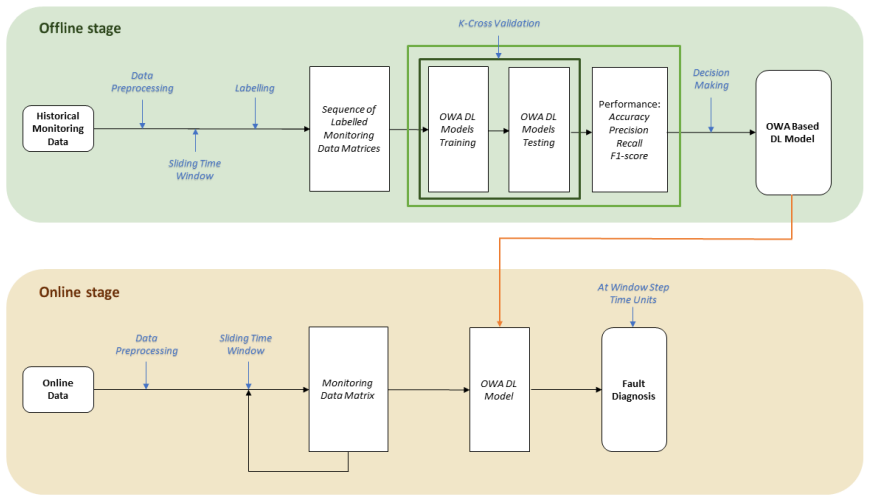
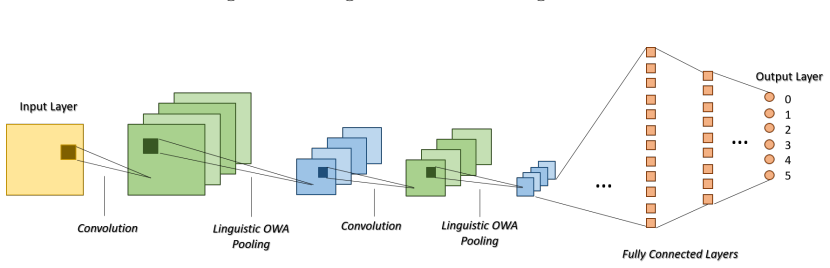
The central object is the linguistic OWA pooling layer, which computes a weighted sum of sorted values inside each pooling window, with weights derived from a Regular Increasing Monotone (RIM) fuzzy quantifier $Q$ by $w_i = Q(i/n) - Q((i-1)/n)$. The quantifier's linguistic label sets an orness level, that is, how much the aggregation behaves like 'and' or 'or', and therefore how much of the high or central feature values dominate the pooled output. The second mechanism is the sliding and overlapping time window: it converts the latest monitoring samples into a $[140 \times 4]$ input matrix at every sampling time, allowing the network to produce a diagnosis every 15 minutes from only four samples.
What would settle it
Train the same Model7 and Model3 architectures with standard max pooling on the same BSM2 sliding-window inputs and hyperparameter grid; if their F1-score reaches or exceeds 0.92, the reported advantage of linguistic OWA pooling would not be attributable to the pooling operator.
Extended reading notes
Core claim
The central claim is that replacing the standard max or average pooling operation in a deep convolutional neural network with a linguistic Ordered Weighted Averaging (OWA) pooling layer built from Regular Increasing Monotone quantifiers like Most, AtLeastHalf, AtMiddle $\alpha$, and AtLeast $\alpha$ improves fault diagnosis in a wastewater treatment plant. Using the BSM2 benchmark, with 140 monitored variables at 15-minute sampling and a sliding, overlapping window of only four samples, the best models reach 0.94 accuracy, 0.94 precision, 0.91 recall, and 0.92 F1-score across the five fault types. The same linguistic pooling layers also outperform the same architectures with max and average pooling on global and per-fault metrics, and reach target performance in fewer training epochs. The paper also introduces two parameterized quantifiers, AtMiddle $\alpha$ and AtLeast $\alpha$, and argues that the linguistic semantics of the quantifiers make pooling choices more intuitive for users.
Load-bearing premise
The 'better than other competitive methodologies' claim assumes that results previously reported on the Tennessee Eastman chemical process, which the paper itself notes was the reference method's application domain, transfer as a fair baseline to the BSM2 wastewater data with its different variables, fault types, and dynamics.
Editorial extensions
If this is right
- If the result holds, plant operators can obtain a diagnosis every sampling interval (15 minutes) from only the last four monitoring samples, without any variable selection.
- Linguistic OWA pooling provides better or equal accuracy, precision, recall, and F1-score than max and average pooling across three lightweight architectures (Model7, Model3, and LeNet-5), so the benefit is not tied to one layout.
- OWA-pooled networks reach target diagnosis performance in fewer epochs; the Most operator, for example, matches or exceeds 700-epoch standard pooling in only 200 epochs.
- The two new quantifiers AtMiddle $\alpha$ and AtLeast $\alpha$ give users tunable, linguistically meaningful pooling options, with the best global results coming from AtMiddle $\alpha=0.2$ and Most.
- On the most difficult faults (Kla and O2), the proposed pooling raises F1-score substantially over the max-pooling baseline within the same network layout.
Reading between the lines
- The comparison against the reference method is cross-process: that method was demonstrated on the Tennessee Eastman chemical process, while the new results are on the BSM2 wastewater benchmark, so the reported percentage gains should be read as provisional until the reference method is re-run on the same sliding-window inputs.
- Because the pooling layer is layout-agnostic, the same linguistic OWA quantifiers could likely transfer to other process-monitoring settings that produce small [variables × time] image matrices, such as chemical reactors, water distribution, or sensor networks.
- The interpretability of the quantifiers suggests a testable design rule: operators could choose a pooling quantifier a priori, for example a more 'or-like' quantifier to make the network sensitive to any anomalous sensor, instead of relying on grid search.
- The labeling rule that a window is faulty if any of its samples is faulty makes the reported scores an average over windows; measuring per-window detection delay would clarify how early the diagnosis can actually be issued.
Editorial analysis
A structured set of objections, weighed in public.
Referee Report
Summary. The paper proposes a fault-diagnosis methodology for wastewater treatment plants that combines a sliding, overlapping time window over 140 BSM2 monitoring variables with a deep convolutional neural network whose pooling layers use linguistic Ordered Weighted Averaging (OWA) quantifiers. Several OWA operators (Most, AtLeastHalf, AtMiddle α, AtLeast α) are compared with standard Max and Average pooling on three lightweight CNN layouts (Model7, Model3, LeNet-5). The authors report accuracy, precision, recall, and F1 around 91–94%, faster learning than standard pooling, and claim superiority over the method of [27] and over standard pooling baselines.
Significance. If the internal comparisons are reliable, the paper makes a useful empirical contribution: fixed, interpretable fuzzy quantifiers can replace learned or max/average pooling in lightweight DCNNs for industrial fault diagnosis, with competitive accuracy and apparently faster convergence at no extra parameter cost. The use of the public BSM2 benchmark and the systematic comparison of pooling operators across several architectures are strengths. However, the external comparison with [27] is invalid because it compares results on different processes, and the reported metrics are selected per metric at the best epoch, so the magnitude of the claimed improvements is not established. The core internal comparison is worth preserving, but the paper needs substantial revision in reporting and claims.
major comments (3)
- [Section 4.2, Tables 4-9] The abstract and Section 4.5 claim the proposal is 'better than other competitive methodologies', but this rests on comparing BSM2 results with [27], which the paper itself states is applied to the Tennessee Eastman process. The two problems differ in the number and meaning of variables, fault types, class definitions, temporal dynamics, and imbalance, so the Accuracy/Precision/Recall/F1 values in Tables 4-9 are not directly comparable. The Δ% gains (e.g., +6.82% accuracy and +19.48% F1 in Table 4) therefore do not support superiority on the wastewater benchmark. Additionally, 'Hao Wu in Model7 [27]' in Table 4 reports 0.88/0.82/0.78/0.77, while 'Model7-MaxPooling[27]' in Table 10 reports 0.91/0.84/0.84/0.83; this discrepancy must be explained. The authors should either re-run the [27] models on the same BSM2 data used here or remove the external comparison and temper the claims accordingly.
- [Sections 4.2 and 4.3, Tables 10-27] The internal comparison against Max and Average pooling is better designed, but the reported numbers are optimistically selected. Each metric is chosen at its own best epoch (the epoch columns differ within each table; e.g., Table 10 reports Accuracy at 700 epochs, Recall at 200, F1 at 200), and the window size, step, and α values were selected by grid search on the same cross-validation folds used for reporting. No standard deviations over the five folds or significance tests are given, so differences of 1–10% in F1 could reflect run-to-run or fold-to-fold variation. Please report mean ± std over the CV folds at a fixed epoch, or learning curves with confidence bands, and use paired statistical tests for the pooling comparisons.
- [Section 4.4, Figures 10-12] The 'faster learning' claim, listed as contribution 2 in Section 1, is supported only by single-point comparisons at 200/500/700 epochs without variance or multiple-seed information. The conclusion that OWA pooling reaches a target performance in fewer epochs than Max/Average should be quantified with learning curves averaged over folds and random seeds, rather than one selected run.
minor comments (5)
- [Table 1] The orness entry for AtMiddle α, 1+2α(α−1), does not follow from the RIM quantifier definition and Eq. (4) in Section 2.2; using the standard integral of Q for RIM quantifiers gives 1−3α+4α^2 for this Q. Please correct the value or justify the formula used.
- [Algorithm 1, line 8] The loop bound 'Run=[(CV-1)*NRuns, ..., NRuns]' is not a valid range and should be rewritten as a proper loop over the runs assigned to each CV fold.
- [Section 4.1] The text says the parameter α 'has not been optimized' and then says it 'has been tuned by a search grid and a cross-validation scheme'; these statements are contradictory. Please clarify whether α=0.2 and α=0.75 are fixed semantic choices or values selected on validation data.
- [References] References [43] and [45] are the same paper, and references [46] and [54] are also the same; please consolidate the duplicated entries.
- [Section 2.2 and Table 1] The names AtLeastHalf and AtLeast α are close enough to be confusing; consider renaming one of them (e.g., 'AtLeastHalf' and 'AtLeastProportion') to make the scale of α clear.
Circularity Check
No significant circularity: the linguistic OWA pooling operators come from external fuzzy-aggregation literature, the diagnostic evaluation uses an external BSM2 benchmark, and the only tuned hyperparameters are selected by grid search with cross-validation, which is standard model selection rather than a fitted prediction.
full rationale
The paper's central derivation is self-contained relative to its inputs. The linguistic OWA/RIM quantifiers are taken from the external fuzzy-aggregation literature: 'In [47] some RIM quantifier linguistic terms have been compiled (see Table 1), with alternative formulation and linguistic meaning, which have been used in this work to implement the linguistic OWA operator in the DCNN pooling layers of the proposal.' The network layouts are adopted from independent sources: the models 'are based on [27] and [55]', where [27] is a published chemical-process fault diagnosis paper and [55] is LeNet-5. The only parameters that are adjusted, alpha and the window size/step, are chosen by a standard grid search under cross-validation: 'The parameter alpha can be tuned by each user. In this case, this parameter has not been optimized, it has been tuned by a search grid and a cross-validation scheme following the linguistic meaning of the operators.' This is model selection, not fitting a parameter to the target result and then calling that result a prediction. The reported 91-94% performance is measured on BSM2, an external benchmark, against external baselines. The comparison to [27] is weakened by the fact that [27] was applied to the Tennessee Eastman process, as the paper itself notes: '[27] where a fault detection approach is applied to the TE process'; however, that is a cross-dataset validity concern, not circularity, because the [27] numbers are independent published results, not outputs of this paper's own derivation. The self-citations in the paper, such as [3] and [11], appear in background context and are not load-bearing for the linguistic OWA pooling claim. No step in the derivation reduces by construction to its own inputs.
Assumptions & free parameters
free parameters (4)
- AtMiddle α =
0.2
- AtLeast α =
0.75
- WindowSize =
4
- WindowStep =
1
assumptions (4)
- standard math OWA aggregation with RIM quantifiers (Eq. 4) is a valid pooling operation for CNNs
- domain assumption BSM2 benchmark faithfully represents full-scale WWTP operation and its fault scenarios
- ad hoc to paper A time window containing at least one fault-sample is labeled entirely as the fault
- ad hoc to paper The two new quantifiers, AtMiddle and AtLeast, are valid RIM quantifiers
Cite this review
Pith. "Pith review of Linguistic Ordered Weighted Averaging based deep learning pooling for fault diagnosis in a wastewater treatment plant." pith.science (2026). https://pith.science/paper/CK7I2QMC
@misc{pith2026250608676,
  author       = {Pith},
  title        = {Pith review of: Linguistic Ordered Weighted Averaging based deep learning pooling for fault diagnosis in a wastewater treatment plant},
  year         = {2026},
  howpublished = {\url{https://pith.science/paper/CK7I2QMC}},
  note         = {Machine review of arXiv:2506.08676}
}
abstract
Nowadays, water reuse is a serious challenge to help address water shortages. Here, the wastewater treatment plants (WWTP) play a key role, and its proper operation is mandatory. So, fault diagnosis is a key activity for these plants. Their high complexity and large-scale require of smart methodologies for that fault diagnosis and safety operation. All these large-scale and complex industrial processes are monitored, allowing the data collection about the plant operation, so data driven approaches for fault diagnosis can be applied. A popular approach to fault diagnosis is deep learning-based methodologies. Here, a fault diagnosis methodology is proposed for a WWTP using a new linguistic Ordered Weighted Averaging (OWA) pooling based Deep Convolutional Neural Network (DCNN) and a sliding and overlapping time window. This window slides over input data based on the monitoring sampling time, then the diagnosis is carried out by the linguistic OWA pooling based DCNN. This alternative linguistic pooling uses well-known linguistic OWA quantifiers, which permit terms such as \textsl{Most, AtLeast, etc.}, supplying new intuitive options for the pooling tasks. This sliding time window and the OWA pooling based network permit a better and earlier fault diagnosis, at each sampling time, using a few monitoring samples and a fewer learning iterations than DCNN standard pooling. Several linguistic OWA operators have been checked with a benchmark for WWTPs. A set of 5 fault types has been used, taking into account 140 variables sampled at 15 minutes time intervals. The performance has been over $91\%$ for $Accuracy$, $Recall$ or $F1-Score$, and better than other competitive methodologies. Moreover, these linguistic OWA operators for DCNN pooling have shown a better performance than the standard \textsl{Max} and \textsl{Average} options.
Figures


Figures from the paper (10 more)


Reference graph
Works this paper leans on
-
[27]
H. Wu, J. Zhao, Deep convolutional neural network model based chemical process fault diagnosis, Computers & Chemical Engineering 115 (2018) 185–197.doi:https://doi.org/ 10.1016/j.compchemeng.2018.04.009. URL https://www.sciencedirect.com/science/article/pii/S0098135418302990
-
[1]
M. Fan, J. Hu, R. Cao, W. Ruan, X. Wei, A review on experimental design for pollutants removal in water treatment with the aid of artificial intelligence, Chemosphere 200 (2018) 330–343.doi:https://doi.org/10.1016/j.chemosphere.2018.02.111
-
[2]
R. Salles, J. Mendes, R. P. Ribeiro, J. Gama, Fault detection in wastewater treatment plants: Application of autoencoders models with streaming data, in: Machine Learning and Principles and Practice of Knowledge Discovery in Databases, Springer Nature Switzerland, 2023, pp. 55–70.doi:https://doi.org/10.1007/978-3-031-23618-1_4
-
[3]
A. S´ anchez-Fern´ andez, M. J. Fuente, G. I. Sainz-Palmero, Fault detection in wastewater treatment plants using distributed PCA methods, in: 2015 IEEE 20th Conference on Emerging Technologies Factory Automation (ETF A), 2015, pp. 1–7.doi:10.1109/ETFA.2015.7301504
-
[4]
H. Cheng, J. Wu, Y. Liu, D. Huang, A novel fault identification and root-causality analysis of incipient faults with applications to wastewater treatment processes, Chemometrics and Intelligent Laboratory Systems 188 (2019) 24–36.doi:https://doi.org/10.1016/j. chemolab.2019.03.004
doi:10.1016/j 2019
-
[5]
Z. Li, L. Tian, Q. Jiang, X. Yan, Dynamic nonlinear process monitoring based on dynamic correlation variable selection and kernel principal component regression, Journal of the Franklin Institute 359 (9) (2022) 4513–4539.doi:https://doi.org/10.1016/j.jfranklin.2022.04. 021
-
[6]
C. Xu, D. Huang, D. Li, Y. Liu, Novel process monitoring approach enhanced by a complex independent component analysis algorithm with applications for wastewater treatment, Industrial & Engineering Chemistry Research 60 (38) (2021) 13914–13926.doi:https: //doi.org/10.1021/acs.iecr.1c01990
-
[7]
G. Lakshmi Priya Palla, A. Kumar Pani, Independent component analysis application for fault detection in process industries: Literature review and an application case study for fault detection in multiphase flow systems, Measurement 209 (2023) 112504.doi:https://doi. org/10.1016/j.measurement.2023.112504. 27
arXiv 2023
Show all 59 references
-
[8]
H. Liu, J. Yang, Y. Zhang, C. Yang, Monitoring of wastewater treatment processes using dynamic concurrent kernel partial least squares, Process Safety and Environmental Protection 147 (2021) 274–282.doi:https://doi.org/10.1016/j.psep.2020.09.034. URL https://www.sciencedirect....
2021 doi
-
[9]
X. Sha, N. Diao, Robust kernel principal component analysis and its application in blockage detection at the turn of conveyor belt, Measurement 206 (2023) 112283.doi:https://doi. org/10.1016/j.measurement.2022.112283. URL https://www.sciencedirect.com/science/article/pii/S0263...
2023
-
[10]
Cheng, J
H. Cheng, J. Wu, D. Huang, Y. Liu, Q. Wang, Robust adaptive boosted canonical correlation analysis for quality-relevant process monitoring of wastewater treatment, ISA Transactions 117 (2021) 210–220.doi:https://doi.org/10.1016/j.isatra.2021.01.039. URL https://www.sciencedire...
2021 doi
-
[11]
M. J. De La Fuente, G. I. Sainz-Palmero, M. Galende-Hern´ andez, Dynamic decentralized monitoring for large-scale industrial processes using multiblock canonical variate analysis based regression, IEEE Access 11 (2023) 26611–26623.doi:10.1109/ACCESS.2023.3256719
2023
-
[12]
Khurshid, A
A. Khurshid, A. K. Pani, Machine learning approaches for data-driven process monitoring of biological wastewater treatment plant: A review of research works on benchmark simulation model no. 1(bsm1), Environmental Monitoring and Assessment 195 (2023) 96.doi:https: //doi.org/10...
2023 doi
-
[13]
Bellamoli, M
F. Bellamoli, M. Di Iorio, M. Vian, F. Melgani, Machine learning methods for anomaly classification in wastewater treatment plants, Journal of Environmental Management 344 (2023) 118594.doi:https://doi.org/10.1016/j.jenvman.2023.118594
2023
-
[14]
S. Fan, X. Zhang, Z. Song, Imbalanced sample selection with deep reinforcement learning for fault diagnosis, IEEE Transactions on Industrial Informatics 18 (4) (2022) 2518–2527. doi:10.1109/TII.2021.3100284
2022
-
[15]
D. Yang, H. R. Karimi, M. Pawelczyk, A new intelligent fault diagnosis framework for rotating machinery based on deep transfer reinforcement learning, Control Engineering Practice 134 (2023) 105475.doi:https://doi.org/10.1016/j.conengprac.2023.105475. URL https://www.sciencedi...
2023
-
[16]
K. B. Newhart, R. W. Holloway, A. S. Hering, T. Y. Cath, Data-driven performance analyses of wastewater treatment plants: A review, Water Research 157 (2019) 498–513.doi:https: //doi.org/10.1016/j.watres.2019.03.030
2019 doi
-
[17]
M. Alvi, D. Batstone, C. K. Mbamba, P. Keymer, T. French, A. Ward, J. Dwyer, R. Cardell- Oliver, Deep learning in wastewater treatment: a critical review, Water Research 245 (2023) 120518.doi:https://doi.org/10.1016/j.watres.2023.120518. URL https://www.sciencedirect.com/scien...
2023
-
[18]
Ismail, N
W. Ismail, N. Niknejad, M. Bahari, R. Hendradi, N. J. M. Zaizi, M. Z. Zulkifli, Water treatment and artificial intelligence techniques: a systematic literature review research, Environmental Science and Pollution Research 30 (2023) 71794–71812.doi:https://doi.org/10.1007/ s113...
2023
-
[19]
Harrou, A
F. Harrou, A. Dairi, Y. Sun, M. Senouci, Statistical monitoring of a wastewater treatment plant: A case study, Journal of Environmental Management 223 (2018) 807–814.doi:https: //doi.org/10.1016/j.jenvman.2018.06.087. URL https://www.sciencedirect.com/science/article/pii/S0301...
2018 doi
-
[20]
J. Yu, X. Yan, Active features extracted by deep belief network for process monitoring, ISA Transactions 84 (2019) 247–261.doi:https://doi.org/10.1016/j.isatra.2018.10.011. URL https://www.sciencedirect.com/science/article/pii/S0019057818303902
2019 doi
-
[21]
J. Yu, X. Yan, A new deep model based on the stacked autoencoder with intensified iterative learning style for industrial fault detection, Process Safety and Environmental Protection 153 (2021) 47–59.doi:https://doi.org/10.1016/j.psep.2021.07.002. URL https://www.sciencedirect...
2021 doi
-
[22]
A. H. Ba-Alawi, P. Vilela, J. Loy-Benitez, S. Heo, C. Yoo, Intelligent sensor validation for sustainable influent quality monitoring in wastewater treatment plants using stacked denoising autoencoders, Journal of Water Process Engineering 43 (2021) 102206.doi:https://doi. org/...
2021
-
[23]
A. H. Ba-Alawi, J. Loy-Benitez, S. Kim, C. Yoo, Missing data imputation and sensor self- validation towards a sustainable operation of wastewater treatment plants via deep variational residual autoencoders, Chemosphere 288 (2022) 132647.doi:https://doi.org/10.1016/j. chemosphe...
2022
-
[24]
J. Liu, L. Xu, Y. Xie, T. Ma, J. Wang, Z. Tang, W. Gui, H. Yin, H. Jahanshahi, Toward robust fault identification of complex industrial processes using stacked sparse-denoising autoencoder with softmax classifier, IEEE Transactions on Cybernetics 53 (1) (2023) 428–442.doi:10. ...
2023
-
[25]
J. Qian, Z. Song, Y. Yao, Z. Zhu, X. Zhang, A review on autoencoder based representation learning for fault detection and diagnosis in industrial processes, Chemometrics and Intelligent Laboratory Systems 231 (2022) 104711.doi:https://doi.org/10.1016/j.chemolab.2022. 104711. U...
2022 doi
-
[26]
Mamandipoor, M
B. Mamandipoor, M. Majd, S. Sheikhalishahi, C. M. ans Venet Osmani, Monitoring and detecting faults in wastewater treatment plants using deep learning, Environmental Monitoring and Assessment 192 (2020) 148.doi:https://doi.org/10.1007/s10661-020-8064-1
2020 doi
-
[28]
Q. Song, P. Jiang, A multi-scale convolutional neural network based fault diagnosis model for complex chemical processes, Process Safety and Environmental Protection 159 (2022) 575–584. doi:https://doi.org/10.1016/j.psep.2021.11.020. URL https://www.sciencedirect.com/science/a...
2022 doi
-
[29]
H. Chen, J. Cen, Z. Yang, W. Si, H. Cheng, Fault diagnosis of the dynamic chemical process based on the optimized cnn-lstm network, ACS Omega 7 (38) (2022) 34389–34400.doi:https: //doi.org/10.1021/acsomega.2c04017
2022 doi
-
[30]
Dairi, T
A. Dairi, T. Cheng, F. Harrou, Y. Sun, T. Leiknes, Deep learning approach for sustainable wwtp operation: A case study on data-driven influent conditions monitoring, Sustainable Cities and Society 50 (2019) 101670.doi:https://doi.org/10.1016/j.scs.2019.101670. URL https://www....
2019
-
[31]
C. Peng, M. Fanchao, Fault detection of urban wastewater treatment process based on combination of deep information and transformer network, IEEE Transactions on Neural Networks and Learning Systems (2022) 1–10doi:10.1109/TNNLS.2022.3224804
2022
-
[32]
L. Zhao, Z. Zhang, A improved pooling method for convolutional neural networks, Scientific Reports 14 (1) (2024) 1589.doi:10.1038/s41598-024-51258-6. URL https://doi.org/10.1038/s41598-024-51258-6
2024 doi
-
[33]
D. E. Diamantis, D. K. Iakovidis, Fuzzy pooling, IEEE Transactions on Fuzzy Systems 29 (11) (2021) 3481–3488.doi:10.1109/TFUZZ.2020.3024023
2021
-
[34]
R. Yager, On ordered weighted averaging aggregation operators in multicriteria decisionmaking, IEEE Transactions on Systems, Man, and Cybernetics 18 (1) (1988) 183– 190.doi:10.1109/21.87068
1988 doi
-
[35]
Forc´ en, M
J. Forc´ en, M. Pagola, E. Barrenechea, H. Bustince, Learning ordered pooling weights in image classification, Neurocomputing 411 (2020) 45–53.doi:https://doi.org/10.1016/j.neucom. 2020.06.028. URL https://www.sciencedirect.com/science/article/pii/S0925231220309991
2020 doi
-
[36]
Dominguez-Catena, D
I. Dominguez-Catena, D. Paternain, M. Galar, A study of owa operators learned in convolutional neural networks, Applied Sciences 11 (16) (2021).doi:10.3390/app11167195. URL https://www.mdpi.com/2076-3417/11/16/7195
2021 doi
-
[37]
Dominguez-Catena, D
I. Dominguez-Catena, D. Paternain, M. Galar, Additional feature layers from ordered aggregations for deep neural networks, in: 2020 IEEE International Conference on Fuzzy Systems (FUZZ-IEEE), 2020, pp. 1–8.doi:10.1109/FUZZ48607.2020.9177555
2020
-
[38]
Hussain, M
W. Hussain, M. R. Raza, M. A. Jan, J. M. Merig´ o, H. Gao, Cloud risk management with owa-lstm and fuzzy linguistic decision making, IEEE Transactions on Fuzzy Systems 30 (11) (2022) 4657–4666.doi:10.1109/TFUZZ.2022.3157951
2022
-
[39]
Hussain, H
W. Hussain, H. Gao, M. R. Raza, F. A. Rabhi, J. M. Merig´ o, Assessing cloud qos predictions using owa in neural network methods, Neural Computing and Applications 34 (17) (2022) 14895–14912.doi:10.1007/s00521-022-07297-z. URL https://doi.org/10.1007/s00521-022-07297-z
2022 doi
-
[40]
Ghosal, A
S. Ghosal, A. Jain, S. Sharma, D. K. Tayal, Armlowa: aspect rating analysis with multi- layer approach, Progress in Artificial Intelligence 10 (4) (2021) 505–516.doi:10.1007/ s13748-021-00252-4. URL https://doi.org/10.1007/s13748-021-00252-4 30
2021 doi
-
[41]
Krizhevsky, I
A. Krizhevsky, I. Sutskever, G. E. Hinton, Imagenet classification with deep convolutional neural networks, Commun. ACM 60 (6) (2017) 84–90.doi:10.1145/3065386. URL https://doi.org/10.1145/3065386
2017 doi
-
[42]
Szegedy, V
C. Szegedy, V. Vanhoucke, S. Ioffe, J. Shlens, Z. Wojna, Rethinking the inception architecture for computer vision, in: Proceedings of the IEEE Conference on Computer Vision and Pattern Recognition (CVPR), 2016.doi:https://doi.org/10.1016/j.neucom.2015.09.081
2016 doi
-
[43]
LeCun, Y
Y. LeCun, Y. Bengio, G. Hinton, Deep learning, Nature 521 (7553) (2015) 436–444.doi: 10.1038/nature14539. URL https://doi.org/10.1038/nature14539
2015 doi
-
[44]
Pouyanfar, S
S. Pouyanfar, S. Sadiq, Y. Yan, H. Tian, Y. Tao, M. P. Reyes, M.-L. Shyu, S.-C. Chen, S. S. Iyengar, A survey on deep learning: Algorithms, techniques, and applications, ACM Comput. Surv. 51 (5) (sep 2018).doi:10.1145/3234150. URL https://doi.org/10.1145/3234150
2018 doi
-
[45]
Shrestha, A
A. Shrestha, A. Mahmood, Review of deep learning algorithms and architectures, IEEE Access 7 (2019) 53040–53065.doi:10.1109/ACCESS.2019.2912200
2019
-
[47]
X. Liu, S. Han, Orness and parameterized rim quantifier aggregation with owa operators: A summary, International Journal of Approximate Reasoning 48 (1) (2008) 77–97, special Section: Perception Based Data Mining and Decision Support Systems.doi:https://doi. org/10.1016/j.ijar...
2008 doi
-
[48]
R. R. Yager, Centered owa operators, Soft Computing 11 (7) (2007) 631–639.doi:10.1007/ s00500-006-0125-z. URL https://doi.org/10.1007/s00500-006-0125-z
2007 doi
-
[49]
Flores-Sosa, E
M. Flores-Sosa, E. Avil´ es-Ochoa, J. M. Merig´ o, J. Kacprzyk, The owa operator in multiple linear regression, Applied Soft Computing 124 (2022) 108985.doi:https://doi.org/10. 1016/j.asoc.2022.108985. URL https://www.sciencedirect.com/science/article/pii/S1568494622003167
2022
-
[50]
S.-M. Zhou, F. Chiclana, R. I. John, J. M. Garibaldi, L. Huo, Type-1 owa operators in aggregating multiple sources of uncertain information: Properties and real-world applications in integrated diagnosis, IEEE Transactions on Fuzzy Systems 29 (8) (2021) 2112–2121. doi:10.1109/...
2021
-
[51]
Serrano-Guerrero, F
J. Serrano-Guerrero, F. Chiclana, J. A. Olivas, F. P. Romero, E. Homapour, A t1owa fuzzy linguistic aggregation methodology for searching feature-based opinions, Knowledge-Based Systems 189 (2020) 105131.doi:https://doi.org/10.1016/j.knosys.2019.105131. URL https://www.science...
2020
-
[52]
R. R. Yager, Families of owa operators, Fuzzy Sets and Systems 59 (2) (1993) 125–148.doi: https://doi.org/10.1016/0165-0114(93)90194-M. URL https://www.sciencedirect.com/science/article/pii/016501149390194M
1993
-
[53]
R. R. Yager, Quantifier guided aggregation using owa operators, International Journal of Intelligent Systems 11 (1) (1996) 49–73.doi:https://doi.org/10.1002/(SICI) 1098-111X(199601)11:1<49::AID-INT3>3.0.CO;2-Z
1996 doi
-
[54]
Z. Li, F. Liu, W. Yang, S. Peng, J. Zhou, A survey of convolutional neural networks: Analysis, applications, and prospects, IEEE Transactions on Neural Networks and Learning Systems 33 (12) (2022) 6999–7019.doi:10.1109/TNNLS.2021.3084827
2022
-
[55]
Lecun, L
Y. Lecun, L. Bottou, Y. Bengio, P. Haffner, Gradient-based learning applied to document recognition, Proceedings of the IEEE 86 (11) (1998) 2278–2324.doi:10.1109/5.726791
1998 doi
-
[56]
Vrecko, K
D. Vrecko, K. Gernaey, C. Rosen, U. Jeppsson, Benchmark simulation model no 2 in matlab- simulink: towards plant-wide wwtp control strategy evaluation, Water Science and Technology 54 (8) (2006) 65–72.arXiv:https://iwaponline.com/wst/article-pdf/54/8/65/431513/ 65.pdf,doi:10.2...
2006 doi
-
[57]
M. K. Elakkiya, Dejey, Novel deep learning models with novel integrated activation functions for autism screening: Autinet and minautinet, Expert Systems with Applications 238 (2024) 122102.doi:https://doi.org/10.1016/j.eswa.2023.122102. URL https://www.sciencedirect.com/scien...
2024
-
[58]
H. Wang, S. Zhang, G. Yang, Z. Zhao, F. Ji, Research on lithology recognition method for borehole camera based on deep learning, 2024 IEEE 3rd International Conference on Electrical Engineering, Big Data and Algorithms (EEBDA) (2024) 1469–1471. URL https://api.semanticscholar....
2024
-
[59]
H. M. Rai, K. Chatterjee, Detection of brain abnormality by a novel lu-net deep neural cnn model from mr images, Machine Learning with Applications 2 (2020) 100004.doi:https: //doi.org/10.1016/j.mlwa.2020.100004. URL https://www.sciencedirect.com/science/article/pii/S2666827020300049
2020
-
[60]
Powers, Evaluation: From precision, recall and f-factor to roc, informedness, markedness & correlation, Mach
D. Powers, Evaluation: From precision, recall and f-factor to roc, informedness, markedness & correlation, Mach. Learn. Technol. 2 (01 2008). 32
2008
Reviewed August 7, 2026 · model on record in the stance chip above.
Discussion (0). Sign in to comment.