REVIEW 4 major objections 6 minor 61 references
Non-Abelian Gauge Effect for 2-D Non-Hermitian Hatano-Nelson Model in Cylinder Type
T0 review · 4 major / 6 minor · reviewed 2026-08-07 · deepseek-v4-flash
Pith's one-line read A non-Abelian SU(2) gauge field can make a 2D non-Hermitian Hatano-Nelson cylinder show Hopf-link band braiding and bipolar skin localization using only nearest-neighbor x-direction hoppings.
desk verdict The exact topology part is correct but largely inherited from Ref. [52]; the new I_p skin classifier is under-specified and needs revision before I would trust its quantitative claim. read the letter →
The pith
A machine-rendered reading of the paper's core claim, the machinery that carries it, and where it could break.
The reading
What carries the argument
The load-bearing object is the generalized Brillouin zone (GBZ) of the spinful lattice. For a finite chain with open boundaries, the GBZ is the locus of complex momenta $\beta=e^{ik}$ selected by the condition $|\beta_M|=|\beta_{M+1}|$ on the roots of the characteristic equation, computed here through the auxiliary-GBZ resultant method; the directions in which the GBZ contour lies outside or inside the unit circle determine where eigenstates accumulate. The paper's new diagnostic is the polarization parameter $I_p = (N_>(R_d)-N_<(R_d))/(N_>(R_d)+N_<(R_d))$, the normalized imbalance between GBZ roots with modulus larger and smaller than the Brillouin-zone radius $R_d=1$. The non-Abelian gauge enters through the two Pauli-matrix phases $e^{i\alpha\sigma_y}$ and $e^{i\beta\sigma_x}$, whose non-commutation couples the two spin sectors and is the reason the characteristic equation acquires the structure that supports both Hopf-link braiding and the bipolar skin effect. The braiding degree $\nu=\int_0^{2\pi}\frac{dk_x}{2\pi i}\frac{d}{dk_x}\ln(J_R^2\sin^2\beta\,e^{-2ik_x}+J_L^2\sin^2\alpha\,e^{2ik_x})$ supplies the topological bookkeeping.
What would settle it
Exact-diagonalize Hamiltonian (3) at $N=50$ on a fine grid in $(J_L,\alpha)$ with $J_R=0.6$, $\beta=\pi/2$, compute the real-space center of mass $C(J_L,\alpha)$ of all eigenstates, and overlay it on the $I_p$ map of Figure 4(a); any region where the two disagree on the skin direction (left, right, or bipolar) would refute the claim that $I_p$ quantitatively classifies the non-Hermitian skin effect.
Extended reading notes
Core claim
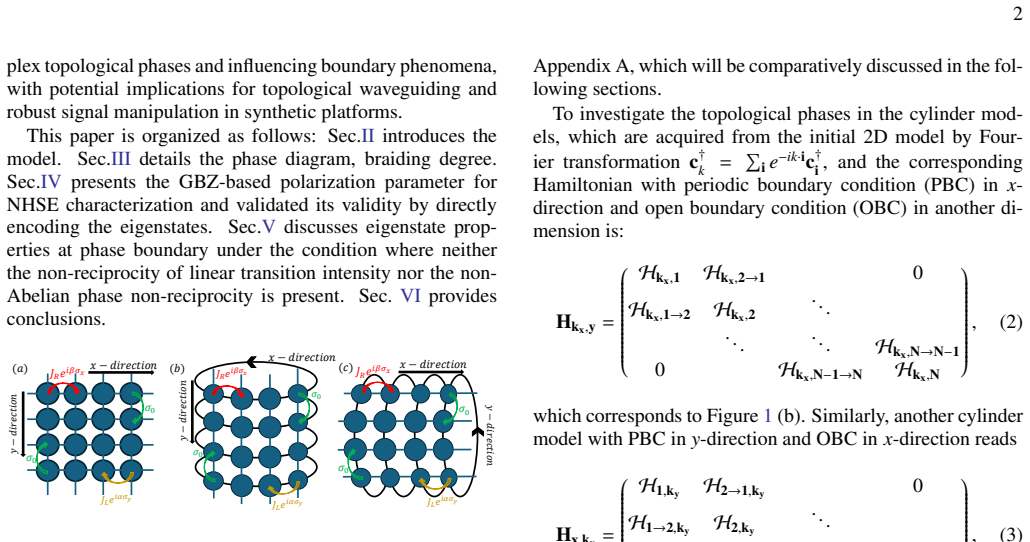
On the paper's own terms, the central discovery is that replacing the usual scalar or Abelian phases in a 2D Hatano-Nelson cylinder with non-commuting SU(2) phases ($\sigma_y$ on leftward hops, $\sigma_x$ on rightward hops) makes the complex energy bands braid into a Hopf link in $(\mathrm{Re}E,\mathrm{Im}E,k_x)$ space without long-range hoppings. The braiding degree is $\nu=\pm2$, and the transition between the two braiding types occurs at the exceptional-point surface $J_R^2\sin^2\beta = J_L^2\sin^2\alpha$, which is also the line on which the skin direction reverses. The paper further claims that the generalized Brillouin zone contains enough information to classify the skin effect quantitatively: the polarization parameter $I_p$, defined by the imbalance of GBZ roots outside and inside the unit circle, separates left-skin, right-skin, and bipolar skin regions, and it does so even at the reciprocal point $J_L=J_R$, $\alpha=\beta$, where ordinary non-reciprocity is absent. At the topological phase boundary half the eigenstates have purely real energies, and those zero-imaginary-energy states show pronounced degeneracy and a bipolar localization that persists as the system size grows.
Load-bearing premise
The whole skin classification rests on the assumption that the auxiliary-GBZ construction — the ordered-root condition $|\beta_M|=|\beta_{M+1}|$ applied to the quartic characteristic equation — faithfully predicts where open-boundary eigenstates sit, and that counting roots inside versus outside the unit circle tracks real-space localization even in parameter regions where the paper's own numerical maps are unconverged.
Editorial extensions
If this is right
- Hopf-link spectral braiding in this model requires no couplings beyond nearest-neighbor $x$-direction hoppings, so the effect should be realizable in the same kinds of short-range synthetic lattices used for Hatano-Nelson systems.
- The single equation $J_R^2\sin^2\beta=J_L^2\sin^2\alpha$ gives a two-parameter phase diagram in which the braiding degree jumps between $\nu=+2$ and $\nu=-2$, providing a direct target for experimental phase-boundary searches.
- The polarization parameter $I_p$ gives a scalar, momentum-space route to telling left-, right-, and bipolar skin regimes apart, which means the skin classification no longer depends only on inspecting real-space density profiles.
- At the critical line $|J_R|=J_L$, half of the eigenstates become purely real and remain bipolarly localized as the system size grows, so the boundary itself carries robust, size-independent spatial structure that can be probed by dynamics and inverse participation ratio.
Reading between the lines
- One extension the paper does not pursue is using $I_p$ as a general-purpose diagnostic for any multiband non-Hermitian lattice; if the GBZ root counting is faithful there, it would replace expensive exact-diagonalization scans with a cheap scalar phase map.
- The bipolar skin effect at $J_L=J_R$, $\alpha=\beta$ suggests a testable statement the authors leave implicit: the non-Abelian phases themselves act as an effective non-reciprocity, so tuning $\alpha$ or $\beta$ alone should rotate the skin direction continuously through the bipolar regime.
- Because the paper's own phase maps show serrated, numerically unconverged regions, a natural next check is to recompute $I_p$ with higher-precision or root-polishing methods on a coarse grid; if the serration collapses into smooth boundaries, the bipolar regimes become sharper experimental predictions.
- In a synthetic platform such as a topolectrical circuit, the predicted size-independent bipolar localization could be detected by measuring impedance or voltage profiles at the topological boundary, without needing time-resolved dynamics.
Editorial analysis
A structured set of objections, weighed in public.
Referee Report
Summary. This manuscript studies a two-dimensional Hatano-Nelson model with SU(2) non-Abelian gauge fields on a cylinder geometry. The authors claim two main results: (i) the complex-energy bands form a Hopf-link braiding with braiding degree nu = +-2, characterized by an exceptional-point boundary J_R^2 sin^2(beta) = J_L^2 sin^2(alpha), achievable with only nearest-neighbor x-direction couplings; and (ii) a generalized-Brillouin-zone polarization parameter I_p, defined in Eq. (11), quantitatively classifies left-, right-, and bipolar skin modes, including a bipolar skin effect at J_L = J_R with alpha = beta. The Hopf-link computation is presented as exact, while the I_p classification is supported by numerical phase diagrams and a limited set of real-space eigenstate comparisons. The paper also discusses zero-imaginary-energy eigenstates at the topological boundary, with claims of degeneracy and size-independent bipolar localization.
Significance. If the central claims hold, the paper would be a useful contribution to non-Hermitian topological physics: it would show that non-Abelian gauge fields can generate spectral braiding and bipolar skin localization without long-range couplings, which is a notable conceptual step beyond previous Abelian-gauge and long-range-hopping constructions. The exact derivation of the braiding degree is a genuine strength: Eq. (8) follows from the model Hamiltonian with no fitted parameters, and the cancellation of k_y in the traceless part correctly reduces the cylinder problem to a one-dimensional model, matching the known construction of Ref. [52]. The cross-validation of I_p against directly encoded real-space eigenstates (Section IV C) is good practice and is convincing at the selected sampling points. However, the central quantitative claim about I_p is currently under-specified and is not supported by fully converged numerical data, so the paper requires major revision before the classification result can be accepted.
major comments (4)
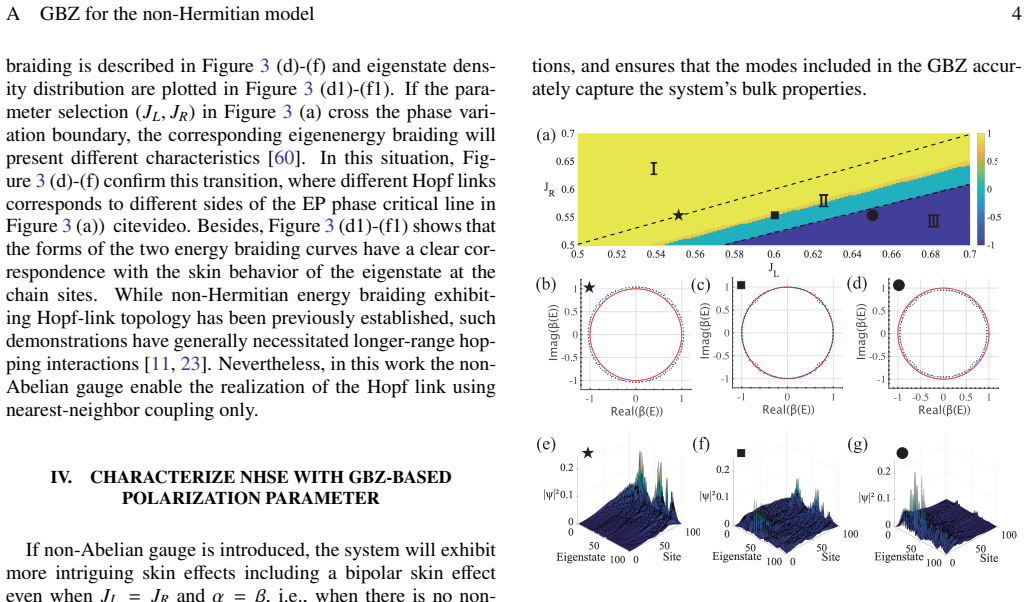
- [Section IV B, Eq. (11)] The definition of I_p is not operationally well specified. The characteristic equation (10) is quartic in beta for each complex energy E, and the GBZ condition |beta_M| = |beta_{M+1}| stated in Section IV A selects a continuum of (beta, E) pairs, not a fixed finite set {beta_1, ..., beta_{2M}}. The manuscript does not state whether I_p is evaluated at a single OBC eigenvalue, averaged over the OBC spectrum, or computed from a theta-grid of the auxiliary resultant, and these different choices can change the root count and therefore the sign or zero of I_p. As a result, the phase maps in Figures 4, 9, and 10 are not reproducible from the text as it stands.
- [Section IV B, Figure 4(a)] The manuscript itself concedes that the serrated patterns in the central I_p phase diagram 'stems from insufficient computational precision' and that reaching the shown precision 'requires a computational duration of 15 days.' Since Figure 4(a) is the primary evidence for the claim that I_p 'quantitatively discerns' left-, right-, and bipolar skin modes, the admitted numerical artifacts undermine the quantitative claim until convergence is demonstrated, the computations are repeated with a more robust method, or the claim is restricted to parameter regions that are demonstrably converged.
- [Section IV C, Figures 5, 9, 10] The verification of I_p against real-space eigenstates is limited to a small number of marker points (pentagram, square, circle) in each parameter plane, and the paper provides no direct comparison between GBZ-predicted OBC spectra and exact OBC spectra. The auxiliary-GBZ construction of Section IV A is load-bearing for the entire I_p classification, yet its fidelity for this spinful quartic characteristic equation is nowhere checked by an exact spectrum overlay. A systematic agreement measure over the full parameter plane, rather than a handful of selected points, is needed to support the claimed correspondence between I_p and the real-space skin modes.
- [Section V B, Figure 7(c1)] The abstract claims that the bipolar localization at the topological boundary is 'unaffected by size effects,' but the supporting evidence in Figure 7(c1) tracks only the most edge-localized eigenstate for system sizes up to N = 300. A size-scaling analysis of the full eigenstate distribution, or at least of the fraction of eigenstates exhibiting the bipolar profile, is needed to substantiate this claim.
minor comments (6)
- [Section II, Eq. (1)] The spinor notation for c^dagger_{x,y} and c_{x,y} is typeset in a garbled way; the components of the spinor and the Pauli-matrix structure should be written out explicitly.
- [Section IV A] The auxiliary-GBZ construction via the resultant of f(beta, E) and f(beta e^{i theta}, E) is introduced without derivation or a self-contained explanation; readers unfamiliar with Ref. [22] will not be able to follow the subsequent I_p computation.
- [Section IV B, Figure 4(a)] The color scale for I_p is not defined in the figure or caption, so statements such as 'yellow area' and 'yellow-blue-middle area' cannot be interpreted quantitatively.
- [Section III, text near Eq. (7)] The placeholder 'citevideo' appears in the sentence describing Figure 3(d)-(f); this should be replaced with a proper citation or reference to the supplementary video.
- [Various] There are multiple typographical issues, including 'systematic-ally' in the abstract, 'y-direction cylinder-types' in Section V, and inconsistent notation for J_L and J_R in the text and figures.
- [Appendix C] The phase diagrams in Figures 9 and 10 are described as reflecting 'rotation' of skin effects, but no quantitative measure of the degree of rotation is provided; the qualitative language should be aligned with the actual I_p values.
Circularity Check
No significant circularity; the derivation chain is self-contained and parameter-free.
full rationale
The braiding degree in Eq. (8) is computed directly from the Bloch Hamiltonian (4)-(6) after subtracting (1/2)Tr H, and Eq. (9) follows as the explicit exceptional-point condition; no fitted constants enter the derivation. The ratio-quantitative index R(alpha,beta) in Eq. (20) is an analytic consequence of the EP boundary (9), so it is not an input renamed as a result. The GBZ-based polarization parameter I_p in Eq. (11) is defined from the characteristic equation (10) using the standard auxiliary-GBZ condition |beta_M|=|beta_{M+1}| from Ref. [22], which is independent external methodology rather than a self-citation chain. The claimed classification of left-, right-, and bipolar skin modes is cross-checked against the real-space eigenstate diagnostics C(A,B) and Q in Eqs. (12)-(14), which are computed directly from exact eigenstates; this is independent validation, not circular reasoning. Although the paper admits that the I_p phase maps are numerically underconverged ('serrated patterns... stems from insufficient computational precision... requires a computational duration of 15 days'), numerical convergence limitations are a correctness risk, not evidence of circularity. No parameter is fitted to a subset of data and then called a prediction, and no load-bearing claim is justified solely by a citation whose authors overlap with the present paper. The central results therefore stand as self-contained derivations from the stated model.
Assumptions & free parameters
free parameters (3)
- k_y (transverse momentum slice) =
1
- System size N =
50 (up to 300 in Fig 7c1)
- delta (Q-classifier tolerance) =
unspecified small tolerance
assumptions (4)
- domain assumption Auxiliary-GBZ method of Yang et al. (PRL 125, 226402) yields the OBC spectrum and localization via |beta_M| = |beta_{M+1}| after resultant-elimination of E.
- domain assumption Skin-effect direction is determined by whether GBZ roots lie inside or outside the unit circle |beta| = 1.
- domain assumption The braiding degree nu (Eq 8), computed from the PBC Bloch Hamiltonian with real k_x, is the topological invariant characterizing the cylinder.
- domain assumption Time evolution is governed by the non-Hermitian Schrodinger equation i d_t psi = H psi with the effective Hamiltonian.
Cite this review
Pith. "Pith review of Non-Abelian Gauge Effect for 2-D Non-Hermitian Hatano-Nelson Model in Cylinder Type." pith.science (2026). https://pith.science/paper/53YIT7AY
@misc{pith2026250608714,
  author       = {Pith},
  title        = {Pith review of: Non-Abelian Gauge Effect for 2-D Non-Hermitian Hatano-Nelson Model in Cylinder Type},
  year         = {2026},
  howpublished = {\url{https://pith.science/paper/53YIT7AY}},
  note         = {Machine review of arXiv:2506.08714}
}
read the original abstract
Non-Abelian gauge offers a powerful route to engineer novel topological phenomena. Here, we systematically investigate a two-dimensional (2D) non-Hermitian Hatano-Nelson model incorporating SU(2) non-Abelian gauge, demonstrating the emergence of Hopf-link bulk braiding topology in the complex energy spectrum solely with x-direction nearest-neighbor couplings. Because of the limitations of exceptional point (EP) topology in fully capturing the rich non-Hermitian skin effect (NHSE) under non-Abelian influence, we introduce a novel polarization parameter derived from the generalized Brillouin zone (GBZ). This parameter quantitatively discerns left-, right-, and notably, bipolar skin modes, with its accuracy corroborated by directly encoding real-space eigenstate. Our findings reveal that non-Abelian gauge provides unprecedented influence over NHSE, compared with Abelian gauge and without gauge cases. Furthermore, we uncover unique characteristics of zero-imaginary-energy eigenstates at these topological boundaries, including pronounced degeneracy and bipolar localization which is unaffected by size effects, investigated via dynamical evolution and Inverse Participation Ratio (IPR). This work establishes a new paradigm for synthesizing and manipulating non-Hermitian topological phases driven by non-Abelian structures, opening avenues for topological engineering and holding promise for experimental realization in synthetic dimensional platforms.
Figures

Figures from the paper (6 more)


Reference graph
Works this paper leans on
- [52]
-
[1]
In other words, this cylindrical model can be studied by analogy with a 1D model
This EP phase boundary condition of this cylinder model is the same as the condition of the one-dimensional (1D) model with the HamiltonianH ′ = P x JLc† xeiασy cx+1 +J Rc† x+1eiβσx cx sincek y is eliminated when calculatingH kx,ky− 1 2TrHkx,ky. In other words, this cylindrical model can be studied by analogy with a 1D model. As Figure 2 (b) shows, the EP...
-
[2]
K. G. Makris, R. El-Ganainy, D. Christodoulides, and Z. H. Musslimani, Physical Review Letters,100, 103904 (2008)
work page 2008
-
[3]
A. Regensburger, C. Bersch, M.-A. Miri, G. Onishchukov, D. N. Christodoulides, and U. Peschel, Nature,488, 167 (2012)
work page 2012
-
[4]
L. Feng, Y .-L. Xu, W. S. Fegadolli, M.-H. Lu, J. E. Oliveira, V . R. Almeida, Y .-F. Chen, and A. Scherer, Nature Materials,12, 108 (2013)
work page 2013
-
[5]
J. Doppler, A. A. Mailybaev, J. B ¨ohm, U. Kuhl, A. Girschik, F. Libisch, T. J. Milburn, P. Rabl, N. Moiseyev, and S. Rotter, Nature,537, 76 (2016)
work page 2016
- [6]
- [7]
Show all 61 references
-
[8]
Xiong, Journal of Physics Communications,2, 035043 (2018)
Y . Xiong, Journal of Physics Communications,2, 035043 (2018)
2018
-
[9]
F. K. Kunst, E. Edvardsson, J. C. Budich, and E. J. Bergholtz, Physical Review Letters,121, 026808 (2018)
2018
-
[10]
T. Liu, Y . R. Zhang, Q. Ai, Z. Gong, K. Kawabata, M. Ueda, and F. Nori, Physical Review Letters,122, 076801 (2019)
2019
-
[11]
F. Song, S. Yao, and Z. Wang, Physical Review Letters,123, 246801 (2019)
2019
-
[12]
K. Wang, A. Dutt, C. C. Wojcik, and S. Fan, Nature,598, 59 (2021)
2021
-
[13]
Y . S. Patil, J. H¨oller, P. A. Henry, C. Guria, Y . Zhang, L. Jiang, N. Kralj, N. Read, and J. G. E. Harris, Nature,607, 271 (2022)
2022
-
[14]
Okuma, and M
N. Okuma, and M. Sato, Annual Review of Condensed Matter Physics,14, 83 (2023)
2023
-
[15]
Y . Wang, Y . Wu, X. Ye, C. K. Duan, Y . Wang, H. Hu, X. Rong, and J. Du, Nature Nanotechnology, https://doi.org/10.1038/s41565-025-01913-4 (2025)
2025 doi
-
[16]
X. Ji, H. Geng, N. Akhtar, and X. Yang, Physical Review B, 111, 195419 (2025)
2025
-
[17]
Z. Gong, Y . Ashida, K. Kawabata, K. Takasan, S. Higashikawa, and M. Ueda, Physical Review X,8, 031079 (2018)
2018
-
[18]
Kawabata, K
K. Kawabata, K. Shiozaki, M. Ueda, and M. Sato, Physical Re- view X,9, 041015 (2019)
2019
-
[19]
Yokomizo, and S
K. Yokomizo, and S. Murakami, Physical Review Letters,123, 066404 (2019)
2019
-
[20]
D. S. Borgnia, A. J. Kruchkov, and R.-J. Slager, Physical Re- view Letters,124, 056802 (2020)
2020
-
[21]
Okuma, K
N. Okuma, K. Kawabata, K. Shiozaki, and M. Sato, Physical Review Letters,124, 086801 (2020)
2020
-
[22]
Zhang, Z
K. Zhang, Z. Yang, and C. Fang, Physical Review Letters,125, 126402 (2020)
2020
-
[23]
Z. Yang, K. Zhang, C. Fang, and J. Hu, Physical Review Letters, 125, 226402 (2020)
2020
-
[24]
Hu, and E
H. Hu, and E. Zhao, Physical Review Letters,126, 010401 (2021)
2021
-
[25]
E. J. Bergholtz, J. C. Budich, and F. K. Kunst, Reviews of Mod- ern Physics,93, 015005 (2021)
2021
-
[26]
T. E. Lee, Physical Review Letters,116, 133903 (2016). B Interplay between Hopping AmplitudeJ L and Non-Abelian Phaseβ11
2016
-
[27]
Yi, and Z
Y . Yi, and Z. Yang, Physical Review Letters,125, 186802 (2020)
2020
-
[28]
Zhang, Z
K. Zhang, Z. Yang, and C. Fang, Nature Communications,13, 2496 (2022)
2022
-
[29]
Zhang, T
X. Zhang, T. Zhang, M. H. Lu, and Y . F. Chen, Advances in Physics: X,7, 2109431 (2022)
2022
-
[30]
Weidemann, M
S. Weidemann, M. Kremer, T. Helbig, T. Hofmann, A. Steg- maier, M. Greiter, R. Thomale, and A. Szameit, Science,368, 311 (2020)
2020
-
[31]
L. Xiao, T. Deng, K. Wang, G. Zhu, Z. Wang, W. Yi, and P. Xue, Nature Physics,16, 761 (2020)
2020
-
[32]
Hofmann, T
T. Hofmann, T. Helbig, F. Schindler, N. Salgo, M. Brzezi ´nska, M. Greiter, T. Kiessling, D. Wolf, A. V ollhardt, A. Kaba ˇsi, et al., Physical Review Research,2, 023265 (2020)
2020
-
[33]
Ghatak, M
A. Ghatak, M. Brandenbourger, J. Van Wezel, and C. Coulais, Proceedings of the National Academy of Sciences,117, 29561 (2020)
2020
-
[34]
L. Li, C. H. Lee, S. Mu, and J. Gong, Nature Communications, 11, 5491 (2020)
2020
-
[35]
Helbig, T
T. Helbig, T. Hofmann, S. Imhof, M. Abdelghany, T. Kiessling, L. Molenkamp, C. Lee, A. Szameit, M. Greiter, and R. Tho- male, Nature Physics,16, 747 (2020)
2020
-
[36]
S. Liu, R. Shao, S. Ma, L. Zhang, O. You, H. Wu, Y . J. Xiang, T. J. Cui, and S. Zhang, Research,2021, 5608038 (2021)
2021
-
[37]
D. Zou, T. Chen, W. He, J. Bao, C. H. Lee, H. Sun, and X. Zhang, Nature Communications,12, 7201 (2021)
2021
-
[38]
K. Wang, A. Dutt, K. Y . Yang, C. C. Wojcik, J. Vuˇckovi´c, and S. Fan, Science,371, 1240 (2021)
2021
-
[39]
Zhang, Y
X. Zhang, Y . Tian, J.-H. Jiang, M.-H. Lu, and Y .-F. Chen, Nature Communications,12, 5377 (2021)
2021
-
[40]
Zhang, Y
L. Zhang, Y . Yang, Y . Ge, Y .-J. Guan, Q. Chen, Q. Yan, F. Chen, R. Xi, Y . Li, D. Jia, et al., Nature Communications,12, 6297 (2021)
2021
-
[41]
W. Wang, X. Wang, and G. Ma, Nature,608, 50 (2022)
2022
-
[42]
Dalibard, F
J. Dalibard, F. Gerbier, G. Juzeli¯unas, and P. ¨Ohberg, Reviews of Modern Physics,83, 1523 (2011)
2011
-
[43]
Goldman, G
N. Goldman, G. Juzeli¯unas, P. ¨Ohberg, and I. B. Spielman, Re- ports on Progress in Physics,77, 126401 (2014)
2014
-
[44]
Y . Yang, C. Peng, D. Zhu, H. Buljan, J. D. Joannopoulos, B. Zhen, and M. Soljaˇci´c, Science,365, 1021 (2019)
2019
-
[45]
Longhi, D
S. Longhi, D. Gatti, and G. Della Valle, Physical Review B,92, 094204 (2015)
2015
-
[46]
Longhi, Physical Review A,95, 062122 (2017)
S. Longhi, Physical Review A,95, 062122 (2017)
2017
-
[47]
Longhi, Physical Review B,95, 014201 (2017)
S. Longhi, Physical Review B,95, 014201 (2017)
2017
-
[48]
Midya, H
B. Midya, H. Zhao, and L. Feng, Nature communications,9, 2674 (2018)
2018
-
[49]
Oztas, and N
Z. Oztas, and N. Candemir, Physics Letters A,383, 1821 (2019)
2019
-
[50]
Z. Lin, L. Ding, S. Ke, and X. Li, Optics Letters,46, 3512 (2021)
2021
-
[51]
Wong, and S
S. Wong, and S. S. Oh, Physical Review Research,3, 033042 (2021)
2021
-
[53]
Z. H. Pang, B. T. T. Wong, J. B. Hu, Y . Yang, Physical Review Letters,132, 043804 (2024)
2024
-
[54]
H. Tang, Z. Wang, L. Tang, D. Song, Z. Chen, and H. Buljan, APL Photonics,9, 056102 (2024)
2024
-
[55]
Cheng, K
D. Cheng, K. Wang, C. Roques-Carmes, E. Lustig, O. Y . Long, H. Wang, and S. Fan, Nature,637, 52 (2025)
2025
-
[56]
S. M. Rafi-U1-Islam, Z. B. Siu, H. Sahin, Md. S. H. Razo, and M. B. A. Jalil, Physical Review B,109, 045410 (2024)
2024
-
[57]
W. D. Heiss, Journal of Physics A: Mathematical and Theoret- ical,45, 444016 (2012)
2012
-
[58]
S. Yao, F. Song, and Z. Wang, Physical Review Letters,121, 136802 (2018)
2018
-
[59]
Hatano, and D
N. Hatano, and D. R. Nelson, Physical Review Letters,77, 570 (1996)
1996
-
[60]
Hatano, and D
N. Hatano, and D. R. Nelson, Physical Review B,56, 8651 (1997)
1997
-
[61]
A video acquired in supplementary materials
Reviewed August 7, 2026 · model on record in the stance chip above.
Discussion (0). Sign in to comment.