REVIEW 4 major objections 5 minor 24 references
Numerical modeling of isochoric heating experiments using the TROLL code in the warm dense matter regime
T0 review · 4 major / 5 minor · reviewed 2026-08-07 · deepseek-v4-flash
Pith's one-line read The TROLL code, using the SESAME equation of state and SRIM stopping power for protons in aluminum, reproduces the rear-face temperatures measured in isochoric proton-heating experiments.
desk verdict Honest TROLL benchmark against two LULI shots, but the headline agreement is partly built by tuning the proton source, so read the validation claim with salt. read the letter →
The pith
A machine-rendered reading of the paper's core claim, the machinery that carries it, and where it could break.
The reading
What carries the argument
The load-bearing object is the TROLL radiation-hydrodynamics code with its Monte-Carlo module for charged-particle transport, which tracks protons from a point source through a Lagrangian mesh and deposits energy via stopping-power formulas. The two stopping models compared are SRIM, for cold non-ionized matter, and Diane, for fully ionized plasma. The input proton source is reconstructed from Thomson-parabola data: the high-energy part is measured, the low-energy part below 0.6 MeV is extrapolated following a reference experiment, the beam divergence comes from that reference's fit, and a normalization factor is applied to match the measured temperature. SESAME provides the equation of state, and the comparison quantity is the rear-face temperature inferred from SOP radiance assuming black-body emission with emissivity 1.
What would settle it
Measure the proton spectrum below 0.6 MeV on the same shots with a diagnostic that reaches lower energies, such as a Thomson parabola with longer imaging plates or a radiochromic-film stack deconvolution, feed the measured spectrum into TROLL without the temperature-tuning normalization factor, and check whether the rear-face temperature still matches; if it does not, the reported agreement rests on the fitted source.
Extended reading notes
Core claim
The central claim is that the TROLL code, using the SESAME equation of state and SRIM stopping power for protons in aluminum, reproduces the rear-face temperature measured by streaked optical pyrometry on proton-heated foils. For both analyzed shots, the simulated time-dependent rear-face temperature is in acceptable agreement with the experiment, and the post-processed radiative emission using SRIM stopping is close to the SOP measurements. The Diane stopping power for fully ionized matter also falls within the experimental error bars but agrees less well. The paper further argues that the black-body assumption with emissivity close to 1 is reliable for aluminum in the 1 to 5 eV range and in the expansion plasma regime, and that TROLL's multidimensional Monte-Carlo proton transport captures the heating geometry.
Load-bearing premise
The argument depends on the reconstructed proton source being the actual beam that hit the foil: the low-energy part below 0.6 MeV, which deposits most of the energy, is taken from a different experiment and scaled by a factor fitted so that the simulated temperature matches the measured one. If that source is wrong, the agreement is produced by the fitting itself.
Editorial extensions
If this is right
- TROLL, originally built for hohlraum and inertial-confinement simulations, can also be used to design and analyze isochoric proton-heating experiments in the warm dense matter regime.
- For aluminum in the 1 to 5 eV range, the cold-matter SRIM stopping power gives better agreement with the measured rear-face temperature than the fully-ionized Diane model, although the measurement uncertainties prevent a definitive ranking.
- The consistency between simulated and measured emission ratios for the 3-micrometer and 6-micrometer shots supports the use of black-body emission with emissivity near 1 for rear-face temperature inference in this regime.
- The simulated temperature is averaged over the rear surface, so the comparison between simulation and experiment is meaningful at the roughly 100-micrometer spatial scale set by the SOP analysis.
- The incident proton distribution is not significantly altered by energy deposition in the thin aluminum foils, so the modeled and measured transmitted distributions can be compared directly to check the transport calculation.
Reading between the lines
- Because the low-energy proton population that dominates heating is not measured on the analyzed shots but taken from a reference experiment and scaled to match the temperature, the comparison should be read as a validation of the coupled transport-and-equation-of-state model conditional on the source model, not as a source-free test.
- A sharper test would use a second target material with the same reconstructed source, since the ratio of rear-face temperatures between materials is less sensitive to the overall normalization and would isolate stopping-power differences.
- The same modeling chain could be used to benchmark partial-ionization stopping-power models by selecting shots where the SRIM and Diane predictions diverge most, which the paper notes is a possible future investigation.
- The unexplained discrepancy between the calibration sensitivity obtained for this campaign and the value expected from a later calibration method suggests that absolute temperature values carry a systematic uncertainty that relative measurements between shots or between materials would help suppress.
Editorial analysis
A structured set of objections, weighed in public.
Referee Report
Summary. The manuscript reports simulations of proton-driven isochoric heating experiments performed at LULI, using the TROLL radiation-hydrodynamics code with a Monte-Carlo charged-particle module and two stopping-power models (SRIM and Diane), together with the SESAME equation of state. Two shots (19 and 40) on aluminum foils of 3 and 6 µm thickness are modeled in 2D cylindrical geometry. The simulated rear-face temperature, radiative emission, and transmitted proton spectra are compared with Thomson-parabola and streaked-optical-pyrometry measurements. The authors conclude that an acceptable agreement is obtained with the SRIM stopping power and SESAME EOS, and that the black-body assumption used to infer experimental temperatures is supported. The paper is transparent about the main difficulty: the measured Thomson-parabola spectra start at 0.6 MeV, while most heating is produced by protons below 0.5 MeV, so the low-energy part of the spectrum is taken from Mančić et al. and the absolute proton number for shot 19 is scaled by a factor f19=1.25 to match the measured temperature.
Significance. If the reported agreement were based on an independently constrained proton source, the work would constitute a valuable benchmark of TROLL, SRIM stopping, and SESAME EOS in the warm dense matter regime. The explicit tuning of the proton normalization f19 and the transplantation of the low-energy spectrum from a different experiment, however, mean that the central claim is currently a consistency check rather than a validation. The paper demonstrates a useful simulation workflow and is honest about its limitations, but the load-bearing comparisons in Figures 14 and 15 need to be reassessed with sensitivity analysis or reframed in terms of what can and cannot be concluded.
major comments (4)
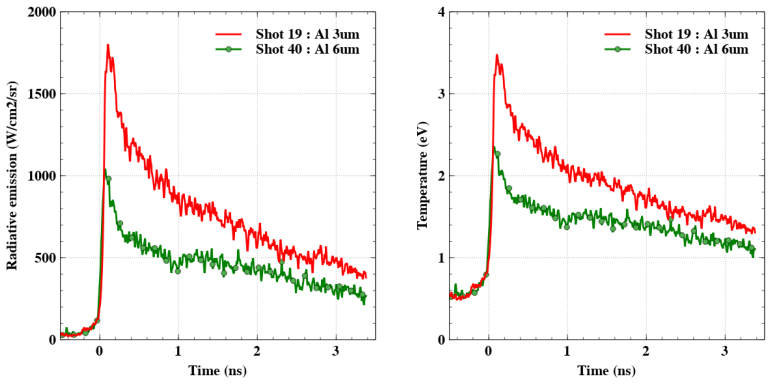
- [§3.3, Figure 14] The proton number for shot 19 is explicitly multiplied by f19=1.25 'to match the temperature measurements' (stated in §3.3). Consequently, the simulated temperature for shot 19 in Figure 14 agrees with experiment partly by construction, and the abstract's claim of 'an acceptable agreement' using SESAME and SRIM is not an independent validation. The manuscript should either provide an independent constraint on the absolute proton number (e.g., from RCF or a calibrated part of the Thomson parabola) or reframe the comparison as a consistency check and state explicitly which physical quantities are not fitted.
- [§3.3, paragraph on low-energy extrapolation] The measured Thomson-parabola data only cover proton energies above 0.6 MeV, while the text notes that most of the energy deposition is due to protons with energies below 0.5 MeV. The low-energy spectrum is therefore taken from Mančić et al. [9] rather than measured on the analyzed shots. Since the simulated rear-face temperature is most sensitive to this unmeasured part of the spectrum, the apparent agreement in Figure 14 depends critically on the assumption that the TNSA spectrum shape is identical to that of Mančić et al. A quantitative sensitivity study (e.g., varying the low-energy spectral slope and normalization within plausible bounds) is needed to establish that the agreement is not accidental.
- [§3.3, shot 40 input] Shot 40 is not an independent check of the source modeling: its input distribution is derived from shot 19's distribution by a single scaling factor f40=0.75 chosen to fit the high-energy (>4 MeV) part of the shot 40 Thomson-parabola data. The low-energy shape, which dominates heating, is therefore the same assumed shape as for shot 19. The manuscript should explicitly list which aspects of the shot 40 comparison are truly independent and which are carried over from the shot 19 assumptions.
- [§2.3, temperature calibration] The SOP calibration is subject to unexplained systematic discrepancies: the estimated red-path sensitivity is 0.17 nW/lsb (-43%; +88%), while the value expected from the calibration of reference [19] is about 2.7 nW/lsb, 'a discrepancy that we cannot explain.' Combined with the stated [-50%; +100%] error bars on the emission, the inferred temperatures used for comparison in Figure 14 carry large, potentially asymmetric uncertainties that are not shown. The comparison should be presented with the full temperature uncertainty (including the calibration ambiguity) and the conclusion should be reevaluated in that light.
minor comments (5)
- [Abstract and §5] The wording 'an acceptable agreement' in the abstract and 'The good agreement' in the conclusions overstates the strength of the comparison given the explicit tuning of f19 and the large experimental uncertainties; a more cautious formulation such as 'consistent within the large uncertainties' would be more accurate.
- [Throughout] The code name is written inconsistently ('Troll', 'TROLL', 'theTrollcode'); please use the official capitalization throughout.
- [Figure 4 caption] The units of dN/dEdΩ are given as part.MeV^-1.sr^-1, but the caption does not define the symbol Ω or specify whether the distribution is at the source or at the target position; this should be clarified.
- [Figure 14] The experimental temperature curves in Figure 14 do not appear to include error bars; adding the estimated temperature uncertainty (derived from the [-50%; +100%] emission error bars) is essential for a meaningful comparison.
- [References] Reference [17] is cited as 'in preparation'; if possible, replace or supplement with a published or accessible version, or indicate that the results do not depend on that reference.
Circularity Check
Shot 19's proton-number scale f19=1.25 is explicitly tuned to match the temperature measurements, so the reported 'acceptable agreement' with SRIM/SESAME is partly a fitting result, not an independent prediction.
-
fitted input called prediction
[Section 3.3 (Modeling the input protons data from experiments), around Fig. 12]
"In addition to the already described corrections applied on the measurements, the incident proton distribution might be tuned to match the temperature measurements. For shot 19, the proton number is multiplied by a factor f19=1.25 and the resulting energy distribution is called “t19s1”."
The quantity being predicted—the rear-face temperature—is the same quantity used to fix the input proton-number scale. The Thomson-parabola measurement provides the spectral shape, but the absolute normalization f19 is chosen so that the simulated temperature matches the SOP-inferred temperature. Since the deposited energy, and therefore the simulated temperature, scales with the proton number, the 'acceptable agreement' in Fig. 14 for shot 19 is at least partly built in. It is a consistency check of a fitted parameter, not an independent prediction of temperature. This makes the headline claim 'An acceptable agreement between experiment and simulation is found... using SESAME equation of state and SRIM stopping power' partly a fitting artifact.
full rationale
The paper builds its central comparison from a proton source that combines Thomson-parabola data, a Mančić et al. low-energy shape for the dominant sub-0.6 MeV part, and Mančić et al. beam divergence. The circular step is explicit in Section 3.3: for shot 19 the absolute proton number is rescaled by f19=1.25, and the text states this is done 'to match the temperature measurements.' Because the simulated rear-face temperature is monotonically tied to deposited proton number, the shot-19 agreement in Fig. 14 is in part guaranteed by the fit and cannot independently validate SESAME+SRIM. Shot 40 is less directly circular: f40=0.75 is fitted to the >4 MeV proton spectrum rather than to temperature, so the temperature comparison retains some independent content, but it inherits the same borrowed low-energy source shape and the same shot-19 source assumption. The radiative-emission comparison shares the same source model and has very large error bars (-50%/+100%). The paper is candid about the remaining uncertainties ('It is difficult to determine the best stopping power model in our case...'), but candor does not remove the fitted-input circularity for shot 19. Overall score 6: one headline 'prediction' reduces by construction, while the second shot provides partial, source-dependent independent content.
Assumptions & free parameters
free parameters (2)
- f19 =
1.25
- f40 =
0.75
assumptions (6)
- domain assumption The low-energy proton distribution below 0.6 MeV follows the shape measured by Mančić et al.
- domain assumption The proton beam has a homogeneous angular distribution with a maximum divergence given by Mančić et al.'s experimental fit for a gold foil TNSA source.
- domain assumption The rear-surface emission follows the black-body formula with emissivity equal to 1.
- standard math The ionic contribution to the proton stopping power is negligible.
- domain assumption The SESAME equation of state accurately describes the aluminum response in the warm dense matter conditions of these experiments.
- domain assumption SRIM stopping power is appropriate for cold, weakly ionized matter, while the Diane model applies to fully ionized matter; the true regime is somewhere between.
Cite this review
Pith. "Pith review of Numerical modeling of isochoric heating experiments using the TROLL code in the warm dense matter regime." pith.science (2026). https://pith.science/paper/PS7EL6Q3
@misc{pith2026250608912,
  author       = {Pith},
  title        = {Pith review of: Numerical modeling of isochoric heating experiments using the TROLL code in the warm dense matter regime},
  year         = {2026},
  howpublished = {\url{https://pith.science/paper/PS7EL6Q3}},
  note         = {Machine review of arXiv:2506.08912}
}
read the original abstract
Experiments of isochoric heating by protons of solid material were recently performed at LULI laser facilities. In these experiments, protons, produced from target normal sheath acceleration (TNSA) of Au foil with the PICO2000 laser, deposit their energy into an aluminum or copper foil initially at room temperature and solid density. The heated material reaches the warm dense matter regime with temperature in the rear face of the material between 1 and 5 eV. The temperature is inferred by streaked optical pyrometry and the proton beam is characterized by Thomson parabola. The high-energy protons produced by TNSA are modeled to deduce the initial proton distribution before the slowing down in the target. Hydrodynamic radiative simulations were next performed using the TROLL code in multidimensional geometry. In the TROLL code, the heating of protons is modeled with a Monte-Carlo transport module of charged particle and the calculation of the energy deposited by the protons in the matter is performed using stopping power formulas like SRIM functions. The results of simulations with the TROLL code are compared with the experimental results. An acceptable agreement between experiment and simulation is found for the temperature at the rear of the material using SESAME equation of state and SRIM stopping power for protons in aluminum.
Figures


Figures from the paper (12 more)




Reference graph
Works this paper leans on
-
[9]
A. Manˇ ci´ c, J. Robiche, P. Antici, P. Audebert, C. Blancard, P. Combis, F. Dorchies, G. Faussurier, S. Fourmaux, M. Harmand, R. Kodama, L. Lancia, S. Mazevet, M. Nakatsutsumi, O. Peyrusse, V. Recoules, P. Renaudin, R. Shepherd, and J. Fuchs. Isochoric heating of solids by laser-accelerated protons: Experimental characterization and self-consistent hydr...
work page 2010
-
[19]
M. Nourry-Martin, A. Denoeud, C. Chollet, M. Bonneau, T. Vinci, A. Ravasio, S. Brygoo, S. Darbon, and F. Balembois. Absolute calibration of a streaked optical pyrometer at nanosecond time scale with a luminescent concentrator.Rev. Sci. Inst., 94(8):083502, 2023
work page 2023
-
[1]
D. G. Hicks, T. R. Boehly, P. M. Celliers, J. H. Eggert, E. Vianello, D. D. Meyerhofer, and G. W. Collins. Shock compression of quartz in the high-pressure fluid regime.Phys. Plasmas, 12(8):082702, 08 2005
work page 2005
-
[2]
W. Cayzac, G. Boutoux, S. Brygoo, A. Denoeud, S. Depierreux, V. Tassin, F. Albert, E. Alozy, C. Baccou, D. Batani, N. Blanchot, M. Bonneau, M. Bonnefille, R. Botrel, C. Bowen, P. Bradford, M. Brochier, T. Caillaud, A. Chaleil, S. Chardavoine, C. Chollet, C. Courtois, S. Darbon, X. Davoine, S. Debesset, V. Denis, R. Diaz, A. Dizi` ere, R. Du Jeu, W. Duchas...
work page 2024
-
[3]
VN Korobenko and AD Rakhel. Technique for measuring thermophysical properties of refractory metals at supercritical temperatures.Int. J. Thermophys., 20(4):1257–1266, 1999
work page 1999
- [4]
-
[5]
M. E. Foord, D. B. Reisman, and P. T. Springer. Determining the equation-of-state isentrope in an isochoric heated plasma.Rev. Sci. Inst., 75(8):2586–2589, 2004
work page 2004
-
[6]
Isochoric heating in heterogeneous solid targets with ultrashort laser pulses.Phys
Y Sentoku, AJ Kemp, R Presura, MS Bakeman, and TE Cowan. Isochoric heating in heterogeneous solid targets with ultrashort laser pulses.Phys. Plasmas, 14(12):122701, 2007
work page 2007
Show all 24 references
-
[7]
Spatiotemporal dynamics of fast electron heating in solid-density matter via XFEL.Nat
H Sawada, T Yabuuchi, N Higashi, T Iwasaki, K Kawasaki, Y Maeda, T Izumi, Y Nakagawa, K Shigemori, Y Sakawa, et al. Spatiotemporal dynamics of fast electron heating in solid-density matter via XFEL.Nat. Commun., 15(1):7528, 2024
2024
-
[8]
R. A. Snavely, B. Zhang, K. Akli, Z. Chen, R. R. Freeman, P. Gu, S. P. Hatchett, D. Hey, J. Hill, M. H. Key, Y. Izawa, J. King, Y. Kitagawa, R. Kodama, A. B. Langdon, B. F. Lasinski, A. Lei, A. J. MacKinnon, P. Patel, R. Stephens, M. Tampo, K. A. Tanaka, R. Town, Y. Toyama, T....
2007
-
[10]
Hoarty, T
D.J. Hoarty, T. Guymer, S.F. James, E. Gumbrell, C.R.D. Brown, M. Hill, J. Morton, and H. Doyle. Equation of state studies of warm dense matter samples heated by laser produced proton beams. High Energy Density Phys., 8(1):50–54, 2012
2012
-
[11]
Feldman, G
S. Feldman, G. Dyer, D. Kuk, and T. Ditmire. Measurement of the equation of state of solid-density copper heated with laser-accelerated protons.Phys. Rev. E, 95(3):031201, 2017
2017
-
[12]
Roycroft, B
R. Roycroft, B. Bowers, H. Smith, E. McCary, F. Aymond, G. M Dyer, H. J. Quevedo, P. A. Bradley, E. L. Vold, L. Yin, and B. M. Hegelich. Streaked optical pyrometer for proton-driven isochoric heating experiments of solid and foam targets.AIP Adv., 10(4):045220, 2020
2020
-
[13]
Curry, Maxence Gauthier, Eric Cunningham, Hae Ja Lee, Pierre Forestier-Colleoni, Adam Hig- ginson, Nicholas Aybar, Rui Hua, Brandon C
Krish Bhutwala, Mathieu Bailly-Grandvaux, Joohwan Kim, Maylis Dozi` eres, Eric Galtier, Chan- dra B. Curry, Maxence Gauthier, Eric Cunningham, Hae Ja Lee, Pierre Forestier-Colleoni, Adam Hig- ginson, Nicholas Aybar, Rui Hua, Brandon C. Edghill, Joseph Strehlow, Gilliss M. Dyer...
2020
-
[14]
Isochoric heating with laser-accelerated proton beams.Phys
M Carri´ e, P Combis, and E Lefebvre. Isochoric heating with laser-accelerated proton beams.Phys. Plasmas, 17(12):122707, 2010
2010
-
[15]
Lefebvre, S
E. Lefebvre, S. Bernard, C. Esnault, P. Gauthier, A. Grisollet, P. Hoch, L. Jacquet, G. Kluth, S. Laffite, S. Liberatore, et al. Development and validation of the TROLL radiation-hydrodynamics code for 3D hohlraum calculations.Nucl. Fusion, 59(3):032010, 2018
2018
-
[16]
Deutsch and G
C. Deutsch and G. Maynard. Ion stopping in dense plasmas: a basic physics approach.Matter Radiat. Extrem., 1(6):277–307, 2016
2016
-
[17]
Barges-Delattre, J
T. Barges-Delattre, J. C. Pain, and S. Rassou. Modelling stopping power of ions in plasmas using parametric potentials.Matter Radiat. Extrem., in preparation
-
[18]
Calibration of imaging plate detectors to mono-energetic protons in the range 1-200 MeV.Rev
N Rabhi, D Batani, G Boutoux, J-E Ducret, K Jakubowska, I Lantuejoul-Thfoin, C Nauraye, A Pa- triarca, A Sa¨ıd, A Semsoum, et al. Calibration of imaging plate detectors to mono-energetic protons in the range 1-200 MeV.Rev. Sci. Inst., 88(11):113301, 2017
2017
-
[20]
Celliers and A
P. Celliers and A. Ng. Optical probing of hot expanded states produced by shock release.Phys. Rev. E, 47(5):3547–3565, 1993
1993
-
[21]
Liberatore, P
S. Liberatore, P. Gauthier, J. L. Willien, P. E. Masson-Laborde, F. Philippe, O. Poujade, E. Alozy, R. Botrel, G. Boutoux, J. Bray, T. Caillaud, C. Chicanne, C. Chollet, A. Debayle, S. Depierreux, W. Duchastenier, M. Ferri, O. Henry, P. Hoch, S. Laffite, O. Landoas, L. Le-Dero...
2023
-
[22]
J. D. McHardy. An introduction to the theory and use of SESAME equations of state. Technical report, Los Alamos National Lab.(LANL), Los Alamos, NM (United States), 2018
2018
-
[23]
J. F. Ziegler, M. D. Ziegler, and J. P. Biersack. SRIM–The stopping and range of ions in matter (2010).Nucl. Instrum. Methods Phys. Res., B, 268(11-12):1818–1823, 2010. 15
2010
-
[24]
Caillaud, S
M. Caillaud, S. Lemaire, S. M´ enard, P. Rathouit, J.-C. Ribes, and D. Riz. DIANE multiparticle transport code. InSNA + MC 2013-Joint International Conference on Supercomputing in Nuclear Applications + Monte Carlo, page 06004. EDP Sciences, 2014. 16
2013
Reviewed August 7, 2026 · model on record in the stance chip above.
Discussion (0). Sign in to comment.