REVIEW 4 major objections 5 minor 114 references
Gamma-Ray Bursts Calibrated by Using Artificial Neural Networks from the Pantheon+ Sample
T0 review · 4 major / 5 minor · reviewed 2026-08-07 · deepseek-v4-flash
Pith's one-line read The paper claims that an ANN+BNN calibration of the Amati relation from Pantheon+ supernovae yields a GRB Hubble diagram whose flat-CPL fit prefers evolving dark energy, with $w_a=-0.98^{+0.58}_{-0.58}$ and $w_0=-1.02^{+0.67}_{-0.50}$, in…
desk verdict Solid incremental ML calibration paper whose wa≠0 headline is undercut by its own model selection and an untested redshift-evolution assumption. read the letter →
The pith
A machine-rendered reading of the paper's core claim, the machinery that carries it, and where it could break.
The reading
What carries the argument
The load-bearing object is the Amati relation written in apparent-magnitude form, $y' = a' + b x$, where $y' = \log_{10}[(1+z)^{-1}S_{\rm bolo}] + \frac{2}{5}m$ and $x = \log_{10}(E_p/300\,\mathrm{keV})$; rewriting the relation this way lets the supernova absolute magnitude be absorbed into the free intercept $a'$, so calibration is cosmology-independent. The ANN+BNN framework first reconstructs the supernova apparent magnitude $m(z)$ from Pantheon+ data, with dropout-based Bayesian averaging over 1000 forward passes supplying the uncertainty, and then Markov-chain Monte Carlo fitting with an unbinned likelihood that incorporates intrinsic scatter fixes $a'$, $b$, and $\sigma_{\rm int}$. This calibrated relation, extrapolated from $z<1.4$ to higher redshifts, produces the GRB Hubble diagram used with 32 OHD points to constrain $\Lambda$CDM and CPL dark-energy parameters.
What would settle it
Calibrate the Amati relation separately in redshift bins of the A219 sample (for example $z<2$, $2<z<4$, $z>4$) with the same ANN+BNN pipeline and check whether the fitted intercept $a'$ and slope $b$ drift beyond their $1\sigma$ uncertainties; a measurable drift would show the calibration does not extend unchanged to high redshift.
Extended reading notes
Core claim
On the paper's own terms, the central discovery is that an ANN+BNN framework trained on Pantheon+ supernovae can replace Gaussian-process interpolation for the model-independent calibration of the Amati relation, and that the calibrated GRB Hubble diagram, when combined with OHD, gives $\Omega_m = 0.321^{+0.078}_{-0.069}$, $h = 0.654^{+0.053}_{-0.071}$, $w_0 = -1.02^{+0.67}_{-0.50}$, and $w_a = -0.98^{+0.58}_{-0.58}$ for the flat CPL model. The paper interprets the non-zero $w_a$ as a $1\sigma$ preference for dark energy with redshift evolution, and notes that these constraints closely track earlier Gaussian-process calibrations, supporting the use of non-Gaussian machine-learning calibrators in high-redshift cosmology.
Load-bearing premise
The load-bearing premise is that the correlation between a burst's spectral peak energy and its total radiated energy, calibrated from bursts at $z<1.4$, holds unchanged at $z>1.4$; if that correlation evolves with redshift, the high-redshift distances and the derived dark-energy parameters are biased.
Editorial extensions
If this is right
- GRB distance measurements calibrated this way extend the Hubble diagram to $z \approx 8.2$, probing dark energy at redshifts far beyond the Pantheon+ supernova range.
- The ANN+BNN constraints agree with Gaussian-process calibrations at the $1\sigma$ level, giving independent evidence that machine-learning calibration does not introduce a large systematic shift.
- Combining high-redshift GRBs with OHD substantially tightens the parameter constraints compared with GRBs alone.
- The fitted $H_0$ from GRBs plus OHD in a flat $\Lambda$CDM model is closer to the CMB-based estimate than to the local distance-ladder value, while $\Omega_m$ agrees with CMB-based estimates at $1\sigma$.
- The flat CPL fit yields $w_a = -0.98^{+0.58}_{-0.58}$ at $1\sigma$, a hint of evolving dark energy, though AIC and BIC still favor $\Lambda$CDM as the simpler model.
Reading between the lines
- I infer that applying the same pipeline to the newer GBM long-GRB catalog mentioned in the conclusion would provide a direct test of whether the $w_a\neq0$ hint strengthens with larger statistics.
- The paper's own note that its uncertainty estimates are not perfectly calibrated suggests one extension: add the covariance-aware KL-divergence term to the loss function, as earlier studies did, and check whether the $w_a$ shift survives.
- I infer that the ANN+BNN reconstructed $m(z)$ could also calibrate other gamma-ray burst luminosity relations, and comparing the resulting dark-energy constraints would test whether the evolving-dark-energy hint is relation-specific.
Editorial analysis
A structured set of objections, weighed in public.
Referee Report
Summary. The paper calibrates the Ep–Eiso (Amati) relation of gamma-ray bursts using a hybrid ANN+BNN trained on Pantheon+ type Ia supernova apparent magnitudes in a cosmology-independent way, then applies the calibrated relation to the A219 GRB sample to construct a Hubble diagram at z ≥ 1.4. Cosmological parameters are fit to 140 high-redshift GRBs and 32 observational Hubble data points using MCMC, for flat ΛCDM and CPL dark-energy models. The reported CPL constraints (Ωm = 0.321+0.078−0.069, h = 0.654+0.053−0.071, w0 = −1.02+0.67−0.50, wa = −0.98+0.58−0.58 at 1σ) are interpreted in the abstract as 'a preference for dark energy with potential redshift evolution (wa ≠ 0)', although the paper's own AIC/BIC comparison favors ΛCDM. The results are compared with Gaussian-process calibrations and found to be consistent.
Significance. If the assumptions hold, the paper offers a useful machine-learning alternative to Gaussian-process calibration of GRB luminosity relations, with the practical advantage of not assuming Gaussian errors and with an explicit treatment of the Pantheon+ covariance. The authors are commendably transparent about the calibration's limitations, including the poor calibration of the ANN+BNN uncertainty estimates and the debated redshift evolution of the Amati relation. However, the headline cosmological claim is only a 1σ hint, it conflicts with the reported model-selection criteria, and it rests on an untested extrapolation from z < 1.4 to z ≈ 8.2. The paper is therefore better read as a proof-of-technique than as a robust new constraint on dark energy; with the current presentation, its significance is moderate and the conclusions need re-scoping.
major comments (4)
- [Section 4] The extrapolation of the Amati relation calibrated at z < 1.4 to the high-redshift sample (z ≥ 1.4, up to z ≈ 8.2) is the load-bearing step for all cosmological results in Table 3. The paper acknowledges in Section 4 that 'the redshift dependence of GRB relations remains debated' and that 'evolutionary effects warrant further scrutiny,' but it provides no internal test of this assumption. A small redshift dependence in the slope b or intercept a' would bias the reconstructed distance moduli and propagate directly into Ωm, w0, and wa. I request an explicit test (e.g., a redshift-dependent term in b or a', or a bin-by-bin calibration) or, at minimum, a prominent caveat stating that the quoted constraints are conditional on no redshift evolution, with the abstract's claim adjusted accordingly.
- [Section 2 / Table 3] There is an unexplained discrepancy in the high-redshift sample size. Section 2 states that the A219 sample is divided into 79 GRBs at z < 1.4 and 182 GRBs at z ≥ 1.4, but Table 3 and the MCMC fits use 140 GRBs at z > 1.4. The paper does not give the selection criteria that reduce 182 to 140. This is essential for reproducibility and can affect the χ2 values and the parameter constraints. Please specify which GRBs are excluded and why.
- [Abstract and Section 5 / Table 3] The claim of a 'preference for dark energy with potential redshift evolution (wa ≠ 0)' is based on 1σ intervals (e.g., wa = −0.96+0.58−0.58 for the ANN+OHD fit), and the same table reports ΔAIC = 3.622 and ΔBIC = 9.917 relative to ΛCDM, which favor the simpler model. At 1σ, zero is only marginally excluded for wa, and the information criteria point in the opposite direction. The abstract and conclusions should be reworded to state that this is a weak, model-dependent hint rather than a preference, or the stronger claim must be supported by additional evidence such as a 2σ detection or a model-comparison test that does not penalize the additional parameters so heavily.
- [Section 4, Eq. (2)] The covariance matrix C_GRB is invoked in the χ2 definition for GRBs but is never defined. The GRB distance moduli inherit uncertainties from the calibrated parameters a', b, σint, from the measured Ep and Sbolo, and from the ANN reconstruction, and the likelihood depends on how these are combined. Please provide the explicit expression for C_GRB (or a reference where it is defined) so that the χ2 is reproducible.
minor comments (5)
- [Section 2 / Section 5] The conclusions state that the results were obtained with 'GRBs at 0.8 < z < 8.2', while the analysis in Table 3 uses GRBs at z > 1.4; please correct this inconsistency.
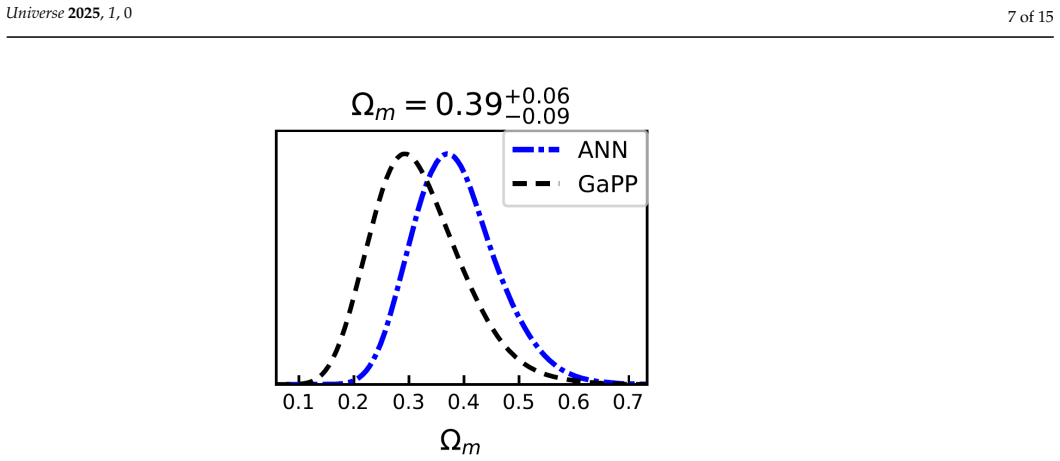
- [Section 3, Table 2] The ANN and GaPP fits give b = 1.99+0.12−0.15 and b = 2.25+0.16−0.21, respectively; the text says these are consistent at 1σ, but the difference is about 1.3σ even with the asymmetric errors. Please clarify the statement or quantify the agreement more carefully.
- [Note 6] The expression for σm contains the factor (5/2) multiplying σy' in the first term; please verify that the units and prefactors are correct, since this directly affects the reported distance-modulus uncertainties.
- [Abstract] The sentence 'which indicating a preference' contains a grammatical error; it should read 'which indicates a preference'.
- [Data Availability Statement] The statement 'Data are contained within the article' is insufficient for a calibration paper that relies on the A219 GRB sample, the Pantheon+ covariance matrix, and the OHD covariance matrix. Consider providing a link to a repository or a detailed description of how the data were obtained.
Circularity Check
No significant circularity: the high-redshift GRB sample used for cosmology is disjoint from the low-redshift sample that fixes the Amati relation.
full rationale
The derivation chain is: train an ANN+BNN on Pantheon+ apparent magnitudes; fit the Amati parameters a', b, and sigma_int to 79 GRBs with z < 1.4; then apply the fixed relation to 140 GRBs with z >= 1.4 and combine with 32 OHD to constrain cosmology. Because the high-redshift GRBs are not used in the calibration, the cosmological constraints are not statistically forced by the fitted relation. The absolute SN magnitude M is absorbed into the fitted offset a' through y' = a' + b x, so no SN distance calibration is smuggled into the derived GRB distances. The paper's own caveat that 'the redshift dependence of GRB relations remains debated... we apply the calibrated Amati relation' is an explicit physical assumption, not a result derived from the input data; an extrapolation assumption can be wrong without being circular. The self-citations (A219 sample from [55], the KL-divergence correction from [80] that the paper states it did not implement, and GP consistency checks [40,55,94]) are not used to forbid alternatives or to define the claimed result. Moreover, the reported Delta AIC and Delta BIC values favor LambdaCDM over the CPL model, so the wa != 0 statement is a weak 1-sigma tendency rather than an enforced output. The analysis is therefore self-contained with respect to external Pantheon+, OHD, and GRB observations, and no circular step is exhibited.
Assumptions & free parameters
free parameters (7)
- a' (Amati intercept) =
4.89+0.05−0.05 (ANN)
- b (Amati slope) =
1.99+0.12−0.15 (ANN)
- σ_int (intrinsic scatter) =
0.55 (ANN)
- Ωm (matter density) =
0.321+0.078−0.069 (CPL joint)
- h (dimensionless Hubble constant) =
0.654+0.053−0.071 (CPL joint)
- w0 (dark energy EoS at z=0) =
−1.02+0.67−0.50 (CPL joint)
- wa (dark energy EoS evolution) =
−0.98+0.58−0.58 (CPL joint)
assumptions (7)
- domain assumption Flatness of the universe
- domain assumption CPL parameterization w(z) = w0 + wa z/(1+z)
- domain assumption Amati relation is linear in log-space: y = a + bx
- domain assumption The Reichart likelihood correctly models the data
- domain assumption Cosmic chronometer H(z) data are model-independent
- domain assumption The ANN+BNN reconstruction of m(z) from Pantheon+ is accurate
- domain assumption The Amati relation does not evolve with redshift
Cite this review
Pith. "Pith review of Gamma-Ray Bursts Calibrated by Using Artificial Neural Networks from the Pantheon+ Sample." pith.science (2026). https://pith.science/paper/A6YK6REZ
@misc{pith2026250608929,
  author       = {Pith},
  title        = {Pith review of: Gamma-Ray Bursts Calibrated by Using Artificial Neural Networks from the Pantheon+ Sample},
  year         = {2026},
  howpublished = {\url{https://pith.science/paper/A6YK6REZ}},
  note         = {Machine review of arXiv:2506.08929}
}
abstract
In this paper, we calibrate the luminosity relation of gamma-ray bursts (GRBs) by Artificial Neural Networks (ANN) which is employed to analyze the Pantheon+ sample of type Ia supernovae (SNe Ia) in a manner independent of cosmological assumptions. The A219 GRB dataset are used to calibrate the Amati relation (\(E_{\rm p}\)-\(E_{\rm iso}\)) at low redshift with the ANN framework, facilitating the construction of the Hubble diagram at higher redshifts. Cosmological models are constrained with GRBs at high-redshift and the latest observational Hubble data (OHD) via a Markov Chain Monte Carlo numerical approach. For the Chevallier-Polarski-Linder (CPL) model within a flat universe, we obtain \(\Omega_{\rm m} = 0.321^{+0.078}_{-0.069}\), \(h = 0.654^{+0.053}_{-0.071}\), \(w_0 = -1.02^{+0.67}_{-0.50}\), and \(w_a = -0.98^{+0.58}_{-0.58}\) at the 1-\(\sigma\) confidence level, which indicating a preference for dark energy with potential redshift evolution (\(w_a \neq 0\)). These findings by using ANN align closely with those derived from GRBs calibrated by using Gaussian Processes.
Figures


Figures from the paper (4 more)


Reference graph
Works this paper leans on
-
[1]
Constraining ΩM and Dark Energy with Gamma-Ray Bursts
Dai, Z.; Liang, E.; Xu, D. Constraining ΩM and Dark Energy with Gamma-Ray Bursts. Astrophys. J. 2004, 612, L101. https://doi.org/10.1086/424694
doi:10.1086/424694 2004
-
[2]
A new method optimized to use gamma-ray bursts as cosmic rulers
Firmani, C.; Ghisellini, G.; Ghirlanda, G.; Avila-Reese, V . A new method optimized to use gamma-ray bursts as cosmic rulers. Mon. Not. R. Astron. Soc. 2005, 360, L1. https://doi.org/10.1111/j.1745-3933.2005.00023.x
arXiv 2005
-
[3]
Gamma-Ray Bursts: New Rulers to Measure the Universe
Ghirlanda, G.; Ghisellini, G.; Lazzati, D.; Firmani, C. Gamma-Ray Bursts: New Rulers to Measure the Universe. Astrophys. J. 2004, 613, L13. https://doi.org/10.1086/424915
doi:10.1086/424915 2004
-
[4]
Gamma-ray bursts as standard candles to constrain the cosmological parameters
Ghirlanda, G.; Ghisellini, G.; Firmani, C. Gamma-ray bursts as standard candles to constrain the cosmological parameters. New J. Phys. 2006, 8, 123. https://doi.org/10.1088/1367-2630/8/7/123
-
[5]
Calibration of gamma-ray burst luminosity indicators
Liang, E.; Zhang, B. Calibration of gamma-ray burst luminosity indicators. Mon. Not. R. Astron. Soc. 2006, 369, L37. https://doi.org/10.1111/j.1745-3933.2006.00169.x
arXiv 2006
-
[6]
Gamma-Ray Burst Hubble Diagram to z = 4.5
Schaefer, B.E. Gamma-Ray Burst Hubble Diagram to z = 4.5. Astrophys. J. 2003, 583, L67. https://doi.org/10.1086/368104
-
[7]
The Hubble Diagram to Redshift >6 from 69 Gamma-Ray Bursts
Schaefer, B.E. The Hubble Diagram to Redshift >6 from 69 Gamma-Ray Bursts. Astrophys. J. 2007, 660, 16. https://doi.org/10.1086/511742. Universe 2025, 1, 0 11 of 15
doi:10.1086/511742 2007
-
[8]
Wang, F.; Dai, Z.G. Constraining the cosmological parameters and transition redshift with gamma-ray bursts and supernovae. Mon. Not. R. Astron. Soc. 2006, 368, 371. https://doi.org/10.1111/j.1365-2966.2006.10108.x
arXiv 2006
Show all 114 references
-
[9]
Can Gamma-Ray Bursts Be Used to Measure Cosmology? A Further Analysis
Xu, D.; Dai, Z.; Liang, E. Can Gamma-Ray Bursts Be Used to Measure Cosmology? A Further Analysis. Astrophys. J. 2005, 633,
2005
-
[10]
A Cosmology-Independent Calibration of Gamma-Ray Burst Luminosity Relations and the Hubble Diagram
Liang, N.; Xiao, W.K.; Liu, Y.; Zhang, S.N. A Cosmology-Independent Calibration of Gamma-Ray Burst Luminosity Relations and the Hubble Diagram. Astrophys. J. 2008, 685, 354. https://doi.org/10.1086/590903
2008 doi
-
[11]
Addressing the circularity problem in the Ep-Eiso correlation of gamma-ray bursts
Amati, L.; D’Agostino, R.; Luongo, O.; Muccino, M.; Tantalo, M. Addressing the circularity problem in the Ep-Eiso correlation of gamma-ray bursts. Mon. Not. R. Astron. Soc. 2019, 486, L46. https://doi.org/10.1093/mnrasl/slz056
2019 doi
-
[12]
Intrinsic spectra and energetics of BeppoSAX Gamma-Ray Bursts with known redshifts
Amati, L.; Frontera, F.; Tavani, M.; in’t Zand, J.J.M.; Antonelli, A.; Costa, E.; Feroci, M.; Guidorzi, C.; Heise, J.; Masetti, N.; et al. Intrinsic spectra and energetics of BeppoSAX Gamma-Ray Bursts with known redshifts. Astron. Astrophys. 2002, 390, 81. https://doi.org/10.1...
2002 doi
-
[14]
Cosmography by GRBs: Gamma Ray Bursts as possible distance indicators
Capozziello, S.; Izzo, L. Cosmography by GRBs: Gamma Ray Bursts as possible distance indicators. Nucl. Phys. B Proc. Suppl. 2009, 194, 206. https://doi.org/10.1016/j.nuclphysbps.2009.07.024
2009 doi
-
[15]
Cosmology with gamma-ray bursts
Demianski, M.; Piedipalumbo, E.; Sawant, D.; Amati, L. Cosmology with gamma-ray bursts. I. The Hubble diagram through the calibrated Ep,I-Eiso correlation. Astron. Astrophys. 2017, 598, A112. https://doi.org/10.1051/0004-6361/201628909
2017 doi
-
[16]
Cosmology with gamma-ray bursts
Demianski, M.; Piedipalumbo, E.; Sawant, D.; Amati, L. Cosmology with gamma-ray bursts. II. Cosmography challenges and cosmological scenarios for the accelerated Universe. Astron. Astrophys. 2017, 598, A113. https://doi.org/10.1051/0004- 6361/201628911
2017 doi
-
[17]
Constraints on cosmological models and reconstructing the acceleration history of the Universe with gamma-ray burst distance indicators
Liang, N.; Wu, P .; ; Zhang, S.N. Constraints on cosmological models and reconstructing the acceleration history of the Universe with gamma-ray burst distance indicators. Phys. Rev. D 2010, 81, 083518. https://doi.org/10.1103/PhysRevD.81.083518
2010 doi
-
[18]
Constraints on the generalized Chaplygin gas model including gamma-ray bursts via a Markov Chain Monte Carlo approach
Liang, N.; Xu, L.; ; Zhu, Z.H. Constraints on the generalized Chaplygin gas model including gamma-ray bursts via a Markov Chain Monte Carlo approach. Astron. Astrophys. 2011, 527, A11. https://doi.org/10.1051/0004-6361/201015919
2011 doi
-
[19]
Reconstructing the cosmic expansion history up to redshift z = 6.29 with the calibrated gamma-ray bursts
Wei, H.; Zhang, S.N. Reconstructing the cosmic expansion history up to redshift z = 6.29 with the calibrated gamma-ray bursts. Eur. Phys. J. C 2009, 63, 139. https://doi.org/10.1140/epjc/s10052-009-1086-z
2009 doi
-
[20]
Observational constraints on cosmological models with the updated long gamma-ray bursts
Wei, H. Observational constraints on cosmological models with the updated long gamma-ray bursts. J. Cosmol. Astropart. Phys. 2010, 8, 020. https://doi.org/10.1088/1475-7516/2010/08/020
2010 doi
-
[21]
Intermediate redshift calibration of gamma-ray bursts and cosmic constraints in non-flat cosmology
Luongo, O.; Muccino, M. Intermediate redshift calibration of gamma-ray bursts and cosmic constraints in non-flat cosmology. Mon. Not. R. Astron. Soc. 2023, 518, 2247. https://doi.org/10.1093/mnras/stac2925
2023 doi
-
[22]
Improving sampling and calibration of gamma-ray bursts as distance indicators
Montiel, A.; Cabrera, J.I.; ; Hidalgo, J.C. Improving sampling and calibration of gamma-ray bursts as distance indicators. Mon. Not. R. Astron. Soc. 2021, 467, 3239. https://doi.org/10.1093/mnras/staa3926
2021 doi
-
[23]
Measuring dark energy with the Eiso - Ep correlation of gamma-ray bursts using model-independent methods
Wang, J.S.; Wang, F.Y.; Cheng, K.S.; Dai, Z.G. Measuring dark energy with the Eiso - Ep correlation of gamma-ray bursts using model-independent methods. Astron. Astrophys. 2016, 585, A68. https://doi.org/10.1051/0004-6361/201526485
2016 doi
-
[24]
Calibration of Gamma-Ray Burst Luminosity Correlations Using Gravitational Waves as Standard Sirens
Wang, Y.Y.; Wang, F.Y. Calibration of Gamma-Ray Burst Luminosity Correlations Using Gravitational Waves as Standard Sirens. Astrophys. J. 2019, 873, 39. https://doi.org/10.3847/1538-4357/ab037b
2019 doi
-
[25]
Redshift evolution of the Amati relation: Calibrated results from the Hubble diagram of quasars at high redshifts
Dai, Y.; Zheng, X.-G.; Li, Z.-X.; Gao, H.; Zhu, Z.-H. Redshift evolution of the Amati relation: Calibrated results from the Hubble diagram of quasars at high redshifts. Astron. Astrophys. 2021, 651, L8. https://doi.org/10.1051/0004-6361/202140895
2021 doi
-
[26]
Calibration of Luminosity Correlations of Gamma-Ray Bursts Using Quasars
Purohit, S.; Desai, S. Calibration of Luminosity Correlations of Gamma-Ray Bursts Using Quasars. Galaxies 2024, 12, 69. https://doi.org/10.3390/galaxies12060069
2024 doi
-
[27]
Low redshift calibration of the Amati relation using galaxy clusters
Gowri, G.; Shantanu, D. Low redshift calibration of the Amati relation using galaxy clusters. J. Cosmol. Astropart. Phys. 2022, 10,
2022
-
[28]
Measuring the cosmological parameters with the E p,i-Eiso correlation of gamma-ray bursts
Amati, L.; Guidorzi, C.; Frontera, F.; Della Valle, M.; Finelli, F.; Landi, F.; Montanari, E. Measuring the cosmological parameters with the E p,i-Eiso correlation of gamma-ray bursts. Mon. Not. R. Astron. Soc. 2008, 391, 577. https://doi.org/10.1111/j.1365- 2966.2008.13943.x
2008
-
[29]
Standardizing Platinum Dainotti-correlated gamma-ray bursts, and using them with standardized Amati-correlated gamma-ray bursts to constrain cosmological model parameters
Cao, S.; Dainotti, M.; Ratra, B. Standardizing Platinum Dainotti-correlated gamma-ray bursts, and using them with standardized Amati-correlated gamma-ray bursts to constrain cosmological model parameters. Mon. Not. R. Astron. Soc. 2022, 512, 439. https://doi.org/10.1093/mnras/stac517
2022 doi
-
[30]
Standardizing Dainotti-correlated gamma-ray bursts, and using them with standardized Amati- correlated gamma-ray bursts to constrain cosmological model parameters
Cao, S.; Khadka, N.; Ratra, B. Standardizing Dainotti-correlated gamma-ray bursts, and using them with standardized Amati- correlated gamma-ray bursts to constrain cosmological model parameters. Mon. Not. R. Astron. Soc. 2022, 510, 2928. https://doi.org/10.1093/mnras/stab3559
2022 doi
-
[31]
Constraints on cosmological parameters from gamma-ray burst peak photon energy and bolometric fluence measurements and other data
Khadka, N.; Ratra, B. Constraints on cosmological parameters from gamma-ray burst peak photon energy and bolometric fluence measurements and other data. Mon. Not. R. Astron. Soc. 2020, 499, 391. https://doi.org/10.1093/mnras/staa2779
2020 doi
-
[32]
Do gamma-ray burst measurements provide a useful test of cosmological models? J
Khadka, N.; Luongo, O.; Muccino, M.; Ratra, B. Do gamma-ray burst measurements provide a useful test of cosmological models? J. Cosmol. Astropart. Phys. 2021, 09, 042. https://doi.org/10.1088/1475-7516/2021/09/042. Universe 2025, 1, 0 12 of 15
2021 doi
-
[33]
Using lower redshift, non-CMB, data to constrain the Hubble constant and other cosmological parameters
Cao, S.; Ratra, B. Using lower redshift, non-CMB, data to constrain the Hubble constant and other cosmological parameters. Mon. Not. R. Astron. Soc. 2022, 513, 5686. https://doi.org/10.1093/mnras/stac1184
2022 doi
-
[34]
Do high redshift QSOs and GRBs corroborate JWST?Phys
Colgáin, E.O.; Sheikh-Jabbari, M.M.; Yin, L. Do high redshift QSOs and GRBs corroborate JWST?Phys. Dark Universe 2025, 49, 101975. https://doi.org/10.1016/j.dark.2025.101975
2025
-
[35]
Towards a new model-independent calibration of Gamma-Ray Bursts
Favale, A.; Dainotti, M.G.; Gómez-Valent, A.; Migliaccio, M. Towards a new model-independent calibration of Gamma-Ray Bursts. J. High Energy Astrophys. 2024, 44, 323. https://doi.org/10.1016/j.jheap.2024.10.010
2024 doi
-
[36]
Detection of gamma-ray burst Amati relation based on Hubble data set and Pantheon+ samples
Han, Y.; Gao, J.; Liu, G.; Xu, L. Detection of gamma-ray burst Amati relation based on Hubble data set and Pantheon+ samples. Eur. Phys. J. C 2024, 84, 934. https://doi.org/10.1140/epjc/s10052-024-13304-5
2024 doi
-
[37]
Measuring cosmological parameters with a luminosity-time correlation of gamma-ray bursts.Mon
Hu, J.P .; Wang, F.Y.; Dai, Z.G. Measuring cosmological parameters with a luminosity-time correlation of gamma-ray bursts.Mon. Not. R. Astron. Soc. 2021, 507, 730. https://doi.org/10.1093/mnras/stab2180
2021 doi
-
[38]
Standardizing the gamma-ray burst as a standard candle and applying it to cosmological probes: Constraints on the two-component dark energy model
Li, J.-L.; Yang, Y.-P .; Yi, S.-X.; Hu, J.-P .; Qu, Y.-K.; Wang, F.-Y. Standardizing the gamma-ray burst as a standard candle and applying it to cosmological probes: Constraints on the two-component dark energy model. Astron. Astrophys. 2024, 689, A165. https://doi.org/10.1051...
2024 doi
-
[39]
The Improved Amati Correlations from Gaussian Copula.Astrophys
Liu, Y.; Chen, F.; Liang, N.; Yuan, Z.; Yu, H.; Wu, P . The Improved Amati Correlations from Gaussian Copula.Astrophys. J. 2022, 931, 50. https://doi.org/10.3847/1538-4357/ac66d3
2022 doi
-
[40]
Gamma-Ray Burst Constraints on Cosmological Models from the Improved Amati Correlation
Liu, Y.; Liang, N.; Xie, X.; Yuan, Z.; Yu, H.; Wu, P . Gamma-Ray Burst Constraints on Cosmological Models from the Improved Amati Correlation. Astrophys. J. 2022, 935, 7. https://doi.org/10.3847/1538-4357/ac7de5
2022 doi
-
[41]
Testing Non-Coincident f (Q)-gravity with DESI DR2 BAO and GRBs
Paliathanasis, A. Testing Non-Coincident f (Q)-gravity with DESI DR2 BAO and GRBs. arXiv 2025, arXiv:2504.11132. https://doi.org/10.48550/arXiv.2504.11132
2025 doi
-
[42]
Radio Plateaus in Gamma-Ray Burst Afterglows and Their Application in Cosmology
Tian, X.; Li, J.-L.; Yi, S.-X.; Yang, Y.-P .; Hu, J.-P .; Qu, Y.-K.; Wang, F.-Y. Radio Plateaus in Gamma-Ray Burst Afterglows and Their Application in Cosmology. Astrophys. J. 2023, 958, 74. https://doi.org/10.3847/1538-4357/acfed8
2023 doi
-
[43]
High-redshift cosmology by Gamma-Ray Bursts: An overview
Bargiacchi, G.; Dainotti, M.G.; Hernandez, X. High-redshift cosmology by Gamma-Ray Bursts: An overview. New Astron. Rev. 2025, 100, 101712. https://doi.org/10.1016/j.newar.2024.101712
2025
-
[44]
The Observed Luminosity Correlations of Gamma-Ray Bursts and Their Applications
Deng, C.; Huang, Y.-F.; Xu, F.; Kurban, A. The Observed Luminosity Correlations of Gamma-Ray Bursts and Their Applications. Galaxies 2025, 13, 15. https://doi.org/10.3390/galaxies13020015
2025 doi
-
[45]
Cosmology-Independent Distance Moduli of 42 Gamma-Ray Bursts between Redshift of 1.44 and 6.60
Liang, N.; Zhang, S. Cosmology-Independent Distance Moduli of 42 Gamma-Ray Bursts between Redshift of 1.44 and 6.60. AIP Conf. Proc. 2008, 1065, 367–372. https://doi.org/10.1063/1.3027949
2008 doi
-
[47]
An updated gamma-ray bursts Hubble diagram.Mon
Cardone, V .F.; Capozziello, S.; Dainotti, M.G. An updated gamma-ray bursts Hubble diagram.Mon. Not. R. Astron. Soc. 2009, 400,
2009
-
[48]
A cosmographic calibration of the Ep,i - Eiso (Amati) relation for GRBs
Capozziello, S.; Izzo, L. A cosmographic calibration of the Ep,i - Eiso (Amati) relation for GRBs. Astron. Astrophys. 2010, 519, A73. https://doi.org/10.1051/0004-6361/201014522
2010 doi
-
[49]
Calibration of GRB Luminosity Relations with Cosmography
Gao, H.; Liang, N.; Zhu, Z.-H. Calibration of GRB Luminosity Relations with Cosmography. Int. J. Mod. Phys. D 2012, 21, 1250016. https://doi.org/10.1142/S0218271812500162
2012 doi
-
[50]
Cosmological models and gamma-ray bursts calibrated by using Padé method
Liu, J.; Wei, H. Cosmological models and gamma-ray bursts calibrated by using Padé method. Gen. Relativ. Gravit. 2015, 47, 141
2015
-
[51]
New measurements of Ωm from gamma-ray bursts
Izzo, L.; Muccino, M.; Zaninoni, E.; Amati, L.; Della Valle, M. New measurements of Ωm from gamma-ray bursts. Astron. Astrophys. 2015, 582, A115. https://doi.org/10.1051/0004-6361/201526461
2015 doi
-
[52]
B.; Zaninoni, E
Muccino, M.; Izzo, L.; Luongo, O.; Boshkayev, K.; Amati, L.; Della Valle, M.; Pisani, G. B.; Zaninoni, E. Tracing Dark Energy History with Gamma-Ray Bursts. Astrophys. J. 2021, 908, 181. https://doi.org/10.3847/1538-4357/abd254
2021 doi
-
[53]
Reconstruction of dark energy and expansion dynamics using Gaussian processes
Seikel, M.; Clarkson, C.; Smith, M. Reconstruction of dark energy and expansion dynamics using Gaussian processes. J. Cosmol. Astropart. Phys. 2012, 6, 036. https://doi.org/10.1088/1475-7516/2012/06/036
2012 doi
-
[54]
Constraints on the Cosmological Parameters with Three-Parameter Correlation of Gamma-Ray Bursts
Li, J.-L.; Yang, Y.-P .; Yi, S.-X.; Hu, J.-P .; Wang, F.-Y.; Qu, Y.-K. Constraints on the Cosmological Parameters with Three-Parameter Correlation of Gamma-Ray Bursts. Astrophys. J. 2023, 953, 58. https://doi.org/10.3847/1538-4357/ace107
2023 doi
-
[55]
Calibrating Gamma-Ray Bursts by Using a Gaussian Process with Type Ia Supernovae.Astrophys
Liang, N.; Li, Z.; Xie, X.; Wu, P . Calibrating Gamma-Ray Bursts by Using a Gaussian Process with Type Ia Supernovae.Astrophys. J. 2022, 941, 84. https://doi.org/10.3847/1538-4357/aca08a
2022 doi
-
[56]
Cosmography via Gaussian process with gamma ray bursts
Mu, Y.; Chang, B.; Xu, L. Cosmography via Gaussian process with gamma ray bursts. J. Cosmol. Astropart. Phys. 2023, 9, 041. https://doi.org/10.1088/1475-7516/2023/09/041
2023 doi
-
[57]
Testing the Phenomenological Interacting Dark Energy Model with Gamma-Ray Bursts and Pantheon+ type Ia Supernovae
Nong, X.-D.; Liang, N. Testing the Phenomenological Interacting Dark Energy Model with Gamma-Ray Bursts and Pantheon+ type Ia Supernovae. Res. Astron. Astrophys. 2024, 24, 125003. https://doi.org/10.1088/1674-4527/ad8a07
2024 doi
-
[58]
Constraining the emergent dark energy models with observational data at intermediate redshift
Wang, G.Z.; ; Li, X.L.; Liang, N. Constraining the emergent dark energy models with observational data at intermediate redshift. Astrophys. Space Sci. 2024, 369, 74. https://doi.org/10.1007/s10509-024-04340-4
2024 doi
-
[59]
Constraints from Fermi observations of long gamma-ray bursts on cosmological parameters
Wang, H.; Liang, N. Constraints from Fermi observations of long gamma-ray bursts on cosmological parameters. Mon. Not. R. Astron. Soc. 2024, 533, 743. https://doi.org/10.1093/mnras/stae1825. Universe 2025, 1, 0 13 of 15
2024 doi
-
[60]
Constraints on cosmological models with gamma-ray bursts in cosmology-independent way
Xie, H.; Nong, X.; Wang, H.; Zhang, B.; Li, Z.; Liang, N. Constraints on cosmological models with gamma-ray bursts in cosmology-independent way. Int. J. Mod. Phys. D 2025, 20, 2450073. https://doi.org/10.1142/S0218271824500731
2025 doi
-
[61]
Using H(z) data as a probe of the concordance model
Seikel, M.; Yahya, S.; Maartens, R.; ; Clarkson, C. Using H(z) data as a probe of the concordance model. Phys. Rev. D 2012, 86, 083001. https://doi.org/10.1103/PhysRevD.86.083001
2012 doi
-
[62]
An Improved Method to Measure the Cosmic Curvature
Wei, J.-J.; Wu, X.-F. An Improved Method to Measure the Cosmic Curvature. Astrophys. J. 2017, 838, 160w. https://doi.org/10.3847/1538-4357/aa674b
2017 doi
-
[63]
Testing the fidelity of Gaussian processes for cosmography
Zhou, H.; Li, Z. Testing the fidelity of Gaussian processes for cosmography. Chin. Phys. 2019, 43, 035103. https://doi.org/10.1088/1674-1137/43/3/035103
2019 doi
-
[64]
Model-independent calibrations of gamma-ray bursts using machine learning
Luongo, O.; Muccino, M. Model-independent calibrations of gamma-ray bursts using machine learning. Mon. Not. R. Astron. Soc. 2021, 503, 4581. https://doi.org/10.1093/mnras/stab795
2021 doi
-
[65]
Measuring the Hubble constant with cosmic chronometers: A machine learning approach
Bengaly, C.; Dantas, ; M.A.; ; Casarini, L.; Alcaniz, J. Measuring the Hubble constant with cosmic chronometers: A machine learning approach. Eur. Phys. J. 2023, 83, 548. https://doi.org/10.1140/epjc/s10052-023-11734-1
2023 doi
-
[66]
Model-independent gamma-ray bursts constraints on cosmological models using machine learning
Zhang, B.; Wang, H.; Nong, X.; Wang, G.; Wu, P .; Liang, N. Model-independent gamma-ray bursts constraints on cosmological models using machine learning. Astrophys. Space Sci. 2025, 370, 10. https://doi.org/10.1007/s10509-025-04401-2
2025 doi
-
[67]
The Pantheon+ Analysis: The Full Data Set and Light-curve Release
Scolnic, D.; Brout, D.; Carr, A.; Riess, A.G.; Davis, T.M.; Dwomoh, A.; Jones, D.O.; Ali, N.; Charvu, P .; Chen, R.; et al. The Pantheon+ Analysis: The Full Data Set and Light-curve Release. Astrophys. J. 2022, 938, 113. https://doi.org/10.3847/1538-4357/ac8b7a
2022 doi
-
[68]
Estimating Cosmological Parameters and Reconstructing Hubble Constant with Artificial Neural Networks: A Test with covariance matrix and mock H(z)
Chen, J.F.; Zhang, T.J.; He, P .; Zhang, T.; Zhang, J. Estimating Cosmological Parameters and Reconstructing Hubble Constant with Artificial Neural Networks: A Test with covariance matrix and mock H(z). arXiv 2024, arXiv:2410.08369. https://doi.org/10.48550/arXiv.2410.08369
2024 doi
-
[69]
https://doi.org/10.1088/1475-7516/2022/10/069
2022 doi
-
[70]
The CosmoVerse White Paper: Addressing observational tensions in cosmology with systematics and fundamental physics
Di Valentino, E.; Levi Said, J.; Riess, A.; Pollo, A.; Poulin, V .; Gómez-Valent, A.; Weltman, A.; Palmese, A.; Huang, C.; van de Bruck, C.; et al. The CosmoVerse White Paper: Addressing observational tensions in cosmology with systematics and fundamental physics. arXiv 2025, ...
-
[71]
A deep learning approach to cosmological dark energy models
Escamilla-Rivera, C.; Quintero, M.A.C.; Capozziello, S. A deep learning approach to cosmological dark energy models. J. Cosmol. Astropart. Phys. 2020, 3, 008. https://doi.org/10.1088/1475-7516/2020/03/008
2020 doi
-
[72]
Neural network reconstruction of late-time cosmology and null tests
Dialektopoulos, K.; Said, J.L.; Mifsud, J.; Sultana, J.; Adami, K.Z. Neural network reconstruction of late-time cosmology and null tests. J. Cosmol. Astropart. Phys. 2022, 2, 023. https://doi.org/10.1088/1475-7516/2022/02/023
2022 doi
-
[73]
Constraining the Hubble Constant with a Simulated Full Covariance Matrix Using Neural Networks
Niu, J.; He, P .; Zhang, T.-J. Constraining the Hubble Constant with a Simulated Full Covariance Matrix Using Neural Networks. arXiv 2025, arXiv:2502.11443. https://doi.org/10.48550/arXiv.2502.11443
2025 doi
-
[74]
Reconstructing Functions and Estimating Parameters with Artificial Neural Networks: A Test with a Hubble Parameter and SNe Ia
Wang, G.-J.; Ma, X.-J.; Li, S.-Y.; Xia, J.-Q. Reconstructing Functions and Estimating Parameters with Artificial Neural Networks: A Test with a Hubble Parameter and SNe Ia. Astrophys. J. Suppl. Ser. 2020, 246, 13. https://doi.org/10.3847/1538-4365/ab620b
2020 doi
-
[75]
Neural network reconstructions for the Hubble parameter, growth rate and distance modulus
Gómez-Vargas, I.; Medel-Esquivel, R.; García-Salcedo, R.; Vázquez, J.A. Neural network reconstructions for the Hubble parameter, growth rate and distance modulus. Eur. Phys. J. C 2023, 83, 304. https://doi.org/10.1140/epjc/s10052-023-11435-9
2023 doi
-
[76]
LADDER: Revisiting the Cosmic Distance Ladder with Deep Learning Approaches and Exploring Its Applications
Shah, R.; Saha, S.; Mukherjee, P .; Garain, U.; Pal, S. LADDER: Revisiting the Cosmic Distance Ladder with Deep Learning Approaches and Exploring Its Applications. Astrophys. J. Suppl. Ser. 2024, 273, 27. https://doi.org/10.3847/1538-4365/ad5558
2024 doi
-
[77]
Model-independent calibration of Gamma-Ray Bursts with neural networks
Mukherjee, P .; Dainotti, M.; Dialektopoulos, K.F.; Levi, Said, J.; Mifsud, J. Model-independent calibration of Gamma-Ray Bursts with neural networks. arXiv 2024, arXiv:2411.03773. https://doi.org/10.48550/arXiv.2411.03773
-
[78]
A Nonparametric Reconstruction of the Hubble Parameter H(z) Based on Radial Basis Function Neural Networks
Zhang, J.C.; Hu, Y.; Jiao, K.; Wang, H.F.; Xie, Y.B.; Yu, B.; Zhao, L.L.; Zhang, T.J. A Nonparametric Reconstruction of the Hubble Parameter H(z) Based on Radial Basis Function Neural Networks. Astrophys. J. Suppl. Ser. 2024, 270, 23. https://doi.org/10.3847/1538-4365/ad0f1e
2024 doi
-
[79]
A Fundamental Plane for Long Gamma-Ray Bursts with X-Ray Plateaus
Dainotti, M.G.; Postnikov, S.; Hernandez, X.; Ostrowski M. A Fundamental Plane for Long Gamma-Ray Bursts with X-Ray Plateaus. Astrophys. J. 2016, 825, L20. https://doi.org/10.3847/2041-8205/825/2/L20
2016 doi
-
[80]
Gamma-ray bursts calibrated from the observational H(z) data in artificial neural network framework
Huang, Z.; Xiong, Z.; Luo, X.; Wang, G.; Liu, Y.; Liang, N. Gamma-ray bursts calibrated from the observational H(z) data in artificial neural network framework. J. High Energy Astrophys. 2025, 47, 100337. https://doi.org/10.1016/j.jheap.2025.100377
2025
-
[81]
A time-luminosity correlation forγ-ray bursts in the X-rays
Dainotti, M.G.; Cardone, V .F.; Capozziello, S. A time-luminosity correlation forγ-ray bursts in the X-rays. Mon. Not. R. Astron. Soc. 2008, 391, L79. https://doi.org/10.1111/j.1745-3933.2008.00560.x
2008
-
[82]
E iso-Ep correlation of gamma-ray bursts: Calibration and cosmological applications
Jia, X.D.; Hu, J.P .; Yang, J.; Zhang, B.B.; Wang, F.Y. E iso-Ep correlation of gamma-ray bursts: Calibration and cosmological applications. Mon. Not. R. Astron. Soc. 2022, 516, 2575. https://doi.org/10.1093/mnras/stac2356
2022 doi
-
[83]
Neural networks and standard cosmography with newly calibrated high redshift GRB observations
Escamilla-Rivera, C.; Carvajal, M.; Zamora, C.; Hendry, M. Neural networks and standard cosmography with newly calibrated high redshift GRB observations. J. Cosmol. Astropart. Phys. 2022, 4, 016. https://doi.org/10.1088/1475-7516/2022/04/016
2022 doi
-
[84]
Testing the standardizability of, and deriving cosmological constraints from, a new Amati-correlated gamma-ray burst data compilation
Cao, S.; Ratra, B. Testing the standardizability of, and deriving cosmological constraints from, a new Amati-correlated gamma-ray burst data compilation. J. Cosmol. Astropart. Phys. 2024, 10, 093. https://doi.org/10.1088/1475-7516/2024/10/093
2024 doi
-
[85]
Reconstructing the Hubble diagram of gamma-ray bursts using deep learning
Tang, L.; Lin, H.-N.; Li, X.; Liu, L. Reconstructing the Hubble diagram of gamma-ray bursts using deep learning. Mon. Not. R. Astron. Soc. 2022, 509, 1194. https://doi.org/10.1093/mnras/stab2932. Universe 2025, 1, 0 14 of 15
2022 doi
-
[86]
Learning representations by back-propagating errors
Rumelhart, D.E.; Hinton, G.E.; Williams, R.J. Learning representations by back-propagating errors. Nature 1986, 323, 533. https://doi.org/10.1038/323533a0
1986 doi
-
[87]
Model-independently Calibrating the Luminosity Correlations of Gamma-Ray Bursts Using Deep Learning
Tang, L.; Li, X.; Lin, H.-N.; Liu, L. Model-independently Calibrating the Luminosity Correlations of Gamma-Ray Bursts Using Deep Learning. Astrophys. J. 2021, 907, 121. https://doi.org/10.3847/1538-4357/abcd92
2021 doi
- [88]
-
[89]
Dropout: A Simple Way to Prevent Neural Networks from Overftting
Srivastava, N.; Hinton, G.; Krizhevsky, A.; Sutskever, I.; Salakhutdinov, R. Dropout: A Simple Way to Prevent Neural Networks from Overftting. J. Mach. Learn. Res. 2014, 15, 1929. http://jmlr.org/papers/v15/srivastava14a.html
2014
- [90]
-
[91]
emcee: The MCMC Hammer
Foreman-Mackey, D.; Hogg, D.W.; Lang, D.; Goodman, J. emcee: The MCMC Hammer. Publ. Astron. Soc. Pac. 2013, 125, 306. https://doi.org/10.1086/670067
2013 doi
-
[92]
Dust Extinction Curves and Lyα Forest Flux Deficits for Use in Modeling Gamma-Ray Burst Afterglows and All Other Extragalactic Point Sources
Reichart, D.E. Dust Extinction Curves and Lyα Forest Flux Deficits for Use in Modeling Gamma-Ray Burst Afterglows and All Other Extragalactic Point Sources. Astrophys. J. 2001, 553, 57. https://doi.org/10.1086/320630
2001 doi
-
[93]
Constraints on cosmological models from quasars calibrated with type Ia supernova by a Gaussian process
Zhang, H.; Liu, Y.; Yu, H.; Nong, X.; Liang, N.; ; Wu, P . Constraints on cosmological models from quasars calibrated with type Ia supernova by a Gaussian process. Mon. Not. R. Astron. Soc. 2024, 530, 4493. https://doi.org/10.1093/mnras/stae1120
2024 doi
-
[94]
Testing dark energy models with gamma-ray bursts calibrated from the observational H(z) data through a Gaussian process
Li, Z.; Zhang, B.; ; Liang, N. Testing dark energy models with gamma-ray bursts calibrated from the observational H(z) data through a Gaussian process. Mon. Not. R. Astron. Soc. 2023, 521, 4406. https://doi.org/10.1093/mnras/stad838
2023 doi
-
[95]
Prospects of high redshift constraints on dark energy models with the Ep,i-Eiso correlation in long gamma ray bursts
Demianski, M.; Piedipalumbo, E.; Sawant, D.; Amati, L. Prospects of high redshift constraints on dark energy models with the Ep,i-Eiso correlation in long gamma ray bursts. Mon. Not. R. Astron. Soc. 2021, 506, 903. https://doi.org/10.1093/mnras/stab1669
2021 doi
-
[96]
Measuring Cosmological Parameters with Gamma Ray Bursts
Amati, L.; Della Valle, M. Measuring Cosmological Parameters with Gamma Ray Bursts. Int. J. Mod. Phys. 2013, 22, 1330028. https://doi.org/10.1142/S0218271813300280
2013 doi
-
[97]
Model-independent distance calibration of high-redshift gamma-ray bursts and constrain on the ΛCDM model
Lin, H.N.; Li, X.; Chang, Z. Model-independent distance calibration of high-redshift gamma-ray bursts and constrain on the ΛCDM model. Mon. Not. R. Astron. Soc. 2016, 455, 2131. https://doi.org/10.1093/mnras/stv2471
2016 doi
-
[98]
Model-independent Constraints on Cosmic Curvature and Opacity.Astrophys
Wang, G.-J.; Wei, J.-J.; Li, Z.-X.; Xia, J.-Q.; Zhu, Z.-H. Model-independent Constraints on Cosmic Curvature and Opacity.Astrophys. J. 2017, 847, 45. https://doi.org/10.3847/1538-4357/aa8725
2017 doi
-
[99]
Gamma rays bursts: A viable cosmological probe? J
Kumar, D.; Rani, N.; Jain, D.; Mahajan, S.; Mukherjee, A. Gamma rays bursts: A viable cosmological probe? J. Cosmol. Astropart. Phys. 2023, 07, 021. https://doi.org/10.1088/1475-7516/2023/07/021
2023 doi
-
[100]
Exploring the Expansion History of the Universe
Linder, E.V . Exploring the Expansion History of the Universe. Phys. Rev. Lett. 2003, 90, 091301
2003
-
[101]
Improved constraints on the expansion rate of the Universe up to z ~1.1 from the spectroscopic evolution of cosmic chronometers
Moresco, M.; Cimatti, A.; Jimenez, R.; Pozzetti, L.; Zamorani, G.; Bolzonella, M.; Dunlop, J.; Lamareille, F.; Mignoli, M.; Pearce, H.; et al. Improved constraints on the expansion rate of the Universe up to z ~1.1 from the spectroscopic evolution of cosmic chronometers. J. Co...
2012 doi
-
[102]
Accelerating Universes with Scaling Dark Matter
Chevallier, M.; Polarski, D. Accelerating Universes with Scaling Dark Matter. Int. J. Mod. Phys. D 2001, 10, 213. https://doi.org/10.1142/S0218271801000822
2001 doi
-
[103]
A 6% measurement of the Hubble parameter at z~0.45: Direct evidence of the epoch of cosmic re-acceleration
Moresco, M.; Pozzetti, L.; Cimatti, A.; Jimenez, R.; Maraston, C.; Verde, L.; Thomas, D.; ; Citro, A.; Tojeiro, R.; Wilkinson, D. A 6% measurement of the Hubble parameter at z~0.45: Direct evidence of the epoch of cosmic re-acceleration. J. Cosmol. Astropart. Phys. 2016, 2016,...
2016 doi
-
[104]
Age-dating lu- minous red galaxies observed with the Southern African Large Telescope
Ratsimbazafy, A.L.; Loubser, S.I.; Crawford, S.M.; Cress, C.M.; Bassett, B.A.; Nichol, R.C.; Väisänen, P . Age-dating lu- minous red galaxies observed with the Southern African Large Telescope. Mon. Not. R. Astron. Soc. 2017, 467, 3239. https://doi.org/10.1093/mnras/stx301
2017 doi
-
[105]
Raising the bar: New constraints on the Hubble parameter with cosmic chronometers at z ~2
Moresco, M. Raising the bar: New constraints on the Hubble parameter with cosmic chronometers at z ~2. Mon. Not. R. Astron. Soc. 2015, 450, L16. https://doi.org/10.1093/mnrasl/slv037
2015 doi
-
[106]
Four new observational H(z) data from luminous red galaxies in the Sloan Digital Sky Survey data release seven
Zhang, C.; Zhang, H.; Yuan, S.; Liu, S.; Zhang, T.; Sun, Y. Four new observational H(z) data from luminous red galaxies in the Sloan Digital Sky Survey data release seven. Res. Astron. Astrophys. 2014, 14, 1221. https://doi.org/10.1088/1674-4527/14/10/002
2014 doi
-
[107]
New Observational H(z) Data from Full-spectrum Fitting of Cosmic Chronometers in the LEGA-C Survey
Jiao, K.; Borghi, N.; Moresco, M.; Zhang, T.-J. New Observational H(z) Data from Full-spectrum Fitting of Cosmic Chronometers in the LEGA-C Survey. Astrophys. J. Suppl. Ser. 2023, 265, 48. https://doi.org/10.3847/1538-4365/acbc77
2023 doi
-
[108]
Cosmic chronometers: Constraining the equation of state of dark energy
Stern, D.; Jimenez, R.; Verde, L.; Kamionkowski, M.; Starford, S.A. Cosmic chronometers: Constraining the equation of state of dark energy. I: H(z) measurements. J. Cosmol. Astropart. Phys. 2010, 2010, 008. https://doi.org/10.1088/1475-7516/2010/02/008
2010 doi
-
[109]
Setting the Stage for Cosmic Chronometers
Moresco, M.; Jimenez, R.; Verde, L.; Cimatti, A.; Pozzetti, L. Setting the Stage for Cosmic Chronometers. II. Impact of Stellar Population Synthesis Models Systematics and Full Covariance Matrix. Astrophys. J. 2020, 898, 82. https://doi.org/10.3847/1538- 4357/ab9eb0
2020 doi
-
[110]
Planck 2018 results
Aghanim, N.; Akrami, Y.; Arroja, F.; Ashdown, M.; Aumont, J.; Baccigalupi, C.; Ballardini, M.; Banday, A.J.; Barreiro, R.B.; et al. Planck 2018 results. I. Overview and the cosmological legacy of Planck. Astron. Astrophys. 2020, 641, A1. https://doi.org/10.1051/0004-6361/20183...
2018 doi
-
[111]
Toward a Better Understanding of Cosmic Chronometers: A New Measurement of H(z) at z∼0.7
Borghi, N.; Moresco, M.; Cimatti, A. Toward a Better Understanding of Cosmic Chronometers: A New Measurement of H(z) at z∼0.7. Astrophys. J. 2022, 928, L4. https://doi.org/10.3847/2041-8213/ac3fb2
2022 doi
-
[112]
Broadband Time-resolved E p,i-L iso Correlation in Gamma-Ray Bursts
Frontera, F.; Amati, L.; Guidorzi, C.; Landi, R.; in’t Zand, J. Broadband Time-resolved E p,i-L iso Correlation in Gamma-Ray Bursts. Astrophys. J. 2012, 754, 138. https://doi.org/10.1088/0004-637X/754/2/138
2012 doi
-
[113]
Testing the consistency of new Amati-correlated gamma-ray burst dataset cosmological constraints with those from better-established cosmological data
Cao, S.; Ratra, B. Testing the consistency of new Amati-correlated gamma-ray burst dataset cosmological constraints with those from better-established cosmological data. arXiv 2025, arXiv:2502.08429. https://doi.org/10.48550/arXiv.2502.08429. Disclaimer/Publisher’s Note: The s...
2025 doi
-
[114]
An Upscattering Spectral Formation Model for the Prompt Emission of Gamma-Ray Bursts
Titarchuk, L.; Farinelli, R.; Frontera, F.; Amati, L. An Upscattering Spectral Formation Model for the Prompt Emission of Gamma-Ray Bursts. Astrophys. J. 2012, 752, 116. https://doi.org/10.1088/0004-637X/752/2/116
2012 doi
-
[603]
https://doi.org/10.1086/466509
-
[775]
https://doi.org/10.1111/j.1365-2966.2009.15456.x
2009
Reviewed August 7, 2026 · model on record in the stance chip above.
Discussion (0). Sign in to comment.