REVIEW 3 major objections 5 minor 110 references
Investigating the physical properties of dusty star-forming galaxies at z>=1.5 in the GOODS-South field using JWST
T0 review · 3 major / 5 minor · reviewed 2026-08-07 · deepseek-v4-flash
Pith's one-line read JWST's JADES survey can recover the stellar masses of dusty proto-spheroids at z≥1.5 to about 0.1 dex, while their star formation rates still need far-infrared data.
desk verdict Useful, honest JWST survey forecast whose headline mass and redshift accuracies are in-family estimates from the same SED machinery; deserves review with a request for a stellar-mass SFH stress test. read the letter →
The pith
A machine-rendered reading of the paper's core claim, the machinery that carries it, and where it could break.
The reading
What carries the argument
The load-bearing object is the simulated proto-spheroid catalog built from the Cai et al. (2013) co-evolution model as upgraded in Mitra et al. (2024), which links star formation and black-hole accretion in haloes with $11.3\le\log(M_{\rm vir}/M_\odot)\le13.3$ virializing at $1.5\le z_{\rm vir}\le8$. Each simulated galaxy gets an SED from the da Cunha et al. (2008) energy-balance formalism plus a smooth-torus AGN component; the survey strategy is applied by imposing 5$\sigma$ depth limits in the nine NIRCam bands and the ancillary HST, Spitzer, and Herschel bands. The recovery test then feeds this photometry through EAZY, a template-based photometric-redshift code, and CIGALE, an energy-balance SED-fitting code, and compares every recovered quantity to the known input value via $Q_{\log P}=\log(P_{\rm CIGALE}/P_{\rm input})$. What carries the argument is this closed model-to-model loop: any bias or scatter the fitting codes show against the model's own SEDs is taken as the expected performance on real DSFGs.
What would settle it
Compare the model-predicted photo-z outlier fractions against real JADES sources with spectroscopic redshifts in GOODS-S: if the fraction with $|\Delta z|/(1+z)>0.15$ exceeds roughly 10 percent for NIRCam-selected DSFGs, the 5-percent forecast is wrong. Similarly, measure stellar masses for a dozen DSFGs from ALMA dynamics or from a second, independent SED code; if the median offset against CIGALE exceeds about 0.3 dex, the claimed 0.1 dex mass recovery will not hold on real data.
Extended reading notes
Core claim
The central claim is that JWST/JADES photometry alone is sufficient to determine photometric redshifts of massive dusty star-forming galaxies at $z\gtrsim1.5$ with an outlier fraction $f_{\rm out}=0.05$ for the parent sample and $0.042$ for the DSFG subsample (defined by a 5$\sigma$ detection at 250 $\mu$m), and stellar masses with 1$\sigma$ dispersions of 0.2 and 0.14 dex respectively. When HST photometry is added, the outlier fractions drop to 0.019 and 0.008, and the DSFG stellar-mass dispersion falls to 0.1 dex. The paper further claims JWST can detect DSFGs with stellar masses down to $\sim10^{10}\,M_\odot$, roughly an order of magnitude below what was accessible before JWST, and that a NIRCam colour-selected DSFG catalog drawn from the ASTRODEEP-JWST data matches the simulated population in stellar mass and SFR distributions. By contrast, the authors report that star formation rates recovered from JWST photometry alone have dispersions of about 0.55–0.8 dex, and that changing the assumed star-formation history in CIGALE changes recovered SFRs by about an order of magnitude. The conclusion is that JWST alone can constrain the stellar content of proto-spheroids, while their ongoing star formation and dust properties remain hostage to far-infrared follow-up.
Load-bearing premise
The forecast stands on the premise that the model's spectral templates, star-formation histories, dust attenuation laws, and AGN fractions span the real diversity of proto-spheroids; the pipeline is only tested against the model's own outputs, and the paper itself shows that changing one star-formation history parametrisation changes recovered SFRs by an order of magnitude.
Editorial extensions
If this is right
- If the recovery statistics hold for real galaxies, JWST photometry alone can map the stellar mass content of DSFGs at $z\gtrsim1.5$ to about 0.15–0.2 dex, enough to test models of proto-spheroid assembly at cosmic noon.
- Photometric redshifts from NIRCam, with outlier fractions of a few percent, mean that DSFG samples can be selected and roughly placed in redshift without far-infrared data, opening the low-mass regime that was Herschel-blind.
- The 250-$\mu$m-selected DSFG sample recovers SFR, dust luminosity, and dust mass with dispersions of about 0.16–0.18, 0.12, and 0.26 dex respectively only when JWST is combined with Spitzer and Herschel, so the far-infrared complement remains essential for star formation.
- JWST lowers the detectable stellar-mass threshold for dusty galaxies by roughly an order of magnitude, to about $10^{10}\,M_\odot$, so future deep surveys should uncover a populous low-mass DSFG population invisible to Herschel and Spitzer.
- The consistency between simulated and ASTRODEEP NIRCam-selected DSFGs supports using the same physical model to predict what future far-infrared and submillimetre facilities will see.
Reading between the lines
- The quoted accuracies are probably optimistic lower bounds, because the test only checks whether the fitting codes can recover the values the model put in; real galaxies with richer star-formation histories or more complex dust geometries could degrade the dispersions.
- The reported order-of-magnitude sensitivity of SFR to the assumed star-formation history implies that any JWST-only SFR reported for an obscured galaxy should be read as template-dependent, not as a measurement.
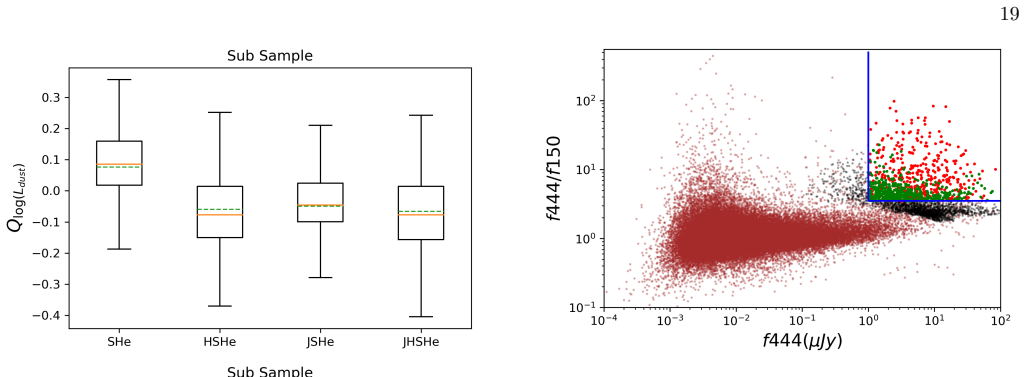
- A sharp, testable extension of the paper would be to apply the NIRCam colour selection $f_{444}/f_{150}>3.5$ to the full JADES footprint and compare EAZY outlier fractions against the growing spectroscopic sample; if the outlier fraction stays near 5 percent, the model-based forecast is confirmed.
- If real DSFGs at $10^{10}\,M_\odot$ are as numerous as simulated, the integrated star-formation-rate density at cosmic noon may be higher than currently inferred from submillimetre-selected samples that miss low-mass dusty galaxies.
Editorial analysis
A structured set of objections, weighed in public.
Referee Report
Summary. The paper uses the Cai et al. (2013) / Mitra et al. (2024) physical model of proto-spheroids to simulate JADES/GOODS-S observations, then applies EAZY and CIGALE to recover photometric redshifts, stellar masses, SFRs, dust luminosities, and dust masses. It reports photo-z outlier fractions of 0.05 with JWST alone and 0.019 with JWST+HST for the parent sample (0.042 and 0.008 for the DSFG sub-sample), stellar-mass dispersions of about 0.2 and 0.14 dex from JWST alone (down to 0.1 dex for the DSFG sample after adding HST and removing outliers), and demonstrates that far-IR photometry is needed to constrain SFRs. It also constructs a NIRCam-selected DSFG sample from the ASTRODEEP-JWST catalog and compares CIGALE-derived masses and SFRs with the simulations, finding broad consistency and claiming that JWST can detect DSFGs down to about 10^10 solar masses.
Significance. The forecasting question is timely, and the paper deserves credit for reporting honest scatter, outlier, and bias metrics, and for clearly separating what JWST can constrain (stellar masses, photo-z) from what it cannot (SFRs without FIR data). The central result, stellar masses recovered to 0.1-0.2 dex, is physically plausible if the generative model spans the real diversity of proto-spheroids. However, the study is a model-to-model recovery test: the simulated SEDs are generated with the same class of physical ingredients and templates that CIGALE fits. The external checks in Figures 1 and 2 and Section 4.3 are suggestive but do not independently validate absolute accuracy, and the paper's own SFH sensitivity test in Section 4.2.2 shows an order-of-magnitude variation in recovered SFRs. With additional robustness tests and an independent observed-sample validation, this would be a useful reference for JWST DSFG studies.
major comments (3)
- [Sec. 4.2.2] The paper reports that switching CIGALE's SFH module from sfhdelayed to sfhdelayedbq changes recovered SFRs by an order of magnitude. This is presented as a caveat for SFRs, but no analogous stress test is shown for stellar masses, which are the headline quantities of Section 4.2.1 and the conclusions. Because the generative model and the fitting model share the same delayed-SFH family, the quoted 0.1-0.2 dex mass dispersions likely understate sensitivity to template assumptions. Please add a robustness test in which the simulated SEDs are generated with a different SFH, dust attenuation law, or AGN prescription, or in which CIGALE is run with deliberately mismatched templates, and quote the resulting stellar-mass dispersions and biases.
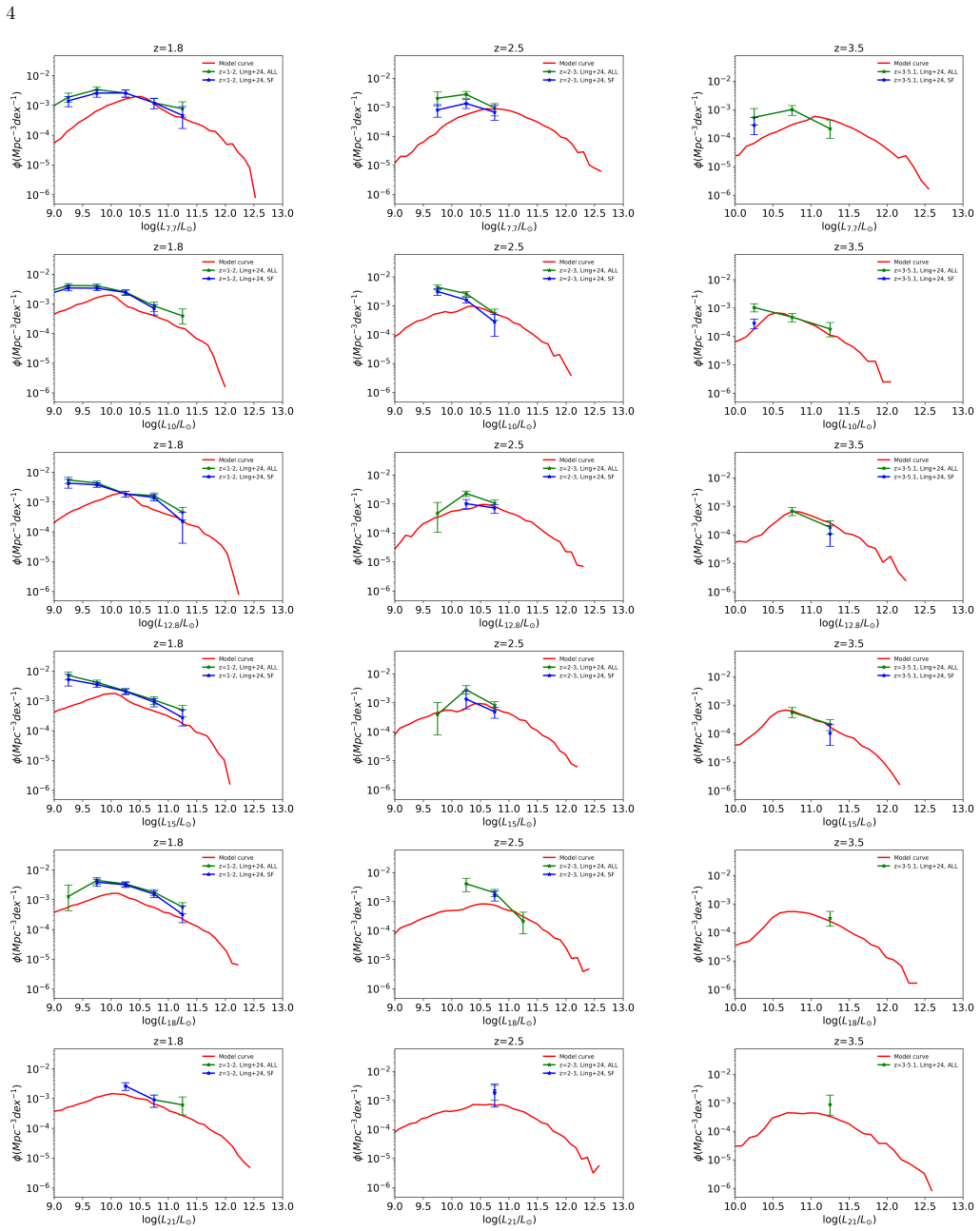
- [Secs. 2.1, 2.3, 4.2, 4.3] The recovery analysis is closed-loop: the simulated SEDs are built with the da Cunha et al. (2008) energy-balance formalism and Fritz et al. (2006) AGN templates, and CIGALE fits the same formalism. The external comparisons do not break the loop: Figure 1 shows the model under-predicts the low-luminosity end of the mid-IR luminosity functions, Figure 2 shows the simulated population occupies a narrower colour-colour region than the CEERS sources, and Section 4.3 applies the same EAZY/CIGALE pipeline to both observed and simulated samples, so systematic template biases cancel. To support the absolute accuracy claims, please validate against an independent benchmark, for example by fitting observed galaxies with spectroscopic redshifts and comparing CIGALE stellar masses with dynamical masses or with a second SED-fitting code, and state the implied systematic floor on stellar mass.
- [Sec. 4.2.1] The reduced dispersions of 0.15 and 0.1 dex are quoted after removing catastrophic photo-z outliers. In a real survey the true redshift is unknown, so an outlier-removal criterion based on |∆z|/(1+z) cannot be applied. Please specify a practical, observable outlier-rejection strategy, such as posterior-based quality cuts or agreement between multiple photo-z codes, and recompute the dispersions and mean offsets using only that strategy. Otherwise the post-outlier-removal numbers are not directly transferable to the JADES data.
minor comments (5)
- [Abstract / Sec. 5] The abstract states photo-z accuracy of at least 95%, while Section 5 says that for 90% of the sources EAZY gave an estimate accurate to better than 15% in (1+z); please reconcile these two numbers.
- [Fig. 3 caption] The caption describes the galaxies as also detected by HST, but the left-hand panels show JWST-only photometry and the right-hand panels show JWST+HST; please clarify which panels correspond to which data combination.
- [Sec. 4.2.3] There is a typo in the sentence preceding Equation (2): 'The the distribution' should read 'The distribution'.
- [References] The reference list contains Liao et al. (2024) twice with identical bibliographic data; please merge the duplicate entries.
- [Sec. 3.2] The text refers to the 'GOOD-S field'; the standard abbreviation used elsewhere is GOODS-S, and this should be made consistent.
Circularity Check
Stellar-mass recovery is an in-family test: the simulated SEDs use the same energy-balance BC03/Fritz-2006 template family CIGALE fits, so the quoted 0.1-0.2 dex dispersions certify internal consistency, not JWST's accuracy on real galaxies.
-
self definitional
[Sec 2.1 (generative SEDs) & Sec 3.3 (CIGALE setup); headline claims in Abstract and Sec 4.2.1]
"we used the SED fitting code CIGALE ... which uses the principle of 'energy balance' ... The G. Bruzual & S. Charlot (2003) SSP models along with a Chabrier initial mass function ... To incorporate the contribution from the AGN, templates from J. Fritz et al. (2006) are used."
The Sec 2.1 generative model builds simulated SEDs with the da Cunha et al. (2008) energy-balance formalism, BC03 stellar populations, and the Fritz et al. (2006) AGN torus — the same ingredients CIGALE is given (energy balance, BC03 SSPs, Fritz 2006 templates). The claimed 0.1-0.2 dex M* dispersions therefore measure in-family self-consistency, not absolute accuracy for real galaxies. External checks do not close the loop: the MIR LF comparison under-predicts the faint end; CEERS simulated colours occupy a narrower region than observed; and the ASTRODEEP comparison (Sec 4.3) fits observed and simulated samples with the same CIGALE configuration, so template bias cancels.
full rationale
The paper is an honest, clearly framed simulation forecast: it draws a proto-spheroid population from the Cai et al. (2013) model as upgraded in Mitra et al. (2024), simulates JADES photometry, and measures how well EAZY and CIGALE recover the input redshifts and physical parameters. Much of this is legitimate. The photometric-redshift claim (f_outlier = 0.05 with JWST alone, 0.019/0.008 with HST added) is a genuinely non-circular test: EAZY's templates (Grazian et al. 2006, Maraston 2005, Erb 2010) are not the generative model's template family, so the Lyman-alpha/4000-break degeneracy test has independent content. The model also faces external data — the Ling et al. (2024) mid-IR luminosity functions and the CEERS colour-colour plane — although both checks are only partially successful (the model under-predicts the faint LF end, and the simulated colours occupy a narrower locus). The central circular step concerns the stellar-mass and panchromatic recovery claims. The simulated SEDs are built from the da Cunha et al. (2008) energy-balance formalism with BC03 stellar populations and Fritz et al. (2006) AGN templates, and CIGALE is configured with energy balance, BC03 SSPs, Charlot and Fall attenuation, and the same Fritz et al. (2006) AGN templates. The quoted 1-sigma M* dispersions (0.2/0.14 dex with JWST alone; 0.1 dex with HST or after outlier rejection) therefore measure how well the fitter recovers galaxies drawn from its own template family — a self-consistency statistic, not a validated accuracy for real galaxies. The ASTRODEEP comparison cannot rescue this: fitting observed and simulated samples with the same CIGALE configuration cancels any shared template bias by construction. The paper's own Section 4.2.2 experiment — switching the CIGALE SFH prior from sfhdelayed to sfhdelayedbq changes recovered SFRs by an order of magnitude — demonstrates that the recovery statistics are controlled by fitting assumptions, yet no equivalent stress test is reported for the headline stellar masses. Because the photo-z claim and the external model checks carry real independent content, the circularity is partial (score 6) rather than total; conversely, it is not a 0-2 case because the abstract's headline mass-recovery claim reduces, by construction, to an in-family recovery within the shared template family.
Assumptions & free parameters
free parameters (5)
- Minimum virial halo mass (log M_vir/M_sun = 11.3) =
11.3
- Maximum virial halo mass (log M_vir/M_sun = 13.3) =
13.3
- Minimum virialization redshift (z_vir = 1.5) =
1.5
- CIGALE parameter grid choices (SFH e-folding times, ages, dust attenuation slopes, AGN fractions, etc.) =
see Table 2 grid
- Dust mass absorption coefficient kappa_0 =
not stated numerically
assumptions (6)
- domain assumption The Cai et al. (2013) model and its Mitra et al. (2024) upgrade correctly describe the co-evolution of proto-spheroids and their AGN, including the halo formation rate approximation.
- domain assumption The halo formation rate is well approximated by the positive term of the cosmic time derivative of the halo mass function.
- domain assumption The da Cunha et al. (2008) energy balance formalism and the Fritz et al. (2006) AGN torus model adequately represent the SEDs of real proto-spheroids.
- domain assumption A single PAH template adequately captures the mid-infrared emission of proto-spheroids.
- domain assumption The JADES survey depths and the 5 sigma detection criteria in Table 1 represent the actual survey
- standard math Photometric scatter and flux uncertainties are correctly propagated through EAZY and CIGALE as implemented
Cite this review
Pith. "Pith review of Investigating the physical properties of dusty star-forming galaxies at z>=1.5 in the GOODS-South field using JWST." pith.science (2026). https://pith.science/paper/6AXPRLLH
@misc{pith2026250608995,
  author       = {Pith},
  title        = {Pith review of: Investigating the physical properties of dusty star-forming galaxies at z>=1.5 in the GOODS-South field using JWST},
  year         = {2026},
  howpublished = {\url{https://pith.science/paper/6AXPRLLH}},
  note         = {Machine review of arXiv:2506.08995}
}
read the original abstract
We investigated how well the physical properties of progenitors of present-day massive spheroidal galaxies (proto-spheroids) can be constrained by the JWST Advanced Deep Extragalactic Survey (JADES) in the GOODS-South field, which benefits from extensive photometric and spectroscopic data, including those from the Hubble, Spitzer and Herschel. We adopted a physical model for the evolution of proto-spheroidal galaxies, which form the bulk of dusty star-forming galaxies (DSFGs) at z>=1.5 and confirmed its consistency with recent mid-infrared high-z galaxy luminosity functions. Using the model and the JADES survey strategy, we simulated a sample of proto-spheroids over 87.5 arcmin^2, matching the JADES/GOODS-S survey area. Photometric redshifts estimated from simulated JWST photometry showed >=95% accuracy and were used in SED fitting with CIGALE. We demonstrated that JWST will provide reliable stellar mass estimates up to 0.1 dex for the majority of proto-spheroids at z>=1.5 and can detect low-mass systems during cosmic noon that were inaccessible in the pre-JWST era. Focusing on the active star-forming phase of the proto-spheroid evolution, we defined a sub-sample flux limited at 250 micron (DSFG sample) and derived SFR, dust luminosity and dust mass complementing the JWST photometry with that from Spitzer/MIPS and Herschel. We also constructed a JWST-selected DSFG catalog from ASTRODEEP data using NIRCam colour criteria and demonstrated strong consistency between the observed and simulated DSFG populations.
Figures


Figures from the paper (11 more)




Reference graph
Works this paper leans on
-
[1]
, " * write output.state after.block = add.period write newline
ENTRY address archivePrefix author booktitle chapter doi edition editor eprint howpublished institution journal key month number organization pages publisher school series title misctitle type volume year version url label extra.label sort.label short.list INTEGERS output.state before.all mid.sentence after.sentence after.block FUNCTION init.state.consts ...
-
[2]
write newline
" write newline "" before.all 'output.state := FUNCTION format.url url empty "" new.block "" url * "" * if FUNCTION format.eprint eprint empty "" archivePrefix empty "" archivePrefix "arXiv" = new.block " " eprint * " " * new.block " " eprint * " " * if if if FUNCTION format.pid doi empty eprint empty url empty "" format.url if format.eprint if format.doi...
-
[3]
_ Tp 7 MVAe Ϲ I Kgϐ1 9d2 rB^ P C9D9 CC9D9 CC9D9 CC9D9 CC9D9 CC9D9 CC9D9 CC9D9 CC9D9 CC9D9 CC9D9 CC9D9 CC9D9 CC9D9 CC5襗^D
thebibliography [1] 20pt to REFERENCES 6pt =0pt \@twocolumntrue 12pt -12pt 10pt plus 3pt =0pt =0pt =1pt plus 1pt =0pt =0pt -12pt =13pt plus 1pt =20pt =13pt plus 1pt \@M =10000 =-1.0em =0pt =0pt 0pt =0pt =1.0em @enumiv\@empty 10000 10000 `\.\@m \@noitemerr \@latex@warning Empty `thebibliography' environment \@ifnextchar \@reference \@latexerr Missing key o...
2017
-
[4]
H., Jagannathan, P., & Nyland, K
Alberts, S., Rujopakarn, W., Rieke, G. H., Jagannathan, P., & Nyland, K. 2020, title Completing the Census of AGN in GOODS-S/HUDF: New Ultradeep Radio Imaging and Predictions for JWST, The Astrophysical Journal, 901, 168
2020
-
[5]
L., Birkin , J
Amvrosiadis , A., Wardlow , J. L., Birkin , J. E., et al. 2025, title The kinematics of massive high-redshift dusty star-forming galaxies , , 536, 3757
2025
-
[6]
2013, title Astropy: A community Python package for astronomy, Astronomy amp; Astrophysics, 558, A33
Astropy Collaboration . 2013, title Astropy: A community Python package for astronomy, Astronomy amp; Astrophysics, 558, A33
2013
-
[7]
2018, title The Astropy Project: Building an Open-science Project and Status of the v2.0 Core Package*, The Astronomical Journal, 156, 123
Astropy Collaboration . 2018, title The Astropy Project: Building an Open-science Project and Status of the v2.0 Core Package*, The Astronomical Journal, 156, 123
2018
-
[8]
Astropy Collaboration . 2022, title The Astropy Project: Sustaining and Growing a Community-oriented Open-source Project and the Latest Major Release (v5.0) of the Core Package*, The Astrophysical Journal, 935, 167
2022
Show all 110 references
-
[9]
J., & Cowie, L
Barger, A. J., & Cowie, L. L. 2023, title Mapping the Decline with Redshift of Dusty Star-forming Galaxies Using JWST and SCUBA-2, The Astrophysical Journal, 956, 95
2023
-
[10]
J., Cowie , L
Barger , A. J., Cowie , L. L., Sanders , D. B., et al. 1998, title Submillimetre-wavelength detection of dusty star-forming galaxies at high redshift , , 394, 248
1998
-
[11]
G., Cava, A., et al
Barro, G., Pérez-González, P. G., Cava, A., et al. 2019, title The CANDELS/SHARDS Multiwavelength Catalog in GOODS-N: Photometry, Photometric Redshifts, Stellar Masses, Emission-line Fluxes, and Star Formation Rates, The Astrophysical Journal Supplement Series, 243, 22
2019
-
[12]
Beckwith, S. V. W., Stiavelli, M., Koekemoer, A. M., et al. 2006, title The Hubble Ultra Deep Field, The Astronomical Journal, 132, 1729–1755
2006
-
[13]
B., et al
Bernardi , M., Shankar , F., Hyde , J. B., et al. 2010, title Galaxy luminosities, stellar masses, sizes, velocity dispersions as a function of morphological type , , 404, 2087
2010
-
[14]
2022, title Dust emissivity in resolved spiral galaxies, Astronomy amp; Astrophysics, 664, A187
Bianchi, S., Casasola, V., Corbelli, E., et al. 2022, title Dust emissivity in resolved spiral galaxies, Astronomy amp; Astrophysics, 664, A187
2022
-
[15]
E., Puglisi , A., Swinbank , A
Birkin , J. E., Puglisi , A., Swinbank , A. M., et al. 2024, title KAOSS: turbulent, but disc-like kinematics in dust-obscured star-forming galaxies at z 1.3-2.6 ,
2024
-
[16]
2024, title A High-resolution Far-infrared Survey to Probe Black Hole Galaxy Co-evolution , , 977, 208
Bonato , M., Leisawitz , D., De Zotti , G., et al. 2024, title A High-resolution Far-infrared Survey to Probe Black Hole Galaxy Co-evolution , , 977, 208
2024
-
[17]
2019, title CIGALE : a python Code Investigating GALaxy Emission , A&A, 622, A103
Boquien, M., Burgarella, D., Roehlly, Y., et al. 2019, title CIGALE : a python Code Investigating GALaxy Emission , A&A, 622, A103
2019
-
[18]
B., van Dokkum, P
Brammer, G. B., van Dokkum, P. G., & Coppi, P. 2008, title EAZY : A Fast , Public Photometric Redshift Code , The Astrophysical Journal, 686, 1503
2008
-
[19]
2003, title Stellar population synthesis at the resolution of 2003, Monthly Notices of the Royal Astronomical Society, 344, 1000
Bruzual, G., & Charlot, S. 2003, title Stellar population synthesis at the resolution of 2003, Monthly Notices of the Royal Astronomical Society, 344, 1000
2003
-
[20]
Burgarella, D., Buat, V., & Iglesias-Páramo, J. 2005, title Star formation and dust attenuation properties in galaxies from a statistical ultraviolet-to-far-infrared analysis, Monthly Notices of the Royal Astronomical Society, 360, 1413
2005
-
[21]
2013, title A HYBRID MODEL FOR THE EVOLUTION OF GALAXIES AND ACTIVE GALACTIC NUCLEI IN THE INFRARED , ApJ, 768, 21
Cai, Z.-Y., Lapi, A., Xia, J.-Q., et al. 2013, title A HYBRID MODEL FOR THE EVOLUTION OF GALAXIES AND ACTIVE GALACTIC NUCLEI IN THE INFRARED , ApJ, 768, 21
2013
-
[22]
2003, title Galactic Stellar and Substellar Initial Mass Function , Publications of the Astronomical Society of the Pacific, 115, 763
Chabrier, G. 2003, title Galactic Stellar and Substellar Initial Mass Function , Publications of the Astronomical Society of the Pacific, 115, 763
2003
-
[23]
Charlot, S., & Fall, S. M. 2000, title A Simple Model for the Absorption of Starlight by Dust in Galaxies , The Astrophysical Journal, 539, 718
2000
-
[24]
2008, title A simple model to interpret the ultraviolet, optical and infrared emission from galaxies, Monthly Notices of the Royal Astronomical Society, 388, 1595
da Cunha, E., Charlot, S., & Elbaz, D. 2008, title A simple model to interpret the ultraviolet, optical and infrared emission from galaxies, Monthly Notices of the Royal Astronomical Society, 388, 1595
2008
-
[25]
R., et al
da Cunha, E., Walter, F., Smail, I. R., et al. 2015, title An ALMA Survey of Sub -millimeter Galaxies in the Extended Chandra Deep Field South : Physical Properties Derived from Ultraviolet -to-radio Modeling , The Astrophysical Journal, 806, 110
2015
-
[26]
P., et al
Davis, M., Guhathakurta, P., Konidaris, N. P., et al. 2007, title The All-Wavelength Extended Groth Strip International Survey (AEGIS) Data Sets, The Astrophysical Journal, 660, L1–L6
2007
-
[27]
2018, title COLOSSUS : A Python Toolkit for Cosmology , Large -scale Structure , and Dark Matter Halos , ApJS, 239, 35
Diemer, B. 2018, title COLOSSUS : A Python Toolkit for Cosmology , Large -scale Structure , and Dark Matter Halos , ApJS, 239, 35
2018
-
[28]
T., Aniano, G., Krause, O., et al
Draine, B. T., Aniano, G., Krause, O., et al. 2014, title Andromeda's Dust , The Astrophysical Journal, 780, 172
2014
-
[29]
2010, title The Herschel ATLAS , PASP, 122, 499
Eales, S., Dunne, L., Clements, D., et al. 2010, title The Herschel ATLAS , PASP, 122, 499
2010
-
[30]
J., Willott, C., Alberts, S., et al
Eisenstein, D. J., Willott, C., Alberts, S., et al. 2023, title Overview of the JWST Advanced Deep Extragalactic Survey ( JADES ), arXiv
2023
-
[31]
K., Pettini, M., Shapley, A
Erb, D. K., Pettini, M., Shapley, A. E., et al. 2010, title PHYSICAL CONDITIONS IN A YOUNG , UNREDDENED , LOW - METALLICITY GALAXY AT HIGH REDSHIFT *, ApJ, 719, 1168
2010
-
[32]
2023, title Euclid preparation: XXIII
Euclid Collaboration . 2023, title Euclid preparation: XXIII . Derivation of galaxy physical properties with deep machine learning using mock fluxes and H -band images, arXiv. http://arxiv.org/abs/2206.14944
2023 arXiv
-
[33]
L., Dickinson , M., Ferguson , H
Finkelstein , S. L., Dickinson , M., Ferguson , H. C., et al. 2017, title The Cosmic Evolution Early Release Science (CEERS) Survey , , JWST Proposal ID 1345. Cycle 0 Early Release Science
2017
-
[34]
2000, title Photometric Redshifts and Selection of High-Redshift Galaxies in the NTT and Hubble Deep Fields*, The Astronomical Journal, 120, 2206
Fontana, A., D’Odorico, S., Poli, F., et al. 2000, title Photometric Redshifts and Selection of High-Redshift Galaxies in the NTT and Hubble Deep Fields*, The Astronomical Journal, 120, 2206
2000
-
[35]
M., & Wuyts , S
F \"o rster Schreiber , N. M., & Wuyts , S. 2020, title Star-Forming Galaxies at Cosmic Noon , , 58, 661
2020
-
[36]
2018, title GOODS - ALMA : 1.1 mm galaxy survey - I
Franco, M., Elbaz, D., Béthermin, M., et al. 2018, title GOODS - ALMA : 1.1 mm galaxy survey - I . Source catalogue and optically dark galaxies, A&A, 620, A152
2018
-
[37]
2020, title GOODS-ALMA: The slow downfall of star formation in z = 2–3 massive galaxies, A&A, 643, A30
Franco, M., Elbaz, D., Zhou, L., et al. 2020, title GOODS-ALMA: The slow downfall of star formation in z = 2–3 massive galaxies, A&A, 643, A30
2020
-
[38]
2006, title Revisiting the infrared spectra of active galactic nuclei with a new torus emission model, Monthly Notices of the Royal Astronomical Society, 366, 767
Fritz, J., Franceschini, A., & Hatziminaoglou, E. 2006, title Revisiting the infrared spectra of active galactic nuclei with a new torus emission model, Monthly Notices of the Royal Astronomical Society, 366, 767
2006
-
[39]
P., Mather, J
Gardner, J. P., Mather, J. C., Clampin, M., et al. 2006, title The James Webb Space Telescope, Space Science Reviews, 123, 485–606
2006
-
[40]
2002, title Chandra Deep Field South: The 1 Ms Catalog, The Astrophysical Journal Supplement Series, 139, 369
Giacconi, R., Zirm, A., Wang, J., et al. 2002, title Chandra Deep Field South: The 1 Ms Catalog, The Astrophysical Journal Supplement Series, 139, 369
2002
-
[41]
C., Koekemoer, A
Giavalisco, M., Ferguson, H. C., Koekemoer, A. M., et al. 2004, title The Great Observatories Origins Deep Survey: Initial Results from Optical and Near-Infrared Imaging*, The Astrophysical Journal, 600, L93
2004
-
[42]
2023, title Sub-millimetre galaxies with Webb
Gillman , S., Gullberg , B., Brammer , G., et al. 2023, title Sub-millimetre galaxies with Webb. Near-infrared counterparts and multi-wavelength morphology , , 676, A26
2023
-
[43]
L., Zotti, G
Granato, G. L., Zotti, G. D., Silva, L., Bressan, A., & Danese, L. 2004, title A Physical Model for the Coevolution of QSOs and Their Spheroidal Hosts , ApJ, 600, 580
2004
-
[44]
D., et al
Grazian, A., Fontana, A., Santis, C. D., et al. 2006, title The GOODS - MUSIC sample: a multicolour catalog of near- IR selected galaxies in the GOODS - South field, A&A, 449, 951
2006
-
[45]
A., Kocevski, D
Grogin, N. A., Kocevski, D. D., Faber, S. M., et al. 2011, title CANDELS: THE COSMIC ASSEMBLY NEAR-INFRARED DEEP EXTRAGALACTIC LEGACY SURVEY, The Astrophysical Journal Supplement Series, 197, 35
2011
-
[46]
M., et al
Gullberg , B., Smail , I., Swinbank , A. M., et al. 2019, title An ALMA survey of the SCUBA-2 Cosmology Legacy Survey UKIDSS/UDS field: high-resolution dust continuum morphologies and the link between sub-millimetre galaxies and spheroid formation , , 490, 4956
2019
-
[47]
C., Giavalisco, M., et al
Guo, Y., Ferguson, H. C., Giavalisco, M., et al. 2013, title CANDELS MULTI-WAVELENGTH CATALOGS: SOURCE DETECTION AND PHOTOMETRY IN THE GOODS-SOUTH FIELD, The Astrophysical Journal Supplement Series, 207, 24
2013
-
[48]
J., Blain , A
Hainline , L. J., Blain , A. W., Smail , I., et al. 2011, title The Stellar Mass Content of Submillimeter-selected Galaxies , , 740, 96
2011
-
[49]
R., Millman, K
Harris, C. R., Millman, K. J., van der Walt, S. J., et al. 2020, title Array programming with NumPy, Nature, 585, 357–362
2020
-
[50]
2018, title ALMA twenty-six arcmin2 survey of GOODS - S at one millimeter ( ASAGAO ): Source catalog and number counts, Publications of the Astronomical Society of Japan, 70, 105
Hatsukade, B., Kohno, K., Yamaguchi, Y., et al. 2018, title ALMA twenty-six arcmin2 survey of GOODS - S at one millimeter ( ASAGAO ): Source catalog and number counts, Publications of the Astronomical Society of Japan, 70, 105
2018
-
[51]
Hatton, S., Devriendt, J. E. G., Ninin, S., et al. 2003, title GALICS- I. A hybrid N-body/semi-analytic model of hierarchical galaxy formation, Monthly Notices of the Royal Astronomical Society, 343, 75–106
2003
-
[52]
H., Serjeant , S., Dunlop , J., et al
Hughes , D. H., Serjeant , S., Dunlop , J., et al. 1998, title High-redshift star formation in the Hubble Deep Field revealed by a submillimetre-wavelength survey , , 394, 241
1998
-
[53]
K., De Looze, I., Boquien, M., et al
Hunt, L. K., De Looze, I., Boquien, M., et al. 2019, title Comprehensive comparison of models for spectral energy distributions from 0.1μm to 1 mm of nearby star-forming galaxies, Astronomy amp; Astrophysics, 621, A51
2019
-
[54]
Hunter , J. D. 2007, title Matplotlib: A 2D Graphics Environment , Computing in Science and Engineering, 9, 90
2007
-
[55]
F., Kishimoto, M., Tristram, K
Hönig, S. F., Kishimoto, M., Tristram, K. R. W., et al. 2013, title DUST IN THE POLAR REGION AS A MAJOR CONTRIBUTOR TO THE INFRARED EMISSION OF ACTIVE GALACTIC NUCLEI , ApJ, 771, 87
2013
-
[56]
M., Tyson, J
Ivezić, ., Kahn, S. M., Tyson, J. A., et al. 2019, title LSST : From Science Drivers to Reference Design and Anticipated Data Products , The Astrophysical Journal, 873, 111
2019
-
[57]
2022, title The Near-Infrared Spectrograph (NIRSpec) on theJames WebbSpace Telescope: I
Jakobsen, P., Ferruit, P., Alves de Oliveira, C., et al. 2022, title The Near-Infrared Spectrograph (NIRSpec) on theJames WebbSpace Telescope: I. Overview of the instrument and its capabilities, Astronomy amp; Astrophysics, 661, A80
2022
-
[58]
2001, title SciPy: Open source scientific tools for Python,
Jones, E., Oliphant, T., Peterson, P., et al. 2001, title SciPy: Open source scientific tools for Python,
2001
-
[59]
S., Rose , C., Vanderhoof , B
Kartaltepe , J. S., Rose , C., Vanderhoof , B. N., et al. 2023, title CEERS Key Paper. III. The Diversity of Galaxy Structure and Morphology at z = 3-9 with JWST , , 946, L15
2023
-
[60]
M., Faber, S
Koekemoer, A. M., Faber, S. M., Ferguson, H. C., et al. 2011, title CANDELS: THE COSMIC ASSEMBLY NEAR-INFRARED DEEP EXTRAGALACTIC LEGACY SURVEY—THE HUBBLE SPACE TELESCOPE OBSERVATIONS, IMAGING DATA PRODUCTS, AND MOSAICS, The Astrophysical Journal Supplement Series, 197, 36
2011
-
[61]
J., Ilbert, O., et al
Laigle, C., McCracken, H. J., Ilbert, O., et al. 2016, title THE COSMOS2015 CATALOG : EXPLORING THE 1 z 6 UNIVERSE WITH HALF A MILLION GALAXIES , ApJS, 224, 24
2016
-
[62]
2014, title The Coevolution of Supermassive Black Holes and Massive Galaxies at High Redshift , , 782, 69
Lapi , A., Raimundo , S., Aversa , R., et al. 2014, title The Coevolution of Supermassive Black Holes and Massive Galaxies at High Redshift , , 782, 69
2014
-
[63]
2011, title Euclid Definition Study Report , arXiv
Laureijs, R., Amiaux, J., Arduini, S., et al. 2011, title Euclid Definition Study Report , arXiv
2011
-
[64]
J., Almaini, O., et al
Lawrence, A., Warren, S. J., Almaini, O., et al. 2007, title The UKIRT Infrared Deep Sky Survey (UKIDSS), Monthly Notices of the Royal Astronomical Society, 379, 1599
2007
-
[65]
T., Rinehart , S
Leisawitz , D., Hyde , T. T., Rinehart , S. A., & Weiss , M. 2008, in Society of Photo-Optical Instrumentation Engineers (SPIE) Conference Series, Vol. 7010, Space Telescopes and Instrumentation 2008: Optical, Infrared, and Millimeter, ed. J. M. Oschmann , Jr., M. W. M. de Gra...
2008
-
[66]
S., & Schombert , J
Lelli , F., McGaugh , S. S., & Schombert , J. M. 2016, title SPARC: Mass Models for 175 Disk Galaxies with Spitzer Photometry and Accurate Rotation Curves , , 152, 157
2016
-
[67]
Liao , C.-L., Chen , C.-C., Wang , W.-H., et al. 2024, title An ALMA Spectroscopic Survey of the Brightest Submillimeter Galaxies in the SCUBA-2-COSMOS Field (AS2COSPEC): Physical Properties of z = 2 5 Ultra- and Hyperluminous Infrared Galaxies , , 961, 226
2024
-
[68]
Liao, C.-L., Chen, C.-C., Wang, W.-H., et al. 2024, title An ALMA Spectroscopic Survey of the Brightest Submillimeter Galaxies in the SCUBA -2- COSMOS Field ( AS2COSPEC ): Physical Properties of z = 2–5 Ultra - and Hyperluminous Infrared Galaxies , ApJ, 961, 226
2024
-
[69]
J., Eales , S
Lilly , S. J., Eales , S. A., Gear , W. K. P., et al. 1999, title The Canada-United Kingdom Deep Submillimeter Survey. II. First Identifications, Redshifts, and Implications for Galaxy Evolution , , 518, 641
1999
-
[70]
J., et al
Ling, C.-T., Goto, T., Kim, S. J., et al. 2024, title Exploring the faintest end of mid-infrared luminosity functions up to z 5 with the JWST CEERS survey, 2402.05386
2024 arXiv
-
[71]
Super-deblended
Liu, D., Daddi, E., Dickinson, M., et al. 2018, title “Super-deblended” Dust Emission in Galaxies. I. The GOODS-North Catalog and the Cosmic Star Formation Rate Density out to Redshift 6, The Astrophysical Journal, 853, 172
2018
-
[72]
S., Antwi-Danso, J., Lambrides, E
Long, A. S., Antwi-Danso, J., Lambrides, E. L., et al. 2024, title Efficient NIRCam Selection of Quiescent Galaxies at 3 lt; z lt; 6 in CEERS, The Astrophysical Journal, 970, 68
2024
-
[73]
2020, title How Well Can We Measure the Stellar Mass of a Galaxy: The Impact of the Assumed Star Formation History Model in SED Fitting, The Astrophysical Journal, 904, 33
Lower, S., Narayanan, D., Leja, J., et al. 2020, title How Well Can We Measure the Stellar Mass of a Galaxy: The Impact of the Assumed Star Formation History Model in SED Fitting, The Astrophysical Journal, 904, 33
2020
-
[74]
2023, title MaNGA DynPop -- II
Lu , S., Zhu , K., Cappellari , M., et al. 2023, title MaNGA DynPop -- II. Global stellar population, gradients, and star-formation histories from integral-field spectroscopy of 10K galaxies: link with galaxy rotation, shape, and total-density gradients , arXiv e-prints, arXiv...
2023 arXiv
-
[75]
1995, title Radiative Transfer in a Clumpy Universe : The Colors of High - Redshift Galaxies , The Astrophysical Journal, 441, 18
Madau, P. 1995, title Radiative Transfer in a Clumpy Universe : The Colors of High - Redshift Galaxies , The Astrophysical Journal, 441, 18
1995
-
[76]
2016, title The Main Sequences of Star-forming Galaxies and Active Galactic Nuclei at High Redshift , , 833, 152
Mancuso , C., Lapi , A., Shi , J., et al. 2016, title The Main Sequences of Star-forming Galaxies and Active Galactic Nuclei at High Redshift , , 833, 152
2016
-
[77]
2005, title Evolutionary population synthesis: models, analysis of the ingredients and application to high-z galaxies, Monthly Notices of the Royal Astronomical Society, 362, 799
Maraston, C. 2005, title Evolutionary population synthesis: models, analysis of the ingredients and application to high-z galaxies, Monthly Notices of the Royal Astronomical Society, 362, 799
2005
-
[78]
W., Feinberg, L
McElwain, M. W., Feinberg, L. D., Perrin, M. D., et al. 2023, title The James Webb Space Telescope Mission: Optical Telescope Element Design, Development, and Performance, Publications of the Astronomical Society of the Pacific, 135, 058001
2023
-
[79]
2024, title ASTRODEEP-JWST: NIRCam-HST multi-band photometry and redshifts for half a million sources in six extragalactic deep fields , , 691, A240
Merlin , E., Santini , P., Paris , D., et al. 2024, title ASTRODEEP-JWST: NIRCam-HST multi-band photometry and redshifts for half a million sources in six extragalactic deep fields , , 691, A240
2024
-
[80]
J., Dunlop, J
Micha owski, M. J., Dunlop, J. S., Cirasuolo, M., et al. 2012, title The stellar masses and specific star-formation rates of submillimetre galaxies, A&A, 541, A85
2012
-
[81]
2024, title Euclid view of the dusty star-forming galaxies at ≳ detected in wide area submillimetre surveys , Monthly Notices of the Royal Astronomical Society, 530, 2292
Mitra, D., Negrello, M., De Zotti, G., & Cai, Z.-Y. 2024, title Euclid view of the dusty star-forming galaxies at ≳ detected in wide area submillimetre surveys , Monthly Notices of the Royal Astronomical Society, 530, 2292
2024
-
[82]
2009, title Analysis of galaxy spectral energy distributions from far- UV to far- IR with CIGALE : studying a SINGS test sample, Astronomy and Astrophysics, 507, 1793
Noll, S., Burgarella, D., Giovannoli, E., et al. 2009, title Analysis of galaxy spectral energy distributions from far- UV to far- IR with CIGALE : studying a SINGS test sample, Astronomy and Astrophysics, 507, 1793
2009
-
[83]
2021, title Unveiling the nature of 11 dusty star-forming galaxies at the peak of cosmic star formation history, Monthly Notices of the Royal Astronomical Society, 504, 928
Pantoni, L., Lapi, A., Massardi, M., et al. 2021, title Unveiling the nature of 11 dusty star-forming galaxies at the peak of cosmic star formation history, Monthly Notices of the Royal Astronomical Society, 504, 928
2021
-
[84]
A., Eales, S., Dunne, L., et al
Pearson, E. A., Eales, S., Dunne, L., et al. 2013, title H- ATLAS : estimating redshifts of Herschel sources from sub-mm fluxes, Monthly Notices of the Royal Astronomical Society, 435, 2753
2013
-
[85]
2012, title Recovering galaxy stellar population properties from broad-band spectral energy distribution fitting, Monthly Notices of the Royal Astronomical Society, 422, 3285
Pforr, J., Maraston, C., & Tonini, C. 2012, title Recovering galaxy stellar population properties from broad-band spectral energy distribution fitting, Monthly Notices of the Royal Astronomical Society, 422, 3285
2012
-
[86]
2013, title Recovering galaxy stellar population properties from broad-band spectral energy distribution fitting – II
Pforr, J., Maraston, C., & Tonini, C. 2013, title Recovering galaxy stellar population properties from broad-band spectral energy distribution fitting – II . The case with unknown redshift, Monthly Notices of the Royal Astronomical Society, 435, 1389
2013
-
[87]
2020, title Planck 2018 results
Planck Collaboration VI, . 2020, title Planck 2018 results. VI . Cosmological parameters, A&A, 641, A6
2020
-
[88]
J., Kelly, D
Rieke, M. J., Kelly, D. M., Misselt, K., et al. 2023, title Performance of NIRCam on JWST in Flight, Publications of the Astronomical Society of the Pacific, 135, 028001
2023
-
[89]
2023, title The Science Performance of JWST as Characterized in Commissioning, Publications of the Astronomical Society of the Pacific, 135, 048001
Rigby, J., Perrin, M., McElwain, M., et al. 2023, title The Science Performance of JWST as Characterized in Commissioning, Publications of the Astronomical Society of the Pacific, 135, 048001
2023
-
[90]
2014, title Herschel- ATLAS : Properties of dusty massive galaxies at low and high redshifts, Monthly Notices of the Royal Astronomical Society, 441, 1017
Rowlands, K., Dunne, L., Dye, S., et al. 2014, title Herschel- ATLAS : Properties of dusty massive galaxies at low and high redshifts, Monthly Notices of the Royal Astronomical Society, 441, 1017
2014
-
[91]
2007, title The Cosmic Evolution Survey (COSMOS): Overview, The Astrophysical Journal Supplement Series, 172, 1–8
Scoville, N., Aussel, H., Brusa, M., et al. 2007, title The Cosmic Evolution Survey (COSMOS): Overview, The Astrophysical Journal Supplement Series, 172, 1–8
2007
-
[92]
M., Swinbank , A
Simpson , J. M., Swinbank , A. M., Smail , I., et al. 2014, title An ALMA Survey of Submillimeter Galaxies in the Extended Chandra Deep Field South: The Redshift Distribution and Evolution of Submillimeter Galaxies , , 788, 125
2014
-
[93]
M., Smail , I., Swinbank , A
Simpson , J. M., Smail , I., Swinbank , A. M., et al. 2017, title The SCUBA-2 Cosmology Legacy Survey: Multi-wavelength Properties of ALMA-identified Submillimeter Galaxies in UKIDSS UDS , , 839, 58
2017
-
[94]
2009, title The Large APEX BOlometer CAmera LABOCA , A&A, 497, 945
Siringo, G., Kreysa, E., Kovács, A., et al. 2009, title The Large APEX BOlometer CAmera LABOCA , A&A, 497, 945
2009
-
[95]
J., & Blain, A
Smail, I., Ivison, R. J., & Blain, A. W. 1997, title A Deep Sub -millimeter Survey of Lensing Clusters : A New Window on Galaxy Formation and Evolution , The Astrophysical Journal, 490, L5
1997
-
[96]
Straatman, C. M. S., Spitler, L. R., Quadri, R. F., et al. 2016, title THE FOURSTAR GALAXY EVOLUTION SURVEY (ZFOURGE): ULTRAVIOLET TO FAR-INFRARED CATALOGS, MEDIUM-BANDWIDTH PHOTOMETRIC REDSHIFTS WITH IMPROVED ACCURACY, STELLAR MASSES, AND CONFIRMATION OF QUIESCENT GALAXIES TO...
2016
-
[97]
M., Chapman , S
Swinbank , A. M., Chapman , S. C., Smail , I., et al. 2006, title The link between submillimetre galaxies and luminous ellipticals: near-infrared IFU spectroscopy of submillimetre galaxies , , 371, 465
2006
-
[98]
M., Simpson, J
Swinbank, A. M., Simpson, J. M., Smail, I., et al. 2014, title An ALMA survey of sub-millimetre Galaxies in the Extended Chandra Deep Field South : the far-infrared properties of SMGs , Monthly Notices of the Royal Astronomical Society, 438, 1267
2014
-
[99]
M., Harrison , C
Swinbank , A. M., Harrison , C. M., Trayford , J., et al. 2017, title Angular momentum evolution of galaxies over the past 10 Gyr: a MUSE and KMOS dynamical survey of 400 star-forming galaxies from z = 0.3 to 1.7 , , 467, 3140
2017
-
[100]
2024, title In situ spheroid formation in distant submillimetre-bright galaxies , , 636, 69
Tan , Q.-H., Daddi , E., Magnelli , B., et al. 2024, title In situ spheroid formation in distant submillimetre-bright galaxies , , 636, 69
2024
-
[101]
2010, title Environment and self-regulation in galaxy formation , , 404, 1775
Thomas , D., Maraston , C., Schawinski , K., Sarzi , M., & Silk , J. 2010, title Environment and self-regulation in galaxy formation , , 404, 1775
2010
-
[102]
2014, title Submillimeter Galaxies as Progenitors of Compact Quiescent Galaxies , , 782, 68
Toft , S., Smol c i \'c , V., Magnelli , B., et al. 2014, title Submillimeter Galaxies as Progenitors of Compact Quiescent Galaxies , , 782, 68
2014
-
[103]
J., Cirasuolo , M., Harrison , C
Turner , O. J., Cirasuolo , M., Harrison , C. M., et al. 2017, title The KMOS Deep Survey (KDS) - I. Dynamical measurements of typical star-forming galaxies at z ≃ 3.5 , , 471, 1280
2017
-
[104]
C., & Varoquaux, G
van der Walt, S., Colbert, S. C., & Varoquaux, G. 2011, title The NumPy Array: A Structure for Efficient Numerical Computation, Computing in Science amp; Engineering, 13, 22–30
2011
-
[105]
2021, title seaborn: statistical data visualization , The Journal of Open Source Software, 6, 3021
Waskom , M. 2021, title seaborn: statistical data visualization , The Journal of Open Source Software, 6, 3021
2021
-
[106]
J., Dahlen, T., et al
Wiklind, T., Conselice, C. J., Dahlen, T., et al. 2014, title PROPERTIES OF SUBMILLIMETER GALAXIES IN THE CANDELS GOODS-SOUTH FIELD, The Astrophysical Journal, 785, 111
2014
-
[107]
C., Curtis-Lake , E., Hainline , K
Williams , C. C., Curtis-Lake , E., Hainline , K. N., et al. 2018, title The JWST Extragalactic Mock Catalog: Modeling Galaxy Populations from the UV through the Near-IR over 13 Billion Years of Cosmic History , , 236
2018
-
[108]
M., Fossati , M., et al
Wisnioski , E., F \"o rster Schreiber , N. M., Fossati , M., et al. 2019, title The KMOS ^ 3D Survey: Data Release and Final Survey Paper , , 886, 124
2019
-
[109]
Yamaguchi, Y., Kohno, K., Hatsukade, B., et al. 2020, title ALMA twenty-six arcmin2 survey of GOODS-S at one millimeter (ASAGAO): Millimeter properties of stellar mass selected galaxies, Publications of the Astronomical Society of Japan, 72
2020
-
[110]
2020, title Dust Reverberation Mapping in Distant Quasars from Optical and Mid -infrared Imaging Surveys , ApJ, 900, 58
Yang, Q., Shen, Y., Liu, X., et al. 2020, title Dust Reverberation Mapping in Distant Quasars from Optical and Mid -infrared Imaging Surveys , ApJ, 900, 58
2020
Reviewed August 7, 2026 · model on record in the stance chip above.
Discussion (0). Sign in to comment.