REVIEW 3 major objections 5 minor 38 references
Deep Reinforcement Learning-Based RAN Slicing with Efficient Inter-Slice Isolation in Tactical Wireless Networks
T0 review · 3 major / 5 minor · reviewed 2026-08-07 · deepseek-v4-flash
Pith's one-line read The paper claims that a two-stage, DRL-based slicing mechanism can keep tactical RAN slices isolated without wasting scarce bandwidth, with the TD3 implementation outperforming all baselines.
desk verdict A plausible two-stage DRL RAN slicing mechanism with a clear problem formulation, but the evaluation's variable user counts are incompatible with the fixed-dimensional DRL models, undermining the stated robustness results. read the letter →
The pith
A machine-rendered reading of the paper's core claim, the machinery that carries it, and where it could break.
The reading
What carries the argument
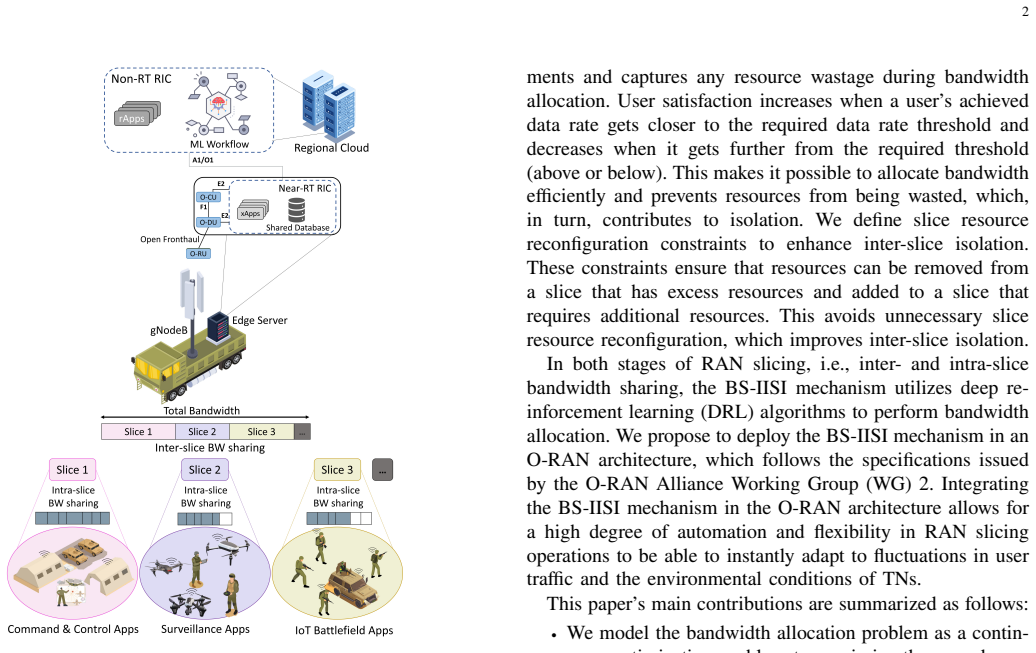
The mechanism that carries the argument is the two-stage hierarchical allocation with gated reconfiguration. In the inter-slice stage, a global agent chooses the fraction $f_s^t$ of the total bandwidth $W$ for each slice, subject to a minimum-per-slice floor and to logical implication constraints: a slice flagged as needing resources must receive at least as much as before, and a slice flagged as having excess must not receive more. In the intra-slice stage, each slice's agent chooses user-level fractions $f_{u,s}^t$ of the slice bandwidth, subject to a sum constraint and per-user floors, which together enforce intra-slice isolation. The satisfaction utility $\Gamma^t_{u,s}$, a normalised function of the ratio of achieved rate to required rate $R_s^{\mathrm{req}}$, provides the reward signal for both agents and penalizes both under-provisioning and over-provisioning, so the same signal drives efficiency and isolation. The reconfiguration cost $\mathcal{C}^t_s$ records any drop in slice satisfaction after a bandwidth change, and the objective $\alpha\Gamma^t-(1-\alpha)\mathcal{C}^t$ is what the DRL agents maximize.
What would settle it
Run the trained TD3 intra-slice agents on a configuration where one slice's user count differs from its training value (for example, 19 eMBB users instead of 20) and observe whether the agent produces a valid allocation vector. If the fixed-size input layer rejects or misinterprets the different-sized observation, the claimed stability across total user counts from 108 to 300 cannot be reproduced, and the mechanism would need a variable-size input architecture to support the claim.
Extended reading notes
Core claim
The central discovery claimed is that a RAN slicing mechanism can serve both goals at once: efficient use of scarce tactical bandwidth and inter- and intra-slice isolation defined through quality of service. The paper models user satisfaction with a utility function that peaks when the achieved data rate equals the required rate and decreases when the rate is either too low or too high, so giving a user more bandwidth than needed is penalized as waste. Slice-level reconfiguration constraints determine when a slice truly requires additional resources or has resources it can give up, and the global objective combines average slice satisfaction with average reconfiguration cost through a weight $\alpha$. Decomposing the problem into inter-slice and intra-slice DRL agents and training them with TD3, DDPG, or PPO yields, according to the paper, the best behavior with TD3: the TD3 implementation is claimed to achieve the highest objective function values in all tested configurations while maintaining stable reconfiguration cost and low resource wastage.
Load-bearing premise
The evaluation assumes that DRL models trained with fixed per-slice user counts (20 eMBB, 70 URLLC, 210 mMTC) can still produce valid bandwidth allocations when slices contain different numbers of users, even though the state and action vectors of the intra-slice agents have lengths equal to the number of users and the paper describes no padding or retraining to handle that change.
Editorial extensions
If this is right
- A tactical RAN could run dynamic bandwidth sharing without sacrificing isolation: slices that need more resources get them only when demand genuinely requires it, and slices with excess give them up without being starved.
- The TD3-based implementation, if correct, gives network operators a concrete algorithm choice: off-policy deterministic actor-critic with double critics outperforms DDPG, PPO, and the RSSI-IP baseline in this setting.
- Deploying training in the non-real-time RIC and inference in the near-real-time RIC keeps DRL model updates off the field infrastructure, which matters for low-latency tactical operations.
- Because over-allocation is penalized by the utility function, the mechanism is designed to avoid the resource wastage that the paper argues leads to frequent reconfiguration and weakened isolation.
- The two-stage structure separates concerns: the global agent manages inter-slice isolation, and each slice's agent manages intra-slice isolation, so the two goals can be tuned independently through constraints and rewards.
Reading between the lines
- Beyond the paper: the reported stability across total user counts from 108 to 300 depends on inference models trained on fixed per-slice counts (20 eMBB, 70 URLLC, 210 mMTC); a feedforward network has fixed input and output sizes, so a direct test would be to check whether the same trained agents can actually accept states with different numbers of users, or whether padding or retraining is silent
- Beyond the paper: because the utility function already penalizes over-allocation, the isolation constraints mainly serve to stabilize reconfiguration; one could test whether a smaller reconfiguration penalty alone, without the logical implication constraints, reproduces the reported isolation.
- Beyond the paper: the same two-stage hierarchical design could be lifted to multi-cell tactical deployments, with one global agent per cell and a higher-level agent arbitrating inter-cell bandwidth, if coordination overhead stays within tactical latency budgets.
Editorial analysis
A structured set of objections, weighed in public.
Referee Report
Summary. The paper proposes BS-IISI, a two-stage deep reinforcement learning (DRL) mechanism for RAN slicing in tactical wireless networks. In the first stage, a global agent allocates fractions of the total bandwidth to RAN slices subject to resource reconfiguration constraints aimed at inter-slice isolation; in the second stage, per-slice agents allocate the slice bandwidth among users subject to intra-slice isolation constraints. The objective combines a user satisfaction utility with a reconfiguration cost, and the paper describes deployment in an O-RAN architecture. Three DRL implementations (TD3, DDPG, PPO) are compared with unconstrained DRL variants and the RSSI-IP baseline, and the paper claims that TD3 consistently achieves the highest objective function values and robust performance as the number of users varies from 108 to 300.
Significance. If the empirical claims were valid, the mechanism would be a useful contribution to RAN slicing for tactical networks, particularly in formulating dynamic bandwidth sharing with isolation constraints and in detailing O-RAN integration and DRL lifecycle management. The problem formulation and the two-stage architecture are clearly presented. However, the evaluation contains a load-bearing flaw: the DRL policies are trained on fixed per-slice user counts and are then evaluated on configurations with different total user counts, although the state and action spaces of the intra-slice agents are defined as vectors of length equal to the number of users in the slice. The paper also evaluates algorithms on the same objective function that serves as their training reward, which weakens the comparative claims. As written, the central conclusion that TD3 outperforms all baselines across varying user counts is not supported.
major comments (3)
- [Section VI-C with Section V-B (Eqs. (24)-(25)) and Table II] The claimed robustness across 108 to 300 users is not reproducible from the described method. The intra-slice state space in Eq. (24) is a vector of channel gains of length |U_s|, and the action space in Eq. (25) is [f_min^s, f_max^s]^{|U_s|}. Training is performed with fixed per-slice user counts (eMBB: 20, URLLC: 70, mMTC: 210), and Section VI-C states that the inference models were trained on these fixed counts. A feedforward TD3, DDPG, or PPO actor has fixed input and output dimensions, so it cannot process state vectors of different lengths at inference time. The paper describes no padding, masking, truncation, retraining, or variable-size architecture to handle configurations with fewer than 300 total users. Consequently, the objective function values in Fig. 5 and the downstream results in Figs. 6-10 cannot be generated by the trained models as described, and the robustness conclusion is unsupported.
- [Section V-A (Eq. (23)) and Section VI-C] The primary evaluation metric is the same as the training objective, making the comparison partly circular. The reward R_g^t in Eq. (23) is exactly alpha*Gamma^t - (1-alpha)*C^t for valid actions, and the objective function plotted in Fig. 5 is Eq. (20a), with C^t defined in Eq. (15). Thus the DRL agents are being evaluated on the same function they were trained to maximize. Although the paper also reports user satisfaction, data rates, and resource wastage, the headline claim that TD3 'consistently achieves the highest objective function values across all configurations' is not independent evidence of superior trade-off performance; it largely reflects reward optimization. The authors should present the isolation and efficiency metrics separately and compare methods that were not trained on the same reward.
- [Section VI-C, Fig. 5] The RSSI-IP baseline is evaluated with a different objective function, so the quantitative comparison is not apples-to-apples. The text explicitly states: 'For the RSSI-IP mechanism, the objective function value excludes the reconfiguration cost, as it is not considered in [21].' Since the reconfiguration cost C^t is nonnegative, subtracting it from the DRL objective changes the scale and meaning of the comparison. The claim that TD3 outperforms RSSI-IP on the objective function is therefore not established. A fair comparison would either compute RSSI-IP with the same full objective or report both components (satisfaction and reconfiguration cost) separately for all algorithms.
minor comments (5)
- [Section VI-A] The text contains a typo: 'gNobeB' should be 'gNodeB'.
- [Eq. (25)] The action vector notation repeats the index: a_s^t = [f_{1,s}^t, f_{1,s}^t, ..., f_{|U_s|,s}^t] should read [f_{1,s}^t, f_{2,s}^t, ..., f_{|U_s|,s}^t].
- [Algorithm 1, line 6] The assignment 'f_s^{t-1} = f_s^t' is written backwards; the intended meaning is that the current bandwidth portion is kept from the previous slot, i.e., f_s^t <- f_s^{t-1}.
- [Figures 3 and 5] The axis labels contain typos: 'Cummulative' should be 'Cumulative', and 'Number f users' should be 'Number of users'.
- [Section VI-A, Table II] The table heading says 'Max. number of users per slice,' but these values are also described as the fixed training counts. Please clarify whether the evaluation at different total user counts uses proportional reductions of these per-slice counts, and if so, state explicitly how the model handles the changed dimensions.
Circularity Check
No circular derivation in the BS-IISI mechanism; the fixed-dimensionality gap for varying user counts is a correctness/reproducibility issue, not circularity.
full rationale
The paper's derivation chain is self-contained with respect to its own optimization design. The utility function (Eq. 9) is taken from external prior work [32], the channel model follows 3GPP specifications, and the DRL algorithms (TD3, DDPG, PPO) and the RSSI-IP baseline are standard external references. The only self-citations ([33], [34]) support a background claim that DRL has been used for RAN slicing; they are not load-bearing for the proposed mechanism or its conclusions. The strongest candidate for circularity is that the reconfiguration cost C^t (Eq. 14) appears both in the training objective (Eq. 20a) and in the global reward (Eq. 23), and Section VI-C reports C^t and the objective-function value as performance metrics. This means Figs. 5 and 6 measure quantities the DRL agents were trained to optimize; however, this is a benchmarking/transparency limitation rather than a logical reduction of the paper's central claim, because the paper does not present these quantities as independent predictions from first principles, and the algorithm comparison is conducted across methods trained under the same objective. The more serious concern is the fixed state/action dimensionality of the intra-slice agents (Eqs. 24-25) versus evaluation configurations with total users from 108 to 300; that is a reproducibility and correctness gap, not circularity. No load-bearing step reduces by construction to its own inputs, and no self-citation chain forces the paper's conclusions.
Assumptions & free parameters
free parameters (4)
- alpha =
0.5
- rho =
1.3
- xi =
5
- Gamma_th =
0.8
assumptions (5)
- domain assumption 3GPP path loss model with shadow fading (Eq. 7) accurately represents tactical wireless channels
- domain assumption Utility function in Eq. (9), imported from [32], correctly quantifies user satisfaction and resource wastage
- ad hoc to paper Reconfiguration cost in Eq. (14) is a valid measure of inter-slice isolation
- domain assumption DRL agents can learn to satisfy logical constraints (20g)-(20i) solely through a -1 penalty for invalid actions
- ad hoc to paper Fixed-size neural networks can generalize to variable numbers of users per slice
Cite this review
Pith. "Pith review of Deep Reinforcement Learning-Based RAN Slicing with Efficient Inter-Slice Isolation in Tactical Wireless Networks." pith.science (2026). https://pith.science/paper/XYEQY5QY
@misc{pith2026250609039,
  author       = {Pith},
  title        = {Pith review of: Deep Reinforcement Learning-Based RAN Slicing with Efficient Inter-Slice Isolation in Tactical Wireless Networks},
  year         = {2026},
  howpublished = {\url{https://pith.science/paper/XYEQY5QY}},
  note         = {Machine review of arXiv:2506.09039}
}
read the original abstract
The next generation of tactical networks (TNs) is poised to further leverage the key enablers of 5G and beyond 5G (B5G) technology, such as radio access network (RAN) slicing and the open RAN (O-RAN) paradigm, to unlock multiple architectural options and opportunities for a wide range of innovative applications. RAN slicing and the O-RAN paradigm are considered game changers in TNs, where the former makes it possible to tailor user services to users requirements, and the latter brings openness and intelligence to the management of the RAN. In TNs, bandwidth scarcity requires a dynamic bandwidth slicing strategy. Although this type of strategy ensures efficient bandwidth utilization, it compromises RAN slicing isolation in terms of quality of service (QoS) performance. To deal with this challenge, we propose a deep reinforcement learning (DRL)-based RAN slicing mechanism that achieves a trade-off between efficient RAN bandwidth sharing and appropriate inter- and intra-slice isolation. The proposed mechanism performs bandwidth allocation in two stages. In the first stage, the bandwidth is allocated to the RAN slices. In the second stage, each slice partitions its bandwidth among its associated users. In both stages, the slicing operation is constrained by several considerations related to improving the QoS of slices and users that in turn foster inter- and intra-slice isolation. The proposed RAN slicing mechanism is based on DRL algorithms to perform the bandwidth sharing operation in each stage. We propose to deploy the mechanism in an O-RAN architecture and describe the O-RAN functional blocks and the main DRL model lifecycle management phases involved. We also develop three different implementations of the proposed mechanism, each based on a different DRL algorithm, and evaluate their performance against multiple baselines across various parameters.
Figures


Figures from the paper (5 more)


Reference graph
Works this paper leans on
-
[21]
N. Yarkinaet al., “Multi-tenant resource sharing with equitable-priority- based performance isolation of slices for 5g cellular systems,”Computer Communications, vol. 188, pp. 39–51, 2022
work page 2022
-
[1]
New horizons in tactical communications: An overview of emerging technologies possibilities,
V. M. Baeza and L. C. Salor, “New horizons in tactical communications: An overview of emerging technologies possibilities,”IEEE Potentials, vol. 43, no. 1, pp. 12–19, 2024
work page 2024
-
[2]
5G RAN slicing for verticals: Enablers and challenges,
S. E. Elayoubi, S. B. Jemaa, Z. Altman, and A. Galindo-Serrano, “5G RAN slicing for verticals: Enablers and challenges,”IEEE Commun. Mag., vol. 57, no. 1, pp. 28–34, 2019
work page 2019
-
[3]
O-RAN: Towards an Open and Smart RAN,
O.-R. Alliance, “O-RAN: Towards an Open and Smart RAN,” , Tech. Rep., Oct. 2018, white Paper
work page 2018
-
[4]
5g o-ran potential for military communications,
D. C. Marqueset al., “5g o-ran potential for military communications,” in2023 International Conference on Military Communications and Information Systems (ICMCIS). IEEE, 2023, pp. 1–8
work page 2023
-
[5]
Y. Azimiet al., “Applications of machine learning in resource manage- ment for RAN-slicing in 5G and beyond networks: A survey,”IEEE Access, vol. 10, pp. 106581–106612, 2022
work page 2022
-
[6]
O-RAN Non-RT RIC Architecture,
O-RAN Working Group 2, “O-RAN Non-RT RIC Architecture,” , Tech. Rep., Feb. 2024, v05.00
work page 2024
-
[7]
O-RAN Near-RT RIC Architecture,
O-RAN Working Group 3, “O-RAN Near-RT RIC Architecture,” , Tech. Rep., Oct. 2023, v05.00
work page 2023
Show all 38 references
-
[8]
A Game Theoretic Framework for Distributed Mission Slice Allocation and Management for Tactical Networks,
F. Yanget al., “A Game Theoretic Framework for Distributed Mission Slice Allocation and Management for Tactical Networks,”Journal of Network and Systems Management, vol. 31, no. 1, p. 23, 2023
2023
-
[9]
Tactical Topology Optimization Methodology for Slice Aware and Reconfigurable Battlefield Networks,
A. Castañareset al., “Tactical Topology Optimization Methodology for Slice Aware and Reconfigurable Battlefield Networks,” inIEEE Military Commun. Conf. (MILCOM), Rockville, MD, USA, 2022, pp. 273–278
2022
-
[10]
Slice aware framework for intelligent and reconfigurable battlefield networks,
A. Castañares, D. K. Tosh, and C. A. Kamhoua, “Slice aware framework for intelligent and reconfigurable battlefield networks,” inIEEE Military Commun. Conf. (MILCOM), San Diego, CA, USA, 2021, pp. 489–494
2021
-
[11]
O-RAN-enabled Intelligent Network Slicing to Meet Service-Level Agreement (SLA),
J. Daiet al., “O-RAN-enabled Intelligent Network Slicing to Meet Service-Level Agreement (SLA),”IEEE Trans. Mobile Comput., 2024
2024
-
[12]
A Multi-Level Deep RL-Based Network Slicing and Resource Management for O-RAN-Based 6G Cell-Free Networks,
N. Ghafouriet al., “A Multi-Level Deep RL-Based Network Slicing and Resource Management for O-RAN-Based 6G Cell-Free Networks,” IEEE Trans. Veh. Technol., 2024
2024
-
[13]
Mobile Network Slicing under Demand Uncertainty: A Stochastic Programming Approach,
A. Gholami, N. Torkzaban, and J. S. Baras, “Mobile Network Slicing under Demand Uncertainty: A Stochastic Programming Approach,” arXiv preprint arXiv:2304.14556, 2023
2023 arXiv
-
[14]
Elastic O-RAN Slicing for Industrial Monitoring and Control: A Distributed Matching Game and DRL Approach,
S. F. Abedinet al., “Elastic O-RAN Slicing for Industrial Monitoring and Control: A Distributed Matching Game and DRL Approach,”IEEE Trans. Veh. Technol., vol. 71, no. 10, pp. 10808–10822, 2022
2022
-
[15]
Highly flexible RAN slicing approach to manage isolation, priority, efficiency,
D. Marabissi and R. Fantacci, “Highly flexible RAN slicing approach to manage isolation, priority, efficiency,”IEEE Access, vol. 7, pp. 97130– 97142, 2019
2019
-
[16]
Dynamic RAN Slicing with Effective Isolation under Imperfect CSI,
J. Zhang, Y. Zu, Y. Zhang, and B. Hou, “Dynamic RAN Slicing with Effective Isolation under Imperfect CSI,” inIEEE International Conf. on Comp. and Commun. Eng. Technol. (CCET). IEEE, 2022, pp. 238–242
2022
-
[17]
Wireless resource management in sliced networks based onisolationindexes,
L. Tianet al., “Wireless resource management in sliced networks based onisolationindexes,”inIEEEWirelessCommunicationsandNetworking Conference (WCNC). IEEE, 2021, pp. 1–6
2021
-
[18]
Energy-efficient deep reinforcement learning assisted resource allocation for 5G-RAN slicing,
Y. Azimi, S. Yousefi, H. Kalbkhani, and T. Kunz, “Energy-efficient deep reinforcement learning assisted resource allocation for 5G-RAN slicing,” IEEE Trans. Veh. Technol., vol. 71, no. 1, pp. 856–871, 2021
2021
-
[19]
Mobility aware and energy-efficient federated deep reinforcement learning assisted resource allocation for 5G-RAN slicing,
——, “Mobility aware and energy-efficient federated deep reinforcement learning assisted resource allocation for 5G-RAN slicing,”Computer Communications, vol. 217, pp. 166–182, 2024
2024
-
[20]
Resource allocation in an open ran system using network slicing,
M. K. Motalleb, V. Shah-Mansouri, S. Parsaeefard, and O. L. A. López, “Resource allocation in an open ran system using network slicing,”IEEE Trans. Netw. Service Manag., vol. 20, no. 1, pp. 471–485, 2022
2022
-
[22]
Data-Driven Estimation of Throughput Performance in Sliced Radio Access Networks via Supervised Learning,
C. Gijón, M. Toril, and S. Luna-Ramírez, “Data-Driven Estimation of Throughput Performance in Sliced Radio Access Networks via Supervised Learning,”IEEE Trans. Netw. Service Manag., 2022
2022
-
[23]
Latency Equalization Policy of End-to-End Network Slicing Based on Reinforcement Learning,
H. Bai, Y. Zhang, Z. Zhang, and S. Yuan, “Latency Equalization Policy of End-to-End Network Slicing Based on Reinforcement Learning,” IEEE Trans. Netw. Service Manag., vol. 20, no. 1, pp. 88–103, 2022
2022
-
[24]
An inter- slice rb leasing and association adjustment scheme in o-ran,
Y. Hou, K. Zhang, X. Liu, G. Chuai, W. Gao, and X. Chen, “An inter- slice rb leasing and association adjustment scheme in o-ran,”IEEE Transactions on Network and Service Management, 2023
2023
-
[25]
Analyticalmodelingandimprovement of interference-coupled ran slicing,
S.A.HashemianandF.Ashtiani,“Analyticalmodelingandimprovement of interference-coupled ran slicing,”IEEE Trans. Mobile Comput., 2024
2024
-
[26]
Hierar- chical reinforcement learning based resource allocation for ran slicing,
H. A. Akyıldız, Ö. F. Gemici, I. Hökelek, and H. A. Çırpan, “Hierar- chical reinforcement learning based resource allocation for ran slicing,” IEEE Access, 2024
2024
-
[27]
Random waypoint mobility model in cellular networks,
E. Hyytiä and J. Virtamo, “Random waypoint mobility model in cellular networks,”Wireless Networks, vol. 13, no. 2, pp. 177–188, 2007
2007
-
[28]
Study on new radio access technology: Radio access architecture and interfaces (Release 14),
3GPP, “Study on new radio access technology: Radio access architecture and interfaces (Release 14),” , Tech. Rep., March 2017, TR 38.801 v14.0.0
2017
-
[29]
Control, User and Synchronization Plane Specification,
O-RAN Working Group 4, “Control, User and Synchronization Plane Specification,” O-RAN.WG4.CUS.0-R004-v16.01, Tech. Rep., october 2024
2024
-
[30]
O-RAN Use Cases and Deployment Scenarios White Paper,
O. Alliance, “O-RAN Use Cases and Deployment Scenarios White Paper,”O-RAN ALLIANCE, Tech. Rep, 2020
2020
-
[31]
5G Study on channel model for frequencies from 0.5 to 100 GHz,
3GPP TR 38.901, “5G Study on channel model for frequencies from 0.5 to 100 GHz,” , Tech. Rep. V15.0.0, Release 15, July 2018
2018
-
[32]
Network slice selection in softwarization-based mobile networks,
G. Zhao, S. Qin, G. Feng, and Y. Sun, “Network slice selection in softwarization-based mobile networks,”Trans. on Emerging Telecom. Technol., vol. 31, no. 1, p. e3617, 2020
2020
-
[33]
Dynamic SDN-based radio access network slicing with deep reinforcement learning for URLLC and eMBB services,
A. Filaliet al., “Dynamic SDN-based radio access network slicing with deep reinforcement learning for URLLC and eMBB services,”IEEE Trans. Netw. Sci. Eng., vol. 9, no. 4, pp. 2174–2187, 2022
2022
-
[34]
Federated deep reinforcement learning for open ran slicing in 6g networks,
A. Abouaomar, A. Taik, A. Filali, and S. Cherkaoui, “Federated deep reinforcement learning for open ran slicing in 6g networks,”IEEE Commun. Mag., vol. 61, no. 2, pp. 126–132, 2022
2022
-
[35]
Addressing function approxi- mation error in actor-critic methods,
S. Fujimoto, H. Hoof, and D. Meger, “Addressing function approxi- mation error in actor-critic methods,” inInternational conference on machine learning. PMLR, 2018, pp. 1587–1596
2018
-
[36]
Continuous control with deep reinforcement learning,
T. P. Lillicrap, J. J. Hunt, A. Pritzel, N. Heess, T. Erez, Y. Tassa, D. Silver, and D. Wierstra, “Continuous control with deep reinforcement learning,”arXiv preprint arXiv:1509.02971, 2015
2015 arXiv
-
[37]
Proximal policy optimization algorithms,
J. Schulmanet al., “Proximal policy optimization algorithms,”arXiv preprint arXiv:1707.06347, 2017
2017 arXiv
-
[38]
AI/ML Workflow Description and Require- ments,
O-RAN Working Group 2, “AI/ML Workflow Description and Require- ments,” O-RAN.WG2.AIML-v01.03, Tech. Rep., October 2021
2021
Reviewed August 7, 2026 · model on record in the stance chip above.
Discussion (0). Sign in to comment.