REVIEW 2 major objections 6 minor 11 references
Gradual Metaprogramming
T0 review · 2 major / 6 minor · reviewed 2026-08-07 · deepseek-v4-flash
Pith's one-line read A gradually typed metaprogramming calculus can guarantee that successful code generation never produces an ill-typed object program.
desk verdict A clean, mechanized reference calculus for gradual metaprogramming; the type-safety result is real but the claimed object-language agnosticism is not supported by the STLC-specific development. read the letter →
The pith
A machine-rendered reading of the paper's core claim, the machinery that carries it, and where it could break.
The reading
What carries the argument
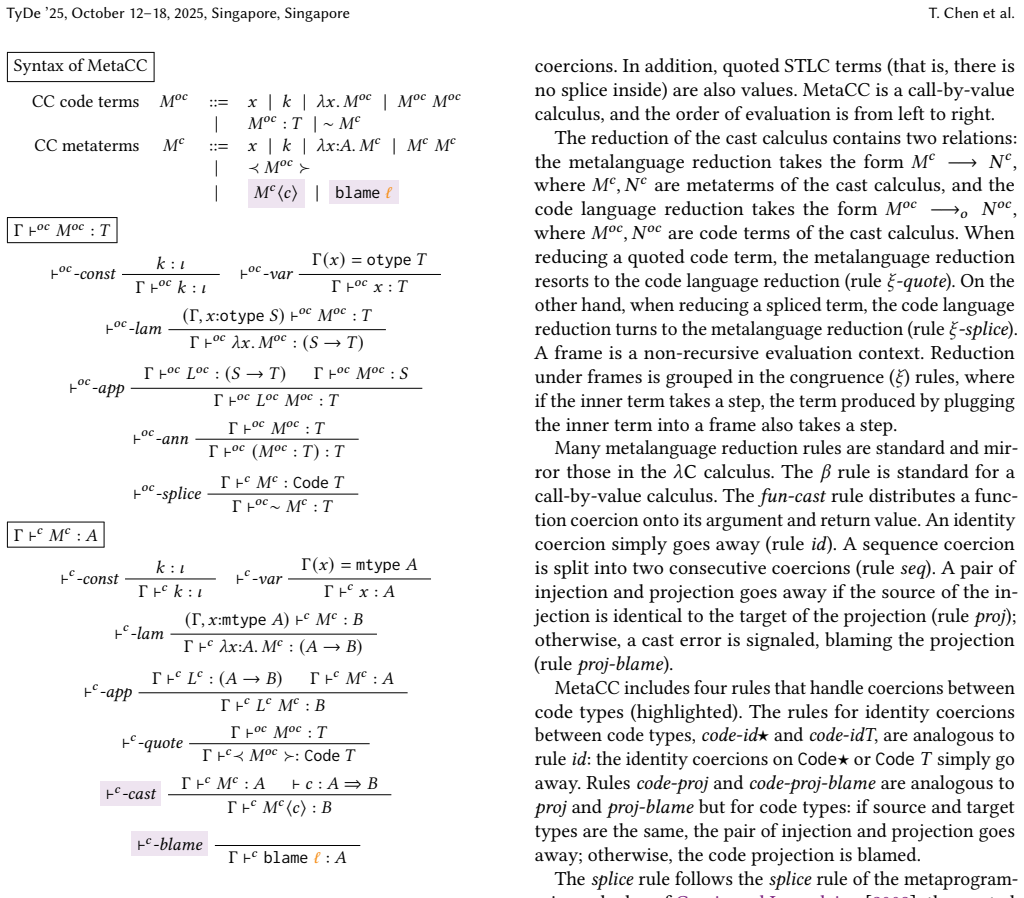
The central mechanism is the compilation function from MetaGTLC to MetaCC, which inserts coercions at every point where a metaterm's type is only consistent with the expected type rather than equal to it. Coercions are combinators of the form $\vdash c : A \Rightarrow B$: identities, injections into $\star$, projections out of $\star$ with blame labels, function coercions, and sequencing; MetaCC adds code-level variants $\mathsf{code!}_T$ and $\mathsf{code?}_{\ell,T}$ between $\mathsf{Code}\,\star$ and $\mathsf{Code}\,T$. Splice is checked bidirectionally, so when $\sim^\ell M$ appears in an object term, the typing context supplies the expected object type $T$ and compilation inserts $\mathsf{coerce}\,A\,(\mathsf{Code}\,T)\,\ell$ around $M$. The operational semantics then does the checking: matching injection/projection pairs cancel, mismatched pairs raise blame $\ell$, and blames propagate out of splices and quotes. The theorem rides on this machinery because the generated object term is validated exactly at the moment its type ceases to be unknown.
What would settle it
Run the paper's own Example 2.1 under the implementation: the theory predicts the splice of a quoted string into an integer context blames the splice location and never yields the ill-typed query; a run that produced the ill-typed query, or a well-typed MetaGTLC term that reduced to a stuck non-value in MetaCC, would refute Theorem 6.6.
Extended reading notes
Core claim
The paper's central claim, Theorem 6.6, is that MetaGTLC is type safe in exactly the sense data engineers need: if $\emptyset \vdash_m M : \mathsf{Code}\,T$ and metaevaluation of $M$ yields a quoted term, that term is well typed at $T$. The argument has four load-bearing pieces: a type-preserving compilation from MetaGTLC into MetaCC, progress and preservation for MetaCC, and a canonical-form lemma showing that any value of type $\mathsf{Code}\,T$ is a quoted simply typed $\lambda$ term. The genuinely new ingredient is that the standard gradual-typing relations extend to code types: consistency between $\mathsf{Code}\,\star$ and $\mathsf{Code}\,T$, coercions $\mathsf{code!}_T$ and $\mathsf{code?}_{\ell,T}$, and a bidirectional typing rule for splice that lets the surrounding object code determine the target type of the inserted cast. The discovery, in short, is that an explicitly cast version of gradual metaprogramming exists and has the MetaML-style well-typed-code guarantee while still tolerating unknown types in the generating program.
Load-bearing premise
The type-safety proof is carried out only for the simply typed lambda calculus as the object language, and the paper's assertion that MetaGTLC is agnostic to the object language is a design choice rather than a stated genericity theorem, so the guarantee as written does not automatically transfer to SQL, Spark, or feature-engineering DSLs with records, polymorphism, or subtyping.
Editorial extensions
If this is right
- A metaprogram that is only partially annotated still gets checked during metaevaluation, so a type error inside a library is reported while the pipeline is being generated, not after it is deployed.
- Blame labels identify the source location responsible for a cast failure, so a wrong argument type is attributed to the caller's code rather than to the library that raised the error.
- If all annotations are added and the metaprogram type-checks statically, the generated object code is guaranteed well typed without needing runtime checks, recovering the MetaML-style guarantee in the simply typed setting.
- Because ill-typed generated programs are prevented, developers can debug entirely in terms of the metaprogram source and usually never need to inspect the generated SQL or Spark code.
Reading between the lines
- The formal theorem treats blame and divergence as well-typed outcomes, so the guarantee that matters in practice is conditional: whenever metaevaluation terminates with a quoted value, that value is well typed.
- The calculus is proved against the simply typed lambda calculus as the object language; extending the same design to object languages with records, polymorphism, or subtyping would require new code coercions and new canonical-form arguments, so the claimed agnosticism to the object language is architectural, not yet a theorem.
- The proof's divergence case invokes the law of excluded middle; the paper does not state whether the Agda mechanization postulates classical logic or reformulates that case constructively, so the mechanized statement is the place to check the classical step.
- The same splice-boundary coercions suggest a general recipe: any property that can be attached to object-code types and checked by projection coercions could be enforced incrementally during metaevaluation, including schema well-formedness or information-flow labels.
Editorial analysis
A structured set of objections, weighed in public.
Referee Report
Summary. The paper proposes gradual metaprogramming as a way to debug dynamically-typed DSLs that generate statically-typed code, motivated by data pipeline languages such as SQL and Spark. It defines MetaGTLC, a calculus with a gradually-typed metalanguage and a statically-typed object language (chosen as simply-typed lambda calculus, STLC), with quote/splice constructs and blame tracking. The semantics is given by a typed compilation to a cast calculus MetaCC that extends the λC calculus with code coercions. The main result (Theorem 6.6) states that metaevaluation of a well-typed MetaGTLC term produces a well-typed result, and the proof is claimed to be mechanized in Agda.
Significance. If established, the result provides a new point in the design space of metaprogramming calculi: a gradual metalanguage generating statically-typed object code, with a machine-checked proof of type safety and blame tracking. The use of coercions and the explicit unknown type follows the standard GTLC approach, and the paper gives intuitive examples of earlier and more precise error detection. However, the formal development is specialized to STLC, so the more ambitious claims about object-language agnosticism and applicability to SQL/Spark pipelines are not supported by the theorems as stated. The paper's central proof is a standard progress-and-preservation argument, and its main value is as a clean, mechanized foundation that could be extended.
major comments (2)
- [§1.2, Figures 4, 7, 8, Lemma 6.5] The statement in §1.2 that the calculus is 'agnostic to the details of the object language, just that it should be statically typed' is not substantiated by the formal development. The object language is fixed to STLC throughout: the typing rules (Figure 4), the reduction rules (Figure 7), the ground types and coercions (Figures 3 and 5), the coerce function (Figure 8), and the canonical-form lemma (Lemma 6.5) all rely on STLC-specific notions such as a fixed set of base types and the STLC reduction relation. No object-language interface, parameterization, or genericity theorem is provided. Consequently, the paper's motivating guarantee for SQL/Spark pipeline languages is not established; it is a claim about the STLC instantiation. I recommend either (a) abstracting the object language (e.g., via a type language with ground types and a reduction relation satisfying suitable properties) and proving the key lemmas polymorphically, or (b) explicitly scoping the claims to STLC and stating which features of the proof would need to change for richer object languages.
- [§6, Theorem 6.6] The proof of Theorem 6.6 invokes the law of excluded middle to split the behaviour of M_c into value, blame, divergence, or stuck. This is a classical argument, and Definition 3.2 defines meta-eval as a total function with a divergence case, so the theorem as stated is inherently classical. Since the paper claims full mechanization in Agda (§1.5 and Lemmas 6.1, 6.2, 6.4, with file names Progress.agda, Preservation.agda, CompilePres.agda), it should report whether the formalization uses postulates or classical axioms, and state the exact theorem proved in Agda. If the theorem is proved constructively, please explain how the divergence case is handled (e.g., by a partial-function formulation or a coinductive definition).
minor comments (6)
- [§1.5] The artifact URL does not include a commit hash or build environment information (Agda version, standard library version); please provide these to make the mechanization independently verifiable.
- [Figure 8] The pattern-matching clauses for coerce ★ A and coerce A ★ overlap with the ground-type clauses (coerce ★ 𝐺 and coerce 𝐺 ★) when A is a ground type such as Code★; please state the intended rule priority or make the clauses disjoint.
- [§2.1] The sentence 'the return value of read_c is bound to r' refers to a function named read_and_quote in Example 2.1; please fix the typo.
- [§1.4] The sentence 'MetaGTLC is novel in the realm of metaprogramming languages...' is immediately followed by the acknowledgment that Miao and Siek [2010] is in the same category; consider rephrasing to match the more precise claim in §1.5, e.g., 'the first to use the standard GTLC approach with an explicit unknown type'.
- [Figure 4] The metaterm grammar shows a mandatory annotation λx:A.M_m, while the text says omitted annotations default to ★; please add a note explaining how omitted annotations are elaborated.
- [§6, Theorem 6.6] Because Figure 10 includes rule WT-diverge, the theorem's case for divergence is trivially true; stating the theorem in the form 'if meta-eval M_m = M_s then M_s is well-typed' would highlight the non-trivial content.
Circularity Check
No circularity: the type-safety theorem is proved from a newly defined calculus by standard syntactic methods and is mechanized in Agda, with no fitted inputs or self-citation chain doing the work.
full rationale
The paper defines MetaGTLC and MetaCC from scratch (Figures 3-10) and proves Theorem 6.6 by composing Lemma 6.4 (compilation preserves types), Lemma 6.3 (multi-step reduction preserves types), Lemma 6.5 (canonical form of quoted code), and Lemma 6.1 (progress). No parameter is fitted to data, no prediction is renamed from an input, and no target result appears in the premises of the proof. The stated conclusion, that successful metaevaluation yields a well-typed STLC object program, is a genuine theorem about the newly introduced calculus rather than an equivalent restatement of its definitions. The background citations, including the λC calculus of Siek et al. and the earlier Miao-Siek calculus, supply terminology and inspiration for the cast representation, but the present paper defines its own coercion syntax, typing rules, reduction rules, and compilation rules, and it reports a machine-checked proof of the main lemmas. The invocation of the law of excluded middle in Theorem 6.6 is a proof-technique observation about case classification, not a circular step. The paper's claim that the calculus is agnostic to the object language is broader than what is proved, since the formal development fixes the object language to STLC; however, an unsupported generalization is an overclaim, not a circularity. Under the review rules, concerns of that kind belong to correctness risk rather than to the circularity score.
Assumptions & free parameters
assumptions (4)
- standard math Law of excluded middle
- standard math Meta-theory of the λC cast calculus (Siek et al. 2021)
- domain assumption Simply-typed lambda calculus is an adequate stand-in for statically-typed data pipeline DSLs
- domain assumption Call-by-value, left-to-right evaluation with frames
Cite this review
Pith. "Pith review of Gradual Metaprogramming." pith.science (2026). https://pith.science/paper/TS5JZ242
@misc{pith2026250609043,
  author       = {Pith},
  title        = {Pith review of: Gradual Metaprogramming},
  year         = {2026},
  howpublished = {\url{https://pith.science/paper/TS5JZ242}},
  note         = {Machine review of arXiv:2506.09043}
}
read the original abstract
Data engineers increasingly use domain-specific languages (DSLs) to generate the code for data pipelines. Such DSLs are often embedded in Python. Unfortunately, there are challenges in debugging the generation of data pipelines: an error in a Python DSL script is often detected too late, after the execution of the script, and the source code location that triggers the error is hard to pinpoint. In this paper, we focus on the scenario where a DSL embedded in Python (so it is dynamically-typed) generates data pipeline description code that is statically-typed. We propose gradual metaprogramming to (1) provide a migration path toward statically typed DSLs, (2) immediately provide earlier detection of code generation type errors, and (3) report the source code location responsible for the type error. Gradual metaprogramming accomplishes this by type checking code fragments and incrementally performing runtime checks as they are spliced together. We define MetaGTLC, a metaprogramming calculus in which a gradually-typed metalanguage manipulates a statically-typed object language, and give semantics to it by translation to the cast calculus MetaCC. We prove that successful metaevaluation always generates a well-typed object program and mechanize the proof in Agda.
Figures


Figures from the paper (7 more)




Reference graph
Works this paper leans on
-
[6]
Incremental Type-Checking for Type- Reflective Metaprograms. In GPCE ’10: Proceedings of the international conference on Generative programming and component engineering. TyDe ’25, October 12–18, 2025, Singapore, Singapore T. Chen et al. Eugenio Moggi, Walid Taha, Zine El-Abidine Benaissa, and Tim Sheard
work page 2025
-
[7]
doi:10.1017/S0956796821000101 Guy L
Blame and coer- cion: Together again for the first time.Journal of Functional Programming 31 (2021), e20. doi:10.1017/S0956796821000101 Guy L. Steele, Jr
-
[1994]
Science of Computer Programming 22, 3 (June 1994), 197–230
Dynamic typing: syntax and proof theory. Science of Computer Programming 22, 3 (June 1994), 197–230. doi:10.1016/0167- 6423(94)00004-2 IBM
doi:10.1016/0167- 1994
-
[1995]
C++ Report 7, 4 (May 1995), 36–43
Using C++ template metaprograms. C++ Report 7, 4 (May 1995), 36–43. Reprinted in C++ Gems, ed. Stanley Lippman. Hiroto Yaguchi and Yukiyoshi Kameyama
work page 1995
-
[1997]
Multi-stage programming with explicit annotations. In PEPM ’97: Proceedings of the 1997 ACM SIGPLAN sym- posium on Partial evaluation and semantics-based program manipulation (Amsterdam, The Netherlands). ACM Press, New York, NY, USA, 203–
work page 1997
-
[2000]
Theoretical computer science 248, 1-2 (2000), 211–242
MetaML and multi-stage programming with explicit annotations. Theoretical computer science 248, 1-2 (2000), 211–242. David Vandevoorde and Nicolai M. Josuttis
work page 2000
-
[2010]
Technical Report PLT-TR- 2010-1
Reference: Racket. Technical Report PLT-TR- 2010-1. PLT Design Inc. https://racket-lang.org/tr1/. Ronald Garcia and Andrew Lumsdaine
work page 2010
-
[2013]
ACM SIGPLAN Notices 48, 9 (2013), 403–416
A practical theory of language-integrated query. ACM SIGPLAN Notices 48, 9 (2013), 403–416. Paul Crickard
work page 2013
Show all 11 references
-
[2021]
ACM Computing Surveys (CSUR) 54, 5 (2021), 1–38
Bidirectional typing. ACM Computing Surveys (CSUR) 54, 5 (2021), 1–38. Robert Bruce Findler and Matthias Felleisen. 2002.Contracts for Higher-Order Functions. Technical Report NU-CCS-02-05. Northeastern University. doi:10.1145/2502508.2502521 Matthew Flatt and PLT
2021
-
[2024]
Proceedings of the ACM on Programming Languages 8, PLDI (2024), 1609–1632
Quest Complete: The Holy Grail of Gradual Security. Proceedings of the ACM on Programming Languages 8, PLDI (2024), 1609–1632. doi:10.1145/3656442 James Cheney, Sam Lindley, and Philip Wadler
2024 doi
-
[2025]
In Proceedings of the 24th ACM SIGPLAN International Conference on Generative Programming: Concepts and Experiences
Staged Gradual Typing. In Proceedings of the 24th ACM SIGPLAN International Conference on Generative Programming: Concepts and Experiences. 94–104. Received 22 June 2025; accepted 23 July 2025
2025
Reviewed August 7, 2026 · model on record in the stance chip above.
Discussion (0). Sign in to comment.