REVIEW 3 major objections 5 minor 56 references
Properties of $\mathrm{H_2O}$ masers and their associated sources in Sagittarius B2
T0 review · 3 major / 5 minor · reviewed 2026-08-07 · deepseek-v4-flash
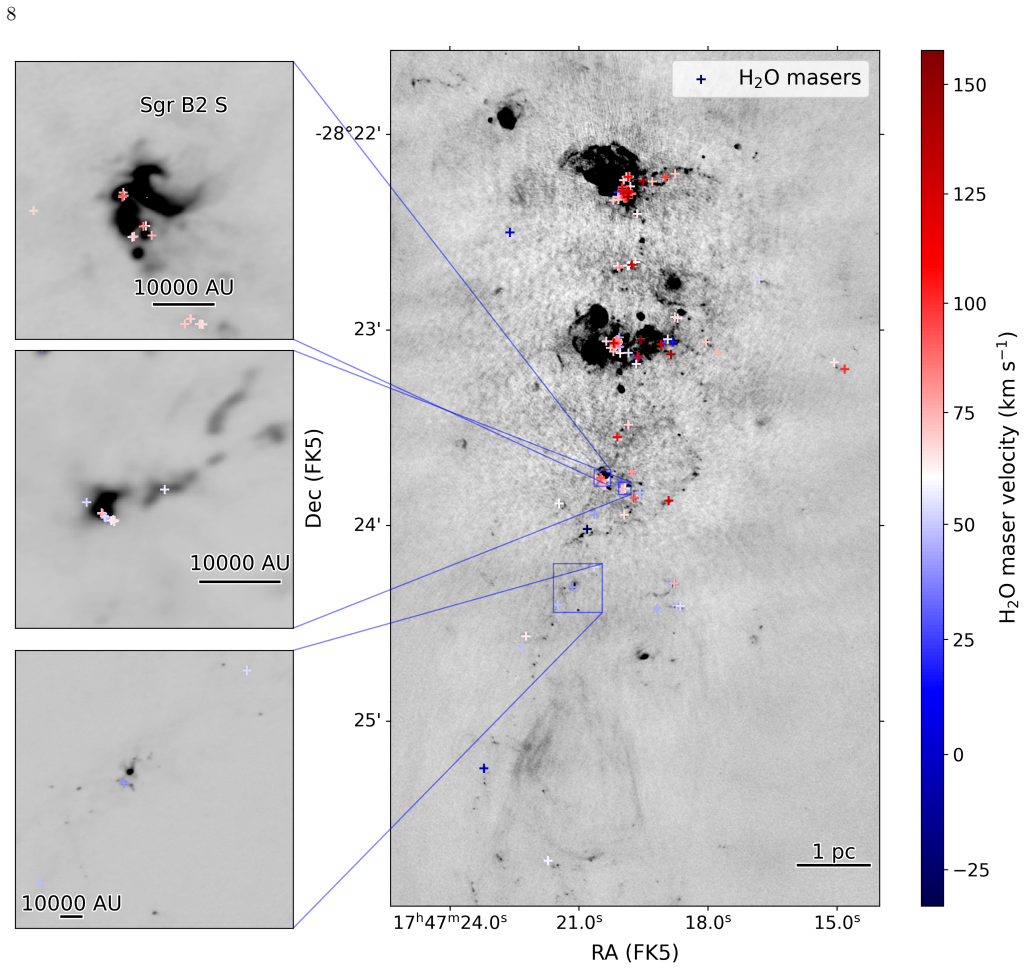
Pith's one-line read Sagittarius B2's outflow-driven water masers light up only the base of the outflow, within about 2000 au of the driving source, not the tens of thousands of au of shocked SiO.
desk verdict This is a genuinely useful maser catalog with a transparent reduction, and the population-level claims are plausible but rest on a hand-set classification threshold whose sensitivity is never quantified. read the letter →
The pith
A machine-rendered reading of the paper's core claim, the machinery that carries it, and where it could break.
The reading
What carries the argument
The paper's load-bearing product is a catalog: 499 water maser detections, each fitted spatially and spectrally, with a completeness limit of 0.66 Jy per beam and relative positional uncertainty below 5 mas. The classification that carries the physical claims is a simple spatial-extent rule applied to DBSCAN clusters of masers: a cluster whose members span less than 100 au is labeled 'YSO-associated' (disk winds, polar winds, or radiative pumping), and a larger cluster is labeled 'outflow-associated' (collisional pumping in outflow shocks). Cross-matching against catalogs of protostellar cores and HII regions assigns the population fractions and defines the 144 maser sites. The velocity-gap and self-absorption proposal is carried by a comparison of maser line-of-sight velocities to the cloud's rest velocity, backed by model calculations of H2O self-absorption by warm dust.
What would settle it
Observe the 18 YSO-associated maser sites with VLBI over two epochs separated by years and measure their proper motions relative to the central continuum source: systematic outward motions of tens of km/s would show that the 100-au cutoff misclassifies outflows, while a lack of organized motion would confirm star-centered pumping.
Extended reading notes
Core claim
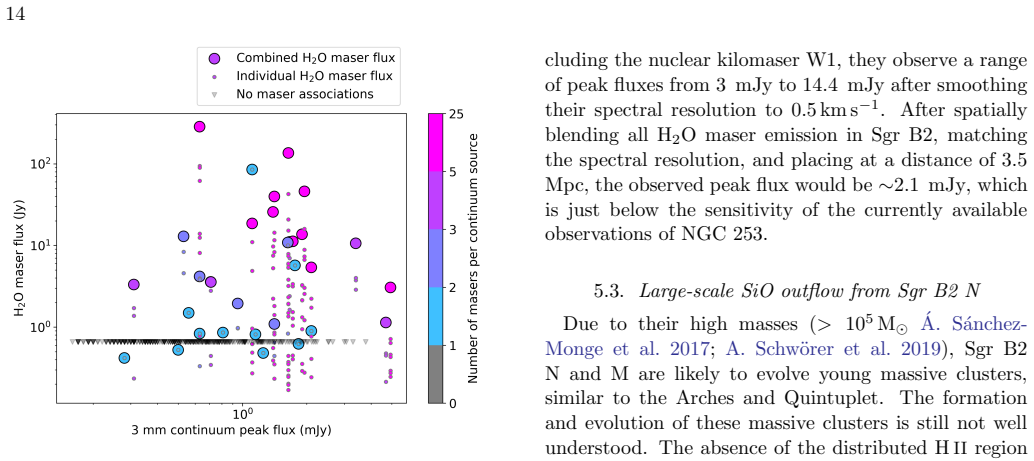
The authors claim that, within one of the most extreme star-forming complexes in the Galaxy, water masers partition cleanly by origin: outflow-associated masers are collisionally pumped shock tracers that stay within roughly 2000 au of their continuum source, while YSO-associated masers arise from processes confined to scales under 100 au, such as disk winds or radiative pumping, and are on average dimmer. On these classes, the paper reports that outflow and YSO maser flux distributions differ (two-sample Kolmogorov-Smirnov test p = 0.0022), that YSO-associated masers are absent at relative velocities between about 5 and 30 km/s with self-absorption by hot dust as a proposed mechanism, and that protostellar cores hosting water masers are brighter at 3 mm although individual maser luminosity does not track continuum flux. In Sgr B2 North, the masers lie along the edges of a large SiO outflow that appears to be driven by one or at most two accreting objects, not by the whole protocluster. Finally, using nine masers matched over a 20-year baseline, the paper shows internal proper motions reaching over 100 km/s and argues that water-maser proper motions of the cloud measured from small samples carry large unquantified biases.
Load-bearing premise
The claim rests on the assumption that the physical process lighting up a group of masers can be read from how far apart the group's members are, with a 100-au cutoff separating star-centered processes (disks and winds) from outflow shocks; the authors themselves list cases where this boundary mislabels the physics.
Editorial extensions
If this is right
- Outflow-driven water masers should be treated as a compact probe of the outflow launch zone, not as a measure of outflow extent; surveys that infer outflow sizes from water maser distributions will underestimate them by more than an order of magnitude.
- The association fractions (62% cores, 32% HII regions, remainder likely cores) give the first single-cloud template for what water maser populations look like in a massive protocluster, and none of the masers in this sample attach to HII regions larger than 5000 au.
- The 5-30 km/s relative-velocity gap predicts a hidden population of self-absorbed YSO masers that deeper, higher-dynamic-range observations should recover.
- The observed >100 km/s internal proper motions imply that published cloud proper motions based on one or two masers can be biased by the excitation mechanism; proper-motion work should use large samples, establish each maser's nature, or switch to dust-core tracers.
- Cores with water masers are a brighter-than-average subset of the 3 mm continuum population, so maser detections preferentially tag the most massive, most active accreting cores in a cloud.
Reading between the lines
- If the <2000 au confinement is general, water masers could serve as astrometric landmarks that pinpoint the driving protostar's location to tens of au when the maser site is identified; combining a maser catalog with ALMA continuum would allow relative astrometry of the launch region rather than of the whole cloud.
- The paper's classification predicts that the observed YSO/outflow ratio depends on viewing geometry: a population of face-on outflows is counted as YSO-associated, so the true outflow fraction among core-associated masers is probably higher than 33 of 94 sites.
- The unexplained blue-shift of YSO-associated masers is a direct target for future Zeeman or high-spectral-resolution observations: if the negative velocities come from infall in the equatorial plane rather than outflow, detecting magnetic field geometry could separate the two.
- A straightforward extension is to apply the same spatial-extent classification and association fractions to the 22 GHz maser surveys already covering other CMZ clouds and the POETS sample; if the flux-distribution offset between outflow and YSO masers is physical, it should reappear at similar completeness.
Editorial analysis
A structured set of objections, weighed in public.
Referee Report
Summary. This paper presents VLA 22 GHz H2O maser observations of Sgr B2, producing a catalog of 499 maser detections grouped into 144 sites. The authors cross-match these detections with existing HII-region and protostellar-core catalogs, classify maser groups as either outflow-associated or YSO-associated using a 100 au intra-group separation threshold, and report population-level properties: outflow-associated masers appear confined to within <2000 au of their central continuum source, YSO-associated masers show a deficit at velocities 5–30 km/s relative to the cloud, and cores with masers have brighter 3 mm continuum on average. The paper also includes a proof-of-concept proper-motion analysis between the 1998 McGrath catalog and the new data, and a comparison of H2O maser locations with SiO outflow emission in Sgr B2 N.
Significance. If the population-level results are robust, this is the first statistically meaningful study of H2O maser properties within a single massive protocluster, with direct implications for how H2O masers trace outflows, disks, and HII-region interfaces in extreme star-forming environments. The catalog itself, with 499 detections and 144 sites, is a valuable community resource, and the paper is unusually transparent about its methodological compromises: the fourth-scan exclusion, the inter-measurement-set offset, the imperfect classification, and the proof-of-concept nature of the proper motions are all disclosed. The paper also provides a useful cautionary note on using small samples of H2O masers for cloud proper-motion measurements, directly relevant to the widely cited Reid et al. (2009) result.
major comments (3)
- [Section 5.1.1 and abstract] The load-bearing classification separates 'outflow-associated' from 'YSO-associated' masers purely by the maximum intra-group separation of DBSCAN groups, with a hand-set threshold of 100 au. The abstract's headline claim that outflow-associated masers are confined to <2000 au from the central continuum source is then computed for these classes. Because the classes are defined by spatial extent, reporting that outflow groups are spatially extended is partly definitional; the distance-to-source confinement must be demonstrated separately from the grouping rule. More importantly, the authors explicitly list failure modes (a face-on outflow is labeled YSO; a chain of faint YSO masers is labeled an outflow; a compact outflow is labeled YSO), yet no sensitivity analysis is presented. I request a quantitative test of the 100 au threshold, e.g., repeating the classification and the <2000 au statistic for thresholds of 50, 75, 150, and 200 au, and ideally a classifier variant that also uses distance to the continuum source and/or velocity information. The manuscript should also show the actual distribution of source separations on which the <2000 au claim is based, since no such plot or table appears in the text.
- [Section 4.3, Section 5.1.1, abstract] The reported numbers do not reconcile. Section 4.3 states 259 masers associated with protostellar cores, 162 with HII regions, 55 with no match, and 1 with an evolved star; these sum to 477 of 499 detections. Section 5.1.1 then states that combining no-match masers with core-associated masers gives a total sample of 336, which implies 77 no-match masers (499 - 162 - 1 = 336), not 55. The abstract's 62% for core association corresponds to about 310 of 499, matching neither 259/499 (52%) nor 336/499 (67%). These inconsistencies propagate into the association fractions and site counts, so the counts and percentages must be reconciled before the paper is publishable.
- [Section 5.1.2 and Figure 3] The claimed deficit of YSO-associated masers at 5 < V_rel < 30 km/s (absolute velocities 65–90 km/s) is based on only 53 YSO-associated detections, and the per-channel noise in Figure 3 is highest in exactly this velocity range. The authors state that filtering to match the average noise in that range preserves the deficit, but this is not a completeness correction. Please provide a quantitative velocity-dependent completeness estimate, e.g., injection-recovery tests as a function of channel noise, and a statistical significance test for the gap (e.g., expected count under the observed velocity distribution of all masers, with uncertainties). As written, the self-absorption interpretation is not yet supported by a demonstrated detection of a significant deficit.
minor comments (5)
- [Section 2.3] There is a typo: 'Match 28th' should be 'March 28th'.
- [Abstract and Section 5.1.2] The abstract's '5 < V_rel < 30 km/s' is defined relative to the cloud velocity, while the text discusses the absolute 65–90 km/s range; please state explicitly that V_rel = V - V_LSR and keep the notation consistent.
- [Section 5.1.1] The term 'ambiguous' is used in the site counts before it is defined; please introduce the definition earlier in the section.
- [Figure 11 caption] The right panel caption says the tightly-packed masers are 'classified as YSO-associated'; this is by construction of the 100 au threshold, so the caption should avoid implying independent validation.
- [Table 1] The W49 row reports a resolution of 0.0012'' with KVN+VERA; please verify the units and ensure all columns use the same conventions for angular resolution and sensitivity.
Circularity Check
Partial circularity: maser populations are defined by a 100 au spatial-extent threshold and then described by their spatial extent; the headline <2000 au confinement and velocity/flux findings retain independent content.
-
self definitional
[Section 5.1.1 (classification) and Section 5.1.2 (population properties); see also Abstract]
"If the maximum separation between members of each cluster is below 100 au, we classify all sources within this group as "YSO-associated". Otherwise, they are classified as "outflow-associated". ... The selection criteria was based on the spatial extent of the groups of the sources."
The two populations compared in Section 5.1.2 are defined by the 100 au maximum intra-group separation threshold. Therefore any spatial-extent contrast between the classes, most directly the statement that outflow-associated groups are extended while YSO-associated groups are tightly clustered, is fixed by the classifier rather than measured from the data.
full rationale
This is an observational catalog paper, not a derivation from first principles, so the fitted-input-called-prediction and uniqueness-import failure modes do not apply. The catalog construction (astrodendro extraction, Gaussian fitting, noise-based completeness, McGrath cross-match) is self-contained and testable against the VLA data. Self-citations to Budaiev et al. (2024) and Budaiev (2025, in prep.) serve as reference continuum and JWST catalogs; because these are independent data products used for alignment and association rather than unverified theorems, they do not constitute load-bearing circularity. The one genuine circular loop is the classification step: YSO- versus outflow-associated masers are defined by a 100 au spatial-extent threshold in Section 5.1.1, and the paper then reports spatial-distribution properties of those classes in Section 5.1.2, explicitly acknowledging "The selection criteria was based on the spatial extent of the groups of the sources." This makes the spatial-extent comparison between the two classes partly true by construction. However, the main headline claims, namely the <2000 au confinement to the central continuum source, the lack of YSO-associated masers at intermediate relative velocities, the KS-test difference in flux distributions, and the brightening of maser-hosting cores, are not mathematically forced by the threshold and retain independent observational content. The manuscript also lists known failure modes of its own classifier. Score 4 reflects this partial, non-central circularity rather than a fully circular derivation.
Assumptions & free parameters
free parameters (6)
- YSO/outflow classification maximum separation =
100 au
- DBSCAN minimum separation d_min =
500 au
- Per-field extraction threshold (min value) =
16 MN, 14 MS, 10 SDS
- Cross-match search radii =
0.3 and 0.5 arcsec cores, 0.5 arcsec HII/McGrath, 0.1 pc SiO
- McGrath catalog systemic offset =
+0.03 arcsec RA, -0.12 arcsec Dec
- Representative completeness noise and threshold =
0.046 Jy/beam at 14 sigma
assumptions (5)
- domain assumption Sgr B2 distance is 8.277 kpc
- ad hoc to paper Spatial extent of a maser group maps to the pumping mechanism
- domain assumption 1.3 cm VLA continuum and 3 mm ALMA continuum trace coincident structure
- domain assumption mm continuum traces protostellar cores
- ad hoc to paper The McGrath 2004 catalog astrometry, not the new VLA astrometry, carries the systemic offset
Cite this review
Pith. "Pith review of Properties of $\mathrm{H_2O}$ masers and their associated sources in Sagittarius B2." pith.science (2026). https://pith.science/paper/6KI5T24C
@misc{pith2026250609115,
  author       = {Pith},
  title        = {Pith review of: Properties of $\mathrmH_2O$ masers and their associated sources in Sagittarius B2},
  year         = {2026},
  howpublished = {\url{https://pith.science/paper/6KI5T24C}},
  note         = {Machine review of arXiv:2506.09115}
}
abstract
We present high-resolution Karl G. Jansky Very Large Array observations of the 22 GHz $\mathrm{H_2O}$ maser line in the extended Sagittarius B2 cloud. We detect 499 $\mathrm{H_2O}$ masers across the observed velocities between -39 and 172 km s$^{-1}$. To investigate the nature of the masers, we analyze their spatial distribution and cross-match with catalogs of HII regions and protostellar cores. 62% of masers are associated with protostellar cores and 32% with HII regions. The nature of the remaining 6% of sources was not established, but is likely associated with protostellar cores. Based on the spatial extent of the groups of masers, we classify them as either outflow-associated or young stellar object (YSO)-associated. We identify 144 unique sites of maser emission: 23 are associated with HII regions and 94 with protostellar cores, of which 33 are associated with protostellar outflows and 18 with YSOs. The outflow-associated $\mathrm{H_2O}$ maser emission is confined to within $<2000$ au of the central continuum source, despite shocked SiO emission extending over tens of thousands of au. The YSO-associated masers show a lack of detections at $5 < V_{rel} < 30$ km s$^{-1}$, which we suggest may be due to maser self-absorption. We show how $\mathrm{H_2O}$ masers trace the large-scale material flow in Sgr B2 N (North) also seen in SiO and mm continuum emission. Finally, we find that protostellar cores with associated $\mathrm{H_2O}$ masers tend to have brighter 3 mm continuum emission on average, although there is no strong correlation between maser brightness and continuum flux.
Figures


Figures from the paper (13 more)





Reference graph
Works this paper leans on
-
[1]
Asanok , K., Gray , M. D., Hirota , T., et al. 2023, title Proper Motions of Water Masers in W49 N Measured by KaVA , , 943, 79, 10.3847/1538-4357/aca6f1
-
[2]
Astropy Collaboration , Robitaille , T. P., Tollerud , E. J., et al. 2013, title Astropy: A community Python package for astronomy , , 558, A33, 10.1051/0004-6361/201322068
-
[3]
Astropy Collaboration , Price-Whelan , A. M., Sip o cz , B. M., et al. 2018, title The Astropy Project: Building an Open-science Project and Status of the v2.0 Core Package , , 156, 123, 10.3847/1538-3881/aabc4f
-
[4]
Bae , J.-H., Kim , K.-T., Youn , S.-Y., et al. 2011, title A Multi-epoch, Simultaneous Water and Methanol Maser Survey toward Intermediate-mass Young Stellar Objects , , 196, 21, 10.1088/0067-0049/196/2/21
-
[5]
Bonfand , M., Belloche , A., Garrod , R. T., et al. 2019, title The complex chemistry of hot cores in Sgr B2(N): influence of cosmic-ray ionization and thermal history , , 628, A27, 10.1051/0004-6361/201935523
-
[6]
2024, title Protostellar Cores in Sagittarius B2 N and M , , 961, 4, 10.3847/1538-4357/ad0383
Budaiev , N., Ginsburg , A., Jeff , D., et al. 2024, title Protostellar Cores in Sagittarius B2 N and M , , 961, 4, 10.3847/1538-4357/ad0383
-
[7]
Crowe , S., Fedriani , R., Tan , J. C., et al. 2025, title The JWST-NIRCam View of Sagittarius C. I. Massive Star Formation and Protostellar Outflows , , 983, 19, 10.3847/1538-4357/ad8889
-
[8]
1973, title Water Masers in a Protostellar Gas Cloud , , 26, 297
de Jong , T. 1973, title Water Masers in a Protostellar Gas Cloud , , 26, 297
work page 1973
Show all 56 references
-
[9]
G., Goss , W
De Pree , C. G., Goss , W. M., & Gaume , R. A. 1998, title Ionized Gas in Sagittarius B2 Main on Scales of 0.065 Arcsecond (600 AU) , , 500, 847, 10.1086/305782
1998 doi
-
[10]
G., Peters , T., Mac Low , M
De Pree , C. G., Peters , T., Mac Low , M. M., et al. 2015, title Evidence of Short Timescale Flux Density Variations of UC HII Regions in Sgr B2 Main and North , , 815, 123, 10.1088/0004-637X/815/2/123
2015 doi
-
[11]
J., & McKee , C
Elitzur , M., Hollenbach , D. J., & McKee , C. F. 1992, title Planar H 2O Masers in Star-forming Regions , , 394, 221, 10.1086/171574
1992 doi
-
[12]
A., Claussen , M
Gaume , R. A., Claussen , M. J., de Pree , C. G., Goss , W. M., & Mehringer , D. M. 1995, title The Sagittarius B2 Star-forming Region. I. Sensitive 1.3 Centimeter Continuum Observations , , 449, 663, 10.1086/176087
1995 doi
-
[13]
Ginsburg , A., & Kruijssen , J. M. D. 2018, title A High Cluster Formation Efficiency in the Sagittarius B2 Complex , , 864, L17, 10.3847/2041-8213/aada89
2018 doi
-
[14]
2022, title Pyspeckit: A Spectroscopic Analysis and Plotting Package , , 163, 291, 10.3847/1538-3881/ac695a
Ginsburg , A., Sokolov , V., de Val-Borro , M., et al. 2022, title Pyspeckit: A Spectroscopic Analysis and Plotting Package , , 163, 291, 10.3847/1538-3881/ac695a
2022 doi
-
[15]
2018, title Distributed Star Formation throughout the Galactic Center Cloud Sgr B2 , , 853, 171, 10.3847/1538-4357/aaa6d4
Ginsburg , A., Bally , J., Barnes , A., et al. 2018, title Distributed Star Formation throughout the Galactic Center Cloud Sgr B2 , , 853, 171, 10.3847/1538-4357/aaa6d4
2018 doi
-
[16]
T., Zhang , Q., & Zapata , L
Goddi , C., Ginsburg , A., Maud , L. T., Zhang , Q., & Zapata , L. A. 2020, title Multidirectional Mass Accretion and Collimated Outflows on Scales of 100-2000 au in Early Stages of High-mass Protostars , , 905, 25, 10.3847/1538-4357/abc88e
2020 doi
-
[17]
2005, title Kinematics of H _ 2 O masers in high-mass star forming regions , , 432, 161, 10.1051/0004-6361:20042074
Goddi , C., Moscadelli , L., Alef , W., et al. 2005, title Kinematics of H _ 2 O masers in high-mass star forming regions , , 432, 161, 10.1051/0004-6361:20042074
2005 doi
-
[18]
M., Uscanga , L., & Cesaroni , R
Goddi , C., Moscadelli , L., Torrelles , J. M., Uscanga , L., & Cesaroni , R. 2006, title Evidence supporting the kinematic interpretation of water maser proper motions , , 447, L9, 10.1051/0004-6361:200500230
2006 doi
-
[19]
D., Ott , J., Rand , R., et al
Gorski , M. D., Ott , J., Rand , R., et al. 2019, title Diagnostics of a nuclear starburst: water and methanol masers , , 483, 5434, 10.1093/mnras/sty3077
2019 doi
-
[20]
2022, title Deep images of the Galactic center with GRAVITY , , 657, A82, 10.1051/0004-6361/202142459
GRAVITY Collaboration , Abuter , R., Aimar , N., et al. 2022, title Deep images of the Galactic center with GRAVITY , , 657, A82, 10.1051/0004-6361/202142459
2022 doi
-
[21]
D., Etoka , S., Richards , A
Gray , M. D., Etoka , S., Richards , A. M. S., & Pimpanuwat , B. 2022, title Collisional and radiative pumping in 22-GHz water masers , , 513, 1354, 10.1093/mnras/stac854
2022 doi
- [22]
-
[23]
E., Hasegawa , T., Saigo , K., Sanhueza , P., & Chibueze , J
Higuchi , A. E., Hasegawa , T., Saigo , K., Sanhueza , P., & Chibueze , J. O. 2015, title Sgr B2(N): A Bipolar Outflow and Rotating Hot Core Revealed by ALMA , , 815, 106, 10.1088/0004-637X/815/2/106
2015 doi
-
[24]
2024, title Thermal Properties of the Hot Core Population in Sagittarius B2 Deep South
Jeff , D., Ginsburg , A., Bulatek , A., et al. 2024, title Thermal Properties of the Hot Core Population in Sagittarius B2 Deep South. , , 962, 48, 10.3847/1538-4357/ad1507
2024 doi
-
[25]
2019, title Simultaneous 22 GHz Water and 44 GHz Methanol Maser Survey of Ultracompact H II Regions , , 244, 2, 10.3847/1538-4365/ab2fc9
Kim , W.-J., Kim , K.-T., & Kim , K.-T. 2019, title Simultaneous 22 GHz Water and 44 GHz Methanol Maser Survey of Ultracompact H II Regions , , 244, 2, 10.3847/1538-4365/ab2fc9
2019 doi
-
[26]
Kruijssen , J. M. D., Dale , J. E., & Longmore , S. N. 2015, title The dynamical evolution of molecular clouds near the Galactic Centre - I. Orbital structure and evolutionary timeline , , 447, 1059, 10.1093/mnras/stu2526
2015 doi
-
[27]
E., Boboltz , D
Lanyi , G. E., Boboltz , D. A., Charlot , P., et al. 2010, title The Celestial Reference Frame at 24 and 43 GHz. I. Astrometry , , 139, 1695, 10.1088/0004-6256/139/5/1695
2010 doi
-
[28]
Liljestr \"o m , T., & Gwinn , C. R. 2000, title Water Masers Diagnosing Postshocked Conditions in W49N , , 534, 781, 10.1086/308781
2000 doi
-
[29]
2019, title Star Formation Rates of Massive Molecular Clouds in the Central Molecular Zone , , 872, 171, 10.3847/1538-4357/ab017d
Lu , X., Zhang , Q., Kauffmann , J., et al. 2019, title Star Formation Rates of Massive Molecular Clouds in the Central Molecular Zone , , 872, 171, 10.3847/1538-4357/ab017d
2019 doi
-
[30]
2014, title Cosmic Star-Formation History , , 52, 415, 10.1146/annurev-astro-081811-125615
Madau , P., & Dickinson , M. 2014, title Cosmic Star-Formation History , , 52, 415, 10.1146/annurev-astro-081811-125615
2014 doi
-
[31]
J., Goss , W
McGrath , E. J., Goss , W. M., & De Pree , C. G. 2004, title H _ 2 O Masers in W49 North and Sagittarius B2 , , 155, 577, 10.1086/424486
2004 doi
-
[32]
P., Waters , B., Schiebel , D., Young , W., & Golap , K
McMullin , J. P., Waters , B., Schiebel , D., Young , W., & Golap , K. 2007, in Astronomical Society of the Pacific Conference Series, Vol. 376, Astronomical Data Analysis Software and Systems XVI, ed. R. A. Shaw , F. Hill , & D. J. Bell , 127
2007
-
[33]
2022, title The physical and chemical structure of Sagittarius B2
Meng , F., S \'a nchez-Monge , \'A ., Schilke , P., et al. 2022, title The physical and chemical structure of Sagittarius B2. VI. UCHii regions in Sgr B2 , , 666, A31, 10.1051/0004-6361/202243674
2022 doi
-
[34]
2025, title The physical and chemical structure of Sagittarius B2: VIII
M \"o ller , T., Schilke , P., S \'a nchez-Monge , \'A ., & Schmiedeke , A. 2025, title The physical and chemical structure of Sagittarius B2: VIII. Full molecular line survey of hot cores , , 693, A160, 10.1051/0004-6361/202451274
2025 doi
-
[35]
2019, title Protostellar Outflows at the EarliesT Stages (POETS)
Moscadelli , L., Sanna , A., Goddi , C., et al. 2019, title Protostellar Outflows at the EarliesT Stages (POETS). III. H _ 2 O masers tracing disk-winds and jets near luminous YSOs , , 631, A74, 10.1051/0004-6361/201936436
2019 doi
-
[36]
2020, title Protostellar Outflows at the EarliesT Stages (POETS)
Moscadelli , L., Sanna , A., Goddi , C., et al. 2020, title Protostellar Outflows at the EarliesT Stages (POETS). IV. Statistical properties of the 22 GHz H _ 2 O masers , , 635, A118, 10.1051/0004-6361/202037472
2020 doi
-
[37]
Oka , T., & Geballe , T. R. 2022, title The Central 300 pc of the Galaxy Probed by Infrared Spectra of H _ 3 ^ + and CO. III. Locations of Sgr B2 and Star Iota , , 927, 97, 10.3847/1538-4357/ac3912
2022 doi
-
[38]
D., Mac Low , M.-M., Klessen , R
Peters , T., Klaassen , P. D., Mac Low , M.-M., Klessen , R. S., & Banerjee , R. 2012, title Are Molecular Outflows around High-mass Stars Driven by Ionization Feedback? , , 760, 91, 10.1088/0004-637X/760/1/91
2012 doi
-
[39]
J., Menten , K
Reid , M. J., Menten , K. M., Zheng , X. W., Brunthaler , A., & Xu , Y. 2009, title A Trigonometric Parallax of Sgr B2 , , 705, 1548, 10.1088/0004-637X/705/2/1548
2009 doi
-
[40]
W., Pineda , J
Rosolowsky , E. W., Pineda , J. E., Kauffmann , J., & Goodman , A. A. 2008, title Structural Analysis of Molecular Clouds: Dendrograms , , 679, 1338, 10.1086/587685
2008 doi
-
[41]
2023, title Water maser distributions and their internal motions in the Sagittarius B2 complex , , 75, 937, 10.1093/pasj/psad052
Sakai , D., Oyama , T., Nagayama , T., Honma , M., & Kobayashi , H. 2023, title Water maser distributions and their internal motions in the Sagittarius B2 complex , , 75, 937, 10.1093/pasj/psad052
2023 doi
-
[42]
2017, title The physical and chemical structure of Sagittarius B2
S \'a nchez-Monge , \'A ., Schilke , P., Schmiedeke , A., et al. 2017, title The physical and chemical structure of Sagittarius B2. II. Continuum millimeter emission of Sgr B2(M) and Sgr B2(N) with ALMA , , 604, A6, 10.1051/0004-6361/201730426
2017 doi
-
[43]
2016, title The physical and chemical structure of Sagittarius B2
Schmiedeke , A., Schilke , P., M \"o ller , T., et al. 2016, title The physical and chemical structure of Sagittarius B2. I. Three-dimensional thermal dust and free-free continuum modeling on 100 au to 45 pc scales , , 588, A143, 10.1051/0004-6361/201527311
2016 doi
-
[44]
2019, title The physical and chemical structure of Sagittarius B2
Schw \"o rer , A., S \'a nchez-Monge , \'A ., Schilke , P., et al. 2019, title The physical and chemical structure of Sagittarius B2. IV. Converging filaments in the high-mass cluster forming region Sgr B2(N) , , 628, A6, 10.1051/0004-6361/201935200
2019 doi
-
[45]
C., Tress , R
Sormani , M. C., Tress , R. G., Glover , S. C. O., et al. 2020, title Simulations of the Milky Way's Central Molecular Zone - II. Star formation , , 497, 5024, 10.1093/mnras/staa1999
2020 doi
-
[46]
S., Morgan , L
Urquhart , J. S., Morgan , L. K., Figura , C. C., et al. 2011, title The Red MSX Source survey: ammonia and water maser analysis of massive star-forming regions , , 418, 1689, 10.1111/j.1365-2966.2011.19594.x
2011
-
[47]
L., Nunez-Iglesias , J., et al
van der Walt, S., S ch\"onberger, J. L., Nunez-Iglesias , J., et al. 2014, title scikit-image: image processing in P ython, PeerJ, 2, e453, 10.7717/peerj.453
2014 doi
-
[48]
J., Purcell , C
Walsh , A. J., Purcell , C. R., Longmore , S. N., et al. 2014, title Accurate water maser positions from HOPS , , 442, 2240, 10.1093/mnras/stu989
2014 doi
-
[49]
Whiting , M. T. 2012, title DUCHAMP: a 3D source finder for spectral-line data , , 421, 3242, 10.1111/j.1365-2966.2012.20548.x
2012
-
[50]
2025, title Dual-band Unified Exploration of Three CMZ Clouds (DUET)
Xu , F., Lu , X., Wang , K., et al. 2025, title Dual-band Unified Exploration of Three CMZ Clouds (DUET). Cloud-wide census of continuum sources showing low spectral indices , arXiv e-prints, arXiv:2503.23700, 10.48550/arXiv.2503.23700
-
[51]
A., Tang , Y.-W., & Leurini , S
Zapata , L. A., Tang , Y.-W., & Leurini , S. 2010, title Extremely Large and Hot Multilayer Keplerian Disk Around the O-type Protostar W51N: The Precursors of the HCH II Regions? , , 725, 1091, 10.1088/0004-637X/725/1/1091
2010 doi
-
[52]
2025, title Subclustering and Star Formation Efficiency in Three Protoclusters in the Central Molecular Zone , , 982, L10, 10.3847/2041-8213/adb30b
Zhang , S., Lu , X., Ginsburg , A., et al. 2025, title Subclustering and Star Formation Efficiency in Three Protoclusters in the Central Molecular Zone , , 982, L10, 10.3847/2041-8213/adb30b
2025 doi
-
[53]
2024, title Masers and Star Formation Activities in W51A , , 168, 10, 10.3847/1538-3881/ad428d
Zhang , Y.-K., Chen , X., Wang , Y.-X., et al. 2024, title Masers and Star Formation Activities in W51A , , 168, 10, 10.3847/1538-3881/ad428d
2024 doi
-
[54]
, " * write output.state after.block = add.period write newline
ENTRY address archivePrefix author booktitle chapter doi edition editor eprint howpublished institution journal key month number organization pages publisher school series title misctitle type volume year version url label extra.label sort.label short.list INTEGERS output.stat...
-
[55]
write newline
" write newline "" before.all 'output.state := FUNCTION format.url url empty "" new.block "" url * "" * if FUNCTION format.eprint eprint empty "" archivePrefix empty "" archivePrefix "arXiv" = new.block " " eprint * " " * new.block " " eprint * " " * if if if FUNCTION format.d...
-
[56]
0c XJC#c7D 5`v7H@n) >: _k ƚX^Hi. 5ՙ 9\ R!*gBeyillmR
thebibliography [1] 20pt to REFERENCES 6pt =0pt \@twocolumntrue 12pt -12pt 10pt plus 3pt =0pt =0pt =1pt plus 1pt =0pt =0pt -12pt =13pt plus 1pt =20pt =13pt plus 1pt \@M =10000 =-1.0em =0pt =0pt 0pt =0pt =1.0em @enumiv\@empty 10000 10000 `\.\@m \@noitemerr \@latex@warning Empty...
2017 arXiv
Reviewed August 7, 2026 · model on record in the stance chip above.
Discussion (0). Sign in to comment.