REVIEW 4 major objections 5 minor 98 references
A Plasma Torus Around a Young Low-Mass Star
T0 review · 4 major / 5 minor · reviewed 2026-08-07 · deepseek-v4-flash
Pith's one-line read Time-series H-alpha spectroscopy of the 3.93-hour rotator TIC 141146667 shows sinusoidal emission at two to four times the star's equatorial velocity, direct evidence for cool plasma clumps magnetically locked in corotation around a…
desk verdict The first spectroscopic evidence for corotating circumstellar plasma around a complex periodic variable—real, novel, and worth refereeing, though the derived clump radii carry more circularity than the paper lets on. read the letter →
The pith
A machine-rendered reading of the paper's core claim, the machinery that carries it, and where it could break.
The reading
What carries the argument
The load-bearing identity is the corotation relation connecting observed velocity semi-amplitude to cylindrical radius: v = Ω R sin i, so a sinusoidal H-alpha velocity curve of semi-amplitude K maps to a clump location R = K / (Ω sin i). The central object is the warped plasma torus, a centrifugally supported accumulation of plasma in a misaligned dipole magnetosphere whose effective potential (gravitational plus centrifugal) has local minima outside the Keplerian corotation radius; those minima lie 180 degrees apart where the rotational and magnetic planes intersect. The machinery also includes the measured velocity dispersion of the H-alpha clumps (~0.24 v_eq), which rules out long arcs or radial spokes and requires blob-like emitting regions with dimensions of order 0.5 R*.
What would settle it
A decisive test would be to re-observe TIC 141146667 spectroscopically across several years: if the H-alpha clumps were on Keplerian orbits, their orbital phase would drift relative to the 3.930-hour stellar rotation period, whereas strict corotation requires the sinusoidal H-alpha pattern to stay locked to the photometric period with no detectable drift. A second direct check is measuring the stellar inclination via spectropolarimetry or asteroseismology; since the radius estimate for the inner clump scales as 1/sin i, a measured inclination near 60 degrees would push the inferred clump radii outward and change the comparison with the Keplerian corotation radius.
Extended reading notes
Core claim
The discovery is direct evidence for cool (≲$10^{4}$ K) plasma clumps trapped in corotation around a CPV. The H-$\alpha$ emission is double-peaked and 180 degrees apart in phase, with velocity semi-amplitudes that map, under rigid corotation, to mean distances of 2.07 R*, 2.88 R*, and 3.88 R* from the star's rotation axis. The innermost clump's orbital period is consistent with the photometric period to within two minutes, while the Keplerian orbital period at 2 R* would be roughly 1-3 days, so the clumps cannot be on free Keplerian orbits; they must be magnetically confined. The authors interpret this as a warped plasma torus with antipodal density enhancements, analogous to the tori around rapidly rotating magnetic B stars and to prominence systems on active cool stars, and they note that the transits of the inner clumps overlap but do not fully explain the complex TESS photometric dips.
Load-bearing premise
The interpretation assumes the system is viewed nearly edge-on and that the H-alpha emission comes from discrete, rigidly corotating clumps whose measured velocity spread maps linearly to their spatial size; if the inclination is significantly below 90 degrees or the emission traces a distributed flow, the quoted radii, the antipodal geometry, and the precise comparison with the corotation radius would shift, although the existence of magnetically controlled circumstellar plasma would remain.
Editorial extensions
If this is right
- At least one CPV is now known to have corotating circumstellar plasma, so the starspot-only explanation cannot account for the entire class.
- The clumps orbit at 2-4 R* while Keplerian orbits at those radii take 1-3 days, so the plasma must be magnetically forced to corotate with the star.
- The spectroscopic transits of the inner H-alpha clump cover roughly 22% of each cycle and coincide only partially with the TESS photometric dip, implying additional opacity sources or spatially distinct structures contribute to the photometric variability.
- Correcting the observed CPV fraction for transit geometry suggests that ≳10% of young M dwarfs may host similar centrifugal magnetospheres during their first ~100 Myr.
- The clump gas mass is estimated at ≈2×10^17 g with dust mass between 10^15 and 10^17 g, setting concrete scales for future models of the composition and origin of the material.
Reading between the lines
- If corotating tori are common around young M dwarfs, their sharp, periodic optical dips could be confused with, or contaminate, searches for short-period rocky exoplanet transits in TESS data; the 3.93-hour period and repeated features of TIC 141146667 illustrate a false-positive population that time-series spectroscopy can distinguish.
- The geometric correction implies that >10% of young, rapidly rotating M dwarfs could host similar structures; a targeted volume-limited TESS survey of young moving groups paired with H-alpha follow-up of a handful of CPVs would test this prediction directly.
- The paper's plasma clumps sit at the cool end of a continuum that includes solar prominences and the tori of rapidly rotating B stars; if dust can condense inside these clumps, the structures could serve as a formation site for small solid bodies around low-mass stars.
- The derived magnetic-field lower bound of ≈1 G at the clump sites is easily exceeded by typical M-dwarf surface fields, so the main uncertainty is not field strength but the topology; future spectropolarimetry that maps the field geometry of a CPV would discriminate between dipole and multipolar confinement.
Editorial analysis
A structured set of objections, weighed in public.
Referee Report
Summary. The paper presents time-series Keck/HIRES spectroscopy and TESS photometry of the young M-dwarf complex periodic variable TIC 141146667 (P=3.93 hr). The Hα spectra show emission components extending to roughly two to four times the equatorial velocity, with apparent sinusoidal phase modulation over the five-hour run. The authors argue that the high observed velocities and the 3.93 hr period rule out a photospheric origin and a Keplerian orbit at the inferred radii, implying magnetically forced corotation of cool circumstellar plasma at roughly 2-4 R*. They quantify the clump properties with a phenomenological multi-Gaussian model, derive order-of-magnitude plasma densities, masses, and dust mass limits, and connect the system to warped plasma tori around magnetic stars. The central claim is that this is the first direct spectroscopic evidence that CPVs can host corotating circumstellar material rather than being purely starspot phenomena.
Significance. If the central claim holds, the paper breaks an important degeneracy in the CPV literature: at least some complex periodic variables have corotating circumstellar plasma, not merely complex starspot distributions. The high-velocity Hα emission is visually striking and the order-of-magnitude physical estimates (n_H~1e11 cm^-3, M_gas~1e17 g, B>1 G) provide a useful starting point. The paper is also commendably candid about several weaknesses: the single-epoch nature of the spectroscopy, the factor-of-several decay of the Hα emissivity, the instability of the outer component, and the model-dependence of the fits. The main limitations are that the quantitative radii and the claimed period agreement are partly conditioned on priors informed by the same data, and the radii assume an edge-on viewing geometry that is only weakly constrained. These issues affect the detailed geometry and the exact corotation radius comparison, but they do not undermine the robust visual detection of high-velocity magnetically controlled circumstellar hydrogen.
major comments (4)
- [Appendix B; Table 1; Section 3] The reported orbital periods and semi-amplitudes (P0=3.92±0.03 hr, K0/veq=2.07±0.04; P1=3.92±0.06 hr, K1/veq=2.88±0.10; P2=3.88±0.20 hr, K2/veq=3.88±0.25) are not independent tests of the photometric period and phase, because the multi-Gaussian component means were fit with priors centered on sinusoids at the photometric period and phase, with amplitudes K_inner≈2.5 veq and K_outer≈3.9 veq, values that the text states were 'suggested by visual inspection' of the same data. This circularity does not invalidate the visual detection of high-velocity Hα emission, but it means the quoted period agreement and the derived radii in Table 1 and Section 3 are model-dependent. The authors should either re-fit with uninformative priors to demonstrate robustness or explicitly label the reported values as estimates obtained under priors derived from the same dataset.
- [Appendix A; Table 1; Section 3] The orbital radii a0=2.07 R*, a1=2.88 R*, and a2=3.88 R* in Table 1 and Section 3 assume sin i=1, whereas Appendix A gives only a 2σ lower limit of i>63°. Since the observed velocity semi-amplitude scales as (r/R*) sin i, the true radii are larger by up to roughly 12% and should be quoted with the inclination dependence made explicit. The corotation conclusion survives this shift because even the smallest inferred radius remains above the Keplerian corotation radius Rc=1.82 R*, but the stated radii are lower limits under the edge-on assumption rather than direct measurements.
- [Appendix B; Section 4.2] The outer component, which is a key element of the antipodal-clump geometry, is acknowledged in Appendix B to be 'inconsistent with the idea of a stable clump of material,' with a poorly constrained period (P2=3.88±0.20 hr) and detection over only part of the cycle. Section 4.2 nevertheless uses two clumps separated by 180° in phase as evidence for a warped torus. The warped-torus interpretation should be explicitly conditioned on the assumption that the outer component is a coherent, long-lived structure; if it is instead transient or a distributed flow, the detailed geometry changes, although the existence of magnetically controlled plasma would remain.
- [Section 4.1; Appendix B] The claim that radial spokes or azimuthally extended arcs are 'ruled out' by the approximately 30 km/s Hα velocity dispersion is stronger than the data support. The argument in Appendix B assumes that the velocity width is well sampled over the full cycle, but the authors note greater uncertainty at mid-transit and the dataset shows large non-periodic emissivity variations and a decaying outer component. With a single five-hour sequence, the quoted widths may not sample the full range of possible geometries. I recommend softening 'ruled out' to 'inconsistent with the simplest arc/spoke geometries' unless additional epochs are analyzed.
minor comments (5)
- [Appendix B] The statement that 'a table of the fitted means, amplitudes, and standard deviations for each component is available upon request' should be replaced by a machine-readable supplementary table, since the subsequent orbit fits depend on these fitted values.
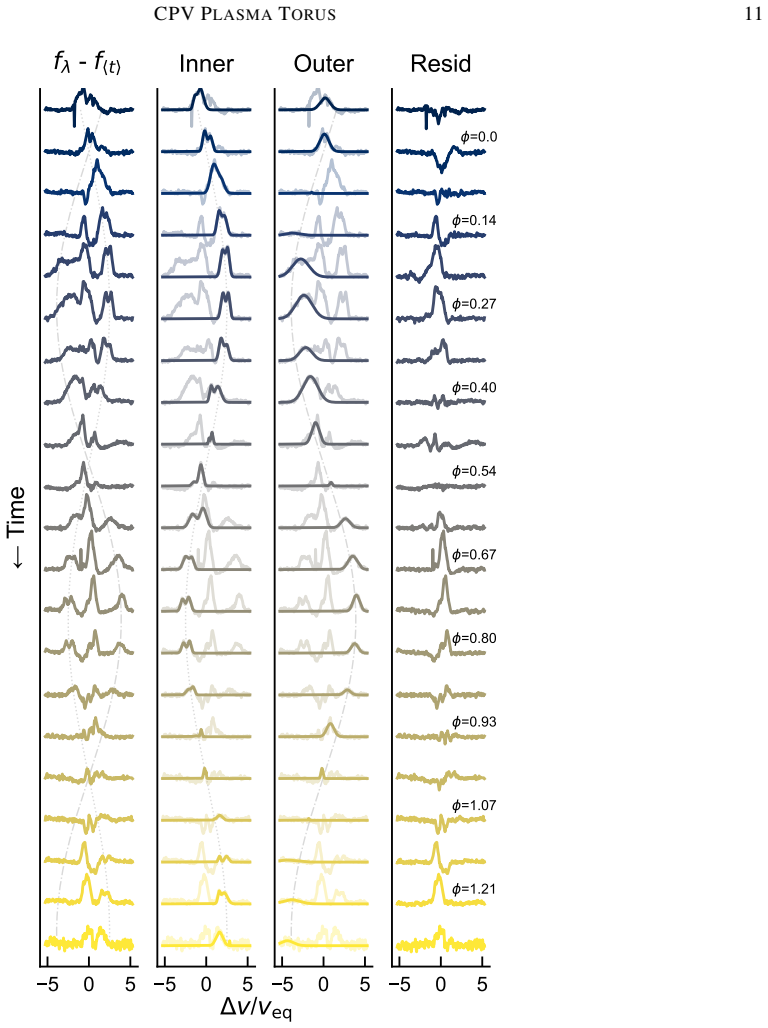
- [Figure 3; Appendix B] The notation f_t and f_λ is used in the figures and text without definition; please define these quantities in the caption or in the text near the first use.
- [References] The reference list contains a duplicate entry for Virtanen et al. (2020); one copy should be removed.
- [Table 1] The quoted veq sin i = 138±8 km/s exceeds veq = 130±4 km/s; although the difference is within the combined uncertainties, a sentence discussing the consistency of these values, or the systematic uncertainties in R* or vsini, would be helpful.
- [Abstract; Section 4.5] The statement that roughly 10% of M dwarfs may host similar structures is an extrapolation from a single object and an assumed geometric correction; the paper should state more explicitly that this is a rough estimate contingent on the CPV occurrence rate and on the assumption that the tori are present in all CPVs.
Circularity Check
No significant load-bearing circularity: the corotating-plasma detection is direct and externally checked; only the quantitative radii inherit visually chosen priors, and the paper discloses this.
-
fitted input called prediction
[Appendix B (Detailed Behavior of Hα), feeding Table 1 a0/a1/a2 and Section 3 radii]
"We assumed that the 'inner' (K_inner≈2.5v_eq) clump would be well-fit by a sum of two gaussians because it is visually double-peaked in the raw data from φ=0.15-0.35 and φ=0.65-0.85 (Figure 3b). ... This prior on the means mitigates multimodality in the likelihood by requiring the mean velocity of each component to be within a one or two v_eq of the time-variable sinusoid suggested by visual inspection."
The quantitative 'orbital radii' (Table 1: a0=2.07, a1=2.88, a2=3.88 R*) are converted from fitted semi-amplitudes (K0/veq=2.07, K1/veq=2.88, K2/veq=3.88) obtained under priors whose guiding sinusoids (K_inner≈2.5, K_outer≈3.9 veq) were chosen by visual inspection of the same spectra. The outer K2 reproduces its prior center (3.88 vs 3.9); the inner values fall inside the prior windows. The priors are wide uniform windows, and the inner fitted values sit roughly 4σ from the prior centers, so nothing is statistically forced. The central claim—sinusoidal Hα at 2-4 veq that cannot be photospheric (exceeds veq sin i) or Keplerian (required radii lie inside the star)—is directly visible in Figure 3b and does not depend on the fitted radii.
full rationale
The paper's load-bearing chain is data-driven, not definitional. High-velocity Hα emission (semi-amplitudes 2.07-3.88 veq) is directly visible in the 5-hour HIRES time series (Figure 3b) without any model fit; it exceeds the maximum photospheric Doppler shift veq sin i = 138 km/s, so it is circumstellar. The sinusoidal phase structure and the period check (P0=3.92±0.03 hr vs photometric 3.930±0.001 hr) tie the material to the stellar rotation; a Keplerian interpretation fails because the observed velocities would require orbits at roughly 0.4-1.5 R*, inside or at the stellar surface. The warped-torus interpretation is checked against external work (Townsend & Owocki 2005; Townsend 2008), which the paper explicitly tests and finds partially deficient (two predicted W-eclipses; unequal clump distances). Self-citations (Bouma et al. 2024) provide the CPV catalog, SED radii, and occurrence statistics, but none carries the spectroscopic detection. The only prior-informed quantity is the radial scale: Appendix B's orbit-fit priors are anchored to visual estimates (K_inner≈2.5, K_outer≈3.9 veq) from the same data, and the quoted radii inherit this, which the paper discloses ('suggested by visual inspection'; 'the model fits noise, not signal'). The paper also flags the factor-of-seven emissivity decay, the outer clump's instability, and the weak inclination constraint (i>63° at 2σ). These affect clump lifetime, geometry, and precise radii, not the existence of corotating cool plasma. Verdict: no load-bearing circularity; score 2 reflects the prior-informed radial scale only.
Assumptions & free parameters
free parameters (4)
- K0/v_eq (inner clump 0 Halpha velocity semi-amplitude) =
2.07 ± 0.04
- K1/v_eq (inner clump 1 Halpha velocity semi-amplitude) =
2.88 ± 0.10
- K2/v_eq (outer clump Halpha velocity semi-amplitude) =
3.88 ± 0.25
- Halpha velocity dispersion sigma_i/v_eq =
about 0.24
assumptions (5)
- domain assumption The warped-torus model of Townsend & Owocki (2005) for centrifugally supported magnetospheres applies to cool M dwarfs with strong multipolar fields.
- domain assumption The Halpha emission is dominated by case B recombination in optically thin, uniform-density plasma (scattering neglected).
- ad hoc to paper Clump orbital radii are computed assuming sin i about 1 (edge-on viewing).
- domain assumption The Halpha line width maps linearly to spatial extent under rigid corotation (sigma = Omega*r/2).
- domain assumption Stellar parameters (M=0.22±0.02 Msun, R=0.42±0.02 Rsun, age 35-150 Myr) from SED and isochrone fitting are correct.
Cite this review
Pith. "Pith review of A Plasma Torus Around a Young Low-Mass Star." pith.science (2026). https://pith.science/paper/4A76YANN
@misc{pith2026250609116,
  author       = {Pith},
  title        = {Pith review of: A Plasma Torus Around a Young Low-Mass Star},
  year         = {2026},
  howpublished = {\url{https://pith.science/paper/4A76YANN}},
  note         = {Machine review of arXiv:2506.09116}
}
abstract
A small fraction of red dwarfs younger than 100 million years show structured, periodic optical light curves suggestive of transiting opaque material that corotates with the star. However, the composition, origin, and even the existence of this material are uncertain. The main alternative hypothesis is that these complex periodic variables (CPVs) are explained by complex distributions of bright or dark regions on the stellar surfaces. Here, we present time-series spectroscopy and photometry of a rapidly-rotating ($P$=3.9 hr) CPV, TIC 141146667. The spectra show sinusoidal time-varying H$\alpha$ emission at twice to four times the star's equatorial velocity, providing direct evidence for cool ($\lesssim$10$^4$ K) plasma clumps trapped in corotation around a CPV. These data support the idea that young, rapidly-rotating M dwarfs can sustain warped tori of cool plasma, similar to other rapidly-rotating magnetic stars. Outstanding questions include whether dust clumps in these plasma tori explain CPV light curves, and whether the tori originate from the star or are fed by external sources. Rough estimates suggest $\gtrsim$10% of M dwarfs host similar structures during their early lives.
Figures


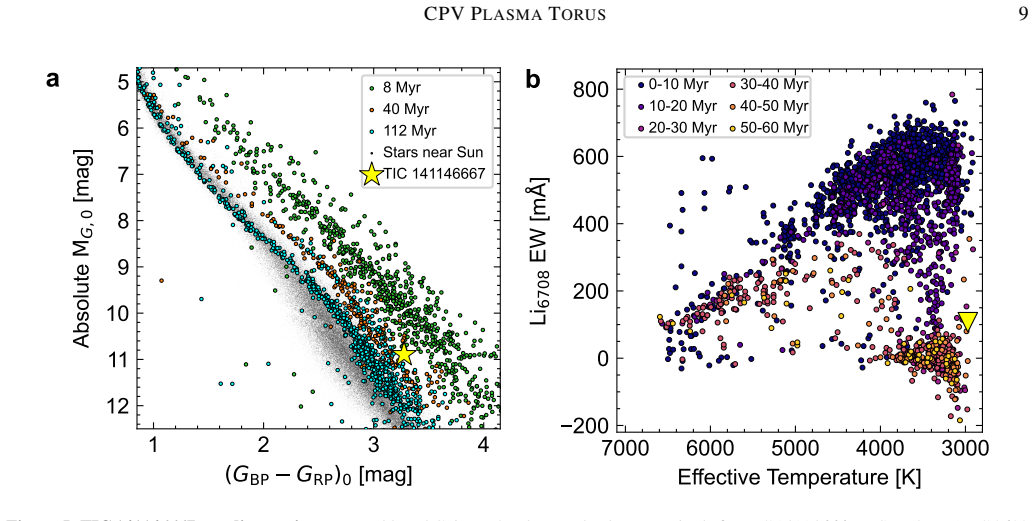
Figures from the paper (3 more)


Reference graph
Works this paper leans on
-
[1]
Allard, F., Homeier, D., & Freytag, B. 2012, Philosophical Transactions of the Royal Society A: Mathematical, Physical and Engineering Sciences, 370, 2765, doi: 10.1098/rsta.2011.0269 Astropy Collaboration, Robitaille, T. P., Tollerud, E. J., et al. 2013, A&A, 558, A33, doi: 10.1051/0004-6361/201322068 Astropy Collaboration, Price-Whelan, A. M., Sip˝ocz, ...
arXiv 2012
-
[2]
Bagenal, F., & Sullivan, J. D. 1981, J. Geophys. Res., 86, 8447, doi: 10.1029/JA086iA10p08447
-
[4]
Bellotti, S., Morin, J., Lehmann, L. T., et al. 2024, A&A, 686, A66, doi: 10.1051/0004-6361/202348043
-
[5]
Berry, I. D., Owocki, S. P., Shultz, M. E., & ud-Doula, A. 2022, MNRAS, 511, 4815, doi: 10.1093/mnras/stac322
-
[6]
2021, waqasbhatti/astrobase: astrobase v0.5.3, v0.5.3, Zenodo, Zenodo, doi: 10.5281/zenodo.1011188
Bhatti, W., Bouma, L., Joshua, et al. 2021, waqasbhatti/astrobase: astrobase v0.5.3, v0.5.3, Zenodo, Zenodo, doi: 10.5281/zenodo.1011188
-
[7]
Bildsten, L., Brown, E. F., Matzner, C. D., & Ushomirsky, G. 1997, ApJ, 482, 442, doi: 10.1086/304151
-
[8]
Bochanski, J. J., West, A. A., Hawley, S. L., & Covey, K. R. 2007, AJ, 133, 531, doi: 10.1086/510240
doi:10.1086/510240 2007
-
[9]
G., Jayaraman, R., Rappaport, S., et al
Bouma, L. G., Jayaraman, R., Rappaport, S., et al. 2024, AJ, 167, 38, doi: 10.3847/1538-3881/ad0c4c
Show all 98 references
-
[10]
G., Winn, J
Bouma, L. G., Winn, J. N., Ricker, G. R., et al. 2020, AJ, 160, 86, doi: 10.3847/1538-3881/ab9e73 Briceño, C., Calvet, N., Hernández, J., et al. 2019, AJ, 157, 85, doi: 10.3847/1538-3881/aaf79b
2020 doi
-
[11]
P., Oishi, J
Brown, B. P., Oishi, J. S., Vasil, G. M., Lecoanet, D., & Burns, K. J. 2020, ApJL, 902, L3, doi: 10.3847/2041-8213/abb9a4 CPV PLASMATORUS15 Time [BJDTDB] RV (kms −1)σ RV (kms −1) 2460357.954919 2.73 5.86 2460357.965845 -4.40 2.37 2460357.976770 -0.19 2.64 2460357.987698 3.84 2...
2020
-
[12]
R., Vedantham, H
Callingham, J. R., Vedantham, H. K., Shimwell, T. W., et al. 2021, Nature Astronomy, 5, 1233, doi: 10.1038/s41550-021-01483-0
2021 doi
-
[13]
Q., Petit, P., Donati, J
Cang, T. Q., Petit, P., Donati, J. F., & Folsom, C. P. 2021, A&A, 654, A42, doi: 10.1051/0004-6361/202141975
2021 doi
-
[14]
Q., Petit, P., Donati, J
Cang, T. Q., Petit, P., Donati, J. F., et al. 2020, A&A, 643, A39, doi: 10.1051/0004-6361/202037693
2020 doi
-
[15]
2014, MNRAS, 444, 2525, doi: 10.1093/mnras/stu1605
Chen, Y ., Girardi, L., Bressan, A., et al. 2014, MNRAS, 444, 2525, doi: 10.1093/mnras/stu1605
2014 doi
-
[16]
A., et al
Chubak, C., Marcy, G., Fischer, D. A., et al. 2012, arXiv e-prints, arXiv:1207.6212, doi: 10.48550/arXiv.1207.6212 Collier Cameron, A., & Robinson, R. D. 1989, MNRAS, 236, 57, doi: 10.1093/mnras/236.1.57 Collier Cameron, A., & Woods, J. A. 1992, MNRAS, 258, 360, doi: 10.1093/m...
-
[17]
2014, ApJ, 786, 100, doi: 10.1088/0004-637X/786/2/100
Croll, B., Rappaport, S., DeV ore, J., et al. 2014, ApJ, 786, 100, doi: 10.1088/0004-637X/786/2/100
2014 doi
-
[18]
M., Wright, E
Cutri, R. M., Wright, E. L., Conrow, T., et al. 2021, VizieR Online Data Catalog, II/328
2021
-
[19]
Dahm, S. E. 2015, ApJ, 813, 108, doi: 10.1088/0004-637X/813/2/108
2015 doi
-
[20]
Daley-Yates, S., & Jardine, M. M. 2024, MNRAS, 534, 621, doi: 10.1093/mnras/stae2131
2024 doi
-
[21]
M., & Johnston, C
Daley-Yates, S., Jardine, M. M., & Johnston, C. D. 2023, MNRAS, 526, 1646, doi: 10.1093/mnras/stad2752
2023 doi
-
[22]
2006, Science, 311, 633, doi: 10.1126/science.1121102
Donati, J.-F., Forveille, T., Collier Cameron, A., et al. 2006, Science, 311, 633, doi: 10.1126/science.1121102
2006 doi
-
[23]
F., & Landstreet, J
Donati, J. F., & Landstreet, J. D. 2009, ARA&A, 47, 333, doi: 10.1146/annurev-astro-082708-101833
2009 doi
-
[25]
T., Curtis, J
Douglas, S. T., Curtis, J. L., Agüeros, M. A., et al. 2019, ApJ, 879, 100, doi: 10.3847/1538-4357/ab2468
2019 doi
-
[26]
Draine, B. T. 2011, Physics of the Interstellar and Intergalactic Medium
2011
-
[27]
D., & Charbonneau, D
Dressing, C. D., & Charbonneau, D. 2015, ApJ, 807, 45, doi: 10.1088/0004-637X/807/1/45
2015 doi
-
[28]
J., Collier Cameron, A., Barnes, J
Dunstone, N. J., Collier Cameron, A., Barnes, J. R., & Jardine, M. 2006, MNRAS, 373, 1308, doi: 10.1111/j.1365-2966.2006.11128.x
2006
-
[29]
Feiden, G. A. 2016, A&A, 593, A99, doi: 10.1051/0004-6361/201527613
2016 doi
-
[30]
D., Montet, B
Feinstein, A. D., Montet, B. T., Ansdell, M., et al. 2020, AJ, 160, 219, doi: 10.3847/1538-3881/abac0a
2020 doi
-
[31]
Ferreira, J. M. 2000, MNRAS, 316, 647, doi: 10.1046/j.1365-8711.2000.03540.x
2000
-
[32]
France, K., Loyd, R. O. P., Youngblood, A., et al. 2016, ApJ, 820, 89, doi: 10.3847/0004-637X/820/2/89 Gagné, J., Mamajek, E. E., Malo, L., et al. 2018, ApJ, 856, 23, doi: 10.3847/1538-4357/aaae09 Gaia Collaboration, Brown, A. G. A., Vallenari, A., et al. 2018, A&A, 616, A1, d...
2016 doi
-
[33]
W., Rojas-Ayala, B., et al
Gaidos, E., Mann, A. W., Rojas-Ayala, B., et al. 2022, MNRAS, 514, 1386, doi: 10.1093/mnras/stac1433
2022 doi
-
[34]
Gray, D. F. 2008, The Observation and Analysis of Stellar Photospheres 16 BOUMA ET AL
2008
-
[35]
2018, The Journal of Open Source Software, 3, 695, doi: 10.21105/joss.00695
Green, G. 2018, The Journal of Open Source Software, 3, 695, doi: 10.21105/joss.00695
2018 doi
-
[36]
M., Schlafly, E., Zucker, C., Speagle, J
Green, G. M., Schlafly, E., Zucker, C., Speagle, J. S., & Finkbeiner, D. 2019, ApJ, 887, 93, doi: 10.3847/1538-4357/ab5362 Günther, M. N., Berardo, D. A., Ducrot, E., et al. 2022, AJ, 163, 144, doi: 10.3847/1538-3881/ac503c
2019 doi
-
[37]
E., Lada, E
Haisch, Jr., K. E., Lada, E. A., & Lada, C. J. 2001, ApJL, 553, L153, doi: 10.1086/320685
2001 doi
-
[38]
1963, Progress of Theoretical Physics, 30, 460, doi: 10.1143/PTP.30.460
Hayashi, C., & Nakano, T. 1963, Progress of Theoretical Physics, 30, 460, doi: 10.1143/PTP.30.460
1963 doi
-
[39]
W., Johnson, J
Howard, A. W., Johnson, J. A., Marcy, G. W., et al. 2010, ApJ, 721, 1467, doi: 10.1088/0004-637X/721/2/1467
2010 doi
-
[40]
G., & Storey, P
Hummer, D. G., & Storey, P. J. 1987, MNRAS, 224, 801, doi: 10.1093/mnras/224.3.801
1987 doi
-
[41]
L., & Reffert, S
Hunt, E. L., & Reffert, S. 2024, A&A, 686, A42, doi: 10.1051/0004-6361/202348662
2024 doi
-
[42]
D., et al
Hunter, J. D., et al. 2007, Computing in science and engineering, 9, 90
2007
-
[43]
O., Wende-von Berg, S., Dreizler, S., et al
Husser, T. O., Wende-von Berg, S., Dreizler, S., et al. 2013, A&A, 553, A6, doi: 10.1051/0004-6361/201219058
2013 doi
-
[44]
Jardine, M., Collier Cameron, A., & Donati, J. F. 2002, MNRAS, 333, 339, doi: 10.1046/j.1365-8711.2002.05394.x
2002
-
[45]
D., Jackson, R
Jeffries, R. D., Jackson, R. J., Wright, N. J., et al. 2023, MNRAS, 523, 802, doi: 10.1093/mnras/stad1293
2023 doi
-
[46]
M., Twicken, J
Jenkins, J. M., Twicken, J. D., McCauliff, S., et al. 2016, in Society of Photo-Optical Instrumentation Engineers (SPIE) Conference
2016
-
[47]
9913, Software and Cyberinfrastructure for Astronomy IV , ed
Series, V ol. 9913, Software and Cyberinfrastructure for Astronomy IV , ed. G. Chiozzi & J. C. Guzman, 99133E, doi: 10.1117/12.2233418
-
[48]
M., Prato, L., McLane, J
Johns-Krull, C. M., Prato, L., McLane, J. N., et al. 2016, ApJ, 830, 15, doi: 10.3847/0004-637X/830/1/15
2016 doi
-
[49]
2018, Research Notes of the American Astronomical Society, 2, 4, doi: 10.3847/2515-5172/aaa4b7
Kanodia, S., & Wright, J. 2018, Research Notes of the American Astronomical Society, 2, 4, doi: 10.3847/2515-5172/aaa4b7
2018 doi
-
[50]
Kaur, S., Viganò, D., Béjar, V . J. S., et al. 2024, A&A, 691, L17, doi: 10.1051/0004-6361/202452037
2024 doi
-
[51]
G., Fossati, L., Johnstone, C
Kislyakova, K. G., Fossati, L., Johnstone, C. P., et al. 2018, ApJ, 858, 105, doi: 10.3847/1538-4357/aabae4
2018 doi
-
[52]
2021, A&A Rv, 29, 1, doi: 10.1007/s00159-020-00130-3
Kochukhov, O. 2021, A&A Rv, 29, 1, doi: 10.1007/s00159-020-00130-3
2021 doi
-
[53]
2017, ApJL, 835, L4, doi: 10.3847/2041-8213/835/1/L4
Kochukhov, O., & Lavail, A. 2017, ApJL, 835, L4, doi: 10.3847/2041-8213/835/1/L4
2017 doi
-
[54]
2011, ApJ, 726, 24, doi: 10.1088/0004-637X/726/1/24
Kochukhov, O., Lundin, A., Romanyuk, I., & Kudryavtsev, D. 2011, ApJ, 726, 24, doi: 10.1088/0004-637X/726/1/24
2011 doi
-
[55]
2021, A&A, 647, L1, doi: 10.1051/0004-6361/202140400 —
Koen, C. 2021, A&A, 647, L1, doi: 10.1051/0004-6361/202140400 —. 2023, MNRAS, 518, 2921, doi: 10.1093/mnras/stac3276 Krtiˇcka, J., Mikulášek, Z., Kurfürst, P., & Oksala, M. E. 2022, A&A, 659, A37, doi: 10.1051/0004-6361/202141997
2021 doi
-
[56]
2020, MNRAS, 494, 62, doi: 10.1093/mnras/staa689
Lee, J., Song, I., & Murphy, S. 2020, MNRAS, 494, 62, doi: 10.1093/mnras/staa689
2020 doi
-
[57]
V ., et al
Leitzinger, M., Odert, P., Zaqarashvili, T. V ., et al. 2016, MNRAS, 463, 965, doi: 10.1093/mnras/stw1922
2016 doi
-
[58]
2008, A&A, 482, 883, doi: 10.1051/0004-6361:20078467 Mikulášek, Z., Krtiˇcka, J., Shultz, M
Marigo, P., Girardi, L., Bressan, A., et al. 2008, A&A, 482, 883, doi: 10.1051/0004-6361:20078467 Mikulášek, Z., Krtiˇcka, J., Shultz, M. E., et al. 2020, in Stellar Magnetism: A Workshop in Honour of the Career and Contributions of John D. Landstreet, ed. G. Wade, E. Alecian,...
-
[59]
1985, Ap&SS, 116, 285, doi: 10.1007/BF00653783 Open-AI
Nakajima, R. 1985, Ap&SS, 116, 285, doi: 10.1007/BF00653783 Open-AI. 2025, ChatGPT, Model o3; Conversational AI model used for editing manuscript and generating testable code; the author wrote all of the original manuscript text. https://chat.openai.com/
1985 doi
-
[60]
J., & Mamajek, E
Pecaut, M. J., & Mamajek, E. E. 2016, MNRAS, 461, 794, doi: 10.1093/mnras/stw1300
2016 doi
-
[61]
P., Wade, G
Petit, V ., Owocki, S. P., Wade, G. A., et al. 2013, MNRAS, 429, 398, doi: 10.1093/mnras/sts344
2013 doi
-
[62]
2024, ApJ, 963, 122, doi: 10.3847/1538-4357/ad1bef
Pfalzner, S., & Dincer, F. 2024, ApJ, 963, 122, doi: 10.3847/1538-4357/ad1bef
2024 doi
- [63]
-
[64]
K., Curtis, J
Popinchalk, M., Faherty, J. K., Curtis, J. L., et al. 2023, ApJ, 945, 114, doi: 10.3847/1538-4357/acb055
2023 doi
-
[65]
V ., Apai, D., & Giampapa, M
Rackham, B. V ., Apai, D., & Giampapa, M. S. 2018, ApJ, 853, 122, doi: 10.3847/1538-4357/aaa08c
2018 doi
-
[66]
A., Curtis, J
Rampalli, R., Agüeros, M. A., Curtis, J. L., et al. 2021, ApJ, 921, 167, doi: 10.3847/1538-4357/ac0c1e
2021 doi
-
[67]
2018, A&A, 612, A99, doi: 10.1051/0004-6361/201731738 Ratzenböck, S., Großschedl, J
Randich, S., Tognelli, E., Jackson, R., et al. 2018, A&A, 612, A99, doi: 10.1051/0004-6361/201731738 Ratzenböck, S., Großschedl, J. E., Möller, T., et al. 2023, A&A, 677, A59, doi: 10.1051/0004-6361/202243690
2018 doi
-
[68]
T., Lisse, C., von Hippel, T., & Mullally, F
Reach, W. T., Lisse, C., von Hippel, T., & Mullally, F. 2009, ApJ, 693, 697, doi: 10.1088/0004-637X/693/1/697
2009 doi
-
[69]
M., Stauffer, J
Rebull, L. M., Stauffer, J. R., Cody, A. M., et al. 2020, AJ, 159, 273, doi: 10.3847/1538-3881/ab893c —. 2018, AJ, 155, 196, doi: 10.3847/1538-3881/aab605
2020 doi
-
[70]
M., Stauffer, J
Rebull, L. M., Stauffer, J. R., Hillenbrand, L. A., et al. 2017, ApJ, 839, 92, doi: 10.3847/1538-4357/aa6aa4 —. 2022, AJ, 164, 80, doi: 10.3847/1538-3881/ac75f1
2017 doi
-
[71]
M., Stauffer, J
Rebull, L. M., Stauffer, J. R., Bouvier, J., et al. 2016, AJ, 152, 114, doi: 10.3847/0004-6256/152/5/114
2016 doi
- [72]
-
[73]
J., et al
Reiners, A., Shulyak, D., Käpylä, P. J., et al. 2022, A&A, 662, A41, doi: 10.1051/0004-6361/202243251 Ribas, Á., Bouy, H., & Merín, B. 2015, A&A, 576, A52, doi: 10.1051/0004-6361/201424846 CPV PLASMATORUS17
2022 doi
-
[74]
R., Winn, J
Ricker, G. R., Winn, J. N., Vanderspek, R., et al. 2015, Journal of Astronomical Telescopes, Instruments, and Systems, 1, 014003, doi: 10.1117/1.JATIS.1.1.014003
2015 doi
-
[75]
1989, Advances in Space Research, 9, 59, doi: 10.1016/0273-1177(89)90241-X
Rickman, H. 1989, Advances in Space Research, 9, 59, doi: 10.1016/0273-1177(89)90241-X
1989 doi
-
[76]
Donati, J. F. 2023, MNRAS, 518, 4734, doi: 10.1093/mnras/stac3302
2023 doi
-
[77]
E., Wade, G
Shultz, M. E., Wade, G. A., Rivinius, T., et al. 2018, MNRAS, 475, 5144, doi: 10.1093/mnras/sty103
2018 doi
-
[78]
2019, A&A, 626, A86, doi: 10.1051/0004-6361/201935315
Shulyak, D., Reiners, A., Nagel, E., et al. 2019, A&A, 626, A86, doi: 10.1051/0004-6361/201935315
2019 doi
-
[79]
M., Wisniewski, J
Silverberg, S. M., Wisniewski, J. P., Kuchner, M. J., et al. 2020, ApJ, 890, 106, doi: 10.3847/1538-4357/ab68e6
2020 doi
-
[81]
F., Cutri, R
Skrutskie, M. F., Cutri, R. M., Stiening, R., et al. 2006, AJ, 131, 1163, doi: 10.1086/498708
2006 doi
-
[82]
2017, AJ, 153, 152, doi: 10.3847/1538-3881/aa5eb9
Stauffer, J., Collier Cameron, A., Jardine, M., et al. 2017, AJ, 153, 152, doi: 10.3847/1538-3881/aa5eb9
2017 doi
-
[83]
J., et al
Stauffer, J., Rebull, L., David, T. J., et al. 2018, AJ, 155, 63, doi: 10.3847/1538-3881/aaa19d
2018 doi
-
[84]
M., Jardine, M., et al
Stauffer, J., Rebull, L. M., Jardine, M., et al. 2021, AJ, 161, 60, doi: 10.3847/1538-3881/abc7c6
2021 doi
-
[85]
Stellingwerf, R. F. 1978, ApJ, 224, 953, doi: 10.1086/156444
1978 doi
-
[86]
2020, PASJ, 72, 23, doi: 10.1093/pasj/psz145 TESS Team
Tanimoto, Y ., Yamashita, T., Ui, T., et al. 2020, PASJ, 72, 23, doi: 10.1093/pasj/psz145 TESS Team. 2021, TESS Light Curves - All Sectors, STScI/MAST, doi: 10.17909/T9-NMC8-F686
2020 doi
-
[87]
M., Rizzuto, A
Tofflemire, B. M., Rizzuto, A. C., Newton, E. R., et al. 2021, AJ, 161, 171, doi: 10.3847/1538-3881/abdf53
2021 doi
-
[88]
2018, AJ, 156, 138, doi: 10.3847/1538-3881/aad906
Tokovinin, A., & Briceño, C. 2018, AJ, 156, 138, doi: 10.3847/1538-3881/aad906
2018 doi
-
[89]
Townsend, R. H. D. 2008, MNRAS, 389, 559, doi: 10.1111/j.1365-2966.2008.13462.x
2008
-
[90]
Townsend, R. H. D., & Owocki, S. P. 2005, MNRAS, 357, 251, doi: 10.1111/j.1365-2966.2005.08642.x
2005
-
[91]
Townsend, R. H. D., Owocki, S. P., & Groote, D. 2005, ApJL, 630, L81, doi: 10.1086/462413 TRAPPIST-1 JWST Community Initiative, de Wit, J., Doyon, R., et al. 2024, Nature Astronomy, 8, 810, doi: 10.1038/s41550-024-02298-5 Van Der Walt, S., Colbert, S. C., & Varoquaux, G. 2011,...
2005 doi
-
[92]
2015, Astrophysics and Space Science
Vial, J.-C., & Engvold, O. 2015, Astrophysics and Space Science
2015
-
[93]
415, Solar Prominences, doi: 10.1007/978-3-319-10416-4
Library, V ol. 415, Solar Prominences, doi: 10.1007/978-3-319-10416-4
-
[94]
A., Jardine, M., Opher, M., Donati, J
Vidotto, A. A., Jardine, M., Opher, M., Donati, J. F., & Gombosi, T. I. 2011, MNRAS, 412, 351, doi: 10.1111/j.1365-2966.2010.17908.x Villarreal D’Angelo, C., Jardine, M., Johnstone, C. P., & See, V . 2019, MNRAS, 485, 1448, doi: 10.1093/mnras/stz477
2011
-
[95]
I., & Jenkins, J
Vines, J. I., & Jenkins, J. S. 2022, MNRAS, 513, 2719, doi: 10.1093/mnras/stac956
2022 doi
-
[97]
E., et al
Virtanen, P., Gommers, R., Oliphant, T. E., et al. 2020, Nature Methods, 17, 261, doi: 10.1038/s41592-019-0686-2 V ogt, S. S., Allen, S. L., Bigelow, B. C., et al. 1994, SPIE Conference Series, ed. D. L. Crawford & E. R. Craine, V ol. 2198
2020 doi
-
[98]
Waugh, R. F. P., & Jardine, M. M. 2022, MNRAS, 514, 5465, doi: 10.1093/mnras/stac1698
2022 doi
-
[99]
G., Henry, T
Winters, J. G., Henry, T. J., Jao, W.-C., et al. 2019, AJ, 157, 216, doi: 10.3847/1538-3881/ab05dc
2019 doi
-
[100]
L., Mann, A
Wood, M. L., Mann, A. W., Barber, M. G., et al. 2023, AJ, 165, 85, doi: 10.3847/1538-3881/aca8fc
2023 doi
-
[101]
G., Adelman, J., Anderson, John E., J., et al
York, D. G., Adelman, J., Anderson, John E., J., et al. 2000, AJ, 120, 1579, doi: 10.1086/301513
2000 doi
-
[102]
N., Rappaport, S., et al
Zhan, Z., Günther, M. N., Rappaport, S., et al. 2019, ApJ, 876, 127, doi: 10.3847/1538-4357/ab158c
2019 doi
Reviewed August 7, 2026 · model on record in the stance chip above.
Discussion (0). Sign in to comment.