REVIEW 4 major objections 4 minor 48 references
Adaptive Bandwidth Sharing for Optimizing QoE of Real-Time Video
T0 review · 4 major / 4 minor · reviewed 2026-08-07 · deepseek-v4-flash
Pith's one-line read This paper claims that a semi-static bandwidth-sharing policy, coordinating only once per hyperperiod, reaches a total QoE within $O(1/V)$ of the optimal static-sharing policy whenever a fixed-sharing policy can meet the 95% quality…
desk verdict The ABS policy is a plausible engineering contribution with encouraging simulations, but Theorem 1's O(1/V) guarantee is not actually established; the proof gaps are real but fixable, so it deserves a serious referee. read the letter →
The pith
A machine-rendered reading of the paper's core claim, the machinery that carries it, and where it could break.
The reading
What carries the argument
ABS, the Adaptive Bandwidth-sharing and Scheduling policy, is the central object. Its two mechanisms are the virtual queue $P_{r,n}^i(k)$, which tracks a client's accumulated shortfall against the smoothed 95% quality constraint through the update $(P+(Q_{\min}-Q+\alpha)^+-0.05\alpha)^+$, and the sharing update $S_{t+1}=\Pi_\Omega(S_t-\eta g(S_t,A_t))$, where $g$ is assembled from the Lagrange multipliers of the per-region constraints in the period scheduling problem. That update is a projected stochastic gradient ascent on the hyperperiod value function, and the proof's Lyapunov function $L=\frac12\sum (P_{r,n}^i)^2+\frac{1}{2\eta}\|S_t-S^{**}\|^2$ couples the two: the negative queue squared terms show the quality constraints are met, while the objective terms yield the $O(1/V)$ optimality gap. The hyperperiod length $H$ is the tunable knob: it sets how often operators coordinate.
What would settle it
Using the paper's simulation parameters (two operators, two regions, 30 clients each, Bernoulli arrivals with rates 0.1 and 0.9, $Q_{\min}=0.3$, $\alpha=0.008$, $T=20$, channel capacity $10^7$ bits per timeslot), compute the minimum of $E[(Q_{\min}-Q(\tau)+\alpha)^+]$ over stationary randomized static-sharing policies. If that minimum is not strictly below $0.0004=0.05\alpha$, strict static feasibility fails and Theorem 1's premise is absent in exactly the regime where the paper demonstrates convergence.
Extended reading notes
Core claim
The central claim is that the difficult joint problem of dynamic sharing and scheduling can be replaced, at negligible QoE cost, by a semi-static policy. ABS keeps the sharing vector $S_t$ fixed during hyperperiod $P_t$, solves per period a convex scheduling problem $RA(S_t,A(k))$ that maximizes total video quality minus virtual-queue penalties, and then updates $S_{t+1}=\Pi_\Omega(S_t-\eta g(S_t,A_t))$ using the optimal Lagrange multipliers of the per-region resource constraints. The proof of Theorem 1 shows that this update is a projected gradient step on the expected per-hyperperiod optimal value, and a Lyapunov-drift argument with virtual queues drains the quality deficits while the $V$-scaled objective term yields the $O(1/V)$ optimality gap. In the paper's own summary, the policy converges to the optimal static sharing policy irrespective of initial conditions or fluctuations in arrival rates. The simulation section additionally claims that optimal static sharing achieves performance nearly equivalent to optimal dynamic sharing, so the coordination savings are not bought with much QoE.
Load-bearing premise
The whole guarantee depends on strict static feasibility: some stationary randomized policy with fixed sharing must already satisfy $E[(Q_{\min}-Q+\alpha)^+]\le \kappa\,0.05\,\alpha$ with $0<\kappa<1$ for every client, so the quality target is met with a strict margin by a policy that does not see the future.
Editorial extensions
If this is right
- For any strictly static feasible target, ABS reaches a long-run average total QoE within $O(1/V)$ of the optimal stationary randomized static-sharing policy, and $V$ can be chosen large enough to make the gap arbitrarily small.
- ABS satisfies the smoothed 95% minimum-quality constraint in the long run, so clients with hard deadlines get the quality-percentile guarantee without per-period inter-operator negotiation.
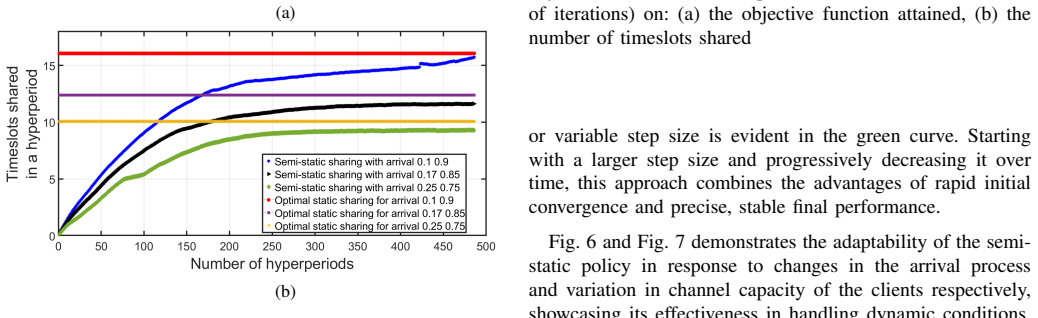
- The convergence statement holds irrespective of the initial sharing configuration and of fluctuations in arrival rates, which the simulations confirm for different starting points and different arrival processes.
- In the simulated two-operator, two-region setting, static sharing captures most of the QoE gain of dynamic sharing, so the coordination savings of ABS come at little performance cost.
- Step size controls the trade-off: too large a step converges fast but misses the optimum, too small a step is accurate but slow, and an annealed step size combines fast initial progress with accurate final convergence.
Reading between the lines
- A finite-horizon statement is left implicit: the theorem is asymptotic in the number of hyperperiods, so a natural next step is a regret bound showing how $V$, the hyperperiod length $H$, and the step size $\eta$ trade off over a fixed number of hyperperiods.
- The manuscript says the proofs of Lemma 2 (convexity of OPT-SS*) and Lemma 4 (convexity of the value function in $S_t$) are omitted for brevity; both supply the convexity on which the projected-gradient update rests, so filling in those proofs would complete the chain backing Theorem 1.
- Because the Lagrange multipliers already measure the marginal value of an extra shared timeslot, the same update could be reinterpreted as a price-based coordination market among operators, moving toward the incentive mechanisms the paper lists as future work.
- Since the optimality benchmark is a static-sharing policy, ABS inherits the static-versus-dynamic gap; a testable prediction is that this gap widens under strong arrival imbalance or channel variability, in which case the hyperperiod would have to shrink to keep the semi-static policy near-optimal.
Editorial analysis
A structured set of objections, weighed in public.
Referee Report
Summary. The paper proposes ABS, an adaptive semi-static bandwidth-sharing policy for multi-operator wireless networks serving real-time video. Sharing variables are updated once per hyperperiod by a projected stochastic-gradient step, while per-period client scheduling is obtained by solving a convex resource-allocation problem with a virtual-queue penalty for the long-run minimum-quality constraint. The main theoretical claim is Theorem 1: under a strict static-feasibility condition, ABS satisfies the sharing and minimum-quality constraints and attains an objective within O(1/V) of the optimal stationary randomized policy with static sharing. The paper also reports simulations comparing ABS with optimal static and dynamic sharing policies, studying effects of step size, hyperperiod length, and arrival/channel variability.
Significance. If the O(1/V) guarantee were fully established, the paper would make a useful contribution: it proposes a concrete, low-coordination mechanism for inter-operator bandwidth sharing with a QoE-aware scheduling component, and it gives a convex relaxation plus a Lyapunov/SGD-style proof architecture that is credible in outline. The authors also provide a clear algorithm, parameter studies, and comparisons against baselines. However, the current proof has a load-bearing gap concerning the boundedness of the stochastic gradient, one supporting convexity lemma is asserted without proof, and the optimality benchmark is internally weaker than the abstract's claim about the optimal static-sharing policy. These issues prevent the central theoretical claim from being accepted as stated.
major comments (4)
- [Appendix B, Lemma 5 and Lemma 7] The O(1/V) claim rests on a uniform upper bound C on E[||g(St, At)||^2 | Theta] in (24), (28), and (32), used in the final gap (43). The proof after (29) asserts that the gradient is bounded because Q is twice differentiable on a compact set. That only bounds Q' with respect to tau; it does not bound the Lagrange multipliers in (18). For RA(St, A(k)), KKT stationarity for a tight per-region constraint (16) gives lambda_i^r = (V + P_i^r,n(k)) Q'(tau*_i^r,n) when the penalty term is active, so lambda, and hence g, scale with V and with the virtual-queue state P. Lemma 6 controls only time averages of P, not a uniform bound independent of V. If C = Theta(V^2), then the term eta C/(2V) in (43) is Theta(V), and the stated O(1/V) optimality gap in Theorem 1 is not established. This needs to be repaired either by proving a true V-uniform bound on the second moment of g or by restating the guarantee with the correct dependence on V and the queue backlog.
- [Appendix B, Lemma 4] Convexity of F_k(tau*(S_t, k), A_t) as a function of S_t is load-bearing: it converts (30) into (31), and hence produces the -2 eta [f(S_t) - f(S**)] term in the drift bound. The proof is omitted and replaced by a citation to Corollary 2.2 of [47]. Given that the entire drift-plus-penalty argument depends on this inequality, the authors should either supply the argument or state exactly which hypotheses of the cited theorem are verified for the parametric program RA(S_t, A(k)).
- [Section V-A and abstract] The benchmark in Theorem 1 is the asymptotically optimal stationary randomized policy with static sharing defined by OPT-SS*, i.e., the convex relaxation with constraint (9), not the original optimal static-sharing problem OPT-SS. Lemma 1 shows only that enforcing (8) implies constraint (1); it does not establish equivalence, and OPT-SS* replaces the expectation by a time average. Therefore the abstract's statement that ABS 'converges to the optimal static sharing policy' and the analogous wording in the conclusion are stronger than what is proved. The claims should be restated relative to OPT-SS*, or an equivalence between the relaxation and OPT-SS must be established.
- [Section VI-A and Theorem 1 hypothesis] The strict static feasibility condition (20) is the hypothesis under which Theorem 1 applies, yet the simulations never verify that this condition holds in any of the reported scenarios. The paper itself notes that the no-sharing baseline is infeasible for Qmin = 0.3, which shows the condition is doing real work. The authors should check (20) for the simulation parameters, or otherwise limit the empirical claims to the feasible regime; otherwise the numerical experiments do not demonstrate the theorem's regime.
minor comments (4)
- [Appendix B] There is a typo in the first sentence: 'thoerem' should be 'theorem'.
- [Notation] The symbol P is used both for the set of periods in a hyperperiod, P_t, and for the virtual-queue array P(k); this is confusing in Section V and in the proof and should be disambiguated.
- [Section IV-C] Lemma 2's convexity argument is only sketched; a one-sentence justification that (Qmin - Q(tau) + alpha)_+ is convex in tau because Q is concave and increasing would remove any doubt.
- [Section VI-B, Fig. 5] The adaptive/variable step-size curve ('green curve') is described in the text, but no adaptive step-size rule is defined in Algorithm 1 or in the parameter table; this makes the simulation result hard to reproduce.
Circularity Check
No significant circularity: the ABS optimality proof is self-contained and the benchmark is explicitly the relaxed objective (10); no fitted parameter is relabeled as a prediction.
full rationale
I traced the claimed derivation chain in Sections IV, V, and Appendix B. The main result, Theorem 1, is proved by a standard drift-plus-penalty / convex-optimization argument: the sharing update is the stochastic gradient of the per-period objective (Lemma 3), convexity is invoked from external results (Boyd-Vandenberghe, Fiacco-Kyparisis), and the O(1/V) gap is derived by telescoping a Lyapunov function, not by definition. No parameter is fitted to data and then reported as a prediction; the constants B, C, D in Lemma 5 are asserted bounds used inside the proof, not fitted quantities. The self-citations [26] and [33] state prior modeling context and are not load-bearing for Theorem 1. The only notable point is that the theorem's benchmark is defined by the paper's own relaxed objective (10), and the abstract phrases this as convergence to the 'optimal static sharing policy'; that is a potential overstatement or correctness gap, but the comparison object is explicitly defined rather than smuggled in, so it is not circularity. Any concern about whether the bound C is truly uniform in V is a proof-validity issue, not an input-equivalence issue.
Assumptions & free parameters
free parameters (4)
- alpha (quality constraint slack) =
0.008
- V (Lyapunov penalty parameter) =
not specified
- step size eta =
0.01 (0.1 and 0.0001 also studied)
- hyperperiod length H =
20 periods
assumptions (7)
- domain assumption Packet arrivals and channel capacities are i.i.d. across periods and independent across clients.
- domain assumption The quality function Q is twice differentiable, increasing, and concave in the allocated timeslots.
- domain assumption Timeslot allocations tau are treated as continuous variables.
- ad hoc to paper Strict static feasibility: a stationary randomized static-sharing policy exists satisfying (20) with 0 < kappa < 1.
- domain assumption The time-average constraint (9) is a valid proxy for the expectation constraint (8) and the original 95th percentile guarantee (1).
- standard math The optimal value of the scheduling problem is convex in S (Lemma 4).
- standard math The Lagrange multiplier sensitivity result used in Lemma 3.
Cite this review
Pith. "Pith review of Adaptive Bandwidth Sharing for Optimizing QoE of Real-Time Video." pith.science (2026). https://pith.science/paper/IZCWKZUY
@misc{pith2026250609197,
  author       = {Pith},
  title        = {Pith review of: Adaptive Bandwidth Sharing for Optimizing QoE of Real-Time Video},
  year         = {2026},
  howpublished = {\url{https://pith.science/paper/IZCWKZUY}},
  note         = {Machine review of arXiv:2506.09197}
}
read the original abstract
The concept of spectrum or bandwidth sharing has gained significant global attention as a means to enhance the efficiency of real-time traffic management in wireless networks. Effective bandwidth sharing enables optimal utilization of available resources, reducing congestion and improving QoE for delay-sensitive applications such as real-time video transmission. In this paper, we propose a novel iterative semi-static bandwidth sharing policy that balances the advantages of both static and dynamic sharing approaches. Our approach minimizes the frequency of coordination between network operators while ensuring efficient resource allocation and meeting the stringent QoE demands of real-time traffic. The proposed policy iteratively optimizes both the spectrum sharing between operators and the resource allocation for individual clients. We establish strong theoretical guarantees for the optimality of the proposed policy and prove that it converges to the optimal static sharing policy irrespective of initial conditions or fluctuations in traffic arrival rates. Additionally, we conduct extensive simulations to evaluate the impact of key system parameters - including step size, hyperperiod length, and arrival process dynamics - on the performance of our policy. Our results demonstrate the effectiveness of the proposed approach in achieving near-optimal bandwidth allocation with reduced overhead, making it a practical solution for real-time wireless applications.
Figures


Figures from the paper (4 more)



Reference graph
Works this paper leans on
-
[33]
Maximizing Real-Time Video QoE via Bandwidth Sharing under Markovian setting
S. A. George and V . Joseph, “Maximizing real-time video QoE via bandwidth sharing under markovian setting,” 2024. [Online]. Available: https://arxiv.org/abs/2401.10681
work page Pith review arXiv 2024
-
[47]
A. V . Fiacco and J. Kyparisis, “Convexity and concavity properties of the optimal value function in parametric nonlinear programming,” Journal of optimization theory and applications, vol. 48, no. 1, pp. 95–126, 1986
work page 1986
-
[1]
Video conferencing market size, growth trends, 2027 report
GMI Global Market Insights, “Video conferencing market size, growth trends, 2027 report.” [Online]. Available: https://www.gminsights.com/ industry-analysis/video-conferencing-market
work page 2027
-
[2]
Available: https://www.meticulousresearch.com/ product/live-streaming-market-5225
Meticulous Research, “Live streaming market by component (platform, services), offering model (B2B, B2C), streaming type (audio, video, game), vertical (media & entertainment, education, sports & gaming, government, fitness), and region - global forecast to 2028.” [Online]. Available: https://www.meticulousresearch.com/ product/live-streaming-market-5225
-
[3]
Enhancing connectivity through spectrum sharing- a white paper,
Policy Impact Partners, Dynamic Spectrum Alliance, “Enhancing connectivity through spectrum sharing- a white paper,” September 2019. [Online]. Available: https://dynamicspectrumalliance.org/wp-content/uploads/2019/10/ Enhancing-Connectivity-Through-Spectrum-Sharing.pdf
work page 2019
-
[4]
Ofcom, “The future role of spectrum sharing for mobile and wireless data services - Licensed sharing, Wi-Fi, and dynamic spectrum access.” [Online]. Available: https://www.ofcom.org.uk/ consultations-and-statements/category-1/spectrum-sharing
-
[5]
National Institute of Standards and Technology, US Department of Commerce. Spectrum sharing. [Online]. Available: https://www.nist. gov/advanced-communications/spectrum-sharing
-
[6]
Spectrum sharing guidelines 2021
Department of Telecommunications, Government of India, “Spectrum sharing guidelines 2021.” [Online]. Available: https: //dot.gov.in/spectrummanagement/spectrum-sharing-guidelines-2021
work page 2021
Show all 48 references
-
[7]
Spectrum leasing,
Federal Communications Commission (FCC), “Spectrum leasing,” Oc- tober 2003. [Online]. Available: https://www.fcc.gov/spectrum-leasing
2003
-
[8]
Spectrum leasing in the 5G era,
GSMA, “Spectrum leasing in the 5G era,” January 2022
2022
-
[9]
Citizens broadband ra- dio service,
Title 47 Code of Federal Regulations Part 96, “Citizens broadband ra- dio service,” 2019
2019
-
[10]
3GPP TS 32.130: Telecommunication management; Network sharing; Concepts and requirements,
3rd Generation Partnership Project (3GPP), “3GPP TS 32.130: Telecommunication management; Network sharing; Concepts and requirements,” 3GPP, Tech. Rep., 2024. [Online]. Available: https: //www.3gpp.org/ftp/Specs/archive/32 series/32.130/
2024
-
[11]
Ericsson sets up japan’s first multi-operator RAN with KDDI and softbank,
Ericsson, “Ericsson sets up japan’s first multi-operator RAN with KDDI and softbank,” June 2021. [Online]. Available: https://www.ericsson.com/en/press-releases/2021/6/ ericsson-sets-up-japans-first-multi-operator-ran-with-kddi-and-softbank
2021
-
[12]
Ericsson selected by APT for first 5G multi- operator core network in Taiwan,
——, “Ericsson selected by APT for first 5G multi- operator core network in Taiwan,” January 2021. [Online]. Available: https://www.ericsson.com/en/press-releases/2021/1/ ericsson-selected-by-apt-for-first-5g-multi-operator-core-network-in-taiwan
2021
-
[13]
White paper-huawei observation to NFV,
Huawei Technologies, “White paper-huawei observation to NFV,” 2013
2013
-
[14]
Optus readies to deploy multi-operator 5G radio dot system
Ericsson. Optus readies to deploy multi-operator 5G radio dot system. [Online]. Available: https://www.ericsson.com/en/press-releases/7/2024/ optus-readies-to-deploy-multi-operator-5g-radio-dot-system
2024
-
[15]
Exploiting different cognition levels of channel information in transmission scheduling of two sources over time varying wireless channels,
M. Kashef and A. Ephremides, “Exploiting different cognition levels of channel information in transmission scheduling of two sources over time varying wireless channels,” IEEE Transactions on Cognitive Communications and Networking , vol. 1, no. 3, pp. 284–293, 2015
2015
-
[16]
On the value of coordi- nation and delayed queue information in multicellular scheduling,
A. Gopalan, C. Caramanis, and S. Shakkottai, “On the value of coordi- nation and delayed queue information in multicellular scheduling,” IEEE Transactions on Automatic Control, vol. 58, no. 6, pp. 1443–1456, 2013
2013
-
[17]
Resource allocation and cross-layer control in wireless networks,
L. Georgiadis, M. Neely, and L. Tassiulas, “Resource allocation and cross-layer control in wireless networks,” Foundations and Trends in Networking, vol. 1, 01 2006
2006
-
[18]
Periodic updates for constrained oco with application to large-scale multi-antenna systems,
J. Wang, M. Dong, B. Liang, and G. Boudreau, “Periodic updates for constrained oco with application to large-scale multi-antenna systems,” IEEE Transactions on Mobile Computing , vol. 22, no. 11, pp. 6705– 6722, 2022
2022
-
[19]
A theory of QoS for wireless,
I.-H. Hou, V . Borkar, and P. R. Kumar, “A theory of QoS for wireless,” in IEEE INFOCOM 2009 , 2009, pp. 486–494
2009
-
[20]
Scheduling heterogeneous real-time traffic over fading wireless channels,
I.-H. Hou, “Scheduling heterogeneous real-time traffic over fading wireless channels,” IEEE/ACM Transactions on Networking , vol. 22, no. 5, pp. 1631–1644, 2013
2013
-
[21]
Scheduling heterogeneous real-time traffic over fading wireless channels,
I.-H. Hou and P. R. Kumar, “Scheduling heterogeneous real-time traffic over fading wireless channels,” in 2010 Proceedings IEEE INFOCOM , 2010, pp. 1–9
2010
-
[22]
Age-based scheduling: Improving data freshness for wireless real-time traffic,
N. Lu, B. Ji, and B. Li, “Age-based scheduling: Improving data freshness for wireless real-time traffic,” in Proceedings of the eighteenth ACM international symposium on mobile ad hoc networking and computing , 2018, pp. 191–200
2018
-
[23]
On the power of randomization for scheduling real-time traffic in wireless networks,
C. Tsanikidis and J. Ghaderi, “On the power of randomization for scheduling real-time traffic in wireless networks,” IEEE/ACM Trans- actions on Networking , vol. 29, no. 4, pp. 1703–1716, 2021
2021
-
[24]
Age-optimal scheduling for heterogeneous traffic with timely throughput constraints,
J. Sun, L. Wang, Z. Jiang, S. Zhou, and Z. Niu, “Age-optimal scheduling for heterogeneous traffic with timely throughput constraints,” IEEE Journal on Selected Areas in Communications , vol. 39, no. 5, pp. 1485– 1498, 2021
2021
-
[25]
Timely- throughput optimal scheduling for wireless flows with deep reinforce- ment learning,
Q. Wang, C. He, K. Jaffr `es-Runser, J. Huang, and Y . Xu, “Timely- throughput optimal scheduling for wireless flows with deep reinforce- ment learning,” in 2022 IEEE/ACM 30th International Symposium on Quality of Service (IWQoS) , 2022, pp. 1–11
2022
-
[26]
Optimizing bandwidth sharing for real- time traffic in wireless networks,
S. A. George and V . Joseph, “Optimizing bandwidth sharing for real- time traffic in wireless networks,” in ICC 2023 - IEEE International Conference on Communications , 2023, pp. 3199–3204
2023
-
[27]
Joint source adaptation and resource allocation for multi-user wireless video stream- ing,
J. Huang, Z. Li, M. Chiang, and A. K. Katsaggelos, “Joint source adaptation and resource allocation for multi-user wireless video stream- ing,” IEEE Transactions on Circuits and Systems for Video Technology , vol. 18, no. 5, pp. 582–595, 2008
2008
-
[28]
A systematic framework for dynamically optimizing multi-user wireless video transmission,
F. Fu and M. Van Der Schaar, “A systematic framework for dynamically optimizing multi-user wireless video transmission,” IEEE Journal on Selected Areas in Communications , vol. 28, no. 3, pp. 308–320, 2010
2010
-
[29]
Jointly optimizing multi-user rate adaptation for video transport over wireless systems: Mean-fairness- variability tradeoffs,
V . Joseph and G. De Veciana, “Jointly optimizing multi-user rate adaptation for video transport over wireless systems: Mean-fairness- variability tradeoffs,” in 2012 Proceedings IEEE INFOCOM . IEEE, 2012, pp. 567–575
2012
-
[30]
The relationship among video quality, screen resolution, and bit rate,
G. Cermak, M. Pinson, and S. Wolf, “The relationship among video quality, screen resolution, and bit rate,” IEEE transactions on broad- casting, vol. 57, no. 2, pp. 258–262, 2011
2011
-
[31]
T. M. Cover, Elements of information theory . John Wiley & Sons, 1999
1999
-
[32]
Troubleshoot Webex calling media quality in control hub
Webex-Help Center, “Troubleshoot Webex calling media quality in control hub.” [Online]. Available: https://help.webex.com/en-us/article/ frj1efb/Troubleshoot-Webex-Calling-Media-Quality-in-Control-Hub
-
[34]
Boyd and L
S. Boyd and L. Vandenberghe, Convex optimization . Cambridge university press, 2004
2004
-
[35]
Choosing the right video format
Adobe, “Choosing the right video format.” [Online]. Available: https:// www.adobe.com/in/creativecloud/video/discover/best-video-format.html
-
[36]
Video codec
Wikipedia, “Video codec.” [Online]. Available: https://en.wikipedia.org/ wiki/Video codec
-
[37]
Video codecs and encoding: Everything you should know
Wowza Media Systems, “Video codecs and encoding: Everything you should know.” [Online]. Available: https://www.wowza.com/blog/ video-codecs-encoding
-
[38]
Real-time media calls and meetings with microsoft teams
Microsoft, “Real-time media calls and meetings with microsoft teams.” [Online]. Available: https://learn.microsoft.com/en-us/microsoftteams/ platform/bots/calls-and-meetings/real-time-media-concepts
-
[39]
Conference room connector supported devices
Zoom Video Communications, “Conference room connector supported devices.” [Online]. Available: https://support.zoom.us/hc/en-us/articles/ 202445433-Conference-Room-Connector-supported-devices
-
[40]
Known issues and limitations for webex video
Webex, “Known issues and limitations for webex video.” [Online]. Available: https://help.webex.com/en-us/article/gw8u4j/ Known-issues-and-limitations-for-Webex-video 14
-
[41]
5G new radio evaluation against IMT-2020 key performance indicators,
M. Fuentes et al. , “5G new radio evaluation against IMT-2020 key performance indicators,” IEEE Access , vol. 8, pp. 110 880–110 896, 2020
2020
-
[42]
Estimating the mid-band spec- trum needs in the 2025-2030 time frame
Coleago Consulting Ltd, “Estimating the mid-band spec- trum needs in the 2025-2030 time frame.” [Online]. Available: https://www.gsma.com/spectrum/wp-content/uploads/2021/ 07/Estimating-Mid-Band-Spectrum-Needs.pdf
2025
-
[43]
SD vs HD resolution: What are the main differences? [Online]
Boris FX. SD vs HD resolution: What are the main differences? [Online]. Available: https://borisfx.com/blog/ sd-vs-hd-resolution-the-main-differences/
-
[44]
What are video resolutions? [Online]
Resi Media LLC. What are video resolutions? [Online]. Available: https://resi.io/glossary/video-resolutions/
-
[45]
Prepare your network for meet meetings & live streams
Google. Prepare your network for meet meetings & live streams. [Online]. Available: https://support.google.com/a/answer/ 1279090?hl=en#zippy=%2Cstep-review-bandwidth-requirements% 2Cstep-set-up-outbound-ports-for-media-traffic% 2Cstep-allow-access-to-uniform-resource-identifie...
-
[46]
Bitrate vs
Dacast. Bitrate vs. resolution for professional broadcasting. [Online]. Available: https://www.dacast.com/blog/bitrate-vs-resolution/#: ∼: text=Bitrate%20and%20resolution%20are%20two%20important% 20measures%20which%20go%20together,difference%20to%20your% 20video%20quality
-
[48]
Hajek, Random processes for engineers
B. Hajek, Random processes for engineers. Cambridge university press, 2015
2015
Reviewed August 7, 2026 · model on record in the stance chip above.
Discussion (0). Sign in to comment.