REVIEW 5 major objections 7 minor 31 references
Power Diagram Enhanced Adaptive Isosurface Extraction from Signed Distance Fields
T0 review · 5 major / 7 minor · reviewed 2026-08-07 · deepseek-v4-flash
Pith's one-line read The paper claims that isosurface extraction from signed distance fields can be made adaptive by building a power diagram from SDF samples weighted by squared distances, reading the mesh from its dual regular Delaunay tetrahedralization…
desk verdict A promising isosurface extraction method that pairs power diagrams with regular Delaunay refinement, but the theoretical support is incomplete and the paper lacks code/data; it deserves peer review with major revisions. read the letter →
The pith
A machine-rendered reading of the paper's core claim, the machinery that carries it, and where it could break.
The reading
What carries the argument
The key objects are the power diagram — a weighted Voronoi partition in which each sample owns the region where its squared distance minus its assigned weight is minimal — and its dual, the regular Delaunay tetrahedralization. The paper separates sites into two categories — inner samples together with outer projections, versus outer samples together with inner projections — so that every tetrahedron mixing the two categories splits as 2-2 or 1-3, and then applies edge-based dualization rules that turn each such tetrahedron into a triangular or quadrilateral surface patch. The deviation metric δ(△), defined as the integral over a face of the component of the SDF gradient orthogonal to the face normal, is the signal that decides where the next sample is placed: the face with the largest δ is refined by inserting the dual vertex of its tetrahedron and that vertex's surface projection. The locality of regular Delaunay insertion is what makes the refinement cheap, since each update touches only the affected neighborhood.
What would settle it
Take a signed distance field with a known analytic surface, run the method from a coarse uniform sample set, and inspect the output mesh for boundary edges, non-manifold edges, or triangles that cross an inner or outer tangent sphere; any such defect would show the dualization rules do not always give the claimed valid surface. A more direct check is to enumerate all assignments of the four site types to the vertices of a single tetrahedral cell and verify that the four edge-based dual vertices form one consistently oriented patch whose edges match the neighboring cells.
Extended reading notes
Core claim
The central discovery, stated on the paper's own terms, is that a power diagram constructed from SDF sample sites with squared distances as weights has a boundary which lies between the inner and outer tangent spheres without intersecting them, and that adding each sample's projection onto the zero level set as an extra site forces the diagram's boundary to become tangent to the surface at those projection points. Because direct power-diagram boundaries are geometrically unstable, the paper extracts the surface mesh from the regular Delaunay tetrahedralization dual to the power diagram: each tetrahedron whose vertices come from both site categories is dualized into a triangle or quadrilateral that represents the surface patch inside that tetrahedron, using per-edge rules that interpolate between the relevant site positions. The regular Delaunay complex supports localized incremental insertion, so adding a new sample only rewrites a small neighborhood of the complex and of the extracted mesh. The paper's second claimed discovery is that the integrated misalignment between the SDF gradient and the face normal is an effective proxy for reconstruction error, and that greedily sampling at the face with the largest such misalignment progressively corrects both geometry and topology until a budget or tolerance is reached. On the paper's evidence, this combination recovers fine details and complex topologies that prior methods miss, and does so with a per-insertion cost that remains roughly constant.
Load-bearing premise
The load-bearing premise is that every tetrahedral cell whose corners mix the two categories of sample sites can always be converted into a surface patch, using the paper's listed edge rules, in a way that joins neighboring patches into a watertight mesh; the paper states this without proof.
Editorial extensions
If this is right
- On fixed uniform grid inputs, the paper reports Chamfer distance 2.68e-5 at 30^3 resolution versus 11.5e-5 for the closest prior method, with the gap widening as resolution increases.
- Because each inserted sample changes only a local neighborhood of the regular Delaunay complex, the time per insertion stays roughly constant and the total cost scales approximately linearly with the point count on the tested models.
- The dual patch construction produces meshes with both triangles and quadrilaterals, avoiding the zigzag artifacts seen when power diagram boundaries are used directly.
- Adding surface projections as extra sites makes the extracted mesh tangent to the true surface at those projections, which the paper argues is what preserves thin structures, sharp features, and high-genus topology.
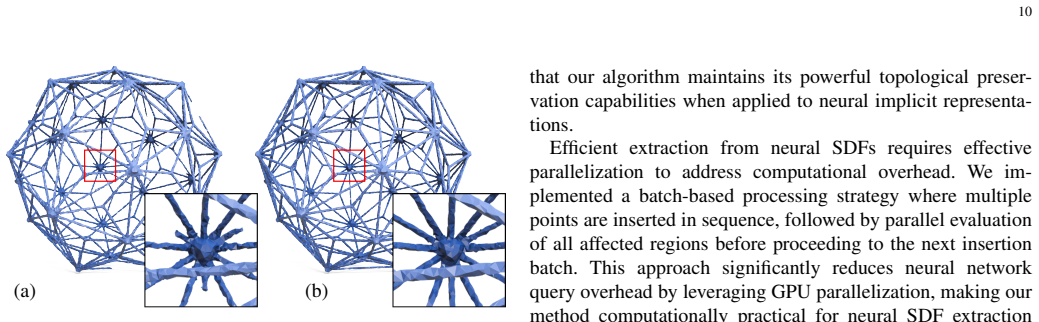
- The same adaptive loop works on neural SDFs such as SIREN and VolSDF, with batched insertion used to keep the number of network queries manageable.
Reading between the lines
- A natural test the paper does not run is to degrade the gradient field, for example by adding controlled noise or using a neural SDF with non-unit gradients, and measure how reconstruction quality falls; the paper notes projections become inaccurate but does not quantify the breakpoint.
- The watertightness of the extracted mesh rests on an unproved combinatorial claim about the dualization; proving that the dual patches agree on shared tetrahedral faces would upgrade the empirical results into a guarantee, and finding a counterexample would bound the method's validity.
- The same weighted-site construction could be applied to fields that are not true signed distances, such as occupancy or density fields, if the projection step is replaced by a gradient-based closest-point estimate; the paper does not explore this setting.
- The gradient-alignment metric can in principle score a flat, normal-aligned triangle highly even if it sits away from the zero level set; the paper's safeguard is that neighboring triangles will carry high energy, which could be stress-tested on a synthetic flat slab.
Editorial analysis
A structured set of objections, weighed in public.
Referee Report
Summary. The paper proposes an adaptive isosurface extraction method for signed distance fields that combines an incrementally constructed power diagram with regular Delaunay tetrahedralization. SDF sample points and their surface projections are used as weighted sites; the surface is extracted by processing tetrahedra with mixed site types using a set of dualization rules. A quality metric based on gradient alignment with triangle normals drives adaptive point insertion, and the process is claimed to refine the mesh locally until a user-specified tolerance or point budget is reached. Experiments compare the method against Marching Cubes, Dual Contouring, RFTS, RFTA, and McGrids, reporting improved Chamfer distances and better preservation of fine details and complex topologies, plus approximately linear scaling of insertion cost.
Significance. If the construction is correct, the paper offers a genuinely useful combination of ideas: using squared SDF values as power diagram weights, incorporating surface projections as sites, and exploiting the locality of regular Delaunay updates to make progressive refinement cheap. The reported quantitative gains in Tables I and II, especially for complex topologies, are substantial and would be of interest to the geometry processing community. However, the paper's central combinatorial step—the dualization of mixed tetrahedra into a watertight surface—is asserted rather than proved, and the theoretical result in Section IV.A does not cover the actual mesh produced by these rules. The empirical results are consistent with the claims, but they do not by themselves establish correctness of the extraction rules. The manuscript is promising but needs a rigorous treatment of the dualization step before the central claim can be accepted.
major comments (5)
- [Section IV.A, Theorem 1] The theorem is stated as establishing that the power diagram boundary forms a valid surface, but the proof does not establish this. Equations (1)-(2) only show that a boundary point with equal power to one inner and one outer site cannot lie strictly inside either sphere, assuming inner and outer spheres are disjoint. The proof does not show that the power diagram boundary is a 2-manifold, that it separates space into inside and outside, or that every boundary facet lies between sites of opposite categories. The sentence "Since x lies on the power diagram boundary, there must exist an outer site p_j^+ with equal power distance" is unjustified unless the boundary is already known to separate inner from outer sites, which is part of what needs proving. The disjointness of inner and outer spheres is also an assumption that should be stated explicitly; it holds for globally 1-Lipschitz SDFs but not for arbitrary fields, including some neural SDFs used later in Section VI.H.
- [Section IV.C] The paper first describes "four distinct categories of sites" (Figure 3(c) and the text introducing P−, P+, P⊥−, P⊥+), then asserts that every tetrahedron containing different types of sites has only a 2-2 split or a 1-3 split. This conclusion is valid only if sites are partitioned into exactly two types. With four categories, a tetrahedron can contain one site from each category, a 1-1-1-1 configuration, and no extraction rule is provided for that case. The intended type system needs to be clarified, and a proof is needed that the claimed splits exhaust all configurations that occur in the regular Delaunay tetrahedralization.
- [Section IV.C, dualization rules] The dualization rules are asserted without a correctness or topology argument. The paper does not show that the dual vertices produced for a tetrahedron are non-degenerate, that the connecting rule "according to the cell's topology" is a well-defined triangulation rule for both 2-2 and 1-3 splits, or that adjacent tetrahedra produce compatible faces so that the resulting mesh is watertight. This is a load-bearing issue because the accuracy numbers in Tables I and II are measured on meshes produced by these rules. If some mixed tetrahedron yields a 1-1-1-1 configuration, or if the prescribed connections create inconsistent edges between neighboring tetrahedra, the reported improvements would not rest on a guaranteed-valid mesh. A proof or a precise citation to a standard dualization theorem for regular triangulations is required.
- [Section V-B, Eq. (3)] The deviation metric δ(△) measures only the tangential component of the SDF gradient. A triangle that is perfectly parallel to the zero level set but located at a distance from it receives δ = 0. The paper's defense, namely that projection points keep triangles near the surface and that adjacent triangles would have high energy, is heuristic and is not a formal guarantee that the adaptive refinement loop cannot stall on a misplaced patch. Since the stopping condition δ < ε is the basis for the claim that the mesh "sufficiently approximates" the surface, this gap should be addressed either by a formal argument or by explicitly presenting the metric as a heuristic rather than a convergence certificate.
- [Section VI.B, Table I] The comparison labeled "fixed grid inputs" may not be input-equivalent. The text says that all algorithms use identical grid point SDF values and gradient information, but the proposed method appears to add each grid point's surface projection as an additional site, giving it roughly twice the number of sites or additional surface-tangent information. If this is the case, the Chamfer distance advantage in Table I is partly attributable to extra input, not solely to the extraction framework. Please state the exact site counts and the input information used by each method in Table I and Figure 6, and, if projections are included, either rerun the comparison with matched information or clearly label the setting as using additional surface points.
minor comments (7)
- [Abstract] The phrase "outperforms sofa methods" appears to be a typo and should read "outperforms state-of-the-art methods."
- [Section IV.B] The sentence "with P− and P+ representing exterior and interior sampling points" reverses the convention established in Section IV.A, where P− denotes negative/interior points and P+ denotes positive/exterior points. Please correct this inconsistency.
- [Section IV.C] The rule for an edge between P− and P+ is well-defined as a vector-valued affine interpolation: v1*phi(v2) - v2*phi(v1) is a vector and phi(v2) - phi(v1) is a scalar. The dimensional inconsistency concern raised in the review does not apply to this formula as written.
- [Section IV.C] For a 2-2 split the dual vertices form a quadrilateral, but the paper does not specify how a non-planar quadrilateral is triangulated. Without this detail the mesh is not unambiguously defined for such cases.
- [Section VI.D] Table II's heading "CD·105" should be "CD·10^5". The paper should also state whether the Chamfer distance is symmetric and how the one million evaluation points are generated.
- [Section VI.E] The sentence "Figure 9 presents a analysis" should be "Figure 9 presents an analysis."
- [Section VI.H] The claim that neural SDF errors exhibit a "self-balancing property" is asserted without evidence or reference; this should be either supported or removed.
Circularity Check
No significant circularity: the method's outputs are not defined in terms of its reported metrics, no fitted constants are renamed as predictions, and the load-bearing geometric facts are either proved in the paper or cited from non-overlapping prior work.
full rationale
I walked the derivation chain: (1) the power-diagram construction and Theorem 1 are self-contained; the theorem is proved from the non-intersection of inner and outer SDF spheres, and the proof does not presuppose the extraction result. (2) The actual surface is extracted from the regular Delaunay tetrahedralization via the dualization rules in Section IV.C. These rules are algorithmic choices, not quantities fitted to the benchmark tables; the reported Chamfer distances, normals, and F1 scores are measured on the produced meshes, not optimized by construction. (3) Projection points are obtained from SDF gradients, and the adaptive insertion strategy uses a gradient-alignment deviation metric; neither is calibrated against Tables I or II. The stopping criteria (epsilon, k_max, initial grid) are user-selected parameters, not fitted to the reported accuracy. (4) External references to RFTS/RFTA/McGrids are by non-overlapping authors and are used for comparison or for the standard property that distance-defined spheres are tangent to the surface; there is no self-citation chain that carries the central claim. I did note two unproven premises: the assertion that every mixed tetrahedron has only a 2-2 or 1-3 split, and the gap between Theorem 1 (power diagram boundary) and the regular-Delaunay-derived mesh. These are correctness risks, not circularity, because the method's output is not definitionally equivalent to its inputs and no prediction reduces to a fitted value. Hence the appropriate circularity score is 0.
Assumptions & free parameters
free parameters (3)
- epsilon (accuracy tolerance) =
not reported
- k_max (max point count) =
varies (e.g., 40,000, 50,000, 60,000)
- initial grid resolution =
e.g., 8^3, 15^3, 20^3
assumptions (5)
- domain assumption Inner and outer tangent spheres of exact SDF samples do not intersect.
- domain assumption SDF gradients are available and unit-length, pointing along the surface normal.
- standard math The power diagram of weighted sites has a dual regular Delaunay tetrahedralization that can be updated locally.
- ad hoc to paper The dualization rules in Section IV.C produce a mesh that approximates the zero level set and is topologically faithful.
- domain assumption Localized Delaunay updates give approximately linear overall runtime.
Cite this review
Pith. "Pith review of Power Diagram Enhanced Adaptive Isosurface Extraction from Signed Distance Fields." pith.science (2026). https://pith.science/paper/XBRNHO7X
@misc{pith2026250609579,
  author       = {Pith},
  title        = {Pith review of: Power Diagram Enhanced Adaptive Isosurface Extraction from Signed Distance Fields},
  year         = {2026},
  howpublished = {\url{https://pith.science/paper/XBRNHO7X}},
  note         = {Machine review of arXiv:2506.09579}
}
read the original abstract
Extracting high-fidelity mesh surfaces from Signed Distance Fields has become a fundamental operation in geometry processing. Despite significant progress over the past decades, key challenges remain namely, how to automatically capture the intricate geometric and topological structures encoded in the zero level set of SDFs. In this paper, we present a novel isosurface extraction algorithm that introduces two key innovations: 1. An incrementally constructed power diagram through the addition of sample points, which enables repeated updates to the extracted surface via its dual regular Delaunay tetrahedralization; and 2. An adaptive point insertion strategy that identifies regions exhibiting the greatest discrepancy between the current mesh and the underlying continuous surface. As the teaser figure shows, our framework progressively refines the extracted mesh with minimal computational cost until it sufficiently approximates the underlying surface. Experimental results demonstrate that our approach outperforms sofa methods, particularly for models with intricate geometric variations and complex topologies.
Figures


Figures from the paper (8 more)



Reference graph
Works this paper leans on
-
[1]
S.F.F. Gibson. Using distance maps for accurate surface representation in sampled volumes. In IEEE Symposium on V olumeVisualization (Cat. No.989EX300), pages 23–30, 1998
work page 1998
-
[2]
Sarah F. Frisken, Ronald N. Perry, Alyn P. Rockwood, and Thouis R. Jones. Adaptively Sampled Distance Fields: A General Representation of Shape forComputer Graphics. Association for Computing Machinery, New York, NY , USA, 1 edition, 2023
work page 2023
-
[3]
M.W. Jones, J.A. Baerentzen, and M. Sramek. 3d distance fields: a sur- vey of techniques and applications. IEEE Transactions on Visualization and Computer Graphics, 12(4):581–599, 2006
work page 2006
-
[4]
Level set methods and fast marching methods:
Marko Suba ˇsi´c. Level set methods and fast marching methods:. Journal of Computing and Information Technology (cit@srce.hr); V ol.11No.1, 11, 03 2003
work page 2003
-
[5]
Stanley Osher and R. Fedkiw. The Level Set Methods and Dynamic Implicit Surfaces, volume 57, pages xiv+273. 05 2004
work page 2004
-
[6]
R. Malladi and J.A. Sethian. Level set and fast marching methods in image processing and computer vision. In Proceedings of 3rd IEEE International Conference on Image Processing, volume 1, pages 489– 492 vol.1, 1996
work page 1996
-
[7]
Constructive solid geometry on neural signed distance fields
Zo ¨e Marschner, Silvia Sell ´an, Hsueh-Ti Derek Liu, and Alec Jacobson. Constructive solid geometry on neural signed distance fields. In SIGGRAPH Asia 2023 Conference Papers, SA ’23, New York, NY , USA, 2023. Association for Computing Machinery
work page 2023
-
[8]
Deepsdf: Learning continuous signed distance func- tions for shape representation
Jeong Joon Park, Peter Florence, Julian Straub, Richard Newcombe, and Steven Lovegrove. Deepsdf: Learning continuous signed distance func- tions for shape representation. In The IEEE Conference on Computer Vision and Pattern Recognition (CVPR), June 2019
work page 2019
Show all 31 references
-
[9]
Neural geometric level of detail: Real-time rendering with implicit 3D shapes
Towaki Takikawa, Joey Litalien, Kangxue Yin, Karsten Kreis, Charles Loop, Derek Nowrouzezahrai, Alec Jacobson, Morgan McGuire, and Sanja Fidler. Neural geometric level of detail: Real-time rendering with implicit 3D shapes. 2021
2021
-
[10]
Neus: Learning neural implicit surfaces by volume rendering for multi-view reconstruction
Peng Wang, Lingjie Liu, Yuan Liu, Christian Theobalt, Taku Ko- mura, and Wenping Wang. Neus: Learning neural implicit surfaces by volume rendering for multi-view reconstruction. arXiv preprint arXiv:2106.10689, 2021
2021 arXiv
-
[11]
Lorensen and Harvey E
William E. Lorensen and Harvey E. Cline. Marching cubes: A high resolution 3d surface construction algorithm. In Proceedings of the 14th Annual Conference on Computer Graphics and Interactive Techniques, SIGGRAPH ’87, page 163–169, New York, NY , USA, 1987. Association for Com...
1987
-
[12]
Neural marching cubes
Zhiqin Chen and Hao Zhang. Neural marching cubes. CoRR, abs/2106.11272, 2021
2021 arXiv
-
[13]
An efficient method of triangulating equi- valued surfaces by using tetrahedral cells
Akio Doi and Akio Koide. An efficient method of triangulating equi- valued surfaces by using tetrahedral cells. IEICE TRANSACTIONS on Information and Systems, 74(1):214–224, 1991
1991
-
[14]
Dual contouring of hermite data
Tao Ju, Frank Losasso, Scott Schaefer, and Joe Warren. Dual contouring of hermite data. ACM Trans. Graph., 21(3):339–346, July 2002
2002
-
[15]
Deep marching cubes: Learning explicit surface representations
Yiyi Liao, Simon Donne, and Andreas Geiger. Deep marching cubes: Learning explicit surface representations. In Proceedings of the IEEE conference on computer vision and pattern recognition, pages 2916– 2925, 2018
2018
-
[16]
Neural dual contouring
Zhiqin Chen, Andrea Tagliasacchi, Thomas Funkhouser, and Hao Zhang. Neural dual contouring. ACM Transactions on Graphics (Special Issue of SIGGRAPH), 41(4), 2022
2022
-
[17]
Richter, Beno ˆıt Guil- lard, Timur Bagautdinov, Pierre Baque, and Pascal Fua
Edoardo Remelli, Artem Lukoianov, Stephan R. Richter, Beno ˆıt Guil- lard, Timur Bagautdinov, Pierre Baque, and Pascal Fua. Meshsdf: differ- entiable iso-surface extraction. In Proceedings of the 34th International Conference on Neural Information Processing Systems, NIPS ’20,...
2020
-
[18]
Reach for the spheres: Tangency-aware surface reconstruction of sdfs, 2023
Silvia Sell ´an, Christopher Batty, and Oded Stein. Reach for the spheres: Tangency-aware surface reconstruction of sdfs, 2023
2023
-
[19]
Reach for the arcs: Reconstructing surfaces from sdfs via tangent points
Silvia Sell ´an, Yingying Ren, Christopher Batty, and Oded Stein. Reach for the arcs: Reconstructing surfaces from sdfs via tangent points. In SIGGRAPH 2024 Conference Papers, 2024
2024
-
[20]
Mcgrids: Monte carlo-driven adaptive grids for iso-surface extraction, 2024
Daxuan Renınst, Hezi Shiınst, Jianmin Zheng, and Jianfei Cai. Mcgrids: Monte carlo-driven adaptive grids for iso-surface extraction, 2024
2024
-
[21]
An efficient method of triangulating equi- valued surfaces by using tetrahedral cells
Akio Doi and Akio Koide. An efficient method of triangulating equi- valued surfaces by using tetrahedral cells. IEICE Transactions on Information and Systems, 74(1):214–224, 1991
1991
-
[22]
G.M. Nielson. Dual marching cubes. In IEEE Visualization 2004, pages 489–496, 2004
2004
-
[23]
Unconstrained Isosurface Extraction on Arbitrary Octrees
Michael Kazhdan, Allison Klein, Ketan Dalal, and Hugues Hoppe. Unconstrained Isosurface Extraction on Arbitrary Octrees. In Alexan- der Belyaev and Michael Garland, editors, Geometry Processing. The Eurographics Association, 2007
2007
-
[24]
Self-adaptive marching cubes 3d surface reconstruction method for 3d-gis spatial raster volume data
Tao Jun, Liu Xu, Wang Yongming, and Chen Jianjie. Self-adaptive marching cubes 3d surface reconstruction method for 3d-gis spatial raster volume data. In 2012 International Conference on Image Analysis and Signal Processing, pages 1–4, 2012
2012
-
[25]
Adaptive marching cubes
Renben Shu, Chen Zhou, and Mohan S Kankanhalli. Adaptive marching cubes. The Visual Computer, 11:202–217, 1995
1995
-
[26]
V oromesh: Learning watertight surface meshes with voronoi diagrams, 2023
Nissim Maruani, Roman Klokov, Maks Ovsjanikov, Pierre Alliez, and Mathieu Desbrun. V oromesh: Learning watertight surface meshes with voronoi diagrams, 2023
2023
-
[27]
Hilton, A.J
A. Hilton, A.J. Stoddart, J. Illingworth, and T. Windeatt. Marching trian- gles: range image fusion for complex object modelling. In Proceedings of 3rd IEEE International Conference on Image Processing, volume 2, pages 381–384 vol.2, 1996
1996
-
[28]
Paul Chew
L. Paul Chew. Guaranteed-quality mesh generation for curved surfaces. In Proceedings of the Ninth Annual Symposium on Computational Geometry, SCG ’93, page 274–280, New York, NY , USA, 1993. Association for Computing Machinery
1993
-
[29]
On volumetric shape reconstruction from implicit forms
Li Wang, Franck H ´etroy-Wheeler, and Edmond Boyer. On volumetric shape reconstruction from implicit forms. In European Conference on Computer Vision, 2016
2016
-
[30]
Lorensen and Harvey E
William E. Lorensen and Harvey E. Cline. Marching cubes: A high resolution 3d surface construction algorithm. SIGGRAPH Comput. Graph., 21(4):163–169, August 1987
1987
-
[31]
gptyoolbox: A python geometry processing toolbox, 2023
Silvia Sell ´an, Oded Stein, et al. gptyoolbox: A python geometry processing toolbox, 2023. https://gpytoolbox.org/
2023
Reviewed August 7, 2026 · model on record in the stance chip above.
Discussion (0). Sign in to comment.