REVIEW 3 major objections 4 minor 41 references
Modelling intermediate internal waves with currents and variable bottom
T0 review · 3 major / 4 minor · reviewed 2026-08-07 · deepseek-v4-flash
Pith's one-line read The paper derives a variable-coefficient Intermediate Long Wave Equation for thermocline waves under a shear current and over a slowly varying sea floor, recovering the integrable ILWE, Benjamin-Ono, and Korteweg-de Vries equations as…
desk verdict New variable-coefficient ILWE with currents and topography, but the WKB ansatz is inconsistent and the key algebra is hidden; the central result is plausible but unverified. read the letter →
The pith
A machine-rendered reading of the paper's core claim, the machinery that carries it, and where it could break.
The reading
What carries the argument
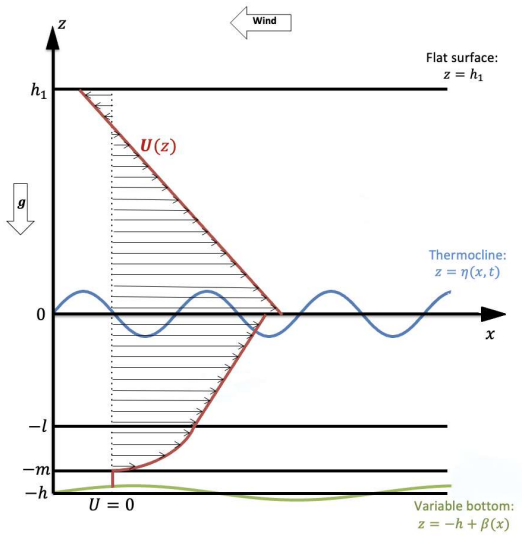
The load-bearing object is the lower-layer Dirichlet-Neumann operator, which maps the interface value of the velocity potential to the normal velocity at the interface and encodes the variable bottom through the expansion $G(b,\eta)=\delta^2 D b(X)D + \delta^3 D\eta D - \frac{\delta^4}{3}D^2 b^3(X)D^2 + O(\delta^5)$. Combined with the upper-layer operator, it converts the fluid equations into the quasi-Hamiltonian system (23)–(25). The reduction to one equation uses a slow variable $X=\varepsilon x$, a single-travelling-wave ansatz, the leading-order linear relation $u = \rho c_0(X)b(X)^{-1}\eta$, and the nonlocal operator $T = -i\coth(h_1 D)$. Compatibility of the two evolution equations fixes the constants (45)–(47) and yields the variable-coefficient ILWE (48).
What would settle it
Evolve a single ILWE soliton over a smooth bottom shoal in the full two-layer fluid equations, with the current profile (4), and measure the amplitude of the counter-propagating component of the linear system (36): if it is not at most $O(\delta)$ relative to the incident wave, the one-component ansatz behind (48) fails. A second check is to track the soliton amplitude across a shoaling lower layer and compare it with the adiabatic prediction $\eta_{\max}(b)\approx \mu_1 b^{1/4}\tan(\mu_2 b^{-7/4})$; systematic deviation would indicate neglected reflection or the birth of new solitons.
Extended reading notes
Core claim
The central claim is that the full two-layer fluid equations with a piecewise-linear shear current and a slowly varying bottom reduce, at order $\delta = h/L$, to the one-component variable-coefficient ILWE (48) for the interfacial elevation $\eta(x,t)$. The reduction fixes the coefficient of the depth-growth term through $c_0'(X)$ and identifies the nonlocal dispersive term $T\eta_{xx}$ and the quadratic nonlinearity $\eta\eta_x$ as the three balancing effects of order $\delta$. When the bottom is flat, $b=h$, the equation becomes the integrable ILWE (52), whose one-soliton solution is (54); in the limits $T\to H$ and $kh_1\to 0$ it gives the Benjamin-Ono and KdV equations. The paper further derives the second-order ILWE (77), which contains cubic and nonlocal nonlinear terms and is not integrable.
Load-bearing premise
The derivation assumes the wave is a single component travelling in one direction, with no reflected wave of comparable size created as the bottom depth changes; if reflection or coupling between the two propagation directions is significant over the varying bottom, equation (48) is not the complete leading-order description.
Editorial extensions
If this is right
- With a flat bottom, equation (48) becomes the integrable ILWE (52), whose one-soliton solution (54) has amplitude set by the parameter $k_0$ and width set by $h_1$.
- In the very-long-wave limit $kh_1\to 0$, the model reduces to the KdV equation (57); in the deep-upper-layer limit $T\to H$, it reduces to the Benjamin-Ono equation.
- Over a slowly varying bottom, mass and energy of the ILWE become adiabatic invariants, and the soliton amplitude follows $\eta_{\max}(b) \approx \mu_1 b^{1/4}\tan(\mu_2 b^{-7/4})$ as the lower layer shallows, assuming no new solitons are created.
- At the critical lower-layer depth (51), the coefficient of $\eta\eta_x$ vanishes, so the leading-order balance is carried by the higher-order and nonlocal terms of the second-order ILWE (77).
Reading between the lines
- A natural extension would be a two-component ansatz keeping both roots of the dispersion relation (38); the resulting equations would yield a reflection coefficient for internal solitons over a shoal, which the one-component model neglects.
- The vanishing-nonlinearity condition (49) suggests a testable situation: with a shear current satisfying $\gamma_1^2 > (\rho/4\rho_1)\gamma^2$, a wave of the right speed should pass through a depth at which the $\eta\eta_x$ term disappears, exposing the higher-order and nonlocal terms.
- Because the adiabatic amplitude law (67) assumes no new solitons are born, comparing it with the known fission behaviour of variable-bottom KdV solitons in the long-wave regime would show whether the nonlocal operator $T$ shifts the fission threshold.
Editorial analysis
A structured set of objections, weighed in public.
Referee Report
Summary. This paper derives an asymptotic model for internal interfacial waves between two layers of inviscid, incompressible fluid, assuming a flat upper surface, a piecewise linear shear current, and a slowly varying bottom. Using a Hamiltonian formulation with Dirichlet–Neumann (DN) operators (with the bottom-dependent DN expansion taken from the authors' earlier work), the authors obtain a coupled system for the interface elevation η and tangential velocity u, then reduce it to a scalar variable-coefficient Intermediate Long Wave Equation (ILWE), equation (48). For flat bottom the equation is claimed to reduce to the known integrable ILWE, whose Benjamin–Ono and Korteweg–de Vries limits are presented. The paper also contains a higher-order ILWE for flat bottom (Appendix 1) and a discussion of adiabatic invariants for slowly varying depth.
Significance. If the central derivation were correct, the paper would provide a single asymptotic model interpolating among KdV, ILWE, and BO regimes for internal waves with currents and variable topography; the explicit reduction to the known flat-bottom integrable equations is a useful check. The authors clearly list all model coefficients and identify a physically interesting condition under which the quadratic nonlinearity vanishes. The strengths are the careful Hamiltonian/DN setup and the explicit limits. However, the validity of the main new result—the variable-coefficient ILWE (48)—is compromised by an inconsistent WKB ansatz, as detailed in the major comments; the central claim is therefore not established as it stands.
major comments (3)
- [Section 6, Eq. (37)] The WKB ansatz η = η0 e^{ik(x−c(X)t)}, u = u0 e^{ik(x−c(X)t)} is not self-consistent. Since X = εx, one has ∂_x e^{ik(x−c(X)t)} = ik(1 − ε t c'(X)) e^{ik(x−c(X)t)}. The O(ε t) correction is discarded when deriving the dispersion relation (38), but at times t = O(1/ε) it is O(1), the same size as the leading-order terms. A valid WKB treatment of a time-independent, slowly varying medium requires a conserved frequency ω and a slowly varying wavenumber k(X) = ω/c(X), with phase θ = ε^{-1} ∫ k(s) ds − ωt; the ansatz (37) instead fixes k and lets ω = k c(X) vary, so it does not satisfy the eikonal equation θ_t + c θ_x = 0. The secular term is therefore not a small correction but a consistency failure, and the derivation of (38), and hence of the compatibility calculation leading to (48), does not establish the claimed variable-coefficient ILWE.
- [Section 6, Eqs. (43)–(47)] The compatibility calculation that determines f(X), α1, and α2 is not shown; the text only states that 'the compatibility ... determines uniquely' the constants. This omission would be a minor issue if the reduction were standard, but because the substitution of (43) into (41)–(42) involves derivatives of the phase (37) with the secular term from the previous comment, the omitted algebra cannot be checked independently. The authors should either provide the full calculation or specify the precise assumptions under which (43)–(47) follow.
- [Section 6, Eq. (39)] The quadratic dispersion relation (38) admits two roots, corresponding to left- and right-travelling waves. The single-component ansatz (37) selects one branch and implicitly neglects reflected waves and coupling between the two modes, which a slowly varying bottom generically generates. No estimate of the reflected wave amplitude or a unidirectionality argument is provided. Even if the eikonal issue were repaired, such an estimate would be necessary to justify that (48) is a complete leading-order description over variable topography.
minor comments (4)
- [Section 3 and Section 5] There are several typographical errors: 'simmilar' should be 'similar' (Section 3), 'parametetr' should be 'parameter', 'neigbourhood' should be 'neighbourhood', and 'the 5-th assumption' should be 'the fifth assumption' (Section 5).
- [Section 6, Eq. (48)] The notation for the operator T = −i coth(h1D) is introduced just before (32), but its action on functions of x is not explicitly defined; a brief reminder (e.g., via Fourier multiplier) would help readers not familiar with this convention.
- [Appendix 1, Eqs. (70)–(75)] The coefficients of the higher-order ILWE are listed without any derivation or reference to a computer-algebra script. Since this is a claimed new result, providing at least a sketch of the matching or stating that the calculation is symbolic and available upon request would improve reproducibility.
- [Section 8, Eqs. (59)–(60)] The derivation of the transformed equation for E(x,t) = √c(X) η is not detailed; in particular, the treatment of the X-dependence of c in the O(δ) terms should be stated explicitly, because ∂_x(√c) is O(ε) and hence of the same order as the retained corrections.
Circularity Check
No significant circularity: the variable-coefficient ILWE is a genuine asymptotic reduction from stated assumptions and prior independent DN expansions.
full rationale
The paper's central result, equation (48), is obtained by a standard asymptotic reduction from the Hamiltonian system (34)-(35), which are derived from the physical setup and the Dirichlet-Neumann operator expansions. The DN expansions in (26) and (29) are quoted from earlier works, including the authors' own [29], but that prior work is an independent published mathematical derivation that does not presuppose equation (48); it is not fitted to the present result and is externally verifiable. The derivation of (48) proceeds by solving the leading-order linear system, posing the correction ansatz (43), and imposing compatibility to determine f(X), alpha1, and alpha2. No parameter is fitted to data, and no step defines the predicted quantity in terms of itself. Self-citations appear only for standard Hamiltonian formulations, DN-operator techniques, and known ILWE/BO/KdV results, none of which are load-bearing in a circular sense. The flat-bottom limit correctly reduces to the known integrable ILWE, providing an external consistency check. Thus the derivation is self-contained with respect to circularity, regardless of any questions about WKB validity or completeness of the ansatz.
Assumptions & free parameters
assumptions (6)
- domain assumption The Hamiltonian formulation (23)-(24) with the DN operators G and G1 correctly describes the dynamics of the interface η and momentum ξ for the piecewise linear current profile (4).
- standard math The Dirichlet-Neumann operator expansion G(b,η) = δ^2 D b D + δ^3 D η D - (δ^4/3) D^2 b^3 D^2 + O(δ^5) for a slowly varying bottom (equation 28).
- standard math The upper-layer DN operator expansion G1(η) = δ D tanh(h1 D) - δ^3 D η D + δ^3 D tanh(h1 D) η D tanh(h1 D) + O(δ^5) (equation 29).
- domain assumption The scaling assumptions in Section 5: ε=O(δ), h/h1=O(δ), h1 k=O(1), ξ=O(1), |β|max << ε^{1/3}, β'(x)=O(ε).
- domain assumption The energy of the bottom boundary layer of the current profile (4) is constant and does not contribute to the interfacial dynamics, as stated in [8].
- domain assumption The commutator [D,b(X)] = -i b'(X) is O(ε) and can be neglected at the orders retained in the expansion.
Cite this review
Pith. "Pith review of Modelling intermediate internal waves with currents and variable bottom." pith.science (2026). https://pith.science/paper/CV43DMRC
@misc{pith2026250610123,
  author       = {Pith},
  title        = {Pith review of: Modelling intermediate internal waves with currents and variable bottom},
  year         = {2026},
  howpublished = {\url{https://pith.science/paper/CV43DMRC}},
  note         = {Machine review of arXiv:2506.10123}
}
read the original abstract
A model for internal interfacial waves between two layers of fluid in the presence of current and variable bottom is studied in the flat-surface approximation. Fluids are assumed to be incompressible and inviscid. Another assumption is that the upper layer is considerably deeper with a lower density than the lower layer. The fluid dynamics is presented in Hamiltonian form with appropriate Dirichlet-Neumann operators for the two fluid domains, and the depth-dependent current is taken into account. The well known integrable Intermediate Long Wave Equation (ILWE) is derived as an asymptotic internal waves model in the case of flat bottom. For a non-flat bottom the ILWE is with variable coefficients. Two limits of the ILWE lead to the integrable Benjamin-Ono and Korteweg-de Vries equations. Higher-order ILWE is obtained as well.
Figures

Reference graph
Works this paper leans on
-
[1]
Benjamin, Internal waves of permanent form in fluids of great depth, J
T.B. Benjamin, Internal waves of permanent form in fluids of great depth, J. Fluid Mech. 29, (1967) 559–592. https://doi.org/10.1017/S002211206700103X
-
[2]
T.B. Benjamin and T.J. Bridges, Reappraisal of the Kelvin-Helmholtz problem. I. Hamiltonian structure. J. Fluid Mech. 333 (1997), 301–325. https://doi.org/10.1017/S0022112096004272
-
[3]
J.L. Bona, D. Lannes, J.-C. Saut, Asymptotic models for internal waves, Journal de Math´ ematiques Pures et Appliqu´ ees 89 (2008) 538–566. https://doi.org/10.1016/j.matpur.2008.02.003 20
-
[4]
Bowden, Physical oceanography of coastal waters
K.F. Bowden, Physical oceanography of coastal waters. Ellis Horwood Ser. Mar. Sci. John Wiley & Sons, Inc., Somerset, N.J. 1984
work page 1984
-
[5]
Boyd, Dynamics of the equatorial ocean, Springer-Verlag GmbH Germany, 2018
J.P. Boyd, Dynamics of the equatorial ocean, Springer-Verlag GmbH Germany, 2018
work page 2018
-
[6]
H.H. Chen and Y.C. Lee, Internal wave solitons of fluids of finite depth, Phys. Rev. Lett. 43 (1979) 264–266. https://doi.org/10.1103/PhysRevLett.43.264
-
[7]
A. Compelli, Hamiltonian formulation of 2 bounded immiscible media with constant non-zero vorticities and a common interface, Wave Motion, 54, (2015) 115–124, https://doi.org/10.1007/s00605-014-0724-1
-
[8]
On the dynamics of internal waves interacting with the equatorial undercurrent
A. Compelli, R.I. Ivanov, On the dynamics of internal waves interacting with the Equatorial Undercurrent, J. Nonlinear Math. Phys.22 (2015), 531–539; arXiv:1510.04096 [math-ph], https://doi.org/10.1080/14029251.2015.1113052
work page Pith review arXiv 2015
Show all 41 references
-
[9]
Compelli, R
A. Compelli, R. Ivanov, The dynamics of flat surface internal geophysical waves with currents, J. Math. Fluid Mech. 19(2), (2017) 329–344; arXiv:1611.06581 [physics.flu-dyn], https://doi.org/10.1007/s00021-016-0283-4
2017 arXiv
-
[10]
Compelli and R
A. Compelli and R. Ivanov, Benjamin-Ono model of an internal wave under a flat surface, Discrete Contin. Dyn. Syst.-A 39(8), (2019) 4519–4532, arXiv:1811.01446 [math.AP] https://doi.org/10.3934/dcds.2019185
2019 arXiv
-
[11]
Compelli, R.I
A.C. Compelli, R.I. Ivanov, C.I. Martin, M.D. Todorov, Surface waves over currents and uneven bottom, Deep Sea Research Part II: Topical Studies in Oceanography, 160, (2019), pp 25–31, arXiv:1811.03140 [physics.flu-dyn], https://doi.org/10.1016/j.dsr2.2018.11.004
2019 arXiv
-
[12]
Constantin, Nonlinear water waves with applications to wave-current interactions and tsunamis
A. Constantin, Nonlinear water waves with applications to wave-current interactions and tsunamis. CBMS-NSF Regional Conference Series in Applied Mathematics81 (SIAM, Philadel- phia, 2011). https://doi.org/10.1137/1.9781611971873
2011 doi
-
[13]
Constantin and R
A. Constantin and R. Ivanov, Equatorial wave-current interactions, Commun. Math. Phys. 370 (2019) 1—48, https://doi.org/10.1007/s00220-019-03483-8 (open access)
2019 doi
-
[14]
Constantin, R.I
A. Constantin, R.I. Ivanov and C.I. Martin, Hamiltonian formulation for wave-current inter- actions in stratified rotational flows, Archive for Rational Mechanics and Analysis, 221 (2016) pp 1417-1447, https://doi.org/10.1007/s00205-016-0990-2 (open access)
2016 doi
-
[15]
Constantin, R
A. Constantin, R. Ivanov and E. Prodanov, Nearly-Hamiltonian structure for water waves with constant vorticity, J. Math. Fluid Mech. 10 (2008) no. 2, 224–237; arXiv:math-ph/0610014, http://dx.doi.org/10.1007/s00021-006-0230-x
2008 arXiv
-
[16]
Constantin and R.S
A. Constantin and R.S. Johnson, The dynamics of waves interacting with the Equatorial Undercurrent, Geophysical and Astrophysical Fluid Dynamics 109 (2015) pp. 311–358, https://doi.org/10.1080/03091929.2015.1066785
2015
-
[17]
Constantin and R.S
A. Constantin and R.S. Johnson, On the non-dimensionalisation, scaling and resulting interpre- tation of the classical governing equations for water waves, Journal of Nonlinear Mathematical Physics 15, Supplement 2 (2008), 58–73. https://doi.org/10.2991/jnmp.2008.15.s2.5 21
2008 doi
-
[18]
Craig and M
W. Craig and M. Groves, Hamiltonian long-wave approximations to the water-wave problem, Wave Motion 19 (1994), 367–389, https://doi.org/10.1016/0165-2125(94)90003-5
1994 doi
-
[19]
Craig, P
W. Craig, P. Guyenne and H. Kalisch, Hamiltonian long wave expansions for free surfaces and interfaces. Comm. Pure Appl. Math.58 (2005) 1587–1641. https://doi.org/10.1002/cpa.20098
2005 doi
-
[20]
Craig, P
W. Craig, P. Guyenne, C. Sulem, The water wave problem and Hamiltonian transformation theory, In: T. Bodn´ ar et al. (eds.),Waves in Flows, Advances in Mathematical Fluid Mechanics, Springer Nature Switzerland AG 2021, https://doi.org/10.1007/978-3-030-67845-6_4
2021 doi
-
[21]
Craig and C
W. Craig and C. Sulem, Numerical simulation of gravity waves, Journal of Computational Physics, 108 (1993), 73–83; http://dx.doi.org/10.1006/jcph.1993.1164
1993
-
[22]
Cullen, R
J. Cullen, R. Ivanov, On the intermediate long wave propagation for internal waves in the presence of currents, European Journal of Mechanics - B/Fluids 84 (2020) 325–333, arXiv:2007.04375 [physics.flu-dyn], https://doi.org/10.1016/j.euromechflu.2020.07.001
2020 arXiv
-
[23]
Cullen, R
J. Cullen, R. Ivanov, Hamiltonian description of internal ocean waves with Coriolis force, Communications on Pure and Applied Analysis 21 (2022), 2291–2307. arXiv:2203.13940 [physics.flu-dyn], http://dx.doi.org/10.3934/cpaa.2022029
2022 arXiv
-
[24]
Curtin and R
C. Curtin and R. Ivanov, The Lagrangian formulation for wave motion with a shear current and surface tension, J. Math. Fluid Mech. 25, (2023) art. 87, arXiv:2406.00202 [physics.flu-dyn], https://doi.org/10.1007/s00021-023-00831-6
2023 arXiv
-
[25]
Djordjevi´ c, L.G
V.D. Djordjevi´ c, L.G. Redekopp, The fission and the disintegration of internal solitary waves moving over two-dimensional topography, J. Phys. Oceanogr. 8 (1978) 1016–1024, http://dx.doi.org/10.1175/1520-0485(1978)008<1016:TFADOI>2.0.CO;2
1978 doi
-
[26]
A. S. Fokas and M. J. Ablowitz, The Inverse Scattering Transform for the Benjamin-Ono equation – a pivot to multidimensional problems, Stud. Appl. Math. 68, (1983) 1–10; https://doi.org/10.1002/sapm19836811
1983 doi
-
[27]
Henry, R
D. Henry, R. Ivanov and Z. Sakellaris, Higher-order integrable models for oceanic internal wave–current interactions, Stud. Appl. Math. 153 (2024) e12778; arXiv:2410.17454 [nlin.SI] https://doi.org/10.1111/sapm.12778
2024 arXiv
-
[28]
R.I. Ivanov, Hamiltonian model for coupled surface and internal waves in the presence of currents, Nonlinear Analysis: R W A34, (2017) 316–334; arXiv:1702.01441 [physics.flu-dyn] https://doi.org/10.1016/j.nonrwa.2016.09.010
2017 arXiv
-
[29]
Ivanov, C.I
R.I. Ivanov, C.I. Martin, M.D. Todorov, Hamiltonian approach to modelling interfacial internal waves over variable bottom, Physica D: Nonlinear Phenomena 433 (2022) 133190; arXiv:2203.02590 [nlin.PS], https://doi.org/10.1016/j.physd.2022.133190
2022 arXiv
-
[30]
Joseph and R
R.I. Joseph and R. Egri, Multi-soliton solutions in a finite depth fluid, J. Phys. A: Math. Gen. 11, (1978) L97–L102. https://doi.org/10.1088/0305-4470/11/5/002
1978 doi
-
[31]
D.J. Kaup, Y. Matsuno, The Inverse Scattering Transform for the Benjamin-Ono equation, Stud. Appl. Math. 101, (1998) 73–98. https://doi.org/10.1111/1467-9590.00086 22
1998
-
[32]
Kodama, M
Y. Kodama, M. Ablowitz and J. Satsuma, Direct and inverse scattering problems of the non- linear intermediate long wave equation, J. Math. Phys 23, (1982) 564–576. https://doi.org/10.1063/1.525393
1982 doi
-
[33]
D. J. Korteweg and G. De Vries, On the change of form of long waves advancing in a rectangular canal, and on a new type of long stationary waves, Philosophical Magazine, 39(240) (1895) 422- 443, https://doi.org/10.1080/14786449508620739
-
[34]
Matsuno, Exact multi-soliton solution of the Benjamin-Ono equation, J
Y. Matsuno, Exact multi-soliton solution of the Benjamin-Ono equation, J. Phys. A: Mat. Gen. 12, (1979) 619–621. https://doi.org/10.1088/0305-4470/12/4/019
1979 doi
-
[35]
Matsuno, Exact multi-soliton solution for nonlinear waves in a stratified fluid of finite depth, Phys
Y. Matsuno, Exact multi-soliton solution for nonlinear waves in a stratified fluid of finite depth, Phys. Lett. A 74, (1979) 233–235. https://doi.org/10.1016/0375-9601(79)90779-5
1979 doi
-
[36]
S. P. Novikov, S. V. Manakov, L. P. Pitaevsky and V. E. Zakharov, Theory of solitons: the inverse scattering method. New York: Plenum, 1984
1984
-
[37]
Ono, Algebraic Solitary Waves in Stratified Fluids, J
H. Ono, Algebraic Solitary Waves in Stratified Fluids, J. Phys. Soc. Japan, 39, (1975) 1082– 1091, https://doi.org/10.1143/JPSJ.39.1082
1975 doi
-
[38]
Satsuma, M.J
J. Satsuma, M.J. Ablowitz and Y. Kodama, On an internal wave equation describing a strat- ified fluid with finite depth, Phys. Lett. A, 73, (1979) 283–286, https://doi.org/10.1016/ 0375-9601(79)90534-6
1979
-
[39]
144–150 (in Russian)
Talipova et al., Propagation of finite amplitude waves in stratified fluid of variable depth, Mod- ern Science: Researches, Ideas, Results, Technologies, 3(2) (2012), pp. 144–150 (in Russian). Available at: https://chiffa.org/JournalEngine/engine/index.php/msj/article/view/ 246
2012
-
[40]
Wahl´ en, A Hamiltonian formulation of water waves with constant vorticity
E. Wahl´ en, A Hamiltonian formulation of water waves with constant vorticity. Lett. Math. Phys. 79, (2007) 303–315. https://doi.org/10.1007/s11005-007-0143-5
2007 doi
-
[41]
Zakharov, Stability of periodic waves of finite amplitude on the surface of a deep fluid, J
V.E. Zakharov, Stability of periodic waves of finite amplitude on the surface of a deep fluid, J. Appl. Mech. Tech. Phys. 9 (1968) 190–194. https://doi.org/10.1007/BF00913182 23
1968 doi
Reviewed August 7, 2026 · model on record in the stance chip above.
Discussion (0). Continue with ORCID to comment.