REVIEW 3 major objections 8 minor 59 references
V455 Car: an oscillating eclipsing Algol-type binary in triple star system
T0 review · 3 major / 8 minor · reviewed 2026-08-07 · deepseek-v4-flash
Pith's one-line read V455 Car is an Algol-type binary whose 26.6-year eclipse-timing wobble points to a low-mass third companion.
desk verdict Solid first TESS photometric solution and pulsation study of V455 Car, with a plausible but unproven third-body claim that the title overstates. read the letter →
The pith
A machine-rendered reading of the paper's core claim, the machinery that carries it, and where it could break.
The reading
What carries the argument
The load-bearing mechanism is the light-travel-time (LTTE) model applied to the $O-C$ diagram: a sinusoidal term of period $P_3$ and semi-amplitude $A$ in the eclipse-timing residuals, converted by the mass function $f(m) = (4\pi^2/GP_3^2)(cA)^3$ into a minimum mass for an unseen third body. The Wilson-Devinney code in semi-detached Mode 5 supplies the binary's geometry and luminosity ratio, and the Period04 software supplies the pulsation frequencies and the identification of red noise as stochastic low-frequency (SLF) variability.
What would settle it
Radial-velocity monitoring of V455 Car over a decade should reveal the predicted roughly 16 AU motion of the binary around the system barycenter; if no such velocity variation appears, or if its phase disagrees with the LTTE model, the third-body interpretation fails. Alternatively, an O–C diagram extended to two or more full cycles that deviates from the fitted sinusoid, or a period change tracking the secondary's expected magnetic-activity cycle, would rule out the LTTE interpretation.
Extended reading notes
Core claim
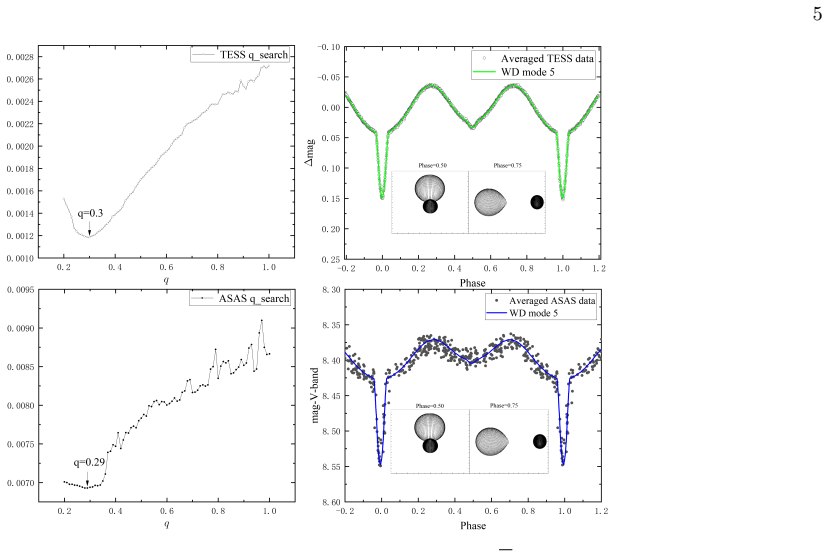
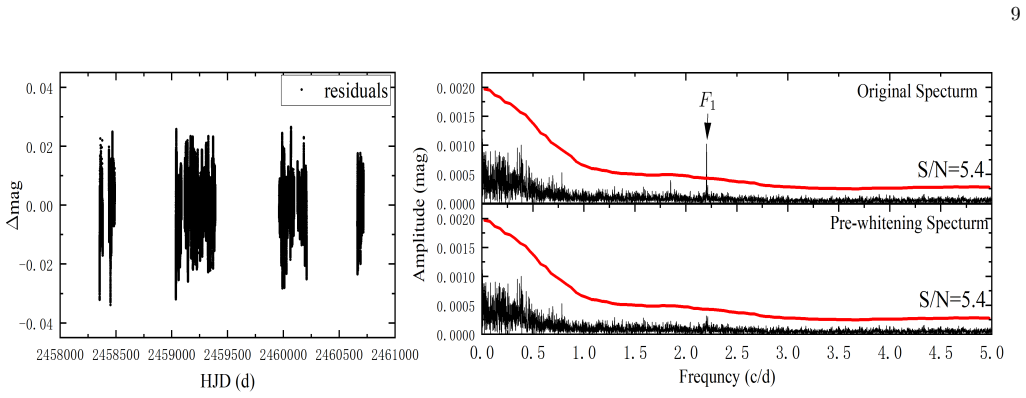
The authors establish that V455 Car is a semi-detached Algol-type binary (mass ratio $q = 0.298$) by fitting TESS and ASAS light curves with the Wilson-Devinney code in Mode 5. Using the FEROS-based primary temperature of $16427 \pm 147$ K and the $(B-V)_0$ color, they derive $M_1 = 5.30 \pm 1.10 \, \mathrm{M}_\odot$, $R_1 = 3.17 \pm 0.22 \, \mathrm{R}_\odot$ and $M_2 = 1.58 \pm 0.32 \, \mathrm{M}_\odot$, $R_2 = 6.66 \pm 0.46 \, \mathrm{R}_\odot$, with the secondary filling $99\%$ of its Roche lobe. The light-curve asymmetry (O'Connell effect) is modeled as a hot spot on the primary, attributed to ongoing mass transfer. From 159 primary eclipse times covering about 34.6 years, the $O-C$ diagram shows a cyclic variation with period $P_3 = 26.62 \pm 1.66$ yr and semi-amplitude $A = 0.0079 \pm 0.0020$ d; interpreted as a light-travel-time effect of a circular third-body orbit, this gives a mass function $f(m) = 0.0036 \pm 0.0028 \, \mathrm{M}_\odot$ and a minimum third-body mass of $0.59 \pm 0.13 \, \mathrm{M}_\odot$. Frequency analysis of the residual light curve detects one independent frequency at $2.20216 \pm 0.00035$ d$^{-1}$ with S/N $= 14.9$, plus stochastic low-frequency variability, indicating the primary is an SPB/SLF star.
Load-bearing premise
The third-body interpretation depends on the 26.62-year sinusoidal O–C wobble being a light-travel-time effect of a circular third-body orbit, rather than a magnetic activity cycle or a residual trend; because the 34.6-year baseline covers only about 1.3 cycles of this sine, the periodic signal is weakly constrained, and no radial velocities or astrometry currently confirm the companion.
Editorial extensions
If this is right
- The absolute masses and radii become a benchmark for evolutionary models of Algol systems that have undergone mass-ratio reversal.
- The detection of an SPB/SLF primary in a semi-detached binary offers a testbed for how mass transfer and tidal forces affect g-mode pulsations and internal mixing.
- The candidate 0.59 solar-mass tertiary strengthens the statistical evidence that many massive binaries reside in hierarchical triples.
- The hot-spot model for the O'Connell effect links the light-curve asymmetry directly to ongoing mass transfer onto the primary.
Reading between the lines
- If the tertiary is a late K-type main-sequence star as the authors suggest, it should be directly detectable through radial-velocity drift of the binary's spectral lines or through Gaia astrometry within roughly a decade — an independent test not presented in the paper.
- Because the 34.6-year timing baseline covers only about 1.3 cycles of the 26.62-year sine, extending the baseline with continued TESS and ground-based photometry could distinguish the third-body interpretation from a slow secular period change or a magnetic-activity cycle.
- The single coherent frequency at 2.202 d$^{-1}$, if confirmed as a high-order g-mode, could yield asteroseismic constraints on the primary's internal rotation and mixing; if its amplitude is tidally damped, comparison with single SPB stars of similar temperature would test tidal effects in Algols.
Editorial analysis
A structured set of objections, weighed in public.
Referee Report
Summary. This manuscript presents a multi-wavelength study of V455 Car, combining TESS and ASAS photometry with FEROS spectroscopy. Wilson-Devinney modeling in Mode 5 returns a semi-detached configuration with mass ratio q≈0.30, a hot spot on the primary to explain the O'Connell effect, and absolute parameters M1=5.30±1.10 Msun, M2=1.58±0.32 Msun. From 159 eclipse timings, the authors identify a 26.62 yr sinusoidal O-C variation that they attribute to a light-travel-time effect of a low-mass tertiary (M3,min≈0.59 Msun). A frequency analysis reveals one independent signal at 2.202 d^-1 plus red noise, leading to the suggestion that the primary is an SPB/SLF star.
Significance. If the triple interpretation is correct, V455 Car would be a valuable example of a massive Algol with a pulsating primary and a tertiary, relevant to binary evolution and the statistics of triples in massive binaries. The paper has notable strengths: it uses high-quality TESS data, cross-checks the q-search against ASAS, obtains FEROS temperatures that improve on Gaia GSP-Phot, and provides the eclipse-timing catalog in machine-readable form. However, the central third-body claim rests on a single sinusoid covering only about 1.3 cycles, and the absolute masses rely on an assumed main-sequence calibration with an arbitrary 20% uncertainty. As a result, the significance as currently stated is not fully established.
major comments (3)
- [§4, Eq. (2)] The periodic O-C variation with P3=26.62 yr is fitted to 159 eclipse times spanning roughly 34.6 yr, i.e., only about 1.3 cycles, with a sparse Hipparcos/ASAS early segment and dense TESS coverage only after 2018. The paper does not compare the sinusoidal LTTE model against alternatives such as a quadratic ephemeris (secular period change) or a quadratic plus a sinusoid, nor does it model an Applegate-type magnetic activity contribution. Because the fitted amplitude and period are controlled by how the few early points connect to the TESS residuals, the quoted errors on A and P3 are likely underestimated. I request a model-comparison analysis (e.g., linear vs. linear+quadratic vs. linear+sine vs. linear+quadratic+sine, with AIC/BIC or an F-test) and a bootstrap or MCMC fit that samples the eclipse times with realistic uncertainties. Without this, the statement in the abstract that the periodic oscillation suggests a possible third body is not supported over the alternatives, and the title's 'triple star system' is premature.
- [§6, Table 4] The absolute masses are derived from the assumption that the primary is a main-sequence star, using (B−V)0 and the Pecaut & Mamajek (2013) calibration, with an adopted 20% uncertainty on M1 citing Li et al. (2024a). No radial velocities are presented, and the paper itself places the primary between the ZAMS and TAMS in Figure 8, so a main-sequence mass assumed a priori is not a safe calibration. Since M1 enters M2 and the third-body mass function (Eq. 5), the arbitrary 20% error propagates into the central results. The authors should either obtain radial velocities (or use published ones), or estimate M1 from the surface gravity and radius, or use a Bayesian evolutionary-model mass estimate, and propagate that uncertainty through Eq. (5).
- [§3, Table 2] The semi-detached geometry is assumed by adopting Mode 5, in which the secondary fills its Roche lobe by construction; the reported filling factor f2=99.2% is therefore not a test of whether the system is actually semi-detached. To support the 'Algol-type' classification, the authors should also fit a detached model (Mode 2) and compare residuals, or allow the secondary surface potential to be a free parameter and check whether it reaches the Roche lobe. Without this, the semi-detached claim is circular.
minor comments (8)
- [§2.2] The text says the two spectra used to derive the primary temperature are 'close to 0.5', but Table 1 lists phases 0.357 and 0.497; please correct the phase statement or the selection criterion.
- [§3, Figure 4] The hot-spot parameters are only listed in Figure 4; please include them in Table 2 or as a separate table so that the spot model is reproducible.
- [§4, Table 3] The eclipse times are provided only as an excerpt in machine-readable form; please state clearly that the full table will be published electronically.
- [§5] The detection of a single independent frequency at 2.202 d^-1 with S/N=14.87 plus red noise is sufficient to say the primary 'may be' an SPB/SLF star, but the abstract and conclusions could be more explicit that this is based on one frequency.
- [§6] The sentence 'which suggest that strong observational results for a high incidence of third bodies in massive binaries' overgeneralizes from one system; please soften it.
- [Eq. (5)] Please show the propagation of uncertainties from A and P3 to f(m) and M3; currently f(m)=0.0036±0.0028 Msun has a relative error of about 78% while M3 has a relative error of about 22%, and the intermediate algebra is not shown.
- [Acknowledgments] The FEROS data DOI is incomplete ('DOI(s): .'); please fill in the actual DOI.
- [General] Several language issues should be corrected: 'secondary star is almost filling its Roche lobe' in the abstract, 'specturm' in §5, and 'masssive' in §6.
Circularity Check
The third-body minimum mass is a direct algebraic inversion of the fitted O-C sinusoid, so the central 'prediction' of a 0.59 M_sun tertiary adds no information beyond the sine fit; the photometric and pulsation analyses are otherwise self-contained.
-
fitted input called prediction
[Section 6, Eq. (5); abstract and Section 4, Eq. (3)]
"In order to have a further study on the third body, we can use the mass function to estimate parameters of the third body by setting the orbital inclination in i3 = 90°: f(m) = (M3 sin i3)^3/(M1+M2+M3)^2 = 4π^2/(G P3^2) × (cA)^3, (5) ... the minimum mass of the third body is M3 = 0.59(±0.13) M_sun."
The quoted M3 and f(m) are computed exclusively from the fitted semi-amplitude A = 0.0079 d and period P3 = 26.62 yr that were already determined by fitting the sinusoidal term in Eq. (3) to the same O-C data. Kepler's third law in Eq. (5) is an algebraic identity connecting these LTTE parameters to a mass function, so the 'prediction' of a 0.59 M_sun tertiary is a deterministic rescaling of the fitted sine, not an independent test or a measurement from new data. The uncertainty also propagates only from the same fit. Thus the third-body mass does not independently support the third-body interpretation; whether the sinusoid is caused by a companion is assumed by adopting the LTTE model, not verified by Eq. (5).
full rationale
The paper contains one significant circular step: the third-body mass is a fitted-parameter restatement. The O-C analysis fits a linear ephemeris plus a sinusoid (Eqs. 2-3), and then Eq. (5) converts the fitted amplitude and period into a mass function and a minimum mass. That conversion is exact and adds no empirical information, so presenting M3 = 0.59 M_sun as a derived 'possible third body' is essentially reporting the fitted sine in different units. This is the load-bearing part of the title's 'triple star system' claim, because no radial velocities, astrometry, or nonzero third light confirm the companion; the paper itself notes l3 is consistent with zero. The rest of the analysis is not circular: the W-D photometric solutions fit TESS and ASAS light curves against the Wilson-Devinney model, and the pulsation frequencies are extracted from residuals using standard pre-whitening with S/N thresholds; those results do not assume their conclusions. The self-citation to Liao & Qian (2010) for the LTTE method is a standard technique and is not load-bearing, and the e3 = 0 circular-orbit assumption is stated openly rather than smuggled in. The sparse baseline (~1.3 cycles of P3) and the degeneracy of the sinusoid with secular trends are correctness/robustness concerns, not themselves circularity. Overall, one core derived quantity reduces by construction to its fitted input, giving a partial circularity score of 6.
Assumptions & free parameters
free parameters (6)
- q = M2/M1 (mass ratio) =
0.2978 ± 0.0017 (TESS); 0.2848 ± 0.0087 (ASAS)
- T2 (secondary effective temperature) =
5619 ± 12 K (TESS)
- i (orbital inclination) =
70.25 ± 0.03 deg
- Spot parameters (co-latitude, longitude, radius, temperature factor) =
given in Fig. 4
- O-C LTTE parameters (A, P3, phase, delta T0, delta P) =
A=0.0079 ± 0.0020 d, P3=1894.5 ± 118.4 cycles (26.62 ± 1.66 yr), phase=-3.02 ± 0.33
- M1 (primary mass) =
5.30 ± 1.10 Msun
assumptions (6)
- domain assumption The binary is semi-detached with the secondary filling its Roche lobe (W-D Mode 5).
- domain assumption Binary orbit is circular (e=0), justified by secondary eclipse at phase 0.5.
- domain assumption The primary is a main-sequence star, so (B-V)0 can be converted to mass via Pecaut & Mamajek (2013).
- domain assumption The third body's orbit is circular (e3=0).
- ad hoc to paper The 26.62 yr O-C oscillation is caused by light-travel-time effect rather than magnetic activity or other mechanisms.
- standard math Pulsation significance threshold S/N > 5.4 is valid for this dataset.
invented entities (2)
-
Third body with minimum mass 0.59 Msun
-
Hot spot on the primary
Cite this review
Pith. "Pith review of V455 Car: an oscillating eclipsing Algol-type binary in triple star system." pith.science (2026). https://pith.science/paper/XJYEKR2F
@misc{pith2026250610124,
  author       = {Pith},
  title        = {Pith review of: V455 Car: an oscillating eclipsing Algol-type binary in triple star system},
  year         = {2026},
  howpublished = {\url{https://pith.science/paper/XJYEKR2F}},
  note         = {Machine review of arXiv:2506.10124}
}
abstract
V455 Car is a southern oscillating eclipsing Algol-type system with an orbital period of 5.132888 days. Our first photometric solutions based on the Transiting Exoplanet Survey Satellite indicate that it is a semi-detached binary with the secondary star is almost filling its Roche lobe. The noticeable O'Connell effect in light curve could be explained by hot spot on the primary component, which may be attributed to the mass transfer from the secondary component to the primary one. The absolute parameters are determined as: $M_{1} = 5.30 \pm 1.10 \, \rm M_{\odot}$, $R_{1} = 3.17 \pm 0.22 \, \rm R_{\odot}$ for the primary, and $M_{2} = 1.58 \pm 0.32 \, \rm M_{\odot}$, $R_{2} = 6.66 \pm 0.46 \, \rm R_{\odot}$ for the secondary. \textbf{Based on $O-C$ analysis, we find a periodic variation of $P_3=26.62(\pm1.66)\,yr$. The periodic oscillation suggests a possible third body with a minimal mass of $0.59(\pm0.13)\,\rm M_{\odot}$}. It is speculated that the secondary star has undergone a longer evolution, leading to a mass ratio reversal being experienced in the binary system. Our frequency analysis finds that the primary of V455 Car may be an SPB/SLF star. This study reports a novel example of an oscillating eclipsing Algol-type system featuring an SPB/SLF primary star and a red giant star, which suggest that strong observational results for a high incidence of third bodies in massive binaries.
Figures


Figures from the paper (5 more)




Reference graph
Works this paper leans on
-
[1]
Aerts, C., Christensen-Dalsgaard, J., & Kurtz, D. W. 2010, Asteroseismology, doi: 10.1007/978-1-4020-5803-5 Ali¸ cavu¸ s, F. K., & Ekinci,¨O. 2022, Research in Astronomy and Astrophysics, 22, 015013
-
[2]
Avdeeva, A. S., Kovaleva, D. A., Malkov, O. Y., & et al. 2023, Monthly Notices of the Royal Astronomical Society, 527, 7382, doi: 10.1093/mnras/stad3601
-
[3]
Bowman, D. M. 2023, Astrophysics and Space Science, 368, 107
work page 2023
-
[4]
M., Aerts, C., Johnston, C., & et al
Bowman, D. M., Aerts, C., Johnston, C., & et al. 2019a, A&A, 621, A135, doi: 10.1051/0004-6361/201833662
-
[5]
Bowman, D. M., Burssens, S., Pedersen, M. G., & et al. 2019b, Nature Astronomy, 3, 760, doi: 10.1038/s41550-019-0768-1
-
[6]
M., Burssens, S., Sim´ on-D ´ ıaz, S., & et al
Bowman, D. M., Burssens, S., Sim´ on-D ´ ıaz, S., & et al. 2020, A&A, 640, A36, doi: 10.1051/0004-6361/202038224
-
[7]
M., Van Daele, P., Michielsen, M., & et al
Bowman, D. M., Van Daele, P., Michielsen, M., & et al. 2024, A&A, 692, A49, doi: 10.1051/0004-6361/202451419
-
[8]
Burssens, S., Bowman, D. M., Aerts, C., & et al. 2019, MNRAS, 489, 1304, doi: 10.1093/mnras/stz2165
Show all 59 references
-
[9]
2021, ApJ, 920, 76, doi: 10.3847/1538-4357/ac1baa
Chen, X., Zhang, X., Li, Y., & et al. 2021, ApJ, 920, 76, doi: 10.3847/1538-4357/ac1baa
2021 doi
-
[10]
Crawford, J. A. 1955, ApJ, 121, 71, doi: 10.1086/145965
1955 doi
-
[11]
2018, MNRAS, 479, 5491, doi: 10.1093/mnras/sty1834
Eker, Z., Bakı¸ s, V., Bilir, S., & et al. 2018, MNRAS, 479, 5491, doi: 10.1093/mnras/sty1834
2018 doi
-
[12]
2020, A&A, 633, A122, doi: 10.1051/0004-6361/201935478
Fedurco, M., Paunzen, E., H¨ ummerich, S., & et al. 2020, A&A, 633, A122, doi: 10.1051/0004-6361/201935478
2020 doi
-
[13]
2013, Monthly Notices of the Royal Astronomical Society, 429, 1585
Fu, J.-N., Dolez, N., Vauclair, G., & et al. 2013, Monthly Notices of the Royal Astronomical Society, 429, 1585
2013
-
[14]
M., & et al
Gebruers, S., Tkachenko, A., Bowman, D. M., & et al. 2022, A&A, 665, A36, doi: 10.1051/0004-6361/202243839
2022 doi
-
[15]
L., Brown, T
Gilliland, R. L., Brown, T. M., Christensen-Dalsgaard, & et al. 2010, Publications of the Astronomical Society of the Pacific, 122, 131
2010
-
[16]
Houk, N., & Cowley, A. P. 1975, University of Michigan Catalogue of two-dimensional spectral types for the HD stars. Volume I. Declinations -90 to -53 ƒ0
1975
-
[17]
B., Sobeck, C., Haas, M., & et al
Howell, S. B., Sobeck, C., Haas, M., & et al. 2014, Publications of the Astronomical Society of the Pacific, 126, 398
2014
-
[18]
S., Stanek, K
Jayasinghe, T., Kochanek, C. S., Stanek, K. Z., & et al. 2018, MNRAS, 477, 3145, doi: 10.1093/mnras/sty838
2018 doi
-
[19]
M., Twicken, J
Jenkins, J. M., Twicken, J. D., McCauliff, S., & et al. 2016, in Software and Cyberinfrastructure for Astronomy IV, Vol. 9913, SPIE, 1232–1251
2016
-
[20]
1999, The Messenger, 95, 8
Kaufer, A., Stahl, O., Tubbesing, S., & et al. 1999, The Messenger, 95, 8
1999
-
[21]
V., Samus, N
Kazarovets, E. V., Samus, N. N., Durlevich, O. V., & et al. 1999, Information Bulletin on Variable Stars, 4659, 1
1999
-
[22]
S., Shappee, B
Kochanek, C. S., Shappee, B. J., Stanek, K. Z., et al. 2017, Publications of the Astronomical Society of the Pacific, 129, 104502
2017
-
[23]
2009, A&A, 501, 1269, doi: 10.1051/0004-6361/200811467
Koleva, M., Prugniel, P., Bouchard, A., & Wu, Y. 2009, A&A, 501, 1269, doi: 10.1051/0004-6361/200811467
2009 doi
-
[24]
W., Shibahashi, H., Murphy, S
Kurtz, D. W., Shibahashi, H., Murphy, S. J., & et al. 2015, Monthly Notices of the Royal Astronomical Society, 450, 3015
2015
-
[25]
2020, AJ, 160, 32, doi: 10.3847/1538-3881/ab952c
Labadie-Bartz, J., Handler, G., Pepper, J., & et al. 2020, AJ, 160, 32, doi: 10.3847/1538-3881/ab952c
2020 doi
-
[26]
2005, Communications in Asteroseismology, 146, 53, doi: 10.1553/cia146s53
Lenz, P., & Breger, M. 2005, Communications in Asteroseismology, 146, 53, doi: 10.1553/cia146s53
2005 doi
-
[27]
X., Liao, W
Li, F. X., Liao, W. P., Qian, S. B., et al. 2022, ApJ, 924, 30, doi: 10.3847/1538-4357/ac3425
2022 doi
- [28]
-
[29]
2010, Monthly Notices of the Royal Astronomical Society, 405, 1930
Liao, W.-P., & Qian, S.-B. 2010, Monthly Notices of the Royal Astronomical Society, 405, 1930
2010
-
[30]
L., & Deeming, T
Loumos, G. L., & Deeming, T. J. 1978, Ap&SS, 56, 285, doi: 10.1007/BF01879560
1978 doi
-
[31]
P., & de Mink, S
Ma, L., Johnston, C., Bellinger, E. P., & de Mink, S. E. 2024, The Astrophysical Journal, 966, 196, doi: 10.3847/1538-4357/ad38bc
2024 doi
-
[32]
Milone, E. F. 1969, Commmunications of the Konkoly Observatory Hungary, 65, 457
1969
-
[33]
2015a, ApJ, 801, 113, doi: 10.1088/0004-637X/801/2/113 —
Moe, M., & Di Stefano, R. 2015a, ApJ, 801, 113, doi: 10.1088/0004-637X/801/2/113 —. 2015b, ApJ, 810, 61, doi: 10.1088/0004-637X/810/1/61
-
[34]
J., & Mamajek, E
Pecaut, M. J., & Mamajek, E. E. 2013, ApJS, 208, 9, doi: 10.1088/0067-0049/208/1/9
2013 doi
-
[35]
G., Chowdhury, S., Johnston, C., & et al
Pedersen, M. G., Chowdhury, S., Johnston, C., & et al. 2019, ApJL, 872, L9, doi: 10.3847/2041-8213/ab01e1
2019 doi
- [36]
- [37]
-
[38]
2011, A&A, 531, A165, doi: 10.1051/0004-6361/201116769 Prˇ sa, A., Kochoska, A., Conroy, K
Prugniel, P., Vauglin, I., & Koleva, M. 2011, A&A, 531, A165, doi: 10.1051/0004-6361/201116769 Prˇ sa, A., Kochoska, A., Conroy, K. E., Eisner, N., & Hey. 2022, ApJS, 258, 16, doi: 10.3847/1538-4365/ac324a
2011 doi
-
[39]
1998, Astronomical and Astrophysical Transactions, 15, 357, doi: 10.1080/10556799808201791
Pustylnik, I. 1998, Astronomical and Astrophysical Transactions, 15, 357, doi: 10.1080/10556799808201791
1998 doi
-
[40]
R., Winn, J
Ricker, G. R., Winn, J. N., Vanderspek, R., et al. 2015, Journal of Astronomical Telescopes, Instruments, and Systems, 1, 014003 14
2015
-
[41]
1969, Acta Astronomica, Vol
Rucinski, S. 1969, Acta Astronomica, Vol. 19, p. 245, 19, 245 S´ anchez-Bl´ azquez, P., Peletier, R. F., Jim´ enez-Vicente, J., et al. 2006, MNRAS, 371, 703, doi: 10.1111/j.1365-2966.2006.10699.x
1969
-
[42]
C., Bildsten, L., & Jiang, Y.-F
Schultz, W. C., Bildsten, L., & Jiang, Y.-F. 2022, The Astrophysical Journal Letters, 924, L11
2022
-
[43]
J., Prieto, J., Grupe, D., et al
Shappee, B. J., Prieto, J., Grupe, D., et al. 2014, The Astrophysical Journal, 788, 48
2014
-
[44]
2021, AJ, 161, 46, doi: 10.3847/1538-3881/abccd7
Shi, X.-D., Qian, S.-B., Li, L.-J., & Liu, N.-P. 2021, AJ, 161, 46, doi: 10.3847/1538-3881/abccd7
2021 doi
-
[45]
2023, The Astrophysical Journal Supplement Series, 265, 33
Shi, X.-D., Qian, S.-B., Zhu, L.-Y., & et al. 2023, The Astrophysical Journal Supplement Series, 265, 33
2023
-
[46]
M., & Pavlovski, K
Southworth, J., Bowman, D. M., & Pavlovski, K. 2021, MNRAS, 501, L65, doi: 10.1093/mnrasl/slaa197
2021 doi
-
[47]
2005, The Astrophysical Journal Supplement Series, 158, 193–216, doi: 10.1086/429408
Stankov, A., & Handler, G. 2005, The Astrophysical Journal Supplement Series, 158, 193–216, doi: 10.1086/429408
2005 doi
-
[48]
J., Zhou, G., Johnson, M
Stevens, D. J., Zhou, G., Johnson, M. C., et al. 2020, MNRAS, 499, 3775, doi: 10.1093/mnras/staa3142
2020 doi
-
[49]
2018, The Astrophysical Journal Supplement Series, 235, 6
Tokovinin, A. 2018, The Astrophysical Journal Supplement Series, 235, 6
2018
-
[50]
1991, A&A, 246, 453
Waelkens, C. 1991, A&A, 246, 453
1991
-
[51]
P., et al
Wagg, T., Johnston, C., Bellinger, E. P., et al. 2024, arXiv preprint arXiv:2403.05627
2024 arXiv
-
[52]
Wilson, R. E. 1979, ApJ, 234, 1054, doi: 10.1086/157588
1979 doi
-
[53]
E., & Devinney, E
Wilson, R. E., & Devinney, E. J. 1971, ApJ, 166, 605, doi: 10.1086/150986
1971 doi
-
[54]
Wilson, R. E. 1994, PASP, 106, 921, doi: 10.1086/133464
1994 doi
-
[55]
Winecki, D., & Kochanek, C. S. 2024, The Astrophysical Journal, 971, 61
2024
-
[56]
2024, Monthly Notices of the Royal Astronomical Society, 531, 3823, doi: 10.1093/mnras/stae1352
Yang, Y., & Wang, S. 2024, Monthly Notices of the Royal Astronomical Society, 531, 3823, doi: 10.1093/mnras/stae1352
2024 doi
-
[57]
2014, The Astronomical Journal, 147, 35
Yang, Y.-G., Wei, J.-Y., & Li, H.-L. 2014, The Astronomical Journal, 147, 35
2014
-
[58]
2020, Publications of the Astronomical Society of the Pacific, 132, 114201, doi: 10.1088/1538-3873/abacd4
Zhang, J., Qian, S.-B., & Lyu, B. 2020, Publications of the Astronomical Society of the Pacific, 132, 114201, doi: 10.1088/1538-3873/abacd4
2020 doi
-
[59]
B., Wang, K., Chen, X
Zhang, X. B., Wang, K., Chen, X. H., Luo, C. Q., & Zhang, C. G. 2019, ApJ, 884, 165, doi: 10.3847/1538-4357/ab3fa9
2019 doi
Reviewed August 7, 2026 · model on record in the stance chip above.
Discussion (0). Continue with ORCID to comment.