REVIEW 3 major objections 5 minor 76 references
Strongly correlated topological surface states in type-II Dirac semimetal NiTe$_{2}$
T0 review · 3 major / 5 minor · reviewed 2026-08-07 · deepseek-v4-flash
Pith's one-line read The paper claims that topological surface states of NiTe2 are only matched to ARPES when surface electronic correlation is included, shifting the SS2 Dirac crossing by about 100 meV.
desk verdict Plausible attribution of the SS2 mismatch to surface Ni 3d correlation, but the U=5 eV match is fitted rather than derived; worth refereeing, not desk-rejecting. read the letter →
The pith
A machine-rendered reading of the paper's core claim, the machinery that carries it, and where it could break.
The reading
What carries the argument
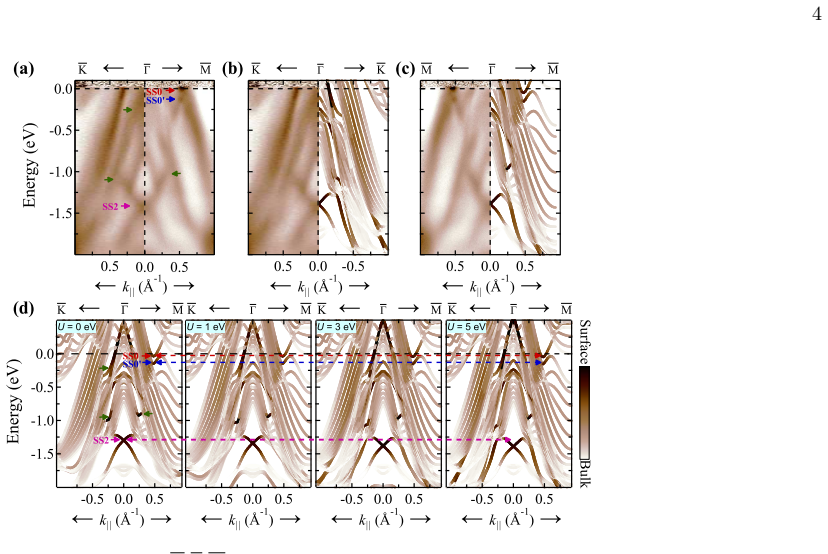
The load-bearing object is the topological surface state SS2, a Dirac-like conical crossing at the $\bar{\Gamma}$ point about 1.4 eV below the Fermi level, formed inside a parity-inverted gap from strongly hybridized Ni $3d$ and Te $5p$ orbitals. The argument runs on a slab calculation that switches on an on-site Hubbard $U$ only for the $3d$ electrons of the surface Ni atoms, leaving bulk Ni and all Te atoms at their DFT level. The paper demonstrates that increasing this surface $U$ moves SS2 monotonically downward while leaving the surface states SS0 and SS0$'$ near the Fermi level essentially fixed, which is what isolates surface correlation as the mechanism rather than a global band shift.
What would settle it
Repeat the surface DFT+U calculation with $U$ set to the cRPA monolayer value of 2.61 eV in a slab that is converged with thickness: if the SS2 crossing still sits about 100 meV above the measured $-1.42$ eV, or if a measurement on a surface whose Ni $3d$ occupation is independently modified does not move the crossing as $U$ predicts, the surface-correlation explanation is contradicted.
Extended reading notes
Core claim
The central claim is that an accurate description of topological surface states in NiTe$_2$ requires surface electronic correlation, and that DFT+U applied to the surface Ni atoms alone provides it. The bulk electronic structure, including the type-II Dirac point at about 55 meV below the Fermi level along $\Gamma$--A, is already well captured by plain DFT; the paper shows that DFT+U, SCAN, and HSE06 all shift the bulk Ni $3d$ states away from the energy where they are observed, confirming that bulk correlation is weak. The decisive evidence is the surface state SS2, a Dirac-like conical crossing inside a parity-inverted gap of hybridized Ni $3d$--Te $5p$ character: ARPES places the crossing at $-1.42$ eV, plain DFT slab calculations at $-1.30$ eV, and DFT+U with $U=5$ eV on surface Ni atoms shifts it by about 100 meV into one-to-one agreement, while neither chalcogen vacancies nor bulk $U$ reproduce the experimental shift.
Load-bearing premise
The comparison hinges on aligning the slab Fermi level with the experimental Fermi level to within about 50 meV, and on accepting the surface $U=5$ eV, which is roughly twice the cRPA monolayer value, as physically justified rather than a parameter tuned to match the measurement.
Editorial extensions
If this is right
- If the claim is right, theory–experiment comparisons for topological surface states in the 1T-MX$_2$ family must treat the surface as a separately correlated subsystem instead of applying a single bulk correlation scheme.
- The energy of the SS2 crossing becomes a quantitative probe of the effective surface Hubbard $U$, since it moves monotonically with $U$ while other surface features do not.
- Predictions of surface-state dispersion and topology that rely on plain DFT slab or Green's-function calculations will be systematically off in energy for states with strong $3d$ character, even when their qualitative topology is correct.
- Chalcogen vacancies can be ruled out as the origin of the experimental shift, because the paper finds they move SS2 toward the Fermi level by about 200 meV, opposite to the observed discrepancy.
- Bulk correlation treatments (DFT+U, SCAN, HSE06) are all inconsistent with the measured bulk valence band, so any future many-body description of NiTe$_2$ must be surface-specific rather than applied to the whole crystal.
Reading between the lines
- The paper's quantitative case leans on a surface $U=5$ eV, nearly twice the cRPA monolayer value of 2.61 eV that it cites; if the mechanism is correct, real surfaces screen far more weakly than a free monolayer, a claim that could be tested by comparing surfaces prepared under different conditions.
- A natural extension the authors do not pursue is to check whether the crossing position tracks the surface Ni $3d$ occupation predicted by the $U$-dependent calculation, which would directly tie the shift to charge redistribution rather than to a one-electron potential shift.
- The same surface-state sensitivity to $U$ suggests that intercalation or strain, both of which alter surface screening, should move SS2 measurably; existing strain studies could be reanalyzed for this correlation effect.
- The Fermi-level alignment between the 10-layer slab and the ARPES data is assumed rather than demonstrated; a slab-thickness convergence study of the SS2 crossing position would separate finite-size errors from the correlation shift the paper attributes to $U$.
Signed reviews
Editorial analysis
A structured set of objections, weighed in public.
Referee Report
Summary. The paper presents an ARPES and DFT study of the type-II Dirac semimetal NiTe2, focusing on the topological surface state SS2 that forms a Dirac-like crossing at the Γ point. The authors report that ARPES places this crossing at -1.42 eV, whereas their slab DFT calculation gives -1.30 eV, a discrepancy of about 100 meV. They show that applying DFT+U with U = 5 eV to the surface Ni atoms only shifts SS2 downward by roughly 100 meV, producing a one-to-one match with experiment, while leaving other surface states largely unchanged. They also argue that bulk electronic structure is well described by plain DFT, that bulk correlation is unimportant, and that Te vacancies produce an upward shift and therefore cannot explain the observed downward shift. The central claim is that an accurate description of the topological surface states requires incorporating surface electronic correlation.
Significance. If the central claim were quantitatively established, this would be a valuable result: it would identify a concrete case where surface-enhanced electron correlation shifts a topological surface state by a measurable amount, and it would provide a route to resolving a known discrepancy between theory and ARPES for NiTe2. The paper contains high-quality experimental data, a careful bulk DFT comparison, and an explicit attempt to rule out the vacancy alternative. However, the central quantitative conclusion currently rests on a Hubbard U chosen post hoc to match the experimental peak position, and the paper itself acknowledges that a first-principles surface U was not computed. The comparison between slab theory and experiment also lacks a discussion of Fermi-level alignment and slab-size convergence. These gaps mean the significance is conditional: the paper demonstrates a plausible mechanism, but it does not yet provide the parameter-free test that would justify the abstract's strong wording.
major comments (3)
- [§3(d) and SM Sec. I] The surface Hubbard U = 5 eV is selected post hoc to reproduce the experimental SS2 position. The cRPA values quoted in the paper are 2.17 eV (bulk) and 2.61 eV (monolayer), and the Supplementary Material states that computing U for surface and bulk Ni atoms in the 10-layer slab is 'forbiddingly expensive' and beyond the authors' resources. Thus the ~100 meV shift is not a prediction from a derived parameter; it is a fit. The abstract's claim that an accurate description is obtained 'only by incorporating surface electronic correlation' is not quantitatively supported by this procedure. The authors should either compute a surface U from first principles (e.g., cRPA or DFPT for the slab, possibly with a reduced model), or explicitly treat U as an adjustable parameter and present the resulting uncertainty, including showing the SS2 position for U = 2.61 eV and for a range of U values.
- [§3(d) and Fig. 3] The comparison between slab DFT and ARPES relies on an implicit alignment of the slab Fermi level with the experimental Fermi level, but the paper never states how the slab E_F is set (e.g., from the electron count, from a bulk reference, or from a band feature) nor what uncertainty this introduces. Slab eigenvalues can shift by tens of meV with slab thickness and vacuum size, and the 10-layer slab used here is not demonstrated to be converged. The 100 meV discrepancy that U = 5 eV is tuned to remove could be partly or wholly a slab finite-size artifact. Please provide the Fermi-level alignment procedure, a slab-thickness convergence test (or an estimate of its error), and a statement of the combined theoretical uncertainty on the SS2 crossing energy.
- [SM Sec. VI] The vacancy exclusion argument is based on calculations at 6% (VCA) and 11% (supercell) Te vacancy concentrations, which give upward shifts of ~200–230 meV for SS2, whereas the measured bulk vacancy concentration is ~1.5%. The paper does not demonstrate that the shift scales linearly or that the direction of the shift persists at 1.5%, so the extrapolation is an unsupported assumption. Since ruling out vacancies is part of the argument that correlation is the relevant mechanism, this gap should be addressed, for example by a lower-concentration supercell calculation (if feasible) or by an explicit discussion of the expected concentration dependence.
minor comments (5)
- [Title page] The title contains a typo: 'se mimetal' should be 'semimetal'.
- [SM Sec. VI] The sentence 'The band structure of surface with Te vacancy matches very well with that of the pristine surface, except for a shift of all the bands related surface states towards EF suggesting that the vacancy induced effects are very similar to that observed using the VCA method' is a run-on; consider splitting it for clarity.
- [Fig. S1 caption] 'Nickle' should be 'Nickel' in the figure caption.
- [SM Sec. I] 'configiration' should be 'configuration'.
- [Fig. 3(d)] The label 'U = 0' in the first panel of Fig. 3(d) is slightly ambiguous because the panel refers to plain DFT; consider labeling it 'DFT (U = 0)' or 'PBE'.
Circularity Check
The quantitative SS2 match is achieved by selecting U = 5 eV post hoc to produce the needed ~100 meV shift, so the central 'surface correlation' claim is partly fitted rather than derived.
-
fitted input called prediction
[Main text, discussion of Fig. 3(d); Supplementary Material Section I]
"As evident in Fig. 3(d), inclusion of electron correlation to surface Ni atoms leads to a monotonous decrease in the energy position of SS2 while all other surface states remain mostly unaffected. Notably, for U = 5 eV, SS2 shifts by ∼100 meV, while SS0 & SS0′ remains unaffected. Thus, for a one to one correspondence, we show the results for U = 5 eV alongside with ARPES spectra along Γ-K and Γ-M in Fig. 3(b) and 3(c), respectively."
The paper's quantitative 'prediction' of SS2 at −1.42 eV is constructed by tuning the surface Hubbard U. DFT gives −1.30 eV and ARPES gives −1.42 eV, so the target shift is ~100 meV; the paper then scans U and selects U = 5 eV precisely because it produces that shift ('for a one to one correspondence').
full rationale
The paper contains a real experimental result (ARPES SS2 at −1.42 eV) and a real computational observation (DFT+U with U on surface Ni atoms moves SS2 downward monotonically). However, the load-bearing quantitative step is the choice U = 5 eV. The paper's own cRPA estimates are 2.17 eV (bulk) and 2.61 eV (monolayer), and no computed U for the actual Te-terminated slab surface is provided; the SM explicitly states that such a calculation is beyond the available resources. With U = 5 eV applied to all Ni atoms, SS2 instead lands at −1.50 eV (SM Fig. S7e), so the surface-only U = 5 eV is additionally tuned to avoid overshooting. The authors show a U scan and then display only the U that gives the desired ~100 meV shift, which is the classic fitted-input-called-prediction pattern. This is partial circularity because the conclusion 'an accurate description of topological surface states is obtained only by incorporating surface electronic correlation' is supported mainly by an interaction parameter chosen to reproduce the target energy. There is no self-citation chain or imported uniqueness theorem, so the score is 6 rather than higher: the DFT-to-DFT+U trend is physically meaningful and independently reproducible, but the quantitative match is fitted, not derived.
Assumptions & free parameters
free parameters (1)
- U_surface (Hubbard U on surface Ni 3d) =
5 eV
assumptions (6)
- domain assumption PBE+SOC band structure accurately describes the bulk electronic structure of NiTe2, including the type-II Dirac point at about 55 meV.
- domain assumption ARPES at 21.2 eV probes kz = 0.34 c*, matching the DFT bulk FS cut, and the observed constant-energy features are bulk bands and the SS0, SS0 prime, and SS2 surface states.
- domain assumption The 10-layer Te-terminated slab with 10 Angstrom vacuum is an adequate model of the surface for SS2 energetics.
- domain assumption cRPA bulk U = 2.17 eV and monolayer U = 2.61 eV indicate enhanced surface correlation; the actual surface follows this trend.
- ad hoc to paper Surface Te vacancies give a higher-energy shift of SS2 and are therefore ruled out; the 6 percent VCA and 11 percent supercell results extrapolate to the about 1.5 percent vacancy concentration measured by EDX.
- domain assumption The slab DFT Fermi level, however defined, is aligned with the experimental Fermi level on an absolute energy scale for the SS2 comparison.
Cite this review
Pith. "Pith review of Strongly correlated topological surface states in type-II Dirac semimetal NiTe$_{2}$." pith.science (2026). https://pith.science/paper/RX7FZUL7
@misc{pith2026250610615,
  author       = {Pith},
  title        = {Pith review of: Strongly correlated topological surface states in type-II Dirac semimetal NiTe$_2$},
  year         = {2026},
  howpublished = {\url{https://pith.science/paper/RX7FZUL7}},
  note         = {Machine review of arXiv:2506.10615}
}
abstract
Nontrivial topology in type-II Dirac semimetal NiTe$_2$ leading to topologically protected surface states give rise to fascinating phenomena holding great promise for next-generation electronic and spintronic devices. Key parameters $-$ such as lattice parameter, disorder, vacancies, and electron correlation $-$ significantly influence the electronic structure and, subsequently, the physical properties. To resolve the discrepancy between the theoretical description and experimentally observed topological surface states, we comprehensively investigate the electronic structure of NiTe$_2$ using angle-resolved photoemission spectroscopy and density functional theory. Although the bulk electronic structure is found to be well-described within mean field approaches, an accurate description of topological surface states is obtained only by incorporating surface electronic correlation. We reveal that the strongly correlated surface states forming Dirac-like conical crossing much below Fermi level have hybridized Ni 3$d$ and Te 5$p$ character. These findings underscore the intricate interplay between electron correlation and band topology, broadening our understanding of many-body correlation effects on the topological surface states in quantum materials.
Figures


Reference graph
Works this paper leans on
-
[1]
H. Zhang, C.-X. Liu, X.-L. Qi, X. Dai, Z. Fang, and S.- C. Zhang, Topological insulators in Bi 2Se3, Bi 2Te3 and Sb2Te3 with a single Dirac cone on the surface, Nat. Phys. 5, 438 (2009)
work page 2009
-
[2]
2(a), the constant energy map at 0 eV clearly re- veals a three-fold symmetric FS
As shown in Fig. 2(a), the constant energy map at 0 eV clearly re- veals a three-fold symmetric FS. A small circular and an irregular hexagon-shaped FS with 3-fold symmetry, cen- tered at Γ, is clearly evident. Additionally, we observe an arc-shaped feature and a circular feature appearing in the alternate Γ-M direction. A closer look reveals that the arc...
work page 2019
-
[3]
M. Z. Hasan and C. L. Kane, Colloquium: Topological insulators, Rev. Mod. Phys. 82, 3045 (2010)
2010
-
[4]
Qi and S.-C
X.-L. Qi and S.-C. Zhang, Topological insulators and su- perconductors, Rev. Mod. Phys. 83, 1057 (2011)
2011
-
[5]
A. A. Burkov and L. Balents, Weyl semimetal in a topo- logical insulator multilayer, Phys. Rev. Lett. 107, 127205 (2011)
work page 2011
-
[6]
B. Q. Lv, H. M. Weng, B. B. Fu, X. P. Wang, H. Miao, J. Ma, P. Richard, X. C. Huang, L. X. Zhao, G. F. Chen, Z. Fang, X. Dai, T. Qian, and H. Ding, Experimental Dis- covery of Weyl Semimetal TaAs, Phys. Rev. X 5, 031013 (2015)
2015
-
[7]
S. Paul, S. Talukdar, R. S. Singh, and S. Saha, Topolog- ical Phase Transition in MoTe 2: A Review, Phys. Status Solidi RRL 17, 2200420 (2023)
work page 2023
-
[8]
A. A. Zyuzin, S. Wu, and A. A. Burkov, Weyl semimetal with broken time reversal and inversion symmetries, Phys. Rev. B 85, 165110 (2012)
work page 2012
Show all 76 references
-
[9]
Bansil, H
A. Bansil, H. Lin, and T. Das, Colloquium: Topological band theory, Rev. Mod. Phys. 88, 021004 (2016)
2016
-
[10]
N. P. Armitage, E. J. Mele, and A. Vishwanath, Weyl and Dirac semimetals in three-dimensional solids, Rev. Mod. Phys. 90, 015001 (2018)
2018
-
[11]
Z. Wang, Y. Sun, X.-Q. Chen, C. Franchini, G. Xu, H. Weng, X. Dai, and Z. Fang, Dirac semimetal and topo- logical phase transitions in A3Bi (A = Na, K, Rb), Phys. Rev. B 85, 195320 (2012)
2012
-
[12]
Chang, S.-Y
T.-R. Chang, S.-Y. Xu, D. S. Sanchez, W.-F. Tsai, S.-M. Huang, G. Chang, C.-H. Hsu, G. Bian, I. Belopolski, Z.- M. Yu, S. A. Yang, T. Neupert, H.-T. Jeng, H. Lin, and 6 M. Z. Hasan, Type-II Symmetry-Protected Topological Dirac Semimetals, Phys. Rev. Lett. 119, 026404 (2017)
2017
-
[13]
F. Fei, X. Bo, R. Wang, B. Wu, J. Jiang, D. Fu, M. Gao, H. Zheng, Y. Chen, X. Wang, H. Bu, F. Song, X. Wan, B. Wang, and G. Wang, Nontrivial Berry phase and type- II Dirac transport in the layered material PdTe 2, Phys. Rev. B 96, 041201 (2017)
2017
-
[14]
Huang, S
H. Huang, S. Zhou, and W. Duan, Type-II Dirac fermions in the PdTe 2 class of transition metal dichalcogenides, Phys. Rev. B 94, 121117 (2016)
2016
-
[15]
Patra, T
C. Patra, T. Agarwal, Arushi, P. Manna, N. Bhatt, R. S. Singh, and R. P. Singh, Superconducting Properties of Layered Chalocogenides 1 T - RhSeTe, Adv. Quantum Technol. 7, 2400175 (2024)
2024
-
[16]
Kuneˇ s, L
J. Kuneˇ s, L. Baldassarre, B. Sch¨ achner, K. Rabia, C. A. Kuntscher, D. M. Korotin, V. I. Anisimov, J. A. McLeod, E. Z. Kurmaev, and A. Moewes, Metal-insulator transi- tion in NiS 2−xSex, Phys. Rev. B 81, 035122 (2010)
2010
-
[17]
Aryal and E
N. Aryal and E. Manousakis, Importance of electron correlations in understanding photoelectron spectroscopy and Weyl character of MoTe 2, Phys. Rev. B 99, 035123 (2019)
2019
-
[18]
N. Xu, Z. W. Wang, A. Magrez, P. Bugnon, H. Berger, C. E. Matt, V. N. Strocov, N. C. Plumb, M. Radovic, E. Pomjakushina, K. Conder, J. H. Dil, J. Mesot, R. Yu, H. Ding, and M. Shi, Evidence of a Coulomb-Interaction- Induced Lifshitz Transition and Robust Hybrid Weyl Semimetal ...
2018
-
[19]
Sharma, A
D. Sharma, A. Ali, N. Bhatt, R. R. Chowdhury, C. Patra, R. P. Singh, and R. S. Singh, Manifestation of incoherent- coherent crossover and non-Stoner magnetism in the elec- tronic structure of Fe 3GeTe2, Phys. Rev. B 110, 125119 (2024)
2024
-
[21]
Bravo, P
S. Bravo, P. A. Orellana, and L. Rosales, Role of Coulomb interactions on the electronic properties of monolayer Ni X2 (X =S, Se ): A DFT +U +V study, Phys. Rev. B 108, 235138 (2023)
2023
-
[22]
Y. Chen, W. Ruan, J. D. Cain, R. L. Lee, S. Kahn, C. Jia, A. Zettl, and M. F. Crommie, Observation of a multitude of correlated states at the surface of bulk 1T −TaSe2 crys- tals, Phys. Rev. B 106, 075153 (2022)
2022
-
[23]
M. Liu, J. Leveillee, S. Lu, J. Yu, H. Kim, C. Tian, Y. Shi, K. Lai, C. Zhang, F. Giustino, and C.-K. Shih, Mono- layer 1T-NbSe 2 as a 2D-correlated magnetic insulator, Sci. Adv. 7 (2021)
2021
-
[24]
Fischer, A
F. Fischer, A. Torche, M. Prada, and G. Bester, GW effects on the topology of type-II Dirac cones in NiTe 2, PtSe2, and PtTe2, Phys. Rev. B 110, 165146 (2024)
2024
-
[25]
W.-M. Zhao, W. Ding, Q.-W. Wang, Y.-X. Meng, L. Zhu, Z.-Y. Jia, W. Zhu, and S.-C. Li, Observation of Electronic Strong Correlation in VTe 2-2 √ 3 × 2 √ 3 Monolayer, Phys. Rev. Lett. 131, 086501 (2023)
2023
-
[26]
Zhang, M
K. Zhang, M. Yan, H. Zhang, H. Huang, M. Arita, Z. Sun, W. Duan, Y. Wu, and S. Zhou, Experimental ev- idence for type-II Dirac semimetal in PtSe 2, Phys. Rev. B 96, 125102 (2017)
2017
-
[27]
H.-J. Noh, J. Jeong, E.-J. Cho, K. Kim, B. I. Min, and B.-G. Park, Experimental Realization of Type-II Dirac Fermions in a PdTe 2 Superconductor, Phys. Rev. Lett. 119, 016401 (2017)
2017
-
[28]
M. Yan, H. Huang, K. Zhang, E. Wang, W. Yao, K. Deng, G. Wan, H. Zhang, M. Arita, H. Yang, Z. Sun, H. Yao, Y. Wu, S. Fan, W. Duan, and S. Zhou, Lorentz-violating type-II Dirac fermions in transition metal dichalcogenide PtTe2, Nat. Commun. 8, 257 (2017)
2017
-
[29]
M. S. Bahramy, O. J. Clark, B.-J. Yang, J. Feng, L. Baw- den, J. M. Riley, I. Markovi´ c, F. Mazzola, V. Sunko, D. Biswas, S. P. Cooil, M. Jorge, J. W. Wells, M. Lean- dersson, T. Balasubramanian, J. Fujii, I. Vobornik, J. E. Rault, T. K. Kim, M. Hoesch, K. Okawa, M. Asakawa, ...
2018
-
[30]
O. J. Clark, M. J. Neat, K. Okawa, L. Bawden, I. Markovi´ c, F. Mazzola, J. Feng, V. Sunko, J. M. Ri- ley, W. Meevasana, J. Fujii, I. Vobornik, T. K. Kim, M. Hoesch, T. Sasagawa, P. Wahl, M. S. Bahramy, and P. D. C. King, Fermiology and Superconductivity of Topological Surface...
2018
-
[34]
Zheng, R
W. Zheng, R. Sch¨ onemann, S. Mozaffari, Y.-C. Chiu, Z. B. Goraum, N. Aryal, E. Manousakis, T. M. Siegrist, K. Wei, and L. Balicas, Bulk Fermi surfaces of the Dirac type-II semimetallic candidate NiTe 2, Phys. Rev. B 102, 125103 (2020)
2020
-
[35]
Settembri, F
P. Settembri, F. Mazzola, I. Vobornik, J. Fujii, M. K¨ ogler, C.-N. Kuo, C. S. Lue, A. Politano, and G. Profeta, Unveiling strain-responsive topological land- scapes in the NiTe 2 Dirac semimetal, Phys. Rev. B 110, L201401 (2024)
2024
-
[36]
J. Cook, S. Mardanya, Q. Lu, C. Conner, M. Snyder, X. Zhang, J. McMillen, G. Watson, T.-R. Chang, and G. Bian, Observation of Gapped Topological Surface States and Isolated Surface Resonances in PdTe 2 Ultra- thin Films, Nano Lett. 23, 1752 (2023)
2023
-
[38]
I. Kar, L. Harnagea, S. Banik, SurjeetSingh, and S. Thirupathaiah, Observation of surface Dirac state in transition metal dichalcogenide NiTe 2 using ARPES, AIP Conf. Proc. 2265, 030361 (2020) . 7
2020
-
[39]
X. Wan, A. M. Turner, A. Vishwanath, and S. Y. Savrasov, Topological semimetal and Fermi-arc surface states in the electronic structure of pyrochlore iridates, Phys. Rev. B 83, 205101 (2011)
2011
-
[40]
A. Go, W. Witczak-Krempa, G. S. Jeon, K. Park, and Y. B. Kim, Correlation Effects on 3D Topological Phases: From Bulk to Boundary, Phys. Rev. Lett. 109, 066401 (2012)
2012
-
[41]
Y. Shao, A. N. Rudenko, J. Hu, Z. Sun, Y. Zhu, S. Moon, A. J. Millis, S. Yuan, A. I. Lichtenstein, D. Smirnov, Z. Q. Mao, M. I. Katsnelson, and D. N. Basov, Electronic correlations in nodal-line semimetals, Nat. Phys. 16, 636 (2020)
2020
-
[42]
Shitade, H
A. Shitade, H. Katsura, J. Kuneˇ s, X.-L. Qi, S.-C. Zhang, and N. Nagaosa, Quantum Spin Hall Effect in a Transi- tion Metal Oxide Na 2IrO3, Phys. Rev. Lett. 102, 256403 (2009)
2009
-
[43]
X. Ma, G. Wang, R. Liu, T. Yu, Y. Peng, P. Zheng, and Z. Yin, Correlation-corrected band topology and topolog- ical surface states in iron-based superconductors, Phys. Rev. B 106, 115114 (2022)
2022
-
[47]
[ 19, 30–32, 36, 43–45, 47– 52, 55, 56, 63–72]
See Supplementary Material at (URL-will-be-inserted- by-publisher) for methods, survey spectra, band stru- ture, FSs, DOS, constant energy maps, effects of va- cancy, surface band struture, wavefunction, and ARPES spectra, which includes Refs. [ 19, 30–32, 36, 43–45, 47– 52, 55...
-
[54]
P. P. Ferreira, A. L. R. Manesco, T. T. Dorini, L. E. Correa, G. Weber, A. J. S. Machado, and L. T. F. Eleno, Strain engineering the topological type-II Dirac semimetal NiTe2, Phys. Rev. B 103, 125134 (2021)
2021
-
[55]
Yeh and I
J. Yeh and I. Lindau, Atomic subshell photoionization cross sections and asymmetry parameters: 1 ⩽Z ⩽103, Atomic Data and Nuclear Data Tables 32, 1 (1985)
1985
-
[58]
B. Yan, D. Zhang, and C. Felser, Topological surface states of Bi 2Se3 coexisting with Se vacancies, Phys. Sta- tus Solidi RRL 7, 148 (2013)
2013
-
[59]
Maiti, D
K. Maiti, D. D. Sarma, M. J. Rozenberg, I. H. Inoue, H. Makino, O. Goto, M. Pedio, and R. Cimino, Electronic structure of Ca 1−xSrxVO3: A tale of two energy scales, Europhys. Lett. 55, 246 (2001)
2001
-
[60]
Maiti and R
K. Maiti and R. S. Singh, Evidence against strong correlation in 4 d transition-metal oxides CaRuO 3 and SrRuO3, Phys. Rev. B 71, 161102 (2005)
2005
-
[61]
Liebsch, Surface versus Bulk Coulomb Correlations in Photoemission Spectra of SrVO 3 and CaVO3, Phys
A. Liebsch, Surface versus Bulk Coulomb Correlations in Photoemission Spectra of SrVO 3 and CaVO3, Phys. Rev. Lett. 90, 096401 (2003)
2003
-
[62]
Kamakura, Y
N. Kamakura, Y. Takata, T. Tokushima, Y. Harada, A. Chainani, K. Kobayashi, and S. Shin, Layer- dependent band dispersion and correlations using tun- able soft X-ray ARPES, Europhys. Lett. 67, 240 (2004)
2004
-
[63]
A. Ali, B. H. Reddy, and R. S. Singh, Evidence of electron correlation and weak bulk plasmon in SrMoO 3, J. Phys. Condens. Matter 35, 11LT01 (2023)
2023
-
[67]
A. A. Mostofi, J. R. Yates, Y.-S. Lee, I. Souza, D. Van- derbilt, and N. Marzari, wannier90: A tool for obtaining maximally-localised Wannier functions, Comput. Phys. Commun. 178, 685 (2008)
2008
-
[72]
M. F. Hossen, S. Shendokar, and S. Aravamudhan, De- fects and Defect Engineering of Two-Dimensional Transi- tion Metal Dichalcogenide (2D TMDC) Materials, Nano- 8 materials 14, 410 (2024)
2024
-
[73]
Strongly correlated topological surface s tates in type-II Dirac semimetal NiTe 2
L. Bellaiche and D. Vanderbilt, Virtual crystal approx- imation revisited: Application to dielectric and piezo- electric properties of perovskites, Phys. Rev. B 61, 7877 (2000). Supplementary Material for “Strongly correlated topological surface s tates in type-II Dirac semime...
2000
-
[74]
Mandal and R
M. Mandal and R. P. Singh, Emergent superconductivity by Re doping in type -II Weyl semimetal NiTe 2, J. Phys. Condens. Matter 33, 135602 (2021)
2021
-
[75]
Kresse and J
G. Kresse and J. Furthm¨ uller, Efficient iterative schemes for ab initio total-energy calculations using a plane-wave basis set, Phys. Rev. B 54, 11169 (1996)
1996
-
[76]
J. P. Perdew, K. Burke, and M. Ernzerhof, Generalized gradient approximation made simple, Phys. Rev. Lett. 77, 3865 (1996)
1996
-
[77]
C. Xu, B. Li, W. Jiao, W. Zhou, B. Qian, R. Sankar, N. D. Zhigadlo, Y. Qi, D. Qian, F.-C. Chou, and X. Xu, Topological Type-II Dirac Fermions Approaching the Fermi Level in a Transition Metal Dichalcogenide NiTe 2, Chem. Mater. 30, 4823 (2018)
2018
-
[78]
J. Sun, A. Ruzsinszky, and J. P. Perdew, Strongly Con- strained and Appropriately Normed Semilocal Density Functional, Phys. Rev. Lett. 115, 036402 (2015)
2015
-
[79]
J. Heyd, G. E. Scuseria, and M. Ernzerhof, Hybrid func- tionals based on a screened Coulomb potential, J. Chem. Phys. 118, 8207 (2003)
2003
-
[80]
Miyake, F
T. Miyake, F. Aryasetiawan, and M. Imada, Ab initio procedure for constructing effective models of correlated materials with entangled band structure, Phys. Rev. B 80, 155134 (2009)
2009
-
[81]
A. A. Mostofi, J. R. Yates, Y.-S. Lee, I. Souza, D. Van- derbilt, and N. Marzari, wannier90: A tool for obtaining maximally-localised Wannier functions, Comput. Phys. Commun. 178, 685 (2008) . 7
2008
-
[82]
Karbalaee Aghaee, S
A. Karbalaee Aghaee, S. Belbasi, and H. Hadipour, Ab initio calculation of the effective Coulomb interactions in M X2(M = Ti , V, Cr, Mn, Fe, Co, Ni; X = S , Se, Te): Intrinsic magnetic ordering and Mott phase, Phys. Rev. B 105, 115115 (2022)
2022
-
[83]
Cococcioni, and S
M. Cococcioni, and S. de Gironcoli, Linear response approach to the calculation of the effective interaction parameters in the LDA+ U method, Phys. Rev. B 71, 035105 (2005)
2005
-
[84]
Timrov, N
I. Timrov, N. Marzari, and M. Cococcioni, HP – A code for the calculation of Hubbard parameters using density- functional perturbation theory, Comput. Phys. Commun. 279, 108455 (2022)
2022
-
[85]
S. R. Krishnakumar, N. Shanthi, P. Mahadevan, and D. D. Sarma, Electronic structure of NiS 1−xSex, Phys. Rev. B 61, 16370 (2000)
2000
-
[86]
Rosencwaig, G
A. Rosencwaig, G. K. Wertheim, and H. J. Guggenheim, Origins of Satellites on Inner-Shell Photoelectron Spec- tra, Phys. Rev. Lett. 27, 479 (1971)
1971
-
[87]
H. W. Nesbitt, D. Legrand, and G. M. Bancroft, Inter- pretation of Ni 2 p XPS spectra of Ni conductors and Ni insulators, Phys. Chem. Miner. 27, 357 (2000)
2000
-
[88]
L. A. Feldkamp and L. C. Davis, X-ray photoemission spectra of core levels in Ni metal, Phys. Rev. B 22, 3644 (1980)
1980
-
[89]
Ghosh, D
B. Ghosh, D. Mondal, C.-N. Kuo, C. S. Lue, J. Nayak, J. Fujii, I. Vobornik, A. Politano, and A. Agarwal, Ob- servation of bulk states and spin-polarized topological surface states in transition metal dichalcogenide Dirac semimetal candidate NiTe 2, Phys. Rev. B 100, 195134 (2019)
2019
-
[90]
Nurmamat, S
M. Nurmamat, S. V. Eremeev, X. Wang, T. Yoshikawa, T. Kono, M. Kakoki, T. Muro, Q. Jiang, Z. Sun, M. Ye, and A. Kimura, Bulk Dirac cone and highly anisotropic electronic structure of NiTe 2, Phys. Rev. B 104, 155133 (2021)
2021
-
[91]
Mukherjee, S
S. Mukherjee, S. W. Jung, S. F. Weber, C. Xu, D. Qian, X. Xu, P. K. Biswas, T. K. Kim, L. C. Chapon, M. D. Watson, J. B. Neaton, and C. Cacho, Fermi-crossing Type-II Dirac fermions and topological surface states in NiTe2, Sci. Rep. 10, 12957 (2020)
2020
-
[92]
Liang, Q
Q. Liang, Q. Zhang, X. Zhao, M. Liu, and A. T. S. Wee, Defect engineering of two-dimensional transition-metal dichalcogenides: Applications, challenges, and opportu- nities, ACS Nano 15, 2165 (2021)
2021
-
[93]
R. L. H. Freire, F. C. de Lima, and A. Fazzio, Vacancy localization effects on M X2 transition-metal dichalco- genides: A systematic ab initio study, Phys. Rev. Mater. 6, 084002 (2022)
2022
-
[94]
M. B. Kanoun, Vacancy defects- and strain-tunable electronic structures and magnetism in two-dimensional MoTe2: Insight from first-principles calculations, Surf. Interfaces. 27, 101442 (2021)
2021
-
[95]
D’Olimpio, C
G. D’Olimpio, C. Guo, C.-N. Kuo, R. Edla, C. S. Lue, L. Ottaviano, P. Torelli, L. Wang, D. W. Boukhvalov, and A. Politano, PdTe2 Transition-Metal Dichalcogenide: Chemical Reactivity, Thermal Stability, and Device Im- plementation, Adv. Funct. Mater. 30, 1906556 (2020)
2020
-
[96]
M. F. Hossen, S. Shendokar, and S. Aravamudhan, De- fects and Defect Engineering of Two-Dimensional Transi- tion Metal Dichalcogenide (2D TMDC) Materials, Nano- materials 14, 410 (2024)
2024
-
[97]
Haldar, H
S. Haldar, H. Vovusha, M. K. Yadav, O. Eriksson, and B. Sanyal, Systematic study of structural, electronic, and optical properties of atomic-scale defects in the two-dimensional transition metal dichalcogenides M X2 (M = Mo, W; X = S, Se, Te), Phys. Rev. B 92, 235408 (2015)
2015
-
[98]
Zhussupbekov, L
K. Zhussupbekov, L. Ansari, J. B. McManus, A. Zhus- supbekova, I. V. Shvets, G. S. Duesberg, P. K. Hurley, F. Gity, C. ´O Coile´ ain, and N. McEvoy, Imaging and identification of point defects in PtTe 2, npj 2D Mater. Appl. 5, 14 (2021)
2021
-
[99]
Bellaiche and D
L. Bellaiche and D. Vanderbilt, Virtual crystal approx- imation revisited: Application to dielectric and piezo- electric properties of perovskites, Phys. Rev. B 61, 7877 (2000)
2000
Reviewed August 7, 2026 · model on record in the stance chip above.
Discussion (0). Continue with ORCID to comment.