Polynomial slowdown in an angle-dependent 2d branching Brownian motion
Pith reviewed 2026-05-19 09:47 UTC · model grok-4.3
The pith
In a 2D branching Brownian motion with angle-dependent branching rate that peaks at direction zero, the maximum distance M_t from the origin stays tight around an explicit function m(t) containing a polynomial correction of order t to the (
A machine-rendered reading of the paper's core claim, the machinery that carries it, and where it could break.
Core claim
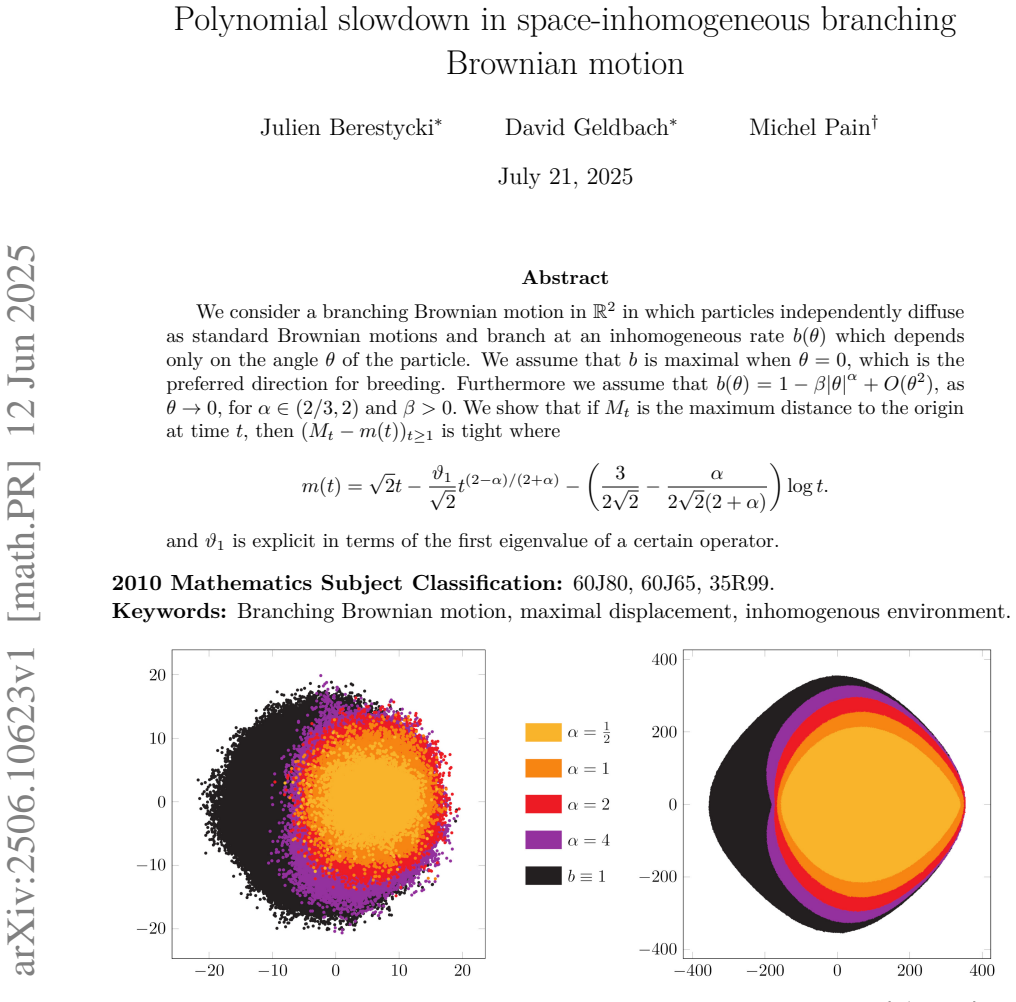
We consider a branching Brownian motion in R^2 in which particles independently diffuse as standard Brownian motions and branch at an inhomogeneous rate b(θ) which depends only on the angle θ of the particle. We assume that b is maximal when θ=0, which is the preferred direction for breeding. Furthermore we assume that b(θ) = 1 - β|θ|^α + O(θ²), as θ → 0, for α ∈ (2/3,2) and β>0. We show that if M_t is the maximum distance to the origin at time t, then (M_t - m(t))_{t ≥ 1} is tight where m(t) = √2 t - (ϑ₁/√2) t^{(2-α)/(2+α)} - ((3/(2√2)) - (α/(2√2(2+α)))) log t and ϑ₁ is explicit in terms of the first eigenvalue of a certain operator.
What carries the argument
Tightness of the centered maximum process (M_t - m(t)), proved via the first eigenvalue of an operator constructed from the local power-law expansion of the branching rate b(θ) near θ = 0.
If this is right
- The leading growth of the maximum remains √2 t, identical to the homogeneous case.
- A polynomial correction of order t raised to the exact power (2-α)/(2+α) appears because of the angular decay rate α.
- An explicit logarithmic correction whose prefactor depends on α also contributes to m(t).
- The amplitude ϑ₁ of the polynomial term is determined by the principal eigenvalue of an operator tied to the local expansion of b.
- The result applies uniformly for all α in the open interval (2/3, 2).
Where Pith is reading between the lines
- The same tightness statement might hold for branching random walks on lattices once the local angular expansion is matched.
- The limiting distribution of the tight fluctuations M_t - m(t), left open here, could be identified by a separate analysis of the eigenvalue problem.
- Analogous polynomial slowdowns are likely to appear in higher-dimensional or non-Brownian particle systems that carry a directional reproduction bias.
- The explicit form of m(t) supplies a testable prediction for numerical or experimental realizations of directionally biased branching processes.
Load-bearing premise
The branching rate admits the local expansion b(θ) = 1 - β|θ|^α + O(θ²) as θ approaches zero, for α between 2/3 and 2.
What would settle it
A direct simulation of the particle system for large t and a concrete value such as α = 1 showing that M_t - m(t) escapes any fixed interval with positive probability bounded away from zero would disprove the claimed tightness.
Figures


read the original abstract
We consider a branching Brownian motion in $\mathbb{R}^2$ in which particles independently diffuse as standard Brownian motions and branch at an inhomogeneous rate $b(\theta)$ which depends only on the angle $\theta$ of the particle. We assume that $b$ is maximal when $\theta=0$, which is the preferred direction for breeding. Furthermore we assume that $b(\theta ) = 1 - \beta \abs{\theta }^\alpha + O(\theta ^2)$, as $\theta \to 0$, for $\alpha \in (2/3,2)$ and $\beta>0.$ We show that if $M_t$ is the maximum distance to the origin at time $t$, then $(M_t-m(t))_{t\ge 1}$ is tight where $$m(t) = \sqrt{2} t - \frac{\vartheta_1}{\sqrt{2}} t^{(2-\alpha)/(2+\alpha)} - \left(\frac{3}{2\sqrt{2}} - \frac{\alpha}{2\sqrt{2}(2+\alpha)}\right) \log t. $$ and $\vartheta_1$ is explicit in terms of the first eigenvalue of a certain operator.
Editorial analysis
A structured set of objections, weighed in public.
Referee Report
Summary. The paper studies a 2D branching Brownian motion in which particles perform standard Brownian motion but branch at an angle-dependent rate b(θ) that attains its maximum at θ=0. Under the local expansion b(θ)=1−β|θ|^α+O(θ²) as θ→0 with α∈(2/3,2) and β>0, the authors establish that the maximum distance M_t to the origin satisfies tightness of the centered process (M_t−m(t))_{t≥1}, where m(t)=√2 t−(ϑ₁/√2) t^{(2−α)/(2+α)}−(3/(2√2)−α/(2√2(2+α)))log t and ϑ₁ is given explicitly in terms of the principal eigenvalue of a scaled angular operator obtained by balancing diffusion against the branching deficit.
Significance. If the central tightness result holds, the work is significant for the theory of inhomogeneous branching diffusions and front propagation. It supplies a precise asymptotic expansion that augments the classical √2 t−(3/(2√2))log t law by a polynomial correction whose exponent (2−α)/(2+α) is determined by the local angular deficit; the eigenvalue characterization of the prefactor ϑ₁ yields an explicit, parameter-dependent prediction. The proof architecture—scaling the angular variable by t^{−1/(2+α)}, controlling large-angle excursions by the global bound b≤1, and verifying integrability for α>2/3—adapts standard comparison techniques to this setting and produces a falsifiable correction term.
minor comments (3)
- The precise definition of the operator whose principal eigenvalue yields ϑ₁ should be stated explicitly (with domain and boundary conditions) already in the introduction or in a dedicated preliminary section, rather than deferred to the technical core.
- In the error analysis for the O(θ²) remainder under the scaling θ∼t^{−1/(2+α)}, an explicit bound on the perturbation of the eigenvalue (e.g., via the variational characterization or Kato perturbation) would make the lower-order claim fully transparent.
- The derivation of the logarithmic coefficient should include a short remark confirming that it reduces exactly to the classical 3/(2√2) value when β=0 (or α→∞), to facilitate comparison with the homogeneous case.
Simulated Author's Rebuttal
We thank the referee for their positive summary of our work on angle-dependent 2D branching Brownian motion and for recommending minor revision. We appreciate the recognition of the significance of the tightness result and the explicit polynomial correction term. Since no specific major comments were raised in the report, we provide a brief overall response below and confirm that the manuscript is ready for minor adjustments if any editorial suggestions arise.
Circularity Check
No significant circularity
full rationale
The paper's derivation of the tightness of (M_t - m(t)) proceeds by constructing matching upper and lower bounds on the maximum position. The leading correction term arises from a scaled eigenvalue problem whose principal eigenvalue ϑ₁ is defined directly from the local expansion of the branching rate b(θ) and the angular diffusion; this is a standard first-principles construction rather than a fit or self-referential definition. The exponent (2-α)/(2+α) is obtained by balancing the angular diffusion scale against the β|θ|^α deficit under the ansatz θ ~ t^{-1/(2+α)}, with the O(θ²) remainder shown to be negligible and large-angle excursions controlled by the global bound b ≤ 1. No step reduces by construction to a fitted parameter, a prior self-citation, or a renaming of an input; the argument is self-contained against the stated assumptions on b.
Axiom & Free-Parameter Ledger
axioms (1)
- domain assumption b(θ) = 1 - β|θ|^α + O(θ²) as θ → 0 for α ∈ (2/3, 2) and β > 0
Lean theorems connected to this paper
-
IndisputableMonolith/Cost/FunctionalEquation.leanwashburn_uniqueness_aczel (J-cost uniqueness) unclear?
unclearRelation between the paper passage and the cited Recognition theorem.
m(t) = √2 t − (ϑ₁/√2) t^{(2-α)/(2+α)} − ((3/(2√2)) − (α/(2√2(2+α)))) log t, with ϑ₁ from the ground-state eigenvalue of the operator with potential |x|^α
-
IndisputableMonolith/Foundation/AlphaCoordinateFixation.leancostAlphaLog_high_calibrated_iff unclear?
unclearRelation between the paper passage and the cited Recognition theorem.
PDE ∂_r u = ϱ (∂_{xx} u − (1−r)^{−α} |x|^α u) and its Sturm–Liouville analysis
What do these tags mean?
- matches
- The paper's claim is directly supported by a theorem in the formal canon.
- supports
- The theorem supports part of the paper's argument, but the paper may add assumptions or extra steps.
- extends
- The paper goes beyond the formal theorem; the theorem is a base layer rather than the whole result.
- uses
- The paper appears to rely on the theorem as machinery.
- contradicts
- The paper's claim conflicts with a theorem or certificate in the canon.
- unclear
- Pith found a possible connection, but the passage is too broad, indirect, or ambiguous to say the theorem truly supports the claim.
Reference graph
Works this paper leans on
-
[1]
E. Aïdékon, J. Berestycki, E. Brunet, and Z. Shi. Branching Brownian motion seen from its tip. Probab. Theory Related Fields, 157(1-2):405–451, 2013
work page 2013
- [2]
- [3]
- [4]
-
[5]
D. G. Aronson and P. Besala. Parabolic equations with unbounded coefficients.J. Differ- ential Equations, 3:1–14, 1967
work page 1967
-
[6]
C. Bennewitz, M. Brown, and R. Weikard. Spectral and scattering theory for ordinary differential equations. Vol. I: Sturm-Liouville equations. Universitext. Springer, Cham, 2020
work page 2020
-
[7]
J. Berestycki, E. Brunet, C. Graham, L. Mytnik, J.-M. Roquejoffre, and L. Ryzhik. The distance between the two BBM leaders.Nonlinearity, 35(4):1558–1609, 2022
work page 2022
-
[8]
J. Berestycki, E. Brunet, J. W. Harris, and S. C. Harris. The almost-sure population growth rate in branching Brownian motion with a quadratic breeding potential.Statist. Probab. Lett., 80(17-18):1442–1446, 2010
work page 2010
-
[9]
J. Berestycki, E. Brunet, J. W. Harris, S. C. Harris, and M. I. Roberts. Growth rates of the population in a branching Brownian motion with an inhomogeneous breeding potential. Stochastic Process. Appl., 125(5):2096–2145, 2015
work page 2096
-
[10]
J. Berestycki, Y. H. Kim, E. Lubetzky, B. Mallein, and O. Zeitouni. The extremal point process of branching Brownian motion inRd. Ann. Probab., 52(3):955–982, 2024
work page 2024
-
[11]
S. Bocharov and S. C. Harris. Branching Brownian motion with catalytic branching at the origin. Acta Appl. Math., 134:201–228, 2014
work page 2014
-
[12]
S. Bocharov and S. C. Harris. Limiting distribution of the rightmost particle in catalytic branching Brownian motion.Electron. Commun. Probab., 21:Paper No. 70, 12, 2016
work page 2016
-
[13]
S. Bocharov and L. Wang. Branching Brownian motion with spatially homogeneous and point-catalytic branching.J. Appl. Probab., 56(3):891–917, 2019
work page 2019
-
[14]
A. N. Borodin and P. Salminen.Handbook of Brownian motion—facts and formulae. Prob- ability and its Applications. Birkhäuser Verlag, Basel, second edition, 2002
work page 2002
-
[15]
A. Bovier and L. Hartung. The extremal process of two-speed branching Brownian motion. Electron. J. Probab., 19:no. 18, 28, 2014
work page 2014
-
[16]
VariablespeedbranchingBrownianmotion1.Extremalprocesses in the weak correlation regime.ALEA Lat
A.BovierandL.Hartung. VariablespeedbranchingBrownianmotion1.Extremalprocesses in the weak correlation regime.ALEA Lat. Am. J. Probab. Math. Stat., 12(1):261–291, 2015
work page 2015
-
[17]
A. Bovier and L. Hartung. From 1 to 6: a finer analysis of perturbed branching Brownian motion. Comm. Pure Appl. Math., 73(7):1490–1525, 2020
work page 2020
-
[18]
A. Bovier and I. Kurkova. Derrida’s generalized random energy models. II. Models with continuous hierarchies.Ann. Inst. H. Poincaré Probab. Statist., 40(4):481–495, 2004
work page 2004
-
[19]
M. Bramson. Convergence of solutions of the Kolmogorov equation to travelling waves. Mem. Amer. Math. Soc., 44(285):iv+190, 1983
work page 1983
-
[20]
M. D. Bramson. Maximal displacement of branching Brownian motion.Comm. Pure Appl. Math., 31(5):531–581, 1978
work page 1978
-
[21]
P. Carmona and Y. Hu. The spread of a catalytic branching random walk.Ann. Inst. Henri Poincaré Probab. Stat., 50(2):327–351, 2014
work page 2014
-
[22]
L. Chaumont and G. Uribe Bravo. Markovian bridges: weak continuity and pathwise constructions. Ann. Probab., 39(2):609–647, 2011
work page 2011
-
[23]
A. Cortines, L. Hartung, and O. Louidor. The structure of extreme level sets in branching Brownian motion.Ann. Probab., 47(4):2257–2302, 2019
work page 2019
-
[24]
M. Fang and O. Zeitouni. Branching random walks in time inhomogeneous environments. Electron. J. Probab., 17:no. 67, 18, 2012
work page 2012
-
[25]
M. Fang and O. Zeitouni. Slowdown for time inhomogeneous branching Brownian motion. J. Stat. Phys., 149(1):1–9, 2012
work page 2012
-
[26]
F. Gao, J. Hannig, T.-Y. Lee, and F. Torcaso. Laplace transforms via Hadamard factoriza- tion. Electron. J. Probab., 8:no. 13, 20, 2003. 52
work page 2003
-
[27]
R. Hardy and S. C. Harris. A spine approach to branching diffusions with applications to Lp-convergence of martingales. InSéminaire de Probabilités XLII, volume 1979 ofLecture Notes in Math., pages 281–330. Springer, Berlin, 2009
work page 1979
-
[28]
J. W. Harris and S. C. Harris. Branching Brownian motion with an inhomogeneous breeding potential. Ann. Inst. Henri Poincaré Probab. Stat., 45(3):793–801, 2009
work page 2009
-
[29]
S. C. Harris, M. Hesse, and A. E. Kyprianou. Branching Brownian motion in a strip: survival near criticality.Ann. Probab., 44(1):235–275, 2016
work page 2016
-
[30]
S. C. Harris and M. I. Roberts. The many-to-few lemma and multiple spines.Ann. Inst. Henri Poincaré Probab. Stat., 53(1):226–242, 2017
work page 2017
-
[31]
L. Hartung, O. Louidor, and T. Wu. On the growth of the extremal and cluster level sets in branching Brownian motion. 2024. arXiv:2405.17634
-
[32]
O. Kallenberg. Foundations of modern probability, volume 99 ofProbability Theory and Stochastic Modelling. Springer, Cham, 2021. Third edition
work page 2021
-
[33]
I. Karatzas and S. E. Shreve. Brownian motion and stochastic calculus, volume 113 of Graduate Texts in Mathematics. Springer-Verlag, New York, second edition, 1991
work page 1991
-
[34]
Y. H. Kim, E. Lubetzky, and O. Zeitouni. The maximum of branching Brownian motion in Rd. Ann. Appl. Probab., 33(2):1315–1368, 2023
work page 2023
-
[35]
S. P. Lalley and T. Sellke. A conditional limit theorem for the frontier of a branching Brownian motion.Ann. Probab., 15(3):1052–1061, 1987
work page 1987
- [36]
-
[37]
P. Maillard and O. Zeitouni. Slowdown in branching Brownian motion with inhomogeneous variance. Ann. Inst. Henri Poincaré Probab. Stat., 52(3):1144–1160, 2016
work page 2016
-
[38]
B. Mallein. Maximal displacement of a branching random walk in time-inhomogeneous environment. Stochastic Process. Appl., 125(10):3958–4019, 2015
work page 2015
-
[39]
B. Mallein. Maximal displacement ofd-dimensional branching Brownian motion.Electron. Commun. Probab., 20:no. 76, 12, 2015
work page 2015
-
[40]
L. Mytnik, J.-M. Roquejoffre, and L. Ryzhik. Fisher-KPP equation with small data and the extremal process of branching Brownian motion.Adv. Math., 396:Paper No. 108106, 58, 2022
work page 2022
-
[41]
M. I. Roberts and J. Schweinsberg. A Gaussian particle distribution for branching Brownian motion with an inhomogeneous branching rate.Electron. J. Probab., 26:Paper No. 103, 76, 2021
work page 2021
-
[42]
B. A. Sevastyanov. Branching stochastic processes for particles diffusing in a bounded domain with absorbing boundaries.Teor. Veroyatnost. i Primenen., 3:121–136, 1958
work page 1958
-
[43]
DerivativemartingaleofthebranchingBrownian motion in dimensiond≥1
R.Stasiński, J.Berestycki, andB.Mallein. DerivativemartingaleofthebranchingBrownian motion in dimensiond≥1. Ann. Inst. Henri Poincaré Probab. Stat., 57(3):1786–1810, 2021
work page 2021
-
[44]
G. Teschl. Mathematical methods in quantum mechanics, volume 157 ofGraduate Studies in Mathematics. American Mathematical Society, Providence, RI, second edition, 2014. With applications to Schrödinger operators
work page 2014
- [45]
-
[46]
A. Zettl. Sturm-Liouville theory, volume 121 ofMathematical Surveys and Monographs. American Mathematical Society, Providence, RI, 2005. 53
work page 2005
discussion (0)
Sign in with ORCID, Apple, or X to comment. Anyone can read and Pith papers without signing in.