REVIEW 4 major objections 5 minor 1 cited by
Large Language Models-Empowered Wireless Networks: Fundamentals, Architecture, and Challenges
T0 review · 4 major / 5 minor · reviewed 2026-08-07 · deepseek-v4-flash
Pith's one-line read This paper argues that wireless networks should be built around LLM-native systems, with telecom LLM agents handling learning and task offloading, and that a hybrid control scheme combining double deep Q-learning with convex optimization…
desk verdict A coherent LLM-for-wireless vision piece whose case-study performance claim rests on an unstated convexity assumption. read the letter →
The pith
A machine-rendered reading of the paper's core claim, the machinery that carries it, and where it could break.
The reading
What carries the argument
The central machinery is the telecom LLM agent: an LLM deployed at an edge server or cloud that fine-tunes a pre-trained model with federated learning and serves inference requests offloaded from end devices. The control loop around it is the proposed hybrid optimizer: double deep Q-learning (DDQN) chooses the association variable \(a\), a convex optimizer (CVX) sets the time-interval allocation \(\tau\), and a second convex optimizer sets the relative local accuracy \(\$\theta$\), where \(\$\theta$\) is defined so that smaller values mean better actual local accuracy. These two convex subproblems are asserted to be low-complexity and fast-converging, and the reward used in training is the reciprocal of the cost, turning the cost-minimization problem into long-term reward maximization.
What would settle it
Run the same ablation with explicit formulations of the \(\tau\) and \(\$\theta$\) subproblems: if a generic convex solver does not improve cumulative reward over plain DDQN when the subproblems are solved by simple heuristics, or if the subproblems turn out to be non-convex, the claimed advantage collapses.
Extended reading notes
Core claim
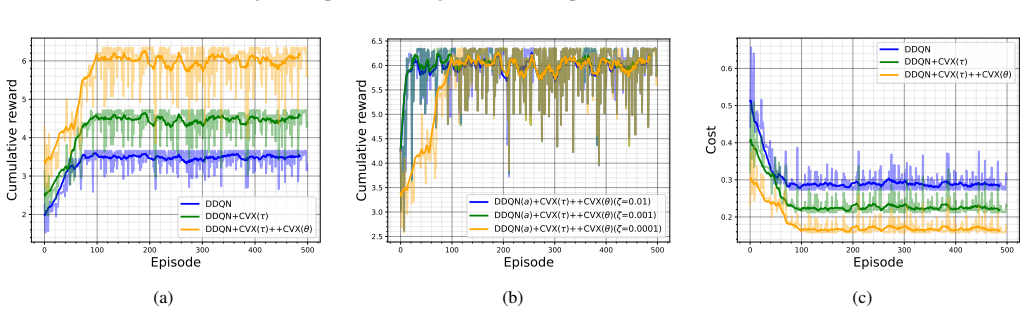
The paper's central claim is that the joint distributed LLM learning and task offloading problem in an LLM-native wireless network is best solved by a hybrid approach: DDQN selects device-to-telecom-LLM associations while convex optimizers handle time-interval allocation and the relative local accuracy parameter \(\$\theta$\). The authors report that this hybrid scheme outperforms traditional DDQN in cumulative reward and cost, with convergence that is significantly faster, and that the improvement appears already when only the time-allocation optimizer is added. Stated on the paper's own terms: a DRL agent makes the discrete association decisions, continuous subproblems that are convex are handed to low-complexity convex solvers, and the resulting system is suitable for practical deployment because both components have reasonable complexity.
Load-bearing premise
The result depends on the assumption that the time-interval allocation and relative-local-accuracy subproblems are convex and can be reliably solved by a generic convex optimizer inside the DDQN loop; the paper asserts this without giving the problem formulations or a proof.
Editorial extensions
If this is right
- If the case-study result holds, combining DRL with convex optimization becomes a practical recipe for joint learning-and-offloading decisions in LLM-native wireless systems.
- Federated fine-tuning of an edge-deployed LLM becomes feasible with modest per-device computing because only fine-tuning, not full training, is done locally.
- The same hybrid pattern can extend to other continuous resource variables, such as transmit power allocation, which the paper names as future work.
- The reported stability across learning rates \(\zeta = 0.01\), \(0.001\), and \(0.0001\) suggests the proposed scheme does not hinge on a finely tuned learning rate.
- Telecom LLM agents can be deployed at the edge, the cloud, or both, with the choice driven by latency and computing requirements.
Reading between the lines
- The case study's advantage is only as strong as the unstated convex formulations of the \(\tau\) and \(\theta\) subproblems; if those subproblems are actually non-convex in a realistic model, the generic-CVX step would need to be replaced and the reported gap over plain DDQN could shrink.
- A natural next test, which the paper does not run, is ablating each optimizer separately against a fixed-schedule baseline to verify that the reward gain comes from the convex updates rather than from the extra computation or replay dynamics.
- The paper's framework suggests a broader design principle: in LLM-native networks, DRL should handle discrete combinatorial decisions while convex solvers handle continuous resource variables, a split that could generalize to caching, spectrum sharing, and multi-agent coordination.
- The simulations use a single case-study configuration (36 agents, 5 telecom LLM agents, 20 steps per episode); whether the outperformance persists across network sizes, channel models, and task mixes is untested.
Editorial analysis
A structured set of objections, weighed in public.
Referee Report
Summary. The paper advocates a vision of LLM-native wireless systems based on telecom LLM agents deployed at end-devices, edge, or cloud. It discusses limitations of traditional ML-enabled wireless systems, presents an architecture for distributed fine-tuning of LLMs via federated learning with task offloading, and reports a case study. In the case study, the authors propose a hybrid solution in which double deep Q-learning (DDQN) handles device-to-telecom-LLM association, while convex optimizers determine TDMA time allocation and relative local accuracy. Simulation results in Fig. 5 claim that the proposed hybrid scheme significantly outperforms plain DDQN in cumulative reward and cost. The paper closes with open challenges and conclusions.
Significance. The conceptual contribution is useful: the paper formulates a vision of LLM-native wireless systems, identifies limitations of conventional ML, and suggests a hybrid DRL-optimization approach for a mixed-integer resource management problem in distributed LLM fine-tuning. If the case study were fully specified, the paper would provide a credible demonstration that combining DRL with convex optimization can improve convergence and cost in such systems. However, the central quantitative claim is not established in the present manuscript because the optimization subproblems are never formulated, convexity is asserted without proof, and the simulation comparison lacks controlled baselines and statistical support. The paper is therefore best understood as a vision/position contribution whose quantitative case study needs substantial strengthening.
major comments (4)
- [Section III.A] The optimization problem is described only in prose. No equations define the cost C, the TDMA time allocation variables τ, the relative local accuracy θ, or the constraints (maximum serving capacity, latency/reliability constraints). Consequently, the assertion that the τ and θ subproblems are convex and can be solved by generic convex optimizers is unsupported. Please add a formal problem statement and a convexity argument or proof for both subproblems.
- [Section III.B, Fig. 5] The performance comparison is confounded. Plain DDQN must learn the association, time allocation, and relative local accuracy, whereas the proposed method only learns the association and is given τ and θ by optimizers. The reported gains may therefore be due to reduced action-space dimension rather than the hybrid architecture itself. Moreover, no seeds, error bars, or multiple independent runs are reported, so the claim that the proposed scheme 'significantly outperform[s]' plain DDQN is not statistically substantiated. Please add a controlled baseline (e.g., DDQN with the same reduced action space, or with τ and θ from a fixed heuristic) and repeated-run statistics.
- [Section III.A and Section III.B] The reward is defined as 1/Cost, but the cost function is never specified. Without a definition of C, the cumulative reward and cost curves in Fig. 5 cannot be interpreted or compared across schemes. Please specify the cost model, including its dependence on latency, reliability, task offloading, and learning update communication.
- [Section III.A] The statement that the convex optimizers have 'generally low complexity and converge within reasonable iterations' is supported only by a textbook reference [15]. Since the subproblems are not written down, no complexity conclusion follows. Please provide either a complexity bound for the specific subproblems or measured runtime results from the simulations.
minor comments (5)
- [Section III.A] The text refers to 'slit FL'; this appears to be a typo for 'split federated learning' (split FL).
- [Section II.B] The phrase 'On other other hand' contains a duplicated word; it should read 'On the other hand.'
- [Figure 5] In the extracted text, the legend entries show 'DDQN+CVX( )' with missing symbols for τ and θ. Please verify that all Greek symbols render correctly in the figure legends and axis labels.
- [Figure 1] The box labeled 'Forensices' appears misspelled; it should be 'Forensics.'
- [Author footnote] The footnote spells the second author as 'M. Muhidat,' whereas the paper header gives 'Sami Muhaidat.' Please harmonize the spelling.
Circularity Check
No circularity: the case study is an empirical comparison; the unformulated convex subproblems create reproducibility concerns, but no claim reduces to its own inputs.
full rationale
The paper's central case-study claim is that DDQN combined with convex optimization for time interval allocation and relative local accuracy outperforms plain DDQN (Section III.B, Fig. 5). This is presented as an empirical simulation comparison, not as a derivation. The subproblems for tau and theta are asserted to be convex in Section III.A ('the convex nature of the time allocation problem') and are solved by generic convex optimizers, but no explicit formulation of these subproblems is given. That absence makes the comparison difficult to audit and could hide an unfair action-space reduction, but it is an evaluation-transparency or reproducibility issue, not circularity: no equation or fitted parameter is defined in terms of the result it is said to predict, and the simulation conclusion is not presupposed by the stated assumptions. The self-citations ([2], [8]) are background references and are not load-bearing. The only citation used to support a technical claim about solver behavior is Boyd and Vandenberghe [15], an external textbook, which is independent evidence for the general statement that convex optimizers converge in reasonable iterations. There is no renaming of a known result, no imported uniqueness theorem, and no fitted input relabeled as a prediction. Therefore the paper receives a circularity score of 0.
Assumptions & free parameters
free parameters (3)
- DDQN learning rate ζ =
0.01, 0.001, 0.0001 (Fig. 5b)
- DDQN training hyperparameters (discount factor, replay memory size, batch size, hidden layer sizes) =
0.9, 500, 16, 64-32-32
- Simulation parameters (area, transmit power, noise power density) =
1000×1000 m, 50 dBm, -174 dBm/Hz
assumptions (4)
- domain assumption The time interval allocation subproblem is convex.
- domain assumption The relative local accuracy θ optimization subproblem is convex.
- domain assumption A pre-trained LLM is available on the cloud and can be fine-tuned via federated learning at edge devices.
- domain assumption TDMA and unique device-to-agent association are sufficient assumptions for the case study.
Cite this review
Pith. "Pith review of Large Language Models-Empowered Wireless Networks: Fundamentals, Architecture, and Challenges." pith.science (2026). https://pith.science/paper/PMVJOJ3Y
@misc{pith2026250610651,
  author       = {Pith},
  title        = {Pith review of: Large Language Models-Empowered Wireless Networks: Fundamentals, Architecture, and Challenges},
  year         = {2026},
  howpublished = {\url{https://pith.science/paper/PMVJOJ3Y}},
  note         = {Machine review of arXiv:2506.10651}
}
read the original abstract
The rapid advancement of wireless networks has resulted in numerous challenges stemming from their extensive demands for quality of service towards innovative quality of experience metrics (e.g., user-defined metrics in terms of sense of physical experience for haptics applications). In the meantime, large language models (LLMs) emerged as promising solutions for many difficult and complex applications/tasks. These lead to a notion of the integration of LLMs and wireless networks. However, this integration is challenging and needs careful attention in design. Therefore, in this article, we present a notion of rational wireless networks powered by \emph{telecom LLMs}, namely, \emph{LLM-native wireless systems}. We provide fundamentals, vision, and a case study of the distributed implementation of LLM-native wireless systems. In the case study, we propose a solution based on double deep Q-learning (DDQN) that outperforms existing DDQN solutions. Finally, we provide open challenges.
Figures


Figures from the paper (2 more)

Forward citations
Cited by 1 Pith paper
-
Large Language Models for Next-Generation Wireless Network Management: A Survey and Tutorial
A survey and tutorial that organizes LLM-enabled wireless network optimization into formulation, solution, and verification stages, with case studies drawn from the authors' own prior papers.
Reference graph
Works this paper leans on
-
[4]
Large language models for telecom: The next big thing?
L. Bariah, Q. Zhao, H. Zou, Y . Tian, F. Bader, and M. Debbah, “Large language models for telecom: The next big thing?” arXiv preprint arXiv:2306.10249, 2023
arXiv 2023
-
[7]
Using large language models to understand telecom standards,
A. Karapantelakis, M. Thakur, A. Nikou, F. Moradi, C. Olrog, F. Gaim, H. Holm, D. D. Nimara, and V . Huang, “Using large language models to understand telecom standards,” in 2024 IEEE International Conference on Machine Learning for Communication and Networking (ICMLCN) . IEEE, 2024, pp. 440–446
work page 2024
-
[15]
S. P. Boyd and L. Vandenberghe, Convex optimization . Cambridge university press, 2004
2004
-
[1]
A vision of 6g wireless systems: Applications, trends, technologies, and open research problems,
W. Saad, M. Bennis, and M. Chen, “A vision of 6g wireless systems: Applications, trends, technologies, and open research problems,” IEEE network, vol. 34, no. 3, pp. 134–142, 2019
2019
-
[2]
A joint communication and learning framework for hierarchical split federated learning,
L. U. Khan, M. Guizani, A. Al-Fuqaha, C. S. Hong, D. Niyato, and Z. Han, “A joint communication and learning framework for hierarchical split federated learning,” IEEE Internet of Things Journal, vol. 11, no. 1, pp. 268–282, 2023
work page 2023
-
[3]
A survey on deep learning for human mobility,
M. Luca, G. Barlacchi, B. Lepri, and L. Pappalardo, “A survey on deep learning for human mobility,” ACM Computing Surveys (CSUR), vol. 55, no. 1, pp. 1–44, 2021
2021
-
[5]
Large language models for telecom: Forthcoming impact on the indus- try,
A. Maatouk, N. Piovesan, F. Ayed, A. De Domenico, and M. Debbah, “Large language models for telecom: Forthcoming impact on the indus- try,” IEEE Communications Magazine , 2024
work page 2024
-
[6]
Telecomgpt: A framework to build telecom-specfic large language models,
H. Zou, Q. Zhao, Y . Tian, L. Bariah, F. Bader, T. Lestable, and M. Debbah, “Telecomgpt: A framework to build telecom-specfic large language models,” arXiv preprint arXiv:2407.09424 , 2024
arXiv 2024
Show all 15 references
-
[8]
Network virtualization empowered metaverse: A hierarchical matching approach,
L. U. Khan, M. Guizani, I. Yaqoob, A. Al-Fuqaha, A. Erbad, and Z. Han, “Network virtualization empowered metaverse: A hierarchical matching approach,” Authorea Preprints, 2023
2023
-
[9]
Qoe-driven uplink scheduling for haptic communications over 5g enabled tactile internet,
S. Liu, M. Li, X. Xu, E. Steinbach, and Q. Liu, “Qoe-driven uplink scheduling for haptic communications over 5g enabled tactile internet,” in 2018 IEEE International Symposium on Haptic, Audio and Visual Environments and Games (HAVE). IEEE, 2018, pp. 1–5
2018
-
[10]
A dynamic resource allocation framework for synchronizing metaverse with iot service and data,
Y . Han, D. Niyato, C. Leung, C. Miao, and D. I. Kim, “A dynamic resource allocation framework for synchronizing metaverse with iot service and data,” in ICC 2022-IEEE International conference on Communications. IEEE, 2022, pp. 1196–1201
2022
-
[11]
Digital twin in industry: State-of-the-art,
F. Tao, H. Zhang, A. Liu, and A. Y . Nee, “Digital twin in industry: State-of-the-art,” IEEE Transactions on industrial informatics , vol. 15, no. 4, pp. 2405–2415, 2018
2018
-
[12]
Wirelessllm: Empowering large language models towards wireless intelligence,
J. Shao, J. Tong, Q. Wu, W. Guo, Z. Li, Z. Lin, and J. Zhang, “Wirelessllm: Empowering large language models towards wireless intelligence,” arXiv preprint arXiv:2405.17053 , 2024
2024 arXiv
-
[13]
Self-adaptive large language model (llm)-based multiagent systems,
N. Nascimento, P. Alencar, and D. Cowan, “Self-adaptive large language model (llm)-based multiagent systems,” in 2023 IEEE International Conference on Autonomic Computing and Self-Organizing Systems Companion (ACSOS-C). IEEE, 2023, pp. 104–109. IEEE INTERNET OF THINGS MAGAZINE 9
2023
-
[14]
Large language models empowered autonomous edge ai for connected intelligence,
Y . Shen, J. Shao, X. Zhang, Z. Lin, H. Pan, D. Li, J. Zhang, and K. B. Letaief, “Large language models empowered autonomous edge ai for connected intelligence,” IEEE Communications Magazine , 2024
2024
Reviewed August 7, 2026 · model on record in the stance chip above.
Discussion (0). Sign in to comment.