REVIEW 3 major objections 5 minor 1 cited by
Integrating Large Language Models into Text Animation: An Intelligent Editing System with Inline and Chat Interaction
T0 review · 3 major / 5 minor · reviewed 2026-08-07 · deepseek-v4-flash
Pith's one-line read LLM inline and chat agents let novices finish text-animation videos
desk verdict A competent LLM text-animation editor with a genuinely new dual-agent design, but the headline validation claim is unsupported because the one controlled comparison the study promised is never reported. read the letter →
The pith
A machine-rendered reading of the paper's core claim, the machinery that carries it, and where it could break.
The reading
What carries the argument
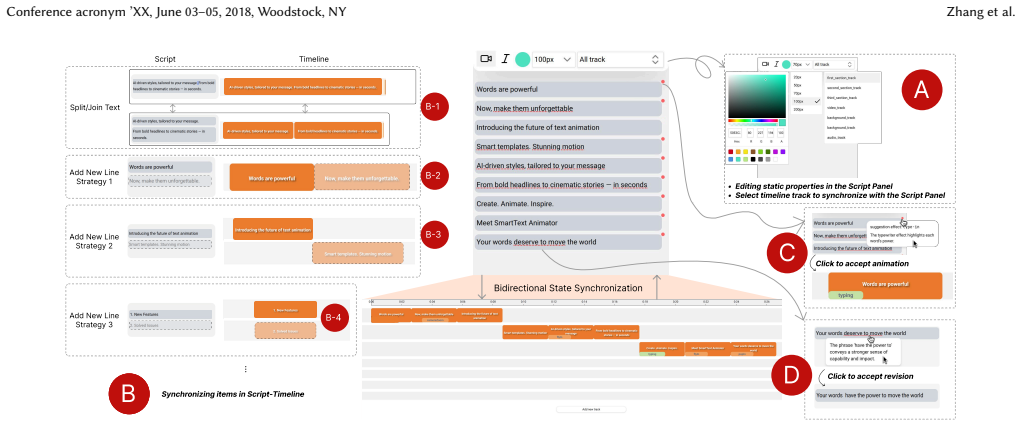
The machinery is a dual-mode agent pipeline: the Inline Agent, which monitors script, timeline, and operation-history context and emits structured, reason-backed suggestions for specific tasks (text revision, animation recommendation, clip placement), and the Chat Agent, which runs a Plan-and-Execute loop that parses user instructions, proposes an execution plan for approval, and calls editor functions through LLM function calling. Both agents rely on a semantic-animation mapping, a structured space linking linguistic features of text to animation parameters, encoded in prompt templates. A meta-object framework represents assets, timeline elements, and animation effects as typed objects, so that newly added element types become available to the agents without changing prompts.
What would settle it
Run an ablation in which the semantic-animation mapping is bypassed and animations are assigned randomly or by a fixed template while everything else stays identical; if users' ratings of appropriateness and task completion time do not change, the mapping is not doing the claimed work. Alternatively, have expert animators rate the system's suggestions on a corpus of one hundred texts; agreement near chance would refute the mapping's effectiveness.
Extended reading notes
Core claim
The central discovery, on the paper's own terms, is that pairing two complementary LLM agents—one embedded in the editor for context-specific suggestions and one conversational for broad instruction—creates a text-animation editing workflow that non-professionals can master quickly while still editing at the granularity of individual animation parameters. The system achieves this through a semantic-animation mapping that connects linguistic features such as semantic importance and emotional tone to static attributes (font size, color, position) and dynamic behaviors (animation type, velocity, timing). The user study reports that all participants completed the assigned and free-form animation tasks, gave the system an SUS score of 75, and rated the learning cost low, which the authors take as evidence that the dual-mode pipeline and synchronized script-timeline editing provide both usability and functionality.
Load-bearing premise
The load-bearing assumption is that GPT-4o, guided only by prompt templates, can reliably translate a text's semantic importance and emotional tone into animation parameters that users find appropriate; this mapping is never tested on its own.
Editorial extensions
If this is right
- If the system is right, non-professional users can complete text-animation projects that previously demanded professional editing skills, with a reported average learning cost of 1.73 on a 5-point scale.
- The dual-agent design implies that the same editor can serve lightweight inline assistance and heavier conversational batch editing without sacrificing fine-grained control over individual animation parameters.
- The meta-object framework means new asset or effect types become agent-addressable without prompt rewrites, making the architecture extensible to future editor features.
- The workflow findings suggest the script-timeline synchronization pattern could be carried into broader video editing tools, as the paper's design implications argue.
- Users with more LLM experience produced better editing results in the study, indicating that the system's value grows with user familiarity with prompt-style interaction.
Reading between the lines
- The semantic-animation mapping is never tested in isolation; a direct ablation that replaces it with random or fixed-template animation assignment would clarify whether the LLM is genuinely reading emotional tone and semantic importance, or merely matching templates to keywords.
- The 11-participant study supports usability claims but not creative quality; a controlled comparison of final videos against professional-made text animations would test whether the system improves output quality, not just workflow ease.
- The meta-object plus agent architecture points naturally to a plugin path for mature editors such as the one a participant suggested, and the absence of multimodal feedback likely caps the agent's ability to judge visual outcomes; adding vision-language input is a testable next step.
- The observation that LLM-savvy users get better results implies the tool rewards prompt literacy, so just-in-time prompt coaching or suggested-command chips could compress the learning gap between novice and experienced users.
Editorial analysis
A structured set of objections, weighed in public.
Referee Report
Summary. The paper proposes an LLM-aided text animation editing system with a dual-stream agent pipeline (Inline Agent and Chat Agent), a script-timeline synchronization interface, and a semantic-animation mapping meant to translate linguistic features into animation parameters. It reports a formative study with nine participants, a full-stack implementation using GPT-4o, Motion-Canvas, Slate.js, LangGraph, and Copilot-Kit, and a user study with 11 participants who completed editing tasks, filled SUS and other questionnaires, and were interviewed. The abstract and contributions claim the user study 'validates the pipeline' and demonstrates the system's ability to help non-professional users complete animation workflows.
Significance. The system design is plausible and well-motivated: the meta-object framework, direct-manipulation referencing, ambiguity-resolving UI prompts, and plan-and-execute chat agent are concrete contributions to LLM-assisted creative editing, and the formative study gives the design goals some empirical grounding. The reported SUS score of 75 and low self-reported learning cost are useful usability signals. However, the central validation claim rests on uncontrolled qualitative feedback; the promised with/without-LLM comparison from Section 7.2 is never reported, and the semantic-animation mapping, the paper's core mechanism, is not separately evaluated. If the missing evidence can be supplied, the paper would be a solid design study for an HCI audience; in its current form, the abstract and contribution claims outstrip the data.
major comments (3)
- [Section 7.2 vs. Section 7.3] Section 7.2 states that the first task asked users to edit a specified text passage 'both with and without the assistance of the LLM-based editing tool.' Sections 7.3.1 through 7.3.5 never report results disaggregated by condition: there is no completion time, output quality rating, error count, perceived-effort score, or statistical comparison. The abstract's claim that the user study validates the pipeline is therefore not supported by the controlled evidence the authors say they collected. Please either report the missing within-subject comparison (e.g., a table of per-condition metrics) or temper the abstract and Section 1 claims to 'a usability assessment of the integrated system.'
- [Section 7.3.1 and Figure 9] The SUS score of 75 and the learning-cost mean of 1.73 (SD = 0.79) are presented as evidence that the system 'validates the effectiveness of the human-computer interaction paradigm adopted in our proposed pipeline.' With 11 participants, no baseline condition, and no task-performance metric, these self-reports cannot isolate the contribution of the LLM agents from other design features such as script-timeline synchronization, preset animations, or the preview panel. In addition, Section 7.3.2, titled 'Comparison with Existing Tools,' contains no actual comparison data—only qualitative quotes and summary statements. Please add a baseline condition or clearly reframe the claims as subjective usability impressions rather than comparative validation.
- [Section 6.2.3] The semantic-animation mapping is the core mechanism behind both the Inline Agent and the Chat Agent (DG2), but it is never evaluated separately or ablated. The prompt templates that implement the mapping are not included, so the reader cannot determine whether the mapping is well-specified or whether the LLM reliably follows it. Concretely, please provide either (a) the mapping definition or prompt template, (b) an evaluation of whether recommended animations match human judgments of semantic importance and emotional tone, or (c) an ablation comparing agent suggestions against no suggestions or random suggestions. Without this, the results cannot be attributed to the mapping, and the claim that the system 'understands editing intent' remains unverified.
minor comments (5)
- [Section 7 introduction] In the paragraph introducing Section 7.3, 'we ralate the findings' should be 'we relate the findings.'
- [Section 5.2.2, 'Add Line'] The sentence 'As shown in Figure 4(B)' appears to refer to the predefined layout strategies that are actually depicted in Figure 5(B-2) through (B-4); please correct the cross-reference.
- [Terminology throughout] The paper uses 'semantic-animation mapping' in Sections 4 and 6 but the Section 6.2.3 heading is 'Semantic-Animation Matching'; please standardize the terminology.
- [Section 7.3.1] The 'mean learning cost = 1.73' is reported without defining the scale, the question asked, or the range of possible values; please specify the measurement instrument.
- [Figure 9] The figure caption says 'Distribution of SUS usability scale results,' but the individual item axes and the SUS items represented are not explained in the text; please add clarity about which SUS items are shown and how the distribution was computed.
Circularity Check
No significant circularity; the usability evaluation is an external behavioral measure independent of the system's design constructs.
full rationale
The paper's central claims are (1) a design proposal with a semantic-animation mapping and dual-mode agents, and (2) a user study validating usability. No derivation chain equates an output with an input. The semantic-animation mapping is introduced in Section 4.2.1 as a design construct based on formative interviews and literature, and used in Section 6.2.3 only as a prompt-level description; the paper does not derive any predictive quantity from it. The user-study evidence (SUS = 75 in Section 7.3.1, qualitative quotes in Sections 7.3.2 through 7.3.5) is an external behavioral measure: usability ratings are not defined in terms of the mapping or the pipeline, and no parameter is fitted to the data and then renamed a prediction. There are no load-bearing self-citations; references such as [35, 50, 52] ground the mapping space in prior work by other authors, and the design goals are stated as goals, not as theorems. The skeptic's observation that Section 7.2 promised a with/without-LLM comparison that Section 7.3 never reports is a legitimate evidentiary gap about whether the LLM agents specifically caused the positive ratings, but it is a missing-controls problem, not circularity: the reported SUS and interview data are not constructed from the claims they support.
Assumptions & free parameters
assumptions (4)
- domain assumption LLMs can reliably map semantic features (e.g., importance, emotion) to appropriate animation parameters through prompt templates.
- domain assumption Preset animations are sufficient for non-professional text-animation creation.
- domain assumption Plan-and-Execute with user approval is an effective interaction pattern for LLM editing agents.
- domain assumption Self-reported SUS and interview responses reflect editing effectiveness.
invented entities (3)
-
Inline Agent
-
Chat Agent
-
semantic-animation mapping
Cite this review
Pith. "Pith review of Integrating Large Language Models into Text Animation: An Intelligent Editing System with Inline and Chat Interaction." pith.science (2026). https://pith.science/paper/VBJOFNM7
@misc{pith2026250610762,
  author       = {Pith},
  title        = {Pith review of: Integrating Large Language Models into Text Animation: An Intelligent Editing System with Inline and Chat Interaction},
  year         = {2026},
  howpublished = {\url{https://pith.science/paper/VBJOFNM7}},
  note         = {Machine review of arXiv:2506.10762}
}
read the original abstract
Text animation, a foundational element in video creation, enables efficient and cost-effective communication, thriving in advertisements, journalism, and social media. However, traditional animation workflows present significant usability barriers for non-professionals, with intricate operational procedures severely hindering creative productivity. To address this, we propose a Large Language Model (LLM)-aided text animation editing system that enables real-time intent tracking and flexible editing. The system introduces an agent-based dual-stream pipeline that integrates context-aware inline suggestions and conversational guidance as well as employs a semantic-animation mapping to facilitate LLM-driven creative intent translation. Besides, the system supports synchronized text-animation previews and parametric adjustments via unified controls to improve editing workflow. A user study evaluates the system, highlighting its ability to help non-professional users complete animation workflows while validating the pipeline. The findings encourage further exploration of integrating LLMs into a comprehensive video creation workflow.
Figures


Figures from the paper (5 more)



Forward citations
Cited by 1 Pith paper
-
Componentization: Decomposing Monolithic LLM Responses into Manipulable Semantic Units
Generative model outputs can be decomposed into typed, linkable components that users edit, toggle, and regenerate before recomposition, as implemented in the MAODchat prototype.
Reference graph
Works this paper leans on
-
[1]
Stability AI. [n. d.].Stability AI - The Foundation of Generative AI. https://stability. ai/
-
[2]
Fereshteh Amini, Nathalie Henry Riche, Bongshin Lee, Christophe Hurter, and Pourang Irani. 2015. Understanding Data Videos: Looking at Narrative Visualiza- tion through the Cinematography Lens. InProceedings of the 33rd Annual ACM Conference on Human Factors in Computing Systems(Seoul, Republic of Korea) (CHI ’15). Association for Computing Machinery, New...
arXiv 2015
-
[3]
Aadit Barua, Karim Benharrak, Meng Chen, Mina Huh, and Amy Pavel. 2025. Lotus: Creating Short Videos From Long Videos With Abstractive and Extractive Summarization. InProceedings of the 30th International Conference on Intelligent User Interfaces (IUI ’25). Association for Computing Machinery, New York, NY, USA, 967–981. doi:10.1145/3708359.3712090
arXiv 2025
-
[4]
ByteDance Ltd. [n. d.].CapCut: Free Video Editing Software. https://www.capcut. com/ Integrating Large Language Models into Text Animation Conference acronym ’XX, June 03–05, 2018, Woodstock, NY
work page 2018
-
[5]
Ángel Alexander Cabrera, Adam Perer, and Jason I. Hong. 2023. Improving Human-AI Collaboration With Descriptions of AI Behavior.Proc. ACM Hum.- Comput. Interact.7, CSCW1, Article 136 (April 2023), 21 pages. doi:10.1145/ 3579612
work page 2023
- [6]
-
[7]
Duygu Ceylan, Chun-Hao Paul Huang, and Niloy J. Mitra. 2023. Pix2Video: Video Editing using Image Diffusion. doi:10.48550/arXiv.2303.12688 arXiv:2303.12688 [cs.CV]
- [8]
Show all 60 references
-
[9]
Florinel-Alin Croitoru, Vlad Hondru, Radu Tudor Ionescu, and Mubarak Shah
-
[10]
Olivier Despouys and François Félix Ingrand. 2000. Propice-Plan: Toward a Unified Framework for Planning and Execution. InRecent Advances in AI Plan- ning, Susanne Biundo and Maria Fox (Eds.). Springer Berlin Heidelberg, Berlin, Heidelberg, 278–293
2000
-
[11]
Iddo Drori and Dov Te’eni. 2024. Human-in-the-Loop AI Reviewing: Feasibility, Opportunities, and Risks.Journal of the Association for Information Systems25 (01 2024), 98–109. doi:10.17705/1jais.00867
2024 doi
-
[12]
Xianzhe Fan, Zihan Wu, Chun Yu, Fenggui Rao, Weinan Shi, and Teng Tu. 2024. ContextCam: Bridging Context Awareness with Creative Human-AI Image Co- Creation. InProceedings of the 2024 CHI Conference on Human Factors in Comput- ing Systems(Honolulu, HI, USA)(CHI ’24). Associati...
2024
-
[13]
Ohad Fried, Ayush Tewari, Michael Zollhöfer, Adam Finkelstein, Eli Shecht- man, Dan B Goldman, Kyle Genova, Zeyu Jin, Christian Theobalt, and Maneesh Agrawala. 2019. Text-based editing of talking-head video.ACM Trans. Graph.38, 4, Article 68 (July 2019), 14 pages. doi:10.1145/...
2019
-
[14]
Jimpei Hitsuwari, Yoshiyuki Ueda, Woojin Yun, and Michio Nomura. 2023. Does human–AI collaboration lead to more creative art? Aesthetic evaluation of human- made and AI-generated haiku poetry.Computers in Human Behavior139 (2023), 107502. doi:10.1016/j.chb.2022.107502
2023
-
[15]
Bernd Huber, Hijung Valentina Shin, Bryan Russell, Oliver Wang, and Gautham J. Mysore. 2019. B-Script: Transcript-based B-roll Video Editing with Recommenda- tions. InProceedings of the 2019 CHI Conference on Human Factors in Computing Systems(Glasgow, Scotland Uk)(CHI ’19). A...
2019
-
[16]
Mina Huh, Saelyne Yang, Yi-Hao Peng, Xiang ’Anthony’ Chen, Young-Ho Kim, and Amy Pavel. 2023. AVscript: Accessible Video Editing with Audio-Visual Scripts. InProceedings of the 2023 CHI Conference on Human Factors in Computing Systems(Hamburg, Germany)(CHI ’23). Association fo...
2023
-
[17]
Adobe Inc. [n. d.].Adobe Premiere Pro: Video editing software. Adobe Inc. https: //www.adobe.com/products/premiere.html
-
[18]
Hyuhng Joon Kim, Youna Kim, Cheonbok Park, Junyeob Kim, Choonghyun Park, Kang Min Yoo, Sang goo Lee, and Taeuk Kim. 2024. Aligning Language Models to Explicitly Handle Ambiguity. arXiv:2404.11972 [cs.CL]
2024 arXiv
-
[19]
Lee, Deborah I
Daninel G. Lee, Deborah I. Fels, and John Patrick Udo. 2007. Emotive captioning. Computers in Entertainment5, 2, Article 11 (April 2007), 15 pages. doi:10.1145/ 1279540.1279551
2007
-
[20]
Lee, Jodi Forlizzi, and Scott E
Johnny C. Lee, Jodi Forlizzi, and Scott E. Hudson. 2002. The kinetic typography engine: an extensible system for animating expressive text. InProceedings of the 15th Annual ACM Symposium on User Interface Software and Technology(Paris, France)(UIST ’02). ACM, New York, NY, USA...
2002
-
[21]
Zelong Li, Wenyue Hua, Hao Wang, He Zhu, and Yongfeng Zhang. 2024. Formal- LLM: Integrating Formal Language and Natural Language for Controllable LLM- based Agents. arXiv:2402.00798 [cs.LG]
2024 arXiv
-
[22]
Minghao Liu, Le Zhang, Yingjie Tian, Xiaochao Qu, Luoqi Liu, and Ting Liu
- [23]
-
[24]
Blackmagic Design Pty. Ltd. [n. d.].DaVinci Resolve: Professional Video Editing and Color Grading Software. https://www.blackmagicdesign.com/cn/products/ davinciresolve
-
[25]
Stephen MacNeil, Andrew Tran, Joanne Kim, Ziheng Huang, Seth Bernstein, and Dan Mogil. 2023. Prompt Middleware: Mapping Prompts for Large Language Models to UI Affordances. arXiv:2307.01142 [cs.HC]
2023 arXiv
-
[26]
Damien Masson, Sylvain Malacria, Géry Casiez, and Daniel Vogel. 2024. Direct- GPT: A Direct Manipulation Interface to Interact with Large Language Models. InProceedings of the 2024 CHI Conference on Human Factors in Computing Systems (Honolulu, HI, USA)(CHI ’24). Association f...
2024
-
[27]
Taichi Murakami, Kazuyuki Fujita, Kotaro Hara, Kazuki Takashima, and Yoshi- fumi Kitamura. 2024. SwapVid: Integrating Video Viewing and Document Ex- ploration with Direct Manipulation. InProceedings of the 2024 CHI Conference on Human Factors in Computing Systems(Honolulu, HI,...
2024
-
[28]
Karen L. Myers. 1999. CPEF: A Continuous Planning and Execution Framework. AI Magazine20, 4 (Dec. 1999), 63. doi:10.1609/aimag.v20i4.1480
1999 doi
-
[29]
Changhoon Oh, Jungwoo Song, Jinhan Choi, Seonghyeon Kim, Sungwoo Lee, and Bongwon Suh. 2018. I Lead, You Help but Only with Enough Details: Understand- ing User Experience of Co-Creation with Artificial Intelligence. InProceedings of the 2018 CHI Conference on Human Factors in...
2018
-
[30]
Jeongeun Park, Seungwon Lim, Joonhyung Lee, Sangbeom Park, Minsuk Chang, Youngjae Yu, and Sungjoon Choi. 2024. CLARA: Classifying and Disambiguating User Commands for Reliable Interactive Robotic Agents.IEEE Robotics and Automation Letters9, 2 (2024), 1059–1066. doi:10.1109/LR...
2024
-
[31]
Amy Pavel, Gabriel Reyes, and Jeffrey P. Bigham. 2020. Rescribe: Authoring and Automatically Editing Audio Descriptions. InProceedings of the 33rd Annual ACM Symposium on User Interface Software and Technology(Virtual Event, USA) (UIST ’20). Association for Computing Machinery...
2020
-
[32]
Muhammad Raees, Inge Meijerink, Ioanna Lykourentzou, Vassilis-Javed Khan, and Konstantinos Papangelis. 2024. From explainable to interactive AI: A litera- ture review on current trends in human-AI interaction.International Journal of Human-Computer Studies189 (2024), 103301. d...
2024
- [33]
-
[34]
Runway. [n. d.].Runway: Tools for Human Imagination. https://runwayml.com/
-
[35]
Zekai Shao, Leixian Shen, Haotian Li, Yi Shan, Huamin Qu, Yun Wang, and Siming Chen. 2025. Narrative Player: Reviving Data Narratives with Visuals. IEEE Transactions on Visualization and Computer Graphics(2025), 1–15. doi:10. 1109/TVCG.2025.3530512
2025
-
[36]
Leixian Shen, Haotian Li, Yun Wang, and Huamin Qu. 2024. From Data to Story: Towards Automatic Animated Data Video Creation with LLM-Based Multi-Agent Systems. In2024 IEEE VIS Workshop on Data Storytelling in an Era of Generative AI (GEN4DS). 20–27. doi:10.1109/GEN4DS63889.2024.00008
2024
-
[37]
Leixian Shen, Yizhi Zhang, Haidong Zhang, and Yun Wang. 2024. Data Player: Automatic Generation of Data Videos with Narration-Animation Interplay.IEEE Transactions on Visualization and Computer Graphics30, 1 (2024), 109–119. doi:10. 1109/TVCG.2023.3327197
2024
-
[38]
Ben Shneiderman. 1981. Direct manipulation: A step beyond programming languages (abstract only).SIGSOC Bull.13, 2–3 (May 1981), 143. doi:10.1145/ 1015579.810991
1981
-
[39]
Ben Shneiderman. 1982. The future of interactive systems and the emergence of direct manipulation.Behaviour & Information Technology1, 3 (1982), 237–256. doi:10.1080/01449298208914450
1982 doi
- [40]
-
[41]
Konrad Sowa, Aleksandra Przegalinska, and Leon Ciechanowski. 2021. Cobots in knowledge work: Human – AI collaboration in managerial professions.Journal of Business Research125 (2021), 135–142. doi:10.1016/j.jbusres.2020.11.038
2021 doi
-
[42]
Hendrik Strobelt, Albert Webson, Victor Sanh, Benjamin Hoover, Johanna Beyer, Hanspeter Pfister, and Alexander M. Rush. 2023. Interactive and Visual Prompt Engineering for Ad-hoc Task Adaptation with Large Language Models.IEEE Transactions on Visualization and Computer Graphic...
2023
- [43]
-
[44]
Maddalena Torricelli, Mauro Martino, Andrea Baronchelli, and Luca Maria Aiello
-
[45]
Sanidhya Vijayvargiya, Xuhui Zhou, Akhila Yerukola, Maarten Sap, and Gra- ham Neubig. 2025. Interactive Agents to Overcome Ambiguity in Software Engineering. arXiv:2502.13069 [cs.AI]
2025
-
[46]
Michael Vössing, Niklas Kühl, Matteo Lind, and Gerhard Satzger. 2022. Design- ing Transparency for Effective Human-AI Collaboration.Information Systems Frontiers24, 3 (June 2022), 877–895. doi:10.1007/s10796-022-10284-3 Conference acronym ’XX, June 03–05, 2018, Woodstock, NY Z...
2022 doi
-
[47]
InProceedings of the 16th ACM Web Science Conference(Stuttgart, Germany)(WEBSCI ’24)
The Role of Interface Design on Prompt-mediated Creativity in Gen- erative AI. InProceedings of the 16th ACM Web Science Conference(Stuttgart, Germany)(WEBSCI ’24). Association for Computing Machinery, New York, NY, USA, 235–240. doi:10.1145/3614419.3644000
-
[48]
Sitong Wang, Samia Menon, Tao Long, Keren Henderson, Dingzeyu Li, Kevin Crowston, Mark Hansen, Jeffrey V Nickerson, and Lydia B Chilton. 2024. Reel- Framer: Human-AI Co-Creation for News-to-Video Translation. InProceedings of the 2024 CHI Conference on Human Factors in Computi...
2024
-
[49]
Sitong Wang, Zheng Ning, Anh Truong, Mira Dontcheva, Dingzeyu Li, and Lydia B Chilton. 2024. PodReels: Human-AI Co-Creation of Video Podcast Teasers. InProceedings of the 2024 ACM Designing Interactive Systems Conference (Copenhagen, Denmark)(DIS ’24). Association for Computin...
2024
-
[50]
Bryan Wang, Yuliang Li, Zhaoyang Lv, Haijun Xia, Yan Xu, and Raj Sodhi. 2024. LAVE: LLM-Powered Agent Assistance and Language Augmentation for Video Editing. InProceedings of the 29th International Conference on Intelligent User Interfaces(Greenville, SC, USA)(IUI ’24). Associ...
2024
-
[51]
Zhuohao Wu, Danwen Ji, Kaiwen Yu, Xianxu Zeng, Dingming Wu, and Moham- mad Shidujaman. 2021. AI Creativity and the Human-AI Co-creation Model. In Human-Computer Interaction. Theory, Methods and Tools: Thematic Area, HCI 2021, Held as Part of the 23rd HCI International Conferen...
2021 doi
-
[52]
Liwenhan Xie, Xinhuan Shu, Jeon Cheol Su, Yun Wang, Siming Chen, and Huamin Qu. 2024. Creating Emordle: Animating Word Cloud for Emotion Expression. IEEE Transactions on Visualization and Computer Graphics30, 8 (2024), 5198–5211. doi:10.1109/TVCG.2023.3286392
2024
-
[53]
Yun Wang, Leixian Shen, Zhengxin You, Xinhuan Shu, Bongshin Lee, John Thomp- son, Haidong Zhang, and Dongmei Zhang. 2024. WonderFlow: Narration-Centric Design of Animated Data Videos.IEEE Transactions on Visualization and Com- puter Graphics(2024), 1–17. doi:10.1109/TVCG.2024.3411575
2024
-
[54]
Zhen Xing, Qijun Feng, Haoran Chen, Qi Dai, Han Hu, Hang Xu, Zuxuan Wu, and Yu-Gang Jiang. 2024. A Survey on Video Diffusion Models.ACM Comput. Surv.57, 2, Article 41 (Nov. 2024), 42 pages. doi:10.1145/3696415
2024 doi
-
[55]
Ling Yang, Zhilong Zhang, Yang Song, Shenda Hong, Runsheng Xu, Yue Zhao, Wentao Zhang, Bin Cui, and Ming-Hsuan Yang. 2023. Diffusion Models: A Comprehensive Survey of Methods and Applications.ACM Comput. Surv.56, 4, Article 105 (Nov. 2023), 39 pages. doi:10.1145/3626235
2023 doi
-
[56]
Liwenhan Xie, Zhaoyu Zhou, Kerun Yu, Yun Wang, Huamin Qu, and Siming Chen. 2023. Wakey-Wakey: Animate Text by Mimicking Characters in a GIF. InProceedings of the 36th Annual ACM Symposium on User Interface Software and Technology(San Francisco, CA, USA)(UIST ’23). ACM, New Yor...
2023
-
[57]
Yuheng Zhao, Junjie Wang, Linbin Xiang, Xiaowen Zhang, Zifei Guo, Cagatay Turkay, Yu Zhang, and Siming Chen. 2024. LightVA: Lightweight Visual Analytics with LLM Agent-Based Task Planning and Execution.IEEE Transactions on Visu- alization and Computer Graphics(2024), 1–13. doi...
2024
-
[59]
Zhiquan Yeo. 2008. Emotional instant messaging with KIM. InCHI ’08 Extended Abstracts on Human Factors in Computing Systems(Florence, Italy)(CHI EA ’08). ACM, New York, NY, USA, 3729–3734. doi:10.1145/1358628.1358921
2008
-
[2023]
doi:10.1109/TPAMI.2023
Diffusion Models in Vision: A Survey.IEEE Transactions on Pattern Analysis and Machine Intelligence45, 9 (2023), 10850–10869. doi:10.1109/TPAMI.2023. 3261988
2023 doi
- [2024]
Reviewed August 7, 2026 · model on record in the stance chip above.
Discussion (0). Continue with ORCID to comment.