REVIEW 5 minor 33 references
On the Weak Error for Local Stochastic Volatility Models
T0 review · 0 major / 5 minor · reviewed 2026-08-07 · deepseek-v4-flash
Pith's one-line read This paper proves that the half-step particle scheme for local stochastic volatility models has a total weak error of order $h + \delta^{1-} + (1/\sqrt{N})\delta^{-1} \exp((T/2h)\log(C\delta^{-1} h^{-1/2}))$, with each term traced to a…
desk verdict A genuinely new and well-supported weak-error decomposition for LSV particle schemes; the core math deserves refereeing, with a typo and the numerics needing cleanup. read the letter →
The pith
A machine-rendered reading of the paper's core claim, the machinery that carries it, and where it could break.
The reading
What carries the argument
The half-step scheme (Equation (14)) is the load-bearing object: each Euler step is split into two half-steps, and the second half-step adds an independent Brownian increment with variance $\lambda = c_{\min}^2 \bar{\rho}^2 h$. This turns the conditional expectation into a ratio of Gaussian convolutions, $E[\xi_{jh}^2 | \widetilde{X}_{jh} = y] = \frac{E[\xi_{jh}^2 \varphi_\lambda(y - \widetilde{X}_{jh-h/2})]}{E[\varphi_\lambda(y - \widetilde{X}_{jh-h/2})]}$ (Lemma 4.5), which a particle system approximates by replacing the expectations with empirical averages plus a $\delta$ regularization. Because this map and its inverse are Lipschitz with explicit constants (Lemma 5.5), a discrete Gronwall argument controls the interacting-particle error, and a parabolic-PDE-regularity argument of the classical weak-error-expansion type controls the Euler bias.
What would settle it
A direct Monte Carlo estimate of $\|\widehat{E}_\delta(\xi^2|X) - E[\xi^2|X]\|_{L^p}$ for $\rho$ very close to $\pm 1$ (for example $\rho = 1 - 10^{-6}$ with a rough-Bergomi-style $\xi$) should decay like $(\delta^p / (-\log \delta))^{1/p}$ according to Lemma 4.8, but the proof relies on a density lower bound $E[\varphi_\lambda(x - X)] \gtrsim \lambda^{-1/2}\int f$ that degenerates as $\lambda = c_{\min}^2 \bar{\rho}^2 h$ shrinks; if the measured $L^p$ error fails to follow this rate as $\delta \to 0$, the error decomposition behind Theorem 5.4 collapses.
Extended reading notes
Core claim
The central claim is Theorem 5.4: for a test function that is three times weakly differentiable with polynomial growth, under the ellipticity and boundedness Assumption 2 and the non-perfect-correlation Assumption 1 ($\rho^2 < 1$), the weak error of the half-step particle scheme $\widetilde{X}^{h,(1),N,\delta}_T$ against the target $Y_T$ is bounded by $h + \delta^{1-} + \frac{1}{\sqrt{N}}\delta^{-1}\exp\bigl(\frac{T}{2h}\log(C\delta^{-1}h^{-1/2})\bigr)$. The proof splits the error into exactly three traceable parts: Theorem 3.3 bounds the Euler discretization with exact conditional expectations by order $h$ (with rates $\sqrt{h}$, $h\log(1/h)$, or $h$ depending on the test-function regularity); Theorem 4.6 charges the $\delta$-regularized estimator only $\delta^{1/p}$; and Theorem 5.2 gives a propagation-of-chaos estimate with an explicit exponential constant. The paper additionally shows that a generic Nadaraya–Watson kernel (Theorem 7.2) yields a similar but strictly worse bound, with an extra $\varepsilon h^{-1}$ bias and a much larger exponential factor, which makes the half-step construction the preferred route whenever $\rho$ is away from $\pm 1$.
Load-bearing premise
The load-bearing premise is Assumption 1, $\rho^2 < 1$: the volatility factor $\xi$ must not be perfectly correlated with the Brownian motion driving the price, because the half-step scheme's closed-form conditional expectation needs the extra independent Gaussian variance $\lambda = c_{\min}^2 \bar{\rho}^2 h$ to be positive; at $\rho = \pm 1$ that smoothing vanishes and, as the paper notes, an analogous bound would require an unverifiable Hölder assumption on $x \mapsto E[\xi^2 | X = x]$.
Editorial extensions
If this is right
- Any combination of $h$, $\delta$, and $N$ that satisfies the bound of Theorem 5.4 achieves a prescribed total error; the paper gives the analogous explicit recipe for the kernel variant in Remark 7.12.
- The Euler scheme with exact conditional expectations has weak order one for test functions that are only weakly differentiable, with rates $\sqrt{h}$ for one derivative and $h\log(1/h)$ for two derivatives.
- The half-step scheme strictly outperforms generic kernel regression on parameter dependence: with $h = \delta$ and $\varepsilon = h^2$, the exponential factor in the statistical error is $h^{-3/2}$ in the log-exponent instead of $h^{-9}$ without the half-step construction.
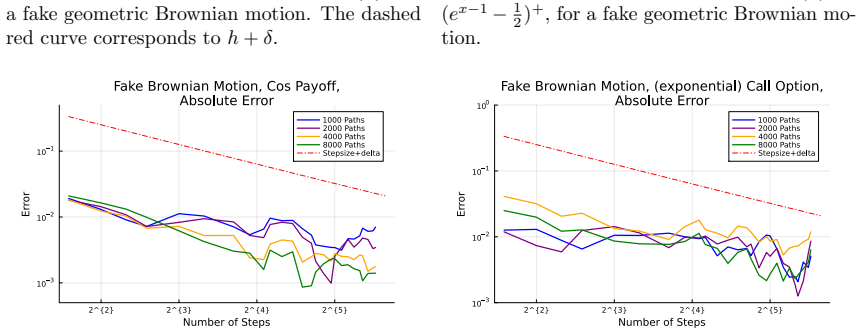
- The scheme matches one-dimensional marginals, not paths: numerical experiments with fake Brownian motion show the variance of the quadratic variation does not vanish as $N$ grows, which is consistent with convergence in law only.
- For smooth payoffs the numerical error sits inside the theoretical bound, and even non-smooth call-type payoffs show the absolute error decreasing quickly, though with a rougher convergence pattern.
Reading between the lines
- The explicit exponential factor suggests a practical rule: the smoothing $\delta$ should not be chosen smaller than about $h^{1/2}$ times a constant, otherwise the statistical error inflates; an optimization over $(h, \delta, N)$ under a fixed computational budget would make this trade-off quantitative.
- Assumption 1 excludes path-dependent volatility models, where the volatility factor is driven by the same Brownian motion as the price; the paper's Remark 7.13 indicates that without $\rho^2 < 1$ one would need an unverifiable Hölder regularity condition on $x \mapsto E[\xi^2 | X = x]$, so the method as stated is tied to models with a separate, not perfectly correlated, volatility driver.
- The 'Euler first, particle second' ordering cleanly separates two sources of error that earlier analyses entangled; the same ordering could be exported to other McKean–Vlasov equations whose coefficients involve conditional expectations, provided a Gaussian smoothing step can be inserted.
- The comparison between Theorem 5.4 and Theorem 7.2 shows that the half-step Gaussian smoothing is doing genuine work rather than being a cosmetic choice, which suggests that implementations should prefer it whenever the correlation parameter is not too close to $\pm 1$.
Editorial analysis
A structured set of objections, weighed in public.
Referee Report
Summary. The paper derives explicit weak-error bounds for a class of local stochastic volatility models. Starting from an Euler scheme with the exact conditional expectation, it proves (Theorem 3.3) first-order weak convergence to the Gyöngy-mimicking Markov process for test functions with three weak derivatives, with degraded rates for rougher test functions. It then introduces a half-step Euler scheme with a Gaussian-regularized estimator of the conditional expectation, proves a propagation-of-chaos estimate (Theorem 5.2), and combines the ingredients into a full parameter-explicit error bound for the interacting particle scheme (Theorems 1 and 5.4). A second part treats Nadaraya-Watson kernel estimators (Theorem 7.2) and compares the resulting rates. Numerical experiments illustrate the scaling in h, delta, and N.
Significance. The contribution is methodologically solid and novel in its 'Euler first, particle second' ordering. The proof of Theorem 3.3 is a coherent Talay-Tubaro expansion with honest tracking of the final grid interval and of the singular weights; Theorem 5.2's Gronwall argument splits the empirical fluctuation into an i.i.d. variance term and a Lipschitz interaction term. The half-step scheme yields an exact conditional-expectation identity (Lemma 4.5), which is an elegant tool and a practical advantage. All error constants are derived rather than fitted, and the dependence on h, delta, and N is stated explicitly. The main limitation, Assumption 1 (rho^2 < 1), is structural and clearly acknowledged in Remark 7.13; it excludes fully correlated or path-dependent volatility, but this is a scope restriction rather than an internal inconsistency.
minor comments (5)
- [Theorem 5.4 and its proof] The printed bound in Theorem 5.4 does not match the proof. Theorem 5.2 gives ||eX_T^{h,(1),delta} - eX_T^{h,(1),N,delta}||_{L2} <= C N^{-1/2} h^{1/4} delta^{-1/2} exp((T/2) h^{-1} log(C delta^{-1} h^{-1/2})), so the displayed prefactor N^{-1/2} delta^{-1} in Theorem 5.4 should be N^{-1/2} delta^{-1/2} (the factor h^{1/4} can be dropped since h < 1). In the proof of Theorem 5.4, the logarithm contains h^{-3/2}; this should be h^{-1/2} to agree with Theorem 5.2. Theorem 1 also omits the delta^{-1/2} prefactor; please either state Theorem 1 as an informal summary or align it with the precise bound in Theorem 5.4.
- [Theorem 5.2 statement] The right-hand side 'c/N h^{1/2} delta^{-1} exp(...)' is ambiguous: it should be written as (c/N) h^{1/2} delta^{-1} exp(...) or with explicit parentheses, since the current typesetting could be read as c/(N h^{1/2} delta^{-1}).
- [Section 2, notation] In the definition of the C1 norm there is a stray 'and .' at the end of the sentence; this appears to be a typographical artifact and should be removed.
- [Section 6.2] In the description of the reference Monte-Carlo simulation, '90 2 Monte Carlo steps' should presumably be '90^2 Monte Carlo steps' (or an explicit number); please correct this typo.
- [Lemma 3.4 statement] The bound in Lemma 3.4 is stated for all (t,x) in [0,T) x R with no positive-part convention on the exponent (2i+j-l)/2; when 2i+j < l the right-hand side would blow up as t approaches T. Since the applications only use cases with 2i+j >= l, this is not a blocking issue, but the statement should clarify that the exponent is meant as max((2i+j-l)/2, 0) or that only the needed parameter ranges are asserted.
Circularity Check
No significant circularity: the weak-error bounds are derived from explicit estimates; the sole self-citation is re-proved in the appendix.
full rationale
The paper's central claims are derived, not fitted. Theorem 3.3 is a standard Talay-Tubaro telescoping argument with PDE regularity estimates (Lemmas 3.4 and 3.5) and does not presuppose its conclusion. The half-step scheme is introduced with reference to the author's thesis [28], but the load-bearing identity, Lemma 4.5, is proved in the paper via Lemma 9.5, so the self-citation is not the actual support. The regularization bias is quantified in Lemma 4.8 by a direct Gaussian-density estimate, and Theorem 4.6 combines this with Theorem 4.1, whose proof is self-contained. Theorem 5.2 is a propagation-of-chaos argument that splits the empirical error into an i.i.d. variance term of order 1/(N lambda) and a Lipschitz interaction term closed by a discrete Gronwall lemma; the constants and exponential prefactors are computed from Lemmas 5.5, 9.8, and 9.9, not imposed by the desired rate. Theorem 5.4 then assembles these pieces, and every parameter h, delta, N appears with an explicit error cost. No fitted constant is renamed as a prediction, and no uniqueness theorem or ansatz is imported from the authors' prior work to force the choice of scheme. The only self-referential element is the half-step scheme from [28], but it is used as a tool whose needed property is re-established inside the paper, so it does not make the argument circular. The discrepancy between the printed prefactor/log-exponent in Theorem 5.4 and the proof's L2 estimate appears to be a typo or a conservative restatement and does not affect the derivation structure.
Assumptions & free parameters
free parameters (1)
- c_min (numerics only) =
0.05 (hand-picked, rounded down)
assumptions (5)
- domain assumption Gyongy's mimicking theorem (Theorem 3.1, quoted from [15])
- standard math Feynman-Kac formula and parabolic regularity estimates (PDE (6) and Lemma 9.1 from Friedman [11])
- domain assumption Assumption 1 (rho^2 < 1)
- domain assumption Assumption 2 (sigma bounded, C^4, uniformly elliptic; a <= xi <= b)
- standard math Exponential tail bound for processes with bounded quadratic variation (Lemma 9.3, from Revuz and Yor)
Cite this review
Pith. "Pith review of On the Weak Error for Local Stochastic Volatility Models." pith.science (2026). https://pith.science/paper/POJWGYWA
@misc{pith2026250610817,
  author       = {Pith},
  title        = {Pith review of: On the Weak Error for Local Stochastic Volatility Models},
  year         = {2026},
  howpublished = {\url{https://pith.science/paper/POJWGYWA}},
  note         = {Machine review of arXiv:2506.10817}
}
read the original abstract
Local stochastic volatility refers to a popular model class in applied mathematical finance that allows for "calibration-on-the-fly", typically via a particle method, derived from a formal McKean-Vlasov equation. Well-posedness of this limit is a well-known problem in the field; the general case is largely open, despite recent progress in Markovian situations. Our take is to start with a well-defined Euler approximation to the formal McKean-Vlasov equation, followed by a newly established half-step-scheme, allowing for good approximations of conditional expectations. In a sense, we do Euler first, particle second in contrast to previous works that start with the particle approximation. We show weak order one for the Euler discretization, plus error terms that account for the said approximation. The case of particle approximation is discussed in detail and the error rate is given in dependence of all parameters used.
Figures


Figures from the paper (2 more)


Reference graph
Works this paper leans on
-
[1]
F. Abergel and R. Tachet. A nonlinear partial integro-differential equation from mathematical finance. Discrete and Continuous Dynamical Systems - Series A , 27(3):907–917, 2010. doi:10.3934/dcds.2010.27.907
-
[2]
C. Bayer, D. Belomestny, O. Butkovsky, and J. Schoenmakers. A reproducing kernel Hilbert space approach to singular local stochastic volatility McKean–Vlasov models, 2024. doi:10.1007/s00780-024-00541-5
-
[3]
M. Beiglb¨ ock, G. Lowther, G. Pammer, and W. Schachermayer. Faking Brownian motion with continuous Markov martingales. Finance and Stochastics , 28(1):259–284, 2024. doi:10.1007/s00780-023-00526-w
-
[4]
Mimicking the marginal distributions of a semimartingale
A. Bentata and R. Cont. Mimicking the marginal distributions of a semimartingale, 2012. arXiv preprint. arXiv:0910.3992
work page Pith review arXiv 2012
-
[5]
B. Bouchard and N. Touzi. Discrete-time approximation and Monte-Carlo simulation of backward stochastic differential equations. Stochastic Processes and their Applications , 111(2):175–206, 2004. doi:10.1016/j.spa.2004.01.001
-
[6]
G. Brunick and S. Shreve. Mimicking an Itˆ o process by a solution of a stochastic differential equation. The Annals of Applied Probability , 23(4):1584 – 1628, 2013. doi:10.1214/12-AAP881
-
[7]
M. F. Djete. Non–regular McKean–Vlasov equations and calibration problem in local stochastic volatility models, 2022. arXiv preprint. arXiv:2208.09986. 33
arXiv 2022
-
[8]
B. Dupire. Pricing with a smile. Risk, 7:18–20, 1994
work page 1994
Show all 33 references
-
[9]
B. Dupire. Pricing and hedging with smiles. In M. A. Dempster and S. R. Pliska, editors, Mathematics of Derivative Securities , pages 103–111. Cambridge University Press, 1997
1997
-
[10]
Forde and A
M. Forde and A. Jacquier. Small-time asymptotics for an uncorrelated local-stochastic volatility model. Appl. Math. Finance , 18(6):517–535, 2011. doi:10.1080/1350486X.2011.591159
2011
-
[11]
Friedman
A. Friedman. Partial differential equations of parabolic type . Prentice-Hall, Inc., Englewood Cliffs, NJ, 1964
1964
-
[12]
Guyon and P
J. Guyon and P. Henry-Labordere. Nonlinear Option Pricing . Chapman and Hall/CRC, 1st edition, 2013. doi:10.1201/b16332
2013 doi
-
[13]
Guyon and P
J. Guyon and P. Henry-Labord` ere. Being particular about calibration. Risk, 25(1):88–93, 01
-
[14]
Guyon and J
J. Guyon and J. Lekeufack. Volatility is (mostly) path-dependent. Quant. Finance, 23(9):1221–1258, 2023. doi:10.1080/14697688.2023.2221281
2023
-
[15]
Gy¨ ongy
I. Gy¨ ongy. Mimicking the one-dimensional marginal distributions of processes having an Itˆ o differential. Probability Theory and Related Fields , 71:501–516, 1986. doi:10.1007/BF00699039
1986 doi
-
[16]
Hamza and F
K. Hamza and F. C. Klebaner. A family of non-Gaussian martingales with Gaussian marginals. Journal of Applied Mathematics and Stochastic Analysis , 2007:19 p., 2007. doi:10.1155/2007/92723
2007 doi
-
[17]
Hirsch, C
F. Hirsch, C. Profeta, B. Roynette, and M. Yor. Peacocks and Associated Martingales, with Explicit Constructions . Bocconi & Springer Series. Springer Milano, 1 edition, 2011. doi:10.1007/978-88-470-1908-9
2011 doi
-
[18]
Jourdain and A
B. Jourdain and A. Zhou. Existence of a calibrated regime switching local volatility model. Math. Finance, 30(2):501–546, 2020. doi:10.1111/mafi.12231
2020 doi
-
[19]
H. G. Kellerer. Markov-Komposition und eine Anwendung auf Martingale. Mathematische Annalen, 198:99–122, 1972. doi:10.1007/BF01432281
1972 doi
-
[20]
Kohatsu-Higa and S
A. Kohatsu-Higa and S. Ogawa. Weak rate of convergence for an Euler scheme of nonlinear SDE’s. Monte Carlo Methods Appl. , 3(4):327–345, 1997. doi:10.1515/mcma.1997.3.4.327
1997 doi
-
[21]
Konakov and E
V. Konakov and E. Mammen. Edgeworth type expansions for Euler schemes for stochastic differential equations. Monte Carlo Methods Appl. , 8(3):271–285, 2002. doi:10.1515/mcma.2002.8.3.271
2002 doi
-
[22]
Lacker, M
D. Lacker, M. Shkolnikov, and J. Zhang. Inverting the Markovian projection, with an application to local stochastic volatility models. The Annals of Probability , 48(5):2189 – 2211, 2020. doi:10.1214/19-AOP1420
2020 doi
-
[23]
Li and J
Q. Li and J. S. Racine. Nonparametric Econometrics: Theory and Practice . Princeton University Press, Princeton, NJ, 2007
2007
-
[24]
Muguruza
A. Muguruza. Not so particular about calibration: Smile problem resolved, 2019. arXiv preprint. arXiv:1909.13366
2019 arXiv
-
[25]
Reisinger and M
C. Reisinger and M. O. Tsianni. Convergence of the Euler–Maruyama particle scheme for a regularised McKean–Vlasov equation arising from the calibration of local-stochastic volatility models, 2024. doi:10.1007/978-3-031-59762-6_28 . 34
2024 doi
-
[26]
Revuz and M
D. Revuz and M. Yor. Continuous Martingales and Brownian Motion , volume 293 of Grundlehren der mathematischen Wissenschaften . Springer-Verlag, Berlin, third edition,
-
[27]
Talay and L
D. Talay and L. Tubaro. Expansion of the global error for numerical schemes solving stochastic differential equations. Stochastic Anal. Appl. , 8(4):483–509, 1990. doi:10.1080/07362999008809220
1990 doi
-
[28]
A. Zhou. Theoretical and numerical study of problems nonlinear in the sense of McKean in finance. Phd thesis, Universit´ e Paris Est,´Ecole des Ponts Paris Tech, Oct. 2018. URL: https://inria.hal.science/tel-01957638. 35 9 Appendix 9.1 Proof of Lemma 3.4 The following lemma is...
2018
-
[31]
∀x ∈ R, ∀γ ∈ (0, 1], |x|φλ(x) ≤ (eγ)− 1 2 λ 1−γ 2 φ1−γ λ (x),
-
[32]
∀x, y∈ R with |x − y| < ε,∀γ ∈ (0, 1], φλ(y) ≥ (2πλ) γ 2 φλ(x)1+γe− ε2 γλ ,
-
[33]
∀x ∈ R, ∀γ >0, φ1+γ λ (x) ≤ (2πλ)− γ 2 φλ(x). Proof. (1): We use the fact that R ∋ y 7→ |y|e− y2 2 is bounded by e− 1 2 and see that for x >0 xφλ(x) = xe− x2 γ 2λ 1√ 2πλ γ φ1−γ λ = x √γ√ λ e− x2 γ 2λ λ 1−γ 2 γ− 1 2 1√ 2π γ φ1−γ λ ≤ (eγ)− 1 2 λ 1−γ 2 φ1−γ λ . By symmetry the fi...
-
[1999]
doi:10.1007/978-3-662-06400-9
-
[2012]
URL: https://www.risk.net/markets/2135540/being-particular-about-calibration
Reviewed August 7, 2026 · model on record in the stance chip above.
Discussion (0). Continue with ORCID to comment.