Exact zero modes in interacting Majorana X- and Y-junctions
Pith reviewed 2026-05-19 09:25 UTC · model grok-4.3
The pith
Interacting Majorana wires in two-, three-, and four-arm junctions produce exact zero modes as interaction strength is tuned.
A machine-rendered reading of the paper's core claim, the machinery that carries it, and where it could break.
Core claim
We report the emergence of exact zero modes in junctions of two, three and four short interacting Majorana wires, equivalent to a chain with an impurity bond, Y- and X- junctions respectively. These exact zero modes arise from incommensurate short-range correlations induced by interacting Majorana fermions and manifest as exact level crossings between in-gap states upon continuously tuning the interaction strength. In a junction of only two chains we report exact zero modes and parity switching as soon as the coupling between the chains across a junction is positive. Remarkably, for junctions with multiple chains the in-gap states group up into sets of parity pairs -- pairs of states with相反奇
What carries the argument
Exact level crossings between in-gap states produced by incommensurate short-range correlations in mapped interacting Majorana Hamiltonians
If this is right
- Positive coupling in two-wire junctions immediately yields exact zero modes and parity switching.
- In-gap states in multi-arm junctions form parity pairs whose behavior is controlled by outer-edge Majorana interactions.
- Y-junctions display exact zero modes both inside and between parity pairs due to a symmetry-protected central Majorana.
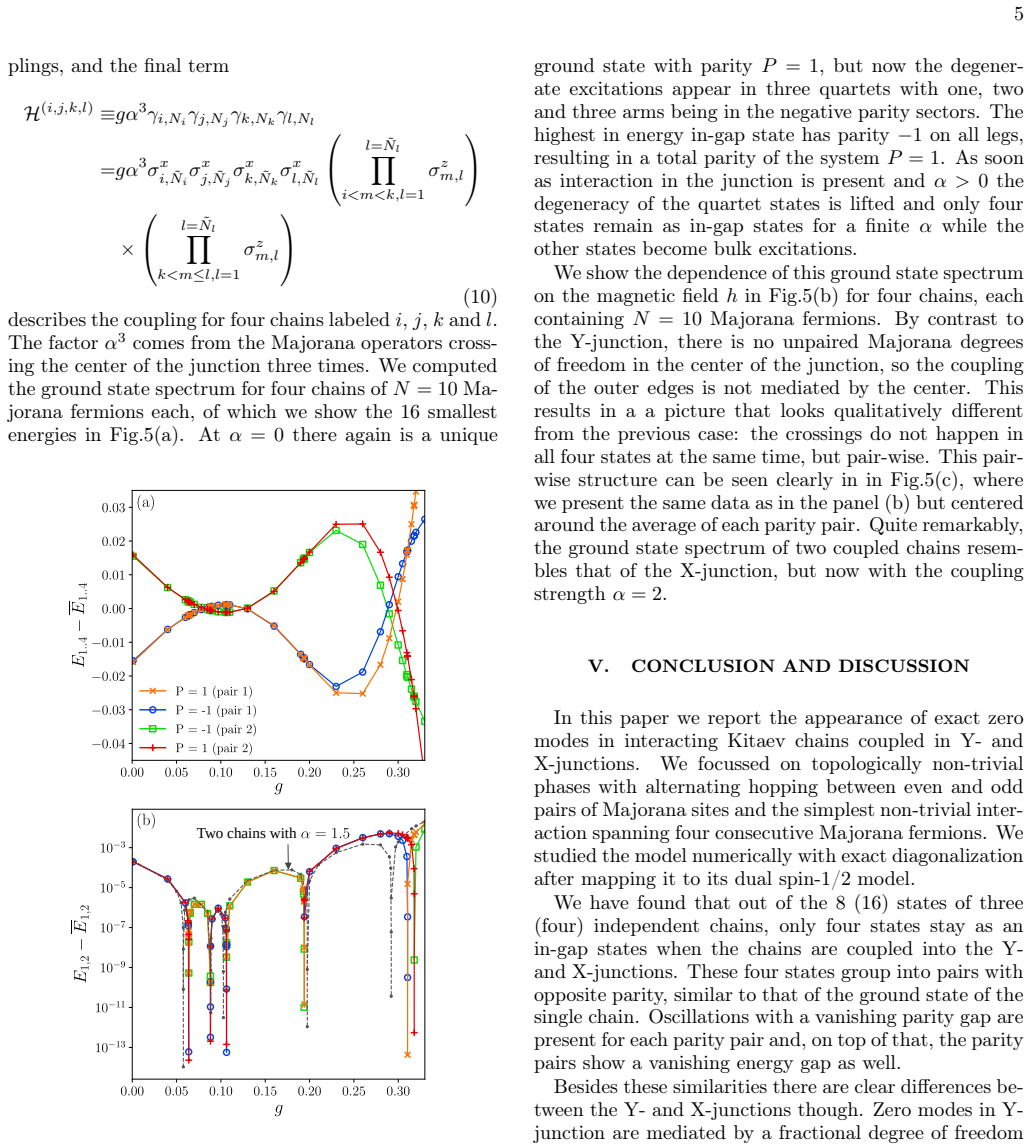
- X-junctions can be tuned so central Majoranas disappear, leaving only four outer-edge zero modes.
Where Pith is reading between the lines
- Interaction tuning could provide a practical handle for controlling Majorana zero modes in quantum-information devices.
- The protected central mode specific to odd-arm junctions may appear in other geometries once interactions are included.
- Checking whether the exact crossings survive in longer wires or with weak disorder would test how generic the reported mechanism is.
Load-bearing premise
The short-wire model with an impurity-bond mapping accurately reproduces the incommensurate correlations that generate the exact crossings.
What would settle it
Exact diagonalization or DMRG on the interacting junction Hamiltonian that shows no level crossings at the specific interaction values where zero modes are predicted.
Figures




read the original abstract
We report the emergence of exact zero modes in junctions of two, three and four short interacting Majorana wires, equivalent to a chain with an impurity bond, Y- and X- junctions respectively. These exact zero modes arise from incommensurate short-range correlations induced by interacting Majorana fermions and manifest as exact level crossings between in-gap states upon continuously tuning the interaction strength. In a junction of only two chains we report exact zero modes and parity switching as soon as the coupling between the chains across a junction is positive. Remarkably, for junctions with multiple chains the in-gap states group up into sets of parity pairs -- pairs of states with opposite parity and similar energies. We demonstrate that the formation of these parity pairs are always due to the effective interaction of the outer edges of the junction. The behavior within each pair can be efficiently described by two coupled chains. In the Y-junction, we detect four in-gap states (two parity pairs) that show exact zero modes not only within each pair but also between them. This is attributed to an additional Majorana fermion localized at the center of junction that is protected by symmetry. Therefore, coupling between the Majorana fermions at the outer edges of the junction is mediated by that in the center. We argue that this is a generic feature of junctions with an odd number of arms. In the X-junction we detect eight in-gap states (four parity pairs) that are the result of two Majorana degrees of freedom localized at the center of the junction. However, we demonstrate that, by contrast to the Y-junction, the appearance of Majorana fermions at the center of the X-junction is not protected and the interaction across the junction can be tuned to the point where there are only Majorana fermions localized at the four outer edges of the junction, forming four in-gap states.
Editorial analysis
A structured set of objections, weighed in public.
Referee Report
Summary. The manuscript reports the emergence of exact zero modes in junctions formed by two, three (Y-junction), and four (X-junction) short interacting Majorana wires, modeled as chains with impurity bonds. These zero modes appear as exact level crossings between in-gap states when the interaction strength is continuously tuned, arising from incommensurate short-range correlations. For the two-wire case, exact zero modes and parity switching occur for any positive inter-chain coupling. In Y-junctions, four in-gap states form two parity pairs with exact zero modes both within and between pairs, attributed to a symmetry-protected central Majorana fermion that mediates outer-edge interactions; this is argued to be generic for odd-arm junctions. In X-junctions, eight in-gap states (four parity pairs) arise from two central Majorana degrees of freedom, but these are not symmetry-protected and can be tuned away, leaving only four outer-edge modes.
Significance. If the numerical observations of precisely zero-energy crossings hold beyond finite-size effects, the work would be significant for the field of interacting topological superconductors. It identifies a mechanism by which interactions alone generate protected zero modes in multi-arm junctions without requiring fine-tuned parameters, distinguishes symmetry-protected central modes (Y-junction) from tunable ones (X-junction), and shows that outer-edge interactions can be effectively described by coupled two-chain models. This could inform designs for robust Majorana-based qubits. The strength lies in the direct spectral evidence for parity pairs and inter-pair crossings; however, significance depends on confirming that the reported exactness is not an artifact of short-chain numerics.
major comments (2)
- The central claim of 'exact zero modes' and 'exact level crossings' at zero energy (Abstract and descriptions of Y- and X-junction spectra) rests on numerical observation in short finite wires. No analytical identity, symmetry argument, or algebraic mapping is provided that forces the in-gap eigenvalues to be identically zero at the tuned interaction values, raising the possibility that the crossings are approximate or specific to the chosen chain lengths and interaction form rather than protected.
- For the X-junction, the manuscript states that central Majorana fermions are not protected and can be tuned away (Abstract). This undercuts the robustness of the eight in-gap states as a generic feature; a concrete demonstration is needed that the tuning point where only outer modes remain is stable against small perturbations or longer chains, as this is load-bearing for the contrast with the Y-junction.
Simulated Author's Rebuttal
We thank the referee for the careful reading and constructive comments. We address the two major comments point by point below, indicating planned revisions where appropriate.
read point-by-point responses
-
Referee: The central claim of 'exact zero modes' and 'exact level crossings' at zero energy (Abstract and descriptions of Y- and X-junction spectra) rests on numerical observation in short finite wires. No analytical identity, symmetry argument, or algebraic mapping is provided that forces the in-gap eigenvalues to be identically zero at the tuned interaction values, raising the possibility that the crossings are approximate or specific to the chosen chain lengths and interaction form rather than protected.
Authors: We agree that the evidence is numerical and that an analytical proof would be desirable. The reported crossings reach zero within numerical precision (better than 10^{-12}) for multiple chain lengths and remain pinned at zero under continuous tuning of the interaction. This behavior is tied to the incommensurate short-range correlations that the interactions generate, which we document through the parity eigenvalues and the effective two-chain mapping. In the revision we will add finite-size scaling plots and an expanded discussion of why the zero crossings are robust rather than accidental, while noting that a full algebraic demonstration lies beyond the present scope. revision: partial
-
Referee: For the X-junction, the manuscript states that central Majorana fermions are not protected and can be tuned away (Abstract). This undercuts the robustness of the eight in-gap states as a generic feature; a concrete demonstration is needed that the tuning point where only outer modes remain is stable against small perturbations or longer chains, as this is load-bearing for the contrast with the Y-junction.
Authors: We acknowledge the need for explicit stability checks. In the current manuscript we already show that a specific tuning of the central bond eliminates the central Majorana pair while the four outer-edge modes remain at zero energy. We have verified this outcome for several chain lengths and for small random perturbations added to the central couplings. In the revised version we will include additional numerical data (both longer chains where feasible and systematic perturbation scans) in a new appendix to demonstrate that the outer-mode zero energies are stable and thereby sharpen the contrast with the symmetry-protected central mode of the Y-junction. revision: yes
Circularity Check
No circularity: zero modes identified via direct numerical spectra of finite Hamiltonians
full rationale
The paper constructs explicit interacting Majorana Hamiltonians for short finite wires in two-, three-, and four-arm junctions, then computes their spectra (via exact diagonalization on small systems) while tuning the interaction parameter. Level crossings at zero energy are reported as numerical observations for specific parameter values; these crossings are not obtained by fitting a parameter to the target zero-mode energies, nor by redefining the input Hamiltonian in terms of the output modes. No self-citation chain or uniqueness theorem is invoked to force the result, and the central claim remains an empirical statement about the computed eigenvalues rather than a tautological re-expression of the model definition.
Axiom & Free-Parameter Ledger
axioms (2)
- standard math Majorana operators satisfy the standard anticommutation relations {γ_i, γ_j} = 2δ_ij.
- domain assumption The junction geometries can be mapped to a one-dimensional chain with an impurity bond or multi-arm star without additional long-range terms.
Reference graph
Works this paper leans on
- [1]
-
[2]
S. D. Sarma, M. Freedman, and C. Nayak, Majorana zero modes and topological quantum computation, npj Quan- tum Inf 1, 10.1038/npjqi.2015.1 (2015)
-
[3]
P. Marra, Majorana nanowires for topological quantum computation, Journal of Applied Physics 132, 231101 (2022)
work page 2022
-
[4]
A. Y. Kitaev, Unpaired Majorana fermions in quantum wires, Physics-Uspekhi 44, 131 (2001)
work page 2001
-
[5]
Fendley, Parafermionic edge zero modes in Zn- invariant spin chains, J
P. Fendley, Parafermionic edge zero modes in Zn- invariant spin chains, J. Stat. Mech.: Theor. Exp.2012, P11020 (2012)
work page 2012
-
[6]
Alicea, New directions in the pursuit of Majorana fermions in solid state systems, Rep
J. Alicea, New directions in the pursuit of Majorana fermions in solid state systems, Rep. Prog. Phys. 75, 076501 (2012)
work page 2012
-
[7]
C. W. J. Beenakker, Search for Majorana Fermions in Superconductors, Annual Review of Condensed Matter Physics 4, 113 (2013)
work page 2013
-
[8]
A. Das, Y. Ronen, Y. Most, Y. Oreg, M. Heiblum, and H. Shtrikman, Zero-bias peaks and splitting in an Al– InAs nanowire topological superconductor as a signature of Majorana fermions, Nature Physics8, 887 (2012)
work page 2012
-
[9]
M. T. Deng, C. L. Yu, G. Y. Huang, M. Larsson, P. Caroff, and H. Q. Xu, Anomalous Zero-Bias Conduc- tance Peak in a Nb–InSb Nanowire–Nb Hybrid Device, Nano Letters 12, 6414 (2012)
work page 2012
- [10]
-
[11]
L. P. Rokhinson, X. Liu, and J. K. Furdyna, The fractional a.c. Josephson effect in a semiconductor– superconductor nanowire as a signature of Majorana par- ticles, Nature Physics8, 795 (2012)
work page 2012
-
[12]
R. Toskovic, R. van den Berg, A. Spinelli, I. S. Eliens, B. van den Toorn, B. Bryant, J.-S. Caux, and A. F. Otte, Atomic spin-chain realization of a model for quantum criticality, Nature Phys12, 656 (2016)
work page 2016
-
[13]
L. Fidkowski and A. Kitaev, Effects of interactions on the topologicalclassificationoffreefermionsystems,Physical Review B 81, 134509 (2010)
work page 2010
-
[14]
L. Fidkowski and A. Kitaev, Topological phases of fermions in one dimension, Physical Review B83, 075103 (2011)
work page 2011
-
[15]
A. Rahmani, X. Zhu, M. Franz, and I. Affleck, Emer- gentSupersymmetryfromStronglyInteractingMajorana ZeroModes,PhysicalReviewLetters 115,166401(2015)
work page 2015
-
[16]
A. Rahmani, X. Zhu, M. Franz, and I. Affleck, Phase diagram of the interacting Majorana chain model, Phys. Rev. B 92, 235123 (2015)
work page 2015
-
[17]
H. Katsura, D. Schuricht, and M. Takahashi, Exact ground states and topological order in interacting Ki- taev/Majorana chains, Phys. Rev. B92, 115137 (2015)
work page 2015
-
[18]
R. Verresen, A. Vishwanath, and F. Pollmann, Stable Luttinger liquids and emergent $U(1)$ symmetry in con- strained quantum chains, arXiv: Strongly Correlated Electrons (2019)
work page 2019
-
[19]
N. Chepiga and N. Laflorencie, Topological and quan- tum critical properties of the interacting Majorana chain model, SciPost Phys.14, 152 (2023)
work page 2023
-
[20]
E. Sela, A. Altland, and A. Rosch, Majorana fermions in strongly interacting helical liquids, Phys. Rev. B84, 085114 (2011). 9
work page 2011
-
[21]
Chepiga, Critical properties of the Majorana chain with competing interactions, Phys
N. Chepiga, Critical properties of the Majorana chain with competing interactions, Phys. Rev. B108, 054509 (2023)
work page 2023
-
[22]
N. Chepiga and F. Mila, Eight-vertex criticality in the interacting Kitaev chain, Phys. Rev. B 107, L081106 (2023)
work page 2023
-
[23]
N. Laflorencie, Universal signatures of majorana zero modes in critical kitaev chains (2023), arXiv:2311.07571 [cond-mat.str-el]
- [24]
-
[25]
N.M.Gergs, L.Fritz,andD.Schuricht,Topologicalorder in the Kitaev/Majorana chain in the presence of disorder and interactions, Phys. Rev. B93, 075129 (2016)
work page 2016
-
[26]
J. F. Karcher, M. Sonner, and A. D. Mirlin, Disorder and interaction in chiral chains: Majoranas versus complex fermions, Phys. Rev. B100, 134207 (2019)
work page 2019
-
[27]
A.M.Lobos, R.M.Lutchyn,andS.DasSarma,Interplay of Disorder and Interaction in Majorana Quantum Wires, Phys. Rev. Lett.109, 146403 (2012)
work page 2012
-
[28]
A. Milsted, L. Seabra, I. C. Fulga, C. W. J. Beenakker, and E. Cobanera, Statistical translation invariance pro- tects atopological insulator frominteractions,Phys. Rev. B 92, 085139 (2015)
work page 2015
-
[29]
B.RobertsandO.I.Motrunich,Infiniterandomnesswith continuously varying critical exponents in the random XYZ spin chain, Phys. Rev. B104, 214208 (2021)
work page 2021
-
[30]
N. Chepiga and N. Laflorencie, Resilient infinite random- ness criticality for a disordered chain of interacting Ma- jorana fermions, Phys. Rev. Lett.132, 056502 (2024)
work page 2024
-
[31]
J. A. Kjäll, J. H. Bardarson, and F. Pollmann, Many- Body Localization in a Disordered Quantum Ising Chain, Phys. Rev. Lett.113, 107204 (2014)
work page 2014
-
[32]
N. Laflorencie, G. Lemarié, and N. Macé, Topological order in random interacting Ising-Majorana chains sta- bilized by many-body localization, Phys. Rev. Res. 4, L032016 (2022)
work page 2022
- [33]
- [34]
-
[35]
T. B. Wahl, F. Venn, and B. Béri, Local integrals of mo- tion detection of localization-protected topological order, Phys. Rev. B105, 144205 (2022)
work page 2022
-
[36]
Kells, Many-body Majorana operators and the equiv- alence of parity sectors, Phys
G. Kells, Many-body Majorana operators and the equiv- alence of parity sectors, Phys. Rev. B92, 081401 (2015)
work page 2015
-
[37]
G. Kells, Multiparticle content of Majorana zero modes intheinteracting$p$-wavewire,Phys.Rev.B 92,155434 (2015)
work page 2015
-
[38]
A.Więckowski, M.M.Maśka,andM.Mierzejewski,Iden- tification of Majorana Modes in Interacting Systems by Local Integrals of Motion, Phys. Rev. Lett.120, 040504 (2018)
work page 2018
-
[39]
Koma, Stability of Majorana Edge Zero Modes against Interactions (2022), 2205.11222 [math-ph]
T. Koma, Stability of Majorana Edge Zero Modes against Interactions (2022), 2205.11222 [math-ph]
-
[40]
P. Fendley, Strong zero modes and eigenstate phase tran- sitions in the XYZ/interacting Majorana chain, Journal of Physics A: Mathematical and Theoretical49, 30LT01 (2016)
work page 2016
-
[41]
N. Chepiga and F. Mila, Exact zero modes in frustrated Haldane chains, Phys. Rev. B96, 060409 (2017)
work page 2017
-
[42]
G. Vionnet, B. Kumar, and F. Mila, Level crossings in- duced by a longitudinal coupling in the transverse field Ising chain, Phys. Rev. B95, 174404 (2017)
work page 2017
-
[43]
K. Wada, T. Sugimoto, and T. Tohyama, Coexistence of strong and weak Majorana zero modes in an anisotropic XY spin chain with second-neighbor interactions, Phys. Rev. B 104, 075119 (2021)
work page 2021
-
[44]
A.Alexandradinata, N.Regnault, C.Fang, M.J.Gilbert, andB.A.Bernevig,Parafermionicphaseswithsymmetry breaking and topological order, Phys. Rev. B94, 125103 (2016)
work page 2016
- [45]
-
[46]
B. Bellazzini, P. Calabrese, and M. Mintchev, Junctions of anyonic luttinger wires, Phys. Rev. B 79, 085122 (2009)
work page 2009
-
[47]
D. Giuliano and P. Sodano, Y-junction of superconduct- ing josephson chains, Nuclear Physics B811, 395 (2009)
work page 2009
-
[48]
A. Rahmani, C.-Y. Hou, A. Feiguin, M. Oshikawa, C. Chamon, and I. Affleck, General method for calcu- lating the universal conductance of strongly correlated junctions of multiple quantum wires, Phys. Rev. B85, 045120 (2012)
work page 2012
-
[49]
B. van Heck, A. R. Akhmerov, F. Hassler, M. Burrello, and C. W. J. Beenakker, Coulomb-assisted braiding of Majorana fermions in a Josephson junction array, New J. Phys. 14, 035019 (2012)
work page 2012
-
[50]
T. E. Pahomi, M. Sigrist, and A. A. Soluyanov, Braid- ing Majorana corner modes in a second-order topological superconductor, Phys. Rev. Research2, 032068 (2020)
work page 2020
- [51]
-
[52]
S. Ikegaya, W. B. Rui, D. Manske, and A. P. Schnyder, Tunable Majorana corner modes in noncentrosymmetric superconductors: Tunneling spectroscopy and edge im- perfections, Phys. Rev. Research3, 023007 (2021)
work page 2021
-
[53]
Z. Yan, F. Song, and Z. Wang, Majorana Corner Modes in a High-Temperature Platform, Phys. Rev. Lett.121, 096803 (2018)
work page 2018
- [54]
-
[55]
F. Buccheri, H. Babujian, V. E. Korepin, P. Sodano, and A. Trombettoni, Thermodynamics of the topologi- cal kondo model, Nuclear Physics B896, 52 (2015)
work page 2015
-
[56]
N. Chepiga and F. Mila, Excitation spectrum and density matrix renormalization group iterations, Phys. Rev. B 96, 054425 (2017)
work page 2017
-
[57]
C. T. Olund, N. Y. Yao, and J. Kemp, Boundary strong zero modes, Phys. Rev. B111, L201114 (2025)
work page 2025
-
[58]
This splitting vanishes fast with the system size, e.g
There are two consecutive crossing points located within the distance δh ≈ 2 · 10−3 for N = 10 . This splitting vanishes fast with the system size, e.g. forN = 8 the corresponding distance is twice as large. Compare with the X-junction in Fig.9(b) where the corresponding dis- tance is O(10−1)
- [59]
-
[60]
Flensberg, Non-Abelian Operations on Majorana Fermions via Single-Charge Control, Phys
K. Flensberg, Non-Abelian Operations on Majorana Fermions via Single-Charge Control, Phys. Rev. Lett. 106, 090503 (2011)
work page 2011
-
[61]
M. Hell, K. Flensberg, and M. Leijnse, Coupling and braiding Majorana bound states in networks defined in two-dimensional electron gases with proximity-induced superconductivity, Phys. Rev. B96, 035444 (2017)
work page 2017
- [62]
- [63]
- [64]
-
[65]
C. Lanczos, An iteration method for the solution of the eigenvalue problem of linear differential and integral op- erators, Journal of Research of the National Bureau of Standards 45, 255 (1950)
work page 1950
discussion (0)
Sign in with ORCID, Apple, or X to comment. Anyone can read and Pith papers without signing in.