REVIEW 3 major objections 6 minor 101 references
Patchy Helium and Hydrogen Reionization from the Kinetic Sunyaev-Zel'dovich Effect and Galaxies
T0 review · 3 major / 6 minor · reviewed 2026-08-07 · deepseek-v4-flash
Pith's one-line read Helium reionization becomes measurable via kSZ-galaxy cross-correlation.
desk verdict The K-eta cross-correlation is a genuine new statistic, but the headline He reionization constraints are conditional on idealized velocity reconstruction that could easily erase them. read the letter →
The pith
A machine-rendered reading of the paper's core claim, the machinery that carries it, and where it could break.
The reading
What carries the argument
The central object is the four-point (trispectrum) kSZ statistic built from filtered temperature-squared maps. The CMB map is split into high-$\ell$ bands; each band is squared to make a field $K_i(\hat{n})$ measuring local small-scale kSZ power. Large-scale variations of $K_i$ are sourced by the squared radial peculiar velocity field $\eta(\hat{n},z) = v_r^2 / \langle v_r^2 \rangle$, whose coherence length sets the angular-scale dependence of the statistic. The paper's new ingredient is a cross-correlation between these $K_i$ fields and redshift-binned $\eta_\alpha$ fields reconstructed from galaxy surveys through the linear continuity equation, with a minimum-variance estimator whose noise is set by shot noise in the galaxy density. This cross-correlation adds tomographic information at $z \lesssim 5$, where He reionization is taking place, and it is what lifts the He signal out of the redshift-integrated background.
What would settle it
A concrete test would be to run the same Fisher pipeline with a velocity-reconstruction noise model taken from realistic light-cone galaxy mocks that include photo-z scatter, redshift-space distortions, fingers-of-God, and survey masks instead of the shot-noise formula in Eq. (39); if the reconstructed-$\eta$ SNR falls by the factor of about 2 reported for LSST-like photo-z samples, the CMB-HD x MegaMapper He-reionization constraints in Fig. 10 would degrade below 1-$\sigma$ detectability. A separate check would be to replace the analytical bubble model with a simulation-based reionization map and recompute the kSZ trispectrum and cross-correlation amplitudes, which would test whether the assumed bubble radii and ionized-electron power spectrum are the main drivers of the forecasted sensitivity.
Extended reading notes
Core claim
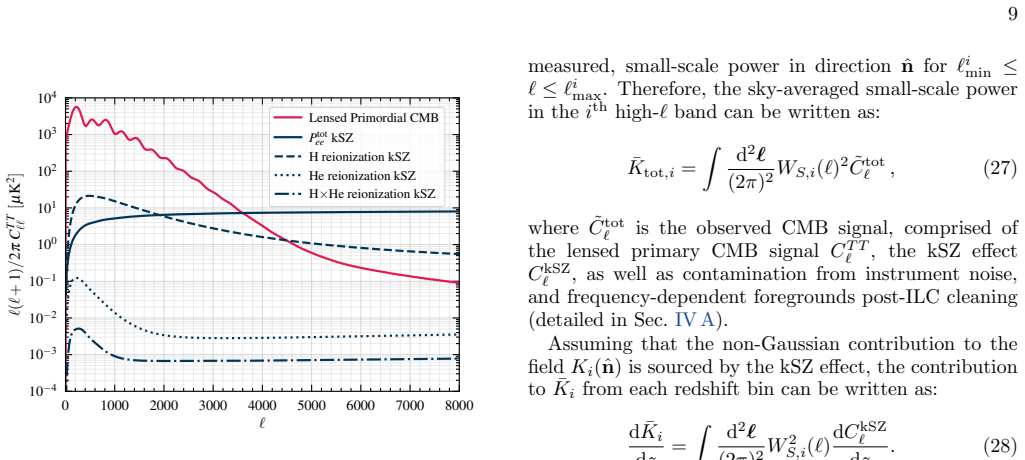
The paper's central claim is that the redshift-integrated kSZ trispectrum, already sensitive to patchy H reionization, can be extended to He reionization by cross-correlating the kSZ-weighted temperature-squared field $K(\hat{n})$ with a galaxy-reconstructed squared radial-velocity field $\eta(\hat{n}, z)$ binned in redshift. The authors model both ionization epochs with a halo-model and bubble prescription, derive the ionized-electron power spectrum including H, He, and mixed terms, and then perform an information-matrix forecast. Their headline quantitative result is that adding the $z$-binned $\eta$-field data allows measurement of the He reionization parameters $y_{\rm re}^{\rm He}$ and $\Delta_y^{\rm He}$ near 1-$\sigma$ for a CMB-HD x MegaMapper baseline, while the same baseline yields sub-1-$\sigma$ errors on all H reionization parameters. Without the galaxy cross-correlation, the auto-correlation trispectrum leaves He parameters essentially unconstrained. The paper therefore proposes that the kSZ effect, previously regarded as a hydrogen-reionization timing statistic, can become a quantitative probe of both epochs if the assumed galaxy velocity reconstruction is achieved.
Load-bearing premise
The forecast assumes that galaxy surveys can reconstruct the squared radial-velocity field $\eta$ with essentially ideal errors: linear continuity between galaxy density and velocity, velocity-reconstruction bias $b_v = 1$, shot-noise-only errors, and no degradation from photo-z errors, redshift-space distortions, or masks; if real reconstruction is noticeably worse, the helium reionization constraints, already near 1-$\sigma$, would weaken.
Editorial extensions
If this is right
- If He reionization parameters can be measured, the epoch of the second ionization of helium becomes a direct observable tied to quasar and AGN activity rather than only an inference from Lyman-$\alpha$ forest or intergalactic-medium temperature measurements.
- Jointly fitting H and He parameters prevents neglected-He biases; the paper finds that using $\ell$-binned $K$ fields keeps H-He covariance minimal, so omitting He would not strongly bias H constraints when that binning is used.
- The forecast detection SNR for CMB-HD x MegaMapper reaches roughly 100 at $L_{\rm max} \sim 50$ when combining the auto- and cross-correlation signals, so the fields do not need to be reconstructed to very small angular scales for a detection.
- If only the redshift-evolution parameters $y_{\rm re}$ and $\Delta_y$ are targeted, without marginalizing over bubble-size parameters, the CMB-HD x MegaMapper baseline can place roughly $3\sigma$ constraints on all four midpoint and duration parameters for both epochs at $L_{\rm max} \sim 200$.
- The constraints depend on the assumed small-scale electron profile; switching to a $W_e(k) \times$ NFW profile changes H parameter errors by up to about a factor of 2 and He parameter errors by up to about a factor of 1.5.
Reading between the lines
- Beyond the paper's forecasts, the same $K \times \eta$ framework could be extended to a bispectrum-level statistic correlating the $K$ fields with galaxy density itself, which would be more sensitive to small-scale patchiness and quasar clustering during He reionization.
- If velocity reconstruction degrades by the factor of about 2 that the cited photometric-redshift studies find for LSST-like samples, the He parameter errors would roughly double, making the headline He detection marginal rather than secure.
- A successful joint measurement would allow kSZ-based constraints on quasar-driven helium reionization to be combined with fast-radio-burst dispersion measures and He II Lyman-$\alpha$ forest observations, providing independent cross-checks on the timing and morphology of the epoch.
- The reliance on linear continuity and an assumed velocity-reconstruction bias $b_v = 1$ suggests that realistic survey masks, fingers-of-God, and residual redshift-space distortions will need to be folded into the Fisher forecasts; the relative advantage of a spectroscopic follow-up like MegaMapper over a photometric sample may therefore be understated in the paper.
Editorial analysis
A structured set of objections, weighed in public.
Referee Report
Summary. This paper extends the kSZ trispectrum estimator of Smith & Ferraro (2017) to model the joint contribution of hydrogen and helium reionization to the small-scale CMB temperature field, and introduces a new cross-correlation between the kSZ-squared field K(ˆn) and a galaxy-reconstructed, redshift-binned radial-velocity-squared field eta_alpha(ˆn) (Eqs. 30, 42, 43). The ionized-electron power spectrum is derived from an HOD-based bubble model following Refs. [13, 43, 47], with explicit dependence on the assumed small-scale electron profile. Fisher-matrix forecasts (Eq. 49) are presented for two baselines, CMB-S4 x LSST and CMB-HD x MegaMapper, jointly marginalizing over ten reionization parameters plus a velocity-to-galaxy bias ratio b_vg. The authors find that the KK auto-correlation alone constrains only H reionization (y_re^H within 1 sigma), while adding the K eta cross-correlation yields sub-1 sigma errors on all H reionization parameters and roughly 1 sigma errors on the He redshift-evolution parameters y_re^He and Delta_y^He for CMB-HD x MegaMapper (Figs. 9-10). The He signal is shown to be strongly suppressed relative to H in the redshift-integrated KK statistic, which motivates the tomographic cross-correlation. The paper's closing claims are explicitly conditional on an idealized velocity-reconstruction model and on the neglect of several non-Gaussian foreground terms, as discussed in the major comments.
Significance. The proposed K-eta cross-correlation is a genuinely new observable, and the joint H+He treatment with explicit H x He mixed terms is more complete than earlier forecasts. If the He constraints hold up, the kSZ trispectrum becomes a quantitative joint probe of both reionization epochs, and the LSST-versus-MegaMapper comparison gives a concrete, actionable argument for a Stage-5 spectroscopic survey. Strengths worth naming explicitly: all signal and noise expressions are given in closed form (Eqs. 31-32, 39-43, 48), making the forecasts reproducible from the text alone; the P^ion_ee derivation reduces to the established expressions of Refs. [13, 43, 47] in the appropriate limits; the manuscript is transparent about its omitted effects (photo-z errors, scale-dependent velocity-reconstruction bias, tSZ/lensing/CIB non-Gaussian terms) and cites Refs. [91, 92] for the magnitude of the photo-z degradation; and the electron-profile dependence of the forecasts is explored rather than ignored. The tension between these explicit limitation statements and the strength of the abstract's and Sec. IV C's claims is the main reason the revision is major rather than minor.
major comments (3)
- [III B, Eqs. (35)-(43); Sec. V] The headline He reionization claim (Fig. 10: y_re^He and Delta_y^He measurable at roughly 1 sigma) rests on the idealized model of the galaxy-reconstructed eta field in Eqs. (35)-(43). The signal template in Eq. (43) uses the true power spectrum P_etaeta, which is only recovered if the estimator weights satisfy P_{eta-hat,eta} = P_etaeta exactly (Eq. 36), and the only velocity noise is the shot-noise term of Eq. (39) with b_v = 1 at all redshifts. The manuscript itself lists the violations (photo-z errors, redshift-space distortions and fingers-of-God, survey masks, satellite velocity bias, smoothing) and states in Sec. V that 'we do not include the effects of photo-z errors,' citing Refs. [91, 92] for a factor of about 2 SNR reduction at low redshift for LSST-like samples. Because the projected He fractional errors in Fig. 10 sit close to unity at the plateau beyond L_max ~ 100-200, a factor-of-2 suppression of C^{K eta} or inflation of N^{eta eta} pushes y_re^He and Delta_y^He above unit fractional error, erasing the central claim for He; a single marginalization over b_vg cannot absorb the scale-dependent transfer functions found in Refs. [91, 92]. I regard this as the decisive sensitivity of the paper's main claim, and I request a quantitative stress test that propagates a fiducial scale-dependent reconstruction transfer function and noise model (or, minimally, a factor-of-2 degradation applied to C^{K eta} and N^{eta eta}) and that reports whether the He parameters remain below unit fractional error.
- [IV A; Sec. V] The KK noise model N^{KK}_L (Eq. 32) and the covariance (Eq. 48) assume a Gaussian small-scale temperature field. The tSZ Poisson contribution ('roughly modeled as a constant offset for large L'), the lensing-induced trispectrum ('comparable to the reconstruction noise N^{KK}_L'), and non-Gaussian CIB/tSZ cross terms are explicitly left out, and the authors state in Sec. IV A that they 'do not account for nuisance parameters to marginalize over this shot-noise effect.' These terms enter the covariance of both the KK and K eta spectra and hence influence the He and H parameter errors directly. This omission matters at the claimed precision: the paper's own electron-profile variation study in Sec. IV C shows changes in forecasted fractional errors up to factors of about 2 between the NFW/AGN and W_e x NFW electron profiles, and the late-time electron distribution is not itself marginalized. I request that at least one representative nuisance marginalization be added (for example, a free amplitude for the late-time kSZ/tSZ offset and a free late-time electron-profile amplitude), or that the authors demonstrate quantitatively that these terms do not shift the Fig. 10 error bars in the relevant direction.
- [II C 2; Fig. 10] The amplitude of the He-dependent signal that drives the Fig. 10 constraints is set by the fiducial patchy-He parameters Rbar_He = 15 Mpc, sigma_lnR^He = ln 2, and b_He = 6.0, which the authors adopt 'due to weaker current constraints and a shortage in simulations of He reionization' (Sec. II C 2). In a Fisher forecast the parameter errors scale approximately inversely with the modeled signal amplitude, so the headline He result is conditional on the He bubble model in a way that the H result, anchored by more abundant observational and simulation input, is not. Because the He errors are marginal even at the fiducial point, I recommend a short robustness scan over the He bubble parameters (for example Rbar_He = 5 and 30 Mpc, and b_He = 4 and 10) to confirm that the measurability claim is not an artifact of the fiducial choice, or an explicit statement that the He constraints are model-conditional.
minor comments (6)
- [Figs. 9-10] The line-style mapping stated in Sec. IV C (solid = y_re, dashed = Delta_y, dot-dashed = Rbar, dotted = sigma_lnR) does not match the order in which the legend entries appear in the figure files (y_re, Delta_y, sigma_lnR, Rbar); please make the style-to-parameter mapping unambiguous and consistent between the text, the captions, and the legends.
- [IV C] The statement that in the absence of He terms and bubble parameters the forecasts 'appropriately condense to the forecasts presented in Ref. [26]' is asserted without a numerical check, despite Sec. III A reporting substantial model differences from Ref. [25] (for example, a stronger late-time contribution to C^{KK}_L); a short table comparing marginalized errors with Ref. [26] would substantiate this claim.
- [References] The bibliography contains duplicates: Refs. [15] and [17] are the same La Plante et al. paper, Refs. [16] and [18] are the same paper, Refs. [49] and [106] are the same Shaw, Rudd, and Nagai paper, and Refs. [45] and [80] are the same Planck result; please consolidate the duplicate entries.
- [Throughout] There are several typos, including 'due to is low relative abundance' in Sec. I, 'Ref, [25]' in Sec. III A, 'th CMB S4 x LSST' in the Fig. 10 caption, and 'the estimation SNR' in Sec. IV C; a careful proofread is needed.
- [II C 2] The sentence 'we assume sigma^H_lnR = sigma^He_lnR = ln 2' mixes the already-fixed H value with the new He assumption; it should read 'we assume sigma^He_lnR = ln 2 (the same value as sigma^H_lnR)' for clarity.
- [III A, after Eq. (31)] The statement that P^perp_etaeta 'results in a z-independent quantity' is asserted without a derivation; since this property underlies the use of Eq. (42) in the forecasts, a one-line confirmation of the cancellation (for example in Appendix B) would be helpful.
Circularity Check
No significant circularity: the paper is a Fisher-matrix sensitivity forecast whose adopted reionization model is explicitly attributed to prior work and anchored to external data, so no prediction reduces to a fitted input or self-citation chain.
full rationale
This paper is a Fisher-matrix sensitivity forecast, not an observational measurement. The reionization model (tanh mean-ionization evolution, lognormal bubble-radius distribution) is explicitly adopted from Refs. [13,43] with fiducial values separately anchored to external data, including Planck optical-depth measurements and Ly-alpha forest observations; the paper does not fit those parameters to data and then relabel the fit as a prediction. The kSZ trispectrum signal and the proposed K-eta cross-spectrum are derived from the linear velocity power spectrum and the adopted ionized-electron power spectrum through Eqs. (29)-(43), with noise terms computed from Gaussian covariance and survey specifications. The claimed He-reionization constraints are inverse-Fisher errors around the fiducial model, so they are conditional on the model, but the derivation does not reduce a predicted quantity to an equivalent input by construction. The self-citations to Refs. [13,25,26,43] supply the estimator and signal model, but these are prior published results with external observational anchors; they are not invoked as an unverified uniqueness theorem or as the sole justification for a forced choice. Acknowledged limitations, such as neglected photo-z errors, velocity-reconstruction biases, and foreground trispectra, affect forecast robustness rather than circularity. No circular step was found.
Assumptions & free parameters
free parameters (11)
- y_re^H fiducial =
33.5
- Delta_y^H fiducial =
8.0
- y_re^He fiducial =
8.0
- Delta_y^He fiducial =
3.5
- Rbar_H fiducial =
5 Mpc
- sigma_lnR^H fiducial =
ln 2
- Rbar_He fiducial =
15 Mpc
- sigma_lnR^He fiducial =
ln 2
- b_X bubble bias fiducial =
6.0
- b_vg = b_v/b_g fiducial =
1/b_g(z) with b_v=1
- Electron profile piecewise choice =
NFW for z>5, AGN for z<5
assumptions (9)
- standard math Wick's theorem factorization of four-point functions in Eqs. (3) and (17)
- standard math Limber approximation in Eqs. (30), (42), and (43)
- domain assumption Linear-theory velocity power spectrum and z-independent P_perp_etaeta
- domain assumption Bubble model: Poisson-distributed spherical ionized regions with log-normal radius distribution, bubbles trace linear matter density with constant bias, no redshift evolution of bubble distribution
- domain assumption tanh redshift evolution of ionization fraction Eq. (15) and no overlap modeling beyond additive H and He fields
- domain assumption All electrons reside in halos with the cosmic baryon fraction, Eq. (6), neglecting gas collapse into stars
- domain assumption Galaxy density reconstructs the linear velocity field via Eq. (33) with no fingers-of-God, no photo-z errors, and shot-noise-dominated velocity noise
- domain assumption The Smith-Ferraro (2017) kSZ trispectrum statistic isolates kSZ from other non-Gaussian CMB signals; no lensing, tSZ, or CIB trispectrum marginalization
- domain assumption Planck 2018 LambdaCDM cosmology
Cite this review
Pith. "Pith review of Patchy Helium and Hydrogen Reionization from the Kinetic Sunyaev-Zel'dovich Effect and Galaxies." pith.science (2026). https://pith.science/paper/QWSHJ5RT
@misc{pith2026250611188,
  author       = {Pith},
  title        = {Pith review of: Patchy Helium and Hydrogen Reionization from the Kinetic Sunyaev-Zel'dovich Effect and Galaxies},
  year         = {2026},
  howpublished = {\url{https://pith.science/paper/QWSHJ5RT}},
  note         = {Machine review of arXiv:2506.11188}
}
read the original abstract
Upcoming cosmic microwave background (CMB) experiments will measure temperature fluctuations on small angular scales with unprecedented precision, enabling improved measurements of the kinetic Sunyaev-Zel'dovich (kSZ) effect. This secondary anisotropy has emerged as a valuable probe of the distribution of ionized electrons in the post-recombination Universe. Although the sensitivity of the kSZ effect has recently been utilized to study the high-redshift epoch of hydrogen (H) reionization, its redshift-integrated nature -- combined with anticipated improvements in measurement precision -- suggests that accounting for the later epoch of helium (He) reionization will become increasingly important in the near future. Joint characterization of the epochs will allow for a more coherent understanding of early-star and -quasar formation, as these sources drive the ionization of H and He in the intergalactic medium. In this paper, we extend the kSZ higher-order statistic introduced by Smith \& Ferraro (2017) to forecast the ability of upcoming CMB surveys to probe the morphology of both H and He reionization. Moreover, given that upcoming large-scale structure surveys will trace density fluctuations at redshifts overlapping with the epoch of He reionization, we propose a novel cross-correlation between the kSZ higher-order statistic and galaxy survey measurements. Using a joint information-matrix analysis of H and He reionization, we show that next-generation CMB and galaxy surveys will have sufficient statistical power to characterize the patchy morphology of H reionization and set constraints on the redshift evolution of its He counterpart.
Figures


Figures from the paper (9 more)


Reference graph
Works this paper leans on
-
[1]
R. Barkana and A. Loeb, In the beginning: The First sources of light and the reionization of the Universe, Phys. Rept.349, 125 (2001), arXiv:astro-ph/0010468
arXiv 2001
-
[3]
P. A. R. Adeet al.(Planck), Planck 2015 results. XIII. Cosmological parameters, Astron. Astrophys.594, A13 (2016), arXiv:1502.01589 [astro-ph.CO]
arXiv 2016
-
[4]
B. E. Robertsonet al., New Constraints on Cos- mic Reionization from the 2012 Hubble Ultra Deep Field Campaign, Astrophys. J.768, 71 (2013), arXiv:1301.1228 [astro-ph.CO]
arXiv 2013
-
[5]
X.-H. Fan, C. L. Carilli, and B. G. Keating, Ob- servational constraints on cosmic reionization, Ann. Rev. Astron. Astrophys.44, 415 (2006), arXiv:astro- ph/0602375
arXiv 2006
-
[6]
X.-H. Fan, M. A. Strauss, R. H. Becker, R. L. White, J. E. Gunn, G. R. Knapp, G. T. Richards, D. P. Schnei- der, J. Brinkmann, and M. Fukugita, Constraining the evolution of the ionizing background and the epoch of reionization with z˜6 quasars. 2. a sample of 19 quasars, Astron. J.132, 117 (2006), arXiv:astro-ph/0512082
arXiv 2006
-
[7]
S. G. Murray, B. Greig, A. Mesinger, J. B. Mu˜ noz, Y. Qin, J. Park, and C. A. Watkinson, 21cmF AST v3: A Python-integrated C code for generating 3D realiza- tions of the cosmic 21cm signal, J. Open Source Softw. 5, 2582 (2020), arXiv:2010.15121 [astro-ph.IM]
arXiv 2020
-
[8]
S. Furlanetto and S. P. Oh, Inhomogeneous Helium Reionization and the Equation of State of the In- tergalactic Medium, Astrophys. J.682, 14 (2008), arXiv:0711.0751 [astro-ph]
arXiv 2008
-
[9]
M. McQuinn, A. Lidz, M. Zaldarriaga, L. Hern- quist, P. F. Hopkins, S. Dutta, and C.-A. Faucher- Gigu` ere, He II Reionization and its Effect on the In- tergalactic Medium, Astrophys. J.694, 842 (2009), arXiv:0807.2799 [astro-ph]
arXiv 2009
Show all 101 references
-
[10]
Kapahtia and T
A. Kapahtia and T. R. Choudhury, Simulating the epoch of Helium Reionization in photon- conserving semi-numerical code SCRIPT, (2024), arXiv:2402.03794 [astro-ph.CO]
2024 arXiv
-
[11]
S. C. Hotinli, S. Ferraro, G. P. Holder, M. C. Johnson, M. Kamionkowski, and P. La Plante, Probing helium reionization with kinetic Sunyaev-Zel’dovich tomogra- phy, Phys. Rev. D107, 103517 (2023), arXiv:2207.07660 [astro-ph.CO]
2023 arXiv
-
[12]
S. C. Hotinli, Cosmological probes of helium reionization, Phys. Rev. D108, 043528 (2023), arXiv:2212.08004 [astro-ph.CO]
2023 arXiv
-
[13]
C ¸ alı¸ skan, N
M. C ¸ alı¸ skan, N. Anil Kumar, S. C. Hotinli, and M. Kamionkowski, Reconstructing patchy helium reion- ization using the cosmic microwave background and large-scale structure, JCAP10, 034, arXiv:2312.00118 [astro-ph.CO]
-
[14]
La Plante and H
P. La Plante and H. Trac, Helium Reionization Sim- ulations. I. Modeling Quasars as Radiation Sources, Astrophys. J.828, 90 (2016), arXiv:1507.03021 [astro- ph.CO]
2016 arXiv
-
[17]
La Plante, H
P. La Plante, H. Trac, R. Croft, and R. Cen, He- lium Reionization Simulations. II. Signatures of Quasar Activity on the IGM, Astrophys. J.841, 87 (2017), arXiv:1610.02047 [astro-ph.CO]
2017 arXiv
-
[18]
La Plante, H
P. La Plante, H. Trac, R. Croft, and R. Cen, Helium Reionization Simulations. III. The Helium LyαForest, Astrophys. J.868, 106 (2018), arXiv:1710.03286 [astro- ph.CO]
2018 arXiv
-
[19]
Boera, M
E. Boera, M. T. Murphy, G. D. Becker, and J. S. Bolton, Constraining the temperature-density relation of the intergalactic medium with the Lymanαand βforests, MNRAS456, L79 (2016), arXiv:1510.08857 [astro-ph.CO]
2016 arXiv
-
[20]
J. S. Bolton, E. Puchwein, D. Sijacki, M. G. Haehnelt, T.-S. Kim, A. Meiksin, J. A. Regan, and M. Viel, The Sherwood simulation suite: overview and data compar- isons with the Lymanαforest at redshifts 2≤z≤ 5, MNRAS464, 897 (2017), arXiv:1605.03462 [astro- ph.CO]
2017 arXiv
-
[21]
H. Hiss, M. Walther, J. F. Hennawi, J. O˜ norbe, J. M. O’Meara, A. Rorai, and Z. Luki´ c, A New Measure- ment of the Temperature–density Relation of the IGM from Voigt Profile Fitting, Astrophys. J.865, 42 (2018), arXiv:1710.00700 [astro-ph.CO]
2018 arXiv
-
[22]
Walther, J
M. Walther, J. O˜ norbe, J. F. Hennawi, and Z. Luki´ c, New Constraints on IGM Thermal Evolution from the LyαForest Power Spectrum, Astrophys. J.872, 13 (2019), arXiv:1808.04367 [astro-ph.CO]
2019 arXiv
-
[23]
Gaikwadet al., Probing the thermal state of the in- tergalactic medium at z>5 with the transmission spikes in high-resolution Lyαforest spectra, Mon
P. Gaikwadet al., Probing the thermal state of the in- tergalactic medium at z>5 with the transmission spikes in high-resolution Lyαforest spectra, Mon. Not. Roy. Astron. Soc.494, 5091 (2020), arXiv:2001.10018 [astro- ph.CO]
2020 arXiv
-
[24]
Gaikwad, R
P. Gaikwad, R. Srianand, M. G. Haehnelt, and T. R. Choudhury, A consistent and robust measurement of the thermal state of the IGM at 2≤z≤4 from a large sample of Lyαforest spectra: evidence for late and rapid He ii reionization, Mon. Not. Roy. Astron. Soc. 506, 4389 (2021), ar...
2021 arXiv
-
[25]
K. M. Smith and S. Ferraro, Detecting Patchy Reion- ization in the Cosmic Microwave Background, Phys. Rev. Lett.119, 021301 (2017), arXiv:1607.01769 [astro- ph.CO]
2017 arXiv
-
[26]
Ferraro and K
S. Ferraro and K. M. Smith, Characterizing the epoch of reionization with the small-scale CMB: Constraints on the optical depth and duration, Phys. Rev. D98, 123519 (2018), arXiv:1803.07036 [astro-ph.CO]
2018 arXiv
-
[27]
D. Jain, T. R. Choudhury, S. Raghunathan, and S. Mukherjee, Probing the physics of reionization us- ing kinematic Sunyaev–Zeldovich power spectrum from current and upcoming cosmic microwave background surveys, Mon. Not. Roy. Astron. Soc.530, 35 (2024), arXiv:2311.00315 [astro-ph.CO]
2024 arXiv
-
[28]
M. A. Alvarez, S. Ferraro, J. C. Hill, R. Hloˇ zek, and M. Ikape, Mitigating the optical depth degeneracy us- ing the kinematic Sunyaev-Zel’dovich effect with CMB- 27 S4, Phys. Rev. D103, 063518 (2021), arXiv:2006.06594 [astro-ph.CO]
2021 arXiv
-
[29]
S. Raghunathanet al.(SPT-3G, SPTpol), First Con- straints on the Epoch of Reionization Using the Non- Gaussianity of the Kinematic Sunyaev-Zel’dovich Ef- fect from the South Pole Telescope and Herschel-SPIRE Observations, Phys. Rev. Lett.133, 121004 (2024), arXiv:2403.02337 [a...
2024 arXiv
-
[30]
MacCrannet al., The Atacama Cosmology Tele- scope: reionization kSZ trispectrum methodology and limits, Mon
N. MacCrannet al., The Atacama Cosmology Tele- scope: reionization kSZ trispectrum methodology and limits, Mon. Not. Roy. Astron. Soc.532, 4247 (2024), arXiv:2405.01188 [astro-ph.CO]
2024 arXiv
-
[31]
Villasenor, B
B. Villasenor, B. Robertson, P. Madau, and E. Schnei- der, Inferring the Thermal History of the Intergalac- tic Medium from the Properties of the Hydrogen and Helium LyαForest, Astrophys. J.933, 59 (2022), arXiv:2111.00019 [astro-ph.CO]
2022 arXiv
-
[32]
Boera, G
E. Boera, G. D. Becker, J. S. Bolton, and F. Nasir, Revealing Reionization with the Thermal History of the Intergalactic Medium: New Constraints from the Lyα Flux Power Spectrum, Astrophys. J.872, 101 (2019), arXiv:1809.06980 [astro-ph.CO]
2019 arXiv
-
[33]
J. S. Bolton, G. D. Becker, M. G. Haehnelt, and M. Viel, A consistent determination of the temperature of the in- tergalactic medium at redshift⟨z⟩= 2.4, Mon. Not. Roy. Astron. Soc.438, 2499 (2014), arXiv:1308.4411 [astro- ph.CO]
2014 arXiv
-
[34]
Masters, P
D. Masters, P. Capak, M. Salvato, F. Civano, B. Mobasher, B. Siana, G. Hasinger, C. D. Impey, T. Nagao, J. R. Trump, H. Ikeda, M. Elvis, and N. Scov- ille, Evolution of the Quasar Luminosity Function over 3 ¡ z ¡ 5 in the COSMOS Survey Field, Astrophys. J. 755, 169 (2012), arX...
2012 arXiv
-
[35]
N. P. Ross, I. D. McGreer, M. White, G. T. Richards, A. D. Myers, N. Palanque-Delabrouille, M. A. Strauss, S. F. Anderson, Y. Shen, W. N. Brandt, C. Y` eche, M. E. C. Swanson, ´E. Aubourg, S. Bailey, D. Bizyaev, J. Bovy, H. Brewington, J. Brinkmann, C. De- Graf, T. Di Matteo, ...
2013 arXiv
-
[36]
I. D. McGreer, L. Jiang, X. Fan, G. T. Richards, M. A. Strauss, N. P. Ross, M. White, Y. Shen, D. P. Schnei- der, A. D. Myers, W. N. Brandt, C. DeGraf, E. Glik- man, J. Ge, and A. Streblyanska, The z = 5 Quasar Luminosity Function from SDSS Stripe 82, Astrophys. J.768, 105 (20...
2013 arXiv
-
[37]
I. D. McGreer, X. Fan, L. Jiang, and Z. Cai, The Faint End of the z = 5 Quasar Luminosity Function from the CFHTLS, Astron. J.155, 131 (2018), arXiv:1710.09390 [astro-ph.GA]
2018 arXiv
-
[38]
Z. Pan, L. Jiang, X. Fan, J. Wu, and J. Yang, Quasar UV Luminosity Function at 3.5 ¡ z ¡ 5.0 from SDSS Deep Imaging Data, Astrophys. J.928, 172 (2022), arXiv:2112.07801 [astro-ph.GA]
2022 arXiv
-
[39]
Shen and L
Y. Shen and L. C. Ho, The diversity of quasars unified by accretion and orientation, Nature513, 210 (2014), arXiv:1409.2887 [astro-ph.GA]
2014 arXiv
-
[40]
P. F. Hopkins, A. Lidz, L. Hernquist, A. L. Coil, A. D. Myers, T. J. Cox, and D. N. Spergel, The Co-Formation of Spheroids and Quasars Traced in their Clustering, Astrophys. J.662, 110 (2007), arXiv:astro-ph/0611792
2007 arXiv
-
[41]
T. M. Schmidt, G. Worseck, J. F. Hennawi, J. X. Prochaska, and N. H. M. Crighton, Statistical Detec- tion of the He II Transverse Proximity Effect: Evidence for Sustained Quasar Activity for ¿25 Million Years, Astrophys. J.847, 81 (2017), arXiv:1701.08769 [astro- ph.GA]
2017 arXiv
-
[42]
Inayoshi, E
K. Inayoshi, E. Visbal, and Z. Haiman, The Assembly of the First Massive Black Holes, Ann. Rev. Astron. As- trophys.58, 27 (2020), arXiv:1911.05791 [astro-ph.GA]
2020 arXiv
-
[43]
Dvorkin and K
C. Dvorkin and K. M. Smith, Reconstructing Patchy Reionization from the Cosmic Microwave Background, Phys. Rev. D79, 043003 (2009), arXiv:0812.1566 [astro- ph]
2009 arXiv
-
[44]
Besuneret al.(Spec-S5), The Spectroscopic Stage-5 Experiment, (2025), arXiv:2503.07923 [astro-ph.CO]
R. Besuneret al.(Spec-S5), The Spectroscopic Stage-5 Experiment, (2025), arXiv:2503.07923 [astro-ph.CO]
2025
-
[46]
Leauthaud, J
A. Leauthaud, J. Tinker, P. S. Behroozi, M. T. Busha, and R. H. Wechsler, A Theoretical Framework for Com- bining Techniques that Probe the Link Between Galax- ies and Dark Matter, Astrophys. J.738, 45 (2011), arXiv:1103.2077 [astro-ph.CO]
2011 arXiv
-
[47]
M. J. Mortonson and W. Hu, The Maximum B-mode Polarization of the Cosmic Microwave Background from Inhomogeneous Reionization, Astrophys. J.657, 1 (2007), arXiv:astro-ph/0607652
2007 arXiv
-
[48]
Battaglia, The Tau of Galaxy Clusters (2016), arXiv:1607.02442 [astro-ph.CO]
N. Battaglia, The Tau of Galaxy Clusters (2016), arXiv:1607.02442 [astro-ph.CO]
2016 arXiv
-
[50]
J. L. Tinker, A. V. Kravtsov, A. Klypin, K. Abaza- jian, M. S. Warren, G. Yepes, S. Gottlober, and D. E. Holz, Toward a halo mass function for precision cosmol- ogy: The Limits of universality, Astrophys. J.688, 709 (2008), arXiv:0803.2706 [astro-ph]
2008 arXiv
-
[51]
J. R. Pritchard and A. Loeb, 21 cm cosmology in the 21st century, Reports on Progress in Physics75, 086901 (2012), arXiv:1109.6012 [astro-ph.CO]
2012 arXiv
-
[52]
McQuinn, Constraints on X-ray Emissions from the Reionization Era, Mon
M. McQuinn, Constraints on X-ray Emissions from the Reionization Era, Mon. Not. Roy. Astron. Soc.426, 1349 (2012), arXiv:1206.1335 [astro-ph.CO]
2012 arXiv
-
[53]
Worseck, J
G. Worseck, J. X. Prochaska, J. F. Hennawi, and M. Mc- Quinn, Early and Extended Helium Reionization Over More Than 600 Million Years of Cosmic Time, As- trophys. J.825, 144 (2016), arXiv:1405.7405 [astro- ph.CO]
2016 arXiv
-
[54]
Furlanetto and S
S. Furlanetto and S. P. Oh, The History and Morphol- ogy of Helium Reionization, Astrophys. J.681, 1 (2008), arXiv:0711.1542 [astro-ph]
2008 arXiv
-
[55]
Worseck, J
G. Worseck, J. X. Prochaska, M. McQuinn, A. Dall’Aglio, C. Fechner, J. F. Hennawi, D. Reimers, P. Richter, and L. Wisotzki, The End of Helium Reionization at z˜2.7 Inferred from Cosmic Variance in HST/COS HeII Lyman Alpha Absorption Spectra, Astrophys. J. Lett.733, L24 (2011),...
2011 arXiv
-
[56]
Sokasian, T
A. Sokasian, T. Abel, and L. E. Hernquist, The epoch of 28 helium reionization, Mon. Not. Roy. Astron. Soc.332, 601 (2002), arXiv:astro-ph/0112297
2002 arXiv
-
[57]
Compostella, S
M. Compostella, S. Cantalupo, and C. Porciani, The imprint of inhomogeneous HeII reionization on the HI and HeII Ly-alpha forest, Mon. Not. Roy. Astron. Soc. 435, 3169 (2013), arXiv:1306.5745 [astro-ph.CO]
2013 arXiv
-
[58]
S. P. Oh, Z. Haiman, and M. J. Rees, HeII recombina- tion lines from the first luminous objects, Astrophys. J. 553, 73 (2001), arXiv:astro-ph/0007351
2001 arXiv
-
[59]
Furlanetto, Fluctuations in the Ionizing Background During and After Helium Reionization, Astrophys
S. Furlanetto, Fluctuations in the Ionizing Background During and After Helium Reionization, Astrophys. J. 703, 702 (2009), arXiv:0812.3411 [astro-ph]
2009 arXiv
-
[60]
K. L. Dixon and S. R. Furlanetto, The evolution of the helium-ionizing background at z ˜ 2-3, Astrophys. J. 706, 970 (2009), arXiv:0906.4116 [astro-ph.CO]
2009 arXiv
-
[61]
Caleb, C
M. Caleb, C. Flynn, and B. Stappers, Constrain- ing the era of helium reionization using fast radio bursts, Mon. Not. Roy. Astron. Soc.485, 2281 (2019), arXiv:1902.06981 [astro-ph.HE]
2019 arXiv
-
[62]
E. V. Linder, Detecting Helium Reionization with Fast Radio Bursts, Phys. Rev. D101, 103019 (2020), arXiv:2001.11517 [astro-ph.CO]
2020 arXiv
-
[63]
Meiksin and E
A. Meiksin and E. R. Tittley, The impact of he- lium reionization on the structure of the intergalactic medium, Mon. Not. Roy. Astron. Soc.423, 7 (2012), arXiv:1109.5037 [astro-ph.CO]
2012 arXiv
-
[64]
Compostella, S
M. Compostella, S. Cantalupo, and C. Porciani, AGN- driven helium reionization and the incidence of extended He III regions at redshiftz >3, Mon. Not. Roy. Astron. Soc.445, 4186 (2014), arXiv:1407.1316 [astro-ph.CO]
2014 arXiv
-
[65]
M. B. Eide, B. Ciardi, L. Graziani, P. Busch, Y. Feng, and T. Di Matteo, Large scale simulations of H and He reionization and heating driven by stars and more en- ergetic sources, Mon. Not. Roy. Astron. Soc.498, 6083 (2020), arXiv:2009.06631 [astro-ph.CO]
2020 arXiv
-
[66]
Upton Sanderbeck and S
P. Upton Sanderbeck and S. Bird, Inhomogeneous He ii reionization in hydrodynamic simulations, Mon. Not. Roy. Astron. Soc.496, 4372 (2020), arXiv:2002.05733 [astro-ph.CO]
2020 arXiv
-
[67]
Bhattacharya, P
M. Bhattacharya, P. Kumar, and E. V. Linder, Fast Ra- dio Burst Dispersion Measure Distribution as a Probe of Helium Reionization, Phys. Rev. D103, 103526 (2021), arXiv:2010.14530 [astro-ph.CO]
2021 arXiv
-
[68]
Meiksin, E
A. Meiksin, E. R. Tittley, and C. K. Brown, Helium reionization and the thermal proximity effect, Mon. Not. Roy. Astron. Soc.401, 77 (2010), arXiv:1004.4765 [astro-ph.CO]
2010 arXiv
-
[69]
Gotberg, S
Y. Gotberg, S. E. de Mink, M. McQuinn, E. Zapartas, J. H. Groh, and C. Norman, Contribution from stars stripped in binaries to cosmic reionization of hydro- gen and helium, Astron. Astrophys.634, A134 (2020), arXiv:1911.00543 [astro-ph.GA]
2020 arXiv
-
[70]
Syphers, S
D. Syphers, S. F. Anderson, W. Zheng, B. Smith, M. Pieri, G. A. Kriss, A. Meiksin, D. P. Schneider, J. M. Shull, and D. G. York, He II Ly\beta Gunn- Peterson Absorption: New HST Observations, and The- oretical Expectations, Astrophys. J.742, 99 (2011), arXiv:1108.4727 [astro-ph.CO]
2011 arXiv
-
[71]
K. L. Dixon, S. R. Furlanetto, and A. Mesinger, Semi- numeric simulations of helium reionization and the fluc- tuating radiation background, Mon. Not. Roy. Astron. Soc.440, 987 (2014), arXiv:1306.1255 [astro-ph.CO]
2014 arXiv
-
[72]
Miralda-Escude, On the He II Gunn-Peterson effect and the He II forest, Mon
J. Miralda-Escude, On the He II Gunn-Peterson effect and the He II forest, Mon. Not. R. Astron. Soc.262, 273 (1993)
1993
-
[73]
R. A. C. Croft, D. H. Weinberg, N. Katz, and L. Hernquist, Intergalactic Helium Absorption in Cold Dark Matter Models, Astrophys. J.488, 532 (1997), arXiv:astro-ph/9611053 [astro-ph]
1997 arXiv
-
[74]
M. L. Giroux and J. M. Shull, The Influence of the Pho- toionizing Radiation Spectrum on Metal-Line Ratios in Ly(alpha) Forest Clouds, Astron. J.113, 1505 (1997), arXiv:astro-ph/9701160 [astro-ph]
1997 arXiv
-
[75]
S. G. Gallegoet al., Constraining the cosmic UV back- ground at z>3 with MUSE Lyman-αemission obser- vations, Mon. Not. Roy. Astron. Soc.504, 16 (2021), arXiv:2103.09250 [astro-ph.GA]
2021 arXiv
-
[76]
Rorai, R
A. Rorai, R. F. Carswell, M. G. Haehnelt, G. D. Becker, J. S. Bolton, and M. T. Murphy, A new measurement of the intergalactic temperature at z∼ 2.55–2.95, Mon. Not. Roy. Astron. Soc.474, 2871 (2018), arXiv:1711.00930 [astro-ph.CO]
2018 arXiv
-
[77]
G. D. Becker, J. S. Bolton, M. G. Haehnelt, and W. L. W. Sargent, Detection of Extended He II Reion- ization in the Temperature Evolution of the Intergalac- tic Medium, Mon. Not. Roy. Astron. Soc.410, 1096 (2011), arXiv:1008.2622 [astro-ph.CO]
2011 arXiv
-
[78]
Schaye, T
J. Schaye, T. Theuns, M. Rauch, G. Efstathiou, and W. L. W. Sargent, The thermal history of the inter- galactic medium ∗, Mon. Not. R. Astron. Soc.318, 817 (2000), arXiv:astro-ph/9912432 [astro-ph]
2000 arXiv
-
[79]
Theuns, J
T. Theuns, J. Schaye, S. Zaroubi, T.-S. Kim, P. Tzanavaris, and B. Carswell, Constraints on Reion- ization from the Thermal History of the Intergalac- tic Medium, Astrophys. J. Lett.567, L103 (2002), arXiv:astro-ph/0201514 [astro-ph]
2002 arXiv
-
[80]
Aghanimet al.(Planck), Planck 2018 results
N. Aghanimet al.(Planck), Planck 2018 results. VI. Cosmological parameters, Astron. Astrophys.641, A6 (2020), [Erratum: Astron.Astrophys. 652, C4 (2021)], arXiv:1807.06209 [astro-ph.CO]
2020 arXiv
-
[81]
Battaglia, A
N. Battaglia, A. Natarajan, H. Trac, R. Cen, and A. Loeb, Reionization on Large Scales. III. Predic- tions for Low-l Cosmic Microwave Background Polar- ization and High-l Kinetic Sunyaev-Zel’dovich Observ- ables, Astrophys. J.776, 83 (2013), arXiv:1211.2832 [astro-ph.CO]
2013 arXiv
-
[82]
O. Zahn, A. Lidz, M. McQuinn, S. Dutta, L. Hern- quist, M. Zaldarriaga, and S. R. Furlanetto, Simulations and Analytic Calculations of Bubble Growth During Hydrogen Reionization, Astrophys. J.654, 12 (2006), arXiv:astro-ph/0604177
2006 arXiv
-
[83]
Liu and J
A. Liu and J. R. Shaw, Data Analysis for Precision 21 cm Cosmology, Publ. Astron. Soc. Pac.132, 062001 (2020), arXiv:1907.08211 [astro-ph.IM]
2020 arXiv
-
[84]
J. Park, A. Mesinger, B. Greig, and N. Gillet, Infer- ring the astrophysics of reionization and cosmic dawn from galaxy luminosity functions and the 21-cm sig- nal, Mon. Not. Roy. Astron. Soc.484, 933 (2019), arXiv:1809.08995 [astro-ph.GA]
2019 arXiv
-
[85]
Weltmanet al., Fundamental physics with the Square Kilometre Array, Publ
A. Weltmanet al., Fundamental physics with the Square Kilometre Array, Publ. Astron. Soc. Austral.37, e002 (2020), arXiv:1810.02680 [astro-ph.CO]
2020 arXiv
-
[86]
A. H. Patilet al., Upper limits on the 21-cm Epoch of Reionization power spectrum from one night with LOF AR, Astrophys. J.838, 65 (2017), arXiv:1702.08679 [astro-ph.CO]
2017 arXiv
-
[87]
A. P. Beardsleyet al., First Season MW A EoR Power Spectrum Results at Redshift 7, Astrophys. J.833, 102 29 (2016), arXiv:1608.06281 [astro-ph.IM]
2016 arXiv
-
[88]
D. R. DeBoeret al., Hydrogen Epoch of Reionization Array (HERA), Publ. Astron. Soc. Pac.129, 045001 (2017), arXiv:1606.07473 [astro-ph.IM]
2017 arXiv
-
[89]
M. B. Silva, M. G. Santos, A. Cooray, and Y. Gong, Prospects for Detecting CIIEmission During the Epoch of Reionization, Astrophys. J.806, 209 (2015), arXiv:1410.4808 [astro-ph.GA]
2015 arXiv
-
[90]
Ma and J
C.-P. Ma and J. N. Fry, Nonlinear kinetic Sunyaev- Zeldovich effect, Phys. Rev. Lett.88, 211301 (2002), arXiv:astro-ph/0106342
2002 arXiv
-
[91]
B. R. Guachalla, E. Schaan, B. Hadzhiyska, and S. Fer- raro, Velocity reconstruction in the era of DESI and Rubin/LSST. I. Exploring spectroscopic, photometric, and hybrid samples, Phys. Rev. D109, 103533 (2024), arXiv:2312.12435 [astro-ph.CO]
2024 arXiv
-
[92]
Hadzhiyska, S
B. Hadzhiyska, S. Ferraro, B. R. Guachalla, and E. Schaan, Velocity reconstruction in the era of DESI and Rubin/LSST. II. Realistic samples on the light cone, Phys. Rev. D109, 103534 (2024), arXiv:2312.12434 [astro-ph.CO]
2024 arXiv
-
[93]
K. N. Abazajianet al.(CMB-S4), CMB-S4 Science Book, First Edition, (2016), arXiv:1610.02743 [astro- ph.CO]
2016 arXiv
-
[94]
Abazajianet al., CMB-S4 Science Case, Reference Design, and Project Plan, (2019), arXiv:1907.04473 [astro-ph.IM]
K. Abazajianet al., CMB-S4 Science Case, Reference Design, and Project Plan, (2019), arXiv:1907.04473 [astro-ph.IM]
2019 arXiv
-
[95]
Sehgalet al., CMB-HD: An Ultra-Deep, High- Resolution Millimeter-Wave Survey Over Half the Sky, (2019), arXiv:1906.10134 [astro-ph.CO]
N. Sehgalet al., CMB-HD: An Ultra-Deep, High- Resolution Millimeter-Wave Survey Over Half the Sky, (2019), arXiv:1906.10134 [astro-ph.CO]
2019 arXiv
-
[96]
Aiolaet al.(CMB-HD), Snowmass2021 CMB-HD White Paper, (2022), arXiv:2203.05728 [astro-ph.CO]
S. Aiolaet al.(CMB-HD), Snowmass2021 CMB-HD White Paper, (2022), arXiv:2203.05728 [astro-ph.CO]
2022 arXiv
-
[97]
M. S. Madhavacheril, N. Battaglia, and H. Miyatake, Fundamental physics from future weak-lensing cali- brated Sunyaev-Zel’dovich galaxy cluster counts, Phys. Rev. D96, 103525 (2017), arXiv:1708.07502 [astro- ph.CO]
2017 arXiv
-
[98]
H. Park, P. R. Shapiro, E. Komatsu, I. T. Iliev, K. Ahn, and G. Mellema, The Kinetic Sunyaev-Zel’dovich effect as a probe of the physics of cosmic reionization: the effect of self-regulated reionization, Astrophys. J.769, 93 (2013), arXiv:1301.3607 [astro-ph.CO]
2013 arXiv
-
[99]
Lagache, M
G. Lagache, M. B´ ethermin, L. Montier, P. Serra, and M. Tucci, Impact of polarised extragalactic sources on the measurement of CMB B-mode anisotropies, Astron. Astrophys.642, A232 (2020), arXiv:1911.09466 [astro- ph.CO]
2020 arXiv
-
[100]
Lewis, A
A. Lewis, A. Challinor, and A. Lasenby, Efficient Com- putation of Cosmic Microwave Background Anisotropies in Closed Friedmann-Robertson-Walker Models, Astro- phys. J.538, 473 (2000), arXiv:astro-ph/9911177 [astro- ph]
2000 arXiv
-
[101]
LSST Science Collaboration, LSST Science Book, Ver- sion 2.0, arXiv e-prints , arXiv:0912.0201 (2009), arXiv:0912.0201 [astro-ph.IM]
2009 arXiv
-
[102]
D. J. Schlegelet al., Astro2020 APC White Paper: The MegaMapper: a z>2 Spectroscopic Instrument for the Study of Inflation and Dark Energy, Bull. Am. Astron. Soc.51, 229 (2019), arXiv:1907.11171 [astro-ph.IM]
2019 arXiv
-
[103]
D. J. Schlegelet al., The MegaMapper: A Stage-5 Spec- troscopic Instrument Concept for the Study of Infla- tion and Dark Energy, (2022), arXiv:2209.04322 [astro- ph.IM]
2022 arXiv
-
[104]
J. L. Tinker, B. E. Robertson, A. V. Kravtsov, A. Klypin, M. S. Warren, G. Yepes, and S. Gottlober, The Large Scale Bias of Dark Matter Halos: Numerical Calibration and Model Tests, Astrophys. J.724, 878 (2010), arXiv:1001.3162 [astro-ph.CO]
2010 arXiv
-
[105]
K. M. Smith, M. S. Madhavacheril, M. M¨ unchmeyer, S. Ferraro, U. Giri, and M. C. Johnson, KSZ tomog- raphy and the bispectrum, (2018), arXiv:1810.13423 [astro-ph.CO]
2018 arXiv
-
[106]
L. D. Shaw, D. H. Rudd, and D. Nagai, Deconstructing the kinetic SZ Power Spectrum, Astrophys. J.756, 15 (2012), arXiv:1109.0553 [astro-ph.CO]
2012 arXiv
Reviewed August 7, 2026 · model on record in the stance chip above.
Discussion (0). Sign in to comment.