REVIEW 3 major objections 4 minor 73 references
Topologically nontrivial and trivial flat bands via weak and strong interlayer coupling in twisted bilayer honeycomb optical lattices for ultracold atoms
T0 review · 3 major / 4 minor · reviewed 2026-08-07 · deepseek-v4-flash
Pith's one-line read This paper shows that a twisted bilayer honeycomb optical lattice for ultracold atoms supports an isolated topological flat band at the Dirac point energy when the interlayer coupling is tuned to a weak 'critical' value, over twist angles…
desk verdict A genuinely new numerical prediction of a topological flat band at a tunable critical coupling in twisted bilayer honeycomb optical lattices, with a real but localized flaw in the proposed clock-state realization. read the letter →
The pith
A machine-rendered reading of the paper's core claim, the machinery that carries it, and where it could break.
The reading
What carries the argument
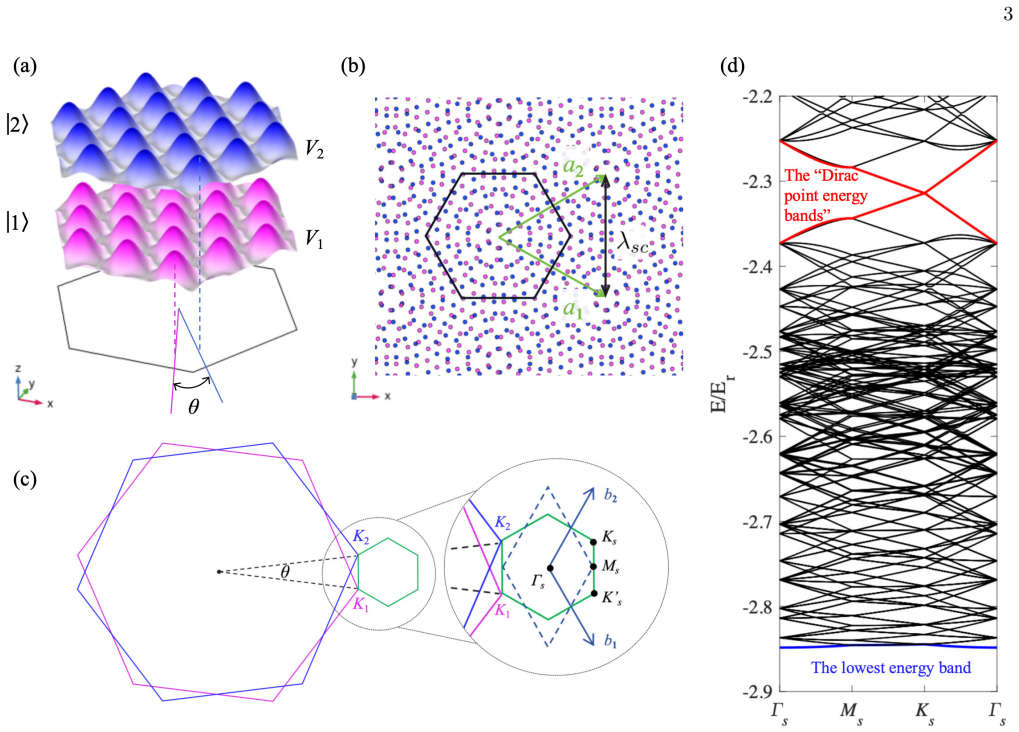
The load-bearing object is the two-layer Hamiltonian $$H = \begin{pmatrix} -\$hbar^{2}$\$nabla^{2}$/2m_a + V_1 & \Omega_R \\ \Omega_R & -\$hbar^{2}$\$nabla^{2}$/2m_a + V_2 \end{pmatrix},$$ with $V_1, V_2$ the two twisted honeycomb lattice potentials and $\Omega_R$ a uniform, spin-flipping microwave coupling that acts as the interlayer coupling strength. The argument runs through the fate of the four folded 'Dirac point energy bands': weak $\Omega_R$ splits the accidental degeneracies at band crossings but leaves the symmetry-protected Dirac point intact, and at the critical coupling the four Bloch modes at the moiré $M_s$ point become degenerate with the Dirac point, producing the flat band. Topological character is carried by the Wilson loop $\hat{W} = \mathcal{P}\exp\left(i\oint \hat{A}(k)\cdot dk\right)$, and its winding number $w=1$ for the isolated flat band is the marker of nontrivial topology.
What would settle it
Calculate the band structure using the actual momentum- and position-dependent matrix elements of the microwave coupling rather than a uniform $\Omega_R$; if the Dirac point acquires a gap at small $\Omega_R$ or the isolated flat band at the critical coupling disappears, the central claim is falsified. A direct experiment would be amplitude-modulation spectroscopy across the critical coupling to look for the predicted bandwidth minimum and Wilson-loop winding $w=1$.
Extended reading notes
Core claim
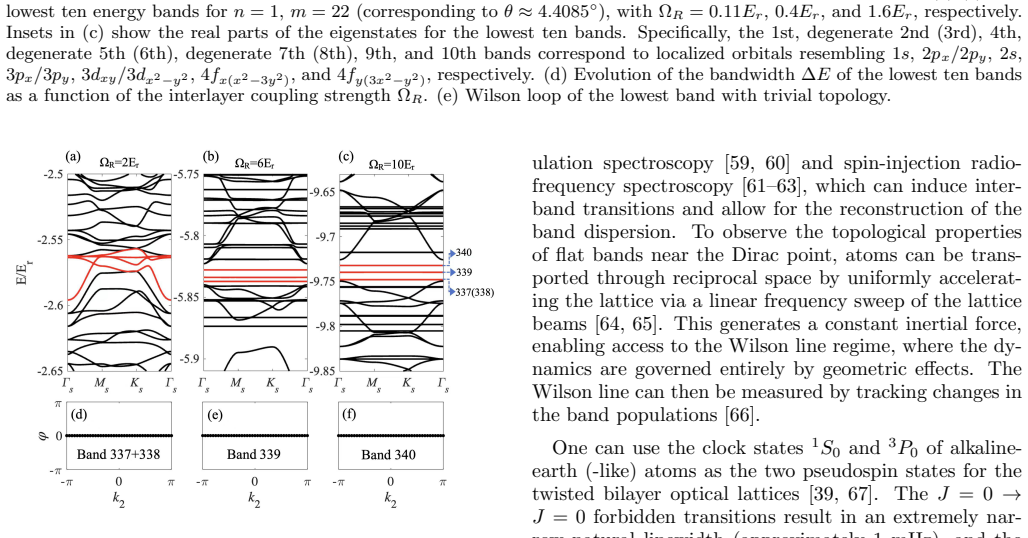
The central claim is that interlayer coupling strength alone, not just twist angle, controls flat-band formation in a twisted bilayer honeycomb lattice. At a weak, twist-angle-dependent critical coupling $\Omega_R^c$, the four folded 'Dirac point energy bands' collapse: their Bloch modes at the $M_s$ point become degenerate with the Dirac point, the group velocity at the Dirac point nearly vanishes, and an isolated flat band appears at the Dirac point energy with Wilson-loop winding $w=1$. The same mechanism that keeps the Dirac point gapless at weak coupling, namely each layer's sublattice symmetry being protected by time-reversal and inversion symmetry, causes the purely accidental degeneracies of the folded bands to be lifted, which is what isolates the flat band. In the strong-coupling regime the lowest bands become progressively flatter and topologically trivial, and beyond $\Omega_R \gtrsim 6E_r$ the Dirac-point-energy bands themselves flatten again as trivial bands. The paper thus establishes a two-regime picture: weak coupling gives one topological flat band at critical coupling; strong coupling gives many trivial flat bands.
Load-bearing premise
The load-bearing premise is that the microwave coupling between the layers is spatially uniform and spin-flipping while leaving each honeycomb layer's sublattice symmetry intact; if the physical coupling had a sublattice- or momentum-dependent structure, the Dirac point would gap out at weak coupling and the flat band at the Dirac point would not form.
Editorial extensions
If this is right
- A topological flat band at the Dirac point can be produced at twist angles up to about $6^\circ$, so the experiment does not require the sub-degree magic-angle alignment of twisted bilayer graphene.
- The critical coupling increases with twist angle and decreases with lattice depth, so the flattening condition can be met by tuning either $\Omega_R$ or $V_0$.
- Slightly above the critical coupling, the flat band becomes a singular band that touches both neighboring bands at $\Gamma_s$, offering a controlled setting for flat bands with band crossings.
- In the strong-coupling limit the system effectively reduces to a single component in a twisted lattice, which is why the high-$\Omega_R$ flat bands are all topologically trivial.
Reading between the lines
- The same critical-coupling mechanism may carry over to other tunable moiré platforms, such as photonic or acoustic twisted lattices, where an adjustable interlayer coupling could replace angle fine-tuning.
- Because the $w=1$ Wilson-loop winding is a fragile-topology signature rather than a Chern number, boundary probes may show no gapless edge states; the cleanest verification would be measuring the Wannier-center flow directly.
- A natural next experiment is to place attractive interlayer interactions into the topological flat band and look for a superfluid with nonzero pairing momentum, and the ultra-narrow band gap suggests exact filling control will be the decisive issue.
- The observed orbital exchange of the Bloch modes at $M_s$ before and after flattening suggests a spectroscopy experiment that tracks the $p_x/d_{xy}$ versus $p_y/d_{x^2-y^2}$ order across the critical coupling, which would confirm the mechanism.
Editorial analysis
A structured set of objections, weighed in public.
Referee Report
Summary. This manuscript studies a twisted bilayer honeycomb optical lattice for ultracold atoms, modeled by Eq. (1) with a uniform interlayer Rabi coupling Ω_R between two spin states. The authors compute moiré band structures for a series of commensurate twist angles and report that a weak critical Ω_R, defined as the value minimizing the bandwidth of the 'Dirac point energy bands', produces an isolated topological flat band at the Dirac point energy with Wilson-loop winding w = 1, over a wide range of twist angles. For stronger coupling they find multiple trivial flat bands, including the lowest band and the Dirac-point-energy bands, and characterize them by Wilson loops and real-space orbital shapes. The paper also discusses experimental detection and proposes realization with alkaline-earth clock states.
Significance. If the predictions hold, the work offers a concrete cold-atom route to tunable topological flat bands in twisted moiré lattices, extending flat-band engineering beyond the narrow magic-angle window of twisted bilayer graphene. The paper's strengths include a clear model Hamiltonian, systematic numerical scans over Ω_R and θ, Wilson-loop calculations that distinguish w = 1 from trivial bands, and a useful table of critical couplings for different angles and lattice depths. However, the central experimental proposal is internally inconsistent with the model, and the numerical results are not accompanied by convergence checks or data/code, so the quantitative claims are not yet fully supported.
major comments (3)
- [Sec. IV and Eq. (1)] The model in Eq. (1) assumes a spatially uniform, sublattice-symmetric interlayer coupling Ω_R, described as a microwave field that couples two spin states. The experimental proposal in Sec. IV instead proposes using the optical clock states 1S0 and 3P0 of alkaline-earth atoms, whose transition is driven by a clock laser with wavelength ~700 nm. Because this wavelength is comparable to the optical lattice spacing, the Rabi field Ω_R(r) will vary appreciably across a unit cell and can acquire sublattice-dependent and momentum-dependent structure. Such a spatially modulated coupling breaks the sublattice symmetry that, according to Sec. III A, protects the gapless Dirac point, and would open a gap that destroys the isolated topological flat band shown in Figs. 2(a)-2(c). The closing suggestion that 'spatially dependent interlayer coupling' might enhance the gap does not resolve this: the proposed clock-state scheme inherently has such spatial dependence. This inconsistency is load-bearing because the paper's central claim is a flat band at the Dirac point energy for ultracold atoms.
- [Sec. II and Table I] All band-structure calculations are performed with COMSOL Multiphysics, but the manuscript reports no convergence tests, no mesh-size dependence, no k-point sampling details, and no checks on the number of retained bands. This matters because the relevant bands are extremely narrow (bandwidths of order 0.01-0.1 E_r in Figs. 2 and 3) and sit among hundreds of folded bands (e.g., bands 337-340 for m = 22). The quantitative claims—critical coupling values in Table I, the relative bandwidth curve in Fig. 3(c), and the Wilson-loop winding number in Fig. 2(e)—depend on numerical accuracy, and without convergence information they cannot be independently assessed. The authors should report at least one systematic convergence study and, ideally, make the numerical data available.
- [Sec. III A, Fig. 3(c)] The statement that topological flat bands form for θ ≲ 6.009° but not for θ ≳ 7.341° is based on the relative bandwidth ΔE/Δg exceeding 0.5, an arbitrary threshold. The paper should state this criterion explicitly and justify it, or quantify how the flatness degrades, since the boundary is presented as a physical transition rather than a chosen cutoff.
minor comments (4)
- [Sec. IV] The sentence 'Considering the ultra-narrow gap between the topological flat band and neighboring bands, which may exceed the atomic thermal energy at finite temperature' appears to state the opposite of the intended meaning: an ultra-narrow gap is smaller than, not larger than, typical thermal energy, which is precisely what makes detection challenging. Please rephrase.
- [Sec. III A, Eq. (4)] The Wilson-loop formulas in Eqs. (4)-(9) do not discuss gauge smoothing or branch choices for the eigenvalues of the Wilson loop, although the Wannier-center plots in Figs. 2(e), 4(e), and 5(d)-5(f) implicitly require a smooth gauge. A sentence on the numerical procedure would improve reproducibility.
- [Sec. IV] The citation of Refs. [5,68] as support for 'spatially dependent interlayer coupling' is not obviously apt, since neither reference appears to discuss spatially varying interlayer coupling in ultracold optical lattices; the authors should cite a more direct source or explain the relevance.
- [Fig. 2(f)] The orbital labels (px-like, dxy-like, etc.) assigned to the Bloch modes at the M_s point are stated without defining the orbital decomposition method; a brief definition or a reference for the projection procedure would clarify the claim.
Circularity Check
No significant circularity: the flat-band result follows from an independent numerical scan, not from a fit or self-citation.
full rationale
The paper's central claim is an isolated, topologically nontrivial flat band at the Dirac point energy for a specific weak interlayer coupling, found by numerically scanning the Hamiltonian of Eq. (1), which contains the uniform coupling Omega_R as an input, and by computing the resulting band structure and Wilson loops. The critical coupling is operationally defined as the value minimizing the bandwidth, and the topological winding w=1 is then computed independently from the Wilson loop spectrum, so the topology and isolation of the band are not assumed or contained in the definition of the critical coupling. Self-citations, notably Ref. [35] for the experimental realization of twisted-bilayer optical lattices and Ref. [65] for a measurement protocol, are contextual and do not enter the theoretical derivation; no uniqueness theorem, ansatz, or prior result by the same authors is invoked to force the conclusion. The manuscript's own discussion of the ultra-narrow gap and of spatially dependent interlayer coupling is an experimental feasibility limitation, not a circular step. Overall, the derivation is self-contained and no reduction of the prediction to its inputs is present.
Assumptions & free parameters
free parameters (3)
- Lattice depth V0 =
4Er and 6Er
- Twist angle integers (m,n) =
n=1, m=7 to 49
- Interlayer coupling strength Ω_R =
varied; critical values in Table I
assumptions (3)
- domain assumption The two spin states see two independent honeycomb optical lattice potentials with a relative twist, and the interlayer coupling is a spatially uniform spin-flip term (microwave field).
- standard math The commensurate twist angle formula and moiré supercell folding from Lopes dos Santos et al.
- domain assumption Bloch's theorem and the finite element method accurately solve the continuum Schrödinger equation for the moiré supercell.
Cite this review
Pith. "Pith review of Topologically nontrivial and trivial flat bands via weak and strong interlayer coupling in twisted bilayer honeycomb optical lattices for ultracold atoms." pith.science (2026). https://pith.science/paper/BQ2XZMYX
@misc{pith2026250611520,
  author       = {Pith},
  title        = {Pith review of: Topologically nontrivial and trivial flat bands via weak and strong interlayer coupling in twisted bilayer honeycomb optical lattices for ultracold atoms},
  year         = {2026},
  howpublished = {\url{https://pith.science/paper/BQ2XZMYX}},
  note         = {Machine review of arXiv:2506.11520}
}
abstract
In recent years, flat electronic bands in twisted bilayer graphene (TBG) have attracted significant attention due to their intriguing topological properties, extremely slow electron velocities, and enhanced density of states. Extending twisted bilayer systems to new configurations is highly desirable, as it offers promising opportunities to explore flat bands beyond TBG. Here, we study both topological and trivial flat bands in a twisted bilayer honeycomb lattice for ultracold atoms and present the evolution of the flat bands with different interlayer coupling strength (ICS). Our results demonstrate that an isolated topological flat band can emerge at the Dirac point energy for a specific value of weak ICS, referred to as the ``critical coupling". This occurs over a wide range of twist angles, surpassing the limits of the magic angle in TBG systems. When the ICS is slightly increased beyond the critical coupling value, the topological flat band exhibits degenerate band crossings with both the upper and lower adjacent bands at the high-symmetry $\Gamma_s$ point. As the ICS is further increased into the strong coupling regime, trivial flat bands arise around Dirac point energy. Meanwhile, more trivial flat bands appear, extending from the lowest to higher energy bands, and remain flat as the ICS increases. The topological properties of the flat bands are studied through the winding pattern of the Wilson loop spectrum. Our research provides deeper insights into the formation of flat bands in ultracold atoms with highly controllable twisted bilayer optical lattices, and may contribute to the discovery of new strongly correlated states of matter.
Figures


Figures from the paper (2 more)

Reference graph
Works this paper leans on
-
[1]
P. C. Adak, S. Sinha, U. Ghorai, L. D. V. Sangani, K. Watanabe, T. Taniguchi, R. Sensarma, and M. M. Desh- mukh, Tunable bandwidths and gaps in twisted double bilayer graphene on the verge of correlations, Phys. Rev. B101, 125428 (2020)
work page 2020
- [2]
-
[3]
Khalaf, A
E. Khalaf, A. J. Kruchkov, G. Tarnopolsky, and A. Vish- wanath, Magic angle hierarchy in twisted graphene mul- tilayers, Phys. Rev. B100, 085109 (2019)
2019
-
[4]
M. Liang, M.-M. Xiao, Z. Ma, and J.-H. Gao, Moir´ e band structures of the double twisted few-layer graphene, Phys. Rev. B105, 195422 (2022)
work page 2022
-
[5]
Tarnopolsky, A
G. Tarnopolsky, A. J. Kruchkov, and A. Vishwanath, Origin of Magic Angles in Twisted Bilayer Graphene, Phys. Rev. Lett.122, 106405 (2019)
2019
- [6]
-
[7]
D. M. Kennes, L. Xian, M. Claassen, and A. Rubio, One- dimensional flat bands in twisted bilayer germanium se- lenide, Nat. commun.11, 1124 (2020)
work page 2020
-
[8]
X. Luet al., Superconductors, orbital magnets and corre- lated states in magic-angle bilayer graphene, Nature574, 653 (2019)
work page 2019
Show all 73 references
-
[9]
J. Wang, X. Mu, L. Wang, and M. Sun, Properties and applications of new superlattice: twisted bilayer graphene, Mater. Today Phys.9, 100099 (2019)
2019
-
[10]
D. M. Kenneset al., Moir´ e heterostructures as a condensed-matter quantum simulator, Nat. Phys.17, 155 (2021)
2021
-
[11]
Y. Cao, V. Fatemi, A. Demir, S. Fang, S. L. Tomarken, J. Y. Luo, J. D. Sanchez-Yamagishi, K. Watanabe, T. Taniguchi, E. Kaxiras, R. C. Ashoori, and P. Jarillo- Herrero, Correlated insulator behaviour at half-filling in magic-angle graphene superlattices, Nature556, 80 (2018)
2018
-
[12]
Y. Cao, V. Fatemi, S. Fang, K. Watanabe, T. Taniguchi, E. Kaxiras, and P. Jarillo-Herrero, Unconventional super- conductivity in magic-angle graphene superlattices, Na- ture556, 43 (2018)
2018
-
[13]
C. C. Liu, L. D. Zhang, W. Q. Chen, and F. Yang, Chi- ral Spin Density Wave and d+id Superconductivity in the Magic-Angle-Twisted Bilayer Graphene, Phys. Rev. Lett.121, 217001 (2018)
2018
-
[14]
Xu and L
C. Xu and L. Balents, Topological Superconductivity in Twisted Multilayer Graphene, Phys. Rev. Lett.121, 087001 (2018)
2018
-
[15]
Gonzalez and T
J. Gonzalez and T. Stauber, Kohn-Luttinger Supercon- ductivity in Twisted Bilayer Graphene, Phys. Rev. Lett. 122, 026801 (2019)
2019
-
[16]
B. Lian, Z. Wang, and B. A. Bernevig, Twisted Bilayer Graphene: A Phonon-Driven Superconductor, Phys. Rev. Lett.122, 257002 (2019)
2019
-
[17]
Yankowitzet al., Tuning superconductivity in twisted bilayer graphene, Science363, 1059 (2019)
M. Yankowitzet al., Tuning superconductivity in twisted bilayer graphene, Science363, 1059 (2019)
2019
-
[18]
Balents, C
L. Balents, C. R. Dean, D. K. Efetov, and A. F. Young, Superconductivity and strong correlations in moir´ e flat bands, Nat. Phys.16, 725 (2020)
2020
-
[19]
F. Wu, T. Lovorn, E. Tutuc, and A. H. MacDonald, Hub- bard Model Physics in Transition Metal Dichalcogenide Moir´ e Bands, Phys. Rev. Lett.121, 026402 (2018)
2018
-
[20]
Bultinck, S
N. Bultinck, S. Chatterjee, and M. P. Zaletel, Mechanism for Anomalous Hall Ferromagnetism in Twisted Bilayer Graphene, Phys. Rev. Lett.124, 166601 (2020)
2020
-
[21]
J. Liu, Z. Ma, J. Gao, and X. Dai, Quantum Valley Hall Effect, Orbital Magnetism, and Anomalous Hall Effect in Twisted Multilayer Graphene Systems, Phys. Rev. X9, 031021 (2019)
2019
-
[22]
(d)-(f) Wilson loops of the trivial flat bands
highlighted in red, along with nearby energy bands, for ΩR = 2E r,6E r and 10E r, respectively. (d)-(f) Wilson loops of the trivial flat bands. tonic systems [32, 34, 56–58]. IV. DISCUSSION AND CONCLUSION In realistic experiments, the topological and trivial flat bands can be ...
-
[23]
Xieet al., Fractional Chern insulators in magic-angle twisted bilayer graphene, Nature600, 439 (2021)
Y. Xieet al., Fractional Chern insulators in magic-angle twisted bilayer graphene, Nature600, 439 (2021)
2021
-
[24]
Cr´ epel and L
V. Cr´ epel and L. Fu, Anomalous Hall metal and fractional Chern insulator in twisted transition metal 9 dichalcogenides, Phys. Rev. B107, L201109 (2023)
2023
-
[25]
Repellin and T
C. Repellin and T. Senthil, Chern bands of twisted bi- layer graphene: Fractional Chern insulators and spin phase transition, Phys. Rev. Res.2, 023238 (2020)
2020
-
[26]
H. C. Po, H. Watanabe, and A. Vishwanath, Fragile Topology and Wannier Obstructions, Phys. Rev. Lett. 121, 126402 (2018)
2018
-
[27]
Z. Song, Z. Wang, W. Shi, G. Li, C. Fang, and B. A. Bernevig, All Magic Angles in Twisted Bilayer Graphene are Topological, Phys. Rev. Lett.123, 036401 (2019)
2019
-
[28]
J. Ahn, S. Park, and B.-J. Yang, Failure of Nielsen- Ninomiya Theorem and Fragile Topology in Two- Dimensional Systems with Space-Time Inversion Symme- try: Application to Twisted Bilayer Graphene at Magic Angle, Phys. Rev. X9, 021013 (2019)
2019
-
[29]
Wang, J.-X
J.-T. Wang, J.-X. Liu, H.-T. Ding, and P. He, Proposal for implementing Stiefel-Whitney insulators in an optical Raman lattice, Phys. Rev. A109, 053314 (2024)
2024
-
[30]
K. Dong, T. Zhang, J. Li, Q. Wang, F. Yang, Y. Rho, D. Wang, C. P. Grigoropoulos, J. Wu, and J. Yao, Flat Bands in Magic-Angle Bilayer Photonic Crystals at Small Twists, Phys. Rev. Lett.126, 223601 (2021)
2021
-
[31]
B. Lou, N. Zhao, M. Minkov, C. Guo, M. Orenstein, and S. Fan, Theory for Twisted Bilayer Photonic Crystal Slabs, Phys. Rev. Lett.126, 136101 (2021)
2021
-
[32]
C. H. Yi, H. C. Park, and M. J. Park, Strong interlayer coupling and stable topological flat bands in twisted bi- layer photonic Moir´ e superlattices, Light:Sci. Appl.11, 289 (2022)
2022
-
[33]
P. Wang, Y. Zheng, X. Chen, C. Huang, Y. V. Kartashov, L. Torner, V. V. Konotop, and F. Ye, Localization and delocalization of light in photonic moir´ e lattices, Nature 577, 42 (2020)
2020
-
[34]
H. Tang, F. Du, S. Carr, C. DeVault, O. Mello, and E. Mazur, Modeling the optical properties of twisted bilayer photonic crystals, Light:Sci. Appl.10, 157 (2021)
2021
-
[35]
X. R. Mao, Z. K. Shao, H. Y. Luan, S. L. Wang, and R. M. Ma, Magic-angle lasers in nanostructured moir´ e superlattice, Nat. Nanotechnol.16, 1099 (2021)
2021
-
[36]
Z. Meng, L. Wang, W. Han, F. Liu, K. Wen, C. Gao, P. Wang, C. Chin, and J. Zhang, Atomic Bose-Einstein con- densate in twisted-bilayer optical lattices, Nature615, 231 (2024)
2024
-
[37]
McDonald, J
M. McDonald, J. Trisnadi, K.-X. Yao, and C. Chin, Su- perresolution microscopy of cold atoms in an optical lat- tice, Phys. Rev. X9, 021001 (2019)
2019
-
[38]
Gonz´ alez-Tudela and J
A. Gonz´ alez-Tudela and J. I. Cirac, Cold atoms in twisted-bilayer optical potentials, Phys. Rev. A100, 053604 (2019)
2019
-
[39]
Salamon, A
T. Salamon, A. Celi, R. W. Chhajlany, I. Fr´ erot, M. Lewenstein, L. Tarruell, and D. Rakshit, Simulating Twistronics without a Twist, Phys. Rev. Lett.125, 030504 (2020)
2020
-
[40]
Luo and C
X.-W. Luo and C. Zhang, Spin-twisted optical lattices: tunable flat bands and Larkin-Ovchinnikov superfluids, Phys. Rev. Lett.126, 103201 (2021)
2021
-
[41]
C. Wang, C. Gao, J. Zhang, H. Zhai, and Z.-Y. Shi, Three-Dimensional Moir´ e Crystal in Ultracold Atomic Gases, Phys. Rev. Lett.133, 163401 (2024)
2024
-
[42]
M. Gall, N. Wurz, J. Samland, C. F. Chan, and M. K¨ ohl, Competing magnetic orders in a bilayer Hubbard model with ultracold atoms, Nature589, 40 (2021)
2021
-
[43]
Tarruell, D
L. Tarruell, D. Greif, T. Uehlinger, G. Jotzu, and T. Esslinger, Creating, moving and merging Dirac points with a Fermi gas in a tunable honeycomb lattice, Nature 483, 302 (2012)
2012
-
[44]
Soltan-Panahi, J
P. Soltan-Panahi, J. Struck, P. Hauke, A. Bick, W. Plenkers, G. Meineke, C. Becker, P. Windpassinger, M. Lewenstein, and K. Sengstock, Multi-component quan- tum gases in spin-dependent hexagonal lattices, Nat. Phys.7, 434 (2011)
2011
-
[45]
Windpassinger and K
P. Windpassinger and K. Sengstock, Engineering novel optical lattices, Rep. Prog. Phys.76, 086401 (2013)
2013
-
[46]
Bloch, J
I. Bloch, J. Dalibard, and W. Zwerger, Many-body physics with ultracold gases, Rev. Mod. Phys.80, 885 (2008)
2008
-
[47]
S. Carr, S. Fang, P. Jarillo-Herrero, and E. Kaxiras, Pres- sure dependence of the magic twist angle in graphene superlattices, Phys. Rev. B98, 085144 (2018)
2018
-
[48]
B. L. Chittari, N. Leconte, S. Javvaji, and J. Jung, Pres- sure induced compression of flatbands in twisted bilayer graphene, Electron. Struct.1, 015001 (2018)
2018
-
[49]
Yankowitz, J
M. Yankowitz, J. Jung, E. Laksono, N. Leconte, B. L. Chittari, K. Watanabe, T. Taniguchi, S. Adam, D. Graf, C. R. Dean, Dynamic band-structure tuning of graphene moir´ e superlattices with pressure, Nature557, 404 (2018)
2018
-
[50]
J. M. B. Lopes dos Santos, N. M. R. Peres, A. H. C. Neto, Graphene Bilayer with a Twist: Electronic Structure, Phys. Rev. Lett.99, 256802 (2007)
2007
-
[51]
Wilczek and A
F. Wilczek and A. Zee, Appearance of gauge structure in simple dynamical systems, Phys. Rev. Lett.52, 2111 (1984)
1984
-
[52]
Taherinejad, K
M. Taherinejad, K. F. Garrity, and D. Vanderbilt, Wan- nier center sheets in topological insulators, Phys. Rev. B 89, 115102 (2014)
2014
-
[53]
Marzari and D
N. Marzari and D. Vanderbilt, Maximally localized gen- eralized Wannier functions for composite energy bands, Phys. Rev. B56, 12847 (1997)
1997
-
[54]
H. C. Po, L. Zou, T. Senthil, and A. Vishwanath, Faithful tight-binding models and fragile topology of magic-angle bilayer graphene, Phys. Rev. B99, 195455 (2019)
2019
-
[55]
Z.-D. Song, L. Elcoro, B. A. Bernevig, Twisted bulk- boundary correspondence of fragile topology, Science 367, 794 (2020)
2020
-
[56]
Peri, Z.-D
V. Peri, Z.-D. Song, M. Serra-Garcia, P. Engeler, R. Queiroz, X. Huang, W. Deng, Z. Liu, B. A. Bernevig, and S. D. Huber, Experimental characterization of frag- ile topology in an acoustic metamaterial, Science367, 797 (2020)
2020
-
[57]
Q. Fu, P. Wang, C. Huang, Y. V. Kartashov, L. Torner, V. V. Konotop, and F. Ye, Optical soliton formation con- trolled by angle twisting in photonic moir´ e lattices, Nat. Photonics14, 663 (2020)
2020
-
[58]
Huang, F
C. Huang, F. Ye, X. Chen, Y. V. Kartashov, V. V. Konotop, and L. Torner, Localization-delocalization wavepacket transition in Pythagorean aperiodic poten- tials, Sci. Rep.6, 32546 (2016)
2016
-
[59]
Luan, Y.-H
H.-Y. Luan, Y.-H. Ouyang, Z.-W. Zhao, W.-Z. Mao, and R-M. Ma, Reconfigurable moir´ e nanolaser arrays with phase synchronization, Nature624, 282 (2023)
2023
-
[60]
St¨ oferle, H
T. St¨ oferle, H. Moritz, C. Schori, M. K¨ ohl, and T. Esslinger, Transition from a Strongly Interacting 1D Su- perfluid to a Mott Insulator, Phys. Rev. Lett.92, 130403 (2004)
2004
-
[61]
Fl¨ aschner, M
N. Fl¨ aschner, M. Tarnowski, B. S. Rem, D. Vogel, K. Sengstock, and C. Weitenberg, High-precision multiband spectroscopy of ultracold fermions in a nonseparable op- 10 tical lattice, Phys. Rev. A97, 051601(R) (2018)
2018
-
[62]
J. T. Stewart, J. P. Gaebler, and D. S. Jin, Using pho- toemission spectroscopy to probe a strongly interacting Fermi gas, Nature454, 744 (2008)
2008
-
[63]
Wang, Z.-Q
P. Wang, Z.-Q. Yu, Z. Fu, J. Miao, L. Huang, S. Chai, H. Zhai, and J. Zhang, Spin-orbit coupled degenerate Fermi gases, Phys. Rev. Lett.109, 095301 (2012)
2012
-
[64]
L. W. Cheuk, A. T. Sommer, Z. Hadzibabic, T. Yefsah, W. S. Bakr, and M. W. Zwierlein, Spin-injection spec- troscopy of a spin-orbit coupled Fermi gas, Phys. Rev. Lett.109, 095302 (2012)
2012
-
[65]
C. D. Brown, S.-W. Chang, M. N. Schwarz, T.-H. Leung, V. Kozii, A. Avdoshkin, J. E. Moore, D. Stamper-Kurn, Direct geometric probe of singularities in band structure, Science377, 1319 (2022)
2022
-
[66]
Y. Li, W. Han, Z. Meng, W. Yang, C. Chin, and J. Zhang, Observation of quantized vortex in an atomic Bose- Einstein condensate at Dirac point, arXiv:2411.16287v2
-
[67]
T. Li, L. Duca, M. Reitter, F. Grusdt, E. Demler, M. Endres, M. Schleier-Smith, I. Bloch, and U. Schneider, Bloch state tomography using Wilson lines, Science352, 1094 (2016)
2016
-
[68]
S. L. Campbell, R. B. Hutson, G. E. Marti, A. Goban, N. Darkwah Oppong, R. L. McNally, L. Sonderhouse, J. M. Robinson, W. Zhang, B. J. Bloom, and J. Ye, A Fermi-degenerate three-dimensional optical lattice clock, Science358, 90 (2017)
2017
-
[69]
Huang, X
C. Huang, X. Zhang, G. Pan, H. Li, K. Sun, X. Dai, and Z. Y. Meng, Evolution from quantum anomalous Hall insulator to heavy-fermion semimetal in magic-angle twisted bilayer graphene, Phys. Rev. B109, 125404 (2024)
2024
-
[70]
C. Chin, R. Grimm, P. Julienne, and E. Tiesinga, Fesh- bach resonances in ultracold gases, Rev. Mod. Phys.82, 1225 (2010)
2010
-
[71]
Chomaz, I
L. Chomaz, I. Ferrier-Barbut, F. Ferlaino, B. Laburthe- Tolra, B. L. Lev, and T. Pfau, Dipolar physics: a review of experiments with magnetic quantum gases, Rev. Mod. Phys.86, 026401 (2023)
2023
-
[72]
Schauß, M
P. Schauß, M. Cheneau, M. Endres, T. Fukuhara, S. Hild, A. Omran, T. Pohl, C. Gross, S. Kuhr, and I. Bloch, Observation of spatially ordered structures in a two-dimensional Rydberg gas, Nature491, 87 (2012)
2012
-
[73]
Meldgin, U
C. Meldgin, U. Ray, P. Russ, D. Chen, D. M. Ceperley and B. DeMarco, Probing the Bose glass-superfluid tran- sition using quantum quenches of disorder, Nat. Phys. 12, 646 (2016)
2016
Reviewed August 7, 2026 · model on record in the stance chip above.
Discussion (0). Continue with ORCID to comment.