REVIEW 3 major objections 5 minor 57 references
Dissecting the Segmentation Model of End-to-End Diarization with Vector Clustering
T0 review · 3 major / 5 minor · reviewed 2026-08-07 · deepseek-v4-flash
Pith's one-line read This paper dissects the segmentation model of end-to-end neural diarization with vector clustering and finds that finetuning a WavLM encoder is the dominant factor, yielding state-of-the-art results on five datasets.
desk verdict A solid, well-executed large benchmark of EEND-VC segmentation choices; the headline SOTA claim is real but the architecture ranking is less settled than the abstract suggests because clustering hyperparameters were fitted once and shared. read the letter →
The pith
A machine-rendered reading of the paper's core claim, the machinery that carries it, and where it could break.
The reading
What carries the argument
The load-bearing mechanism is the EEND-VC pipeline itself: a local end-to-end segmentation model that outputs per-chunk speaker activity posteriors, followed by a vector-clustering step that assigns global speaker identities to the chunks. Within the segmentation model, the paper's controlled variation of encoder (SincNet vs. WavLM), decoder (LSTM, Mamba, Conformer), loss (multilabel BCE vs. multiclass powerset CE), and chunk size (5, 10, 30, 50 s) is what carries the argument. The powerset encoding — each speaker combination is a class — is the secondary central object; the paper shows it changes the error distribution and interacts with model strength. The chunk size is treated as a hyperparameter that shifts the burden between the segmentation model and the clustering stage.
What would settle it
Re-run the full comparison with clustering threshold and minimum cluster size re-optimized per architecture, loss, and chunk size on the development sets, and check whether the finetuned-WavLM Conformer 50s multilabel configuration still wins; if the ranking shifts, the shared clustering hyperparameters, not model quality, produced the reported gaps.
Extended reading notes
Core claim
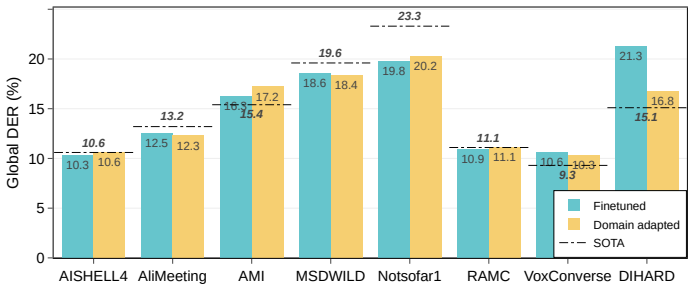
The paper's central claim is that in the EEND-VC framework, the segmentation model's encoder is the decisive component, and that finetuning a self-supervised speech encoder (WavLM Base+) on the diarization task yields the largest single improvement — around 25% relative DER reduction over SincNet, and another 11% relative over frozen WavLM Base+. When WavLM is finetuned, all three decoders (LSTM, Mamba, Conformer) converge to within a small margin, with Conformer at 50-second chunks slightly best; before finetuning, Mamba is the most robust decoder and Conformer needs the powerset loss to beat it. The paper also claims that the multiclass powerset loss and the traditional multilabel loss produce systematically different error profiles: powerset keeps false alarm plus missed detection constant across chunk sizes and helps weaker models, but it caps very strong models, so multilabel wins after WavLM finetuning. Chunk size interacts with all of these choices, with 30–50 second chunks only paying off when the encoder and decoder can actually use long context.
Load-bearing premise
The comparison assumes that clustering hyperparameters (threshold and minimum cluster size) tuned once on development outputs from prior models and shared across all models of the same chunk size remain near-optimal for every architecture, loss, and encoder combination; if the optimal clustering differs between models, the reported ranking could be distorted by this fixed choice.
Editorial extensions
If this is right
- Builders of EEND-VC systems should start from a finetuned self-supervised encoder (WavLM Base+ or stronger) and treat the decoder as a secondary choice; LSTM becomes competitive once the encoder is finetuned.
- Powerset loss is a safe default for weaker or fixed-encoder models, but multilabel should be used when the encoder itself is finetuned.
- Chunk size must be reported and optimized as a first-class hyperparameter; 30–50 s chunks can improve DER for Mamba/Conformer-based systems but hurt LSTM/SincNet systems.
- Domain adaptation on in-domain data gave little or no improvement over the compound-trained finetuned WavLM models, so the encoder's pretraining data is more valuable than small amounts of in-domain adaptation data.
Reading between the lines
- If the encoder dominates to the degree the paper shows, then the next scaling step is not a better decoder but a larger or more specialized self-supervised encoder; the paper's data implies that the next generation of SSL speech models could push DER down further without any architectural change.
- The paper's analysis suggests a testable hypothesis: the powerset loss acts as a curriculum or regularizer that helps under-parameterized models converge, but restricts the expressiveness of very strong models; one could verify this by training intermediate-capacity models with both losses.
- A natural extension the authors mention only in passing is variable chunk size at inference: since optimal chunk size varies by dataset, a model trained on mixed chunk sizes could choose per-recording chunk length, likely improving mean DER beyond the fixed-chunk best.
Editorial analysis
A structured set of objections, weighed in public.
Referee Report
Summary. This paper presents a systematic empirical comparison of the segmentation component of EEND-VC speaker diarization pipelines. It varies the encoder (SincNet, frozen and finetuned WavLM Base/Base+), the decoder (LSTM, Conformer, Mamba), the training loss (multilabel BCE vs. powerset CE), and the chunk size (5/10/30/50 s), trains all configurations on the same compound set, and evaluates local and global DER on eight datasets plus DIHARD III. The main reported findings are that finetuned WavLM encoders give the largest gains, Conformer is the best decoder when paired with the right configuration while Mamba is more robust, powerset loss helps most configurations but is worse than multilabel after WavLM finetuning, and chunk size is an important hyperparameter. The best system (finetuned WavLM Base+, Conformer, multilabel, 50 s chunks) is claimed to achieve state-of-the-art results on five datasets.
Significance. This is a useful and unusually broad empirical study. It evaluates 120 configurations under a common training and evaluation protocol across nine datasets, reports both local and global DER with a component breakdown (false alarm, missed detection, speaker confusion), and includes an out-of-domain test (DIHARD III). If the findings hold, the field obtains a practical recipe: finetuned WavLM Base+ with Conformer or Mamba decoder, long chunks, and multilabel loss for state-of-the-art performance; SincNet + Mamba + powerset for lightweight applications; and a clear warning that the powerset loss can become suboptimal when the encoder is powerful enough. The paper is also honest about the shared clustering hyperparameters and about the uncertainty in the powerset/multilabel trade-off, but those self-reported limitations are exactly what need to be addressed before the headline ranking can be accepted.
major comments (3)
- [§4.2.1, Table 2, Table 5] The global DER comparisons in Table 5 and Figures 7–11 are confounded by the vector-clustering hyperparameters (HAC threshold and minimum cluster size), which were tuned once on dev outputs of the authors' previous Mamba models [19] and then shared across all encoders, decoders, and losses for a given chunk size. The HAC threshold directly controls the number of global clusters and hence the speaker-confusion component of DER (Section 5.1.5), and Table 2 shows thresholds varying from 0.6791 to 0.6915 across chunk sizes. The top systems in Table 5 are separated by only 0.2–0.4 macro DER (system 12: 14.1, system 10: 14.3, system 11: 14.5), so the headline conclusion that the Conformer 50 s multilabel system is the best overall and reaches state-of-the-art could be an artifact of inheriting a clustering setting fitted to [19] rather than a property of the architecture. The authors should either tune the clustering hyperparameters separately for each final system on the dev set (nested validation), or report a sensitivity analysis showing that the ranking and SOTA claims are stable over a grid of thresholds and minimum cluster sizes. This is the main load-bearing concern, and it is not resolved by the local DER results in Figure 6 because the SOTA and 'best overall' claims are global DER claims.
- [§5.2, §5.3, Figures 10–11, Table 5] All reported numbers are single runs, with no multiple seeds, error bars, or significance tests. Several findings that support the 'best overall' statement and the loss/decoder interaction rest on small margins, such as the finetuned Conformer macro DER of 14.1 versus the finetuned Mamba macro DER of 14.5, and the claim that powerset becomes inferior to multilabel after WavLM finetuning. These margins may be within run-to-run variation for training large self-supervised models, particularly with early stopping (Section 4.3.1). I ask for multiple seeds for the final systems, or at least a paired test over the evaluation datasets (for example, a Wilcoxon signed-rank test on per-dataset DER), to distinguish genuine architecture differences from training noise. The large encoder gap is likely robust, but the decoder and loss rankings are not.
- [Table 5 and §5.3] The state-of-the-art comparison mixes evaluation protocols: some entries are reported without a collar and some with a 0.25 s collar (indicated by parentheses), and the cited SOTA numbers come from different papers with different training and evaluation setups. For example, the VoxConverse SOTA value is given with a collar (4.0 from [12]) while our system's no-collar and collar values are both reported, and the AMI SOTA entry (15.4 from [15]) is not shown to be measured under the same channel and scoring conditions as our system. The claim of 'state-of-the-art results on five datasets' is therefore not fully established unless the best model is re-scored under the exact protocol of each cited SOTA system, or the claims are explicitly restricted to the common protocol used in this paper. At minimum, the table should state which entries are directly comparable and which are not.
minor comments (5)
- [§1 and §4.2.1] The introduction says '120 different configurations' while Section 4.2.1 says 'more than 200 experiments in total'; these counts should be reconciled.
- [§5.1.1 and Figure 8 caption] There are typos: 'Section Section 5.1.5' should be 'Section 5.1.5', and 'WavLeM' in the Figure 8 caption should be 'WavLM'.
- [§4.3.1] The wording 'unfreezed WavLM parameters' should be 'unfrozen WavLM parameters'.
- [Figures 10c–10d] The WavLM Base+ panels omit the 5 s chunk-size condition; please state explicitly whether those runs were not performed or were excluded, since the corresponding WavLM Base panels include it.
- [Equations (9)–(12)] The powerset class set and the conversion matrix would be easier to follow if C_{N,K} and the dimensions of M were defined explicitly before the equations are used; the text alternates between C and C_{N,K} without clarifying the relation.
Circularity Check
No circularity: the ablation is empirical and self-contained; the shared clustering hyperparameters are a disclosed validity caveat, not a by-construction reduction.
full rationale
This is an empirical ablation study rather than a derivation, and its claims are supported by measured DER values, not by a chain of equations that reduces to its inputs. The powerset loss [18] and Mamba decoder [19] are prior self-contributions, but they are treated as factors to be evaluated, and the main 'finetuned WavLM is best' conclusion is supported by local DER results (Figures 6 and 10) that do not depend on the vector-clustering step. The only potentially load-bearing self-referential element is Section 4.2.1, where the agglomerative clustering threshold and minimum cluster size were tuned on dev-set outputs from the authors' previous paper [19] and then shared across all models of the same chunk size 'regardless of encoder, decoder or training loss.' This is a real methodological caveat: the global DER rankings in Table 5, including the 0.2-0.4 macro-average margins that separate the top finetuned systems, could be distorted if the optimal clustering hyperparameters differ across architectures. However, this is a validity risk about a fixed hyperparameter, not a circularity risk: global DER is still computed from the model's local segmentations and speaker embeddings, so no result is equivalent to the fitted threshold by construction. The paper itself discloses the limitation and explains that the ideal protocol would optimize clustering after all other choices. No uniqueness theorem is imported from the authors' prior work, and no ansatz is smuggled in as an external mathematical fact. The central claims therefore have independent empirical content, and the presence of self-citations does not make the argument circular.
Assumptions & free parameters
free parameters (4)
- HAC clustering threshold per chunk size =
0.6915 (5s), 0.6836 (10s), 0.6791 (30s), 0.6846 (50s)
- HAC minimum cluster size per chunk size =
10 (5s), 7 (10s), 6 (30s), 6 (50s)
- Maximum number of speakers per chunk N =
4, 4, 5, 6 for 5, 10, 30, 50s
- Maximum simultaneous speakers K for powerset =
2
assumptions (3)
- domain assumption Speaker-count coverage of at least 97% is sufficient; the remaining chunks and frames are negligible for the conclusions.
- domain assumption The VoxCeleb-trained ResNet embedding extractor and hierarchical agglomerative clustering are adequate for all test datasets.
- standard math Mamba's selective SSM equations and discretization (Eq. 5-6) are accepted from prior literature.
Cite this review
Pith. "Pith review of Dissecting the Segmentation Model of End-to-End Diarization with Vector Clustering." pith.science (2026). https://pith.science/paper/MQZ5U244
@misc{pith2026250611605,
  author       = {Pith},
  title        = {Pith review of: Dissecting the Segmentation Model of End-to-End Diarization with Vector Clustering},
  year         = {2026},
  howpublished = {\url{https://pith.science/paper/MQZ5U244}},
  note         = {Machine review of arXiv:2506.11605}
}
read the original abstract
End-to-End Neural Diarization with Vector Clustering is a powerful and practical approach to perform Speaker Diarization. Multiple enhancements have been proposed for the segmentation model of these pipelines, but their synergy had not been thoroughly evaluated. In this work, we provide an in-depth analysis on the impact of major architecture choices on the performance of the pipeline. We investigate different encoders (SincNet, pretrained and finetuned WavLM), different decoders (LSTM, Mamba, and Conformer), different losses (multilabel and multiclass powerset), and different chunk sizes. Through in-depth experiments covering nine datasets, we found that the finetuned WavLM-based encoder always results in the best systems by a wide margin. The LSTM decoder is outclassed by Mamba- and Conformer-based decoders, and while we found Mamba more robust to other architecture choices, it is slightly inferior to our best architecture, which uses a Conformer encoder. We found that multilabel and multiclass powerset losses do not have the same distribution of errors. We confirmed that the multiclass loss helps almost all models attain superior performance, except when finetuning WavLM, in which case, multilabel is the superior choice. We also evaluated the impact of the chunk size on all aforementioned architecture choices and found that newer architectures tend to better handle long chunk sizes, which can greatly improve pipeline performance. Our best system achieved state-of-the-art results on five widely used speaker diarization datasets.
Figures


Figures from the paper (9 more)


Reference graph
Works this paper leans on
-
[19]
A. Plaquet, N. Tawara, M. Delcroix, S. Horiguchi, A. Ando, S. Araki, Mamba-based segmentation model for speaker diarization, in: Proc. IEEE International Conference on Acoustics, Speech and Signal Processing (ICASSP), 2024.doi:10.1109/ICASSP49660.2025.10889446
arXiv 2024
-
[12]
S. Baroudi, H. Bredin, A. Plaquet, T. Pellegrini, pyannote.audio speaker diarization pipeline at VoxSRC 2023, The VoxCeleb Speaker Recognition Challenge (2023)
work page 2023
-
[15]
J. Han, F. Landini, J. Rohdin, A. Silnova, M. Diez, L. Burget, Leveraging self-supervised learning for speaker diarization (2024).arXiv:2409.09408. URLhttps://arxiv.org/abs/2409.09408
work page Pith review arXiv 2024
-
[1]
D. Reynolds, P. Torres-Carrasquillo, Approaches and applications of audio diarization, in: Proc. IEEE International Conference on Acoustics, Speech, and Signal Processing (ICASSP), Vol. 5, 2005, pp. v/953–v/956 Vol. 5. doi:10.1109/ICASSP.2005.1416463
work page Pith review arXiv 2005
-
[2]
N. Dehak, P. J. Kenny, R. Dehak, P. Dumouchel, P. Ouellet, Front-end fac- tor analysis for speaker verification, IEEE Transactions on Audio, Speech, andLanguageProcessing19(4)(2011)788–798.doi:10.1109/TASL.2010. 2064307
- [3]
-
[4]
J. Ajmera, C. Wooters, A robust speaker clustering algorithm, in: 2003 IEEE Workshop on Automatic Speech Recognition and Understanding (IEEE Cat. No.03EX721), 2003, pp. 411–416.doi:10.1109/ASRU.2003. 1318476
-
[5]
X. Anguera, C. Wooters, B. Peskin, M. Aguiló, Robust speaker segmen- tation for meetings: The ICSI-SRI spring 2005 diarization system, in: S. Renals, S. Bengio (Eds.), Machine Learning for Multimodal Interaction, Springer Berlin Heidelberg, Berlin, Heidelberg, 2006, pp. 402–414
work page 2005
Show all 57 references
-
[6]
Landini, J
F. Landini, J. Profant, M. Diez, L. Burget, Bayesian HMM clustering of x-vector sequences (VBx) in speaker diarization: Theory, implementation and analysis on standard tasks, Computer Speech & Language 71 (2022) 101254. 31
2022
-
[7]
In- terspeech, 2019, pp
Y.Fujita, N.Kanda, S.Horiguchi, K.Nagamatsu, S.Watanabe, End-to-end neural speaker diarization with permutation-free objectives, in: Proc. In- terspeech, 2019, pp. 4300–4304.doi:10.21437/Interspeech.2019-2899
2019 doi
-
[8]
Fujita, N
Y. Fujita, N. Kanda, S. Horiguchi, Y. Xue, K. Nagamatsu, S. Watanabe, End-to-end neural speaker diarization with self-attention, in: 2019 IEEE Automatic Speech Recognition and Understanding Workshop (ASRU), 2019, pp. 296–303.doi:10.1109/ASRU46091.2019.9003959
2019
-
[9]
Horiguchi, Y
S. Horiguchi, Y. Fujita, S. Watanabe, Y. Xue, P. García, Encoder-decoder based attractors for end-to-end neural diarization, IEEE/ACM Transac- tions Audio, Speech and Language Processing 30 (2022) 1493–1507
2022
-
[10]
Kinoshita, M
K. Kinoshita, M. Delcroix, N. Tawara, Integrating end-to-end neural and clustering-based diarization: Getting the best of both worlds, in: Proc. ICASSP,2021, pp.7198–7202.doi:10.1109/ICASSP39728.2021.9414333
2021
-
[11]
Bredin, pyannote.audio 2.1 speaker diarization pipeline: Principle, benchmark, and recipe, in: Proc
H. Bredin, pyannote.audio 2.1 speaker diarization pipeline: Principle, benchmark, and recipe, in: Proc. Interspeech, 2023, pp. 1983–1987.doi: 10.21437/Interspeech.2023-105
2023 doi
-
[13]
Delcroix, N
M. Delcroix, N. Tawara, M. Diez, F. Landini, A. Silnova, A. Ogawa, T. Nakatani, L. Burget, S. Araki, Multi-stream extension of variational Bayesian HMM clustering (MS-VBx) for combined end-to-end and vector clustering-based diarization, in: Proc. Interspeech, 2023, pp. 3477–34...
2023 doi
-
[16]
Ravanelli, Y
M. Ravanelli, Y. Bengio, Speaker recognition from raw waveform with Sinc- Net, in: 2018 IEEE Spoken Language Technology Workshop (SLT), 2018, pp. 1021–1028.doi:10.1109/SLT.2018.8639585
2018
-
[17]
S. Chen, C. Wang, Z. Chen, Y. Wu, S. Liu, Z. Chen, J. Li, N. Kanda, T. Yoshioka, X. Xiao, J. Wu, L. Zhou, S. Ren, Y. Qian, Y. Qian, J. Wu, M. Zeng, X. Yu, F. Wei, WavLM: Large-scale self-supervised pre-training for full stack speech processing, IEEE Journal of Selected Topics ...
2022
-
[18]
Plaquet, H
A. Plaquet, H. Bredin, Powerset multi-class cross entropy loss for neural speaker diarization, in: Proc. Interspeech, 2023, pp. 3222–3226.doi:10. 21437/Interspeech.2023-205
2023
- [20]
- [21]
-
[22]
Interspeech 2024, 2024, pp
K.Miyazaki, Y.Masuyama, M.Murata, ExploringthecapabilityofMamba in speech applications, in: Proc. Interspeech 2024, 2024, pp. 237–241.doi: 10.21437/Interspeech.2024-994
2024 doi
-
[23]
Desplanques, J
B. Desplanques, J. Thienpondt, K. Demuynck, ECAPA-TDNN: Empha- sized channel attention, propagation and aggregation in TDNN based speaker verification, in: Proc. Interspeech, 2020, pp. 3830–3834.doi: 10.21437/Interspeech.2020-2650
2020 doi
-
[25]
Bullock, H
L. Bullock, H. Bredin, L. P. Garcia-Perera, Overlap-aware diarization: Resegmentation using neural end-to-end overlapped speech detection, in: Proc. IEEE International Conference on Acoustics, Speech and Signal Processing (ICASSP), 2020, pp. 7114–7118.doi:10.1109/ICASSP40776. ...
2020
-
[26]
Baroudi, T
S. Baroudi, T. Pellegrini, H. Bredin, Specializing self-supervised speech representations for speaker segmentation, in: Proc. Interspeech, 2024, pp. 3769–3773.doi:10.21437/Interspeech.2024-962
2024 doi
-
[27]
W.-N. Hsu, B. Bolte, Y.-H. H. Tsai, K. Lakhotia, R. Salakhutdinov, A. Mo- hamed, HuBERT:Self-supervisedspeechrepresentationlearningbymasked prediction of hidden units, IEEE/ACM Transactions Audio, Speech and Language Processing 29 (2021) 3451–3460.doi:10.1109/TASLP.2021. 3122291. 33
2021 doi
-
[28]
Baevski, H
A. Baevski, H. Zhou, A. Mohamed, M. Auli, wav2vec 2.0: a framework for self-supervised learning of speech representations, in: Proc. Advances in neural information processing systems, Vol. 33, 2020, pp. 12449–12460
2020
-
[30]
Hochreiter, J
S. Hochreiter, J. Schmidhuber, Long short-term memory, Neural Compu- tation 9 (8) (1997) 1735–1780.doi:10.1162/neco.1997.9.8.1735. URLhttps://doi.org/10.1162/neco.1997.9.8.1735
1997 doi
-
[31]
Gulati, J
A. Gulati, J. Qin, C.-C. Chiu, N. Parmar, Y. Zhang, J. Yu, W. Han, S. Wang, Z. Zhang, Y. Wu, R. Pang, Conformer: Convolution-augmented transformer for speech recognition, in: Interspeech 2020, 2020, pp. 5036– 5040.doi:10.21437/Interspeech.2020-3015
2020 doi
-
[32]
Vaswani, N
A. Vaswani, N. Shazeer, N. Parmar, J. Uszkoreit, L. Jones, A. N. Gomez, L. Kaiser, I. Polosukhin, Attention is all you need, in: Proceedings of the 31st International Conference on Neural Information Processing Systems, NIPS’17, Curran Associates Inc., Red Hook, NY, USA, 2017,...
2017
-
[33]
G. Yang, M. He, S. Niu, R. Wang, Y. Yue, S. Qian, S. Wu, J. Du, C.-H. Lee, Neural speaker diarization using memory-aware multi-speaker embed- ding with sequence-to-sequence architecture, in: Proc. IEEE International Conference on Acoustics, Speech and Signal Processing (ICASSP...
2024
- [34]
-
[35]
A. Gu, I. Johnson, K. Goel, K. Saab, T. Dao, A. Rudra, C. Ré, Combin- ing recurrent, convolutional, and continuous-time models with linear state space layers, in: Proc. Advances in Neural Information Processing Systems, Vol. 34, 2021, pp. 572–585
2021
-
[36]
Y. Fu, L. Cheng, S. Lv, Y. Jv, Y. Kong, Z. Chen, Y. Hu, L. Xie, J. Wu, H. Bu, X. Xu, J. Du, J. Chen, AISHELL-4: An Open Source Dataset for Speech Enhancement, Separation, Recognition and Speaker Diarization in Conference Scenario, in: Proc. Interspeech, 2021, pp. 3665–3669.doi...
2021 doi
-
[37]
F. Yu, S. Zhang, Y. Fu, L. Xie, S. Zheng, Z. Du, W. Huang, P. Guo, Z. Yan, B. Ma, X. Xu, H. Bu, M2MeT: The ICASSP 2022 multi-channel multi-party meeting transcription challenge, in: Proc. IEEE International 34 Conference on Acoustics, Speech and Signal Processing (ICASSP), 202...
2022
-
[38]
Carletta, S
J. Carletta, S. Ashby, S. Bourban, M. Flynn, M. Guillemot, T. Hain, J. Kadlec, V. Karaiskos, W. Kraaij, M. Kronenthal, The AMI meetings corpus, in: Proc. Symposium on Annotating and Measuring Meeting Be- havior, 2005
2005
-
[39]
T. Liu, S. Fan, X. Xiang, H. Song, S. Lin, J. Sun, T. Han, S. Chen, B. Yao, S. Liu, Y. Wu, Y. Qian, K. Yu, MSDWild: Multi-modal speaker diarization dataset in the wild, in: Proc. Interspeech, 2022, pp. 1476–1480.doi: 10.21437/Interspeech.2022-10466
2022 doi
-
[40]
Vinnikov, A
A. Vinnikov, A. Ivry, A. Hurvitz, I. Abramovski, S. Koubi, I. Gurvich, S. Pe‘er, X. Xiao, B. M. Elizalde, N. Kanda, X. Wang, S. Shaer, S. Yagev, Y. Asher, S. Sivasankaran, Y. Gong, M. Tang, H. Wang, E. Krupka, NOTSOFAR-1 challenge: New datasets, baseline, and tasks for distant...
2024 doi
-
[41]
Z. Yang, Y. Chen, L. Luo, R. Yang, L. Ye, G. Cheng, J. Xu, Y. Jin, Q. Zhang, P. Zhang, L. Xie, Y. Yan, Open source MagicData-RAMC: A rich annotated Mandarin conversational (RAMC) speech dataset, in: Proc. Interspeech, 2022, pp. 1736–1740.doi:10.21437/Interspeech.2022-729
2022 doi
-
[42]
J. S. Chung, J. Huh, A. Nagrani, T. Afouras, A. Zisserman, Spot the conversation: Speaker diarisation in the wild, in: Proc. Interspeech, 2020, pp. 299–303.doi:10.21437/Interspeech.2020-2337
2020 doi
-
[43]
Yamashita, S
N. Yamashita, S. Horiguchi, T. Homma, Improving the naturalness of sim- ulated conversations for end-to-end neural diarization, in: Proc. Odyssey, 2022, pp. 133–140.doi:10.21437/Odyssey.2022-1
2022 doi
-
[45]
Snyder, G
D. Snyder, G. Chen, D. Povey, MUSAN: A music, speech, and noise corpus, arXiv preprint arXiv:1510.08484 (2015).arXiv:1510.08484. URLhttps://arxiv.org/abs/1510.08484
2015 arXiv
-
[46]
T. Ko, V. Peddinti, D. Povey, M. L. Seltzer, S. Khudanpur, A study on data augmentation of reverberant speech for robust speech recognition, in: Proc. ICASSP, 2017, pp. 5220–5224.doi:10.1109/ICASSP.2017.7953152
2017
-
[47]
H. Wang, C. Liang, S. Wang, Z. Chen, B. Zhang, X. Xiang, Y. Deng, Y. Qian, Wespeaker: A research and production oriented speaker em- bedding learning toolkit, in: Proc. ICASSP, 2023.doi:10.1109/ ICASSP49357.2023.10096626. 35
2023
-
[48]
Nagrani, J
A. Nagrani, J. S. Chung, A. Zisserman, VoxCeleb: A large-scale speaker identification dataset, in: Proc. Interspeech, 2017, pp. 2616–2620.doi: 10.21437/Interspeech.2017-950
2017 doi
-
[49]
J. S. Chung, A. Nagrani, A. Zisserman, VoxCeleb2: Deep speaker recog- nition, in: Proc. Interspeech, 2018, pp. 1086–1090.doi:10.21437/ Interspeech.2018-1929
2018
-
[50]
Nagrani, J
A. Nagrani, J. S. Chung, W. Xie, A. Zisserman, VoxCeleb: Large-scale speaker verification in the wild, Computer Science and Language 60 (2020) 101027.doi:10.1016/j.csl.2019.101027
2020
-
[51]
Akiba, S
T. Akiba, S. Sano, T. Yanase, T. Ohta, M. Koyama, Optuna: A next-generation hyperparameter optimization framework, in: Proc. ACM SIGKDD, 2019, pp. 2623–2631.doi:10.1145/3292500.333070
2019
-
[52]
Panayotov, G
V. Panayotov, G. Chen, D. Povey, S. Khudanpur, LibriSpeech: an ASR corpus based on public domain audio books, in: Proc. ICASSP, 2015, pp. 5206–5210.doi:10.1109/ICASSP.2015.7178964
2015
-
[53]
J. Kahn, M. Rivière, W. Zheng, E. Kharitonov, Q. Xu, P. E. Mazaré, J. Karadayi, V. Liptchinsky, R. Collobert, C. Fuegen, T. Likhomanenko, G. Synnaeve, A. Joulin, A. Mohamed, E. Dupoux, Libri-light: A bench- mark for asr with limited or no supervision, in: Proc. ICASSP, 2020, p...
2020
-
[54]
C. Wang, M. Riviere, A. Lee, A. Wu, C. Talnikar, D. Haziza, M. Williamson, J. Pino, E. Dupoux, VoxPopuli: A large-scale multi- lingual speech corpus for representation learning, semi-supervised learn- ing and interpretation, in: Proc. the 59th Annual Meeting of the Asso- ciati...
2021 doi
-
[55]
G. Chen, S. Chai, G.-B. Wang, J. Du, W.-Q. Zhang, C. Weng, D. Su, D. Povey, J. Trmal, J. Zhang, M. Jin, S. Khudanpur, S. Watanabe, S. Zhao, W. Zou, X. Li, X. Yao, Y. Wang, Z. You, Z. Yan, Gigaspeech: An evolv- ing, multi-domain asr corpus with 10,000 hours of transcribed audio...
2021 doi
-
[56]
L. N. Smith, Cyclical learning rates for training neural networks, in: IEEE Winter Conference on Applications of Computer Vision (WACV), 2017, pp. 464–472.doi:10.1109/WACV.2017.58
2017 doi
-
[57]
Seetharaman, G
P. Seetharaman, G. Wichern, B. Pardo, J. L. Roux, Autoclip: Adaptive gradient clipping for source separation networks, in: 2020 IEEE 30th In- ternational Workshop on Machine Learning for Signal Processing (MLSP), 2020, pp. 1–6.doi:10.1109/MLSP49062.2020.9231926. 36
2020
-
[58]
URLhttps://web.archive.org/web/20100606041157if_ /http://www.itl.nist.gov/iad/mig/tests/rt/2009/docs/ rt09-meeting-eval-plan-v2.pdf
NIST, The 2009 (rt-09) rich transcription meeting recognition evaluation plan (2009). URLhttps://web.archive.org/web/20100606041157if_ /http://www.itl.nist.gov/iad/mig/tests/rt/2009/docs/ rt09-meeting-eval-plan-v2.pdf
2009
-
[59]
Landini, M
F. Landini, M. Diez, T. Stafylakis, L. Burget, DiaPer: End-to-end neural diarization with Perceiver-based attractors, IEEE/ACM Transactions on Audio, Speech, and Language Processing 32 (2024) 3450–3465.doi:10. 1109/TASLP.2024.3422818
2024
-
[60]
Härkönen, S
M. Härkönen, S. J. Broughton, L. Samarakoon, EEND-M2F: Masked- attention mask transformers for speaker diarization, in: Proc. Interspeech, 2024, pp. 37–41.doi:10.21437/Interspeech.2024-668
2024 doi
-
[61]
Cheng, Y
M. Cheng, Y. Lin, M. Li, Sequence-to-sequence neural diarization with au- tomatic speaker detection and representation (2024).arXiv:2411.13849. URLhttps://arxiv.org/abs/2411.13849 37
2024 arXiv
Reviewed August 7, 2026 · model on record in the stance chip above.
Discussion (0). Continue with ORCID to comment.