REVIEW 2 major objections 5 minor 1 cited by
Two Tiling is Undecidable
T0 review · 2 major / 5 minor · reviewed 2026-08-07 · deepseek-v4-flash
Pith's one-line read Given two polygonal prototiles, deciding whether they tile the plane is undecidable, improving the previous three-tile bound.
desk verdict Plausible two-tile undecidability with a genuinely new construction, but the completeness direction rests on an unproven converse and Lemma 17 has a missing angle case; deserves serious refereeing, not acceptance yet. read the letter →
The pith
A machine-rendered reading of the paper's core claim, the machinery that carries it, and where it could break.
The reading
What carries the argument
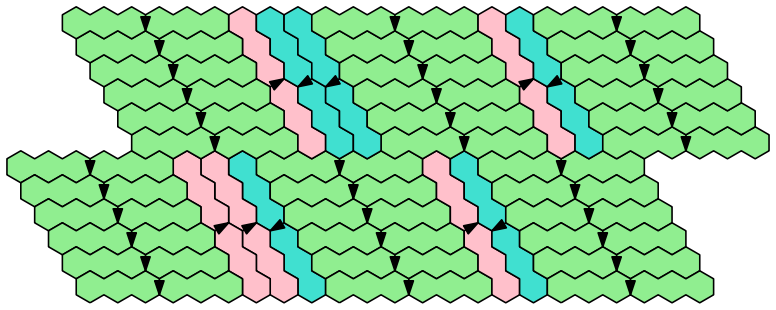
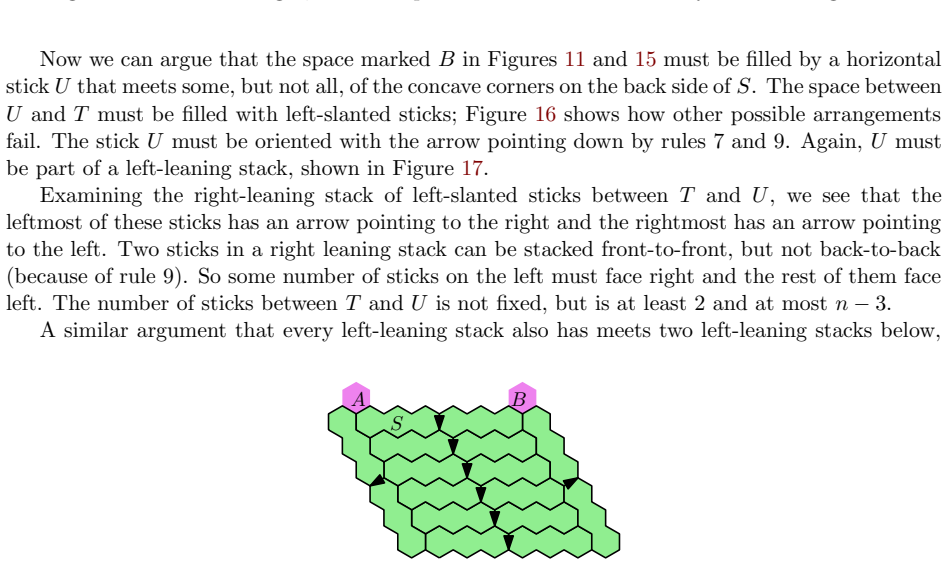
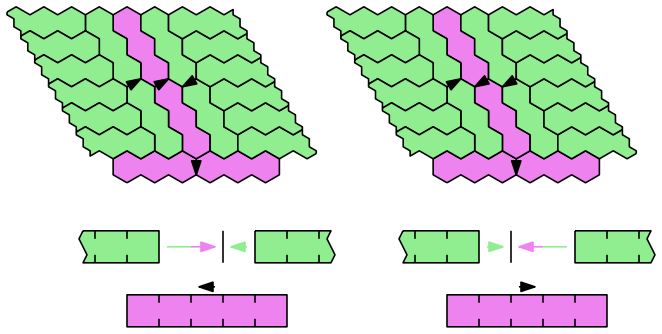
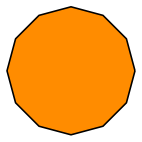
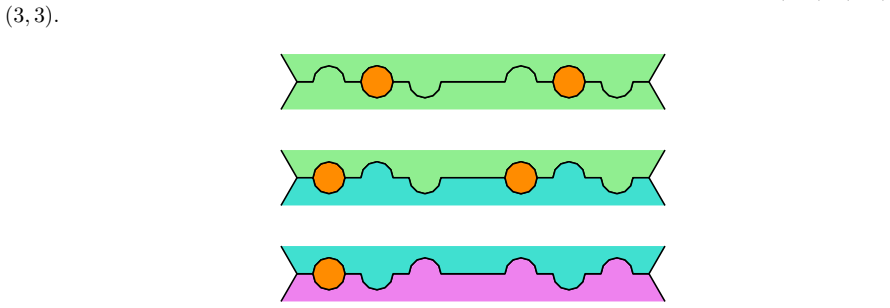
The central object is a stick prototile made of n hexagons, realizable as a polyhex, together with a list of forbidden edge pairings that force any tiling into a weave pattern: a diagonal grid of horizontal and slanted stacks of sticks. The argument's movable mechanism is the tiling schematic, in which each horizontal stack becomes a block, gaps between blocks carry left and right values, and the matching rules become arrow and triangle markings on block edges. The gap conditions, constraints on states, left and right values, and how they change across rows, make the schematic programmable: they simulate the AB tiling dynamics in the same way that rules on Wang tiles simulate a computation. The second key object is the staple tile, a small regular 12-gon; bumps and dents cut into the stick edges ensure that legal edge pairings leave holes the staple fills, while illegal pairings overlap bumps, converting matching rules into pure geometry.
What would settle it
For a small Wang tile set, implement the reduction and check a finite patch: enumerate all gap-condition assignments on a finite diagonal lattice and test whether each can be aligned into a schematic; a single assignment that satisfies Lemmas 7-9 but cannot be realized geometrically would refute the completeness direction and force a repair of the reduction that the two-tile theorem depends on.
Extended reading notes
Core claim
The central claim is Theorem 1: there is no algorithm that, given two polygonal prototiles, decides whether rotated and translated copies of them tile the plane. The theorem is proved through Theorem 2, which says the same problem is undecidable for a single prototile when edge-to-edge matching rules forbid certain edge pairs. The reduction chain is: Wang tiling reduces to AB tiling, a parity-constrained tiling by two families of 1x2 rectangles; AB tiling reduces to tilings by a stick of n hexagons that local matching rules force into a weave pattern; and a weave pattern is compressed into a schematic whose rows of blocks and gaps satisfy explicit gap conditions. The two-tile theorem follows by modifying the stick's edges with bumps and dents and adding a small staple tile so that every legitimate edge match leaves spaces exactly fillable by the staple, while forbidden matches create overlapping bumps. The author also notes the construction yields undecidability of translational 4-tiling and sketches how the same ideas give undecidability with three polyomino prototiles.
Load-bearing premise
The proof depends on an unproved converse in Section 2.5: that every assignment of states and values to the diagonal lattice of gaps satisfying the gap conditions actually gives a valid schematic and hence a real tiling; if that converse fails, the reduction from AB tilings to stick tilings is incomplete.
Editorial extensions
If this is right
- Two polygonal prototiles are sufficient to make the plane-tiling decision problem undecidable, lowering the known tile count from three to two.
- A single prototile with edge-to-edge matching rules has an undecidable tiling problem, so local matching constraints alone do not restore decidability to monotiling.
- The construction uses four total tile orientations, so translational 4-tiling is undecidable; since translational monotiling is decidable, only the two- and three-tile translation cases remain open.
- The same technique is sketched to give undecidability with three polyomino prototiles, improving the previous five-polyomino bound.
- The reduction is robust to whether reflections are allowed, because the stick can be modified so reflected copies can never sit next to each other.
Reading between the lines
- Editorial: the weave-pattern scaffolding treats the plane as a programmable lattice, so the same gap-condition machinery may transfer to other decision problems where a few geometric objects must simulate a computation, not just tiling.
- Editorial: making the Section 2.5 converse fully explicit would turn the proof into a constructive compiler from Wang tile sets to concrete polygon coordinates, making the undecidability reduction directly testable on finite patches.
- Editorial: if the three-polyomino sketch can be completed rigorously, the only remaining gap between decidable and undecidable polyomino tilability would be two polyominoes, close to the one-tile case that is still open.
Editorial analysis
A structured set of objections, weighed in public.
Referee Report
Summary. The paper claims that the following problem is undecidable: given two polygonal prototiles, determine whether the plane can be tiled with rotated and translated copies of them. This would improve the recent three-tile undecidability result of Demaine and Langerman. The proof proceeds by first proving a stronger intermediate statement: with edge-to-edge matching rules, a single prototile has an undecidable tiling problem. The construction reduces from Wang tiling via AB tiling, encodes AB tilings as "weave patterns" of stick-shaped polyhexes, abstracts these tilings into row schematics with states and values governed by local "gap conditions," and then uses a small staple tile to simulate the edge-to-edge matching rules geometrically. The paper also states consequences for translational tiling and sketches a three-polyomino analogue.
Significance. If the proofs are completed as claimed, Theorem 1 is a genuine quantitative improvement (from three to two polygonal prototiles) for a long-studied undecidability question in tiling theory, and Theorem 2 is the first undecidability result for monotiling under purely local edge-to-edge matching constraints. The reduction is self-contained: it is anchored in the independent undecidability of AB tiling, it defines all constants explicitly (such as d=12k and v=(2t+1)d), and it addresses both directions of the main biconditional. The schematic/gap-condition framework is a useful abstraction that could be reused. However, one load-bearing converse direction is currently asserted without proof, so the central result is not yet fully established.
major comments (2)
- [2.5] The claim at the end of Section 2.5 that "any assignment of the states, left values, and right values to a diagonal lattice of gaps that satisfies the gap conditions corresponds to a valid schematic (and so to a valid tiling)" is asserted without proof; the text defers the verification with "These calculations are essentially no different from the ones in the proofs of Lemmas 6 to 9, so we will not include them here." This is a load-bearing step, not a cosmetic omission: the AB-tiling-to-stick-tiling direction of Theorem 15 (Section 2.9) constructs only states and values via Lemmas 11 and 13 and then invokes this converse to obtain a geometric tiling. The gap conditions constrain the algebraic quantities locally, but they do not, as written, establish that row offsets can be chosen consistently around cycles, that adjacent rows overlap by at least one unit, or that every gap end lands on the prescribed triangle and arrow marks. Please supply the missing proof, for example by an inductive construction of the row offsets and a verification that the overlap and marking requirements follow from the value-difference constraints in Lemma 9.
- [2.1] The proof of Lemma 4 contains an unexpanded key step: after showing that every left-leaning stack has two stacks above and two below, it states "It remains to check that the left-leaning stacks forms a grid. Specifically... But this is straightforward." This commutation property is part of the definition of a weave pattern and is what justifies the passage to the row-schematic representation used in Section 2.3 and throughout the reduction. Since the second direction of Theorem 15 starts from an arbitrary valid tiling and extracts a schematic, the grid property must be verified explicitly rather than deferred as straightforward. Please either provide the local case analysis or state and prove the missing lemma.
minor comments (5)
- [2.5] There are several typos and grammatical slips that should be corrected: "Any of assignment" (Section 2.5), "vise versa" (Section 2.3), "undecideable" (Theorem 15), and "polyonimo" (Section 4).
- [2.9] In the proof of Theorem 15, the sentence "the B tile with lower-left corner is the one represented by gap (e1 - sr, 2c + 1)" is missing the coordinates of the lower-left corner; it should specify (2c+1, 2r+1) or the equivalent.
- [3] Lemma 16 is stated without proof; a short argument that a regular 12-gon cannot tile the plane on its own would make the staple construction self-contained.
- [2.1] The proof of Lemma 4 relies heavily on visual case analysis in Figures 6-18; a text enumeration of the forbidden local configurations would help verification and would avoid the need to infer cases from the figures.
- [4] The three-polyomino undecidability result is presented only as a sketch; the text should state explicitly which parts are complete and which remain to be supplied.
Circularity Check
No circularity: the reduction chain runs from Wang/AB tiling through an explicit geometric encoding; the §2.5 converse is an omitted proof, not a circular step.
full rationale
The paper's derivation chain is not circular. Theorem 2 reduces monotiling with edge-to-edge matching rules to AB tiling, which is reduced in Lemma 5 from the standard undecidable Wang tiling problem via an explicit S-tetromino encoding. The stick-tile construction is self-contained: the weave pattern is enforced by explicit forbidden edge pairings (rules 1-11, Lemma 4), and the schematic representation is built from explicit geometric objects (blocks, gaps, buckets, triangle and arrow marks) with stated positions. Lemmas 6-9 derive the gap conditions from the geometry rather than assuming the target result; Lemmas 10-14 and Theorem 15 then translate between AB tilings and schematics by explicit value assignments. No parameter is fitted to data and no equation is definitionally equal to its input: the constants d = 12k, v = (2t+1)d, and s = 16+8(t-1) are instance-dependent construction choices, not fitted quantities. The staple-tile simulation in Section 3 is likewise geometric, using angle sums to argue that modified sticks and staples simulate matching rules, with the forbidden-pair bump/dent construction making the iff argument concrete rather than presupposed. The weakest passage is Section 2.5, where the converse of the gap conditions is asserted: 'any of assignment of the states, left values, and right values to a diagonal lattice of gaps that satisfies the gap conditions corresponds to a valid schematic (and so to a valid tiling)', with the justification deferred to 'calculations essentially no different from the ones in the proofs of Lemmas 6 to 9'. This is a genuine completeness gap in the AB-to-schematic direction, and it should be flagged as a proof omission, but it is not circularity: the converse is not used as an input to the construction, it is not a renamed version of an assumption, and it does not make the undecidability claim reduce to itself. The paper also cites Demaine and Langerman for the prior three-tile result and for the staple-tile idea, and cites Berger, Ollinger, and Yang-Zhang for baseline undecidability results; these citations are external support, not self-citations, and none is load-bearing in place of the paper's own construction. Overall, the central claim has independent content and the reduction is self-contained against an established undecidable problem; the appropriate score is 0.
Assumptions & free parameters
free parameters (6)
- d = 12k =
12k, where k is the number of AB/Wang colors
- v = (2t+1)d =
(2t+1)*12k
- s = 16 + 8(t-1) =
16 + 8(t-1), where t = |A| = |B|
- bucket length l_b = (2v-1)(s-1) + 2v =
instance-dependent
- encoding state indices e1=1, e1.5=5, e2=9, e3=9+4(t-1), e4=17+4(t-1) =
as listed
- gadget interval families for I_i and L_i =
[−d+1,1], [−1,d−1], [0,6k], and the shifted L sets in Section 2.7
assumptions (4)
- standard math The Wang tiling problem is undecidable (Berger 1966).
- standard math In any tiling of the plane, the angles of tiles meeting at a point sum to 2π.
- standard math A regular 12-gon cannot tile the plane by itself (Lemma 16).
- domain assumption Edge-to-edge matching rules are well defined for partial edge contacts in the weave pattern.
invented entities (3)
-
Stick prototile (chain of n hexagons with labeled edges)
independent evidence
-
Staple prototile (regular 12-gon with diameter smaller than 1/(8n+4) of an edge length)
independent evidence
-
AB tiling framework (1x2 rectangles with parity placement and edge colors)
independent evidence
Cite this review
Pith. "Pith review of Two Tiling is Undecidable." pith.science (2026). https://pith.science/paper/XO7KGZQG
@misc{pith2026250611628,
  author       = {Pith},
  title        = {Pith review of: Two Tiling is Undecidable},
  year         = {2026},
  howpublished = {\url{https://pith.science/paper/XO7KGZQG}},
  note         = {Machine review of arXiv:2506.11628}
}
read the original abstract
We show that the following problem is undecidable: given two polygonal prototiles, determine whether the plane can be tiled with rotated and translated copies of them. This improves a result of Demaine and Langerman [SoCG 2025], who showed undecidability for three tiles. Along the way, we show that tiling with one prototile is undecidable if there can be edge-to-edge matching rules. This is the first result to show undecidability for monotiling with only local matching constraints.
Figures


Figures from the paper (45 more)










Forward citations
Cited by 1 Pith paper
-
Undecidability of Translational Tiling with 2 Polycubes
The translational tiling problem for Z^3 is undecidable even for a set of two connected polycubes.
Reference graph
Works this paper leans on
-
[1]
The undecidability of the domino problem
Robert Berger. The undecidability of the domino problem. Mem. Amer. Math. Soc. , 66:72, 1966
work page 1966
-
[2]
Tiling with three polygons is undecidable
Erik Demaine and Stefan Langerman. Tiling with three polygons is undecidable. In 41st International Symposium on Computational Geometry (SoCG 2025) , Leibniz International Proceedings in Informatics (LIPIcs), Dagstuhl, Germany, 2025. Schloss Dagstuhl – Leibniz- Zentrum f¨ ur Informatik. To appear. URL:https://arxiv.org/abs/2409.11582. 36
arXiv 2025
-
[3]
D. Girault-Beauquier and M. Nivat. Tiling the plane with one tile. In Proceedings of the Sixth Annual Symposium on Computational Geometry , SCG ’90, page 128–138, New York, NY, USA, 1990. Association for Computing Machinery. doi:10.1145/98524.98553
arXiv 1990
-
[4]
Solomon W. Golomb. Tiling with sets of polyominoes. Journal of Combinatorial The- ory, 9(1):60–71, 1970. URL: https://www.sciencedirect.com/science/article/pii/ S0021980070800552, doi:10.1016/S0021-9800(70)80055-2
-
[5]
Chaim Goodman-Strauss. Open questions in tiling. 01 2000. URL: https://strauss.hosted. uark.edu/papers/survey.pdf
work page 2000
-
[6]
On the undecidability of the tiling problem
Jarkko Kari. On the undecidability of the tiling problem. In Viliam Geffert, Juhani Karhum¨ aki, Alberto Bertoni, Bart Preneel, Pavol N´ avrat, and M´ aria Bielikov´ a, editors,SOFSEM 2008: Theory and Practice of Computer Science , pages 74–82, Berlin, Heidelberg, 2008. Springer Berlin Heidelberg
work page 2008
-
[7]
Two-by-two substitution systems and the undecidability of the domino prob- lem
Nicolas Ollinger. Two-by-two substitution systems and the undecidability of the domino prob- lem. In Arnold Beckmann, Costas Dimitracopoulos, and Benedikt L¨ owe, editors, Logic and Theory of Algorithms , pages 476–485, Berlin, Heidelberg, 2008. Springer Berlin Heidelberg
work page 2008
-
[8]
Tiling the plane with a fixed number of polyominoes
Nicolas Ollinger. Tiling the plane with a fixed number of polyominoes. In Adrian Horia Dediu, Armand Mihai Ionescu, and Carlos Mart ´ ın-Vide, editors,Language and Automata Theory and Applications, pages 638–647, Berlin, Heidelberg, 2009. Springer Berlin Heidelberg
work page 2009
Show all 12 references
-
[9]
Robinson
Raphael M. Robinson. Undecidability and nonperiodicity for tilings of the plane. Inventiones mathematicae, 12(3):177–209, 1971. doi:10.1007/BF01418780
1971 doi
-
[10]
Kaplan, and Chaim Goodman-Strauss
David Smith, Joseph Samuel Myers, Craig S. Kaplan, and Chaim Goodman-Strauss. An aperiodic monotile. Combinatorial Theory , 4(1), July 2024. URL: http://dx.doi.org/10. 5070/C64163843, doi:10.5070/c64163843
2024 doi
-
[11]
Kaplan, and Chaim Goodman-Strauss
David Smith, Joseph Samuel Myers, Craig S. Kaplan, and Chaim Goodman-Strauss. A chiral aperiodic monotile. Combinatorial Theory, 4(2), September 2024. URL: http://dx.doi.org/ 10.5070/C64264241, doi:10.5070/c64264241
2024 doi
-
[12]
Translational tiling with 8 polyominoes is undecidable
Chao Yang and Zhujun Zhang. Translational tiling with 8 polyominoes is undecidable. Dis- crete and Computational Geometry , November 2024. URL: http://dx.doi.org/10.1007/ s00454-024-00706-1 , doi:10.1007/s00454-024-00706-1 . 37
2024 doi
Reviewed August 7, 2026 · model on record in the stance chip above.
Discussion (0). Continue with ORCID to comment.