REVIEW 3 major objections 4 minor 3 references
Revisiting Taxicab Apollonius Circles
T0 review · 3 major / 4 minor · reviewed 2026-08-07 · deepseek-v4-flash
Pith's one-line read In taxicab geometry, a triangle has an Apollonius circle exactly when its excircle contact points form an inscribed triangle; the paper gives the slope conditions and corrects an earlier criterion.
desk verdict Clear, checkable correction of an earlier taxicab Apollonius circle result, but the main proof jumps from 'a circle through three excircle points' to 'tangent to the excircles' without proving that leap. read the letter →
The pith
A machine-rendered reading of the paper's core claim, the machinery that carries it, and where it could break.
The reading
What carries the argument
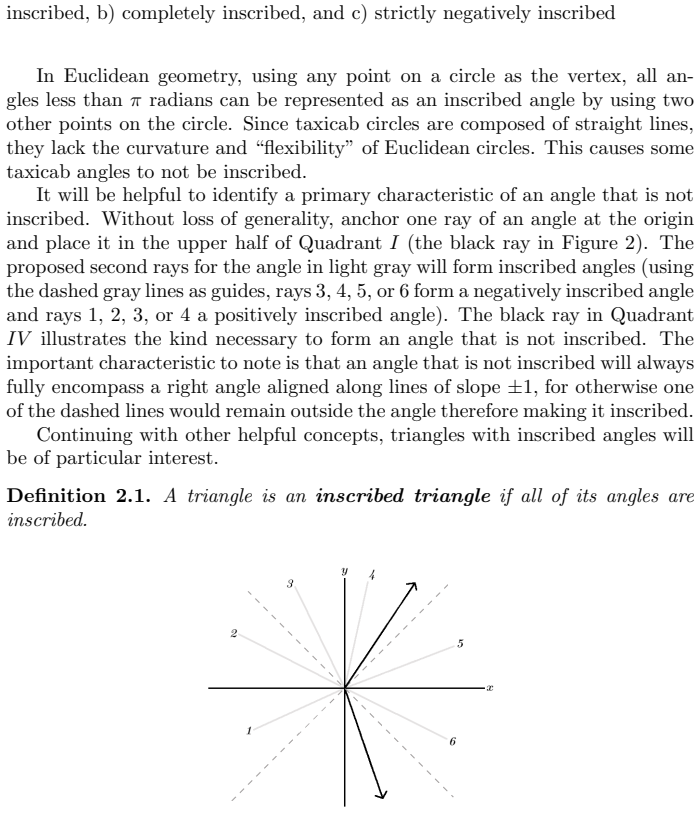
The object doing the work is the inscribed triangle, defined through taxicab angles: an angle is completely inscribed when it is fully contained in a taxicab circle at its vertex, and strictly positively or negatively inscribed when it straddles the circle's side of slope $-1$ or $+1$. The bridge is the Three-Point Circle Theorem, which says three non-collinear points lie on a taxicab circle if and only if the triangle they form is inscribed. The proof then reduces the Apollonius problem to slope bookkeeping: choose one point on each excircle, require the three points to form an inscribed triangle, and translate that geometric condition into the inequalities of Theorem 4.3 by comparing the third side's extension with the two diagonal lines of slope $\pm1$ that delimit taxicab circles.
What would settle it
Compute the three taxicab excircles of a triangle satisfying the first inequality in Theorem 4.3 with $m_c>1$ (for instance $m_a=3/4$, $m_b=1/5$, $m_c=5/2$), then construct the taxicab circle through one point chosen on each excircle in the way the proof prescribes. If that circle fails to be externally tangent to, or to tangentially encompass, any one of the three excircles, the central claim collapses. Conversely, a triangle that violates both inequalities and the two-completely-inscribed condition yet still admits a tangentially encompassing circle would also refute the classification.
Extended reading notes
Core claim
The paper's central claim is that the existence of a taxicab Apollonius circle is governed by the inscribed-triangle structure of the original triangle rather than by a single formula. Working in pure taxicab geometry with native taxicab angles, the paper shows that a side opposite a non-inscribed angle has no excircle, so any candidate triangle must be inscribed; it then splits inscribed triangles according to how many of their angles are completely inscribed. A minimally inscribed triangle (one completely inscribed angle) has a full set of excircles, and an Apollonius circle exists exactly when the third side's slope $m_c$ satisfies one of the two inequalities $\frac{m_b}{m_c}+2m_a-m_b-1\ge\frac{1}{m_c}$ or $1-m_a+2m_b-\frac{m_a}{m_c}\le\frac{1}{m_c}$ when $1<|m_c|<\infty$, or $2m_a-m_b\ge1$ when $AB$ is vertical. A triangle with exactly two completely inscribed angles has an Apollonius circle whenever its excircles exist, which forces its two non-diagonal sides to be one steep and one shallow. Along the way the paper corrects [1]: the earlier combined $\rho$ condition is overly restrictive, and the triangle with slopes $3/4$, $1/5$, and $3$ is a counterexample.
Load-bearing premise
The load-bearing premise is that when three points, one chosen on each excircle, form an inscribed triangle, the taxicab circle through them (guaranteed by the Three-Point Circle Theorem) is automatically tangent to all three excircles; this tangency is asserted by construction rather than proved, and it is the bridge from the three-point condition to an Apollonius circle.
Editorial extensions
If this is right
- Every triangle with exactly two completely inscribed angles and non-diagonal sides of opposing slopes (one steep, one shallow) has a taxicab Apollonius circle whenever its three excircles exist.
- For a minimally inscribed triangle with shallow slopes $0<m_a<1$ and $-1<m_b<m_a$, the third side's slope may range over two intervals, and which of the two inequalities holds corresponds to which side of the triangle the small excircle is visible from; requiring both inequalities, as [1] does, is wrong.
- A taxicab triangle with horizontal and vertical sides has an Apollonius circle precisely when the slope of the side opposite the right angle satisfies $\frac{1}{2}\le |m|<1$ or $1<|m|\le2$; slope $\pm1$ is excluded because it makes the third angle completely inscribed and destroys the full excircle set.
- Triangles with three completely inscribed angles never admit a complete set of excircles, so they cannot have a taxicab Apollonius circle.
- In taxicab geometry the Apollonius circle is usually tangent to an excircle along a segment, so the Euclidean Apollonius point does not exist; the paper notes that the lines from each vertex to its excircle's center nevertheless appear concurrent.
Reading between the lines
- Editorial extension: the two inequalities of Lemma 4.2 can be read as placing the smallest excircle either below one diagonal boundary or above the other, so the Apollonius question is really a visibility problem for that small excircle; a coordinate-free restatement in terms of convex position of the three excircles may be possible.
- Editorial extension: because the Three-Point Circle Theorem is the essential bridge, any other normed plane with an analogous three-point-circle theorem should admit the same inscribed-triangle reformulation of its Apollonius problem, though with different slope conditions.
- Editorial extension: the correction of [1] invites re-checking taxicab results that built on the old $\rho$ condition—for example optimum-location or covering problems where the Apollonius circle was assumed not to exist for negative $\rho$; numerical sampling of inscribed triangles with random slopes could verify the corrected inequalities quickly.
- Editorial extension: Figure 13's gray region identifies slope pairs $(m_a,m_b)$ for which every choice of $|m_c|>1$ yields an Apollonius circle; this is a stability statement that could be turned into a simple decision rule for applications.
Editorial analysis
A structured set of objections, weighed in public.
Referee Report
Summary. The paper studies taxicab excircles and Apollonius circles, using the author's earlier notions of inscribed angles and inscribed triangles. It separates the existence of taxicab excircles from the existence of a taxicab Apollonius circle, derives explicit slope inequalities for a class of minimally inscribed triangles and for triangles with exactly two completely inscribed angles, and presents these as Theorem 4.3, the Triangle Apollonius Circle Theorem. It also claims to identify an error in a 2018 result [1], giving a triangle with slopes 3/4, 1/5, and 3 as a counterexample.
Significance. If the main gap identified below can be repaired, the paper would offer a useful reformulation of the taxicab Apollonius-circle problem: the existence question is reduced to checking whether certain points on the excircles form an inscribed triangle, with explicit, parameter-free inequalities in terms of side slopes. The paper is also commendable for working in native taxicab geometry, for providing a concrete counterexample to a prior condition, and for presenting the conditions in a form that can be checked by direct substitution. These strengths are, however, contingent on the correctness of the tangency step, which is currently the weakest point of the proof.
major comments (3)
- [Section 4, paragraph beginning 'In order for ∠P1T3P2 to be inscribed ...'] The central inference from the Three-Point Circle Theorem to the existence of an Apollonius circle is not proved. Theorem 2.6 guarantees only that three non-collinear points forming an inscribed triangle lie on some taxicab circle; it says nothing about whether that circle is tangent to the three given excircles, let alone that it tangentially encompasses all three. The proof of Lemma 4.2 verifies conditions for the angle at T3 to be inscribed, hence for the existence of a taxicab circle through P1, T3, P2, but it never shows that this circle is tangent to the three excircles. Consequently, Lemma 4.2 and Theorem 4.3 currently establish only the existence of a circle through one selected point on each excircle, not an Apollonius circle. The author should either prove that the circle produced by Theorem 2.6 is tangent to each excircle, or show that the three-point circle is unique and argue tangency by a separate, explicit check for each case in Lemma 4.2.
- [Lemmas 3.2, 3.3, 3.4] The proofs of the excircle-existence lemmas are qualitative and rely on figures: phrases such as 'can be expanded to be tangent', 'will always be able to be tangent', and 'proven similarly' are used without coordinate verifications. Since these lemmas are prerequisites for Theorem 4.3, the author should give the same kind of explicit slope-based proof used elsewhere in the paper, or at least provide a fully specified construction for each orientation case. The current level of rigor is not commensurate with the algebraic precision of Lemma 4.2.
- [Lemma 4.2, case 2 (AB vertical)] The vertical-side condition 2ma - mb ≥ 1 is derived by 'letting mc → ±∞' in the non-vertical inequalities. This limiting argument is not a proof: the derivation of the inequalities uses division by expressions involving mc and assumes finite mc; the vertical case may have different sign and exclusion conditions. The vertical case should be derived directly, as was done for the non-vertical cases, before it appears as part of Theorem 4.3(1b).
minor comments (4)
- [Abstract] The abstract contains line-break artifacts in the rendered text ('tri angle', 't riangles'); these should be fixed in the final manuscript.
- [Lemma 3.3, Case 2] There is a typo in the inequality '|mb| > 1|'; it should read '|mb| > 1'.
- [After Lemma 4.1] The statement that this result agrees with Corollary 2.1 of [1] would be easier to verify if the corollary were stated explicitly; as written, the comparison requires the reader to consult the earlier paper.
- [Section 4.1] The claim that 'the concept of an Apollonius point does not exist in taxicab geometry' is asserted without proof. Since taxicab circles can be tangent along line segments, a short explanation of why the three tangency sets cannot be reduced to isolated points would be helpful.
Circularity Check
No significant circularity: Apollonius conditions are derived from explicit coordinate inequalities; the cited Three-Point Circle Theorem is independent prior support, not a restatement of the target result.
full rationale
The derivation chain does not reduce to its own inputs. Excircle existence (Lemmas 3.1-3.4) is established by geometric slope arguments about inscribed angles, independent of the Apollonius-circle conclusion. Lemma 4.1 derives a slope range for the right-triangle case by explicit coordinate constraints on the point D. Lemma 4.2 obtains the two inequalities by substituting coordinates of the excircle vertices T1-T4 into linear-boundary conditions (green dashed line for T3, red dashed line for T2); these are explicit algebra, not fitted parameters. Theorem 4.3 then assembles the cases. No parameter is fitted to a subset of the data and later called a prediction, and no object is defined in terms of the quantity it is supposed to predict. The main external dependency is Theorem 2.6, the Three-Point Circle Theorem, from the author's prior paper [3]. This is a self-citation, but it is not circular: it is an independent characterization of when three non-collinear points lie on a taxicab circle, and it does not state or presuppose the Apollonius-circle conditions under investigation. The paper's comparison with and correction of [1] is an external benchmark, not a self-confirming loop. One legitimate concern is that the proof bridges from a taxicab circle through one selected point on each excircle to an Apollonius circle without explicitly verifying tangency to all three excircles; that is an omitted proof or correctness gap, not a circularity, because the claimed equivalence is not asserted by definition. The paper is therefore free of construction-level circularity.
Assumptions & free parameters
assumptions (3)
- domain assumption Taxicab geometry is R^2 with the L1 metric; circles are diamonds bounded by lines of slope +/-1.
- domain assumption Three-Point Circle Theorem (Thompson 2011): three non-collinear points lie on a taxicab circle iff the triangle they form is inscribed.
- domain assumption Excircle definition (Definition 3.1): a circle outside the triangle tangent to a side and to the extensions of the opposite angle's rays.
Cite this review
Pith. "Pith review of Revisiting Taxicab Apollonius Circles." pith.science (2026). https://pith.science/paper/RLHIODBA
@misc{pith2026250612058,
  author       = {Pith},
  title        = {Pith review of: Revisiting Taxicab Apollonius Circles},
  year         = {2026},
  howpublished = {\url{https://pith.science/paper/RLHIODBA}},
  note         = {Machine review of arXiv:2506.12058}
}
read the original abstract
The existence of excircles and an Apollonius circle for a triangle in taxicab geometry are connected to the concept of inscribed triangles.
Figures


Figures from the paper (11 more)


Reference graph
Works this paper leans on
-
[1]
Journal of Mahani Mathematical Research Center
Ermis, Temel, Gelisgen, Ozcan, Ekici, Aybuke: A Taxicab Version of a Tri- angle’s Apollonius Circle. Journal of Mahani Mathematical Research Center. 7 (1), 25-36 (2018)
work page 2018
-
[2]
Thompson, Kevin Dray, Tevian: Taxicab Angles and Trigonometry . The Pi Mu Epsilon Journal. 11 (2), 87-96 (2000)
work page 2000
-
[3]
Thompson, Kevin P.: Taxicab Triangle Incircles and Circumcircles . The Pi Mu Epsilon Journal. 13 (5), 299-305 (2011). 15 Figure 14: Lines connecting the excenters of a triangle to their cor responding vertices are concurrent 16
work page 2011
Reviewed August 7, 2026 · model on record in the stance chip above.
Discussion (0). Sign in to comment.