REVIEW 4 major objections 6 minor 9 references
Tropical Ptolemy Transformations and Invariants of Braids
T0 review · 4 major / 6 minor · reviewed 2026-08-07 · deepseek-v4-flash
Pith's one-line read Tropical label flips on triangulations are claimed to give braid invariants.
desk verdict Tropical Ptolemy idea is original but the paper's central definition is internally inconsistent and the pentagon identity is asserted, not proved, so Theorem 1 is unsupported. read the letter →
The pith
A machine-rendered reading of the paper's core claim, the machinery that carries it, and where it could break.
The reading
What carries the argument
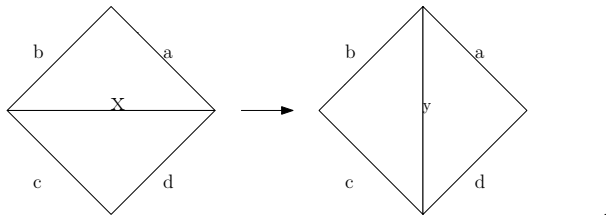
The central object is the tropical Ptolemy label flip $F(x) = \max(a+c, b+d) - x$, acting on the label $x$ of a diagonal in a quadrilateral with boundary labels $a,b,c,d$; all other edge labels are unchanged. The paper needs this transformation to be an involution, to commute for disjoint quadrilaterals, and to satisfy the pentagon relation, so that the sequence of label updates induced by a braid is unchanged under the standard relations that appear when a braid isotopy passes through a degeneracy. These identities are what turn a single flip sequence into a well-defined assignment on isotopy classes.
What would settle it
Take a pentagon with explicit integer labels, compute the five label updates from equations (2)-(6) in Section 3.1, and compare the final labeling with the initial one; any mismatch disproves the tropical pentagon relation and thereby the claimed braid invariant.
Extended reading notes
Core claim
Theorem 1 states that for $n \ge 5$, the map $f_n$ from the spherical braid group to $X^{N}$, where $N = 3n-6$ is the number of edges of the triangulation, is a braid invariant up to flip equivalence: isotopic braids $\beta$ and $\beta'$ satisfy $f_n(\beta) = f_n(\beta')$. The argument has two parts: Proposition 1 says that isotopic braids give flip sequences that differ only by involution, far-commutativity, and the pentagon move on triangulations, and Section 3.1 claims that the tropical label flips are compatible with all three moves. The identity carrying the claim is the tropical pentagon relation $f_4 \circ f_3 \circ f_2 \circ f_1 \circ f_0(A_0) = A_0$, which is asserted but not verified in the paper.
Load-bearing premise
The load-bearing premise is that the five tropical label flips around a pentagon compose to the identity on every labeling; the paper asserts this without proof, and the invariant collapses if any labeling fails to return.
Editorial extensions
If this is right
- Every braid on $n \ge 5$ strands in the sphere acquires a well-defined vector of $3n-6$ tropical labels once an initial labeling is fixed.
- The invariant can distinguish braids in principle: if two braids produce different final labelings, they cannot be isotopic.
- The construction transfers a pure-braid invariant based on matrix pentagon equations to the full spherical braid group by replacing matrices with tropical label flips.
- The invariant is computable in principle by simulating a generic path of the braid and applying the tropical flip rule at each critical time.
Reading between the lines
- A direct, case-by-case proof that the five label flips return every initial labeling would be a natural companion result; it would also make the invariant easier to verify in computations.
- The same tropical flip machinery may produce invariants for braid groups on surfaces other than the sphere, or for cluster-algebra dynamics where Ptolemy-type transformations are defined.
- A simple test of the construction is the trivial braid: the final labeling should equal the initial one, and for small braids one can compute the invariant explicitly for various word representatives to see whether it is stable.
Editorial analysis
A structured set of objections, weighed in public.
Referee Report
Summary. The paper proposes an invariant of spherical braids obtained by assigning tropical (max,+) labels to edges of Delaunay triangulations of S^2 and updating those labels by a tropical Ptolemy flip rule whenever the triangulation changes by a diagonal flip. Section 2 recalls Delaunay triangulations, flips, and the pentagon and far-commutativity relations for triangulations. Section 3 defines a tropical flip on edge labels and claims that it is consistent with involution, far-commutativity, and the pentagon relation. Section 4 associates to a generic braid a sequence of Delaunay triangulations and flips. Section 5 defines fn(β) as the final labeling and states Theorem 1, asserting that isotopic braids yield the same final labeling in X^N. The proof of Theorem 1 depends on the label-level consistency checks of Section 3.1, especially the unproved pentagon identity.
Significance. If made rigorous, the construction would give a new parameter-free family of braid invariants arising from tropical geometry, extending the pure-braid invariant of [7] to the full spherical braid group and exhibiting a concrete topological use of the tropical Ptolemy relation. The involution and far-commutativity checks in §3.1 are correct for the operative rule x' = max(a+c,b+d) - x, and the strategy of deriving braid invariants from flip-sequence consistency is natural. However, the significance is conditional: the definition of the label flip is internally inconsistent as written, and the pentagon identity—the load-bearing algebraic input—is asserted rather than proved. Until those gaps are repaired, the main theorem is not established.
major comments (4)
- [§3, Definition 6 and §3.1] Definition 6 and §3.1 use two incompatible definitions of the label flip. Definition 6 says the new label y satisfies Eq. (1), i.e. max(x,y)=max(a,c)+max(b,d), whereas the formula actually used throughout §3.1 is x' = max(a+c,b+d) - x, which is equivalent to x + x' = max(a+c,b+d). These are not the same equation: for a=b=c=d=0 and x=1, Eq. (1) would require max(1,y)=0, which has no solution, while the operative formula gives x'=-1. Thus the map F whose involution, far-commutativity, and pentagon properties are analyzed is not the map defined by Definition 6. The correct tropicalization of xy=ac+bd is x+y=max(a+c,b+d), and Eq. (1) should be replaced accordingly.
- [§3.1, pentagon bullet] The pentagon identity is asserted, not verified. The bullet introduces variables x,y,z,t,u,v,w without specifying the initial pentagon labeling or the order of the five flips, writes equations (2)–(6) without derivation, and then states "The tropical pentagon relation asserts: f4∘f3∘f2∘f1∘f0(A0)=A0". No composition, substitution, or verification is given. This is load-bearing: the proof of Theorem 1 explicitly relies on the claim that label flips are consistent with the pentagon relation. Until the identity is verified from the flip formula, or a counterexample is given, the well-definedness of fn(β) is unsupported.
- [§4, Proposition 1] The proof of Proposition 1 does not establish that isotopic braids give flip sequences related only by the listed moves at the level of label transformations. The proof asserts that each codimension-two degeneracy "gives rise to" one of the three relations and that nearby sequences agree, but no argument is supplied for why the tropical label updates along the two related sequences produce the same final labeling. In particular, the pentagon case reduces precisely to the unproved label identity of §3.1. The proof of Theorem 1 therefore rests on the two gaps above: the coherent definition of the label flip and the verification of the pentagon identity.
- [§5, Definition 10 and Theorem 1] The statement of the invariant is ambiguous about the role of the initial labeling. The construction fixes a labeling A1 of T1 and an edge ordering of T1, but Definition 10 and Theorem 1 write fn: SP Bn → X^N without carrying this parameter or specifying an equivalence relation on labelings. The theorem says "up to flip equivalence" while also asserting equality in X^N. The paper should either define the invariant as depending on A1 and state the resulting family of invariants, or define the equivalence relation on X^N that makes the equality statement precise.
minor comments (6)
- [§3.1] Equation numbers (2)–(6) are reused several times within §3.1 (in the involution, far-commutativity, and pentagon bullets), making cross-references ambiguous.
- [§2, Definition 2] The general position condition for k=1 refers to a great (−1)-dimensional subsphere, which is undefined; for S^2 it would be cleaner to state directly that no three points lie on a great circle and no four points lie on a circle.
- [§5, Theorem 1] The notation "SP Bn" is undefined; the paper otherwise uses Bn(S^2) for the spherical braid group.
- [References] Reference [8] lists the identifier "arXiv.3202.06379", which is not a valid arXiv number; this should be corrected.
- [Figure 6] Figure 6 is cited as evidence for the pentagon equation, but a caption alone does not constitute a proof; the text should contain the actual computation or a reference to a verifiable derivation.
- [§5, Definition 10] The codomain is written as "X × N"; since a labeling is an N-tuple of tropical values, this should be X^N.
Circularity Check
No circularity: the braid invariant is defined by a concrete flip evolution and checked against local consistency relations; the cited background is standard and no fitted parameter or self-citation is load-bearing.
full rationale
The derivation chain is not circular. The invariant fn(β) is the terminal labeling of a deterministic sequence of label flips induced by a braid; it is not obtained by fitting or by renaming an input. The proof requires two independent facts: (i) isotopic braids induce flip sequences related by involution, far-commutativity, and pentagon moves (Proposition 1, argued by the codimension-two degeneracy analysis), and (ii) the label flip F(x)=max(a+c,b+d)-x is consistent with those moves (Section 3.1). Involution and far-commutativity are verified algebraically; the pentagon identity is explicitly stated as 'The tropical pentagon relation asserts: f4∘f3∘f2∘f1∘f0(A0)=A0' with no derivation in the text. That omission is a correctness gap, not a circular reduction: the identity is a local algebraic property of the tropical Ptolemy transformation, independent of the braid-invariance claim, and its failure would invalidate Theorem 1 rather than tautologically prove it. Citations to [2], [4], [5], [6], and [9] supply standard background (Delaunay triangulations, braid groups, tropical geometry) and are not used to assume the conclusion. No parameter is fitted to the quantity being predicted, and no alternative is excluded by an author-imported uniqueness theorem. Hence no step of the paper reduces to its own input by construction; circularity score 0. Flagged as correctness issues, not circularity: Eq. (1) as written, x⊕y=(a⊕c)⊗(b⊕d), is inconsistent with the operative flip formula x'=max(a+c,b+d)-x, which is the correct tropicalization x⊗y=(a⊗c)⊕(b⊗d); and the pentagon identity for labels is asserted rather than proven.
Assumptions & free parameters
free parameters (2)
- Initial edge labeling A1 in X^N =
arbitrary (unspecified)
- Tropical semifield convention (plus = max) =
max-plus (max, +)
assumptions (4)
- domain assumption A generic n-point configuration on S^2 has a Delaunay triangulation that changes only by flips at cocircularity events; E = 3n - 6 and F = 2n - 4.
- domain assumption Isotopic braids induce flip sequences that differ only by involution, far-commutativity, and pentagon moves (Proposition 1).
- ad hoc to paper The tropical Ptolemy label flips satisfy the pentagon identity f4∘f3∘f2∘f1∘f0 = id on labels.
- ad hoc to paper The operative flip rule is x' = max(a+c,b+d) - x, not the relation max(x,y) = max(a,c) + max(b,d) written as Eq (1).
Cite this review
Pith. "Pith review of Tropical Ptolemy Transformations and Invariants of Braids." pith.science (2026). https://pith.science/paper/5K3VOY5H
@misc{pith2026250612085,
  author       = {Pith},
  title        = {Pith review of: Tropical Ptolemy Transformations and Invariants of Braids},
  year         = {2026},
  howpublished = {\url{https://pith.science/paper/5K3VOY5H}},
  note         = {Machine review of arXiv:2506.12085}
}
read the original abstract
It often happens in mathematics that one and the same equation is known under different names in different areas of mathematics. The famous pentagon identity appears in low-dimensional topology in different ways. In this paper, we use the tropical version of the Ptolemy equation to construct invariants of braids.
Figures


Figures from the paper (3 more)


Reference graph
Works this paper leans on
-
[7]
Illia E. Rohozhkin, Pentagon equations, Delaunay triangulations and pure braid group invariant, Journal of Knot Theory and Its Ramifications, vol. 34, no. 3, article 2540007, 2025. World Scientific Publishing Co., ISSN: 0218-2165. https://doi.org/10.1142/S0218216525400073
-
[1]
Manturov,Knot Theory, Chapman & Hall/CRC Press, Boca Raton, FL, 2004
Vassily O. Manturov,Knot Theory, Chapman & Hall/CRC Press, Boca Raton, FL, 2004. ISBN: 978-0-415- 31001-6. DOI: 10.1201/9780203402849
-
[2]
Vassily O. Manturov, Denis A. Fedoseev, Seongjeong Kim, and Igor M. Nikonov,Invariants and Pictures: Low- Dimensional Topology and Combinatorial Group Theory, World Scientific Publishing Company, 2020. ISBN: 978-9811220111. DOI: 10.1142/11821
-
[3]
F. Aurenhammer, R. Klein, D.-T. Lee,Voronoi Diagrams and Delaunay Triangulations, World Scientific Pub- lishing Company, Nov. 15, 2012. ISBN: 978-9814447638. DOI: 10.1142/8685
-
[4]
Seongjeong Kim and Vassily O. Manturov,Artin’s braids, braids for three space, and groupsΓ4 n and Gk n, Journal of Knot Theory and Its Ramifications, 28(3):1950063, 2019. https://doi.org/10.1142/S0218216519500639
-
[5]
Vassily O. Manturov and Igor M. Nikonov,The groups Γ4 n, braids, and 3-manifolds, arXiv:2305.06316, 10 May 2023
arXiv 2023
-
[6]
D.A. Fedoseev, V.O. Manturov, and I.M. Nikonov,Manifolds of Triangulations, Braid Groups of Manifolds, and the Groups Γk n, in Numerical Geometry, Grid Generation and Scientific Computing, Lecture Notes in Computational Science and Engineering, vol. 143, V.A. Garanzha, L. Kamenski, and H. Si, Eds., Springer, Cham, 2021, pp. 13–36. https://doi.org/10.1007/...
-
[8]
Felikson,Ptolemy Relation and Friends, arXiv.3202.06379, 2 April 2023
A. Felikson,Ptolemy Relation and Friends, arXiv.3202.06379, 2 April 2023
Show all 9 references
-
[9]
161, American Mathematical Society, Providence, RI, 2015
Diane Maclagan and Bernd Sturmfels,Introduction to Tropical Geometry, Graduate Studies in Mathematics, vol. 161, American Mathematical Society, Providence, RI, 2015. ISBN-13: 978-0-8218-5198-2 (print), 978-1- 4704-2221-9 (online). https://bookstore.ams.org/gsm-161 10
2015
Reviewed August 7, 2026 · model on record in the stance chip above.
Discussion (0). Sign in to comment.