REVIEW 6 major objections 5 minor 40 references
DoublyAware: Dual Planning and Policy Awareness for Temporal Difference Learning in Humanoid Locomotion
T0 review · 6 major / 5 minor · reviewed 2026-08-07 · deepseek-v4-flash
Pith's one-line read DoublyAware speeds humanoid locomotion learning by splitting uncertainty into planning and policy parts.
desk verdict Solid empirical direction undermined by an invalid conformal coverage claim; needs substantial correction before acceptance. read the letter →
The pith
A machine-rendered reading of the paper's core claim, the machinery that carries it, and where it could break.
The reading
What carries the argument
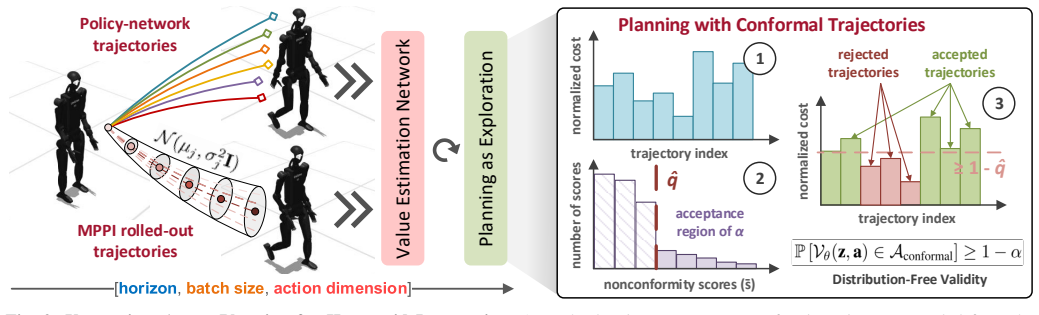
The central machinery is a two-part uncertainty treatment. First, a conformal quantile filter: at each planning step, candidate trajectories from the policy network and the MPPI sampler are scored by their normalized TD value estimate, a quantile threshold (Eq. 6) is computed from the union's nonconformity scores, and only trajectories within the $(1-\alpha)$ prediction set are used to update the sampling distribution. Second, the Group-Relative Policy Constraint (GRPC): a softmax-weighted group advantage (Eq. 9) replaces absolute advantage estimates in the policy objective, and a KL divergence penalty to the MPPI-derived behavior prior (Eq. 13) enforces an adaptive trust region. Together they are meant to keep planning robust to aleatoric noise and learning stable under epistemic uncertainty.
What would settle it
Run the planner on a fixed hard task, record the empirical coverage of the conformal set (the fraction of retained high-return trajectories) as the value function is updated; if during early training the coverage falls below $1-\alpha$ for a sustained period, or if artificially freezing the value function changes the success rate significantly, the weak-teacher or exchangeability assumption is violated.
Extended reading notes
Core claim
DoublyAware is an uncertainty-aware extension of TD-MPC that explicitly decomposes overall uncertainty into planning uncertainty (aleatoric, from stochastic dynamics and sampling-based optimization) and policy uncertainty (epistemic, from incomplete policy knowledge). For planning, it builds a conformal prediction set over the union of policy-rollout and MPPI candidate trajectories, computes nonconformity scores from the TD value estimate, and retains only trajectories below a quantile threshold, which guarantees marginal coverage under exchangeability and asymptotic weak validity under a sub-linear teaching schedule. For learning, it replaces standard advantage normalization with a group-relative softmax advantage (GRPO-style) and adds a KL trust-region penalty to the policy prior, reducing gradient variance and keeping updates close to the behavior policy. Evaluated on HumanoidBench with the Unitree 26-DoF H1-2, DoublyAware achieves faster convergence and better motion feasibility than the compared RL baselines on standing, walking, running, sitting, pole navigation, hurdling, and slide-walking tasks, while remaining unsolved on crawling and stair-climbing.
Load-bearing premise
The load-bearing premise is that the policy rollouts and MPPI samples are statistically interchangeable, and that the learning value function can serve as a weak teacher whose teaching schedule satisfies the sub-linearity condition; without this, the conformal filter's coverage guarantee breaks.
Editorial extensions
If this is right
- If a model-based RL agent separates aleatoric planning noise from epistemic policy uncertainty, it can explore in a targeted way without sacrificing statistical guarantees.
- Conformal filtering can be applied to latent trajectory selection inside TD-MPC without modifying the underlying planner, giving distribution-free coverage even with an imperfect value function as long as a mild schedule condition holds.
- Replacing normalized advantages with softmax group advantages reduces policy-gradient variance, leading to more stable updates and faster convergence in high-dimensional continuous control.
- The method's success on six of nine HumanoidBench tasks suggests that structured uncertainty modeling is a practical lever for data-efficient humanoid locomotion.
Reading between the lines
- We infer that the same disjoint uncertainty decomposition could be applied to other MBRL planners (e.g., CEM or iCEM) beyond MPPI, since the conformal filter is model-agnostic; this is not tested in the paper.
- The weak-teacher schedule assumption suggests the benefit of conformal filtering should grow as the value function improves; a testable prediction is that early in training the filter is loose and becomes tighter as learning progresses, and coverage may degrade if the value function is updated too aggressively.
- The failure on crawling and stair-climbing may indicate that the current conformal score based on the TD value estimate is not sensitive to whole-body coordination constraints; replacing the score with a kinematic-feasibility-aware cost could extend the method.
- The KL trust region on the policy prior might be adapted with automatic coefficient tuning, since GRPC's beta is fixed; adaptive beta could improve performance on tasks that need more exploration.
Editorial analysis
A structured set of objections, weighed in public.
Referee Report
Summary. DoublyAware proposes an uncertainty-aware extension of TD-MPC for humanoid locomotion. It decomposes uncertainty into planning (aleatoric) and policy (epistemic) components. For planning, it uses conformal prediction to filter a union of policy rollouts and MPPI candidate trajectories based on normalized nonconformity scores from the TD value estimate (Eq. 4), claiming finite-sample marginal coverage (Eq. 5) and asymptotic weak validity (Eq. 8). For learning, it introduces GRPC, a group-relative policy constraint derived from GRPO with softmax advantage scores and a trust-region penalty. Experiments on nine HumanoidBench tasks with the H1-2 humanoid compare DoublyAware against SAC, BC-SAC, AWAC, TD-MPC2, and TD-M(PC)2, reporting faster convergence and qualitatively more feasible motion on six of nine tasks, with ablations isolating the CP and GRPC contributions.
Significance. If the theoretical claims were valid, the work would offer a principled way to handle aleatoric uncertainty in TD-MPC planning and to regularize policy learning, with a plausible empirical payoff on a relevant humanoid benchmark. The paper includes useful ablations and qualitative behavior comparisons, and it targets an important problem. However, as written, the conformal validity and asymptotic weak-validity results are not established: Eq. 5 is essentially a tautological statement about an empirical quantile of the same scores used for selection, the exchangeability assumption is violated by the online MPPI feedback, and Eq. 8 is asserted without proof or construction. The GRPC variance-reduction argument is also under-derived, and the trust-region objective is not specified precisely. The contribution therefore currently reduces to a heuristic extension with suggestive but statistically unquantified empirical evidence.
major comments (6)
- [Section III-B, Eqs. (4)-(7)] Equation (5) does not follow from split-conformal theory. The same nonconformity scores are used both to compute the quantile qhat in Eq. (6) and to define the selected set A_conformal in Eq. (7); there is no calibration/test split, and no independent future trajectory is scored against a quantile learned from separate data. The statement that Vtheta(z,a) belongs to A_conformal with probability at least 1-alpha is therefore not a finite-sample marginal coverage guarantee but a property of the empirical quantile of the very same scores. A valid conformal argument would require either a disjoint calibration set or a leave-one-out construction, neither of which appears in Alg. 1.
- [Section III-B and Alg. 1, lines 15-17] The exchangeability assumption underlying Eq. (5) is asserted rather than shown and is violated by the algorithm's own feedback. The set A_pi is sampled from the policy network and A_mppi from the MPPI sampling distribution; these are different samplers, so their scores need not be exchangeable even at a single planning step. More importantly, Alg. 1 updates the MPPI sampling distribution (mu_j, sigma_j) using A_conformal (lines 15-17), so the scores at the next planning step depend on the previously accepted set. This destroys the exchangeability between calibration scores and candidate scores that Eq. (5) requires. The paper needs either an explicit online-conformal argument that accounts for this feedback or a clear statement that Eq. (5) is only a heuristic motivation.
- [Section III-B, Eq. (8)] The asymptotic weak-validity claim is unsupported. The teaching schedule L = {n_k}_{k>=1} and the sub-linearity condition lim_{k->infinity} n_k/n_{k-1} = 1 are never connected to the algorithm: n_k is not defined, the schedule is never constructed, and no theorem or proof is given for Eq. (8). Without a precise online-conformal result, this equation should be removed or replaced by a rigorously stated theorem with assumptions that are checked for Alg. 1.
- [Section III-C, Eqs. (10)-(11)] The variance-reduction argument for GRPC is not a derivation. The losses L_softmax and L_std-norm are never defined, the variance operators in Eq. (10) are ambiguous (variance over what randomness: the sampled actions, the Q estimates, or the gradient estimates?), and Eq. (11) is a statement about norms, not variances. The conclusion that softmax-based advantages give more stable policy updates therefore does not follow from the stated assumptions. The authors should either provide a self-contained derivation or explicitly label this as a heuristic.
- [Section III-C, Eq. (13) and Alg. 2, line 22] The trust-region objective is not implemented as described. Eq. (13) adds beta log mu(a|s) to the group-relative term, but a KL trust-region penalty would involve an expectation over the policy ratio or an explicit KL divergence; L_KL is not defined in Eq. (13) or in Alg. 2, and Alg. 2 line 22 refers to beta L_KL without specifying L_KL. Moreover, the sentence 'mu_k denotes the behavior policy at kth iteration from D in Eq. 3' is inconsistent with Eq. (3), which defines the MPPI mean and variance update. The algorithm as written cannot be reproduced from the paper.
- [Section IV-A, Fig. 4 and Table I] The empirical comparison is difficult to evaluate because no number of seeds, error bars, or standard deviations are reported for the learning curves in Fig. 4, and Table I uses subjective symbols (check, circle, cross) without a scoring rubric. Since the main quantitative claim is improved sample efficiency and convergence, the authors should report multiple seeds and provide a quantitative success criterion for Table I.
minor comments (5)
- [Alg. 1, line 18] The returned action samples from N(mu, sigma^2 I) but mu and sigma are not defined; presumably mu_J and sigma_J are intended.
- [Section III-B, after Eq. (7)] The text says 'A_conformal contains the best trajectories with probability at least 1-alpha', which conflates 'best' with 'conforming'; this is an overclaim given the issues with Eq. (5).
- [Section III-C, Eq. (9)] The symbol tau is used for the temperature in Eq. (9) and also for the MPPI temperature in Eq. (3); please use distinct symbols to avoid ambiguity.
- [References] Several references are incomplete or informal, such as [9] without a year or venue details and [20] without proceedings information; these should be completed.
- [Introduction] The phrase 'we proposed DoublyAware' should be 'we propose DoublyAware'; minor copyedit.
Circularity Check
Eq. 5's conformal coverage guarantee is self-definitional: Aconformal is defined as the empirical 1−α quantile of the same scores used to build qhat, so 'coverage' is a tautology rather than split-conformal validity.
-
self definitional
[Section III-B (Eqs. 4-7) and Alg. 1 lines 13-15]
"ˆq = quantile({¯s(i)} Nπ+N i=1, (1−α)) ... Aconformal = {a(j) 1:H ∈ A | ¯s(j) ≤ ˆq} ... 1 − α + 1/(Nπ+N)+1 ≥ P[Vθ(z, a) ∈ Aconformal] ≥ 1 − α."
The conformal prediction set Aconformal is defined as the subset of trajectories whose nonconformity scores are at or below the empirical (1−α) quantile qhat, and qhat is computed from exactly the same scores. Standard split-conformal validity requires a separate calibration set and a new exchangeable test score; here the 'test' trajectories are the same data used to form the quantile. Consequently, Eq. 5 is a restatement of the definition of the empirical quantile (the accepted set contains about 1−α of the available scores by construction), not finite-sample marginal coverage for a future trajectory. The claimed distribution-free validity therefore reduces, by construction, to the quantile definition.
full rationale
The only place where the paper's formal claims reduce to their inputs is the conformal coverage argument. The HumanoidBench comparisons, ablations, and qualitative results are independent empirical evaluations and show no circularity. Self-citations (e.g., Peters et al. [16]) appear as background, not as load-bearing evidence. The conformal step is different: qhat in Eq. 6 is built from all scores, and Aconformal in Eq. 7 is the level set of those same scores, so the claimed coverage bound in Eq. 5 is tautological at the level of the current batch rather than an out-of-sample guarantee. In addition, the exchangeability of policy rollouts and MPPI samples is asserted rather than shown, and the online update of µj, σj from Aconformal breaks exchangeability across planning iterations. Eq. 8's weak-validity statement depends on a teaching schedule L that is never constructed, and the asymptotic guarantee is imported without verifying its conditions. These are substantial correctness risks, but they do not make the empirical method itself circular. Overall, the circularity is concentrated in the theoretical conformal core, while the empirical contribution retains independent content.
Assumptions & free parameters
free parameters (6)
- alpha (conformal risk level) =
0.05
- G (group size for GRPC) =
3
- beta (KL trust-region weight) =
not reported
- tau (temperature) =
not reported
- N_pi (number of policy-prior trajectories) =
24
- planning horizon H =
3
assumptions (4)
- ad hoc to paper The union of policy-rollout and MPPI trajectory scores is exchangeable at each planning step.
- ad hoc to paper The TD value estimator V_theta is a weak teacher with a teaching schedule L satisfying lim_{k->infty} (n_k/n_{k-1}) = 1.
- domain assumption For the variance bound, ||grad_theta log pi_theta(a|s)|| = C and Q_theta, r_theta are bounded.
- standard math The TD-MPC framework with latent dynamics, MPPI, and value and reward estimators from Hansen et al. works as described.
invented entities (1)
-
Disjoint planning and policy uncertainty decomposition
Cite this review
Pith. "Pith review of DoublyAware: Dual Planning and Policy Awareness for Temporal Difference Learning in Humanoid Locomotion." pith.science (2026). https://pith.science/paper/VMFF3LH6
@misc{pith2026250612095,
  author       = {Pith},
  title        = {Pith review of: DoublyAware: Dual Planning and Policy Awareness for Temporal Difference Learning in Humanoid Locomotion},
  year         = {2026},
  howpublished = {\url{https://pith.science/paper/VMFF3LH6}},
  note         = {Machine review of arXiv:2506.12095}
}
read the original abstract
Achieving robust robot learning for humanoid locomotion is a fundamental challenge in model-based reinforcement learning (MBRL), where environmental stochasticity and randomness can hinder efficient exploration and learning stability. The environmental, so-called aleatoric, uncertainty can be amplified in high-dimensional action spaces with complex contact dynamics, and further entangled with epistemic uncertainty in the models during learning phases. In this work, we propose DoublyAware, an uncertainty-aware extension of Temporal Difference Model Predictive Control (TD-MPC) that explicitly decomposes uncertainty into two disjoint interpretable components, i.e., planning and policy uncertainties. To handle the planning uncertainty, DoublyAware employs conformal prediction to filter candidate trajectories using quantile-calibrated risk bounds, ensuring statistical consistency and robustness against stochastic dynamics. Meanwhile, policy rollouts are leveraged as structured informative priors to support the learning phase with Group-Relative Policy Constraint (GRPC) optimizers that impose a group-based adaptive trust-region in the latent action space. This principled combination enables the robot agent to prioritize high-confidence, high-reward behavior while maintaining effective, targeted exploration under uncertainty. Evaluated on the HumanoidBench locomotion suite with the Unitree 26-DoF H1-2 humanoid, DoublyAware demonstrates improved sample efficiency, accelerated convergence, and enhanced motion feasibility compared to RL baselines. Our simulation results emphasize the significance of structured uncertainty modeling for data-efficient and reliable decision-making in TD-MPC-based humanoid locomotion learning.
Figures


Figures from the paper (2 more)


Reference graph
Works this paper leans on
-
[1]
Learning humanoid locomotion with transformers,
I. Radosavovic, T. Xiao, B. Zhang, T. Darrell, J. Malik, and K. Sreenath, “Learning humanoid locomotion with transformers,” CoRR, 2023
work page 2023
-
[2]
Real-world humanoid locomotion with reinforcement learning,
——, “Real-world humanoid locomotion with reinforcement learning,” Science Robotics, vol. 9, no. 89, p. eadi9579, 2024
work page 2024
-
[3]
B. Kouvaritakis and M. Cannon, “Model predictive control,” Switzer- land: Springer International Publishing , vol. 38, no. 13-56, p. 7, 2016
work page 2016
-
[4]
Aleatoric and epistemic uncertainty with random forests,
M. H. Shaker and E. H ¨ullermeier, “Aleatoric and epistemic uncertainty with random forests,” in International Symposium on Intelligent Data Analysis. Springer, 2020, pp. 444–456
work page 2020
-
[5]
Aleatoric and epistemic uncertainty in machine learning: An introduction to concepts and methods,
E. H ¨ullermeier and W. Waegeman, “Aleatoric and epistemic uncertainty in machine learning: An introduction to concepts and methods,”Machine learning, vol. 110, no. 3, pp. 457–506, 2021
2021
-
[6]
Stochasticity in Motion: An Information-Theoretic Approach to Trajectory Prediction
A. Distelzweig, A. Look, E. Kosman, F. Janjo ˇs, J. Wagner, and A. Val- ada, “Stochasticity in motion: An information-theoretic approach to trajectory prediction,” arXiv preprint arXiv:2410.01628 , 2024
work page Pith review arXiv 2024
-
[7]
S. Hagedorn, A. Distelzweig, M. Hallgarten, and A. P. Condurache, “Learning through retrospection: Improving trajectory prediction for au- tomated driving with error feedback,” arXiv preprint arXiv:2504.13785, 2025
work page Pith review arXiv 2025
-
[8]
Temporal difference learning for model predictive control,
N. A. Hansen, H. Su, and X. Wang, “Temporal difference learning for model predictive control,” in International Conference on Machine Learning. PMLR, 2022, pp. 8387–8406
2022
Show all 40 references
-
[9]
Td-mpc2: Scalable, robust world models for continuous control,
N. Hansen, H. Su, and X. Wang, “Td-mpc2: Scalable, robust world models for continuous control,” in The Twelfth International Conference on Learning Representations
-
[10]
Deep reinforce- ment learning in a handful of trials using probabilistic dynamics models,
K. Chua, R. Calandra, R. McAllister, and S. Levine, “Deep reinforce- ment learning in a handful of trials using probabilistic dynamics models,” NeurIPS, 2018
2018
-
[11]
Model-based offline planning,
A. Argenson and G. Dulac-Arnold, “Model-based offline planning,” arXiv preprint arXiv:2008.05556 , 2020
2008 arXiv
-
[12]
Improving td-mpc through policy constraint,
H. Lin, P. Wang, J. Schneider, and G. Shi, “Improving td-mpc through policy constraint,” arXiv preprint arXiv:2502.03550 , 2025
2025 arXiv
-
[13]
V ovk, A
V . V ovk, A. Gammerman, and G. Shafer, Algorithmic learning in a random world. Springer, 2005, vol. 29
2005
-
[14]
Pushing the limits of mathematical reasoning in open language models,
Z. Shao, P. Wang, Q. Zhu, R. Xu, J. Song, X. Bi, H. Zhang, M. Zhang, Y . Li, Y . Wuet al. , “Pushing the limits of mathematical reasoning in open language models,” arXiv preprint arXiv:2402.03300 , 2024
2024 arXiv
-
[15]
Humanoid- bench: Simulated humanoid benchmark for whole-body locomotion and manipulation,
C. Sferrazza, D.-M. Huang, X. Lin, Y . Lee, and P. Abbeel, “Humanoid- bench: Simulated humanoid benchmark for whole-body locomotion and manipulation,” arXiv preprint arXiv:2403.10506 , 2024
2024 arXiv
-
[16]
Reinforcement learning for humanoid robotics,
J. Peters, S. Vijayakumar, and S. Schaal, “Reinforcement learning for humanoid robotics,” in Proceedings of the third IEEE-RAS international conference on humanoid robots , 2003, pp. 1–20
2003
-
[17]
Learning off-policy with online planning,
H. Sikchi, W. Zhou, and D. Held, “Learning off-policy with online planning,” in CoRL, 2022
2022
-
[18]
Conformal prediction in manifold learning,
A. Kuleshov, A. Bernstein, and E. Burnaev, “Conformal prediction in manifold learning,” in Conformal and Probabilistic Prediction and Applications. PMLR, 2018, pp. 234–253
2018
-
[19]
Conformal prediction with learned features,
S. Kiyani, G. Pappas, and H. Hassani, “Conformal prediction with learned features,” arXiv preprint arXiv:2404.17487 , 2024
2024 arXiv
-
[20]
Confor- mal prediction for semantically-aware autonomous perception in urban environments,
A. Doula, T. G ¨udelh¨ofer, M. M ¨uhlh¨auser, and A. S. Guinea, “Confor- mal prediction for semantically-aware autonomous perception in urban environments,” in 8th Annual Conference on Robot Learning
-
[21]
Conformal prediction for uncertainty-aware planning with diffusion dynamics model,
J. Sun, Y . Jiang, J. Qiu, P. Nobel, M. J. Kochenderfer, and M. Schwager, “Conformal prediction for uncertainty-aware planning with diffusion dynamics model,” Advances in Neural Information Processing Systems , vol. 36, pp. 80 324–80 337, 2023
2023
-
[22]
Adaptive conformal prediction for motion planning among dynamic agents,
A. Dixit, L. Lindemann, S. X. Wei, M. Cleaveland, G. J. Pappas, and J. W. Burdick, “Adaptive conformal prediction for motion planning among dynamic agents,” in Learning for Dynamics and Control Con- ference. PMLR, 2023, pp. 300–314
2023
-
[23]
Safe planning in dynamic environments using conformal prediction,
L. Lindemann, M. Cleaveland, G. Shim, and G. J. Pappas, “Safe planning in dynamic environments using conformal prediction,” IEEE Robotics and Automation Letters , vol. 8, no. 8, pp. 5116–5123, 2023
2023
-
[24]
Safe perception-based control under stochastic sensor uncertainty using con- formal prediction,
S. Yang, G. J. Pappas, R. Mangharam, and L. Lindemann, “Safe perception-based control under stochastic sensor uncertainty using con- formal prediction,” in 2023 62nd IEEE Conference on Decision and Control (CDC). IEEE, 2023, pp. 6072–6078
2023
-
[25]
Conformal decision theory: Safe autonomous decisions from imperfect predictions,
J. Lekeufack, A. N. Angelopoulos, A. Bajcsy, M. I. Jordan, and J. Malik, “Conformal decision theory: Safe autonomous decisions from imperfect predictions,” in 2024 IEEE International Conference on Robotics and Automation (ICRA). IEEE, 2024, pp. 11 668–11 675
2024
-
[26]
Safe pomdp online planning among dynamic agents via adaptive conformal prediction,
S. Sheng, P. Yu, D. Parker, M. Kwiatkowska, and L. Feng, “Safe pomdp online planning among dynamic agents via adaptive conformal prediction,” IEEE Robotics and Automation Letters , 2024
2024
-
[27]
Conformal policy learning for sensorimotor control under distribution shifts,
H. Huang, S. Sharma, A. Loquercio, A. Angelopoulos, K. Goldberg, and J. Malik, “Conformal policy learning for sensorimotor control under distribution shifts,” in 2024 IEEE International Conference on Robotics and Automation (ICRA) . IEEE, 2024, pp. 16 285–16 291
2024
-
[28]
Conformalized teleoperation: Confidently mapping human inputs to high-dimensional robot actions,
M. Zhao, R. Simmons, H. Admoni, and A. Bajcsy, “Conformalized teleoperation: Confidently mapping human inputs to high-dimensional robot actions,” arXiv preprint arXiv:2406.07767 , 2024
2024 arXiv
-
[29]
Stabilizing off- policy q-learning via bootstrapping error reduction,
A. Kumar, J. Fu, M. Soh, G. Tucker, and S. Levine, “Stabilizing off- policy q-learning via bootstrapping error reduction,” NeurIPS, 2019
2019
-
[30]
Conservative q-learning for offline reinforcement learning,
A. Kumar, A. Zhou, G. Tucker, and S. Levine, “Conservative q-learning for offline reinforcement learning,” NeurIPS, 2020
2020
-
[31]
A minimalist approach to offline reinforce- ment learning,
S. Fujimoto and S. S. Gu, “A minimalist approach to offline reinforce- ment learning,” NeurIPS, vol. 34, pp. 20 132–20 145, 2021
2021
-
[32]
Off-policy deep reinforcement learning without exploration,
S. Fujimoto, D. Meger, and D. Precup, “Off-policy deep reinforcement learning without exploration,” in ICML, 2019
2019
-
[33]
Advantage-weighted regression: Simple and scalable off-policy reinforcement learning,
X. B. Peng, A. Kumar, G. Zhang, and S. Levine, “Advantage-weighted regression: Simple and scalable off-policy reinforcement learning,”arXiv preprint arXiv:1910.00177, 2019
1910 arXiv
-
[34]
Extreme q-learning: Maxent rl without entropy,
D. Garg, J. Hejna, M. Geist, and S. Ermon, “Extreme q-learning: Maxent rl without entropy,” arXiv preprint arXiv:2301.02328 , 2023
2023 arXiv
-
[35]
Offline reinforcement learning with implicit q-learning,
I. Kostrikov, A. Nair, and S. Levine, “Offline reinforcement learning with implicit q-learning,” arXiv preprint arXiv:2110.06169 , 2021
2021 arXiv
-
[36]
Aggressive driving with model predictive path integral control,
G. Williams, P. Drews, B. Goldfain, J. M. Rehg, and E. A. Theodorou, “Aggressive driving with model predictive path integral control,” in 2016 IEEE international conference on robotics and automation (ICRA). IEEE, 2016, pp. 1433–1440
2016
-
[37]
Trust region policy optimization,
J. Schulman, S. Levine, P. Abbeel, M. Jordan, and P. Moritz, “Trust region policy optimization,” in International conference on machine learning. PMLR, 2015, pp. 1889–1897
2015
-
[38]
Soft actor-critic: Off- policy maximum entropy deep reinforcement learning with a stochastic actor,
T. Haarnoja, A. Zhou, P. Abbeel, and S. Levine, “Soft actor-critic: Off- policy maximum entropy deep reinforcement learning with a stochastic actor,” in ICML, 2018
2018
-
[39]
Imitation is not enough: Ro- bustifying imitation with reinforcement learning for challenging driving scenarios,
Y . Lu, J. Fu, G. Tucker, X. Pan, E. Bronstein, R. Roelofs, B. Sapp, B. White, A. Faust, S. Whiteson et al. , “Imitation is not enough: Ro- bustifying imitation with reinforcement learning for challenging driving scenarios,” in 2023 IEEE/RSJ International Conference on Intelli...
2023
-
[40]
Awac: Accelerating online reinforcement learning with offline datasets,
A. Nair, A. Gupta, M. Dalal, and S. Levine, “Awac: Accelerating online reinforcement learning with offline datasets,” arXiv preprint arXiv:2006.09359, 2020
2006 arXiv
Reviewed August 7, 2026 · model on record in the stance chip above.
Discussion (0). Sign in to comment.