Tossing half-coins and other partial coins: signed probabilities and Sibuya distribution
Pith reviewed 2026-05-19 09:45 UTC · model grok-4.3
The pith
Tossing one-nth of a coin generates samples from signed probability distributions numerically.
A machine-rendered reading of the paper's core claim, the machinery that carries it, and where it could break.
Core claim
The authors introduce a simulation procedure for signed probability distributions that arises when a coin is conceptually divided into n equal parts and only one part is tossed; the procedure produces random variates whose statistics remain consistent with the rules of signed measures and is demonstrated through explicit examples involving the Sibuya distribution.
What carries the argument
The numerical simulation algorithm that converts fractional coin tosses into random samples drawn from a signed measure via the Sibuya distribution.
If this is right
- The outputs remain consistent with the axioms of signed measures for any chosen fraction 1/n.
- Random variates can be produced for distributions that include negative probability masses.
- The same procedure applies across a range of fractional coin sizes without changing the underlying logic.
- Concrete numerical examples confirm that the generated samples match the expected behavior of the Sibuya distribution.
Where Pith is reading between the lines
- The simulation could be tested by checking whether sample moments converge to the analytically known values of the Sibuya distribution as sample size grows.
- The technique may connect to generating functions used for other discrete distributions that allow signed weights.
- Extending the method to continuous-time analogs of fractional coin tosses could link it to fractional Poisson processes.
Load-bearing premise
Signed probability distributions that arise from tossing one-nth of a coin admit a stable numerical simulation whose outputs stay consistent with signed-measure axioms without requiring extra validation or error bounds.
What would settle it
Generate a large sample using the method for a fixed n, compute the empirical signed probabilities or moments, and compare them to the known closed-form values of the Sibuya distribution for that n; systematic mismatch would show the simulation does not preserve the required properties.
Figures

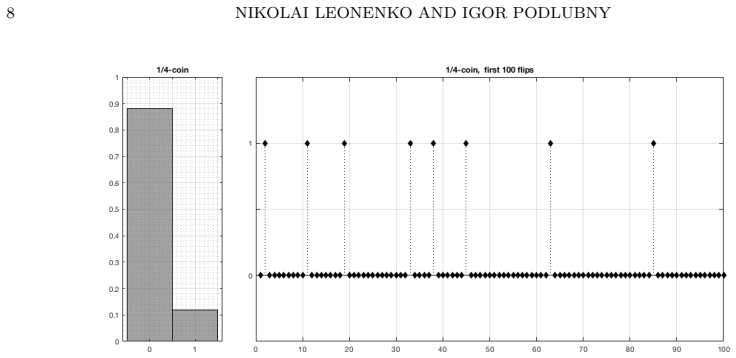


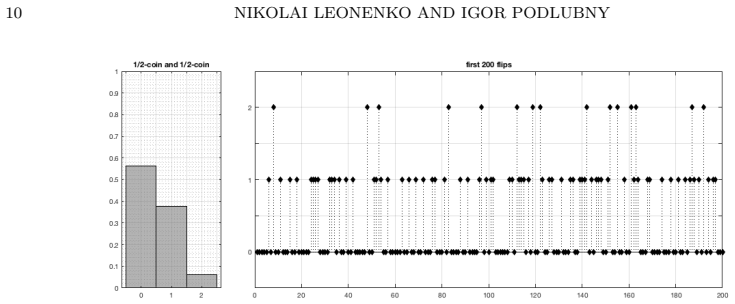


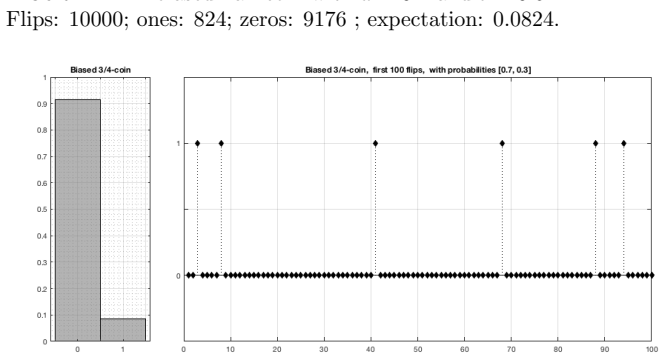

read the original abstract
A method for the numerical simulation of signed probability distributions for the case of tossing $1/n$-th of a coin is presented and illustrated by examples.
Editorial analysis
A structured set of objections, weighed in public.
Referee Report
Summary. The manuscript presents a method for the numerical simulation of signed probability distributions arising from tossing a 1/n-th coin. The approach relies on the Sibuya distribution and is illustrated through explicit examples that demonstrate consistency with the axioms of signed measures.
Significance. If the simulation procedure is rigorously validated, the paper offers a concrete computational tool for handling signed probabilities in fractional coin-toss models. This could facilitate numerical studies of processes where negative probabilities arise naturally, such as certain branching or renewal models linked to the Sibuya distribution. The explicit examples provide a useful starting point for reproducibility.
minor comments (3)
- The abstract and introduction would benefit from a brief statement of the precise convergence criterion or error bound used to validate the simulation outputs against the signed-measure axioms.
- Notation for the signed probabilities (e.g., the definition of the measure on the state space) should be introduced earlier and used consistently in the example sections.
- A short discussion of computational cost or stability for large n would help readers assess practical applicability.
Simulated Author's Rebuttal
We thank the referee for their positive assessment of the manuscript and for recommending minor revision. The summary accurately captures the contribution, and we appreciate the note on potential utility for numerical studies involving signed measures and the Sibuya distribution.
Circularity Check
No significant circularity detected
full rationale
The paper introduces a numerical simulation procedure for signed measures in the context of 1/n-coin tosses, grounded in the Sibuya distribution and demonstrated through concrete examples. No load-bearing step reduces by construction to a fitted parameter, self-citation, or definitional equivalence; the method is presented as an independent construction whose consistency is shown directly via the examples rather than assumed from prior fitted outputs. The derivation chain remains self-contained against the stated axioms of signed measures.
Axiom & Free-Parameter Ledger
axioms (2)
- standard math Signed measures satisfy the usual additivity and normalization properties of probability measures except that total mass may be signed.
- standard math The Sibuya distribution is a well-defined discrete probability distribution on the positive integers.
Lean theorems connected to this paper
-
IndisputableMonolith/Cost/FunctionalEquation.leanwashburn_uniqueness_aczel unclear?
unclearRelation between the paper passage and the cited Recognition theorem.
f(x) = ((1+x)/2)^α, gk(x) = (1-(1-x)^α) x^k, hk(x) = 2^α x^k ((1+x)^α - (1-x²)^α)
-
IndisputableMonolith/Foundation/ArithmeticFromLogic.leanembed_injective unclear?
unclearRelation between the paper passage and the cited Recognition theorem.
Sibuya pmf pk = (-1)^{k+1} binom(α,k)
What do these tags mean?
- matches
- The paper's claim is directly supported by a theorem in the formal canon.
- supports
- The theorem supports part of the paper's argument, but the paper may add assumptions or extra steps.
- extends
- The paper goes beyond the formal theorem; the theorem is a base layer rather than the whole result.
- uses
- The paper appears to rely on the theorem as machinery.
- contradicts
- The paper's claim conflicts with a theorem or certificate in the canon.
- unclear
- Pith found a possible connection, but the passage is too broad, indirect, or ambiguous to say the theorem truly supports the claim.
Reference graph
Works this paper leans on
-
[1]
Fractional Calculus and Applied Analysis, 25 (2) 346–361 (2022)
Leonenko, N., and Podlubny, I.: Monte Carlo method for fractional-order differentiation. Fractional Calculus and Applied Analysis, 25 (2) 346–361 (2022). doi:10.1007/s13540-022-00017-3
-
[2]
Fractional Calculus and Applied Analysis,25 (3) 871–857 (2022)
Leonenko, N., and Podlubny, I.: Monte Carlo method for fractional-order differentiation extended to higher orders. Fractional Calculus and Applied Analysis,25 (3) 871–857 (2022). doi:10.1007/s13540- 022-00048-w
-
[3]
arXiv:2504.21523, z doi:10.48550/arXiv.2504.21523
Leonenko, N., and Podlubny, I.: Sibuya probability distributions and numerical evaluation of fractional-order operators. arXiv:2504.21523, z doi:10.48550/arXiv.2504.21523
-
[4]
J.: Half of a coin: negative probabilities
Sz´ ekely, G. J.: Half of a coin: negative probabilities. WILMOTT magazine, July 2005, pp. 66-68
work page 2005
-
[5]
Annals of the In- stitute of Statistical Mathematics, 31, 373–390 (1979)
Sibuya, M.: Generalized hypergeometric, digamma and trigamma distributions. Annals of the In- stitute of Statistical Mathematics, 31, 373–390 (1979). doi:10.1007/BF02480295
-
[6]
Annals of the Institute of Statistical Mathematics, 33, 177–190 (1981)
Sibuya, M., and Shimitzu, R.: The generalized hypergeometric family of distributions. Annals of the Institute of Statistical Mathematics, 33, 177–190 (1981). doi:10.1007/BF02480931
-
[7]
Statistics and Probability Letters, 18(5), 349–351 (1993)
Devroye, L.: A triptych of discrete distributions related to the stable law. Statistics and Probability Letters, 18(5), 349–351 (1993). doi:10.1016/0167-7152(93)90027-G
-
[8]
Statistics and Probability Letters, 23(3), 271–274 (1995)
Pillai, R.N., and Jayakumar, K.: Discrete Mittag-Leffler distributions. Statistics and Probability Letters, 23(3), 271–274 (1995). doi:10.1016/0167-7152(94)00124-Q
-
[9]
Annals of the Institute of Statistical Mathematics, 70, 855–887 (2018)
Kozubowski, T.J., and Podgorski, K.: A generalized Sibuya distribution. Annals of the Institute of Statistical Mathematics, 70, 855–887 (2018). doi:10.1007/s10463-017-0611-3
-
[10]
Monatshefte f¨ ur Math- ematik, 33, 235–239 (1983)
Ruzsa, I., and Sz´ ekely, G.: Convolution quotients of nonnegative functions. Monatshefte f¨ ur Math- ematik, 33, 235–239 (1983). doi:10.1007/BF01352002 14 NIKOLAI LEONENKO AND IGOR PODLUBNY
-
[11]
Wiley, New York, ISBN 0471918032 (1988)
Ruzsa, I., and Sz´ ekely, G.: Algebraic Probability Theory. Wiley, New York, ISBN 0471918032 (1988)
work page 1988
-
[12]
Academic Press, San Diego (1999), ISBN 0125588402, ISBN-13 978-0125588409
Podlubny, I.: Fractional Differential Equations. Academic Press, San Diego (1999), ISBN 0125588402, ISBN-13 978-0125588409
work page 1999
-
[13]
MATLAB Central File Exchange, Submission No
Podlubny, I., Sibuya probability distribution, 2025. MATLAB Central File Exchange, Submission No. 180923 (2025). https://www.mathworks.com/matlabcentral/fileexchange/180923
work page 2025
-
[14]
MATLAB Central File Exchange, Submission No
Podlubny, I., Partial coin, 2025. MATLAB Central File Exchange, Submission No. 181284 (2025). https://www.mathworks.com/matlabcentral/fileexchange/181284 Nikolai Leonenko, School of Mathematics, Cardiff University, UK Email address : leonenkon@cardiff.ac.uk Igor Podlubny, BERG F aculty, Technical University of Kosice, Slovakia Email address : igor.podlubn...
work page 2025
discussion (0)
Sign in with ORCID, Apple, or X to comment. Anyone can read and Pith papers without signing in.