REVIEW 3 major objections 6 minor 26 references
SINDybrid: automatic generation of hybrid models for dynamic systems
T0 review · 3 major / 6 minor · reviewed 2026-08-07 · deepseek-v4-flash
Pith's one-line read One optimization pass finds the unreliable equations and patches them automatically.
desk verdict A clear, honest MILP-based method for column-sparse SINDy correction terms, but the location-identification claim overreaches until FPM parameter errors are actually tested. read the letter →
The pith
A machine-rendered reading of the paper's core claim, the machinery that carries it, and where it could break.
The reading
What carries the argument
The load-bearing object is the residual matrix $h_{\rm exp} = dx_{\rm exp}/dt - f(x_{\rm exp}, r_{\rm exp})$: the difference between numerically estimated time derivatives of the measured states and the first-principles model's prediction. A correct equation leaves a residual column scattered around zero, while an equation under epistemic uncertainty leaves a column with a structured, non-centred deviation, and that contrast is what the optimisation exploits. SINDybrid approximates the residual as $h_{\rm pred} = X_L \cdot \Xi$, where $X_L$ is a library of candidate functions evaluated on the state data and $\Xi$ is a sparse coefficient matrix; the MILP adds binary variables $\delta_j$ that activate entire columns (equations) and $\alpha_{ij}$ that bound individual coefficients, with regularisation terms penalising both coefficient magnitude and the number of active columns. Column-wise normalisation of $X_L$ prevents large-magnitude states from dominating the selection.
What would settle it
Generate synthetic data from a first-principles model whose parameters are deliberately wrong (for example, set the catalytic arylation rate constant $k_M$ 20--30% off) with no added epistemic uncertainty; if SINDybrid still returns a sparse equation-level correction instead of flagging the parameter error, then the residual-as-uncertainty premise is refuted.
Extended reading notes
Core claim
On its own terms, the paper's central discovery is that constructing a hybrid model is equivalent to solving one mixed-integer linear program over a residual matrix. With a known mechanistic model $f$, the epistemic uncertainty $h$ is defined through the residual $h_{\rm exp} = dx_{\rm exp}/dt - f(x_{\rm exp}, r_{\rm exp})$, and the algorithm must decide which columns of this residual are nonzero (which state equations are wrong) and which functions from a user-supplied library best describe each nonzero column. The MILP formulation uses binary variables to force whole equations on or off, a sparsity penalty on the coefficient matrix, and an absolute-error objective, so the result is a hybrid model in which untouched equations remain exactly the mechanistic ones and corrected equations receive compact symbolic expressions. The paper further argues that the localisation works because an equation under epistemic uncertainty produces a residual column whose distribution is clearly shifted from the zero-centred Gaussian scatter produced by numerical differentiation and measurement noise.
Load-bearing premise
The method assumes the mechanistic model has the right structure and correctly identified parameters, and that every state is measured, so the leftover difference between the data and the model is entirely the missing correction rather than parameter error or unmeasured dynamics.
Editorial extensions
If this is right
- A user can supply a mechanistic model and data and receive both the location of the unreliable equations and sparse symbolic corrections for them, with no expert pre-selection of where machine learning enters.
- The approach keeps the trustworthy part of the model intact: equations that are not flagged are left exactly as the mechanistic model states them.
- The reported robustness bounds — up to 20% measurement noise, as few as 2 training batches, and 5 time samples per experiment — imply the method can work on realistically limited experimental campaigns.
- Systems with exponential or rational terms in the mechanistic model, such as the continuous fermentation case, are more sensitive to noise and may need de-noising or denser sampling to avoid overfitting and integration failures on test data.
- Periodic systems benefit most from additional time samples, because their low output variance lets many candidate functions fit few points.
Reading between the lines
- A natural extension the paper leaves implicit is to use the column-wise distribution of $h_{\rm exp}$ as a cheap pre-screen: the paper shows uncertain columns are shifted by roughly an order of magnitude more than noise, so a statistical test on column means could warm-start or independently verify the MILP's column selection.
- Because the method operates in derivative space, its success depends on how derivatives are computed; replacing finite differences with a more robust differentiation scheme could plausibly remove the one reported failure at 5 time samples in the fermentation case, where the algorithm misassigns the deviation to a correlated equation.
- The paper assumes every state is measured and all parameters are correct; if either assumption fails, the residual contains more than epistemic uncertainty, so a practical workflow would alternate parameter estimation and SINDybrid rather than applying it once.
- For periodic or low-variance dynamics, the plateau behaviour suggests an experiment-design rule: allocate sampling effort where trajectory diversity is highest, since extra points in already-visited regions contribute little information.
Editorial analysis
A structured set of objections, weighed in public.
Referee Report
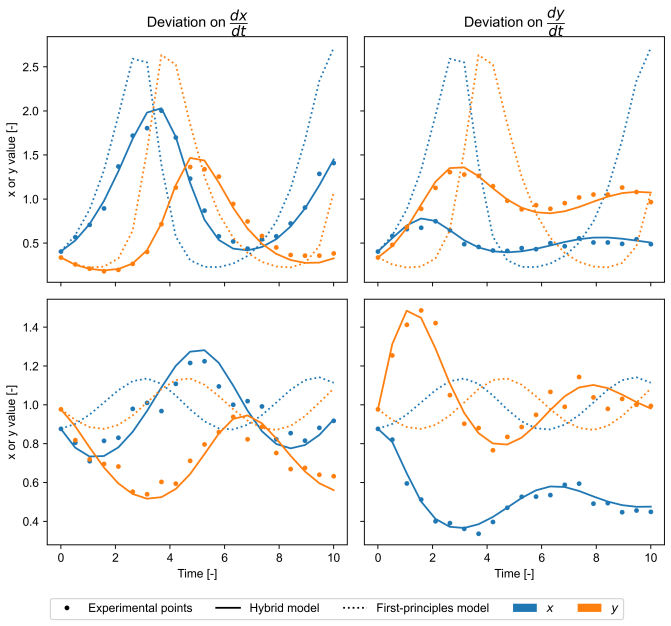
Summary. The paper proposes SINDybrid, an algorithm for automatic hybrid model construction for systems described by ordinary differential equations. Given a first-principles mechanistic model f(x,r) and experimental data, the method computes the residual h_exp = dx_exp/dt - f(x_exp,r_exp) and solves a mixed-integer linear program (MILP) that selects, from a user-supplied library of basis functions, a sparse set of correction terms and the equations to which the corrections apply. The authors introduce binary variables for term and column selection, an L1 regularizer, and scaled basis columns, and validate the approach on three synthetic case studies: a Meerwein arylation reaction, a continuous fermentation process, and a Lotka-Volterra oscillator. For each case, a known deviation h is injected into one equation at a time, and the paper reports the success of the location identification and the accuracy of the resulting hybrid model under varying measurement noise, number of training batches, and number of time samples.
Significance. The MILP formulation is coherent and the idea of automatically identifying which mechanistic equations carry epistemic uncertainty is practically relevant, since hybrid model construction still relies heavily on expert judgment. The authors provide an open-source implementation and the synthetic experiments are described in enough detail to follow the pipeline. If the method is robust under realistic conditions, it could lower the barrier to adopting hybrid modelling in chemical engineering. However, the validation is entirely in silico with injected deviations, and the two most consequential assumptions of the method - that the first-principles model has exactly correct structure and parameters, and that the epistemic uncertainty is exactly expressible in the chosen function library - are not tested or even fully specified in the manuscript. These omissions leave the central 'automatic detection' claim weaker than the abstract suggests.
major comments (3)
- [Sections 1, 3.1, and 3.4; Eq. (2)] The central claim that SINDybrid automatically detects epistemic uncertainty is only valid when the mechanistic model f has the correct structure and parameters. If parameters are misspecified or the model structure is incomplete in ways not captured by the assumed h, the residual h_exp computed from Eq. (2) contains parametric or structural error in addition to the epistemic correction. The MILP in Eq. (9) will then minimise the loss by fitting the wrong columns of Xi, potentially attributing the error to an equation that is actually correct. The authors acknowledge this in Section 3.4 ('operates under the assumption that the FPM parameters have been correctly identified') and state that parameter-level uncertainty and partial-state observation were not explored, but the abstract and introduction make unqualified claims. The validation protocol never perturbs f: in all three case studies, the FPM is exact and only known h terms are added. A parameter-misspecification test, such as shifting a kinetic constant by 10-20% and checking whether the algorithm still locates the true deviation or instead activates a spurious column, is needed before the abstract's wording can be accepted. At minimum, the claims should be qualified to state the exactness assumption prominently.
- [Section 3.1 and SI Section s1] The candidate function libraries X_L used for the three case studies are not reported anywhere in the manuscript or the supplementary material. The true deviation functions h are given in the SI (equations s2, s4, s6), but the function libraries from which the algorithm selects are not. Since the success of SINDybrid depends on h being exactly representable as a sparse linear combination of the library columns, the absence of the library specification prevents reproducibility and makes it impossible to assess whether the positive results are an artefact of cherry-picked libraries that already contain the true deviation terms. The authors should report the full library for each case (e.g., the set of monomials, rational terms, and other candidate functions) and, ideally, test with libraries that do not contain the exact h, to demonstrate that the method does not rely on knowing the answer in advance.
- [Figures 1, 2, 3 and Section 3.2] The robustness results are reported without error bars or any measure of variability. Each point in the figures is described as an average over multiple runs ('Each run sets the synthetic epistemic uncertainty location on a different model equation'), which corresponds to at most four runs for the Meerwein case, three for fermentation, and two for Lotka-Volterra. With such small numbers, the claims that the algorithm is 'robust' and that R^2 values are consistently above 0.85 are not statistically quantified. The authors should report the number of replicates, the standard deviation or confidence intervals, or show all individual runs in the figures. This is particularly important because the location identification results are binary (success/failure), and a single failure at the boundary significantly changes the reported success rates.
minor comments (6)
- [Abstract and Section 4] The abstract claims R^2 scores above 0.85 on validation data, while the conclusion states 'test R^2 > 0.89 in all cases'; these threshold values should be reconciled.
- [Section 3.2.1 and 3.2.3] There are typos: 'SINDyrid' instead of 'SINDybrid' in Section 3.2.3, and 'Loka-V olterra' instead of 'Lotka-Volterra' in Section 3.2.1.
- [Equations (4), (5), (8), (9)] The sums use indices starting at 0 (e.g., Nt,NS sum over i,j=0), but the matrices are naturally indexed from 1; the convention should be stated or corrected.
- [Section 2.2, Eq. (10)] After normalising the library columns with Eq. (10), the coefficients Xi are those for the scaled columns, not for the original library functions. The manuscript should state this explicitly so that the final correction h_pred = X_L * Xi can be interpreted correctly.
- [Section 3.2.2] The caption of Figure 2 mentions 'Plots a), b) and c)' but the panels are labelled a1/a2/a3, b1/b2/b3, and c1/c2/c3; the caption is confusing and should be aligned with the actual panel labels.
- [Section 3.1] The manuscript does not state which MILP solver was used (e.g., Gurobi, CPLEX, CBC) or give typical computation times. Since MILP scalability is a practical concern, a brief statement on solver and run times would help assess the method's usability.
Circularity Check
No significant circularity: the identification target hexp is externally constructed from data and the supplied FPM, and the fitted correction is evaluated against held-out experiments.
full rationale
The core loop is not circular. In Eq. (2), hexp is computed as dx_exp/dt - f(x_exp, r_exp) from measured states and a user-supplied mechanistic model, independently of the fitted coefficient matrix Xi. The MILP in Eq. (9) then fits h_pred = X_L * Xi to this residual and selects nonzero columns. Location identification is therefore an empirical sparse-fit to an externally constructed residual, not a quantity derived from the fitted parameters; the synthetic validation cases add known deviations to an exact FPM to provide ground truth, and held-out experiments test generalization. The Section 3.4 limitations explicitly state the FPM-parameter and full-state-measurement assumptions, which is the opposite of circularity: the paper admits these scenarios were not explored. The Section 3.3 Gaussian-distribution explanation is post hoc rationalization rather than a load-bearing derivation. The regularizer lambda_1,xi is tuned on validation cases, but this is ordinary model selection and does not make the prediction target depend on the fitted parameters. Citations such as Brunton et al. [11] and Willis and von Stosch [6] are external prior work used for the SINDy and MILP formulations, not self-citations carrying the argument. No step in the derivation chain reduces to its own inputs by construction.
Assumptions & free parameters
free parameters (4)
- L1 regularisation weight lambda_1,xi =
3 (nominal)
- Column and term cardinality caps K_alpha, K_delta =
infinity
- Function library composition =
not specified per case
- Coefficient bounds ub, lb =
not specified
assumptions (5)
- domain assumption The first-principles model f has correct structure and correctly identified parameters.
- domain assumption All system states are measured.
- ad hoc to paper The epistemic uncertainty h is exactly expressible as a sparse linear combination of the user-supplied library functions.
- domain assumption Numerical differentiation and measurement noise produce errors that are zero-mean so the residual matrix hexp is informative.
- domain assumption The MILP solver returns a globally optimal or sufficiently good solution within the time limit.
Cite this review
Pith. "Pith review of SINDybrid: automatic generation of hybrid models for dynamic systems." pith.science (2026). https://pith.science/paper/Z2T25L5E
@misc{pith2026250612498,
  author       = {Pith},
  title        = {Pith review of: SINDybrid: automatic generation of hybrid models for dynamic systems},
  year         = {2026},
  howpublished = {\url{https://pith.science/paper/Z2T25L5E}},
  note         = {Machine review of arXiv:2506.12498}
}
read the original abstract
Hybrid modelling enhances the accuracy and predictive capability of dynamic models by integrating first principles with data-driven methods, effectively mitigating epistemic uncertainties inherent in mechanistic approaches. However, hybrid model construction remains complex, typically requiring expert knowledge to identify model epistemic uncertainty and select suitable machine-learning components to capture it. This complexity limits broader adoption in research and industry. We introduce SINDybrid, an automated algorithm designed to streamline hybrid model development for dynamic systems. SINDybrid employs a mixed-integer linear programming (MILP) approach to systematically identify epistemic uncertainty sources and compensate them using optimally selected data-driven components. For broader accessibility and reproducibility, we provide SINDybrid as an open-source Python library. SINDybrid was validated through three case studies: a catalytic reaction system, a continuous fermentation process, and a Lotka-Volterra oscillator, each showcasing different epistemic uncertainties. The robustness of the algorithm is tested against varying experimental conditions, including measurement noise (up to 20%), limited training batches (minimum 2), and sparse temporal sampling (minimum 5 samples per experiment). Results demonstrate a consistent ability of the SINDybrid approach to produce accurate hybrid models, achieving R^2 scores above 0.85 on validation data. Additionally, the algorithm effectively identifies uncertainty locations within system dynamics under challenging scenarios. This work highlights SINDybrid potential as a versatile, automated solution for hybrid modelling, significantly reducing the barriers to adopting hybrid methods in complex dynamic systems across scientific research and industrial applications.
Figures


Figures from the paper (4 more)



Reference graph
Works this paper leans on
-
[6]
Mark J. Willis and Moritz von Stosch. Simultaneous parameter identification and discrimination of the nonparametric structure of hybrid semi-parametric models. Computers and Chemical Engineering , 104:366–376, 2017
work page 2017
-
[1]
Joswiak, Ivan Castillo, Zhenyu Wang, Ricardo Rendall, Leo H
Joel Sansana, Mark N. Joswiak, Ivan Castillo, Zhenyu Wang, Ricardo Rendall, Leo H. Chiang, and Marco S. Reis. Recent trends on hybrid modeling for industry 4.0. Computers & Chemical Engineering , 151:107365, August 2021
work page 2021
-
[2]
Chiang, Birgit Braun, Zhenyu Wang, and Ivan Castillo
Leo H. Chiang, Birgit Braun, Zhenyu Wang, and Ivan Castillo. Towards artificial intelligence at scale in the chemical industry. AIChE Journal, 68(6), 2022
work page 2022
-
[3]
Artur M. Schweidtmann, Erik Esche, Asja Fischer, Marius Kloft, Jens-Uwe Repke, Sebastian Sager, and Alexander Mitsos. Machine learning in chemical engineering: A perspective. Chemie Ingenieur Technik, 93(12):2029–2039, December 2021
work page 2021
-
[4]
Moritz von Stosch, Rui Oliveira, Joana Peres, and Sebastião Feyo de Azevedo. Hybrid semi-parametric modeling in process systems engineering: Past, present and future.Computers and Chemical Engineering, 60:86–101, 2014
work page 2014
-
[5]
Schweidtmann, Dongda Zhang, and Moritz V on Stosch
Artur M. Schweidtmann, Dongda Zhang, and Moritz V on Stosch. A review and perspective on hybrid modeling methodologies. Digital Chemical Engineering, 10:100136, March 2024
work page 2024
-
[7]
Harini Narayanan, Mariano Nicolas Cruz Bournazou, Gonzalo Guillén Gosálbez, and Alessandro Butté. Functional-hybrid modeling through automated adaptive symbolic regression for interpretable mathemat- ical expressions. Chemical Engineering Journal, 430:133032, 2022
work page 2022
-
[8]
The ALAMO approach to machine learning
Zachary T. Wilson and Nikolaos V . Sahinidis. The alamo approach to machine learning. Computers and Chemical Engineering, 106:785–795, 2017. arXiv: 1705.10918
work page Pith review arXiv 2017
Show all 26 references
-
[9]
The automated discovery of kinetic rate models – methodological frameworks
Miguel Ángel De Carvalho Servia, Ilya Orson Sandoval, King Kuok Mimi Hii, Klaus Hellgardt, Dongda Zhang, and Antonio Del Rio Chanona. The automated discovery of kinetic rate models – methodological frameworks. Digital Discovery, page 10.1039.D3DD00212H, 2024. 17
-
[10]
Savage, and Bovinille A
Dongda Zhang, Thomas R. Savage, and Bovinille A. Cho. Combining model structure identification and hybrid modelling for photo-production process predictive simulation and optimisation. Biotechnology and Bioengineering, 117(11):3356–3367, 2020
2020
-
[11]
Brunton, Joshua L
Steven L. Brunton, Joshua L. Proctor, and J. Nathan Kutz. Discovering governing equations from data by sparse identification of nonlinear dynamical systems. Proceedings of the National Academy of Sciences , 113(15):3932–3937, 2016
2016
-
[12]
Brunton, Joshua L
Steven L. Brunton, Joshua L. Proctor, and J. Nathan Kutz. Sparse identification of nonlinear dynamics with control (sindyc). IF AC-PapersOnLine, 49(18):710–715, 2016
2016
-
[13]
Adam-sindy: An efficient optimization frame- work for parameterized nonlinear dynamical system identification
Siva Viknesh, Younes Tatari, and Amirhossein Arzani. Adam-sindy: An efficient optimization frame- work for parameterized nonlinear dynamical system identification. (arXiv:2410.16528), January 2025. arXiv:2410.16528
2025 arXiv
-
[14]
Generalizing the sindy approach with nested neural networks.arXiv, 2025
Camilla Fiorini, Clément Flint, Louis Fostier, Emmanuel Franck, Reyhaneh Hashemi, Victor Michel- Dansac, and Wassim Tenachi. Generalizing the sindy approach with nested neural networks.arXiv, 2025
2025
-
[15]
Mangan, Travis Askham, Steven L
Niall M. Mangan, Travis Askham, Steven L. Brunton, J. Nathan Kutz, and Joshua L. Proctor. Model selection for hybrid dynamical systems via sparse regression. Proceedings of the Royal Society A: Math- ematical, Physical and Engineering Sciences , 475(2223):20180534, 2019. arXiv...
2019 arXiv
-
[16]
Multidimensional approximation of non- linear dynamical systems
Patrick Gelß, Stefan Klus, Jens Eisert, and Christof Schütte. Multidimensional approximation of non- linear dynamical systems. Journal of Computational and Nonlinear Dynamics , 14(6):061006, 2019. arXiv:1809.02448 [math]
2019 arXiv
-
[17]
Hirsh, David A
Seth M. Hirsh, David A. Barajas-Solano, and J. Nathan Kutz. Sparsifying priors for bayesian uncertainty quantification in model discovery. arXiv, (arXiv:2107.02107), 2021. arXiv:2107.02107
2021 arXiv
-
[18]
Alhajeri, and Panagiotis D
Fahim Abdullah, Mohammed S. Alhajeri, and Panagiotis D. Christofides. Modeling and control of non- linear processes using sparse identification: Using dropout to handle noisy data.Industrial & Engineering Chemistry Research, 61(49):17976–17992, 2022
2022
-
[19]
Christofides
Fahim Abdullah and Panagiotis D. Christofides. Data-based modeling and control of nonlinear process systems using sparse identification: An overview of recent results. Computers & Chemical Engineering , 174:108247, 2023
2023
-
[20]
Christofides
Fahim Abdullah and Panagiotis D. Christofides. Real-time adaptive sparse-identification-based predictive control of nonlinear processes. Chemical Engineering Research and Design , 196:750–769, 2023
2023
-
[21]
Reactive sindy: Discovering governing reactions from concentration data
Moritz Hoffmann, Christoph Fröhner, and Frank Noé. Reactive sindy: Discovering governing reactions from concentration data. The Journal of Chemical Physics , 150(2):025101, 2019
2019
-
[22]
Nuno M. C. De Oliveira and Lorenz T. Biegler. Constraint handing and stability properties of model- predictive control. AIChE Journal, 40(7):1138–1155, 1994
1994
-
[23]
Fast model predictive control with soft constraints
Arthur Richards. Fast model predictive control with soft constraints. European Journal of Control , 25:51–59, September 2015
2015
-
[24]
Shukla, Ranjit S
Chinmay A. Shukla, Ranjit S. Atapalkar, and Amol A. Kulkarni. Selectivity engineering of meerwein arylation in a continuous flow reactor: a modelling approach. Reaction Chemistry & Engineering , 5(4):736–746, 2020. 18
2020
-
[25]
Geraldo, Carlos Eduardo Vaz Rossell, Rubens Maciel Filho, and Antonio Bonomi
Elmer Alberto Ccopa Rivera, Celina Kiyomi Yamakawa, Magaly Herrera Garcia, Viictor C. Geraldo, Carlos Eduardo Vaz Rossell, Rubens Maciel Filho, and Antonio Bonomi. A procedure for estimation of fermentation kinetic parameters in fed-batch bioethanol production process with cel...
2013
-
[26]
Lotka-volterra population models
Peter J Wangersky. Lotka-volterra population models. Annual Review of Ecology and Systematics , 9:189–218, 1978. 19 SINDybrid: automatic generation of hybrid models for dynamic systems Ulderico Di Caprio1*, M. Enis Leblebici1† 1 Centre for Industrial Process Technology, Depart...
1978
Reviewed August 7, 2026 · model on record in the stance chip above.
Discussion (0). Sign in to comment.