REVIEW 2 major objections 2 minor 63 references
Permutation invariance in last-passage percolation and the distribution of the Busemann process
T0 review · 2 major / 2 minor · reviewed 2026-08-07 · deepseek-v4-flash
Pith's one-line read For exponential last-passage percolation, the joint distribution of all Busemann increments in any finite grid and any finite set of directions equals the joint distribution of last-passage increments in a slightly larger finite grid with…
desk verdict Genuinely new finite-dimensional description of the Busemann process in exponential LPP, proved in detail; the main risk is its heavy but transparent reliance on an overlapping preprint's inhomogeneous Busemann theory. read the letter →
The pith
A machine-rendered reading of the paper's core claim, the machinery that carries it, and where it could break.
The reading
What carries the argument
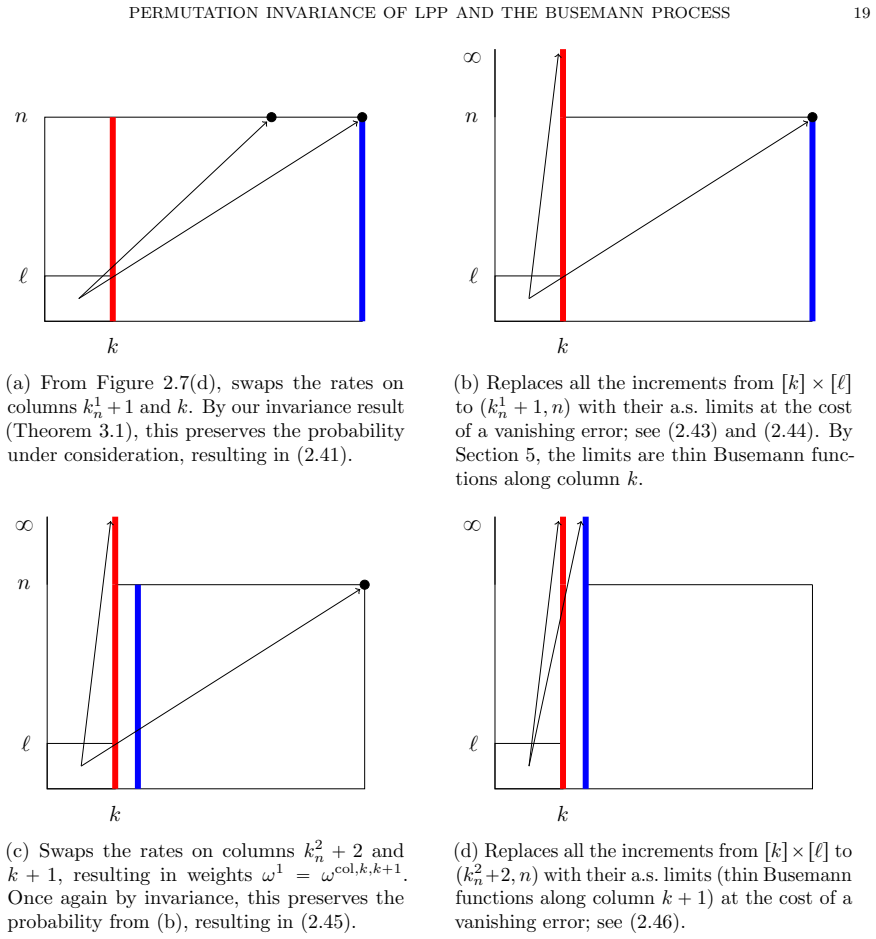
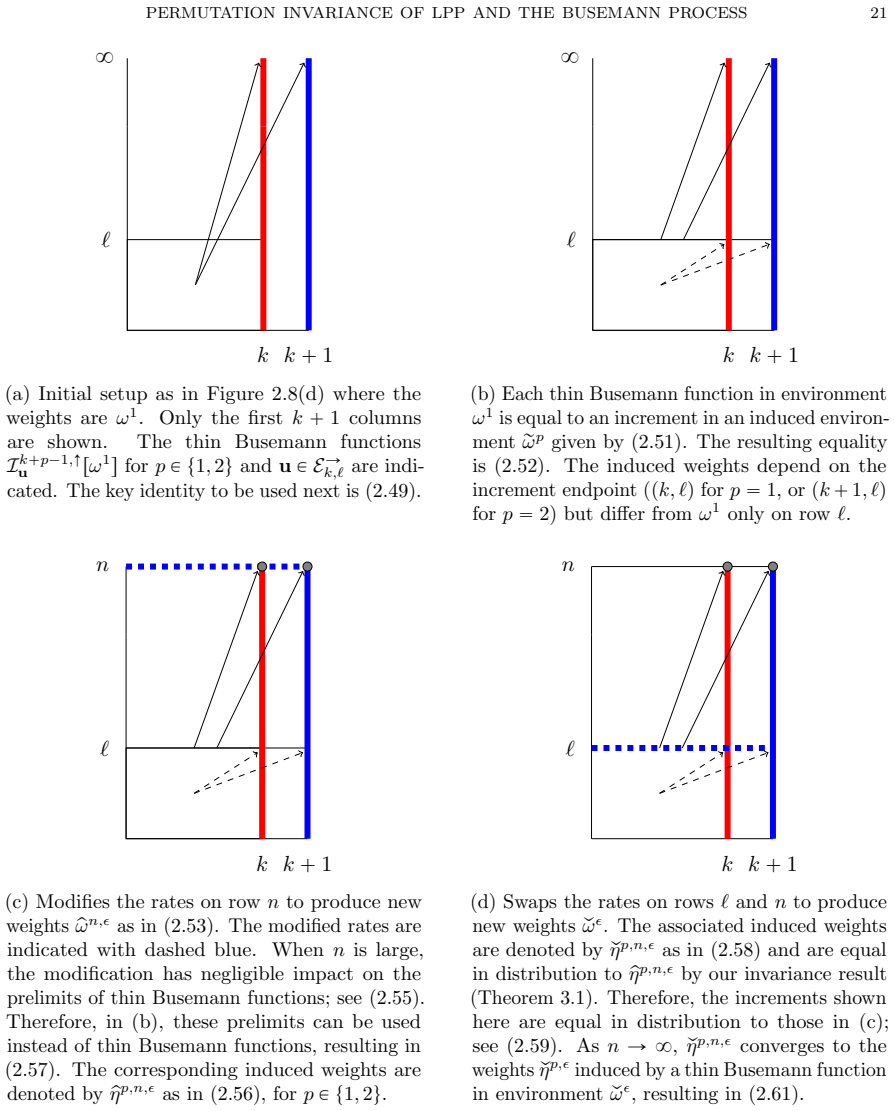
The central device is a new permutation invariance (Theorem 3.1): the joint law of inhomogeneous last-passage times between certain endpoint pairs is preserved when the inhomogeneity parameters of columns and rows are permuted. It is proved by swapping two neighboring rows or columns through an explicit coupling based on a queue with exponential service and arrivals, where the Burke property shows that the unused-service transformation swaps the rate parameters while preserving all crossing passage times. The second key ingredient is the theory of thin Busemann functions, column- or row-limited versions of Busemann limits in inhomogeneous exponential LPP, together with an induced-weights identity that rewrites increments to far-off terminal points as increments in a smaller finite grid. These ingredients combine to convert the infinite Busemann joint law into a finite-grid last-passage problem whose weights are explicitly described by (2.13).
What would settle it
Choose a small explicit case such as k=2, l=2, d=2 with directions r_1 < r_2. Theorem 2.4 expresses the joint law of the four Busemann increments as explicit functions of five independent exponentials; compute that joint law numerically, then simulate long last-passage paths to terminals (m_1,n) and (m_2,n) with m_1/n to r_1 and m_2/n to r_2, and compare the empirical joint distribution with the predicted finite formula. Any systematic mismatch in the joint CDF would refute the theorem.
Extended reading notes
Core claim
Theorem 2.4 states that the collection of Busemann increments ($I^{{r_p}}$_u, $J^{{r_p}}$_v) for u in the horizontal-edge set, v in the vertical-edge set, and directions r_1 < ... < r_d is distributionally identical to the collection of last-passage increments (I_{u,z_p}[\eta], J_{v,z_p}[\eta]) computed in a finite inhomogeneous environment \eta with independent exponential weights of rates a_i + b_j, where the sequences a and b are built from the values \zeta(r_p) and the terminal points z_p lie on an antidiagonal of the enlarged grid. ВThus a genuinely infinite-dimensional object, the Busemann process across both space and direction, is encoded by finitely many random variables. The paper also derives from this identity a complete characterization of the Busemann process on a single lattice edge, recovers an independence theorem of Shen in a special case, and extends the description to include the axis directions.
Load-bearing premise
The derivation takes as given a body of results on Busemann functions in inhomogeneous exponential last-passage percolation from a related preprint by overlapping authors, especially the identification of directional Busemann limits with thin column and row limits; if those results had narrower validity than assumed, the proof of the main theorem would not go through.
Editorial extensions
If this is right
- Every finite joint distribution of Busemann increments for any set of edges and directions can be sampled exactly from finitely many independent exponentials, without simulating an infinite environment.
- The Busemann process on a single lattice edge has independent increments with respect to direction, and the distribution of each increment is explicitly computable, recovering and reproving known results without queuing maps.
- The description extends to the axis directions r = 0 and r = 8 by a simple two-sided version that also records the underlying i.i.d. weights.
- A special case of Shen's independence theorem, concerning monotone variation of direction along a down-right path, follows directly from the finite-grid representation.
- The permutation invariance provides an explicit coupling of the weights before and after swapping inhomogeneity parameters, giving a tool that may apply to other problems involving inhomogeneous last-passage percolation.
Reading between the lines
- Editorial: Because the finite environment uses only finitely many random variables, the result gives a practical numerical route to previously inaccessible quantities such as multi-direction geodesic coalescence probabilities inside a finite box.
- Editorial: The coupling-based proof of permutation invariance suggests that analogous invariance may hold for directed polymers at positive temperature, where arrival and service are replaced by ratios of partition functions and a Burke-type stationarity is available.
- Editorial: Combining this finite representation with scaling limits such as the directed landscape could lead to testable approximations: the joint law of Busemann increments in a growing box should converge to the corresponding multi-direction quantities in the continuum scaling limit.
- Editorial: The multi-point version mentioned in the paper indicates that the invariance is not special to single paths, so extensions to multi-point last-passage observables may allow exact finite sampling of more complex functionals.
Editorial analysis
A structured set of objections, weighed in public.
Referee Report
Summary. The paper studies the joint distribution of Busemann functions in i.i.d. exponential last-passage percolation. The main result, Theorem 2.4, asserts that Busemann increments on a k x l grid for d directions are equal in distribution to point-to-point last-passage increments in a finite inhomogeneous environment on a (k+d-1) x (l+d-1) grid with terminal points along an antidiagonal. The proof introduces a new permutation invariance of inhomogeneous LPP (Theorem 3.1) proved via a queueing/Burke argument, and imports the inhomogeneous Busemann theory from the preprint [24]. The paper also derives corollaries on independent increments and Shen's independence theorem.
Significance. If the central identity is correct, it gives the first explicit finite-dimensional description of the joint Busemann distribution for arbitrary edge sets, which was previously available only along a horizontal line. The permutation invariance theorem is of independent interest and its proof via the Burke property is elegant and distinct from RSK-based approaches. The paper is clearly written, with a detailed two-direction proof sketch and explicit examples that make the result accessible. The main caveats are the incomplete proof of the full permutation invariance stated in Theorem 3.1 and the heavy reliance on an unreviewed preprint by overlapping authors.
major comments (2)
- [Section 4, Theorem 3.1] The proof of Theorem 3.1 is incomplete as stated. The two-row swap Propositions 4.1 and 4.2 are proved only under the assumption b2 > b1 (see the setup before (4.2) and Lemma 4.5, where the stationary distribution Exptb2-b1u requires b2>b1). The theorem, however, allows arbitrary finite permutations with no ordering condition, and the proof of Theorem 3.1 does not explain how to handle the opposite order for rows or the analogous ordering condition for columns. This is not a cosmetic gap: in Lemma 6.1, for example, the invariance is used to interchange a column of rate 1-zeta(r_p) with a column of rate 1, with the smaller-rate column to the right of the larger-rate column, which is exactly the case excluded by the transposed-row condition a_{i+1} > a_i. The authors should either prove the missing cases (or show they follow from the proved case by a limiting argument) or restrict Theorem 3.1 to the situations actually verified and used.
- [Sections 5-6] The proof of Theorem 2.4 relies crucially on Propositions 5.1, 5.3, 5.4, 5.5 and Corollary 5.2, which are imported from the preprint [24] and not proved in this manuscript. In particular, the identification at the critical direction in (6.28) uses Proposition 5.5 at the endpoint r = c_i^ver; the proof would fail if that proposition requires strict inequality. Since [24] is a preprint by overlapping authors and the presented results are load-bearing for the central identity, the authors should include a self-contained proof of the necessary statements (at least the endpoint case of Proposition 5.5) or, if that is impractical, clearly state the dependency and verify explicitly that all hypotheses of the imported results are satisfied in every application in Section 6.
minor comments (2)
- [Section 6, Lemma 6.1] In the proof of Lemma 6.1, equation (6.14) is presented as a chain of equalities and an inequality, but the first 'equality' appears to combine a re-indexing of the event with a monotonicity step; the logical structure should be clarified for readability.
- [Section 2, equations (2.3)-(2.4)] The same symbols I and J are used for initial-point and terminal-point increments; while this follows the field's conventions, the double use alongside Busemann functions I^r and J^r may be confusing on first reading. A brief remark or a change of notation for terminal increments could help.
Circularity Check
No significant circularity: the joint-distribution identity is proved by comparing joint CDFs, not built into the definition of the eta environment.
full rationale
Theorem 2.4 is not circular. The eta rates in (2.13) are chosen from the one-directional rate function zeta(r) of Proposition 2.2(b), but the joint identity is not imposed: Section 6 proves it by bounding the prelimit probabilities in (6.4), using the permutation invariance of Theorem 3.1 (proved self-contained in Section 4 via the Burke property) and the thin-Busemann identifications of Section 5. The imported results from [24] (Propositions 5.1, 5.3, 5.4, 5.5 and Corollary 5.2) are external statements with the stated hypotheses (5.1)-(5.2), and none of them assumes Theorem 2.4. The critical endpoint use at (6.28) is exactly the case r = c_i^ver allowed by Proposition 5.5; this is a dependency on an overlapping-authors preprint, hence a provenance and verification risk, but it is not a definitional reduction. Proposition 2.2 is also used only to provide the Busemann limits and continuity in (6.3)-(6.4); Remark 2.7's later derivation of the d=1 marginals from Theorem 2.4 is a consistency check, not an input to the proof. No fitted parameter is renamed as a prediction, no uniqueness theorem is imported to force the choice, and no known result is merely relabeled. Accordingly, no circular step is exhibited.
Assumptions & free parameters
assumptions (5)
- domain assumption Existence, marginal distributions, and down-right path independence of Busemann functions in i.i.d. exponential LPP (Proposition 2.2), cited from [56] Theorem 4.2 and [11] Lemma 3.3.
- domain assumption Inhomogeneous Busemann functions satisfy Propositions 5.1, 5.3, 5.4, 5.5 and Corollary 5.2 of [24] under conditions (5.1)-(5.2).
- domain assumption Law of large numbers for inhomogeneous LPP (Proposition 6.3, from [22, Theorem 3.7]).
- standard math The queueing Burke property as derived in Lemma 4.5 (proved in this paper).
- standard math Lemma 2.1 monotonicity of increments, from [54, Lemma 6.2] and [56, Lemma 4.6].
Cite this review
Pith. "Pith review of Permutation invariance in last-passage percolation and the distribution of the Busemann process." pith.science (2026). https://pith.science/paper/VJNQ3S5H
@misc{pith2026250612641,
  author       = {Pith},
  title        = {Pith review of: Permutation invariance in last-passage percolation and the distribution of the Busemann process},
  year         = {2026},
  howpublished = {\url{https://pith.science/paper/VJNQ3S5H}},
  note         = {Machine review of arXiv:2506.12641}
}
abstract
In i.i.d. exponential last-passage percolation, we describe the joint distribution of Busemann functions, over all edges and over all directions, in terms of a joint last-passage problem in a finite inhomogeneous environment. More specifically, the Busemann increments within a $k\times\ell$ grid, and associated to $d$ different directions, are equal in distribution to a particular collection of last-passage increments inside a $(k+d-1)\times(\ell+d-1)$ grid. The joint Busemann distribution was previously described along a horizontal line by Fan and the fourth author, using certain queuing maps. By contrast, our new description explicitly gives the joint distribution for any collection of edges (not just along a horizontal line) using only finitely many random variables. Our result thus provides an exact and accessible way to sample from the joint distribution. In the proof, we rely on one-directional marginal distributions of the inhomogeneous Busemann functions recently studied by Janjigian and the second and fourth authors. The second ingredient of our proof is a novel joint invariance of inhomogeneous last-passage times under permutations of the inhomogeneity parameters. Our proof of the invariance is different from earlier proofs of such results, using the Burke property instead of the RSK correspondence, and leading to an explicit coupling of the weights before and after the permutation of the parameters.
Figures


Figures from the paper (11 more)




Reference graph
Works this paper leans on
- [24]
-
[1]
T. Alberts, F. Rassoul-Agha, and M. Simper. Busemann functions and semi-infinite O’Connell-Yor polymers. Bernoulli, 26(3):1927–1955, 2020. 2
work page 1927
-
[2]
D. Aldous and P. Diaconis. Hammersley’s interacting particle process and longest increasing subsequences. Probab. Theory Related Fields, 103(2):199–213, 1995. 2
work page 1995
-
[3]
J. Baik, G. Ben Arous, and S. P´ ech´ e. Phase transition of the largest eigenvalue for nonnull complex sample covariance matrices. Ann. Probab., 33(5):1643–1697, 2005. 25
work page 2005
-
[4]
M. Bal´ azs, E. Cator, and T. Sepp¨ al¨ ainen. Cube root fluctuations for the corner growth model associated to the exclusion process. Electron. J. Probab., 11:no. 42, 1094–1132 (electronic), 2006. 2, 9, 12
work page 2006
-
[5]
E. Bates, W.-T. L. Fan, and T. Sepp¨ al¨ ainen. Intertwining the Busemann process of the directed polymer model. Electron. J. Probab., 30:article no. 50, 80 pp, 2025. 2, 3
work page 2025
-
[6]
A. Borodin, V. Gorin, and M. Wheeler. Shift-invariance for vertex models and polymers. Proc. Lond. Math. Soc. (3), 124(2):182–299, 2022. 4
work page 2022
-
[7]
A. Borodin and S. P´ ech´ e. Airy kernel with two sets of parameters in directed percolation and random matrix theory. J. Stat. Phys. , 132(2):275–290, 2008. 4, 25, 27
work page 2008
Show all 63 references
-
[8]
Busani, T
O. Busani, T. Sepp¨ al¨ ainen, and E. Sorensen. The stationary horizon and semi-infinite geodesics in the directed landscape. Ann. Probab., 52(1):1–66, 2024. 2, 3
2024
-
[9]
Busemann
H. Busemann. The geometry of geodesics . Academic Press, Inc., New York, 1955. 2
1955
-
[10]
Cator and P
E. Cator and P. Groeneboom. Second class particles and cube root asymptotics for Hammersley’s process. Ann. Probab., 34(4):1273–1295, 2006. 2
2006
-
[11]
Cator and L
E. Cator and L. P. R. Pimentel. Busemann functions and the speed of a second class particle in the rarefaction fan. Ann. Probab., 41(4):2401–2425, 2013. 6
2013
-
[12]
Chaumont
H. Chaumont. Some Results on Lattice Directed Polymer Models . ProQuest LLC, Ann Arbor, MI, 2018. Thesis (Ph.D.)–The University of Wisconsin - Madison. 3, 9
2018
-
[13]
I. Corwin. Invariance of polymer partition functions under the geometric RSK correspondence. In Stochastic analysis, random fields and integrable probability—Fukuoka 2019 , volume 87 of Adv. Stud. Pure Math. , pages 89–136. Math. Soc. Japan, Tokyo, 2021. 28
2019
-
[14]
Corwin, Y
I. Corwin, Y. Gu, and E. Sorensen. Periodic Pitman transforms and jointly invariant measures. Preprint:arXiv:2409.03613, 2024. 3
2024
-
[15]
D. Coupier. Multiple geodesics with the same direction. Electron. Commun. Probab., 16:517–527, 2011. 6
2011
-
[16]
Damron and J
M. Damron and J. Hanson. Busemann functions and infinite geodesics in two-dimensional first-passage percolation. Comm. Math. Phys. , 325(3):917–963, 2014. 2
2014
-
[17]
Damron and J
M. Damron and J. Hanson. Bigeodesics in first-passage percolation. Comm. Math. Phys. , 349(2):753–776,
-
[18]
Dauvergne
D. Dauvergne. Hidden invariance of last passage percolation and directed polymers. Ann. Probab., 50(1):18– 60, 2022. 4, 27, 29
2022
-
[19]
Dauvergne, J
D. Dauvergne, J. Ortmann, and B. Vir´ ag. The directed landscape. Acta Math., 229(2):201–285, 2022. 28
2022
-
[20]
Dauvergne and B
D. Dauvergne and B. Vir´ ag. The directed landscape from Brownian motion.Preprint:arXiv:2405.00194,
-
[21]
Draief, J
M. Draief, J. Mairesse, and N. O’Connell. Queues, stores, and tableaux. Journal of Applied Probability , 42(4):1145–1167, 2005, 0707.4104. 32 PERMUTATION INV ARIANCE OF LPP AND THE BUSEMANN PROCESS 53
2005 arXiv
-
[22]
Emrah, C
E. Emrah, C. Janjigian, and T. Sepp¨ al¨ ainen. Flats, spikes and crevices: the evolving shape of the inhomogeneous corner growth model. Electron. J. Probab., 26:Paper No. 33, 45, 2021. 44
2021
-
[23]
Emrah, C
E. Emrah, C. Janjigian, and T. Sepp¨ al¨ ainen. Optimal-order exit point bounds in exponential last-passage percolation via the coupling technique. Probab. Math. Phys. , 4(3):609–666, 2023. 2
2023
-
[25]
W.-T. L. Fan and T. Sepp¨ al¨ ainen. Joint distribution of Busemann functions in the exactly solvable corner growth model. Probab. Math. Phys. , 1(1):55–100, 2020. 3, 9, 10, 12
2020
-
[26]
P. A. Ferrari and J. B. Martin. Multi-class processes, dual points and M{M{1 queues. Markov Process. Related Fields, 12(2):175–201, 2006. 3
2006
-
[27]
P. A. Ferrari and J. B. Martin. Stationary distributions of multi-type totally asymmetric exclusion processes. Ann. Probab., 35(3):807–832, 2007. 3
2007
-
[28]
P. A. Ferrari and J. B. Martin. Multiclass Hammersley-Aldous-Diaconis process and multiclass-customer queues. Ann. Inst. Henri Poincar´ e Probab. Stat., 45(1):250–265, 2009. 3
2009
-
[29]
P. A. Ferrari and L. P. R. Pimentel. Competition interfaces and second class particles. Ann. Probab., 33(4):1235–1254, 2005. 6
2005
-
[30]
P. L. Ferrari and H. Spohn. Scaling limit for the space-time covariance of the stationary totally asymmetric simple exclusion process. Comm. Math. Phys. , 265(1):1–44, 2006. 2
2006
-
[31]
Georgiou, F
N. Georgiou, F. Rassoul-Agha, and T. Sepp¨ al¨ ainen. Variational formulas and cocycle solutions for directed polymer and percolation models. Comm. Math. Phys. , 346(2):741–779, 2016. 2
2016
-
[32]
Georgiou, F
N. Georgiou, F. Rassoul-Agha, and T. Sepp¨ al¨ ainen. Geodesics and the competition interface for the corner growth model. Probab. Theory Related Fields, 169(1-2):223–255, 2017. 2
2017
-
[33]
Georgiou, F
N. Georgiou, F. Rassoul-Agha, and T. Sepp¨ al¨ ainen. Stationary cocycles and Busemann functions for the corner growth model. Probab. Theory Related Fields, 169(1-2):177–222, 2017. 2
2017
-
[34]
Georgiou, F
N. Georgiou, F. Rassoul-Agha, T. Sepp¨ al¨ ainen, and A. Yilmaz. Ratios of partition functions for the log-gamma polymer. Ann. Probab., 43(5):2282–2331, 2015. 2
2015
-
[35]
Groathouse, C
S. Groathouse, C. Janjigian, and F. Rassoul-Agha. Existence of generalized Busemann functions and Gibbs measures for random walks in random potentials. Preprint: arXiv:2306.17714 , 2023. To appear in Trans. Amer. Math. Soc. 2
2023 arXiv
-
[36]
Groathouse, F
S. Groathouse, F. Rassoul-Agha, T. Sepp¨ al¨ ainen, and E. Sorensen. Jointly invariant measures for the Kardar–Parisi–Zhang equation. Probab. Theory Related Fields, 192(1-2):303–372, 2025. 3
2025
-
[37]
C. Hoffman. Coexistence for Richardson type competing spatial growth models. Ann. Appl. Probab. , 15(1B):739–747, 2005. 2
2005
-
[38]
C. Hoffman. Geodesics in first passage percolation. Ann. Appl. Probab., 18(5):1944–1969, 2008. 2
1944
-
[39]
Janjigian and F
C. Janjigian and F. Rassoul-Agha. Busemann functions and Gibbs measures in directed polymer models on Z2. Ann. Probab., 48(2):778–816, 2020. 2
2020
-
[40]
Janjigian, F
C. Janjigian, F. Rassoul-Agha, and T. Sepp¨ al¨ ainen. Ergodicity and synchronization of the Kardar-Parisi- Zhang equation. Preprint:arXiv:2211.06779, 2022. 2
2022 arXiv
-
[41]
Janjigian, F
C. Janjigian, F. Rassoul-Agha, and T. Sepp¨ al¨ ainen. Geometry of geodesics through Busemann measures in directed last-passage percolation. J. Eur. Math. Soc. (JEMS) , 25(7):2573–2639, 2023. 2, 3, 12
2023
-
[42]
Johansson
K. Johansson. Random growth and random matrices. In European Congress of Mathematics, Vol. I (Barcelona, 2000), volume 201 of Progr. Math., pages 445–456. Birkh¨ auser, Basel, 2001. 25
2000
-
[43]
Johansson
K. Johansson. On some special directed last-passage percolation models. In Integrable systems and random matrices, volume 458 of Contemp. Math. , pages 333–346. Amer. Math. Soc., Providence, RI, 2008. 25
2008
-
[44]
K¨ onig, N
W. K¨ onig, N. O’Connell, and S. Roch. Non-colliding random walks, tandem queues, and discrete orthogonal polynomial ensembles. 2002. 32
2002
-
[45]
Landon, C
B. Landon, C. Noack, and P. Sosoe. KPZ-type fluctuation exponents for interacting diffusions in equilibrium. Ann. Probab., 51(3):1139–1191, 2023. 2
2023
-
[46]
J. B. Martin. Batch queues, reversibility and first-passage percolation. Queueing Systems , 62(4):411–427, 2009, 0902.2026. 32
2009 arXiv
-
[47]
C. M. Newman. A surface view of first-passage percolation. In Proceedings of the International Congress of Mathematicians, Vol. 1, 2 (Z¨ urich, 1994), pages 1017–1023. Birkh¨ auser, Basel, 1995. 2
1994
-
[48]
Noack and P
C. Noack and P. Sosoe. Central moments of the free energy of the stationary O’Connell-Yor polymer. Ann. Appl. Probab., 32(5):3205–3228, 2022. 2 54 ERIK BATES, ELNUR EMRAH, JAMES MARTIN, TIMO SEPP ¨AL ¨AINEN, AND EV AN SORENSEN
2022
-
[49]
Noack and P
C. Noack and P. Sosoe. Concentration for integrable directed polymer models. Ann. Inst. Henri Poincar´ e Probab. Stat., 58(1):34–64, 2022. 2
2022
-
[50]
O’Connell and M
N. O’Connell and M. Yor. A representation for non-colliding random walks. Electron. Comm. Probab., 7:1–12, 2002. 32
2002
-
[51]
Okounkov
A. Okounkov. Infinite wedge and random partitions. Selecta Math. (N.S.) , 7(1):57–81, 2001. 4
2001
-
[52]
Okounkov and N
A. Okounkov and N. Reshetikhin. Correlation function of Schur process with application to local geometry of a random 3-dimensional Young diagram. J. Amer. Math. Soc. , 16(3):581–603, 2003. 4
2003
-
[53]
Rahman and B
M. Rahman and B. Vir´ ag. Infinite geodesics, competition interfaces and the second class particle in the scaling limit. Ann. Inst. Henri Poincar´ e Probab. Stat., 61(2):–, 2025. 2
2025
-
[54]
Rassoul-Agha
F. Rassoul-Agha. Busemann functions, geodesics, and the competition interface for directed last-passage percolation. In Random growth models , volume 75 of Proc. Sympos. Appl. Math. , pages 95–132. Amer. Math. Soc., Providence, RI, 2018. 6
2018
-
[55]
Sepp¨ al¨ ainen
T. Sepp¨ al¨ ainen. Scaling for a one-dimensional directed polymer with boundary conditions.Ann. Probab., 40(1):19–73, 2012. Corrected version available at http://arxiv.org/abs/0911.2446. 2
2012 arXiv
-
[56]
Sepp¨ al¨ ainen
T. Sepp¨ al¨ ainen. The corner growth model with exponential weights. InRandom growth models, volume 75 of Proc. Sympos. Appl. Math. , pages 133–201. Amer. Math. Soc., Providence, RI, 2018. arXiv:1709.05771. 6, 44
2018 arXiv
-
[57]
Sepp¨ al¨ ainen and E
T. Sepp¨ al¨ ainen and E. Sorensen. Busemann process and semi-infinite geodesics in Brownian last-passage percolation. Ann. Inst. Henri Poincar´ e Probab. Stat., 59(1):117–165, 2023. 2
2023
-
[58]
Sepp¨ al¨ ainen and E
T. Sepp¨ al¨ ainen and E. Sorensen. Global structure of semi-infinite geodesics and competition interfaces in Brownian last-passage percolation. Probab. Math. Phys. , 4(3):667–760, 2023. 2, 3
2023
-
[59]
Sepp¨ al¨ ainen and B
T. Sepp¨ al¨ ainen and B. Valk´ o. Bounds for scaling exponents for a 1` 1 dimensional directed polymer in a Brownian environment. ALEA Lat. Am. J. Probab. Math. Stat. , 7:451–476, 2010. 2
2010
-
[60]
X. Shen. Independence property of the Busemann function in exactly solvable KPZ models. Ann. Appl. Probab., 35(1):458–480, 2025. 4, 11, 15
2025
-
[61]
Tsoucas and J
P. Tsoucas and J. Walrand. On the interchangeability and stochastic ordering of ¨{M{1 queues in tandem. Advances in Applied Probability, 19(2):515–520, 1987. 28
1987
-
[62]
R. R. Weber. The interchangeability of¨{M{1 queues in series. Journal of Applied Probability, 16(3):690–695,
-
[63]
M. V. W¨ uthrich. Asymptotic behaviour of semi-infinite geodesics for maximal increasing subsequences in the plane. In In and out of equilibrium (Mambucaba, 2000) , volume 51 of Progr. Probab., pages 205–226. Birkh¨ auser Boston, Boston, MA, 2002. 6 PERMUTATION INV ARIANCE OF ...
2000
Reviewed August 7, 2026 · model on record in the stance chip above.
Discussion (0). Continue with ORCID to comment.