REVIEW 4 major objections 5 minor 26 references
Undecidability of Translational Tiling of the Plane with Orthogonally Convex Polyominoes
T0 review · 4 major / 5 minor · reviewed 2026-08-07 · deepseek-v4-flash
Pith's one-line read The paper proves that translational tiling of the plane with a set of seven orthogonally convex polyominoes is undecidable, by reducing Wang's domino problem to this tiling problem.
desk verdict A plausible and important step toward undecidability with nearly convex tiles, but the rigidity lemmas that carry the reduction are asserted rather than proved; the paper deserves a referee but needs a rigorous rewrite of Section 4. read the letter →
The pith
A machine-rendered reading of the paper's core claim, the machinery that carries it, and where it could break.
The reading
What carries the argument
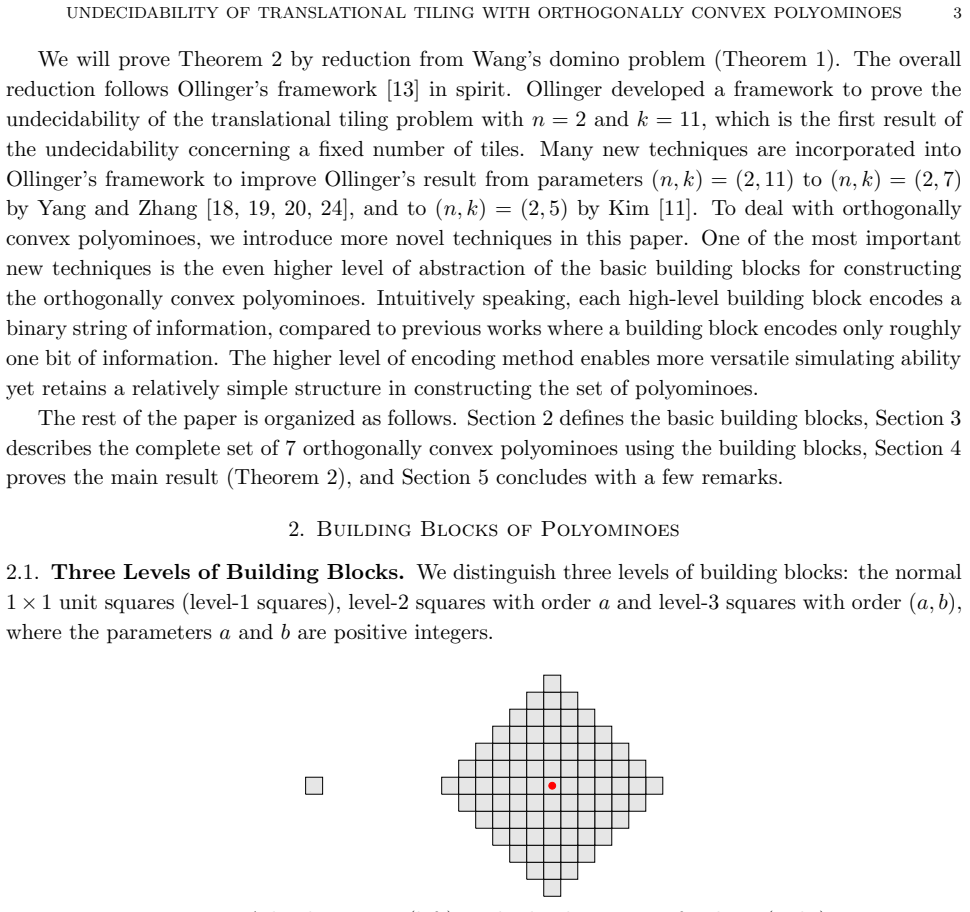
The load-bearing object is the level-3 square of order $(13,22)$, a bundle of 22 by 22 level-2 squares, each an order-13 diamond-shaped 'square simulator' that carries either a dent or a bump on its northwest or southeast side. Binary strings written in dents (0) and bumps (1) on these sides encode the colored edges of simulated Wang tiles, and a fixed pattern in the middle twelve positions of each side forces level-3 squares to align edge-to-edge. The set of seven polyominoes — one tiny filler, one encoder, two linkers, and three partial locators that act as a single locator — is engineered so that any plane tiling must align every level-2 square to the common lattice generated by $i=(13,12)$ and $j=(-12,13)$, align every level-3 square in the northwest-southeast direction, and finally arrange the locators into a rigid grid. In that grid the encoder exposes exactly the information needed to simulate a Wang tiling, and the linkers fill the gaps exactly when simulated edge colors match.
What would settle it
Exhibit a plane tiling of the seven polyominoes in which two level-2 squares belonging to different level-3 polyominoes are not aligned on the lattice generated by (13,12) and (-12,13), or in which the locators do not form the claimed grid; such a tiling would directly contradict Lemma 4 or the rigidity argument and would break the only-if direction of the reduction. A finite-patch search with a tiling solver for a violation of Lemma 3 (two adjacent tiny fillers) would be the most direct place to look first.
Extended reading notes
Core claim
The paper's central claim is Theorem 2: translational tiling of the plane with a set of seven orthogonally convex polyominoes is undecidable. The proof establishes a tiling equivalence: for any finite set of Wang tiles, the constructed seven polyominoes admit a plane tiling by translations if and only if the Wang set does. The 'only if' direction is the hard part; it shows that every tiling of the plane by the seven polyominoes must arrange the pieces in a rigid lattice of locators and encoders, so that the dents and bumps on the tiles read off as encoded colors on simulated Wang-tile edges, and the linkers enforce that adjacent edges share a color. Any algorithm deciding the seven-polyomino tiling problem would therefore decide Wang's domino problem, which is known to be undecidable.
Load-bearing premise
The reduction assumes that every tiling of the plane using the seven polyominoes forces all level-2 squares to lie on the common lattice generated by $i=(13,12)$ and $j=(-12,13)$, and all locators to form the rigid grid claimed in Section 4; if any tiling escaped this alignment, the dents and bumps could not be read as encoded Wang-tile edges.
Editorial extensions
If this is right
- No algorithm can decide, for an arbitrary input of seven orthogonally convex polyominoes, whether translated copies tile the whole plane.
- The undecidability barrier for fixed tile sets in the plane now holds at $k=7$ with orthogonally convex tiles, where previous fixed-tile-set constructions used extremely concave shapes.
- Any Wang tile set that admits only nonperiodic tilings would yield, through this construction, a set of seven orthogonally convex polyominoes that also tiles only nonperiodically, since the polyomino tiling exists exactly when the Wang tiling does.
- The decidability question for translational tiling with orthogonally convex tiles is now closed for $k \geq 7$ and remains open for $k \leq 6$.
- The construction also shows that a relatively simple family of shapes can simulate arbitrary Wang computation, so further restrictions on geometry alone will not automatically restore decidability.
Reading between the lines
- Editorial extension: because the locator is split into three partial pieces only to maintain orthogonal convexity, a variant that relaxes the convexity condition slightly might reduce the tile count further, or the same splitting idea might be applied to other gap-filling roles.
- Editorial extension: the construction's encoding density — one binary string per building block, rather than one bit per block — suggests that the information-carrying capacity of a single tile can be made large; testing whether a single orthogonally convex tile can simulate arbitrary Wang computation would be a natural stress test of the framework's limits.
- Editorial extension: one could computationally instantiate the construction for a small Wang tile set whose tilability is known and search finite patches of the resulting polyomino set for the predicted rigid lattice; if a patch fails to follow Lemma 4 or Lemma 5, it would localize exactly which rigidity claim breaks.
Editorial analysis
A structured set of objections, weighed in public.
Referee Report
Summary. The paper claims Theorem 2: translational tiling of the plane with translated copies of a particular set of 7 orthogonally convex polyominoes is undecidable. The proof reduces from Wang's domino problem (Theorem 1, Berger). For a given set of Wang tiles, Section 3 constructs one tiny filler, one encoder, two linkers, and three partial locators intended to behave as one locator; the design is meant to ensure that the 7 polyominoes tile the plane if and only if the corresponding Wang tiles do. Section 4 argues that every tiling must follow the rigid pattern of Figure 15, that each encoder exposes a simulated Wang tile, and that linkers enforce color matching. If this equivalence is established, the undecidability of Wang's domino problem transfers, yielding the stated result.
Significance. If correct, this is a notable result: it provides a fixed-size undecidable translational tiling problem under a restricted-convexity condition, and it introduces an elegant high-level encoding of binary strings via dents and bumps on level-3 squares. The construction is explicit and the reduction from Berger's theorem is conceptually clear. However, the proof of the direction from polyomino tilings to Wang tilings rests on several rigidity assertions that are currently only supported by informal, figure-based case analyses. The paper does not ship machine-checked proofs or code, but the burden here is not likely to require that; rather, the missing piece is a complete geometric case analysis for the alignment lemmas and for the global locator lattice. Those gaps are load-bearing for the central equivalence.
major comments (4)
- [Section 3, Lemma 3] The proof of Lemma 3 is not a complete case analysis. It asserts that after placing two adjacent tiny fillers the cells marked with red dots in Figure 14 cannot be covered by any level-3 polyomino, and that the partial tiling cannot be extended, but it does not systematically examine all translations and orientations of the six large polyominoes that could cover those cells while avoiding overlap. Since Lemma 3 is the only stated reason why two tiny fillers cannot be adjacent, and Lemma 4 depends on that exclusion, this needs a rigorous argument or an explicit finite check with coordinates.
- [Section 3, Lemma 4] The proof of Lemma 4 assumes part of what it must establish. It moves from Lemma 3 to the assertion that every level-3 polyomino is surrounded by level-3 polyominoes with isolated gaps fillable by a single tiny filler. Lemma 3 only rules out two adjacent tiny fillers; it does not rule out a gap that is a tiny filler combined with a shifted level-2 boundary, nor does it prove that every non-perfect northwest-southeast gap has exactly the shape of the tiny filler. Consequently the concluding sentence 'In all cases, the level-2 squares must be aligned' is unsupported. Without a proof of this lemma, the direction from arbitrary polyomino tilings to Wang tilings cannot be read off.
- [Section 4, bullet 'The locators form a rigid lattice structure'] This is the central global-rigidity step, but it is only asserted. From the fact that a marker {M|L} must be matched by a selector {L|M}, the text concludes that locators 2, 3, 4, and 5 are placed as in Figure 15 and then extends the pattern inductively. No case analysis excludes other relative translations of locators, rotated or reflected arrangements, or partial interlockings among the three pieces of a locator. The claim that at least one simulated Wang tile is exposed only gives a marker somewhere outside the locator; it does not fix the exact grid placement. If a tiling deviates from Figure 15, the encoder boundaries need not form a valid Wang tiling, so this gap affects the only-if direction of the main equivalence.
- [Section 3, end of Section 3] Theorem 2 asserts that all seven pieces are orthogonally convex, but the verification is dismissed with 'It is straightforward to verify that all of them are orthogonally convex.' Since the level-3 shapes are described symbolically and the locator is deliberately split into three pieces, a check should be supplied: for each of the seven pieces, every horizontal and vertical line should intersect the piece in a segment or empty set. This is not a purely cosmetic point, because the assembled locator is explicitly not orthogonally convex and the splitting into three pieces is what makes the claim possible.
minor comments (5)
- [Section 3, locator paragraph] The text says the two light gray partial locators have size 3 x 15 'in light gray in Figure 12', but Figure 12 depicts the linkers; the light gray pieces appear in Figure 13. The figure reference should be corrected.
- [Introduction, Section 1] The phrase 'several different notations of restricted convexity' should read 'several different notions of restricted convexity'.
- [Section 2.3, notation after Lemma 2] The definition of SR writes SR = {Y1, ..., Yi}; since the right part has j entries, this should be {Y1, ..., Yj}.
- [Proof of Theorem 2, last sentence] The final sentence says 'translational tiling of the plane with a set of 7 orthogonally convex is undecidable'; it should say 'a set of 7 orthogonally convex polyominoes is undecidable'.
- [References] Reference [11] is cited as 'a manuscript'; if it is publicly available, the authors should provide an arXiv identifier or a publication status.
Circularity Check
No significant circularity: the reduction rests on Berger's external undecidability of Wang tilings; the flagged rigidity gaps in Lemma 4 and Section 4 are omitted proofs (correctness risks), not circular reductions.
full rationale
The paper's derivation chain is anchored to Berger's Theorem 1, an externally established undecidability result, and the constructed seven-polyomino set is a genuine simulation of Wang tiles rather than a renamed or fitted version of the target claim. The equivalence asserted in the proof of Theorem 2, 'our set of 7 polyominoes can tile the plane if and only if the corresponding set of Wang tiles can tile the plane,' has two independent directions: the if-direction lays down the Figure 15 rigid pattern from a given Wang tiling, and the only-if direction reads a Wang tiling off an assumed rigid polyomino tiling. Neither direction defines its conclusion into existence, and no parameter is fitted so as to predetermine the theorem; the geometric constants (i=(13,12), j=(-12,13), order (13,22)) are design choices. The self-citations [18]-[24] appear only in the introduction's literature review and are not load-bearing; the proof of Theorem 2 relies on internal lemmas plus the external frameworks of Ollinger [13] and Kim [11], and Berger's result is independent of this paper. The genuine weakness is that the rigidity lemmas are asserted with incomplete case analyses: Lemma 4's proof restricts dent/bump adjacencies to lattice-aligned configurations ('dents and bumps of two adjacent level-2 squares must be one of the following three combinations') without a case analysis ruling out non-lattice offsets, Lemma 5 inherits this gap, and the Section 4 locator-lattice induction ('the locators 2, 3, 4 and 5 must be placed as illustrated in Figure 15') is asserted without eliminating shifted or rotated placements. These are omitted proofs and correctness risks in the only-if direction, not circular steps: no premise is defined in terms of the conclusion, and no self-citation supplies the missing support. Honest verdict: no significant circularity, score 1.
Assumptions & free parameters
free parameters (4)
- a, order of level-2 squares =
13
- b, order of level-3 squares =
22
- side part split =
5 first part, 12 second part, 5 third part
- fixed second-part code =
011111111110 (NW), 100000000001 (SE)
assumptions (5)
- standard math Berger's theorem: Wang's domino problem is undecidable
- standard math Beauquier-Nivat and Winslow classification for single-polyomino translational tilability
- domain assumption The seven constructed polyominoes are orthogonally convex
- domain assumption Local adjacency cases in Lemma 3 and Lemma 4 are exhaustive
- domain assumption The rigid lattice pattern extends to the whole plane by induction
Cite this review
Pith. "Pith review of Undecidability of Translational Tiling of the Plane with Orthogonally Convex Polyominoes." pith.science (2026). https://pith.science/paper/7KPKOAWC
@misc{pith2026250612726,
  author       = {Pith},
  title        = {Pith review of: Undecidability of Translational Tiling of the Plane with Orthogonally Convex Polyominoes},
  year         = {2026},
  howpublished = {\url{https://pith.science/paper/7KPKOAWC}},
  note         = {Machine review of arXiv:2506.12726}
}
read the original abstract
The first undecidability result on the tiling is the undecidability of translational tiling of the plane with Wang tiles, where there is an additional color matching requirement. Later, researchers obtained several undecidability results on translational tiling problems where the tilings are subject to the geometric shapes of the tiles only. However, all these results are proved by constructing tiles with extremely concave shapes. It is natural to ask: can we obtain undecidability results of translational tiling with convex tiles? Towards answering this question, we prove the undecidability of translational tiling of the plane with a set of 7 orthogonally convex polyominoes.
Figures


Figures from the paper (12 more)


Reference graph
Works this paper leans on
-
[1]
D. Beauquier, M. Nivat, On translating one polyomino to tile the plane, Discrete & Computational Geometry, 6(1991), 575-592
work page 1991
-
[2]
R. Berger, The undecidability of the domino problem, Memoirs of the American Mathematical Society, 66(1966), 1-72
work page 1966
-
[3]
Bhattacharya, Periodicity and decidability of tilings of Z2
B. Bhattacharya, Periodicity and decidability of tilings of Z2. American Journal of Mathematics, 142(2020), 255- 266
work page 2020
-
[4]
J. de Dios, J. Grebik, R. Greenfeld, J. Madrid, Periodicity and decidability of translational tilings by rational polygonal sets. Expositiones Mathematicae, (2024), 125620, in press
work page 2024
-
[5]
E. Fink, D. Wood, Restricted-Orientation Convexity, Springer Berlin, Heidelberg, 2004
work page 2004
-
[6]
H. Gonz´ alez-Aguilar, D. Orden, P. P´ erez-Lantero, D. Rappaport, C. Seara, J. Tejel and J. Urrutia. Maximum Rectilinear Convex Subsets. In: L. Gasieniec, J. Jansson, C. Levcopoulos (eds), Fundamentals of Computation Theory (FCT 2019). Lecture Notes in Computer Science, vol 11651. Springer, Cham, 274-291
work page 2019
-
[7]
R. Greenfeld, T. Tao. The structure of translational tilings in Zd. Discrete Analysis. (2021:16). 1-28
work page 2021
-
[8]
R. Greenfeld, T. Tao, A counterexample to the periodic tiling conjecture. Annals of Mathematics, 200(1)(2024), 301-363
work page 2024
Show all 26 references
-
[9]
Greenfeld, T
R. Greenfeld, T. Tao, Undecidability of translational monotilings. to appear in Journal of the European Mathemat- ical Society, arXiv:2309.09504 [math.CO]
-
[10]
Gr¨ unbaum, G
B. Gr¨ unbaum, G. C. Shephard, Tilings and Patterns, 2nd Edition, Dover Publications, 2016
2016
-
[11]
Kim, Undecidability of tiling the plane with a set of 5 polyominoes, (2025), a manuscript
Y. Kim, Undecidability of tiling the plane with a set of 5 polyominoes, (2025), a manuscript
2025
-
[12]
J. C. Lagarias, Y. Wang, Tiling the line with translates of one tile, Inventiones mathematicae, 124 (1996), 341-365
1996
-
[13]
Ollinger, Tiling the plane with a fixed number of polyominoes, In: A.H
N. Ollinger, Tiling the plane with a fixed number of polyominoes, In: A.H. Dediu, A.M. Ionescu, C. Mart ´ ın-Vide (eds), Language and Automata Theory and Applications (LATA 2009). Lecture Notes in Computer Science, vol
2009
-
[14]
Sidorenko, Periodicity of one-dimensional tilings
V. Sidorenko, Periodicity of one-dimensional tilings. In: A. Chmora, S.B. Wicker (eds), Error Control, Cryptology, and Speech Compression (ECCSP 1993). Lecture Notes in Computer Science, vol 829. Springer, Berlin, Heidelberg. 103-108
1993
-
[15]
S. K. Stein, Algebraic tiling, The American Mathematical Monthly, 81 (1974), 445-462
1974
-
[16]
Wang, Proving theorems by pattern recognition-II, Bell System Technical Journal, 40(1961) 1-41
H. Wang, Proving theorems by pattern recognition-II, Bell System Technical Journal, 40(1961) 1-41
1961
-
[17]
Winslow, An optimal algorithm for tiling the plane with a translated polyomino, In: K
A. Winslow, An optimal algorithm for tiling the plane with a translated polyomino, In: K. Elbassioni, K. Makino (eds), Algorithms and Computation (2015), Springer, Berlin, Heidelberg, 3-13
2015
-
[18]
Yang, Tiling the plane with a set of ten polyominoes, International Journal of Computational Geometry & Applications, 33(03n04)(2023), 55-64
C. Yang, Tiling the plane with a set of ten polyominoes, International Journal of Computational Geometry & Applications, 33(03n04)(2023), 55-64
2023
-
[19]
Yang, On the undecidability of tiling the plane with a set of 9 polyominoes (in Chinese), SCIENTIA SINICA Mathematica, (2024), https://doi.org/10.1360/SSM-2024-0035
C. Yang, On the undecidability of tiling the plane with a set of 9 polyominoes (in Chinese), SCIENTIA SINICA Mathematica, (2024), https://doi.org/10.1360/SSM-2024-0035
2024 doi
-
[20]
C. Yang, Z. Zhang, Translational tiling with 8 polyominoes is undecidable, Discrete & Computational Geometry, (2024), https://doi.org/10.1007/s00454-024-00706-1
2024 doi
-
[21]
C. Yang, Z. Zhang, Undecidability of translational tiling of the 3-dimensional space with a set of 6 polycubes, arXiv:2408.02196 [math.CO], to appear in Proceedings of the AMS
-
[22]
C. Yang, Z. Zhang, Undecidability of translational tiling of the 4-dimensional space with a set of 4 polyhypercubes, SCIENCE CHINA Mathematics, (2025), https://doi.org/10.1007/s11425-024-2365-2
2025 doi
-
[23]
C. Yang, Z. Zhang, Undecidability of translational tiling with three tiles, arXiv:2412.10646 [math.CO]
-
[24]
C. Yang, Z. Zhang, Translational aperiodic sets of 7 polyominoes, arXiv:2412.17382 [math.CO]
-
[25]
Zong, Can you pave the plane with identical tiles? Notices of the American Mathematical Society, 67(5)(2020), 635-646
C. Zong, Can you pave the plane with identical tiles? Notices of the American Mathematical Society, 67(5)(2020), 635-646. 20 CHAO YANG AND ZHUJUN ZHANG School of Mathematics and Statistics, Guangdong University of Foreign Studies, Guangzhou, 510006, China Email address: sokoba...
2020
-
[5457]
Springer, Berlin, Heidelberg, 638-649
Reviewed August 7, 2026 · model on record in the stance chip above.
Discussion (0). Continue with ORCID to comment.