REVIEW 3 major objections 3 minor 1 cited by
First detection of HS2 in a cold dark cloud
T0 review · 3 major / 3 minor · reviewed 2026-08-07 · deepseek-v4-flash
Pith's one-line read This paper reports the first detection of the HS2 radical in the cold dark cloud TMC-1, with an abundance about seven times that of its oxygen analogue HSO.
desk verdict HS2 in TMC-1 is a plausible first detection, but the paper's >4σ claim doesn't survive Table 1; the lines are ~3σ, so the detection needs a proper combined significance. read the letter →
The pith
A machine-rendered reading of the paper's core claim, the machinery that carries it, and where it could break.
The reading
What carries the argument
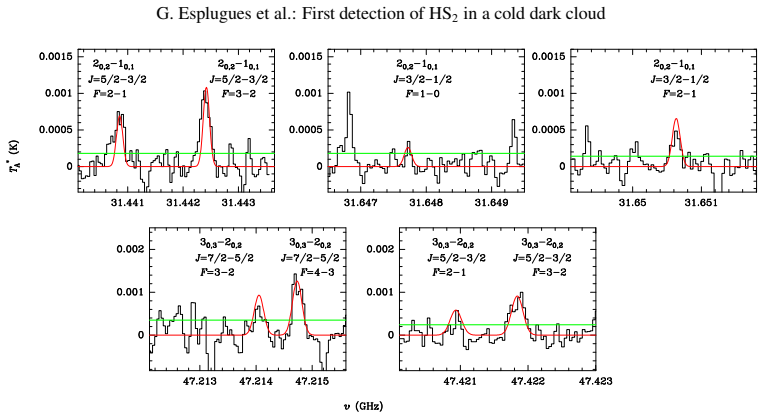
The object that carries the claim is the HS2 radical, a bent molecule with an unpaired electron, which produces fine and hyperfine line structure that gives each rotational transition a characteristic multiplet. The argument works by matching five observed lines to the predicted multiplet positions and relative intensities of the $2_{0,2}-1_{0,1}$ and $3_{0,3}-2_{0,2}$ transitions, then using an LTE excitation model with rotational temperature and column density as free parameters to reproduce the full set of profiles. Because the upper levels lie at only 2.2 and 4.5 K, the derived column density is insensitive to the exact temperature as long as it is not below about 4.5 K. A three-phase gas-grain chemical model (gas, surface, mantle) with a standard astrochemical network supplies the formation and destruction rates used to interpret the observed abundance.
What would settle it
Observe the three hyperfine components of HS2 that this survey did not detect ($2_{0,2}-1_{0,1}$, $J=3/2-1/2$, $F=1-0$, and the $F=3-2$ and $F=2-1$ components of $3_{0,3}-2_{0,2}$) with deeper integration: if the assignment is correct they must appear at their predicted relative intensities and at the same source velocity as the five detected lines, near 5.8–6.1 km s$^{-1}$.
Extended reading notes
Core claim
On the paper's own terms, the discovery is that HS2 exists in the cold gas of TMC-1 with observable emission. Five lines, four above $4\sigma$ and one at $3.5\sigma$, match catalog rest frequencies and hyperfine patterns of HS2 and are not blended with known spectral features. Fitting all five line profiles with a local thermodynamic equilibrium model at $T_{\rm rot}=7$ K yields $N({\rm HS}_2)=(5.7\pm1.1)\times10^{11}$ cm$^{-2}$, and adopting $N({\rm H}_2)=10^{22}$ cm$^{-2}$ gives a fractional abundance of $(5.7\pm1.1)\times10^{-11}$. The chemical model identifies dissociative recombination of H$_3$S$_2^+$ and H$_2$S$_2^+$ as the dominant gas-phase formation channels, with destruction by proton transfer from H$^+$, H$_3^+$, HCO$^+$, and H$_3$O$^+$, and finds no significant grain-surface contribution in the adopted network. The paper concludes that this is the first detection of a species containing more than one sulfur atom in a cold dark cloud.
Load-bearing premise
The identification hinges on the catalog rest frequencies and hyperfine intensities of HS2 and on the five lines being genuine rather than chance coincidences with unknown carriers; the weakest detected line is only at $3.5\sigma$.
Editorial extensions
If this is right
- HS2 becomes the first two-sulfur molecule found in a cold dark cloud, so searches for related di-sulfur species such as S2, H2S2, and HSSH in TMC-1 become well motivated.
- The HS2/HSO abundance ratio of about seven in TMC-1 means the sulfur analogue is not suppressed relative to its oxygen counterpart, a constraint for chemical networks that treat S and O similarly.
- The model's ability to reproduce the observed abundance with a depleted initial sulfur abundance of $1.5\times10^{-6}$ supports the idea that HS2 forms mainly via gas-phase ion-electron recombination rather than requiring new grain-surface reactions.
- Because the modeled HS2 abundance depends strongly on cloud density and on the sulfur depletion factor, future detections in other dark clouds could be used as probes of sulfur depletion.
- The very low upper-level energies of the detected transitions imply that HS2 emission traces the cold envelope of TMC-1, consistent with other sulfur molecules in the same source.
Reading between the lines
- A natural extension not developed in the paper is a direct search for the precursor ions H$_3$S$_2^+$ and H$_2$S$_2^+$ in the same Q-band data; detecting them would test the proposed formation pathway rather than only its product.
- The chemical network omits the grain-surface reaction S$_2$ + H $\rightarrow$ HS$_2$ while treating H$_2$ + S$_2$ as barrierless; updating that choice could raise or lower the predicted HS$_2$ abundance at early times and is a concrete way to test the assumed surface chemistry.
- If the HS2/HSO ratio reflects a general chalcogen pattern, cold clouds should also show measurable differences between HO2 and HSO-type chemistries; better abundance limits on HO2 in TMC-1 would show whether sulfur and oxygen really diverge in this way.
Editorial analysis
A structured set of objections, weighed in public.
Referee Report
Summary. The paper reports the first detection of the HS2 radical toward the cold dark cloud TMC-1 using the QUIJOTE Q-band survey. Five hyperfine components of the 20,2-10,1 and 30,3-20,2 rotational transitions are identified with the help of CDMS/MADEX spectroscopic data. An LTE model with Trot = 7 K and an assumed source size of 80 arcsec yields a column density of (5.7 ± 1.1) × 10^11 cm^-2 and an abundance of (5.7 ± 1.1) × 10^-11 relative to H2. The authors also run Nautilus chemical models with the KIDA network and attribute the main formation of HS2 to dissociative recombination of H2S2+ and H3S2+.
Significance. If the detection is secure, it would be the first identification of a molecule containing more than one sulfur atom in a cold dark cloud, and it would add a new observational constraint on sulfur chemistry in dense, quiescent gas. The comparison with HSO and the use of standard, publicly available tools (CDMS/MADEX and Nautilus/KIDA) are strengths. However, the detection claim currently rests on a significance statement that is contradicted by the tabulated line parameters, and the self-consistency of the hyperfine pattern is not demonstrated quantitatively. These issues are load-bearing for the central claim, so the paper needs major revision.
major comments (3)
- [Section 3, Table 1] The claimed detection significance is not supported by the uncertainties in Table 1. From the tabulated peak antenna temperatures and their 1σ errors, the signal-to-noise ratios are 0.60/0.22 = 2.7, 1.02/0.28 = 3.6, 0.47/0.17 = 2.8, 1.41/0.50 = 2.8, and 1.00/0.36 = 2.8. The integrated values give 3.0, 3.7, 3.0, 2.8, and 3.3. None of the five lines reaches 4σ, and the weakest is 2.7σ, not the quoted 3.5σ. The statement in Section 3 that four lines are detected above 4σ and one at 3.5σ is therefore inconsistent with the table. Please define the precise noise measure and smoothing used for the significance estimate, or revise the detection claim. If the Table 1 errors are the true uncertainties, a statistical combination of the five lines (and the nondetected components) should be presented to justify a secure identification.
- [Section 3] The three nondetected hyperfine components (20,2-10,1, J = 3/2-1/2, F = 1-0; 30,3-20,2, J = 7/2-5/2, F = 3-2; and 30,3-20,2, J = 5/2-3/2, F = 2-1) are dismissed as being weaker or falling in noisier regions, but no quantitative evidence is provided. To establish that the five detected lines form a self-consistent hyperfine pattern, give the local rms noise at each nondetected frequency, the expected peak intensity from the best-fit LTE model, and the resulting upper limit or detection. Without these numbers, the possibility that one or more of the five features are unrelated chance fluctuations or lines of a different carrier is not excluded.
- [Section 3, LTE fit] The quoted 20% uncertainty in the HS2 column density appears to reflect only the dispersion of the line fits and does not propagate the assumed source size of 80 arcsec, the assumed H2 column density of 10^22 cm^-2, or the range of plausible rotational temperatures. Since the abundance is directly compared with HSO and with the Horsehead value, please specify how the 20% error was computed and report the sensitivity of N(HS2) to the source-size and temperature assumptions. This does not affect the reality of the lines, but it is essential for the quantitative abundance comparison that is a central result of the paper.
minor comments (3)
- [Throughout] There are several typographical errors, including 'dest uction' in Figure B.2, 'effotts' in Section 4.1, and the corrupted text 't/greaterorsimilar104 yr' in Section 4.2. Please correct these and check the final PDF for symbol rendering.
- [Table 1] The header for the integrated intensity column is difficult to parse; consider writing it as '∫ T_A^* dv' and using consistent units in the column caption.
- [Section 2] The sentence describing the FFTS spectral resolution says 'a spectral resolution of 38.15 kHz (~0.27 km/s) was also used' but the verb is missing; please rephrase.
Circularity Check
No significant circularity: detection and abundance analysis are anchored to external spectroscopic and chemical databases.
full rationale
The paper's central claims are (i) the detection of HS2 lines in TMC-1 and (ii) a LTE column density plus chemical model abundance. The line identification is checked against the external CDMS database and MADEX code, with rest frequencies and hyperfine structure taken from published laboratory spectroscopy; the observed vLSR and line widths are consistent with TMC-1, and no blend is claimed. The column density is obtained by fitting an LTE model to the observed line intensities with Trot and N(HS2) as free parameters, which is a standard reduction of the data rather than a self-referential prediction. The chemical modeling uses the public Nautilus code with the KIDA kida.uva.2022 network; initial elemental abundances and physical parameters (AV, zeta) are taken from prior literature, and the model's HS2 abundance is compared with the observed value rather than adjusted to reproduce it. Self-citations appear only as descriptions of the QUIJOTE survey, the MADEX code, and consistency checks against previous molecular analyses in TMC-1; none of these carries the argument alone. The weakest line significance and nondetected hyperfine components are statistical and identification concerns, not circularity.
Assumptions & free parameters
free parameters (8)
- Rotational temperature T_rot =
7 K
- Source size (emitting region diameter) =
80 arcsec
- H2 column density =
1e22 cm^-2
- Line width =
1.3 km/s
- Initial S+ abundance =
1.5e-6 (and 1.5e-7)
- Hydrogen density nH =
1e4 or 1e5 cm^-3
- Gas temperature Tg =
5 K (and 10 K for one model)
- Cosmic-ray ionisation rate zeta =
1.3e-17 s^-1
assumptions (5)
- domain assumption Local thermodynamic equilibrium (LTE) applies to HS2 excitation
- domain assumption CDMS/MADEX spectroscopic line list for HS2 is accurate
- domain assumption The chemical network (kida.uva.2022) is sufficiently complete to identify dominant formation and destruction paths
- domain assumption Adopted physical parameters for TMC-1 are representative
- domain assumption TMC-1 H2 column density is 1e22 cm^-2
Cite this review
Pith. "Pith review of First detection of HS2 in a cold dark cloud." pith.science (2026). https://pith.science/paper/2KL4MCP3
@misc{pith2026250612974,
  author       = {Pith},
  title        = {Pith review of: First detection of HS2 in a cold dark cloud},
  year         = {2026},
  howpublished = {\url{https://pith.science/paper/2KL4MCP3}},
  note         = {Machine review of arXiv:2506.12974}
}
read the original abstract
We report the first detection of HS2 towards the cold dark cloud TMC-1. This is the first observation of a chemical species containing more than one sulphur atom in this type of sources. The astronomical observations are part of QUIJOTE, a line survey of TMC-1 in the Q band (31-50 GHz). The detection is confirmed by the observation of the fine and hyperfine components of two rotational transitions (2(0,2)-1(0,1) and 3(0,3)-2(0,2)). Assuming a rotational temperature of 7 K, we derived an HS2 column density of 5.7x10^11 cm-2, using a local thermodynamic equilibrium model that reproduces the observed spectra. The abundance of HS2 relative to H2 is 5.7x10^-11, which means that it is about seven times more abundant than its oxygenated counterpart HSO. We also explored the main formation and destruction mechanisms of HS2 using a chemical model, which reproduces the observed abundance of HS2 and indicates that dissociative recombination reactions from the ions H2S2+ and H3S2+ play a major role in forming HS2.
Figures
Forward citations
Cited by 1 Pith paper
-
Chemistry of Dark Molecular Clouds
A comprehensive review arguing that the chemically rich cores TMC-1 CP and L1544 are representative molecular-cloud laboratories, and that complex organic molecule production is largely insensitive to metallicity.
Reference graph
Works this paper leans on
-
[1]
, " * write output.state after.block = add.period write newline
ENTRY address archiveprefix author booktitle chapter edition editor howpublished institution eprint journal key month note number organization pages publisher school series title type volume year label extra.label sort.label short.list INTEGERS output.state before.all mid.sentence after.sentence after.block FUNCTION init.state.consts #0 'before.all := #1 ...
-
[2]
write newline
" write newline "" before.all 'output.state := FUNCTION n.dashify 't := "" t empty not t #1 #1 substring "-" = t #1 #2 substring "--" = not "--" * t #2 global.max substring 't := t #1 #1 substring "-" = "-" * t #2 global.max substring 't := while if t #1 #1 substring * t #2 global.max substring 't := if while FUNCTION word.in bbl.in " " * FUNCTION format....
-
[3]
Ag \'u ndez , M., Molpeceres , G., Cabezas , C., et al. 2025, , 693, L20
work page 2025
-
[4]
J., & Scott , P
Asplund , M., Grevesse , N., Sauval , A. J., & Scott , P. 2009, , 47, 481
2009
-
[5]
P., Xi , J., Kinsland , C., Taylor , S., & McLafferty , F
Begley , T. P., Xi , J., Kinsland , C., Taylor , S., & McLafferty , F. 1999, Chemical Biology, Elsevier Science, 3, 5, 623
work page 1999
- [6]
-
[7]
2025, accepted by , doi 10.1051/0004-6361/202554670
Cabezas , C., Vávra , K., Molpeceres , G., et al. 2025, accepted by , doi 10.1051/0004-6361/202554670
- [8]
Show all 62 references
-
[9]
1985, Internal IRAM report (Granada: IRAM)
Cernicharo , J. 1985, Internal IRAM report (Granada: IRAM)
1985
-
[10]
2012, in EAS Publications Series, Vol
Cernicharo , J. 2012, in EAS Publications Series, Vol. 58, EAS Publications Series, ed. C. Stehl \'e , C. Joblin , & L. d'Hendecourt , 251--261
2012
-
[11]
I., et al
Cernicharo , J., Ag \'u ndez , M., Kaiser , R. I., et al. 2021 a , , 652, L9
2021
-
[12]
2024, , 688, L13
Cernicharo , J., Cabezas , C., Ag \'u ndez , M., et al. 2024, , 688, L13
2024
-
[13]
2021 b , , 648, L3
Cernicharo , J., Cabezas , C., Ag \'u ndez , M., et al. 2021 b , , 648, L3
2021
-
[14]
2021 c , , 650, L14
Cernicharo , J., Cabezas , C., Endo , Y., et al. 2021 c , , 650, L14
2021
-
[15]
2021 d , , 646, L3
Cernicharo , J., Cabezas , C., Endo , Y., et al. 2021 d , , 646, L3
2021
-
[16]
& Guelin , M
Cernicharo , J. & Guelin , M. 1987, , 176, 299
1987
-
[17]
2023, , 674, L4
Cernicharo , J., Tercero , B., Marcelino , N., Ag \'u ndez , M., & de Vicente , P. 2023, , 674, L4
2023
-
[18]
& Hausinger , R
Chatterjee , S. & Hausinger , R. P. 2022, Critical Reviews in Biochemistry and Molecular Biology, 57, 461
2022
-
[19]
Clark , B. C. 1981, in NASA Conference Publication, Vol. 2156, NASA Conference Publication, ed. J. Billingham , 47
1981
-
[20]
& Wakelam , V
Druard , C. & Wakelam , V. 2012, , 426, 354
2012
-
[21]
P., Schlemmer , S., Schilke , P., Stutzki , J., & M \"u ller , H
Endres , C. P., Schlemmer , S., Schilke , P., Stutzki , J., & M \"u ller , H. S. P. 2016, Journal of Molecular Spectroscopy, 327, 95
2016
-
[22]
2022, , 662, A52
Esplugues , G., Fuente , A., Navarro-Almaida , D., et al. 2022, , 662, A52
2022
-
[23]
2023, , 678, A199
Esplugues , G., Rodr \' guez-Baras , M., San Andr \'e s , D., et al. 2023, , 678, A199
2023
-
[24]
B., Tercero , B., Cernicharo , J., et al
Esplugues , G. B., Tercero , B., Cernicharo , J., et al. 2013, , 556, A143
2013
-
[25]
B., Viti , S., Goicoechea , J
Esplugues , G. B., Viti , S., Goicoechea , J. R., & Cernicharo , J. 2014, , 567, A95
2014
-
[26]
2001, , 552, 168
Foss \'e , D., Cernicharo , J., Gerin , M., & Cox , P. 2001, , 552, 168
2001
-
[27]
2025, arXiv e-prints, arXiv:2505.22117
Fuente , A., Esplugues , G., Rivi \`e re-Marichalar , P., et al. 2025, arXiv e-prints, arXiv:2505.22117
2025 arXiv
-
[28]
R., Pety , J., et al
Fuente , A., Goicoechea , J. R., Pety , J., et al. 2017, , 851, L49
2017
-
[29]
G., Caselli , P., et al
Fuente , A., Navarro , D. G., Caselli , P., et al. 2019, , 624, A105
2019
-
[30]
2023, , 670, A114
Fuente , A., Rivi \`e re-Marichalar , P., Beitia-Antero , L., et al. 2023, , 670, A114
2023
-
[31]
T., Wakelam , V., & Herbst , E
Garrod , R. T., Wakelam , V., & Herbst , E. 2007, , 467, 1103
2007
-
[32]
E., Langer , W
Graedel , T. E., Langer , W. D., & Frerking , M. A. 1982, , 48, 321
1982
-
[33]
A., Millar , T
Hatchell , J., Thompson , M. A., Millar , T. J., & MacDonald , G. H. 1998, , 133, 29
1998
-
[34]
2022, , 658, A168
Hily-Blant , P., Pineau des For \^e ts , G., Faure , A., & Lique , F. 2022, , 658, A168
2022
-
[35]
C., Sembach , K
Howk , J. C., Sembach , K. R., & Savage , B. D. 2006, , 637, 333
2006
-
[36]
& Mu \ n oz Caro , G
Jim \'e nez-Escobar , A. & Mu \ n oz Caro , G. M. 2011, , 536, A91
2011
-
[37]
2018, , 862, 128
Jim \'e nez-Serra , I., Viti , S., Qu \'e nard , D., & Holdship , J. 2018, , 862, 128
2018
-
[38]
2019, , 485, 5777
Loison , J.-C., Wakelam , V., Gratier , P., et al. 2019, , 485, 5777
2019
-
[39]
2023, , 674, L13
Marcelino , N., Puzzarini , C., Ag \'u ndez , M., et al. 2023, , 674, L13
2023
-
[40]
M., et al
Mart \' n-Dom \'e nech , R., Jim \'e nez-Serra , I., Mu \ n oz Caro , G. M., et al. 2016, , 585, A112
2016
-
[41]
Morton , D. C. 1974, , 193, L35
1974
-
[42]
u ller , H. S. P., Schl \
M \"u ller , H. S. P., Schl \"o der , F., Stutzki , J., & Winnewisser , G. 2005, Journal of Molecular Structure, 742, 215
2005
-
[43]
M \"u ller , H. S. P., Thorwirth , S., Roth , D. A., & Winnewisser , G. 2001, , 370, L49
2001
-
[44]
P., Kumar , P., Yadav , B., & Joohri , A
Narayan , O. P., Kumar , P., Yadav , B., & Joohri , A. K. 2023, Plant Signaling & Behavior, 18, 1
2023
-
[45]
2021, , 653, A15
Navarro-Almaida , D., Fuente , A., Majumdar , L., et al. 2021, , 653, A15
2021
-
[46]
A., Wolfire , M
Neufeld , D. A., Wolfire , M. G., & Schilke , P. 2005, , 628, 260
2005
-
[47]
E., Geballe , T
Palumbo , M. E., Geballe , T. R., & Tielens , A. G. G. M. 1997, , 479, 839
1997
-
[48]
R., Cernicharo , J., & Serabyn , E
Pardo , J. R., Cernicharo , J., & Serabyn , E. 2001, IEEE Transactions on Antennas and Propagation, 49, 1683
2001
-
[49]
2012, , 541, L11
Parise , B., Bergman , P., & Du , F. 2012, , 541, L11
2012
-
[50]
Prasad , S. S. & Tarafdar , S. P. 1983, , 267, 603
1983
-
[51]
& Toupance , G
Raulin , F. & Toupance , G. 1977, Journal of Molecular Evolution, 9, 329
1977
-
[52]
J., Changala , P
Remijan , A. J., Changala , P. B., Xue , C., et al. 2025, , 982, 191
2025
-
[53]
2016, , 459, 3756
Ruaud , M., Wakelam , V., & Hersant , F. 2016, , 459, 3756
2016
-
[54]
P., Hartquist , T
Ruffle , D. P., Hartquist , T. W., Caselli , P., & Williams , D. A. 1999, , 306, 691
1999
-
[55]
Sendt , K., Jazbec , M., & Haynes , B. S. 2002, Elsevier, 29, 2439
2002
-
[56]
N., Lamberts , T., Laas , J
Shingledecker , C. N., Lamberts , T., Laas , J. C., et al. 2020, , 888, 52
2020
-
[57]
A., Gallego , J
Tercero , F., L \'o pez-P \'e rez , J. A., Gallego , J. D., et al. 2021, , 645, A37
2021
-
[58]
M., Tew , K
Townsend , D. M., Tew , K. D., & Tapiero , H. 2004, in Biomedicine and Pharmacotherapy, Vol. 58, 47--55
2004
-
[59]
Vidal , T. H. G., Loison , J.-C., Jaziri , A. Y., et al. 2017, , 469, 435
2017
-
[60]
2021, , 652, A63
Wakelam , V., Dartois , E., Chabot , M., et al. 2021, , 652, A63
2021
-
[61]
C., et al
Wakelam , V., Gratier , P., Loison , J. C., et al. 2024, , 689, A63
2024
-
[62]
& Herbst , E
Wakelam , V. & Herbst , E. 2008, , 680, 371
2008
Reviewed August 7, 2026 · model on record in the stance chip above.
Discussion (0). Continue with ORCID to comment.