REVIEW 4 major objections 6 minor 43 references
Dual guidance: ROM-informed field reconstruction with generative models
T0 review · 4 major / 6 minor · reviewed 2026-08-15 · deepseek-v4-flash
Pith's one-line read Optimal sensor placement computed from a reduced-order model lets a guided diffusion model reconstruct unsteady wake flows from as few as 9 or 16 sensors, while the advantage over uniform grids disappears beyond about 25 sensors.
desk verdict A sensible integration of MI-based sensor placement and guided diffusion, but the headline sparse-sensor gains are in-sample because sensor positions are chosen from the full dataset. read the letter →
The pith
A machine-rendered reading of the paper's core claim, the machinery that carries it, and where it could break.
The reading
What carries the argument
The load-bearing object is the Gaussian mutual-information identity $I(y;a)=\frac{1}{2}\log\det(I+\sigma^{-2}\Phi_S\Sigma_a\Phi_S^\top)$, which turns the combinatorial sensor-placement problem into a greedy selection: at each step, choose the candidate location whose addition gives the largest marginal increase in this determinant. On the generation side, the second mechanism is guided diffusion sampling: at each denoising step, a deterministic estimate $\hat{x}_N^i$ is updated by gradients of the observation mismatch $\|y_{\mathrm{obs}}-M(\hat{x}_N^i)\|_2^2$ and of the PDE residual $\|f(\hat{x}_N^i)\|_2^2$, with $f$ taken here as the divergence-free constraint $\nabla\cdot v=0$. Together these two mechanisms are what the paper calls dual guidance: ROM-informed sensor selection plus physics-constrained generative reconstruction.
What would settle it
Select sensors using only a strict subset of the 300 simulations, freeze those coordinates, reconstruct the remaining held-out runs with the same guided diffusion model at 9 and 16 points, and compare $\ell^2$ errors against a uniform grid; if the improvement drops substantially below the reported 55-90% in either velocity component, the gains are evidence of in-sample sensor tuning rather than of the placement criterion itself.
Extended reading notes
Core claim
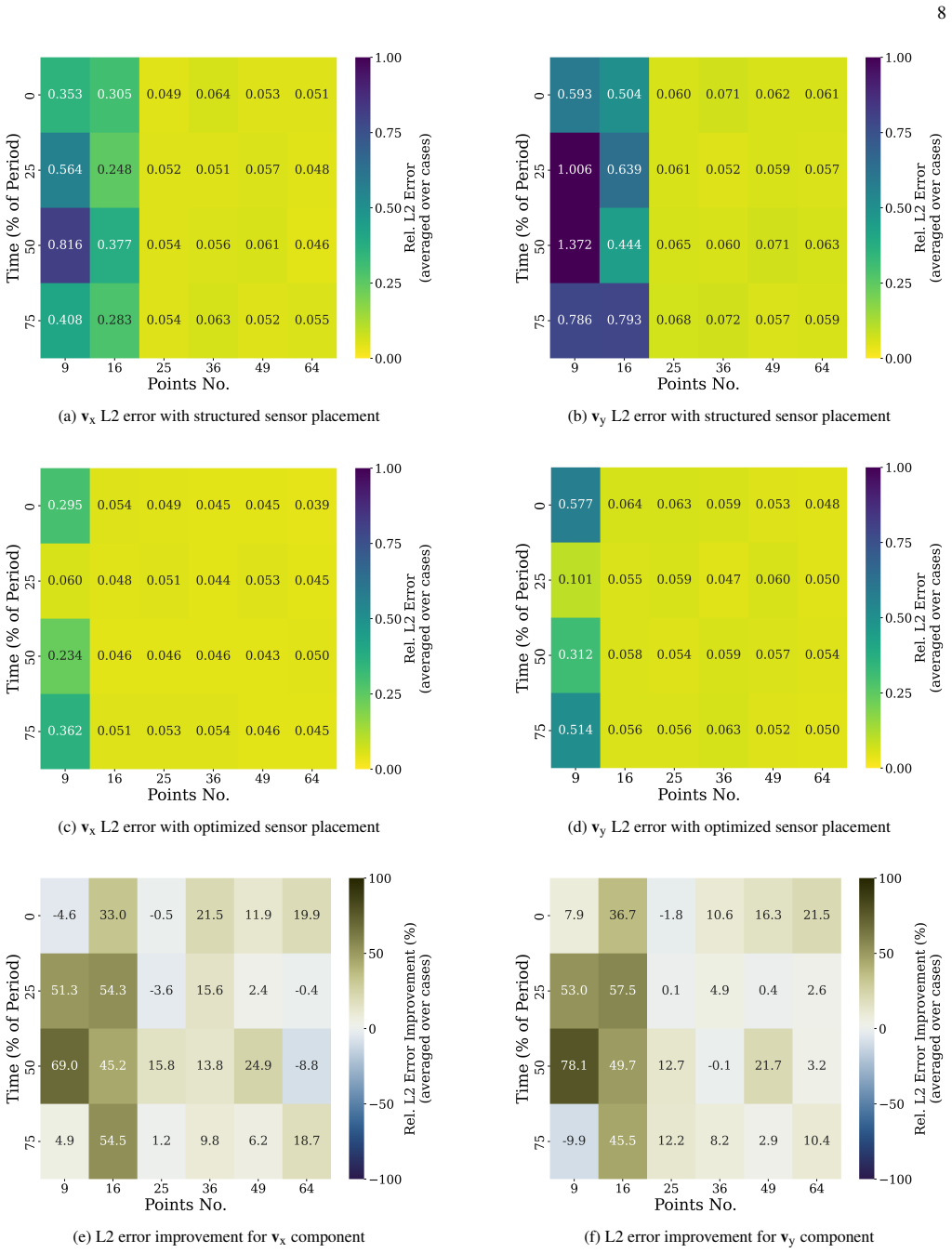
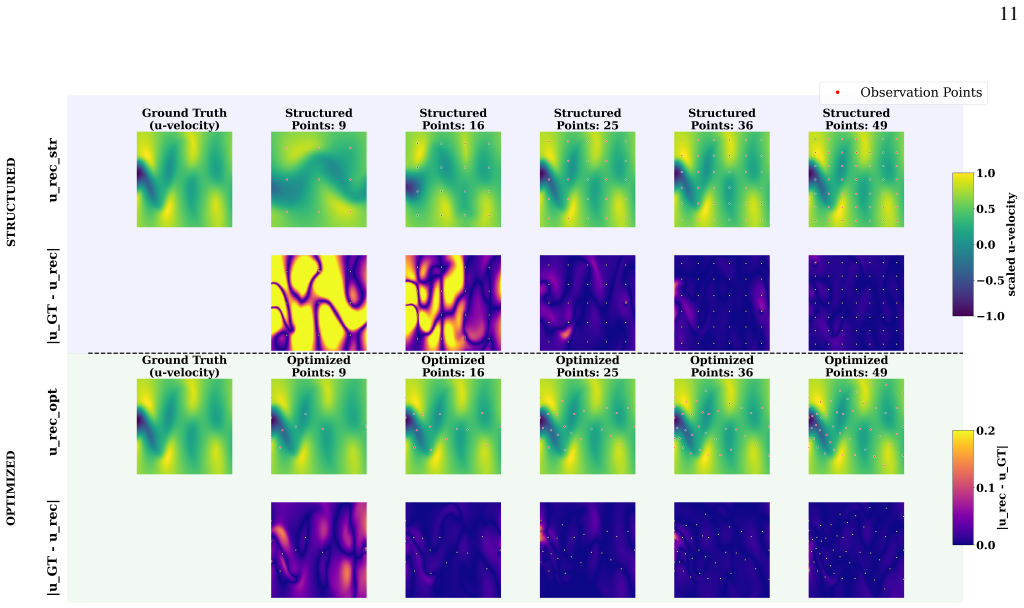
The central claim is that a greedy mutual-information objective computed from a POD-reduced representation of the flow selects sensor locations that are much better for diffusion-based reconstruction than uniform coverage, and that this advantage is concentrated in the data-scarce regime where reconstruction is otherwise unreliable. Formally, with sensor selection matrix $P$, POD basis $\Phi$, reduced-coordinate covariance $\Sigma_a$, and noise variance $\sigma^2$, the mutual information between sensor readings and the reduced state is $I(y;a) = \tfrac{1}{2}\log\det(I + \sigma^{-2} P\Phi\Sigma_a\Phi^\top P^\top)$. Maximizing this quantity greedily yields sensors concentrated near vortex cores and shear layers. When those points are used as conditioning for a denoising diffusion model, the paper reports $\ell^2$ errors near 0.05 for $v_x$ and $v_y$ once roughly 25 points are available, with the largest relative gains at 9 and 16 points: at 16 points the improvement over a uniform grid is 83% for $v_x$ and 90% for $v_y$, and at 9 points it is 55% and 60%. The paper further claims that beyond about 25 sensors the two placement strategies converge, because the measurement set already resolves the dominant flow structures.
Load-bearing premise
The load-bearing premise is that sensor locations can be fixed using flow statistics drawn from the full dataset, including the cases and time steps used for evaluation; if sensors must be chosen from training data alone and transferred to unseen flow conditions, the reported advantage over structured layouts may not hold.
Editorial extensions
If this is right
- At 9 or 16 observation points, sensor-location choice can move reconstruction from unusable (structured errors above 0.8 in some cases) to practically accurate ($\ell^2$ error around 0.05), so placement is the deciding factor in data-limited flow reconstruction.
- Beyond about 25 sensors, structured and optimized layouts converge to similar errors, meaning expensive placement optimization is unnecessary when the observation budget already resolves the dominant flow structures.
- Because sensor selection runs on a POD basis and covariance rather than on full-order brute-force search, the placement step is cheap enough to apply to large spatial domains.
- The dual guidance of observation consistency plus the divergence-free constraint is what allows the diffusion model to extrapolate from sparse points; the same guided diffusion model, when conditioned on uniform-grid sensors, fails only when sensors are few.
Reading between the lines
- Beyond the paper: because the sensor positions are selected using POD statistics of the full dataset, including the test cases, part of the reported 55-90% gain may be in-sample tuning; a held-out protocol that fixes sensors using only training runs would separate placement quality from selection bias.
- Beyond the paper: the authors note that fixed sensors cannot be optimal at every timestep and report negative improvements at some timesteps; a phase-adaptive or online sensor-selection policy could recover that lost margin in unsteady wakes.
- Beyond the paper: the saturation near 25 sensors indicates that the effective information dimension of this laminar wake is low; for turbulent or 3D flows with higher-dimensional active manifolds, the saturation threshold should rise and the value of MI-based placement would likely persist longer.
Signed reviews
Editorial analysis
A structured set of objections, weighed in public.
Referee Report
Summary. The paper proposes a dual-guided framework for reconstructing unsteady incompressible flow fields from sparse sensor observations. First, sensor locations are selected by a greedy mutual-information maximization criterion applied to a POD-based reduced-order model (Eqs. 11-13, Algorithm 1). Second, a denoising diffusion probabilistic model (DDPM) is guided during sampling by both the observed sensor values and a divergence-free constraint from the incompressible Navier-Stokes equations (Eqs. 18-21, Algorithm 2). The method is evaluated on 2D laminar cylinder-wake flow simulations with 300 parameterized cases, comparing structured uniform sensor grids with the optimized placements at sensor counts from 9 to 64. The central empirical claim is that at 9-16 sensors, optimized placement reduces L2 reconstruction error by 55-90% relative to structured placement, while the two strategies converge for roughly 25 or more sensors.
Significance. If established, the proposed connection between ROM-based information-theoretic sensor placement and physics-guided generative reconstruction is a valuable contribution, potentially improving sparse-sensing reconstructions in practical flow-monitoring applications. The paper provides clear algorithmic descriptions (Algorithms 1 and 2), a reproducible experimental setup based on a public diffusion-model codebase, and a physically meaningful test case (laminar vortex shedding). However, the central quantitative claim is currently weakened by a selection-bias issue: the sensor placement uses the full dataset, including the test simulations, and the evaluation is based on only 4 test cases and 4 timesteps. The error metric is also incompletely defined, and key hyperparameters are unreported. These issues must be addressed before the claimed improvements can be considered established.
major comments (4)
- [Section IV (sensor placement based on entirety of dataset)] The paper states in Section IV that the ROM-informed mutual information sensor placement method 'identifies optimal fixed sensor positions based on the entirety of the dataset,' and the POD basis and covariance in Eqs. (11)-(13) are computed from all 300 simulations, which include the 50 'test' simulations. The structured baseline is generic and not informed by data. Consequently, the reported 55-90% improvements at 9-16 sensors may reflect in-sample selection bias rather than a generalizable property of MI-based placement. Please re-compute sensor placement using only the 250 training simulations and evaluate on the 50 held-out cases, or at least report both in-sample and out-of-sample improvements. This is load-bearing for the paper's claim of effectiveness in 'data-limited regimes,' since in practice sensor positions must be fixed before test data are available.
- [Section IV (test set size and statistical support)] The evaluation uses only 4 test cases and 4 timesteps (16 scenarios) for each sensor-count and placement strategy, and the sensor locations are optimized with access to those same cases. The aggregated L2 errors and percentage improvements in Fig. 4 therefore rest on very limited statistical evidence. Please report per-case and per-timestep error tables or plots, confidence intervals or paired significance tests, and explicitly state which 4 test cases and timesteps were used. Without this, the claim that optimized placement 'systematically' outperforms structured placement at low sensor counts is not supported.
- [Section IV (error metric unnormalized)] The L2 error is never defined. It is unclear whether the reported values are normalized by a reference velocity, by the field norm, or by the number of grid points, and whether the error is computed on the 128x128 wake grid over the full field or only in a subregion. Without a precise definition (e.g., ||v_hat - v||_2 / ||v||_2 over the wake box, averaged over cases and timesteps), the absolute values such as 0.05 versus 0.816 are uninterpretable, and the claimed 'accurate reconstructions' cannot be assessed. Please define the error metric exactly and specify the normalization.
- [Section II and Appendix B (unreported hyperparameters)] Key hyperparameters that directly affect the results are not reported: the observation guidance weight zeta_obs, the PDE guidance weight zeta_pde, the POD rank r, the noise variance sigma^2 used in the sensor-selection objective, and the number of sampling steps N. Since reconstruction accuracy is known to be sensitive to guidance weights, and sensor placements depend on r and sigma^2, the experiments cannot be replicated or their robustness assessed. Please report all hyperparameters in a table, including how their values were chosen and whether they were tuned separately for each sensor count.
minor comments (6)
- [Section II.A (notation I(u;a) vs I(y;a))] The text introduces Eq. (4) as 'the mutual information between the full state u and the reduced representation a,' but the criterion actually optimized in Eq. (12) is I(y;a), where y=P u are sensor observations. Please clarify that the method maximizes the MI between the observed measurements and the reduced coordinates, not directly between u and a.
- [Section IV (Eq. 25 placement)] The improvement percentage is defined by Eq. (25) only after Fig. 4 has already shown percentages above the bars. Please move the definition before the first use in the text.
- [Section IV (negative improvements discussion)] The explanation of negative improvements via the fixed-sensor limitation is reasonable, but it does not address the more serious selection-bias concern raised above; please add a sentence explicitly acknowledging that the current sensor placements are computed with access to the test cases and that a training-only computation is needed to assess generalization.
- [Algorithm 2 (clarity of final update)] In Algorithm 2, the guidance updates are applied after the trapezoidal correction, including for the final iteration i=N-1 before returning x_N. This is consistent with returning a guided sample, but the presentation could be made more explicit if this is the intended behavior.
- [Table II (formatting)] The last row of Table II, 'Sampling Frequency (Hz)', contains the fragment '100×F= 100 samples per run -' which appears incomplete. Please reformat to state clearly that 100 snapshots per shedding cycle are extracted.
- [General (code availability)] The Data Availability statement says data are available 'upon reasonable request' but no code is mentioned. Given the paper's reproducibility-oriented appendices, a statement on whether the code will be released would be useful.
Circularity Check
Sensor positions are selected using the full dataset including test cases, so the reported sparse-sensor improvements are in-sample fitted results, not out-of-sample predictions.
-
fitted input called prediction
[Section IV, discussion of Figs. 4-6 and the paragraph beginning 'Notably, however, negative improvements are occasionally recorded'; see also Section II A, Eqs. (11)-(13).]
"For training the guided-DDPM, 250 simulations were utilized, with the remaining 50 reserved for testing. ... the ROM-informed mutual information sensor placement method identifies optimal fixed sensor positions based on the entirety of the dataset, inherently averaging over different timesteps."
The greedy MI objective (Eq. 12) takes as inputs the POD basis Φ and reduced-coordinate covariance Σ_a. The quoted sentence says the resulting sensor positions are 'based on the entirety of the dataset,' which includes the 50 test simulations. Thus the sensor locations are fitted parameters computed from the same cases on which reconstruction L2 errors are later reported. The structured baseline is generic and never sees the data, so the 55-90% improvements at 9-16 sensors measure an in-sample optimization advantage rather than an out-of-sample prediction. The paper labels these measured errors as demonstrating the method's effectiveness, but the sensor-placement part of the pipeline has already been fit to the test distribution.
full rationale
The paper's central comparison is between MI-optimized and structured sensor placements for DDPM reconstruction. The DDPM itself is trained on 250 simulations and tested on 50, so the generative model is not circular. However, the sensor placement step leaks test information: the greedy MI algorithm in Section II A consumes the POD basis Φ and covariance Σ_a, and Section IV explicitly says these sensor positions are determined 'based on the entirety of the dataset,' which includes the 50 test cases. Consequently, the reported 55-90% L2-error improvements at 9-16 sensors compare a sensor set fitted to the test distribution against a generic grid that has no access to any data. This is a fitted input presented as a predictive result, so the central quantitative claim is partially circular. No load-bearing self-citations or ansatz-smuggling are present; the only circular step is the in-sample sensor placement. Score 6 reflects that the sensor-placement prediction reduces to a fit on the evaluation data, while the reconstruction algorithm itself retains independent content.
Assumptions & free parameters
free parameters (5)
- POD rank r
- observation noise variance sigma^2
- observation guidance weight zeta_obs
- PDE guidance weight zeta_pde
- number of sampling steps N
assumptions (5)
- domain assumption Reduced coordinates a follow a multivariate Gaussian, a ~ N(0, Sigma_a)
- domain assumption Sensor measurements are linear observations of the full state with i.i.d. Gaussian noise, y = Pu + eta
- domain assumption Truncated POD basis Phi of rank r captures the solution manifold for the purpose of sensor selection
- domain assumption The 300-simulation dataset spans the test configuration space
- domain assumption Enforcing only the divergence-free constraint is sufficient physics guidance for reconstruction
Cite this review
Pith. "Pith review of Dual guidance: ROM-informed field reconstruction with generative models." pith.science (2026). https://pith.science/paper/NERCNBCY
@misc{pith2026250613369,
  author       = {Pith},
  title        = {Pith review of: Dual guidance: ROM-informed field reconstruction with generative models},
  year         = {2026},
  howpublished = {\url{https://pith.science/paper/NERCNBCY}},
  note         = {Machine review of arXiv:2506.13369}
}
read the original abstract
We present a dual-guided framework for reconstructing unsteady incompressible flow fields using sparse observations. The approach combines optimized sensor placement with a physics-informed guided generative model. Sensor locations are selected using mutual information theory applied to a reduced-order model of the flow, enabling efficient identification of high-information observation points with minimal computational cost. These sensors, once selected, provide targeted observations that guide a denoising diffusion probabilistic model conditioned by physical constraints. Extensive experiments on 2D laminar cylinder wake flows demonstrate that under sparse sensing conditions, the structured sensor layouts fail to capture key flow dynamics, yielding high reconstruction errors. In contrast, our optimized sensor placement strategy achieves accurate reconstructions with L2 errors as low as 0.05, even with a limited number of sensors, confirming the effectiveness of the proposed approach in data-limited regimes. When the number of sensors is higher than a threshold, however, both methods perform comparably. Our dual-guided approach bridges reduced order model-based sensor position optimization with modern generative modeling, providing accurate, physics-consistent reconstruction from sparse data for scientific machine-learning problems.
Figures


Figures from the paper (5 more)



Reference graph
Works this paper leans on
-
[1]
merlin.mbs aapmrev4-1.bst 2010-07-25 4.21a (PWD, AO, DPC) hacked
FUNCTION id.bst "merlin.mbs aapmrev4-1.bst 2010-07-25 4.21a (PWD, AO, DPC) hacked" ENTRY address archive archivePrefix author bookaddress booktitle chapter collaboration doi edition editor eid eprint howpublished institution isbn issn journal key language month note number organization pages primaryClass publisher school SLACcitation series title translat...
2010
-
[2]
merlin.mbs aipauth4-1.bst 2010-07-25 4.21a (PWD, AO, DPC) hacked
FUNCTION id.bst "merlin.mbs aipauth4-1.bst 2010-07-25 4.21a (PWD, AO, DPC) hacked" ENTRY address archive archivePrefix author bookaddress booktitle chapter collaboration doi edition editor eid eprint howpublished institution isbn issn journal key language month note number organization pages primaryClass publisher school SLACcitation series title translat...
2010
-
[3]
merlin.mbs aipnum4-1.bst 2010-07-25 4.21a (PWD, AO, DPC) hacked
FUNCTION id.bst "merlin.mbs aipnum4-1.bst 2010-07-25 4.21a (PWD, AO, DPC) hacked" ENTRY address archive archivePrefix author bookaddress booktitle chapter collaboration doi edition editor eid eprint howpublished institution isbn issn journal key language month note number organization pages primaryClass publisher school SLACcitation series title translati...
2010
-
[4]
merlin.mbs apsrev4-1.bst 2010-07-25 4.21a (PWD, AO, DPC) hacked
FUNCTION id.bst "merlin.mbs apsrev4-1.bst 2010-07-25 4.21a (PWD, AO, DPC) hacked" ENTRY address archive archivePrefix author bookaddress booktitle chapter collaboration doi edition editor eid eprint howpublished institution isbn issn journal key language month note number organization pages primaryClass publisher school SLACcitation series title translati...
2010
-
[5]
merlin.mbs apsrmp4-1.bst 2010-07-25 4.21a (PWD, AO, DPC) hacked
FUNCTION id.bst "merlin.mbs apsrmp4-1.bst 2010-07-25 4.21a (PWD, AO, DPC) hacked" ENTRY address archive archivePrefix author bookaddress booktitle chapter collaboration doi edition editor eid eprint howpublished institution isbn issn journal key language month note number organization pages primaryClass publisher school SLACcitation series title translati...
2010
-
[6]
author author J. Huang , author G. Yang , author Z. Wang , \ and\ author J. J. \ Park ,\ title title Diffusionpde: Generative pde-solving under partial observation , \ @noop journal journal arXiv preprint arXiv:2406.17763 \ ( year 2024 a ) NoStop
arXiv 2024
-
[7]
author author Q. Lin \ and\ author C. Li ,\ title title Kriging based sequence interpolation and probability distribution correction for gaussian wind field data reconstruction , \ @noop journal journal Journal of Wind Engineering and Industrial Aerodynamics \ volume 205 ,\ pages 104340 ( year 2020 ) NoStop
work page 2020
-
[8]
author author A. K. \ Sekar , author M. van Dooren , \ and\ author M. K \"u hn ,\ title title Overcoming blade interference: A gappy-pod data reconstruction method for nacelle-mounted lidar measurements , \ in\ @noop booktitle Journal of Physics: Conference Series ,\ Vol.\ volume 2265 \ ( organization IOP Publishing ,\ year 2022 )\ p.\ pages 022078 NoStop
work page 2022
Show all 43 references
-
[9]
Fernandez-Grande , author X
author author E. Fernandez-Grande , author X. Karakonstantis , author D. Caviedes-Nozal , \ and\ author P. Gerstoft ,\ title title Generative models for sound field reconstruction , \ @noop journal journal The Journal of the Acoustical Society of America \ volume 153 ,\ pages ...
2023
-
[10]
author author M. Y. \ Hosseini \ and\ author Y. Shiri ,\ title title Flow field reconstruction from sparse sensor measurements with physics-informed neural networks , \ @noop journal journal Physics of Fluids \ volume 36 ( year 2024 ) NoStop
2024
-
[11]
Shu , author Z
author author D. Shu , author Z. Li , \ and\ author A. B. \ Farimani ,\ title title A physics-informed diffusion model for high-fidelity flow field reconstruction , \ @noop journal journal Journal of Computational Physics \ volume 478 ,\ pages 111972 ( year 2023 ) NoStop
2023
-
[12]
Zhou , author A
author author L. Zhou , author A. Lou , author S. Khanna , \ and\ author S. Ermon ,\ title title Denoising diffusion bridge models , \ @noop journal journal arXiv preprint arXiv:2309.16948 \ ( year 2023 ) NoStop
2023 arXiv
-
[13]
Buzzicotti , author F
author author M. Buzzicotti , author F. Bonaccorso , author P. C. \ Di Leoni , \ and\ author L. Biferale ,\ title title Reconstruction of turbulent data with deep generative models for semantic inpainting from turb-rot database , \ @noop journal journal Physical Review Fluids ...
2021
-
[14]
Zhang , author M
author author Z. Zhang , author M. Li , \ and\ author J. Yu ,\ title title On the convergence and mode collapse of gan , \ in\ @noop booktitle SIGGRAPH Asia 2018 Technical Briefs \ ( year 2018 )\ pp.\ pages 1--4 NoStop
2018
-
[15]
author author M. Z. \ Yousif , author D. Zhou , author L. Yu , author M. Zhang , author A. Mohammadikarachi , author J. Sub Lee , \ and\ author H.-C. \ Lim ,\ title title Flow field recovery in restricted domains using a generative adversarial network framework , \ @noop journ...
2024
-
[16]
Dhariwal \ and\ author A
author author P. Dhariwal \ and\ author A. Nichol ,\ title title Diffusion models beat gans on image synthesis , \ @noop journal journal Advances in neural information processing systems \ volume 34 ,\ pages 8780--8794 ( year 2021 ) NoStop
2021
-
[17]
Mukhopadhyay , author M
author author S. Mukhopadhyay , author M. Gwilliam , author V. Agarwal , author N. Padmanabhan , author A. Swaminathan , author S. Hegde , author T. Zhou , \ and\ author A. Shrivastava ,\ title title Diffusion models beat gans on image classification , \ @noop journal journal ...
2023 arXiv
-
[18]
Bayat ,\ title title A study on sample diversity in generative models: Gans vs
author author R. Bayat ,\ title title A study on sample diversity in generative models: Gans vs. diffusion models , \ @noop \ ( year 2023 ) NoStop
2023
-
[19]
Jacobsen , author Y
author author C. Jacobsen , author Y. Zhuang , \ and\ author K. Duraisamy ,\ title title Cocogen: Physically consistent and conditioned score-based generative models for forward and inverse problems , \ @noop journal journal SIAM Journal on Scientific Computing \ volume 47 ,\ ...
2025
-
[21]
Dasgupta , author H
author author A. Dasgupta , author H. Ramaswamy , author J. Murgoitio-Esandi , author K. Y. \ Foo , author R. Li , author Q. Zhou , author B. F. \ Kennedy , \ and\ author A. A. \ Oberai ,\ title title Conditional score-based diffusion models for solving inverse elasticity prob...
2025
-
[22]
Guo , author X
author author Y. Guo , author X. Cao , author M. Zhou , author H. Leng , \ and\ author J. Song ,\ title title Enhancing high-resolution reconstruction of flow fields using physics-informed diffusion model with probability flow sampling , \ https://api.semanticscholar.org/Corpu...
2024
-
[23]
\ Bastek , author W
author author J.-H. \ Bastek , author W. Sun , \ and\ author D. M. \ Kochmann ,\ title title Physics-informed diffusion models , \ https://api.semanticscholar.org/CorpusID:268553986 journal journal ArXiv \ volume abs/2403.14404 ( year 2024 b ) NoStop
2024 arXiv
-
[24]
Du , author M
author author P. Du , author M. H. \ Parikh , author X. Fan , author X.-Y. \ Liu , \ and\ author J.-X. \ Wang ,\ title title Confild: Conditional neural field latent diffusion model generating spatiotemporal turbulence , \ @noop journal journal arXiv preprint arXiv:2403.05940 ...
2024 arXiv
-
[25]
Gao , author S
author author H. Gao , author S. Kaltenbach , \ and\ author P. Koumoutsakos ,\ title title Generative learning of the solution of parametric partial differential equations using guided diffusion models and virtual observations , \ @noop journal journal Computer Methods in Appl...
2025
-
[26]
Song , author A
author author J. Song , author A. Vahdat , author M. Mardani , \ and\ author J. Kautz ,\ title title Pseudoinverse-guided diffusion models for inverse problems , \ in\ @noop booktitle International Conference on Learning Representations \ ( year 2023 ) NoStop
2023
-
[27]
Mardani , author J
author author M. Mardani , author J. Song , author J. Kautz , \ and\ author A. Vahdat ,\ title title A variational perspective on solving inverse problems with diffusion models , \ @noop journal journal arXiv preprint arXiv:2305.04391 \ ( year 2023 ) NoStop
2023 arXiv
-
[28]
Chung , author J
author author H. Chung , author J. Kim , author M. T. \ Mccann , author M. L. \ Klasky , \ and\ author J. C. \ Ye ,\ title title Diffusion posterior sampling for general noisy inverse problems , \ @noop journal journal arXiv preprint arXiv:2209.14687 \ ( year 2022 ) NoStop
2022 arXiv
-
[29]
Hu , author Z
author author J. Hu , author Z. Lu , \ and\ author Y. Yang ,\ title title Generative prediction of flow field based on the diffusion model , \ @noop journal journal arXiv preprint arXiv:2407.00735 \ ( year 2024 ) NoStop
2024
-
[30]
author author K. Willcox ,\ title title Unsteady flow sensing and estimation via the gappy proper orthogonal decomposition , \ @noop journal journal Computers & fluids \ volume 35 ,\ pages 208--226 ( year 2006 ) NoStop
2006
-
[31]
Li , author C
author author X. Li , author C. Hu , author H. Liu , author X. Shi , \ and\ author J. Peng ,\ title title Data-driven pressure estimation and optimal sensor selection for noisy turbine flow with blocked clustering strategy , \ @noop journal journal Physics of Fluids \ volume 3...
2024
-
[32]
Drmac \ and\ author S
author author Z. Drmac \ and\ author S. Gugercin ,\ title title A new selection operator for the discrete empirical interpolation method---improved a priori error bound and extensions , \ @noop journal journal SIAM Journal on Scientific Computing \ volume 38 ,\ pages A631--A64...
2016
-
[33]
Manohar , author B
author author K. Manohar , author B. W. \ Brunton , author J. N. \ Kutz , \ and\ author S. L. \ Brunton ,\ title title Data-driven sparse sensor placement for reconstruction: Demonstrating the benefits of exploiting known patterns , \ @noop journal journal IEEE Control Systems...
2018
-
[34]
author author P. P. \ Rao ,\ title title Inverse parameter estimation using compressed sensing and pod-rbf reduced order models , \ https://api.semanticscholar.org/CorpusID:267621481 journal journal Computer Methods in Applied Mechanics and Engineering \ ( year 2024 ) NoStop
2024
-
[35]
Huang , author Z
author author Q. Huang , author Z. Li , author Y. Han , author Y. Zhang , author C. Zhao , author W. Cai , \ and\ author J. Ma ,\ title title Compressed sensing based on an improved k-svd for vibration signal compression reconstruction in wireless sensor networks , \ https://a...
2024
-
[36]
Zhu , author K
author author H. Zhu , author K. Bordner , author R. J. \ Bomphrey , author J. R. \ Usherwood , author K. Haughn , \ and\ author C. Harvey ,\ title title Distributed pressure sensing for analyzing aerodynamic characteristics in avian-like formation flight , \ https://api.seman...
2025
-
[37]
author author R. W. \ Yeung \ and\ author R. W. \ Yeung ,\ title title Differential entropy , \ @noop journal journal Information Theory and Network Coding \ ,\ pages 229--256 ( year 2008 ) NoStop
2008
-
[38]
Song , author J
author author Y. Song , author J. Sohl-Dickstein , author D. P. \ Kingma , author A. Kumar , author S. Ermon , \ and\ author B. Poole ,\ title title Score-based generative modeling through stochastic differential equations , \ @noop journal journal arXiv preprint arXiv:2011.13...
2011 arXiv
-
[39]
author author M. Zdravkovich ,\ title title Different modes of vortex shedding: an overview , \ @noop journal journal Journal of fluids and Structures \ volume 10 ,\ pages 427--437 ( year 1996 ) NoStop
1996
-
[40]
Roshko ,\ @noop title On the development of turbulent wakes from vortex streets , \ type Tech
author author A. Roshko ,\ @noop title On the development of turbulent wakes from vortex streets , \ type Tech. Rep. \ ( year 1954 ) NoStop
1954
-
[41]
author author C. H. \ Williamson \ and\ author G. Brown ,\ title title A series in 1/ re to represent the strouhal--reynolds number relationship of the cylinder wake , \ @noop journal journal Journal of Fluids and Structures \ volume 12 ,\ pages 1073--1085 ( year 1998 ) NoStop
1998
-
[42]
Zhou , author Z
author author A. Zhou , author Z. Li , author M. Schneier , author J. R. \ Buchanan Jr , \ and\ author A. B. \ Farimani ,\ title title Text2pde: Latent diffusion models for accessible physics simulation , \ @noop journal journal arXiv preprint arXiv:2410.01153 \ ( year 2024 ) NoStop
-
[43]
Baldan , author Q
author author G. Baldan , author Q. Liu , author A. Guardone , \ and\ author N. Thuerey ,\ title title Flow matching meets pdes: A unified framework for physics-constrained generation , \ @noop journal journal arXiv preprint arXiv:2506.08604 \ ( year 2025 ) NoStop
2025
-
[44]
Karras , author M
author author T. Karras , author M. Aittala , author T. Aila , \ and\ author S. Laine ,\ title title Elucidating the design space of diffusion-based generative models , \ in\ @noop booktitle Proc. NeurIPS \ ( year 2022 ) NoStop
2022
Reviewed August 15, 2026 · model on record in the stance chip above.
Discussion (0). Continue with ORCID to comment.