REVIEW 5 major objections 5 minor 70 references
Jet outbursts, non-thermal pressure and the AGN jet duty cycle
T0 review · 5 major / 5 minor · reviewed 2026-08-15 · deepseek-v4-flash
Pith's one-line read AGN jet outbursts create a small, duty-cycle-dependent non-thermal pressure in cluster cores, so its peak fraction can reveal past jet activity.
desk verdict Useful and transparent population model for AGN-driven NTP, but the Perseus duty-cycle inference rests on an untested ensemble-to-time-average equivalence that should be addressed before publication. read the letter →
The pith
A machine-rendered reading of the paper's core claim, the machinery that carries it, and where it could break.
The reading
What carries the argument
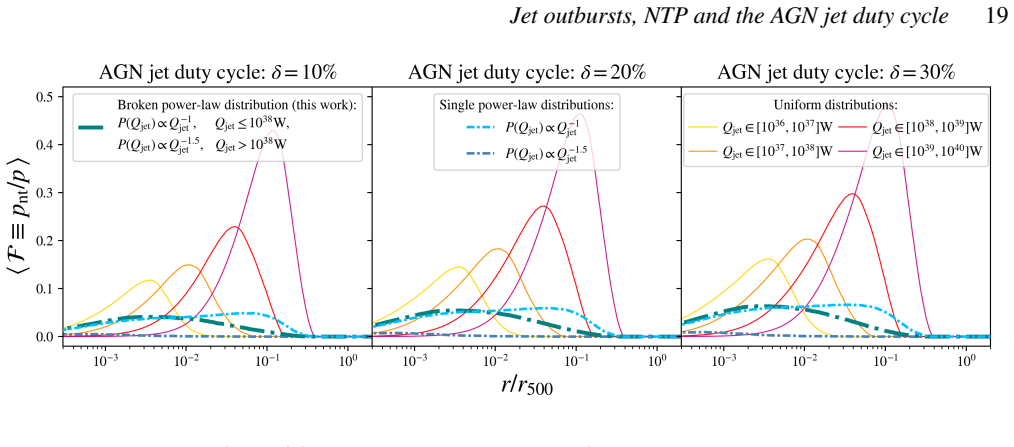
The machinery is a Monte Carlo population of Fanaroff-Riley type I jets, sampled from a broken power-law in jet power and a pink-noise power-law in jet age, each evolved with a two-phase analytical jet-lobe model: a ballistic phase with $R(t) \propto t^{2/(4-\varepsilon)}$ until the jet reaches pressure equilibrium with the ambient cluster gas, followed by a flaring phase with $R(t) \propto t^{1/(3-\varepsilon)}$. Each outburst's energy is spread through the jet lobe volume, and the first law of thermodynamics applied to spherical gas shells yields a 'velocity kick', $v_{\rm gas}$; the NTP fraction is then the ratio of the induced kinetic energy density to the total energy density. A calibration based on hydrodynamic simulations removes jets that cannot escape the central galaxy, and a population of compact sources is added to keep the duty cycle definition consistent with the observed radio-loud fraction.
What would settle it
Measure the NTP profile in several clusters whose jet duty cycles are independently known from radio bubble counts, as done for Perseus, and check whether the inferred duty cycles match the bubble-counting values; systematic disagreement would falsify the claimed relation. A sharper test would be a hydrodynamic simulation with a prescribed on/off jet cycle, checking whether the time-averaged core NTP fraction matches the paper's predicted peak for that duty cycle.
Extended reading notes
Core claim
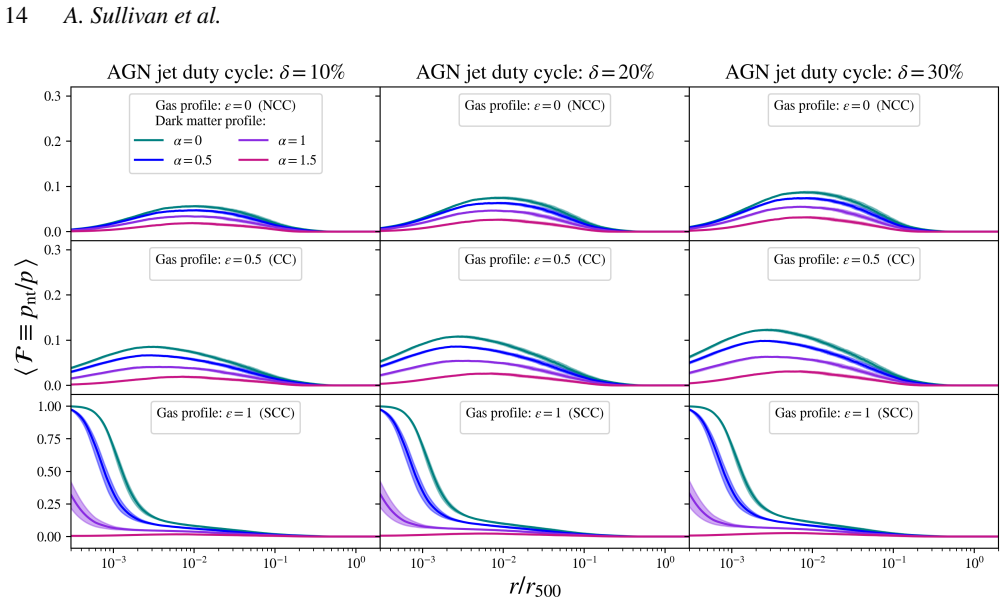
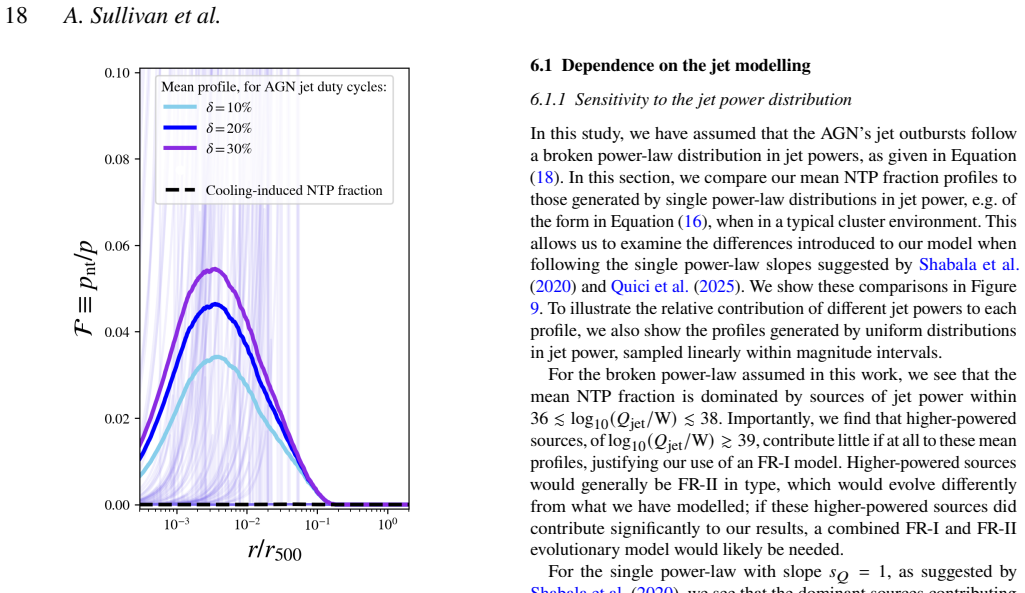
The central claim is that the peak of the mean non-thermal pressure fraction, defined as $F \equiv p_{\rm nt}/p$, in a cluster core is set by the AGN jet duty cycle $\delta \equiv t_{\rm on}/(t_{\rm on}+t_{\rm off})$, and that this peak is small for realistic conditions. For a typical cluster with an NFW dark matter halo and a weakly cusped gas profile, the predicted peak values are $\langle F\rangle \simeq 4.1\%$, $5.4\%$, and $6.3\%$ for $\delta = 10\%$, $20\%$, and $30\%$, respectively. The paper also claims that this relationship is environment-dependent but robust across a range of non-cool core and cool core clusters, and that the combined predictions agree with existing constraints from the Hitomi satellite, Dupourqué et al., and early XRISM results. Applying the relation to the observed NTP in Perseus yields a jet duty cycle of about 13% (or 3-48% within the observed range), which is consistent with independent evidence of Perseus' recent jet activity.
Load-bearing premise
The population average over many modelled outbursts is treated as the time average in a single real cluster, and the measured extra pressure is assumed to come from jets rather than from gas sloshing or mergers.
Editorial extensions
If this is right
- In typical clusters, the mean NTP fraction peaks at roughly 4-6% for jet duty cycles of 10-30%, matching the Hitomi and early XRISM observations and implying that AGN jet feedback is not the dominant source of non-thermal pressure in cluster cores.
- Because the peak NTP fraction increases with duty cycle in every non-cool core and cool core environment considered, cooler and cuspier gas profiles are more susceptible to kinetic AGN feedback.
- Combining the new core predictions with earlier large-scale NTP profiles gives a complete radial NTP fraction profile, with a pronounced dip around 100-200 kpc where the core contribution fades and the outer contribution grows.
- For the Perseus cluster, the observed NTP implies a jet duty cycle of about 13%, with a range of 3-48% allowed by the measurements; this is consistent with independent estimates from the cluster's X-ray bubbles.
- The predicted NTP fraction changes by only a few percent when the cluster's hydrostatic equilibrium is perturbed to account for the NTP itself, indicating a convergent steady-state description of the core pressure balance.
Reading between the lines
- Inference: if the relation holds, high-resolution X-ray spectroscopy of many clusters could produce a statistical map of jet duty cycles as a function of halo mass and cool-core status, effectively turning NTP maps into an AGN activity census.
- Inference: clusters with similar NTP but no detectable jet activity, such as merger-dominated systems, should map to near-zero duty cycle, so the method could help separate jet-driven turbulence from merger-driven turbulence.
- Inference: the duty cycle inferred from NTP could be cross-calibrated with the independently measured radio-loud fraction, providing a new check on the relationship between jet activity and the observable radio-loud population.
- Inference: a direct hydrodynamic test would be to prescribe a known on/off jet cycle in a simulation and compare the time-averaged core NTP fraction against the paper's predicted peak for that duty cycle; agreement would strengthen the interpretation of NTP as a duty-cycle probe.
Signed reviews
Editorial analysis
A structured set of objections, weighed in public.
Referee Report
Summary. The paper develops an analytical model for the non-thermal pressure (NTP) fraction induced by AGN jet outbursts in the cores of galaxy clusters. The authors sample jet powers and ages from observationally motivated probability distributions, evolve each source with a two-phase (ballistic and flaring) FR-I jet model, and couple the injected energy to spherical gas shells using the first law of thermodynamics. The model predicts mean radial NTP fraction profiles for different cluster environments and AGN jet duty cycles, finding peak values of roughly 4-6% for duty cycles of 10-30% in a typical cluster. The central new claim is a relation between the peak mean NTP fraction and the AGN jet duty cycle, which the authors apply to the Hitomi measurements in the Perseus cluster to infer a duty cycle of about 13%, with a broader range of 3-48% from the 2018 Hitomi data; this is claimed to be consistent with independent estimates of Perseus' recent jet activity. The paper also combines the core predictions with the large-scale NTP profiles from previous work, and presents a perturbation analysis that suggests the pristine-equilibrium assumption is self-consistent.
Significance. If the central assumptions hold, the paper offers a novel and potentially practical framework: inferring past AGN jet duty cycles from single-epoch X-ray measurements of core gas motions. The first-law-based derivation in Section 3.2 is internally consistent, the perturbation scheme in Section 6.2.2 converges, the predicted NTP fractions are of the order seen by Hitomi and the first XRISM results, and the code is publicly available. However, the duty-cycle inference depends on two load-bearing modeling choices that are not adequately tested: the equivalence between an ensemble-averaged population mean and a single cluster's time-averaged NTP, and the identification of the thermodynamic shell expansion rate with the turbulent velocity that produces non-thermal pressure. Because the practical headline result (the Perseus duty-cycle estimate) rests on these choices, the paper needs substantial revision before its central claim can be regarded as robust.
major comments (5)
- [Section 5.2.1 and Eq. (41)] The inference of Perseus's duty cycle rests on treating the Monte Carlo ensemble-averaged mean <F> (Eq. (57)) as equal to the time-averaged NTP of a single cluster over its AGN lifecycle. The sqrt(delta) factor introduced in Eq. (41) already assumes that NTP responds as the square of the instantaneous heating rate and that the time average is the relevant quantity. A Hitomi snapshot is not a time average: if the turbulent velocity dispersion decays on timescales shorter than the off-phase t_off = (1-delta)/delta * t_on, the observed NTP at a random epoch will be systematically below the time-averaged value unless the cluster happens to be caught in an outburst. For Perseus, the ripple period is about 9.2 Myr and the outburst time about 2.5 Myr, giving t_off about 6.7 Myr, comparable to the roughly 3 Myr sound-crossing time of the 3 kpc core. The paper cites Bîrzan et al. (2012) for long-lived bubble heating, but that work concerns enthalpy injection from bubbles rather than the decay of turbulence. No NTP decay timescale is modelled or observationally constrained. Please either model the time dependence explicitly and test the ergodicity assumption, or reframe the inferred duty cycle as an upper or lower limit that depends on the assumed NTP lifetime.
- [Section 3.2.2, Eqs. (47)-(48)] The identification of dr/dt as the gas velocity that generates non-thermal pressure is a modeling leap. The first law of thermodynamics, Eq. (43), determines the rate of change of shell volume under a given energy injection rate; the 'velocity kick' in Eq. (47) is defined as that radial expansion rate. The paper then uses v_gas^2 in Eqs. (55)-(57) as the kinetic energy density of gas motions contributing to NTP. In a real cluster, the injected energy can go into thermal heating, bulk expansion, turbulence, waves, and other forms, and there is no derivation given for why the adiabatic shell expansion rate equals (or maps to) the observable velocity dispersion producing non-thermal pressure. The perturbation analysis in Section 6.2.2 validates the pristine-equilibrium assumption, not this identification. Because the NTP fraction scales as v_gas^2, the predicted profiles and the peak-vs-duty-cycle relation are directly sensitive to this assumption. Please validate the mapping against simulations (for example, the Perseus-like TNG-Cluster runs of Truong et al. 2024 or the jet simulations of Bourne & Sijacki 2017), or clearly state that the model predicts the NTP only under this identification.
- [Section 2.4.4] All jet sources with t_outburst < t_eq are removed from the population, with the justification that they would deposit all their energy in a very small volume and produce unphysically high heating rates. Figure 2 indicates that this is a substantial cut: roughly 80% of the ~60% of sources that escape the BCG, i.e., about 48% of the original sample, are removed. The paper does not quantify how the results change if these sources are retained with an alternative prescription (for example, a minimum deposition volume, or a purely thermal coupling model). The mean NTP amplitude and the shape of the peak-vs-duty-cycle relation could be sensitive to how this large subpopulation is handled. Please add a sensitivity test, or at least quantify the fraction removed and justify that their exclusion does not bias the central results.
- [Section 5.1.1, Eqs. (61)-(62) and Table 4] The claimed relationship between the peak NTP fraction and the AGN jet duty cycle is partly constructed rather than independently predicted. Equation (61) reduces algebraically to F approximately equal to delta/(A + delta), and the coefficients k1 and k2 in Eq. (62) are fit to the model's own peak values at only three duty cycles (10%, 20%, 30%). The resulting fit is therefore, to a large extent, a restatement of the sqrt(delta) time-averaging ansatz introduced in Eq. (41). The application to Perseus in Section 5.2.2 inverts this relation, so the inferred duty cycle inherits the assumptions of the model's time-averaging prescription. Please make this dependence explicit, and ideally test the relation against a simulated cluster whose duty cycle is known from the simulation, such as the TNG-Cluster runs.
- [Multiple passages (e.g., the interleaved author notes after Section 3.2.2 and before Section 5, and in the vicinity of…] The manuscript contains unresolved author notes that state unfinished work: 'Will find a scaling relation to convert [delta] to a radio-loud fraction? Suggestions welcome.', 'This feels like the most significant finding, and worth discussing the correlation we find...', and 'Other things to discuss: — Gentle heating assumption in the methods. — Relationship between [delta] and halo mass...'. These passages show that central parts of the analysis, including the interpretation of the duty-cycle relation and the gentle-heating assumption, are still under development. The paper is not in a publishable state until these notes are removed and the promised analyses are either completed in the text or explicitly deferred to future work.
minor comments (5)
- [Whole manuscript] The submitted text has severe typesetting problems: large duplicated blocks, repeated figure captions, interleaved page headers such as '24 Andrew Sullivan et al.', and equations numbered inconsistently in the inserted summary blocks. This must be cleaned up before any resubmission.
- [Section 3.1.3] The time-averaging argument states that since NTP is proportional to the square of the heating rate, the effective heating rate carries a sqrt(delta) factor. This proportionality is asserted rather than derived from microphysics or simulation; a brief justification or a reference to supporting simulations would strengthen the presentation.
- [Abstract and Section 4.1.2] The abstract states that the mean NTP fraction peaks at ~4-6% for duty cycles of 10-30%, but the text also notes that these peaks occur at only ~3 kpc and may be obscured by the BCG. This caveat should appear in the abstract or at least in the conclusions, since it affects observational applicability.
- [Section 5.2.2] The sentence excluding the upper Hitomi bound (F ~ 11-12%) says 'if the gas is undergoing sloshing motion', but does not explain why sloshing invalidates that particular bound. Please clarify the reasoning or cite the relevant discussion.
- [Section 5.2.2] The Perseus-like cluster uses a different virial mass and radius (r500 = 1.3 Mpc, M500 = 5.8e14 Msun) than the 'typical cluster' used elsewhere (Table 2), so comparisons with the other environments are not directly on the same normalization. This is acceptable, but it should be stated explicitly when the fits are compared in Table 4 and Figure 7.
Circularity Check
No significant circularity: NTP profiles are forward-model predictions checked against external data; the duty-cycle inversion is a stated model calibration, not a self-referential fit.
full rationale
The paper's central predictions are forward-model outputs, not fits to the data they are compared with. The peak mean NTP fractions (~4-6% at duty cycles of 10-30%) are computed by Monte Carlo sampling of observationally constrained jet power and age distributions and evolving each outburst with an FR-I jet-lobe model; Hitomi, Dupourqué, and XRISM measurements are used only for comparison. The NTP-duty-cycle relation used to infer Perseus' duty cycle is derived from the model's stated time-averaging assumption: Eq. (41) introduces the sqrt(delta) factor because NTP is proportional to the square of the heating rate, and Eq. (61) then reduces to F approx delta/(A + delta). This is a model-derived calibration curve rather than an independently discovered empirical law, and inverting a measured NTP fraction to a duty cycle with that curve is legitimate forward-model inference: the coefficients k1 and k2 in Eq. (62) are fit to the model's own simulated peak values (Table 4), not to any observed NTP value, so no observed datum is used to set the relation and then re-predicted. The self-citations to S24a and S24b supply the cluster profile parameterization and the large-scale NTP template, but the core predictions and the Perseus inference do not depend on a self-citation chain; the relevant equations are reproduced in the present paper. The main caveat, namely interpreting a single-epoch Hitomi measurement as a time average (Section 5.2.1), is an explicit but untested ergodicity assumption, which is a correctness or robustness concern rather than a circularity. No specific step reduces a claimed prediction to its own input by construction.
Assumptions & free parameters
free parameters (5)
- k1, k2 fit coefficients =
typical cluster: k1 = 0.142, k2 = -0.048
- jet half-opening angles theta_jet, theta_flare =
8.5 deg, 15 deg
- compact source fraction f_compact =
0.4
- jet power and age distribution parameters =
s_Q,low=1; s_Q,high=1.5; Q_break=1e38 W; Q_max=1e40 W; t_max=1 Gyr; s_t=1
- BCG escape calibration =
M_gas=2.67e10 Msun, r_gas=2.5 kpc, t_esc=1.27 Myr at 1e37 W
assumptions (7)
- domain assumption The cluster is in virial and hydrostatic equilibrium and is described by the S24a five-parameter density profiles.
- standard math The gas can be treated as an ideal gas in spherical shells subject to the first law of thermodynamics.
- domain assumption The thermal pressure and temperature remain close to the pristine equilibrium values (p_th approx p_eq, T approx T_eq).
- ad hoc to paper The radial shell expansion rate dr/dt is identified as the gas velocity generating non-thermal pressure.
- ad hoc to paper Time-averaged NTP is proportional to the square of the heating rate, so the effective heating rate scales as sqrt(delta).
- domain assumption The Monte Carlo population mean equals the time-average for a single cluster with frequent outbursts.
- domain assumption Jet evolution follows the two-phase FR-I model (ballistic then flaring) from Turner and Shabala 2023 and Luo and Sadler 2010.
Cite this review
Pith. "Pith review of Jet outbursts, non-thermal pressure and the AGN jet duty cycle." pith.science (2026). https://pith.science/paper/MNUSBOL7
@misc{pith2026250613422,
  author       = {Pith},
  title        = {Pith review of: Jet outbursts, non-thermal pressure and the AGN jet duty cycle},
  year         = {2026},
  howpublished = {\url{https://pith.science/paper/MNUSBOL7}},
  note         = {Machine review of arXiv:2506.13422}
}
read the original abstract
We predict the non-thermal pressure (NTP) induced in the cores of galaxy clusters by kinetic jet feedback from an active galactic nucleus (AGN). We model a population of Fanaroff-Riley type I jets when sampling power-law distributions in jet power and age, which we evolve in time with a two-phase jet-lobe model. We couple the energy of each jet outburst to the surrounding gas inside spherical shells, allowing us to estimate the fraction of NTP to total pressure induced in the cluster. We predict the mean profile for this NTP fraction over the source population in a variety of cluster environments and for different AGN jet duty cycles. For typical gas and dark matter profiles, the mean NTP fraction peaks at ~4-6% when the AGN jets are active for 10-30% of the total AGN lifecycle. These predictions are in good agreement with observational constraints, suggesting that AGN feedback imparts only small non-thermal contributions to the cluster's core. Furthermore, we find a relationship between the peak in the mean NTP fraction and the AGN jet duty cycle in a given cluster environment. Applying this to Hitomi measurements of the NTP in the Perseus cluster, we infer an AGN jet duty cycle that is consistent with independent evidence of Perseus' AGN jet activity. We propose this as a novel approach for observationally inferring the past AGN activity of real clusters from their observed NTP fraction and environmental profiles.
Figures


Figures from the paper (7 more)




Reference graph
Works this paper leans on
-
[1]
Angelinelli M., Vazza F., Giocoli C., Ettori S., Jones T. W., Brunetti G., Br \"u ggen M., Eckert D., 2020, @doi [ ] 10.1093/mnras/staa975 , https://ui.adsabs.harvard.edu/abs/2020MNRAS.495..864A 495, 864
-
[2]
Benson A. J., 2010, @doi [ ] 10.1016/j.physrep.2010.06.001 , https://ui.adsabs.harvard.edu/abs/2010PhR...495...33B 495, 33
-
[3]
Best P. N., 2009, @doi [Astronomische Nachrichten] 10.1002/asna.200811152 , https://ui.adsabs.harvard.edu/abs/2009AN....330..184B 330, 184
-
[5]
Boehringer H., Voges W., Fabian A. C., Edge A. C., Neumann D. M., 1993, @doi [ ] 10.1093/mnras/264.1.L25 , https://ui.adsabs.harvard.edu/abs/1993MNRAS.264L..25B 264, L25
-
[6]
Bourne M. A., Sijacki D., 2017, @doi [ ] 10.1093/mnras/stx2269 , https://ui.adsabs.harvard.edu/abs/2017MNRAS.472.4707B 472, 4707
-
[7]
Bourne M. A., Yang H.-Y. K., 2023, @doi [Galaxies] 10.3390/galaxies11030073 , https://ui.adsabs.harvard.edu/abs/2023Galax..11...73B 11, 73
-
[8]
Hydrostatic mass bias for galaxy groups and clusters in the FLAMINGO simulations
Braspenning J., Schaye J., Schaller M., Kugel R., Kay S. T., 2024, @doi [arXiv e-prints] 10.48550/arXiv.2409.07849 , https://ui.adsabs.harvard.edu/abs/2024arXiv240907849B p. arXiv:2409.07849
work page Pith review arXiv doi:10.48550/arxiv.2409.07849 2024
-
[10]
Churazov E., Forman W., Jones C., B \"o hringer H., 2000, @doi [ ] 10.48550/arXiv.astro-ph/0002375 , https://ui.adsabs.harvard.edu/abs/2000A&A...356..788C 356, 788
Show all 70 references
-
[11]
Churazov E., Forman W., Jones C., B \"o hringer H., 2003, @doi [ ] 10.1086/374923 , https://ui.adsabs.harvard.edu/abs/2003ApJ...590..225C 590, 225
2003 doi
-
[12]
A., Webb T
Dunne D. A., Webb T. M. A., Noble A., Lidman C., Shipley H., Muzzin A., Wilson G., Yee H. K. C., 2021, @doi [ ] 10.3847/2041-8213/abeb6f , https://ui.adsabs.harvard.edu/abs/2021ApJ...909L..29D 909, L29
2021 doi
-
[13]
Dupourqu \'e S., Clerc N., Pointecouteau E., Eckert D., Ettori S., Vazza F., 2023, @doi [ ] 10.1051/0004-6361/202245779 , https://ui.adsabs.harvard.edu/abs/2023A&A...673A..91D 673, A91
2023 doi
-
[14]
Eckert D., Ettori S., Molendi S., Vazza F., Paltani S., 2013, @doi [ ] 10.1051/0004-6361/201220403 , https://ui.adsabs.harvard.edu/abs/2013A&A...551A..23E 551, A23
2013 doi
-
[15]
Eckert D., et al., 2019, @doi [ ] 10.1051/0004-6361/201833324 , https://ui.adsabs.harvard.edu/abs/2019A&A...621A..40E 621, A40
2019 doi
-
[16]
Ettori S., Eckert D., 2022, @doi [ ] 10.1051/0004-6361/202142638 , https://ui.adsabs.harvard.edu/abs/2022A&A...657L...1E 657, L1
2022 doi
-
[17]
C., 2012, @doi [ ] 10.1146/annurev-astro-081811-125521 , https://ui.adsabs.harvard.edu/abs/2012ARA&A..50..455F 50, 455
Fabian A. C., 2012, @doi [ ] 10.1146/annurev-astro-081811-125521 , https://ui.adsabs.harvard.edu/abs/2012ARA&A..50..455F 50, 455
2012 doi
-
[18]
C., et al., 2000, @doi [ ] 10.1046/j.1365-8711.2000.03904.x , https://ui.adsabs.harvard.edu/abs/2000MNRAS.318L..65F 318, L65
Fabian A. C., et al., 2000, @doi [ ] 10.1046/j.1365-8711.2000.03904.x , https://ui.adsabs.harvard.edu/abs/2000MNRAS.318L..65F 318, L65
2000
-
[19]
C., Sanders J
Fabian A. C., Sanders J. S., Allen S. W., Crawford C. S., Iwasawa K., Johnstone R. M., Schmidt R. W., Taylor G. B., 2003, @doi [ ] 10.1046/j.1365-8711.2003.06902.x , https://ui.adsabs.harvard.edu/abs/2003MNRAS.344L..43F 344, L43
2003
-
[21]
L., Riley J
Fanaroff B. L., Riley J. M., 1974, @doi [ ] 10.1093/mnras/167.1.31P , https://ui.adsabs.harvard.edu/abs/1974MNRAS.167P..31F 167, 31P
1974 doi
-
[22]
Gaspari M., S a dowski A., 2017, @doi [ ] 10.3847/1538-4357/aa61a3 , https://ui.adsabs.harvard.edu/abs/2017ApJ...837..149G 837, 149
2017 doi
-
[23]
Ghirardini V., et al., 2019, @doi [ ] 10.1051/0004-6361/201833325 , https://ui.adsabs.harvard.edu/abs/2019A&A...621A..41G 621, A41
2019 doi
-
[25]
J., et al., 2019, @doi [ ] 10.1051/0004-6361/201833893 , https://ui.adsabs.harvard.edu/abs/2019A&A...622A..12H 622, A12
Hardcastle M. J., et al., 2019, @doi [ ] 10.1051/0004-6361/201833893 , https://ui.adsabs.harvard.edu/abs/2019A&A...622A..12H 622, A12
2019 doi
-
[26]
Hitomi Collaboration et al., 2016, @doi [ ] 10.1038/nature18627 , https://ui.adsabs.harvard.edu/abs/2016Natur.535..117H 535, 117
2016 doi
-
[27]
Hitomi Collaboration et al., 2018, @doi [ ] 10.1093/pasj/psx138 , https://ui.adsabs.harvard.edu/abs/2018PASJ...70....9H 70, 9
2018 doi
-
[28]
A., Livio M., 1999, @doi [ ] 10.1038/44780 , https://ui.adsabs.harvard.edu/abs/1999Natur.401..891J 401, 891
Junor W., Biretta J. A., Livio M., 1999, @doi [ ] 10.1038/44780 , https://ui.adsabs.harvard.edu/abs/1999Natur.401..891J 401, 891
1999 doi
-
[29]
R., Alexander P., 1997, @doi [ ] 10.1093/mnras/286.1.215 , https://ui.adsabs.harvard.edu/abs/1997MNRAS.286..215K 286, 215
Kaiser C. R., Alexander P., 1997, @doi [ ] 10.1093/mnras/286.1.215 , https://ui.adsabs.harvard.edu/abs/1997MNRAS.286..215K 286, 215
1997 doi
-
[30]
R., Best P
Kaiser C. R., Best P. N., 2007, @doi [ ] 10.1111/j.1365-2966.2007.12350.x , https://ui.adsabs.harvard.edu/abs/2007MNRAS.381.1548K 381, 1548
2007
-
[31]
R., Dennett-Thorpe J., Alexander P., 1997, @doi [ ] 10.1093/mnras/292.3.723 , https://ui.adsabs.harvard.edu/abs/1997MNRAS.292..723K 292, 723
Kaiser C. R., Dennett-Thorpe J., Alexander P., 1997, @doi [ ] 10.1093/mnras/292.3.723 , https://ui.adsabs.harvard.edu/abs/1997MNRAS.292..723K 292, 723
1997 doi
-
[32]
Krause M., Alexander P., Riley J., Hopton D., 2012, @doi [ ] 10.1111/j.1365-2966.2012.21645.x , https://ui.adsabs.harvard.edu/abs/2012MNRAS.427.3196K 427, 3196
2012
-
[33]
F., de Souza R
Lagan \'a T. F., de Souza R. S., Keller G. R., 2010, @doi [ ] 10.1051/0004-6361/200911855 , https://ui.adsabs.harvard.edu/abs/2010A&A...510A..76L 510, A76
2010 doi
-
[34]
A., Bridle A
Laing R. A., Bridle A. H., 2014, @doi [ ] 10.1093/mnras/stt2138 , https://ui.adsabs.harvard.edu/abs/2014MNRAS.437.3405L 437, 3405
2014 doi
-
[35]
M., 2010, @doi [ ] 10.1088/0004-637X/713/1/398 , https://ui.adsabs.harvard.edu/abs/2010ApJ...713..398L 713, 398
Luo Q., Sadler E. M., 2010, @doi [ ] 10.1088/0004-637X/713/1/398 , https://ui.adsabs.harvard.edu/abs/2010ApJ...713..398L 713, 398
2010 doi
-
[36]
I., Burenin R., Starobinsky A
Lyskova N., Churazov E., Khabibullin I. I., Burenin R., Starobinsky A. A., Sunyaev R., 2023, @doi [ ] 10.1093/mnras/stad2305 , https://ui.adsabs.harvard.edu/abs/2023MNRAS.525..898L 525, 898
2023 doi
- [37]
-
[38]
McKinley B., et al., 2022, @doi [Nature Astronomy] 10.1038/s41550-021-01553-3 , https://ui.adsabs.harvard.edu/abs/2022NatAs...6..109M 6, 109
2022 doi
-
[39]
E., Atri P., Matthews J
Motta S. E., Atri P., Matthews J. H., van den Eijnden J., Fender R. P., Miller-Jones J. C. A., Heywood I., Woudt P., 2025, @doi [ ] 10.1051/0004-6361/202452838 , https://ui.adsabs.harvard.edu/abs/2025A&A...696A.222M 696, A222
2025 doi
-
[40]
F., Frenk C
Navarro J. F., Frenk C. S., White S. D. M., 1995, @doi [ ] 10.1093/mnras/275.3.720 , https://ui.adsabs.harvard.edu/abs/1995MNRAS.275..720N 275, 720
1995 doi
-
[41]
F., Frenk C
Navarro J. F., Frenk C. S., White S. D. M., 1996, @doi [ ] 10.1086/177173 , https://ui.adsabs.harvard.edu/abs/1996ApJ...462..563N 462, 563
1996 doi
-
[42]
F., Frenk C
Navarro J. F., Frenk C. S., White S. D. M., 1997, @doi [ ] 10.1086/304888 , https://ui.adsabs.harvard.edu/abs/1997ApJ...490..493N 490, 493
1997 doi
-
[43]
T., Nagai D., 2014, @doi [ ] 10.1088/0004-637X/792/1/25 , https://ui.adsabs.harvard.edu/abs/2014ApJ...792...25N 792, 25
Nelson K., Lau E. T., Nagai D., 2014, @doi [ ] 10.1088/0004-637X/792/1/25 , https://ui.adsabs.harvard.edu/abs/2014ApJ...792...25N 792, 25
2014 doi
-
[44]
P., 1998, @doi [ ] 10.1086/316162 , https://ui.adsabs.harvard.edu/abs/1998PASP..110..493O 110, 493
O'Dea C. P., 1998, @doi [ ] 10.1086/316162 , https://ui.adsabs.harvard.edu/abs/1998PASP..110..493O 110, 493
1998 doi
-
[45]
J., 1966, @doi [ ] 10.1103/PhysRevLett.16.410 , https://ui.adsabs.harvard.edu/abs/1966PhRvL..16..410P 16, 410
Peebles P. J., 1966, @doi [ ] 10.1103/PhysRevLett.16.410 , https://ui.adsabs.harvard.edu/abs/1966PhRvL..16..410P 16, 410
1966 doi
-
[46]
Planck Collaboration et al., 2016, @doi [ ] 10.1051/0004-6361/201525830 , https://ui.adsabs.harvard.edu/abs/2016A&A...594A..13P 594, A13
2016 doi
-
[47]
Pope E. C. D., Mendel J. T., Shabala S. S., 2012, @doi [ ] 10.1111/j.1365-2966.2011.19669.x , https://ui.adsabs.harvard.edu/abs/2012MNRAS.419...50P 419, 50
2012
-
[48]
W., Arnaud M., Maughan B
Pratt G. W., Arnaud M., Maughan B. J., Melin J. B., 2023, @doi [ ] 10.1051/0004-6361/202243074e , https://ui.adsabs.harvard.edu/abs/2023A&A...669C...2P 669, C2
2023 doi
-
[49]
J., Seymour N., Hurley-Walker N., 2025, @doi [ ] 10.1093/mnras/staf024 , https://ui.adsabs.harvard.edu/abs/2025MNRAS.537..343Q 537, 343
Quici B., Turner R. J., Seymour N., Hurley-Walker N., 2025, @doi [ ] 10.1093/mnras/staf024 , https://ui.adsabs.harvard.edu/abs/2025MNRAS.537..343Q 537, 343
2025 doi
- [50]
-
[51]
Sabater J., et al., 2019, @doi [ ] 10.1051/0004-6361/201833883 , https://ui.adsabs.harvard.edu/abs/2019A&A...622A..17S 622, A17
2019 doi
-
[52]
Sayers J., Sereno M., Ettori S., Rasia E., Cui W., Golwala S., Umetsu K., Yepes G., 2021, @doi [ ] 10.1093/mnras/stab1542 , https://ui.adsabs.harvard.edu/abs/2021MNRAS.505.4338S 505, 4338
2021 doi
-
[53]
N., Wagoner R
Schramm D. N., Wagoner R. V., 1977, @doi [Annual Review of Nuclear and Particle Science] 10.1146/annurev.ns.27.120177.000345 , https://ui.adsabs.harvard.edu/abs/1977ARNPS..27...37S 27, 37
1977
-
[55]
S., Godfrey L
Shabala S. S., Godfrey L. E. H., 2013, @doi [ ] 10.1088/0004-637X/769/2/129 , https://ui.adsabs.harvard.edu/abs/2013ApJ...769..129S 769, 129
2013 doi
-
[56]
S., Ash S., Alexander P., Riley J
Shabala S. S., Ash S., Alexander P., Riley J. M., 2008, @doi [ ] 10.1111/j.1365-2966.2008.13459.x , https://ui.adsabs.harvard.edu/abs/2008MNRAS.388..625S 388, 625
2008
-
[57]
S., Jurlin N., Morganti R., Brienza M., Hardcastle M
Shabala S. S., Jurlin N., Morganti R., Brienza M., Hardcastle M. J., Godfrey L. E. H., Krause M. G. H., Turner R. J., 2020, @doi [ ] 10.1093/mnras/staa1172 , https://ui.adsabs.harvard.edu/abs/2020MNRAS.496.1706S 496, 1706
2020 doi
-
[58]
R., et al., 2018, @doi [ ] 10.3847/1538-4357/aac5f8 , https://ui.adsabs.harvard.edu/abs/2018ApJ...861...71S 861, 71
Siegel S. R., et al., 2018, @doi [ ] 10.3847/1538-4357/aac5f8 , https://ui.adsabs.harvard.edu/abs/2018ApJ...861...71S 861, 71
2018 doi
-
[59]
Sullivan A., Power C., Bottrell C., Robotham A., Shabala S., 2024a, @doi [ ] 10.1017/pasa.2024.24 , https://ui.adsabs.harvard.edu/abs/2024PASA...41...22S 41, e022
2024 doi
-
[60]
Sullivan A., Shabala S., Power C., Bottrell C., Robotham A., 2024b, @doi [ ] 10.1017/pasa.2024.63 , https://ui.adsabs.harvard.edu/abs/2024PASA...41...64S 41, e064
2024 doi
-
[61]
Sun M., et al., 2015, @doi [ ] 10.1088/0004-637X/802/1/14 , https://ui.adsabs.harvard.edu/abs/2015ApJ...802...14S 802, 14
2015 doi
-
[62]
S., Dopita M
Sutherland R. S., Dopita M. A., 1993, @doi [ ] 10.1086/191823 , https://ui.adsabs.harvard.edu/abs/1993ApJS...88..253S 88, 253
1993 doi
-
[63]
Truong N., Pillepich A., Nelson D., Zhuravleva I., Lee W., Ayromlou M., Lehle K., 2024, @doi [ ] 10.1051/0004-6361/202348562 , https://ui.adsabs.harvard.edu/abs/2024A&A...686A.200T 686, A200
2024 doi
-
[64]
J., Shabala S
Turner R. J., Shabala S. S., 2015, @doi [ ] 10.1088/0004-637X/806/1/59 , https://ui.adsabs.harvard.edu/abs/2015ApJ...806...59T 806, 59
2015 doi
-
[65]
J., Shabala S
Turner R. J., Shabala S. S., 2023, @doi [Galaxies] 10.3390/galaxies11040087 , https://ui.adsabs.harvard.edu/abs/2023Galax..11...87T 11, 87
2023 doi
-
[66]
Urban O., et al., 2014, @doi [ ] 10.1093/mnras/stt2209 , https://ui.adsabs.harvard.edu/abs/2014MNRAS.437.3939U 437, 3939
2014 doi
-
[67]
S., Van Speybroeck L., 2006, @doi [ ] 10.1086/500288 , https://ui.adsabs.harvard.edu/abs/2006ApJ...640..691V 640, 691
Vikhlinin A., Kravtsov A., Forman W., Jones C., Markevitch M., Murray S. S., Van Speybroeck L., 2006, @doi [ ] 10.1086/500288 , https://ui.adsabs.harvard.edu/abs/2006ApJ...640..691V 640, 691
2006 doi
-
[68]
Vikhlinin A., et al., 2009, @doi [ ] 10.1088/0004-637X/692/2/1033 , https://ui.adsabs.harvard.edu/abs/2009ApJ...692.1033V 692, 1033
2009 doi
-
[69]
M., Kay S
Voit G. M., Kay S. T., Bryan G. L., 2005, @doi [ ] 10.1111/j.1365-2966.2005.09621.x , https://ui.adsabs.harvard.edu/abs/2005MNRAS.364..909V 364, 909
2005
-
[70]
J., Rawlings S., Blundell K
Willott C. J., Rawlings S., Blundell K. M., Lacy M., 1999, @doi [ ] 10.1046/j.1365-8711.1999.02907.x , https://ui.adsabs.harvard.edu/abs/1999MNRAS.309.1017W 309, 1017
1999
- [71]
-
[72]
XRISM Collaboration et al., 2025b, @doi [ ] 10.1038/s41586-024-08561-z , https://ui.adsabs.harvard.edu/abs/2025Natur.638..365X 638, 365
-
[73]
Xrism Collaboration et al., 2025, @doi [ ] 10.3847/2041-8213/ada7cd , https://ui.adsabs.harvard.edu/abs/2025ApJ...982L...5X 982, L5
2025 doi
- [74]
-
[75]
write newline
" write newline "" before.all 'output.state := FUNCTION fin.entry write newline FUNCTION new.block output.state before.all = 'skip after.block 'output.state := if FUNCTION new.sentence output.state after.block = 'skip output.state before.all = 'skip after.sentence 'output.stat...
Reviewed August 15, 2026 · model on record in the stance chip above.
Discussion (0). Continue with ORCID to comment.