REVIEW 2 major objections 3 minor 128 references
The User Perspective on Island-Ready 6G Communication: A Survey of Future Smartphone Usage in Crisis-Struck Areas with Local Cellular Connectivity
T0 review · 2 major / 3 minor · reviewed 2026-08-15 · deepseek-v4-flash
Pith's one-line read Citizens in crisis-hit 6G 'islands' prefer general-purpose apps over dedicated crisis apps for most crisis use cases, a survey of 857 German urban smartphone users finds.
desk verdict A well-run, first-of-its-kind survey of user preferences in a local-only 6G crisis scenario; the main demand-shift claim partly conflates crisis effects with island-connectivity effects, but the paper remains a solid contribution and deserves serious review. read the letter →
The pith
A machine-rendered reading of the paper's core claim, the machinery that carries it, and where it could break.
The reading
What carries the argument
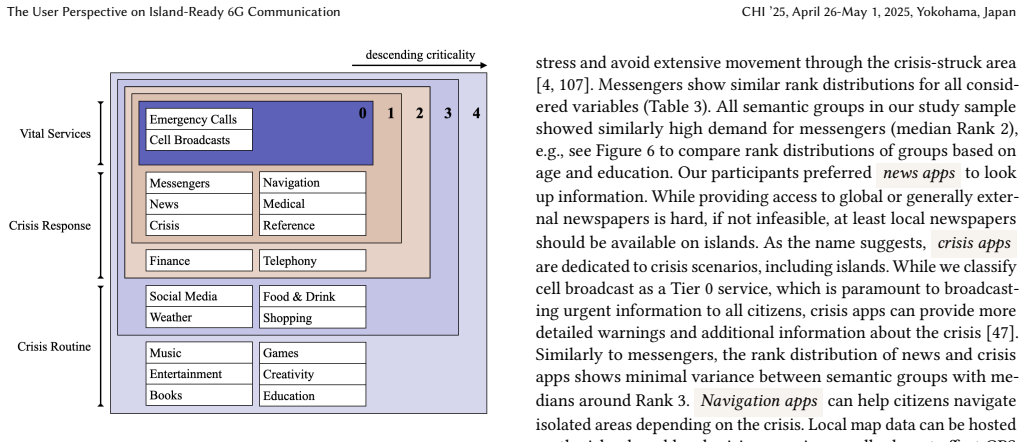
The machinery is a two-stage survey instrument plus a classification scheme. Stage one uses comic boards and a short video to make the abstract idea of island connectivity concrete: an earthquake strikes the participant's city, the Internet goes down, and the mobile operator restores only local connectivity. Stage two uses positional voting, in which participants rank app categories, and the rankings are analyzed with the Borda count to compare normal-operation and island-operation demand. The output feeds a five-tier smartphone service typology (Tier 0: crisis-critical cellular services; Tier 1: immediate crisis response apps; Tier 2: critical-purpose services; Tier 3: crisis routine; Tier 4: crisis well-being) that translates demand ranks into prioritization guidance.
What would settle it
Run a field trial in which a city district is put into island operation during a live exercise or a real outage, log actual app usage from the local core network, and compare the observed app ranks with the survey's stated ranks; a clear divergence would falsify the central demand-shift claim.
Extended reading notes
Core claim
On the paper's own terms, the discovery is that citizens' crisis smartphone behavior is general-purpose first: asked which apps they would use in seven crisis-specific situations, respondents chose crisis apps for warnings, safety tips, and emergency contact, but messengers for communicating with others and for distraction, news apps for information, and navigation apps for moving around the city. When the same participants ranked app categories under a scenario in which only local cellular connectivity remains, messengers stayed at rank 1, news rose to rank 2, and crisis apps jumped from rank 21 to rank 3, while shopping fell from rank 6 to rank 19 and travel from 16 to 21. These shifts are the empirical basis for the paper's smartphone service typology for island connectivity, ordered from Tier 0 (emergency calls and cell broadcasts) through Tier 4 (well-being apps like music and games).
Load-bearing premise
The paper assumes that what participants said they would do in a scripted, hypothetical earthquake with local-only connectivity matches what they would actually do on their phones during a real crisis.
Editorial extensions
If this is right
- If island connectivity is built into 6G, operators should plan for messengers, news, and crisis apps as the highest-demand data services, not assume that dedicated crisis apps alone will suffice.
- Capacity-limited island networks can use the five-tier typology as a prioritization ladder, keeping emergency calls and cell broadcasts above telephony and entertainment when capacity is scarce.
- App developers should prepare general-purpose apps for local operation, including local edge servers and local identity and authentication, so users do not need a separate crisis version.
- Authorities gain a concrete checklist for regulating 6G resilience, including distributed app stores and geographically adapted crisis content.
- Demand decreases for shopping, travel, and sports suggest these services can be deprioritized first when edge capacity is limited.
Reading between the lines
- If stated preferences carry over to real crises, crisis-app designers may need to interoperate with messengers and news rather than compete with them; a natural test is integrating official warnings into messenger and news feeds.
- The German urban sample and earthquake scenario mean the ranking might shift for rural users, different risk cultures, or hazards like flooding, which the paper itself notes participants suggested.
- The typology could be operationalized as technical quality-of-service classes in 6G network slicing, with each tier mapped to a guaranteed capacity and latency profile.
- A local-only connectivity model creates a new design space for island-aware app features, such as showing which contacts are reachable locally, which the survey's demand data does not by itself specify.
Signed reviews
Editorial analysis
A structured set of objections, weighed in public.
Referee Report
Summary. This manuscript introduces the concept of "island connectivity" for 6G networks to the HCI community and reports a large survey (N=857) of adult smartphone users in major German cities. The survey measures (RQ1) which app categories citizens prefer for crisis-specific use cases, (RQ2) how app demand changes when the participants are asked to imagine a crisis scenario with local-only cellular connectivity, and (RQ3) builds a five-tier smartphone service typology to guide operator prioritization. The headline findings are that general-purpose apps (messengers, news) are preferred for several crisis use cases over dedicated crisis apps, and that in the island scenario demand for messengers, news, and crisis apps rises while demand for shopping and travel apps falls. The typology is then derived by combining these survey results with German regulatory documents and 3GPP standards. The paper includes a replication package with data, analysis scripts, and survey structure.
Significance. If taken as descriptive of user preferences in the combined crisis-plus-island scenario, the study is valuable: it is the first large-sample empirical view of a novel 6G service model, with implications for operators, app developers, and authorities. The methodology is a strength: a pilot study, valid attention checks (SRSI UseMe, IRI), very high inter-coder reliability, Bonferroni corrections, and a public replication package. The findings also support a concrete, actionable prioritization framework that goes beyond prior crisis-informatics studies. However, the load-bearing inference that the observed demand shifts are specifically attributable to island connectivity (rather than to the crisis context alone) is not supported by the design, as discussed in the major comments.
major comments (2)
- [§4.2] The Q11-to-Q13 comparison conflates two factors: the crisis scenario and the local-only connectivity. Q13 asks participants to imagine an ongoing earthquake with island connectivity, while Q11 asks about everyday normal operation, so these conditions differ in both crisis presence and connectivity mode. The paper itself shows in §5.1 that crisis context alone changes app choices (crisis apps dominate warnings, messengers dominate communication, news dominates information). Therefore, the demand increases for messengers, news, and crisis apps and the decreases for shopping and travel apps cannot be uniquely attributed to island connectivity. This matters because the RQ2 results are the empirical basis for the RQ3 typology and the design implications in §6.2 that specifically target island-ready 6G. The manuscript should either explicitly reframe RQ2 as a descriptive study of the combined scenario (which is arguably the real deployment context) and add a corresponding limitation, or add a crisis-without-island control condition in a future study. As written, the causal-sounding language in §5.2 ("increased demand in island operation") and the design advice derived from it overstate the evidence for island-specific effects.
- [§4.2/§4.5/§5.4] There is no comprehension check for the island connectivity concept beyond the video and comic materials. The paper reports six participants doubting the island scenario, including P69, who said "The described scenario is wrong because the Internet does not work locally," and the authors classify these as inattention or misunderstanding. Without a direct measure of comprehension (e.g., a post-video fact-check question), it is difficult to know how many participants actually understood that local cellular connectivity would be available while global Internet connectivity would not. This is particularly relevant given the abstract and hypothetical nature of the scenario. The paper already has strong attention checks, so adding one or two comprehension items about the island model would have strengthened validity. In the current version, the authors should at minimum analyze the open comments to estimate how prevalent misunderstanding of the connectivity model was, and report this as a limitation.
minor comments (3)
- [§4.6] The sentence "We warned participants that the survey’s subject included crises, which might be a sensible topic for them" appears to use "sensible" where "sensitive" is intended.
- [References] Reference [33] contains a typo: "Turkye" should be "Turkey".
- [§5.2] The description of Table 2 refers to arrows ("Dotted arrows indicate trends...") but the manuscript text as provided does not show the arrows in the table; please ensure the published version includes the arrow symbols or reword the description to match the actual table rendering.
Circularity Check
No circularity: the survey provides primary empirical evidence and the typology is a post-hoc classification informed by external standards, not a prediction derived from its own inputs.
full rationale
This paper is a self-contained empirical survey rather than a derivation or prediction chain. RQ1 and RQ2 are answered directly from participants' stated preferences collected in Q11, Q12, and Q13, and the reported shifts between normal and island operation are descriptive Borda-count comparisons of those responses. No parameter is fitted to a subset of data and then renamed as a prediction, and no equation reduces to an input by construction. RQ3's smartphone service typology is explicitly constructed by combining the survey results with external practice-informed sources (the German federal network agency's resilience strategy [12], the 3GPP system architecture [1], and other cited standards), so the tiers are an interpretive classification rather than a self-justifying output. The paper also publishes its dataset and evaluation scripts, making the empirical claims independently checkable. Although several references are authored by members of the same research group (e.g., [42], [51], [55], [58], [61], [115]), these citations are contextual or supplementary and are not load-bearing for the central survey findings; the core evidence is the N=857 dataset, which stands outside any self-citation chain. The manuscript's own limitation passages, including the participant who rejected the island scenario (P69 in Section 5.4), concern scenario realism and potential misunderstanding of the local-connectivity construct, which are validity threats rather than circularity. Overall, the derivation chain from raw survey responses to reported results and the typology is transparent and non-circular.
Assumptions & free parameters
assumptions (3)
- domain assumption 6G networks will include distributed core network replicas that can provide local cellular connectivity to crisis-struck islands.
- domain assumption Self-reported app preferences in a hypothetical scenario (earthquake plus island connectivity) approximate real-world behavior in comparable crises.
- domain assumption The app categorization based on the Apple App Store, modified by the authors, is a valid and comprehensive taxonomy for studying smartphone app usage among German adults.
Cite this review
Pith. "Pith review of The User Perspective on Island-Ready 6G Communication: A Survey of Future Smartphone Usage in Crisis-Struck Areas with Local Cellular Connectivity." pith.science (2026). https://pith.science/paper/J6Z5HR3S
@misc{pith2026250613466,
  author       = {Pith},
  title        = {Pith review of: The User Perspective on Island-Ready 6G Communication: A Survey of Future Smartphone Usage in Crisis-Struck Areas with Local Cellular Connectivity},
  year         = {2026},
  howpublished = {\url{https://pith.science/paper/J6Z5HR3S}},
  note         = {Machine review of arXiv:2506.13466}
}
read the original abstract
Using smartphone apps during crises is well-established, proving critical for efficient crisis response. However, such apps become futile without an Internet connection, which is a common issue during crises. The ongoing 6G standardization explores the capability to provide local cellular connectivity for areas cut off from the Internet in crises. This paper introduces to the HCI community the concept of cellular island connectivity in isolated areas, promising a seamless transition from normal operation to island operation with local-only cellular connectivity. It presents findings from a survey (N = 857) among adult smartphone users from major German cities regarding their smartphone usage preferences in this model. Results show a shift in app demand, with users favoring general-purpose apps over dedicated crisis apps in specific scenarios. We prioritize smartphone services based on their criticality, distinguishing between apps essential for crisis response and those supporting routines. Our findings provide operators, developers, and authorities insights into making user-centric design decisions for implementing island-ready 6G communication.
Figures


Figures from the paper (4 more)



Reference graph
Works this paper leans on
-
[1]
2023.System architecture for the 5G System (5GS), Technical Specification (TS) 23.501, version 18.4.0.Technical Specification
3GPP. 2023.System architecture for the 5G System (5GS), Technical Specification (TS) 23.501, version 18.4.0.Technical Specification. 3rd Generation Partner- ship Projec (3GPP). https://portal.3gpp.org/desktopmodules/Specifications/ SpecificationDetails.aspx?specificationId=3144
2023
-
[2]
Hervé Abdi. 2007. Bonferroni and Šidák corrections for multiple comparisons. Encyclopedia of measurement and statistics3, 01 (2007), 2007
2007
-
[3]
Firoj Alam, Ferda Ofli, and Muhammad Imran. 2020. Descriptive and visual summaries of disaster events using artificial intelligence techniques: case studies of Hurricanes Harvey, Irma, and Maria.Behaviour & Information Technology39, 3 (2020), 288–318. Publisher: Taylor & Francis
2020
-
[4]
Hadi Alizadeh, Ayyoob Sharifi, Safiyeh Damanbagh, Hadi Nazarnia, and Mo- hammad Nazarnia. 2023. Impacts of the COVID-19 pandemic on the social sphere and lessons for crisis management: a literature review.Natural Hazards 117, 3 (2023), 2139–2164
2023
-
[5]
Flor Álvarez, Lars Almon, Patrick Lieser, Tobias Meuser, Yannick Dylla, Björn Richerzhagen, Matthias Hollick, and Ralf Steinmetz. 2018. Conducting a large- scale field test of a smartphone-based communication network for emergency response. InProceedings of the 13th Workshop on Challenged Networks. ACM, New Dheli, India, 3–10
2018
-
[6]
Scott Anderson, Loqman Salamatian, Zachary S Bischof, Alberto Dainotti, and Paul Barford. 2022. iGDB: connecting the physical and logical layers of the internet. InProceedings of the 22nd ACM Internet Measurement Conference. ACM, Madrid, Spain, 433–448
2022
-
[7]
Apple Inc. 2024. Categories and Discoverability - App Store. https://developer. apple.com/app-store/categories/ [Accessed 2024-09-12]
2024
-
[8]
Bahareh Bahrami, Mohammad Reza Khayyambashi, and Seyedali Mirjalili. 2023. Edge server placement problem in multi-access edge computing environment: models, techniques, and applications.Cluster Computing26, 5 (2023), 3237–3262. Publisher: Springer
2023
Show all 128 references
-
[9]
BBK. 2024. Informationstechnik und Telekommunikation. https: //www.bbk.bund.de/DE/Themen/Kritische-Infrastrukturen/Sektoren- Branchen/Informationstechnik-Telekommunikation/informationstechnik- telekommunikation_node.html [Accessed 2024-09-12]
2024
-
[10]
Abrudan, Tommy Svensson, Kim Schindhelm, Andreas Wolfgang, Simon Lindberg, and Henk Wymeersch
Ali Behravan, Vijaya Yajnanarayana, Musa Furkan Keskin, Hui Chen, Deep Shrestha, Traian E. Abrudan, Tommy Svensson, Kim Schindhelm, Andreas Wolfgang, Simon Lindberg, and Henk Wymeersch. 2023. Positioning and Sensing in 6G: Gaps, Challenges, and Opportunities.IEEE Vehicular Tec...
2023
-
[11]
Jelke Bethlehem. 2010. Selection bias in web surveys.International statistical review78, 2 (2010), 161–188. Publisher: Wiley Online Library
2010
-
[12]
2022.Resilience of Telecommunications Networks
BNA. 2022.Resilience of Telecommunications Networks. Technical Re- port. Bundesnetzagentur (BNA). https://www.bundesnetzagentur.de/ SharedDocs/Downloads/DE/Sachgebiete/Telekommunikation/Unternehmen_ Institutionen/Strategiepapier_Resilienz_eng.pdf?__blob=publicationFile&v=2
2022
-
[13]
BNA. 2024. Informationsplattform Schienengüterverkehr (ISA). https://isa. bundesnetzagentur.de/home/#/ [Accessed 2024-09-12]
2024
-
[14]
1989.Rfc1122: Requirements for internet hosts-communication layers
Robert Braden. 1989.Rfc1122: Requirements for internet hosts-communication layers. Technical Report. RFC Editor
1989
-
[15]
Aeschbach, and Klaus Opwis
Florian Brühlmann, Serge Petralito, Lena F. Aeschbach, and Klaus Opwis. 2020. The quality of data collected online: An investigation of careless responding in a crowdsourced sample.Methods in Psychology2 (2020), 100022. https: //doi.org/10.1016/j.metip.2020.100022
2020
-
[16]
2023.ZwiBACK-Studie: Zwischenfälle in Bezug auf Bedenken und Achtsamkeit bei der Cybersicherheit
BSI. 2023.ZwiBACK-Studie: Zwischenfälle in Bezug auf Bedenken und Achtsamkeit bei der Cybersicherheit. Technical Report. Bundesamt für Sicherheit in der Informationstechnik (BSI). https://www.bsi.bund.de/ SharedDocs/Downloads/DE/BSI/Publikationen/Studien/ZwiBACK/ZwiBACK- Studi...
2023
-
[17]
Patrice Calégari, Frédéric Guidec, Pierre Kuonen, and Daniel Kobler. 1997. Par- allel island-based genetic algorithm for radio network design.J. Parallel and Distrib. Comput.47, 1 (1997), 86–90
1997
-
[18]
2016.Big crisis data: social media in disasters and time-critical situations
Carlos Castillo. 2016.Big crisis data: social media in disasters and time-critical situations. Cambridge University Press, New York, US
2016
-
[19]
Songyan Chen, Junjie Chen, and Hongjun Li. 2024. Joint optimization of UPF placement and traffic routing for 5G core network user plane.Computer Com- munications216 (2024), 86–94. https://doi.org/10.1016/j.comcom.2023.12.029
2024 doi
-
[20]
1988.Statistical Power Analysis for the Behavioral Sciences
Jacob Cohen. 1988.Statistical Power Analysis for the Behavioral Sciences. L. Erlbaum Associates, New York, US
1988
-
[21]
Marius Corici, Hemant Zope, Hauke Buhr, Christian Scheich, and Thomas Magedanz. 2024. Shortcuts: A Simple Mechanism for Reducing the Data Path Delay in Beyond 5G and 6G Networks. In27th Conference on Innovation in Clouds, Internet and Networks (ICIN). IEEE, Paris, France, 47–51
2024
-
[22]
Marius-Iulian Corici, Fabian Eichhorn, Roland Bless, Michael Gundall, Daniel Lindenschmitt, Bastian Bloessl, Marina Petrova, Lara Wimmer, Ronny Kreuch, Thomas Magedanz, et al. 2023. Organic 6G networks: Vision, requirements, and research approaches.IEEE Access11 (2023), 70698–...
2023
-
[23]
Alessio Cornia, Kerstin Dressel, and Patricia Pfeil. 2016. Risk cultures and dominant approaches towards disasters in seven European countries.Journal of Risk Research19, 3 (2016), 288–304. Publisher: Taylor & Francis
2016
-
[24]
Cybersecurity and Infrastructure Security Agency. 2024. Communications Sector. https://www.cisa.gov/topics/critical-infrastructure-security-and- resilience/critical-infrastructure-sectors/communications-sector [Accessed 2024-09-12]
2024
-
[25]
Cybersecurity and Infrastructure Security Agency. 2024. Information Technol- ogy Sector. https://www.cisa.gov/topics/critical-infrastructure-security-and- resilience/critical-infrastructure-sectors/information-technology-sector [Ac- cessed 2024-09-12]
2024
-
[26]
Irina Dallo and Michèle Marti. 2021. Why should I use a multi-hazard app? Assessing the public’s information needs and app feature preferences in a participatory process.International journal of disaster risk reduction57 (2021), 102197. Publisher: Elsevier
2021
-
[27]
GC Deepak, Alexandros Ladas, Yusuf Abdulrahman Sambo, Haris Pervaiz, Chris- tos Politis, and Muhammad Ali Imran. 2019. An overview of post-disaster emergency communication systems in the future networks.IEEE Wireless Communications26, 6 (2019), 132–139. Publisher: IEEE
2019
-
[28]
Destatis. 2024. Ausstattung privater Haushalte mit Informations- und Kommunikationstechnik - Deutschland. https://www.destatis.de/DE/Themen/ Gesellschaft-Umwelt/Einkommen-Konsum-Lebensbedingungen/Ausstattung- Gebrauchsgueter/Tabellen/liste-infotechnik-d.html#115502 [Accessed 2...
2024
-
[29]
Destatis. 2024. Großstadtregionen im Wandel. https://www.destatis.de/ DE/Themen/Querschnitt/Demografischer-Wandel/Aspekte/demografie- grossstadtregionen.html [Accessed 2024-09-12]
2024
-
[30]
2014.Internet, phone, mail, and mixed-mode surveys: The tailored design method
Don A Dillman, Jolene D Smyth, and Leah Melani Christian. 2014.Internet, phone, mail, and mixed-mode surveys: The tailored design method. John Wiley & Sons, Hoboken, US
2014
-
[31]
Ramakrishnan Durairajan, Paul Barford, Joel Sommers, and Walter Willinger
-
[32]
Frances L. Edwards. 2022. Crisis, Emergency, Disaster, and Catastrophe Defined. InGlobal Encyclopedia of Public Administration, Public Policy, and Governance, Ali Farazmand (Ed.). Springer International Publishing, Cham, 2793–2797. https: //doi.org/10.1007/978-3-030-66252-3_2878
2022 doi
-
[33]
Kathrin Eismann, Oliver Posegga, and Kai Fischbach. 2016. Collective behaviour, Social Media, and disasters: a Systematic literature Review.. InECIS. Association for Information Systems, Istanbul, Turkye, 1–20
2016
-
[34]
Dirk M. Elston. 2021. Survivorship bias.Journal of the American Academy of Dermatology10 (2021), 1–2. https://doi.org/10.1016/j.jaad.2021.06.845
2021 doi
-
[35]
Alexander Fekete and Simone Sandholz. 2021. Here comes the flood, but not failure? Lessons to learn after the heavy rain and pluvial floods in Germany 2021.Water13, 21 (2021), 3016. Publisher: MDPI
2021
-
[36]
Diana Fischer-Preßler, Dario Bonaretti, and Kai Fischbach. 2022. A protection- motivation perspective to explain intention to use and continue to use mobile warning systems.Business & Information Systems Engineering64, 2 (2022), 167–182. Publisher: Springer
2022
-
[37]
Thomas Franke, Christiane Attig, and Daniel Wessel. 2019. A personal re- source for technology interaction: development and validation of the affinity for technology interaction (ATI) scale.International Journal of Human–Computer Interaction35, 6 (2019), 456–467. Publisher: Ta...
2019
-
[38]
Wei Gao and Guohong Cao. 2011. User-centric data dissemination in disruption tolerant networks. In2011 Proceedings IEEE INFOCOM. IEEE, Shanghai, China, 3119–3127
2011
-
[39]
Wei Gao, Guohong Cao, Arun Iyengar, and Mudhakar Srivatsa. 2011. Supporting cooperative caching in disruption tolerant networks. In2011 31st International Conference on Distributed Computing Systems. IEEE, Minneapolis, USA, 151–161
2011
-
[40]
GapFish GmbH. 2024. GapFish – Knowing what really matters. https://gapfish. com [Accessed 2024-09-12]
2024
-
[41]
too fast
Robert Greszki, Marco Meyer, and Harald Schoen. 2015. Exploring the effects of removing “too fast” responses and respondents from web surveys.Public Opinion Quarterly79, 2 (2015), 471–503. Publisher: Oxford University Press US
2015
-
[42]
Logan, Nadja Thiessen, Katharina Kleinschnitger, Lars Baumgärtner, Jan-Philipp Stroscher, Christian Reuter, Michele Knodt, and Matthias Hollick
Steffen Haesler, Ragnark Mogk, Florentin Putz, Kevin T. Logan, Nadja Thiessen, Katharina Kleinschnitger, Lars Baumgärtner, Jan-Philipp Stroscher, Christian Reuter, Michele Knodt, and Matthias Hollick. 2021. Connected Self-Organized Citizens in Crises: An Interdisciplinary Resi...
2021
-
[43]
Yunita Astriani Hardayati and Mustikasari Mustikasari. 2019. The implemen- tation of relaxation and distraction techniques on adolescents experiencing anxiety in earthquake prone areas.International Journal of Nursing and Health Services (IJNHS)2, 3 (2019), 9–15
2019
-
[44]
Jasmin Haunschild, Marc-André Kaufhold, and Christian Reuter. 2020. Sticking with Landlines? Citizens’ and Police Social Media Use and Expectation During Emergencies. InProceedings of the International Conference on Wirtschaftsin- formatik (WI) (Best Paper Social Impact A ward...
2020 doi
-
[45]
Jasmin Haunschild, Marc-André Kaufhold, and Christian Reuter. 2022. Per- ceptions and Use of Warning Apps – Did Recent Crises Lead to Changes in Germany?. InMensch und Computer - Tagungsband. ACM, New York, 25–40. https://doi.org/10.1145/3543758.3543770
2022
-
[46]
Jasmin Haunschild, Selina Pauli, and Christian Reuter. 2023. Preparedness Nudging for Warning Apps? A Mixed-Method Study Investigating Popularity and Effects of Preparedness Alerts in Warning Apps.International Journal on Human-Computer Studies (IJHCS)172 (2023), 102995. https...
2023
-
[47]
2022.A comparative assess- ment of mobile device-based multi-hazard warnings: Saving lives through public alerts in europe
Andrin Hauri, Kevin Kohler, and Benjamin Scharte. 2022.A comparative assess- ment of mobile device-based multi-hazard warnings: Saving lives through public alerts in europe. Technical Report. ETH Zurich
2022
-
[48]
Heckathorn
Douglas D. Heckathorn. 2011. Comment: Snowball versus Respondent-Driven Sampling.Sociological Methodology41, 1 (2011), 355–366. https://doi. org/10.1111/j.1467-9531.2011.01244.x _eprint: https://doi.org/10.1111/j.1467- 9531.2011.01244.x
2011
-
[49]
Michael Heise, Martin Pietsch, Florian Steinke, Maximilian Bauer, and Burak Yilmaz. 2022. Optimized UAV Placement for Resilient Crisis Communication and Power Grid Restoration. In2022 IEEE PES Innovative Smart Grid Technologies Conference Europe (ISGT-Europe). IEEE, Novi Sad, ...
2022
-
[50]
Joseph Henrich. 2015. Culture and social behavior.Current opinion in behavioral sciences3 (2015), 84–89. Publisher: Elsevier
2015
-
[51]
Matthias Hollick, Anne Hofmeister, Jens Ivo Engels, Bernd Freisleben, Gerrit Hornung, Anja Klein, Michèle Knodt, Imke Lorenz, Max Mühlhäuser, Peter Pelz, and others. 2019. The emergency responsive digital city. In2019 World Congress on Resilience, Reliability and Asset Managem...
2019
-
[52]
Muzammil Hussain, Ahmed Al-Haiqi, AA Zaidan, BB Zaidan, Miss Laiha Mat Kiah, Nor Badrul Anuar, and Mohamed Abdulnabi. 2015. The landscape of re- search on smartphone medical apps: Coherent taxonomy, motivations, open chal- lenges and recommendations.Computer methods and progra...
2015
-
[53]
Jonas Höchst, Lars Baumgärtner, Franz Kuntke, Alvar Penning, Artur Sterz, Markus Sommer, and Bernd Freisleben. 2023. Mobile Device-to-Device Com- munication for Crisis Scenarios Using Low-Cost LoRa Modems. InDisaster Management and Information Technology: Professional Response...
2023 doi
-
[54]
Muhammad Imran, Carlos Castillo, Fernando Diaz, and Sarah Vieweg. 2015. Processing social media messages in mass emergency: A survey.ACM Computing Surveys (CSUR)47, 4 (2015), 1–38. Publisher: ACM New York, NY, USA
2015
-
[55]
2025.Survey Dataset: The User Perspective on Island- Ready 6G Commu- nication
Leon Janzen, Florentin Putz, Kolja Straub, Marc-André Kaufhold, and Matthias Hollick. 2025.Survey Dataset: The User Perspective on Island- Ready 6G Commu- nication. https://doi.org/10.5281/zenodo.14812894
2025 doi
-
[56]
Marc-André Kaufhold. 2024. Exploring the evolving landscape of human-centred crisis informatics: current challenges and future trends.i-com - Journal of Interactive Media2 (2024), 155–163. https://doi.org/10.1515/icom-2024-0002
2024 doi
-
[57]
Marc-André Kaufhold, Julian Bäumler, and Christian Reuter. 2022. The Im- plementation of Protective Measures and Communication of Cybersecurity Alerts in Germany - A Representative Survey of the Population. InMensch und Computer 2022 - Workshopband (Mensch und Computer 2022 - ...
2022 doi
-
[58]
Marc-André Kaufhold, Margarita Grinko, Christian Reuter, Marén Schorch, Amanda Langer, Sascha Skudelny, and Matthias Hollick. 2019. Potentiale von IKT beim Ausfall kritischer Infrastrukturen: Erwartungen, Informationsgewinnung und Mediennutzung der Zivilbevölkerung in Deutschl...
2019
-
[59]
Marc-André Kaufhold, Thea Riebe, Markus Bayer, and Christian Reuter. 2024. ’We Do Not Have the Capacity to Monitor All Media’: A Design Case Study on Cyber Situational Awareness in Computer Emergency Response Teams. In Proceedings of the Conference on Human Factors in Computin...
2024
-
[60]
Marc-André Kaufhold, Nicola Rupp, Christian Reuter, and Matthias Habdank
-
[61]
Ladan Khaloopour, Yanpeng Su, Florian Raskob, Tobias Meuser, Roland Bless, Leon Würsching, Kamyar Abedi, Marko Andjelkovic, Hekma Chaari, Pousali Chakraborty, Michael Kreutzer, Matthias Hollick, Thorsten Strufe, Norman The User Perspective on Island-Ready 6G Communication CHI ...
2025 arXiv
-
[62]
Wolfgang Kiess and Ashiq Khan. 2014. Centralized vs. distributed: On the placement of gateway functionality in 5G cellular networks. In2014 IEEE Global Communications Conference. IEEE, Texas, United Stated of America, 4788–4793
2014
-
[63]
Jooho Kim and Makarand Hastak. 2018. Social network analysis: Characteristics of online social networks after a disaster.International journal of information management38, 1 (2018), 86–96
2018
-
[64]
Martin Kleppmann, Adam Wiggins, Peter Van Hardenberg, and Mark Mc- Granaghan. 2019. Local-first software: you own your data, in spite of the cloud. InProceedings of the 2019 ACM SIGPLAN International Symposium on New Ideas, New Paradigms, and Reflections on Programming and Sof...
2019
-
[65]
2004.Content Analysis: An Introduction to Its Methodology
Klaus Krippendorff. 2004.Content Analysis: An Introduction to Its Methodology. Sage Publications, Inc., London, UK
2004
-
[66]
Ivar Krumpal. 2013. Determinants of social desirability bias in sensitive surveys: a literature review.Quality & quantity47, 4 (2013), 2025–2047. Publisher: Springer
2013
-
[67]
Franz Kuntke, Lars Baumgärtner, and Christian Reuter. 2023. Rural Commu- nication in Outage Scenarios: Disruption-Tolerant Networking via LoRaWAN Setups. InProceedings of Information Systems for Crisis Response and Manage- ment (ISCRAM). Department of Information Systems & Qua...
2023
-
[68]
Franz Kuntke, Merve Bektas, Laura Buhleier, Ella Pohl, Rebekka Schiller, and Christian Reuter. 2023. How Would Emergency Communication Based on Lo- RaWAN Perform? Empirical Findings of Signal Propagation in Rural Areas. InProceedings of Information Systems for Crisis Response ...
2023
-
[69]
Jeremy Lakeman, Matthew Lloyd, Romana Challans, Angus Wallace, Paul Gardner-Stephen, Milan Stute, and Matthias Hollick. 2017. A practical and secure social media facility for internet-deprived populations. In2017 IEEE Global Humanitarian Technology Conference (GHTC). IEEE, San...
2017
-
[70]
Glyn Lewis and Simon Wessely. 1992. The epidemiology of fatigue: more questions than answers.Journal of epidemiology and community health46, 2 (1992), 92. Publisher: BMJ Publishing Group
1992
-
[71]
Feng Li and Jie Wu. 2009. MOPS: Providing content-based service in disruption- tolerant networkks. In2009 29th IEEE international conference on distributed computing systems. IEEE, Montreal, Canada, 526–533
2009
-
[72]
Yuanzhe Li, Xiao Ma, Mengwei Xu, Ao Zhou, Qibo Sun, Ning Zhang, and Shangguang Wang. 2021. Joint placement of UPF and edge server for 6G network.IEEE Internet of Things Journal8, 22 (2021), 16370–16378. Publisher: IEEE
2021
-
[73]
LimeSurvey. 2024. LimeSurvey - Free Online Survey Tool. https://www. limesurvey.org/de [Accessed 2024-09-12]
2024
-
[74]
MASTD. 2021. Mobilfunk und Breitbandversorgung im Ahrtal weiter im Fokus. https://mastd.rlp.de/service/presse/detail/mobilfunk-und- breitbandversorgung-im-ahrtal-weiter-im-fokus [Accessed 2024-09-12]
2021
-
[75]
James Mccauley, Scott Shenker, and George Varghese. 2023. Extracting the essential simplicity of the Internet.Commun. ACM66, 2 (2023), 64–74
2023
-
[76]
Urken, and Fiona Hewitt
Iain McLean, Arnold B. Urken, and Fiona Hewitt. 1995.Classics of Social Choice. University of Michigan Press, Michigan, US
1995
-
[77]
Adam W Meade and S Bartholomew Craig. 2012. Identifying careless responses in survey data.Psychological methods17, 3 (2012), 437. Publisher: American Psychological Association
2012
-
[78]
François Michel, Martino Trevisan, Danilo Giordano, and Olivier Bonaventure
-
[79]
Thea Palsgaard Møller, Annette Kjær Ersbøll, Janne Schurmann Tolstrup, Doris Østergaard, Søren Viereck, Jerry Overton, Fredrik Folke, and Freddy Lippert
-
[80]
Neema Moraveji, Jason Li, Jiarong Ding, Patrick O’Kelley, and Suze Woolf. 2007. Comicboarding: using comics as proxies for participatory design with children. InProceedings of the SIGCHI conference on Human factors in computing systems. ACM, San Jose, US, 1371–1374
2007
-
[81]
Simon Moss. 2008. Acquiescence bias. http://www.psych-it.com.au/ Psychlopedia/article.asp [Accessed 2024-09-12]
2008
-
[82]
Shreyasee Mukherjee, Ravishankar Ravindran, and Dipankar Raychaudhuri
-
[83]
Why and when citizens call for emergency help: an observational study of 211,193 medical emergency calls.Scandinavian journal of trauma, resuscitation and emergency medicine23 (2015), 1–10
2015
-
[84]
Francesco Palmieri, Ugo Fiore, Aniello Castiglione, Fang-Yie Leu, and Alfredo De Santis. 2013. Analyzing the internet stability in presence of disasters. In Security Engineering and Intelligence Informatics: CD-ARES 2013 Workshops: MoCrySEn and SeCIHD, Regensburg, Germany, Sep...
2013
-
[85]
Guy Paré, Marie-Claude Trudel, Mirou Jaana, and Spyros Kitsiou. 2015. Syn- thesizing information systems knowledge: A typology of literature reviews. Information & management52, 2 (2015), 183–199
2015
-
[86]
Mukaddim Pathan, Rajkumar Buyya, and Athena Vakali. 2008. Content delivery networks: State of the art, insights, and imperatives.Content Delivery Networks 9 (2008), 3–32
2008
-
[87]
Karl Pearson. 1992. On the criterion that a given system of deviations from the probable in the case of a correlated system of variables is such that it can be reasonably supposed to have arisen from random sampling. InThe London, Edinburgh, and Dublin Philosophical Magazine a...
1992
-
[88]
Alexandra Olteanu, Sarah Vieweg, and Carlos Castillo. 2015. What to expect when the unexpected happens: Social media communications across crises. In Proceedings of the 18th ACM conference on computer supported cooperative work & social computing. ACM, Vancouver, Canada, 994–1009
2015
-
[89]
2024.R: A Language and Environment for Statistical Computing
R Core Team. 2024.R: A Language and Environment for Statistical Computing. R Foundation for Statistical Computing, Vienna, Austria. https://www.R- project.org/ [Accessed 2024-09-12]
2024
-
[90]
Springer, Regensburg, Germany, 253–268
-
[91]
Christian Reuter, Oliver Heger, and Volkmar Pipek. 2013. Combining real and virtual volunteers through social media.. InProceedings of the 10th International ISCRAM Conference. KIT, Karlsruhe, Germany, Baden-Baden, Germany, 780– 790
2013
-
[92]
Christian Reuter, Amanda Lee Hughes, and Marc-André Kaufhold. 2018. Social Media in Crisis Management: An Evaluation and Analysis of Crisis Informatics Research.International Journal on Human-Computer Interaction (IJHCI)34, 4 (2018), 280–294. https://doi.org/10.1080/10447318.2...
2018
-
[93]
Christian Reuter, Marc-André Kaufhold, Tom Biselli, and Helene Pleil. 2023. Increasing adoption despite perceived limitations of social media in emergencies: Representative insights on German citizens’ perception and trends from 2017 to 2021.International Journal of Disaster R...
2023
-
[94]
Matteo Pozza, Ashwin Rao, Hannu Flinck, and Sasu Tarkoma. 2018. Network- in-a-box: A survey about on-demand flexible networks.IEEE Communications Surveys & Tutorials20, 3 (2018), 2407–2428
2018
-
[95]
Christian Reuter, Marc-André Kaufhold, Thomas Spielhofer, and Anna Sophie Hahne. 2017. Social Media in Emergencies: A Representative Study on Citizens’ Perception in Germany.Proc. ACM Hum.-Comput. Interact.1, CSCW (Dec. 2017), 1–19. https://doi.org/10.1145/3134725 Place: New Y...
2017 doi
-
[96]
Aravindh Raman, Sagar Joglekar, Emiliano De Cristofaro, Nishanth Sastry, and Gareth Tyson. 2019. Challenges in the decentralised web: The mastodon case. InProceedings of the internet measurement conference. ACM, Amsterdam, Netherlands, 217–229
2019
-
[97]
Justus Rischke, Peter Sossalla, Sebastian Itting, Frank HP Fitzek, and Martin Reisslein. 2021. 5G campus networks: A first measurement study.IEEE Access9 (2021), 121786–121803
2021
-
[98]
2017.Adopting a Gateway Centric View for Cellular Network Content Delivery
John Paul Rula. 2017.Adopting a Gateway Centric View for Cellular Network Content Delivery. PhD Thesis. Northwestern University
2017
-
[99]
Donald G Saari. 2000. Mathematical structure of voting paradoxes: II. Positional voting.Economic Theory15 (2000), 55–102. Publisher: Springer
2000
-
[100]
Christian Reuter, Marc-André Kaufhold, Stefka Schmid, Thomas Spielhofer, and Anna Sophie Hahne. 2019. The Impact of Risk Cultures: Citizens’ Perception of Social Media Use in Emergencies across Europe.Technological Forecasting and Social Change (TFSC)148, 119724 (2019), 1–17. ...
2019
-
[101]
Lucy Simko, Harshini Sri Ramulu, Tadayoshi Kohno, and Yasemin Acar. 2023. The Use and Non-Use of Technology During Hurricanes.Proc. ACM Hum.- Comput. Interact.7, CSCW2 (Oct. 2023), 1–54. https://doi.org/10.1145/3610215 Place: New York, NY, USA Publisher: Association for Comput...
2023 doi
-
[102]
Matei Ripeanu. 2001. Peer-to-peer architecture case study: Gnutella network. InProceedings first international conference on peer-to-peer computing. IEEE, Linköping, Sweden, 99–100
2001
-
[103]
Robert Soden and Leysia Palen. 2018. Informating crisis: Expanding critical perspectives in crisis informatics.Proceedings of the ACM on human-computer interaction2, CSCW (2018), 1–22. Publisher: ACM New York, NY, USA
2018
-
[104]
Voluntweeters
Kate Starbird and Leysia Palen. 2011. " Voluntweeters" self-organizing by digital volunteers in times of crisis. InProceedings of the SIGCHI conference on human factors in computing systems. ACM, Vancouver, Canada, 1071–1080. CHI ’25, April 26-May 1, 2025, Yokohama, Japan Janzen et al
2011
-
[105]
Statista. 2024. Number of smartphone users worldwide 2016-2028. On- line. https://www.statista.com/statistics/330695/number-of-smartphone-users- worldwide/ [Accessed 2024-11-07]
2024
-
[106]
1996.Questions and answers in attitude surveys: Experiments on question form, wording, and context
Howard Schuman and Stanley Presser. 1996.Questions and answers in attitude surveys: Experiments on question form, wording, and context. Sage, London, UK
1996
-
[107]
Milan Stute, Max Maass, Tom Schons, and Matthias Hollick. 2017. Reverse Engineering Human Mobility in Large-scale Natural Disasters. InProceedings of the 20th ACM International Conference on Modelling, Analysis and Simulation of Wireless and Mobile Systems(Miami, Florida, USA)...
2017
-
[108]
Rishabh Singla, Shreyas Srinivasa, Narasimha Reddy, Jens Myrup Pedersen, Emmanouil Vasilomanolakis, and Riccardo Bettati. 2023. An Analysis of War Impact on Ukrainian Critical Infrastructure Through Network Measurements. In2023 7th Network Traffic Measurement and Analysis Conf...
2023
-
[109]
Marion Lara Tan, Raj Prasanna, Kristin Stock, Emma Hudson-Doyle, Graham Leonard, and David Johnston. 2017. Mobile applications in crisis informatics literature: A systematic review.International journal of disaster risk reduction24 (2017), 297–311. Publisher: Elsevier
2017
-
[110]
George R Terrell and David W Scott. 1992. Variable kernel density estimation. The Annals of Statistics20, 3 (1992), 1236–1265
1992
-
[111]
Annegret H Thieken, Philip Bubeck, Anna Heidenreich, Jennifer Von Keyser- lingk, Lisa Dillenardt, and Antje Otto. 2023. Performance of the flood warning system in Germany in July 2021–insights from affected residents.Natural haz- ards and earth system sciences23, 2 (2023), 973...
2023
-
[112]
Artur Sterz, Robin Klose, Markus Sommer, Jonas Höchst, Jakob Link, Bernd Simon, Anja Klein, Matthias Hollick, and Bernd Freisleben. 2023. Energy- Efficient Decentralized Broadcasting in Wireless Multi-Hop Networks.Sensors 23, 17 (2023), 7419. Publisher: MDPI
2023
-
[113]
Houcai Wang, Li Xiong, Chengwen Wang, and Nan Chen. 2022. Understanding Chinese mobile social media users’ communication behaviors during public health emergencies.Journal of Risk Research25, 7 (2022), 874–891. Publisher: Taylor & Francis
2022
-
[114]
Marion Lara Tan, Raj Prasanna, Kristin Stock, Emma EH Doyle, Graham Leonard, and David Johnston. 2020. Usability factors influencing the continuance inten- tion of disaster apps: A mixed-methods study.International Journal of Disaster Risk Reduction50 (2020), 101874. Publisher...
2020
-
[115]
Leon Würsching and Matthias Hollick. 2023. Maintaining App Services in Disrupted Cities: A Crisis and Resilience Evaluation Tool. InNetMob ’23 Book of Abstracts. IMDEA, Madrid, Spain, Madrid, Spain, 141–142. http://tubiblio.ulb.tu- darmstadt.de/140700/ event-place: Madrid, Spain
2023
-
[116]
Kerstin K Zander, Duy Nguyen, Milad Mirbabaie, and Stephen T Garnett. 2023. Aware but not prepared: understanding situational awareness during the century flood in Germany in 2021.International journal of disaster risk reduction96 (2023), 103936. Publisher: Elsevier
2023
-
[117]
Kateryna Zarembo, Michèle Knodt, and Jannis Kachel. 2024. Smartphone re- silience: ICT in Ukrainian civic response to the Russian full-scale invasion. Media, War & Conflict0, 0 (2024), 17506352241236449. Publisher: SAGE Publi- cations Sage UK: London, England
2024
-
[118]
Amos Tversky and Daniel Kahneman. 1974. Judgment under Uncertainty: Heuristics and Biases: Biases in judgments reveal some heuristics of thinking under uncertainty.science185, 4157 (1974), 1124–1131
1974
-
[119]
Haijun Zhang, Chunxiao Jiang, Rose Qingyang Hu, and Yi Qian. 2016. Self- organization in disaster-resilient heterogeneous small cell networks.IEEE Network30, 2 (2016), 116–121. https://doi.org/10.1109/MNET.2016.7437033
2016
-
[120]
2023.Mapping the World’s Critical Infrastructure Sectors
Valentin Weber, Maria Pericàs Riera, and Emma Laumann. 2023.Mapping the World’s Critical Infrastructure Sectors. Technical Report. Forschungsinstitut der Deutschen Gesellschaft für Auswärtige Politik e.V. 9 pages. https://www.ssoar. info/ssoar/handle/document/91328 Publisher: DEU
2023
-
[121]
Shiyao Zhu, Dezhi Li, Haibo Feng, Tiantian Gu, Kasun Hewage, and Rehan Sadiq. 2020. Smart city and resilient city: Differences and connections.Wiley Interdisciplinary Reviews: Data Mining and Knowledge Discovery10, 6 (2020), e1388. Publisher: Wiley Online Library
2020
-
[122]
How old are you?
Naomi Ziv and Revital Hollander-Shabtai. 2022. Music and COVID-19: Changes in uses and emotional reaction to music under stay-at-home restrictions.Psy- chology of Music50, 2 (2022), 475–491. A QUESTIONNAIRE We translated the transcript of the questionnaire from German to Engli...
2022
-
[124]
Kyriakos Zarifis, Tobias Flach, Srikanth Nori, David Choffnes, Ramesh Govin- dan, Ethan Katz-Bassett, Z Morley Mao, and Matt Welsh. 2014. Diagnosing path inflation of mobile client traffic. InPassive and Active Measurement: 15th International Conference, PAM 2014, Los Angeles,...
2014
-
[126]
Zesen Zhang, Alexander Marder, Ricky Mok, Bradley Huffaker, Matthew Luckie, Kimberly C Claffy, and Aaron Schulman. 2021. Inferring regional access network topologies: Methods and applications. InProceedings of the 21st ACM Internet Measurement Conference. ACM, Virtual Event, U...
2021
-
[2015]
In Proceedings of the 2015 ACM Conference on Special Interest Group on Data Com- munication
InterTubes: A study of the US long-haul fiber-optic infrastructure. In Proceedings of the 2015 ACM Conference on Special Interest Group on Data Com- munication. ACM, London, United Kingdom, 565–578
2015
-
[2018]
In Proceedings of the 2018 Workshop on Networking for Emerging Applications and Technologies
A distributed core network architecture for 5G systems and beyond. In Proceedings of the 2018 Workshop on Networking for Emerging Applications and Technologies. ACM, Budapest, Hungary, 33–38
2018
-
[2020]
https://doi.org/10.1080/ 0144929X.2019.1620334
Mitigating Information Overload in Social Media during Conflicts and Crises: Design and Evaluation of a Cross-Platform Alerting System.Behaviour & Information Technology (BIT)39, 3 (2020), 319–342. https://doi.org/10.1080/ 0144929X.2019.1620334
2020
-
[2022]
InProceedings of the 22nd ACM Internet Measurement Conference
A first look at starlink performance. InProceedings of the 22nd ACM Internet Measurement Conference. ACM, Nice, France, 130–136
Reviewed August 15, 2026 · model on record in the stance chip above.
Discussion (0). Continue with ORCID to comment.