REVIEW 3 major objections 5 minor 32 references
Bordered contact invariants and half Giroux torsion
T0 review · 3 major / 5 minor · reviewed 2026-08-07 · deepseek-v4-flash
Pith's one-line read The paper constructs infinitely many closed contact 3-manifolds with half Giroux torsion along a separating torus whose contact invariants do not vanish, falsifying the conjecture stated as Conjecture 1.1 in its introduction.
desk verdict A likely disproof of Ghiggini's conjecture with a new construction, but the key non-vanishing computation is asserted by inspection rather than proved. read the letter →
The pith
A machine-rendered reading of the paper's core claim, the machinery that carries it, and where it could break.
The reading
What carries the argument
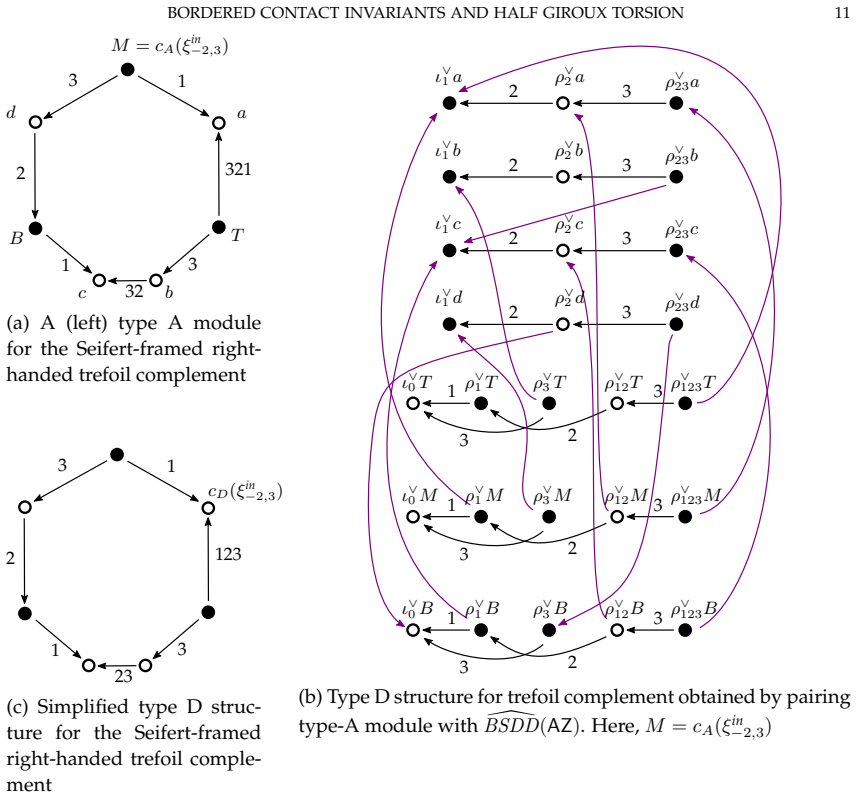
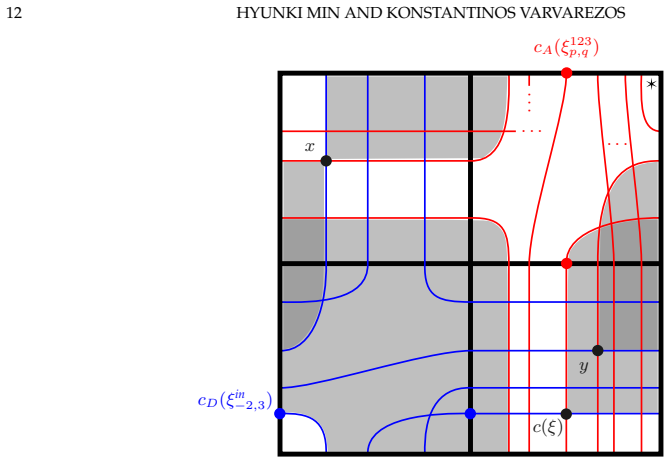
The argument is carried by the bordered contact invariants $c_A$ and $c_D$ developed by the authors: $c_A(\xi)$ lives in a type-A module associated to a bordered sutured 3-manifold, and a pairing theorem (Theorem 2.8) recovers the sutured contact invariant of a glued manifold as $c_A(\xi_1)\boxtimes c_D(\xi_2)$. The examples are built from innermost contact structures, the minimal tight contact structures on knot complements (defined by the non-thickening condition on the convex boundary), together with the element $\rho_{123}$ in the punctured-torus algebra, which corresponds to a $3\pi/2$-layer containing half Giroux torsion. The non-vanishing of $\hat{c}(\xi)$ is established by computing the placement $c_A(\xi^{123}_{p,q}) \boxtimes c_D(\xi^{\mathrm{in}}_{-2,3})$ through immersed curves in the punctured torus, where the differential counts immersed bigons; the bigons displayed in Figures 4 and 6 show that the class $c(\xi)$ survives in homology.
What would settle it
An independent computation of the bordered pairing complex for Y_{p,q} (or the double of the figure-eight knot complement) that finds an immersed bigon not shown in Figure 4 (or Figure 6) among the generators x, y, c(ξ) (or x, y, z, c(ξ)) would alter the differential and could make the claimed contact class vanish in homology.
Extended reading notes
Core claim
The paper's central claim is that, for any coprime integers (p,q) with pq<0, the splice Y_{p,q} of the left-handed trefoil and the (p,q)-torus knot admits a contact structure ξ_{p,q} that contains half Giroux torsion along a separating torus and whose contact invariant $\hat{c}(\xi_{p,q})$ is non-zero. If correct, this gives infinitely many closed-manifold counterexamples to Conjecture 1.1, which predicted that separating half Giroux torsion always kills the contact invariant. The paper also claims a contact structure on the double of the figure-eight knot complement that contains convex torsion along a separating torus and has non-vanishing contact invariant, implying that a full 2π twist is the minimal amount of twisting needed to ensure vanishing.
Load-bearing premise
The non-vanishing proof rests on the manual immersed-curve counts in Figures 4 and 6, which assume that the displayed bigons are the only differentials among the relevant generators; an extra bigon or differential could make the class c(ξ) null-homologous.
Editorial extensions
If this is right
- Conjecture 1.1 is false: separating half Giroux torsion does not force the contact invariant to vanish in closed manifolds.
- Separating half Giroux torsion alone cannot obstruct symplectic fillability, because these examples carry the non-vanishing contact invariant that filling obstructions detect.
- Convex torsion and Giroux torsion are inequivalent notions: a convex torsion layer can be present where no Giroux torsion layer embeds, and the contact invariant can survive the former but not the latter.
- The minimal twisting amount along a separating torus that guarantees vanishing of the contact invariant is exactly 2π.
- The same construction applied to splices of the left-handed trefoil with any negative L-space knot, whose complements admit innermost contact structures, would yield further counterexamples.
Reading between the lines
- The paper's method gives a template for producing contact manifolds with unusual non-vanishing invariants: splice knot complements whose innermost contact structures have known bordered invariants, then insert a torsion layer whose algebra element is detectable under the pairing.
- If the spliced manifolds Y_{p,q} turn out to be symplectically fillable, half Giroux torsion would join half convex torsion as a twist that fillability can tolerate, sharpening the distinction between torsion and convex torsion.
- The immersed-curve bigon counts in Figures 4 and 6 are concrete enough to be checked by an automated search; such a verification would either confirm the theorem as stated or identify a missing differential, making this an unusually testable proof.
- By analogy with the figure-eight case, doubling complements of even twist knots may yield an infinite family of closed manifolds with separating convex torsion and non-vanishing contact invariants, as the authors suggest in their concluding questions.
Editorial analysis
A structured set of objections, weighed in public.
Referee Report
Summary. The paper constructs explicit closed contact 3-manifolds that contain half Giroux torsion (respectively convex torsion) along a separating torus and whose Heegaard Floer contact invariants are claimed to be nonzero. Theorem 1.2 gives infinitely many such examples, obtained as splices of the left-handed trefoil complement with negative torus knot complements; Theorem 1.4 gives a single example, the double of the figure-eight knot complement, with convex torsion along a separating torus. The proofs use the authors' bordered contact invariant machinery from [25] together with innermost contact structures on knot complements, and the main nonvanishing computations are presented via immersed curve bigon counts.
Significance. If the main theorems are correct, they provide the first closed-manifold counterexamples to Ghiggini's conjecture and show that separating half Giroux torsion does not force the contact invariant to vanish. The paper also sharpens the known vanishing threshold for twisting along a separating torus. The use of bordered contact invariants is well matched to the construction, and the reduction of the convex torsion case to Giroux torsion via Proposition 2.5 is elegant. However, the central nonvanishing claims rest on manual bigon-counting arguments in two figures, and the manuscript does not supply the algebraic or machine-checked verification needed to rule out additional differentials into the contact class. This gap is load-bearing for both theorems.
major comments (3)
- [Section 3.2, Figure 4] The proof of nonvanishing of c(ξ) asserts that 'these are the only bigons involving these three generators' in a local fragment of the immersed curve diagram. This only controls the subcomplex generated by x, y, and c(ξ); a bigon from any intersection point outside the drawn fragment into c(ξ) would make the contact class exact, destroying the counterexample in Theorem 1.2. No algebraic computation, Maslov index bound, or computer verification is provided to rule out such bigons. This is a load-bearing gap and must be closed.
- [Section 3.4, Figure 6] The same issue affects Theorem 1.4: the four drawn generators are asserted to form a summand, but bigons from generators outside the local picture into c(ξ) are not excluded. Additionally, the statement that the vertical type-A curve has been homotoped 'for admissibility reasons' needs justification that this homotopy does not create or destroy bigons involving c(ξ). A complete differential computation or a formal grading argument is required to establish the claimed nonvanishing.
- [Section 3.3] The step from Proposition 2.13(4) to 'we know m2(cA(ξin_8),ρ1)≠0' is not justified as written, since ρ1 is described in Theorem 2.10 as a basic slice, not a half convex torsion layer; the surrounding argument uses ρ23. The identification of cA(ξin_8) as either E or E+I depends on this step, and if cA(ξin_8)=I were possible then the computation in Theorem 1.4 would collapse. Please clarify which generator corresponds to the half convex torsion layer and verify the resulting identification of cA(ξin_8).
minor comments (5)
- [Introduction, Question 1.10 paragraph] The reference '[21, Propostion 2.5]' contains a typo: 'Propostion' should be 'Proposition'.
- [Section 3.2] The phrase 'bordered paring computation' should read 'bordered pairing computation'.
- [Theorem 1.2] The statement allows all coprime (p,q) with pq<0, but the proof fixes p<0<q; the case p>0>q should be addressed explicitly, for instance by symmetry of torus knots.
- [Section 3.3] The sentence 'Since B and T are the unique generators in Alexander gradings 1 and -1, respectively, they represent the contact invariants of conjugate contact structures' is terse; a brief justification or reference would help the reader.
- [Corollary 1.5] The phrase 'the minimal amount of twisting along a separating torus necessary to ensure that the contact invariant vanishes' could be misread as a universal statement; consider rephrasing to make clear that it means no smaller amount forces vanishing in general, since Theorem 1.4 provides one counterexample.
Circularity Check
Self-citation is present, but no load-bearing circular step in the derivation chain: the central non-vanishing computations in Figures 4 and 6 are new applications of prior theorems with independent proofs.
full rationale
The paper's derivation for Theorems 1.2 and 1.4 proceeds by (i) invoking innermost contact structures whose sutured invariants are non-vanishing and have known Alexander gradings (Propositions 2.13 and 2.14, from [3] and [8]); (ii) identifying the corresponding bordered contact invariants by uniqueness in the relevant Alexander grading within the known knot Floer complexes; (iii) attaching the ρ123 or ρ23 layers and using the bordered pairing theorem (Theorem 2.8, from the authors' prior work [25]); and (iv) explicitly pairing type-A and type-D generators and counting immersed bigons to show that c(ξ) survives in homology. Nowhere does the argument assume the target non-vanishing of c(ξ) or the falsity of Ghiggini's conjecture as an input; the non-vanishing is a conclusion drawn from the bigon counts in Figures 4 and 6. The cited results in [3], [8], and [25] are prior theorems with independent proofs, and the present paper does not reduce either main theorem to a restatement of those results: the immersed curve pairings are the substantive new computational content. The heavy reliance on the authors' own bordered machinery is a self-citation, but it is not a circular one in the sense of this analysis, because the cited theorems do not depend on the present conclusions. Whether the manual bigon enumeration is fully complete is a correctness and exhaustiveness concern about the proof, not an instance of a result being equivalent to its input by construction. Accordingly, the appropriate finding is no significant circularity, with at most minor non-load-bearing self-citation.
Assumptions & free parameters
assumptions (5)
- domain assumption Bordered contact invariants satisfy the pairing theorem [25, Thm 2.8], identifying cA(ξ1) ⊠ cD(ξ2) with EH(ξ1 ∪ ξ2).
- domain assumption The torus algebra element ρ123 corresponds to a contact layer containing half Giroux torsion [25, Thm 2.10, Prop 2.11].
- domain assumption Innermost contact structures exist on the figure-eight and negative torus knot complements with prescribed invariants [3, 8].
- domain assumption Immersed curve interpretation of bordered Floer homology yields correct bigon counts and differentials [13, 14].
- domain assumption Contact invariants vanish in the presence of Giroux torsion (Theorem 2.6).
Cite this review
Pith. "Pith review of Bordered contact invariants and half Giroux torsion." pith.science (2026). https://pith.science/paper/7745KYRQ
@misc{pith2026250614050,
  author       = {Pith},
  title        = {Pith review of: Bordered contact invariants and half Giroux torsion},
  year         = {2026},
  howpublished = {\url{https://pith.science/paper/7745KYRQ}},
  note         = {Machine review of arXiv:2506.14050}
}
abstract
We show that there exist infinitely many closed contact 3-manifolds containing half Giroux torsion along a separating torus whose contact invariants do not vanish. This provides counterexamples to Ghiggini's conjecture and suggests that separating half Giroux torsion may not obstruct symplectic fillability. The main tools are the bordered contact invariants recently developed by the authors and the innermost contact structures on knot complements. We also show that there exists a closed contact 3-manifold containing convex torsion along a separating torus with non-vanishing contact invariant, which implies that $2\pi$ is the minimal amount of twisting necessary to ensure vanishing of the contact invariant.
Figures


Figures from the paper (3 more)


Reference graph
Works this paper leans on
-
[25]
On contact invariants in bordered Floer homology
Hyunki Min and Konstantinos Varvarezos. On contact invariants in bordered floer homology, 2024. arXiv:2410.05511
work page Pith review arXiv 2024
-
[1]
Legendrian invariants and half Giroux torsion
Alberto Cavallo and Irena Matkoviˇ c. Legendrian invariants and half giroux torsion.arXiv:2310.07593
-
[2]
Finitude homotopique et isotopique des structures de contact tendues
Vincent Colin, Emmanuel Giroux, and Ko Honda. Finitude homotopique et isotopique des structures de contact tendues. Publ. Math. Inst. Hautes Études Sci., (109):245–293, 2009
work page 2009
-
[3]
Classification of tight contact structures on surgeries on the figure- eight knot
James Conway and Hyunki Min. Classification of tight contact structures on surgeries on the figure- eight knot. Geom. Topol., 24(3):1457–1517, 2020
work page 2020
-
[4]
Symplectic fillability of tight contact structures on torus bundles.Algebr
Fan Ding and Hansjörg Geiges. Symplectic fillability of tight contact structures on torus bundles.Algebr. Geom. Topol., 1:153–172, 2001
work page 2001
-
[5]
Strong symplectic fillability of contact torus bundles
Fan Ding and Youlin Li. Strong symplectic fillability of contact torus bundles. Geom. Dedicata, 195:403– 415, 2018
work page 2018
-
[6]
Unique holomorphically fillable contact structure on the 3-torus
Yasha Eliashberg. Unique holomorphically fillable contact structure on the 3-torus. Internat. Math. Res. Notices, (2):77–82, 1996
work page 1996
-
[7]
John B. Etnyre. Convex surfaces in contact geometry: class notes, 2004. https://etnyre.math.gatech. edu/preprints/papers/surfaces.pdf
work page 2004
Show all 32 references
-
[8]
Etnyre, Hyunki Min, and Anubhav Mukherjee
John B. Etnyre, Hyunki Min, and Anubhav Mukherjee. Non-loose torus knots, 2022. arXiv:2206.14848
2022 arXiv
-
[9]
David T. Gay. Four-dimensional symplectic cobordisms containing three-handles.Geom. Topol., 10:1749– 1759, 2006
2006
-
[10]
An introduction to contact topology, volume 109 of Cambridge Studies in Advanced Math- ematics
Hansjörg Geiges. An introduction to contact topology, volume 109 of Cambridge Studies in Advanced Math- ematics. Cambridge University Press, Cambridge, 2008
2008
-
[11]
Giroux torsion and twisted coefficients, 2008
Paolo Ghiggini and Ko Honda. Giroux torsion and twisted coefficients, 2008. arXiv:0804.1568
2008 arXiv
-
[12]
The vanishing of the contact invariant in the presence of torsion, 2008
Paolo Ghiggini, Ko Honda, and Jeremy Van Horn-Morris. The vanishing of the contact invariant in the presence of torsion, 2008. arXiv:0706.1602
2008 arXiv
-
[13]
Heegaard Floer homology for manifolds with torus boundary: properties and examples
Jonathan Hanselman, Jacob Rasmussen, and Liam Watson. Heegaard Floer homology for manifolds with torus boundary: properties and examples. Proc. Lond. Math. Soc. (3), 125(4):879–967, 2022
2022
-
[14]
Bordered Floer homology for manifolds with torus boundary via immersed curves
Jonathan Hanselman, Jacob Rasmussen, and Liam Watson. Bordered Floer homology for manifolds with torus boundary via immersed curves. J. Amer. Math. Soc., 37(2):391–498, 2024
2024
-
[15]
On the classification of tight contact structures
Ko Honda. On the classification of tight contact structures. II. J. Differential Geom., 55(1):83–143, 2000
2000
-
[16]
Kazez, and Gordana Mati´ c
Ko Honda, William H. Kazez, and Gordana Mati´ c. Convex decomposition theory. Int. Math. Res. Not., (2):55–88, 2002
2002
-
[17]
Filtering the Heegaard Floer contact invariant
Ça˘ gatay Kutluhan, Gordana Mati´ c, Jeremy Van Horn-Morris, and Andy Wand. Filtering the Heegaard Floer contact invariant. Geom. Topol., 27(6):2181–2236, 2023
2023
-
[18]
Algebraic torsion in contact manifolds.Geom
Janko Latschev and Chris Wendl. Algebraic torsion in contact manifolds.Geom. Funct. Anal., 21(5):1144– 1195, 2011. With an appendix by Michael Hutchings
2011
-
[19]
Ozsvath, and Dylan P
Robert Lipshitz, Peter S. Ozsvath, and Dylan P . Thurston. Bordered Heegaard Floer homology. Mem. Amer. Math. Soc., 254(1216):viii+279, 2018
2018
-
[20]
Stipsicz
Paolo Lisca and András I. Stipsicz. Contact Ozsváth-Szabó invariants and Giroux torsion. Algebr. Geom. Topol., 7:1275–1296, 2007
2007
-
[21]
Dehn surgery on the minimally twisted seven-chain link
Bruno Martelli. Dehn surgery on the minimally twisted seven-chain link. Comm. Anal. Geom. , 29(7):1597–1641, 2021
2021
-
[22]
Daniel V . Mathews. Strand algebras and contact categories.Geom. Topol., 23(2):637–683, 2019
2019
-
[23]
Tight contact structures on a family of hyperbolic L-spaces, 2023
Hyunki Min and Isacco Nonino. Tight contact structures on a family of hyperbolic L-spaces, 2023. arXiv:2311.14103
2023 arXiv
-
[24]
Spinal open books and symplectic fillings with exotic fibers,
Hyunki Min, Agniva Roy, and Luya Wang. Spinal open books and symplectic fillings with exotic fibers,
-
[26]
Contact structures, sutured polytopes and knot floer ho- mology in the next-to-top grading, In preparation
Hyunki Min and Konstantinos Varvarezos. Contact structures, sutured polytopes and knot floer ho- mology in the next-to-top grading, In preparation
-
[27]
On knot Floer homology and lens space surgeries
Peter Ozsváth and Zoltán Szabó. On knot Floer homology and lens space surgeries. Topology, 44(6):1281–1300, 2005
2005
-
[28]
Classification of tight contact structures on some seifert fibered manifolds: I, 2025
Tanushree Shah. Classification of tight contact structures on some seifert fibered manifolds: I, 2025. arXiv:2303.09490
2025 arXiv
-
[29]
Tight contact structures on toroidal plumbed 3-manifolds, 2024
Tanushree Shah and Jonathan Simone. Tight contact structures on toroidal plumbed 3-manifolds, 2024. arXiv:2412.10225
2024
-
[30]
Heegaard Floer homology and chirally cosmetic surgeries
Konstantinos Varvarezos. Heegaard Floer homology and chirally cosmetic surgeries. Comm. Anal. Geom., 32(10):2673–2715, 2024
2024
-
[31]
Strongly fillable contact manifolds and J-holomorphic foliations
Chris Wendl. Strongly fillable contact manifolds and J-holomorphic foliations. Duke Math. J. , 151(3):337–384, 2010. DEPARTMENT OF MATHEMATICS , U NIVERSITY OF CALIFORNIA , 520 P ORTOLA PLAZA , L OS ANGELES , CA, U NITED STATES , 90095 Email address: hkmin27@math.ucla.edu Emai...
2010
-
[2024]
BORDERED CONTACT INVARIANTS AND HALF GIROUX TORSION 17
arXiv:2410.10697. BORDERED CONTACT INVARIANTS AND HALF GIROUX TORSION 17
Reviewed August 7, 2026 · model on record in the stance chip above.
Discussion (0). Continue with ORCID to comment.