A Robust Nonparametric Framework for Detecting Repeated Spatial Patterns
Pith reviewed 2026-05-19 09:54 UTC · model grok-4.3
The pith
A two-stage nonparametric method detects repeated spatial patterns that are similar but spatially separated.
A machine-rendered reading of the paper's core claim, the machinery that carries it, and where it could break.
Core claim
The authors develop a two-stage procedure combining constrained clustering with a post-clustering reassignment using the MMD statistic and block permutations. They establish asymptotic consistency of the MMD² statistic under second-order stationarity and spatial mixing. This enables identification of clusters that are spatially distant yet similar in distribution, as demonstrated in simulations and breast cancer proteomics data.
What carries the argument
The two-stage approach of constrained clustering followed by MMD-based reassignment using block permutation for the null distribution.
Load-bearing premise
The data must obey second-order stationarity and spatial mixing conditions for the MMD squared statistic to be asymptotically consistent.
What would settle it
A simulation study on data that violates spatial mixing conditions where the method fails to correctly identify the repeated patterns would disprove the consistency claim.
Figures


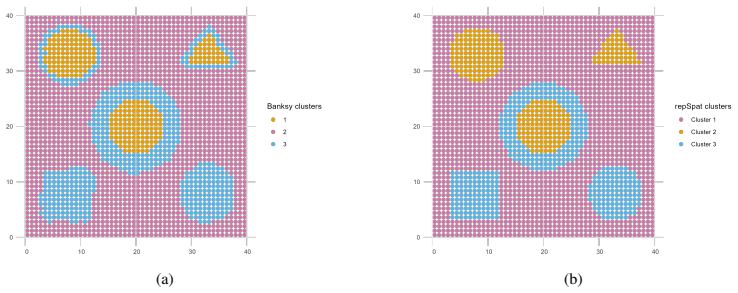


read the original abstract
Identifying spatially contiguous clusters and repeated spatial patterns (RSP) characterized by similar underlying distributions that are spatially apart is a key challenge in modern spatial statistics. Existing constrained clustering methods enforce spatial contiguity but are limited in their ability to identify RSP. We propose a novel nonparametric framework that addresses this limitation by combining constrained clustering with a post-clustering reassigment step based on the maximum mean discrepancy (MMD) statistic. We employ a block permutation strategy within each cluster that preserves local attribute structure when approximating the null distribution of the MMD. We also show that the MMD$^2$ statistic is asymptotically consistent under second-order stationarity and spatial mixing conditions. This two-stage approach enables the detection of clusters that are both spatially distant and similar in distribution. Through simulation studies that vary spatial dependence, cluster sizes, shapes, and multivariate dimensionality, we demonstrate the robustness of our proposed framework in detecting RSP. We further illustrate its applicability through an analysis of spatial proteomics data from patients with triple-negative breast cancer. Overall, our framework presents a methodological advancement in spatial clustering, offering a flexible and robust solution for spatial datasets that exhibit repeated patterns.
Editorial analysis
A structured set of objections, weighed in public.
Referee Report
Summary. The paper proposes a two-stage nonparametric framework for detecting repeated spatial patterns (RSP) that combines constrained clustering (to enforce spatial contiguity) with a post-clustering reassignment step based on the maximum mean discrepancy (MMD) statistic. The method uses block permutations within clusters to approximate the null distribution of MMD while preserving local spatial structure. It establishes that the MMD² statistic is asymptotically consistent under second-order stationarity and spatial mixing conditions, demonstrates robustness via simulations that vary spatial dependence, cluster sizes/shapes, and dimensionality, and applies the approach to spatial proteomics data from triple-negative breast cancer patients.
Significance. If the asymptotic result and simulation evidence hold, the framework fills a clear gap in spatial statistics by allowing detection of distributionally similar clusters that are spatially distant, which existing constrained clustering methods cannot do. The choice of MMD with block-permutation nulls is well-motivated for dependent spatial data, the explicit statement of mixing and stationarity conditions is a strength, and the multi-factor simulation design plus real-data illustration add practical value. The work could be a useful methodological contribution provided the theoretical derivations are complete and the finite-sample behavior is adequately characterized.
major comments (2)
- [§3] §3 (theoretical results): the asymptotic consistency claim for MMD² is stated under second-order stationarity plus spatial mixing, but the manuscript does not provide a self-contained proof sketch or reference the precise theorem from the MMD literature that is being invoked; this makes it difficult to verify that the block-permutation approximation preserves the required convergence rate.
- [Simulation section] Simulation section (around Tables 1–3): while dependence, size, shape, and dimension are varied, the reported power curves do not include a direct comparison against a pure constrained-clustering baseline without the MMD reassignment step, so the incremental benefit of the second stage is not isolated.
minor comments (3)
- [Abstract] Abstract: 'reassigment' is a typographical error and should read 'reassignment'.
- [Methods] Notation: the definition of the block-permutation scheme should be given explicitly (e.g., as an equation) rather than described only in prose, to facilitate reproducibility.
- [Figures] Figure captions: several simulation figures lack axis labels for the MMD threshold or permutation count; adding these would improve clarity.
Simulated Author's Rebuttal
We thank the referee for their positive evaluation and recommendation of minor revision. We address the two major comments point by point below and will incorporate the suggested changes.
read point-by-point responses
-
Referee: [§3] §3 (theoretical results): the asymptotic consistency claim for MMD² is stated under second-order stationarity plus spatial mixing, but the manuscript does not provide a self-contained proof sketch or reference the precise theorem from the MMD literature that is being invoked; this makes it difficult to verify that the block-permutation approximation preserves the required convergence rate.
Authors: We agree that the presentation of the asymptotic result can be strengthened. The manuscript invokes standard consistency results for the MMD statistic under α-mixing and second-order stationarity (e.g., building on theorems from Gretton et al. and subsequent extensions to dependent data), but does not include an explicit sketch or citation. In the revised version we will add a concise proof outline in §3 that (i) recalls the relevant MMD consistency theorem under the stated mixing conditions, (ii) verifies that the block-permutation scheme respects the same dependence structure, and (iii) confirms that the convergence rate is preserved. We will also add the precise reference to the invoked theorem. revision: yes
-
Referee: [Simulation section] Simulation section (around Tables 1–3): while dependence, size, shape, and dimension are varied, the reported power curves do not include a direct comparison against a pure constrained-clustering baseline without the MMD reassignment step, so the incremental benefit of the second stage is not isolated.
Authors: We concur that isolating the contribution of the MMD reassignment step would make the simulation results more informative. We will augment the simulation section with an additional baseline that applies only the constrained clustering step (without the subsequent MMD-based reassignment). Updated power curves and tables will directly compare the two-stage procedure against this baseline across the same design factors, thereby quantifying the incremental gain from the post-clustering reassignment. revision: yes
Circularity Check
No significant circularity in derivation chain
full rationale
The paper's central claims rest on a two-stage procedure (constrained clustering plus MMD-based reassignment) whose asymptotic consistency for MMD² is asserted under explicitly external conditions (second-order stationarity and spatial mixing) drawn from standard spatial statistics literature rather than from any equation or fit internal to the manuscript. The MMD statistic is imported from prior independent work, the block-permutation null is a direct structural device, and no step equates a claimed prediction or uniqueness result to a self-defined quantity, fitted parameter, or self-citation chain. The derivation therefore remains self-contained against external benchmarks.
Axiom & Free-Parameter Ledger
axioms (1)
- domain assumption Data satisfies second-order stationarity and spatial mixing conditions
Reference graph
Works this paper leans on
-
[1]
Sci- ence (New York, N.Y .) 381, eabq4964
The dawn of spatial omics. Sci- ence (New York, N.Y .) 381, eabq4964. doi:10.1126/science.abq4964. de Bruijn, I., Nikolov, M., Lau, C., Clayton, A., Gibbs, D.L., Mitraka, E., Pozhi- dayeva, D., Lash, A., Sumer, S.O., Altreuter, J., et al.,
-
[2]
Finite sample properties of parametric MMD estimation: Robustness to misspecification and dependence. Bernoulli 28, 181–213. doi:10.3150/21-BEJ1338. Dries, R., Zhu, Q., Dong, R., Eng, C.H.L., Li, H., Liu, K., Fu, Y ., Zhao, T., Sarkar, A., Bao, F., George, R.E., Pierson, N., Cai, L., Yuan, G.C.,
-
[3]
doi:10.1186/s13059-021-02286-2. Editorial Board,
-
[4]
Method of the year 2024: spatial proteomics. Nature Methods 21, 2195–2196. doi:10.1038/s41592-024-02565-3. editorial. 37 Ester, M., Kriegel, H.P., Sander, J., Xu, X.,
-
[5]
Journal of Statistical Software 103, 1–26
Hierarchical Clustering with Con- tiguity Constraint in R. Journal of Statistical Software 103, 1–26. doi:10.18637/jss.v103.i07. Hubert, L., Arabie, P.,
-
[6]
STICC: A multivariate spatial clustering method for repeated geographic pattern discov- ery with consideration of spatial contiguity. doi:10.48550/arXiv.2203.09611. Keren, L., Bosse, M., Marquez, D., Angoshtari, R., Jain, S., Varma, S., Yang, S.R., Kurian, A., Valen, D.V ., West, R., Bendall, S.C., Angelo, M.,
-
[7]
A Structured Tumor-Immune Microenvironment in Triple Negative Breast Can- cer Revealed by Multiplexed Ion Beam Imaging. Cell 174, 1373–1387.e19. doi:10.1016/j.cell.2018.08.039. Kulldorff, M.,
-
[8]
The Computer Journal 9, 373–380
Hierarchical Systems. The Computer Journal 9, 373–380. doi:10.1093/comjnl/9.4.373. 38 Miranda, L., Filho, J.V ., Bernardini, F.C.,
-
[9]
RegK-Means: A Clustering Al- gorithm Using Spatial Contiguity Constraints for Regionalization Problems, in: 2017 Brazilian Conference on Intelligent Systems (BRACIS), pp. 31–36. doi:10.1109/BRACIS.2017.70. Muandet, K., Fukumizu, K., Sriperumbudur, B., Schölkopf, B.,
-
[10]
Foundations and Trends® in Machine Learning , author =
Ker- nel Mean Embedding of Distributions: A Review and Beyond. FNT in Machine Learning 10, 1–141. URL: http://arxiv.org/abs/1605.09522, doi:10.1561/2200000060. arXiv:1605.09522 [stat]. Murtagh, F.,
-
[11]
The Computer Journal 28, 82–88
A Survey of Algorithms for Contiguity-constrained Clustering and Related Problems. The Computer Journal 28, 82–88. doi:10.1093/comjnl/28.1.82. Rousseeuw, P.J.,
-
[12]
Silhouettes: A graphical aid to the interpretation and vali- dation of cluster analysis. Journal of Computational and Applied Mathematics 20, 53–65. doi:10.1016/0377-0427(87)90125-7. Schabenberger, O., Gotway, C.A.,
-
[13]
Spatial domain detection using contrastive self-supervised learning for spatial multi- omics technologies. doi:10.1101/2024.02.02.578662. 39
discussion (0)
Sign in with ORCID, Apple, or X to comment. Anyone can read and Pith papers without signing in.