REVIEW 4 major objections 8 minor 61 references
Latitudinal dependence of the solar wind during periods of high and low activity through interplanetary scintillation
T0 review · 4 major / 8 minor · reviewed 2026-08-07 · deepseek-v4-flash
Pith's one-line read At solar minimum, the solar wind's latitudinal density profile is a steep sigmoid with an equator-to-south-pole reduction ratio of 1.62±0.02, while in the active phase it is consistent with spherical symmetry.
desk verdict A genuinely large IPS dataset and a plausible qualitative result, but the headline numbers—the sigmoid shape and the 1.62 reduction ratio—need to survive a model comparison and a line-of-sight smearing analysis before I'd trust them. read the letter →
The pith
A machine-rendered reading of the paper's core claim, the machinery that carries it, and where it could break.
The reading
What carries the argument
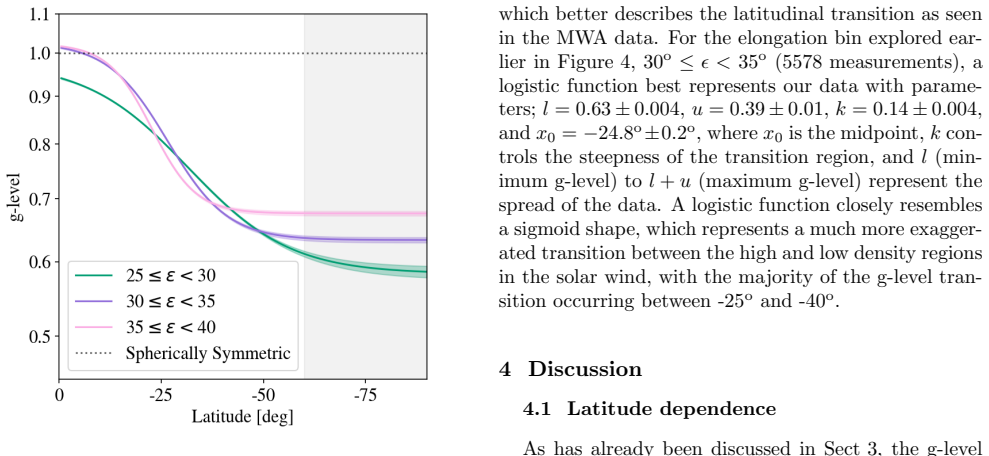
The central object is the g-level, the ratio of a source's observed scintillation to the scintillation expected for a point source in a spherically symmetric solar wind, after dividing out source angular size through the normalized scintillation index. This isolates the density-turbulence enhancement along each line of sight. Latitude is assigned by tracing each line-of-sight piercepoint back to the Sun's centre (the effective Carrington latitude), an assumption of radial outflow. The argument is carried by fitting a logistic function $y = l + u/(1+e^{-k(x-x_0)})$ to g-level versus latitude in three elongation bins; the parameters $l$ and $u$ define the reduction ratio $(u+l)/l$, while $k$ and $x_0$ quantify the steepness and midpoint of the latitudinal transition.
What would settle it
Measure the same three elongation bins with an independent IPS telescope, or perform a tomographic inversion that solves for density turbulence in three dimensions without assuming radial outflow, and fit the same logistic function; if the fitted midpoint ($x_0\approx-24.8^\circ$) and steepness ($k\approx0.14$) do not reproduce within errors, the sigmoid and the $1.62\pm0.02$ reduction ratio are artifacts of the latitude assignment.
Extended reading notes
Core claim
The central discovery is that the latitude dependence of the solar wind's density turbulence at 162 MHz switches between two states over the solar cycle. During the 2019 sunspot-minimum period, the g-level as a function of effective Carrington latitude in the southern hemisphere is well described by a logistic function, with a sharp transition around $-24.8^\circ$ and most of the drop occurring between $-25^\circ$ and $-40^\circ$. The fitted equator-to-pole reduction ratio, $(u+l)/l$, is $1.67\pm0.04$ at $90$–$108\,R_\odot$, $1.62\pm0.02$ at $108$–$123\,R_\odot$, and $1.51\pm0.01$ at $123$–$138\,R_\odot$, decreasing with heliospheric distance. During the 2023 active period, the g-level distributions stay flat across latitude at elevated values, matching a spherically symmetric solar wind. The sigmoid contrasts with the smoother elliptical transition favored by earlier IPS studies at similar distances.
Load-bearing premise
The load-bearing premise is that each measurement can be tied to a single solar latitude by tracing the closest-approach point of the line of sight back to the Sun's centre, which assumes purely radial solar wind flow and ignores solar rotation; if the flow is non-radial or the sensitive region of the line of sight lies elsewhere, the fitted sigmoid and the quoted 1.62 ratio would be systematically biased.
Editorial extensions
If this is right
- At solar minimum, IPS-based models of the solar wind at 90–140 solar radii should replace elliptical or spherical latitude profiles with a sigmoid having a transition near -25 to -40 degrees.
- The equator-to-south-pole reduction ratio of 1.62±0.02 at 108–123 solar radii is larger than some earlier values reported at similar elongations, suggesting cycle-to-cycle variation in the sharpness of the polar-equator boundary.
- During the active ascending phase, treating the solar wind as spherically symmetric is sufficient to describe g-level variations at these distances.
- The decline of the reduction ratio from 1.67 to 1.51 across the three elongation bins indicates that the latitudinal contrast in density turbulence relaxes as the wind moves outward.
- The steep sigmoid implies the boundary between equatorial and polar wind structure sits at a higher southern latitude than the smoother elliptical transition used in earlier models.
Reading between the lines
- If the sigmoid is a generic feature of solar minima, the midpoint and steepness could be cycle-specific diagnostics; applying this fit to the other MWA epochs (2020, 2024) would test whether the boundary shifts with cycle strength.
- A steep density-turbulence gradient near -25 to -40 degrees at these distances implies pulsar timing and dispersion-measure solar wind models will see larger scattering changes just below the equator than elliptical models predict.
- The flat 2023 profile may partly reflect line-of-sight averaging with transient events present; repeating the analysis after removing identified CMEs, which the paper says was not done, would test whether a hidden latitude dependence remains.
- An independent check would compare the fitted logistic profile to a tomographic IPS reconstruction that does not assume radial outflow, hardening or refuting the 1.62 ratio.
Signed reviews
Editorial analysis
A structured set of objections, weighed in public.
Referee Report
Summary. This paper uses Murchison Widefield Array interplanetary scintillation (IPS) observations at 162 MHz from the 2019 solar minimum and the early-2023 ascending phase of cycle 25 to study the latitudinal dependence of the g-level. After restricting to the southern hemisphere and to elongations 25–40 degrees, the authors bin the data by elongation and latitude and fit a logistic function (Eq. 4) to the 2019 profiles, obtaining a reduction ratio (Eq. 5) of 1.62±0.02 for the 30–35 degree elongation bin (108–123 R_sun). The 2023 data are interpreted as consistent with a spherically symmetric active solar wind. The results are compared with prior IPS studies and discussed in terms of solar-cycle variation of the density-fluctuation environment.
Significance. If the results are robust, this paper provides the highest-density IPS source sample to date in the 90–140 R_sun range and would be the first MWA-based claim that the solar-minimum latitude profile is steeper than the elliptical form found in earlier IPS work. The paper is explicit about its definitions, reports parameter errors for the logistic fit, and honestly labels the reduction ratio as derived from fitted parameters rather than as a prediction. The main value is observational: a large, homogeneous IPS dataset that can test and constrain solar-wind models at heliocentric distances that complement coronagraph and in-situ measurements. The central claims, however, rest on two assumptions that are acknowledged but not quantitatively validated: the localization of a line-of-sight-integrated measurement to a single piercepoint latitude, and the interpretation of visual inspection as statistical evidence for flatness in 2023.
major comments (4)
- [Section 2.2 and Section 3, Eq. (4)-(5)] The latitude assigned to each g-level is obtained by tracing the line-of-sight piercepoint back to the Sun's center, but Section 2.2 explicitly states that IPS is a weighted line-of-sight integration and that the method assumes radial flow and neglects solar rotation. The paper claims that the adopted 'Carrington' latitude partially mitigates line-of-sight effects, but no quantitative estimate of the remaining latitude smearing is given. For the MWA geometry, the half-power region at nearly constant heliocentric distance can span tens of degrees in heliographic latitude, which is comparable to the claimed transition width in Figure 5. This systematic can bias the fitted logistic steepness k, the midpoint x0, and therefore the reduction ratio in Eq. (5), and it is not included in the quoted statistical errors. Please provide a quantitative assessment, for example by forward-modeling the line-of-sight integral for a trial latitude profile and comparing the recovered logistic parameters, or otherwise demonstrate that the piercepoint assignment is unbiased for the actual weighting function.
- [Section 3, Figure 4] The claim that the 2023 observing period is consistent with a spherically symmetric solar wind is based on visual inspection of the g-level distributions. No quantitative test of flatness is reported: there is no fit of a constant or latitude-independent model, no upper limit on a latitude gradient, and no goodness-of-fit statistic. Because the 2019-versus-2023 contrast is a central conclusion of the paper, please add a statistical test (e.g., fitting a constant to the binned means or medians with uncertainties and reporting a confidence interval on any slope) to support the spherical-symmetry statement.
- [Section 3, Figure 5; Abstract] The paper states that a logistic/sigmoid function better represents the 2019 data than the elliptical function used by Manoharan (1993), but no model comparison is performed. Only the logistic function is fitted in Figure 5. Please fit the elliptical functional form (or another published alternative) to the same binned data and compare the models using an appropriate criterion (e.g., AIC/BIC, residual scatter, or a nested test) before concluding that the sigmoid is required. As written, the claim that the sigmoid is 'more exaggerated' than an ellipse is not supported by the analysis presented.
- [Section 2.2.1 and Section 4.1] The 2023 analysis deliberately does not remove transient events such as CMEs or stream interaction regions, and the text acknowledges that removal of such events 'may potentially' change the 2023 results. Since the 2023 flatness claim is based on elevated and broadened g-level distributions that could be influenced by a small number of large transients, please perform a sensitivity analysis—for example, excluding clearly enhanced measurements, using robust statistics such as the median, or identifying and removing obvious events—to demonstrate that the spherical-symmetry conclusion is not driven by transient contamination.
minor comments (8)
- [Section 2.2.1] The phrase 'refereed to simply' should be 'referred to simply'.
- [Section 4.2] The heading 'F uture W ork' contains stray spaces; please correct.
- [References] The reference list contains apparent typos: 'Crammer' is likely 'Cranmer' for the 2017 solar wind origins paper, and 'actiivty' in the McIntosh et al. reference should be 'activity'.
- [Section 3] The fitting procedure for the logistic function is not described: the minimization method, the treatment of outliers, and the way parameter uncertainties were computed are not stated. Please add this information so the reported parameters and errors are reproducible.
- [Section 3, Figure 4] The caption says that outliers above 4 sigma were removed from the figure; please clarify whether the statistics and fits use the full data or only the outlier-clipped data, since this affects the reported means and the logistic fit.
- [Section 2.2] The term 'Carrington latitude' is used for a latitude obtained by tracing the piercepoint to the Sun's center, which is nonstandard; please define this coordinate more carefully and distinguish it from helioprojective latitude throughout the paper.
- [Table 2] The 'Source Count' column lists values (e.g., 1265 for the 30–35 degree bin) that are much smaller than the population sizes stated in Section 3 (5578 for the same bin); please clarify whether these are unique sources rather than individual measurements, and how they were obtained.
- [Abstract and Section 4] The sentence in the abstract that an elliptical function 'better represents' the transition while a sigmoid is 'required' is confusing and appears to contradict the body of the paper; please rephrase to state clearly that the paper finds a sigmoid provides a better description than an ellipse.
Circularity Check
No significant circularity: the central latitude profile and reduction ratio are data-derived fits, not predictions from their own inputs.
full rationale
The paper's central claims are empirical fits to MWA IPS data, and none of the load-bearing results reduce by construction to the analysis inputs. The m_pt normalization in Eq. (2) does assume a spherically symmetric solar wind and fixes b=1.6 from Readhead (1971), an independent external IPS measurement, not a parameter fitted to the present dataset. This normalization provides an isotropic baseline, but the 2019 latitude dependence is detected as residual variation of g-level with latitude after that normalization; Eq. (2) contains no latitude term, so it cannot generate the observed latitude profile. The 2023 'spherically symmetric' conclusion is supported by the observed flatness of the g-level distributions across latitude bins, not merely by the normalization; the measured g-levels are elevated above 1 during activity, showing that the normalization does not force g=1. The headline reduction ratio of 1.62±0.02 is read directly from the fitted logistic parameters l and u via Eq. (5), and the paper explicitly labels this as a fit summary in Table 2 rather than an out-of-sample prediction. The logistic function in Eq. (4) is chosen and fitted to the data; references to Coles et al. (1995) and Manoharan (1993) are external comparisons used for context, not load-bearing self-citations. The self-citations that appear (Morgan et al. 2019, 2022; Waszewski et al. 2023; Chhetri et al. 2018) are methodological, data-processing, or source-calibration references; the NSI values are independently measured source properties and no cited 'uniqueness' theorem is invoked to forbid alternative models. The Section 2.2 piercepoint-latitude mapping relies on an unvalidated assumption of radial flow and neglect of solar rotation, which is a legitimate systematic-accuracy concern, but it is not circular: the fitted latitude profile is not defined by that mapping in a way that makes the output equal to the input. Overall, the derivation chain is self-contained against independent external calibrations and the paper's numerical claims are honest fits to the data, so no significant circularity is present.
Assumptions & free parameters
free parameters (3)
- Radial dependence index b =
1.6
- Logistic parameters for 30 to 35 degree bin =
l=0.63, u=0.39, k=0.14, x0=-24.8 degrees
- Elongation bin boundaries =
25 to 30, 30 to 35, 35 to 40 degrees
assumptions (4)
- domain assumption Weak scattering regime holds for elongations above 15 degrees at 162 MHz, so the m_pt formula (Eq. 2) is valid.
- domain assumption Solar wind flows radially so the piercepoint latitude can be mapped by a straight line to the Sun's center, ignoring solar rotation.
- domain assumption The radial dependence of Delta N_e^2, proportional to R^{-(2b+1)} with b constant, does not vary with solar activity or latitude.
- domain assumption g-level is a valid proxy for electron density fluctuations along the line of sight, dominated by the piercepoint.
Cite this review
Pith. "Pith review of Latitudinal dependence of the solar wind during periods of high and low activity through interplanetary scintillation." pith.science (2026). https://pith.science/paper/WBLPWFF4
@misc{pith2026250614155,
  author       = {Pith},
  title        = {Pith review of: Latitudinal dependence of the solar wind during periods of high and low activity through interplanetary scintillation},
  year         = {2026},
  howpublished = {\url{https://pith.science/paper/WBLPWFF4}},
  note         = {Machine review of arXiv:2506.14155}
}
abstract
We present a study of the solar wind over different periods of the solar cycle, specifically focussing on the minimum between solar cycles 24 and 25, and the active, ascending phase of solar cycle 25. With the use of interplanetary scintillation (IPS) data taken by the Murchison Widefield Array (MWA) from mid-2019 and early 2023, we have sampled over a wide range of solar latitudes and elongations, probing a large section of the surrounding heliosphere from $\sim$90 to 140R$_\odot$. The MWA observations provide the highest density of sampled IPS radio sources to date, allowing for an investigation into the latitudinal dependence of the scattering effect caused by the solar wind on a radio source as observed throughout the solar cycle. We find our measurements during periods of heightened solar activity are consistent with a spherically symmetric solar wind. On the other hand, with a reduction in solar activity we find the solar wind density inherits a latitudinal dependence. As is consistent with prior studies, an elliptical function better represents the transition from poles to equator, although we find a more exaggerated sigmoid shaped curve is required to represent the low- to mid-latitude transition region during the minimum of solar cycle 24. We find for a heliospheric distance range of 108 - 123R$_{\odot}$ the reduction ratio between the equator and the southern pole is 1.62$\pm$0.02.
Figures


Figures from the paper (2 more)

Reference graph
Works this paper leans on
-
[1]
, Kojima, M
Asai1998 APACrefauthors Asai, K. , Kojima, M. , Tokumaru, M. , Yokobe, A. , Jackson, B V. , Hick, P L. \ Manoharan, P K. APACrefauthors \ 1998 02 . Heliospheric tomography using interplanetary scintillation observations: 3. Correlation between speed and electron density fluctuations in the solar wind Heliospheric tomography using interplanetary scintillat...
1998
-
[2]
Bisi2010 APACrefauthors Bisi, M M. , Fallows, R A. , Breen, A R. \ O’Neill, I J. APACrefauthors \ 2010 1 . Interplanetary Scintillation Observations of Stream Interaction Regions in the Solar Wind Interplanetary Scintillation Observations of Stream Interaction Regions in the Solar Wind . Solar Physics 261 149-172 . APACrefDOI doi:10.1007/s11207-009-9471-1...
-
[3]
Breen2002 APACrefauthors Breen, A. , Canals, A. , Fallows, R. , Moran, P. \ Kojima, M. APACrefauthors \ 2002 01 . Large-scale structure of the solar wind from interplanetary scintillation measurements during the rising phase of cycle 23 Large-scale structure of the solar wind from interplanetary scintillation measurements during the rising phase of cycle ...
-
[4]
, Morgan, J
Chhetri2018 APACrefauthors Chhetri, R. , Morgan, J. , Ekers, R D. , Macquart, J P. , Sadler, E M. , Giroletti, M. Tingay, S J. APACrefauthors \ 2018 3 . Interplanetary scintillation studies with the Murchison Widefield Array – II. Properties of sub-arcsecond compact sources at low radio frequencies Interplanetary scintillation studies with the Murchison W...
2018
-
[5]
clarke APACrefauthors Clarke , M. APACrefauthors \ 1964 July . PhD Thesis PhD Thesis . Cambridge University . APACrefURL https://ethos.bl.uk/OrderDetails.do?uin=uk.bl.ethos.597742 APACrefURL
work page 1964
-
[6]
clette2014 APACrefauthors Clette , F. , Svalgaard , L. , Vaquero , J M. \ Cliver , E W. APACrefauthors \ 2014 12 . Revisiting the Sunspot Number. A 400-Year Perspective on the Solar Cycle Revisiting the Sunspot Number. A 400-Year Perspective on the Solar Cycle . Space Science Reviews 186 1-4 35-103 . APACrefDOI doi:10.1007/s11214-014-0074-2 APACrefDOI
-
[7]
Coles1978 APACrefauthors Coles, W. APACrefauthors \ 1978 2 . Interplanetary scintillation Interplanetary scintillation . Space Science Reviews 21 . APACrefDOI doi:10.1007/BF00173067 APACrefDOI
-
[8]
Coles1996 APACrefauthors Coles , W A. APACrefauthors \ 1996 03 . A Bimodal Model of the Solar Wind Speed A Bimodal Model of the Solar Wind Speed . Astrophysics and Space Science 243 1 87 . APACrefDOI doi:10.1007/BF00644037 APACrefDOI
Show all 61 references
-
[9]
, Grall , R R
Coles1995 APACrefauthors Coles , W A. , Grall , R R. , Klinglesmith , M T. \ Bourgois , G. APACrefauthors \ 1995 09 . Solar cycle changes in the level of compressive microturbulence near the Sun Solar cycle changes in the level of compressive microturbulence near the Sun . Jou...
1995 doi
-
[10]
\ Rickett, B J
Coles1976 APACrefauthors Coles, W A. \ Rickett, B J. APACrefauthors \ 1976 09 . IPS observations of the solar wind speed out of the ecliptic Ips observations of the solar wind speed out of the ecliptic . Journal of Geophysical Research 81 25 4797–4799 . APACrefURL http://dx.do...
1976 doi
-
[11]
, Gibson, S
crammer2017 APACrefauthors Crammer, S. , Gibson, S. \ Riley, P. APACrefauthors \ 2017 . Origins of the Ambient Solar Wind: Implications for Space Weather Origins of the ambient solar wind: Implications for space weather . Space Science Reviews 212 . APACrefDOI doi:https://doi....
2017 doi
-
[12]
APACrefauthors \ 2015
hathaway APACrefauthors Hathaway, D. APACrefauthors \ 2015 . The Solar Cycle The solar cycle . Living Rev. Sol. Phys. 12 . APACrefDOI doi:https://doi.org/10.1007/lrsp-2015-4 APACrefDOI
2015 doi
-
[13]
, Scott, P F
HEWISH1964 APACrefauthors Hewish, A. , Scott, P F. \ Wills, D. APACrefauthors \ 1964 9 . Interplanetary Scintillation of Small Diameter Radio Sources Interplanetary Scintillation of Small Diameter Radio Sources . Nature 203 1214-1217 . APACrefDOI doi:10.1038/2031214a0 APACrefDOI
1964 doi
-
[14]
APACrefauthors \ 2007
Hunter2007 APACrefauthors Hunter, J D. APACrefauthors \ 2007 . Matplotlib: A 2D graphics environment Matplotlib: A 2d graphics environment . Computing in Science & Engineering 9 3 90--95 . APACrefDOI doi:10.1109/MCSE.2007.55 APACrefDOI
2007 doi
-
[15]
, Callingham, J R
hurley-walker2017 APACrefauthors Hurley-Walker, N. , Callingham, J R. , Hancock, P J. , Franzen, T M O. , Hindson, L. , Kapińska, A D. Williams, C L. APACrefauthors \ 2017 1 . GaLactic and Extragalactic All-sky Murchison Widefield Array (GLEAM) survey - I. A low-frequency extr...
2017
-
[16]
, Shiota, D
Iwai2019 APACrefauthors Iwai, K. , Shiota, D. , Tokumaru, M. , Fujiki, K. , Den, M. \ Kubo, Y. APACrefauthors \ 2019 12 . Development of a coronal mass ejection arrival time forecasting system using interplanetary scintillation observations Development of a coronal mass ejecti...
2019 doi
-
[17]
, Shiota, D
iwai2021 APACrefauthors Iwai, K. , Shiota, D. , Tokumaru, M. , Fujiki, K. , Den, M. \ Kubo, Y. APACrefauthors \ 2021 12 . Validation of coronal mass ejection arrival-time forecasts by magnetohydrodynamic simulations based on interplanetary scintillation observations Validation...
2021 doi
-
[18]
, Hick, P
Jackson2007 APACrefauthors Jackson, B. , Hick, P. , Buffington, A. , Bisi, M. , Kojima, M. \ Tokumaru, M. APACrefauthors \ 2007 . Comparison of the extent and mass of CME events in the interplanetary medium using IPS and SMEI Thomson scattering observations Comparison of the e...
2007 doi
-
[19]
, Tokumaru , M
Jackson2023 APACrefauthors Jackson , B V. , Tokumaru , M. , Iwai , K. , Bracamontes , M T. , Buffington , A. , Fujiki , K. Saito , Y. APACrefauthors \ 2023 05 . Forecasting Heliospheric CME Solar-Wind Parameters Using the UCSD Time-Dependent Tomography and ISEE Interplanetary ...
2023
-
[20]
, Tokumaru, M
kojima2007 APACrefauthors Kojima, M. , Tokumaru, M. , Fujiki, K. , Hayashi, K. \ Jackson, B. APACrefauthors \ 2007 . IPS tomographic observations of 3D solar wind structure Ips tomographic observations of 3d solar wind structure . Astronomical & Astrophysical Transactions 26 6...
2007 doi
-
[21]
, Wexler , D B
Kooi2022 APACrefauthors Kooi , J E. , Wexler , D B. , Jensen , E A. , Kenny , M N. , Nieves-Chinchilla , T. , Wilson , I., Lynn B. Manchester , W B. APACrefauthors \ 2022 04 . Modern Faraday Rotation Studies to Probe the Solar Wind Modern Faraday Rotation Studies to Probe the ...
2022
-
[22]
, Floyd, O
lamy2019 APACrefauthors Lamy, P. , Floyd, O. , Boclet, B. \ . APACrefauthors \ 2019 . Coronal Mass Ejections over Solar Cycles 23 and 24 Coronal Mass Ejections over Solar Cycles 23 and 24 . Space Science Reviews 215 . APACrefDOI doi:10.1007/s11214-019-0605-y APACrefDOI
2019 doi
-
[23]
APACrefauthors \ 1993 11
Manoharan1993 APACrefauthors Manoharan, P K. APACrefauthors \ 1993 11 . Three-dimensional structure of the solar wind: Variation of density with the solar cycle Three-dimensional structure of the solar wind: Variation of density with the solar cycle . Solar Physics 148 153-167...
1993 doi
-
[24]
APACrefauthors \ 2012
Manoharan2012 APACrefauthors Manoharan, P K. APACrefauthors \ 2012 . Three-dimensional Evolution of Solar Wind during Solar Cycles 22-24 Three-dimensional evolution of solar wind during solar cycles 22-24 . The Astrophysical Journal 751 . APACrefDOI doi:http://dx.doi.org/10.10...
2012 doi
-
[25]
, Ebert , R W
McComas2008 APACrefauthors McComas , D J. , Ebert , R W. , Elliott , H A. , Goldstein , B E. , Gosling , J T. , Schwadron , N A. \ Skoug , R M. APACrefauthors \ 2008 09 . Weaker solar wind from the polar coronal holes and the whole Sun Weaker solar wind from the polar coronal ...
2008 doi
-
[26]
, Chapman, S
mcintosh2020 APACrefauthors McIntosh, S. , Chapman, S. , Leamon, R. \ . APACrefauthors \ 2020 . Overlapping Magnetic Actiivty Cycles and the Sunspot Number: Forecasting Sunspot Cycle 25 Amplitude Overlapping magnetic actiivty cycles and the sunspot number: Forecasting sunspot ...
2020 doi
-
[27]
, Chhetri, R
ipssurvey APACrefauthors Morgan, J. , Chhetri, R. \ Ekers, R. APACrefauthors \ 2022 . A census of compact sources at 162 MHz: First data release from the MWA Phase II IPS Survey A census of compact sources at 162 MHz: First data release from the MWA Phase II IPS Survey . Publi...
2022 doi
-
[28]
, Macquart, J P
Morgan2019 APACrefauthors Morgan, J. , Macquart, J P. , Chhetri, R. , Ekers, R D. , Tingay, S J. \ Sadler, E M. APACrefauthors \ 2019 . Interplanetary Scintillation with the Murchison Widefield Array V: An all-sky survey of compact sources using a modern low-frequency radio te...
2019
-
[29]
, McCauley, P I
Morgan2023 APACrefauthors Morgan, J. , McCauley, P I. , Waszewski, A. , Ekers, R. \ Chhetri, R. APACrefauthors \ 2023 5 . Detection and Characterization of a Coronal Mass Ejection Using Interplanetary Scintillation Measurements From the Murchison Widefield Array Detection and ...
2023 doi
-
[30]
, Freij, N
sunpy APACrefauthors Mumford, S J. , Freij, N. , Stansby, D. , Christe, S. , Ireland, J. , Mayer, F. others APACrefauthors \ 2022 Jun . SunPy SunPy . APACrefDOI doi:10.5281/zenodo.6727769 APACrefDOI
2022 doi
-
[31]
APACrefauthors \ 2023
ASVO APACrefauthors MWA ASVO . APACrefauthors \ 2023 . A ll- S ky V irtual O bservatory A ll- S ky V irtual O bservatory \ [Archive]. APACrefURL https://asvo.mwatelescope.org/ APACrefURL
2023
-
[32]
APACrefauthors \ 2024
sunspot APACrefauthors NOAA Space Weather Prediction Centre . APACrefauthors \ 2024 . Solar Cycle Progression. Solar cycle progression. https://www.spaceweather.gov/products/solar-cycle-progression . Accessed: 24-07-24
2024
-
[33]
, Howe , R
Norton2023 APACrefauthors Norton , A. , Howe , R. , Upton , L. \ Usoskin , I. APACrefauthors \ 2023 12 . Solar Cycle Observations Solar Cycle Observations . Space Science Reviews 219 8 64 . APACrefDOI doi:10.1007/s11214-023-01008-3 APACrefDOI
2023 doi
-
[34]
, Barlow, H
giant APACrefauthors Null, D. , Barlow, H. , Jordan, C H. \ Sleap, G. APACrefauthors \ 2021 . giant-squid giant-squid \ [Software]. GitHub . APACrefURL https://github.com/MWATelescope/giant-squid APACrefURL
2021
-
[35]
, Berrilli, F
Penza_2021 APACrefauthors Penza, V. , Berrilli, F. , Bertello, L. , Cantoresi, M. \ Criscuoli, S. APACrefauthors \ 2021 nov . Prediction of Sunspot and Plage Coverage for Solar Cycle 25 Prediction of sunspot and plage coverage for solar cycle 25 . The Astrophysical Journal Let...
2021 doi
-
[36]
, Bzowski, M
porowski2022 APACrefauthors Porowski, C. , Bzowski, M. \ Tokumaru, M. APACrefauthors \ 2022 . A New 3D Solar Wind Speed and Density Model Based on Interplanetary Scintillation A new 3d solar wind speed and density model based on interplanetary scintillation . The Astrophysical...
2022 doi
-
[37]
APACrefauthors \ 1971 12
Readhead1971 APACrefauthors Readhead, A C S. APACrefauthors \ 1971 12 . Interplanetary Scintillation of Radio Sources at Metre Wavelengths--II: Theory Interplanetary scintillation of radio sources at metre wavelengths--ii: Theory . Monthly Notices of the Royal Astronomical Soc...
1971 doi
-
[38]
APACrefauthors \ 1973 4
Rickett1973 APACrefauthors Rickett, B J. APACrefauthors \ 1973 4 . Power spectrum of density irregularities in the solar wind plasma Power spectrum of density irregularities in the solar wind plasma . Journal of Geophysical Research 78 1543-1552 . APACrefDOI doi:10.1029/JA078i...
1973 doi
-
[39]
\ Coles, W A
rickett1991 APACrefauthors Rickett, B J. \ Coles, W A. APACrefauthors \ 1991 . Evolution of the solar wind structure over a solar cycle: Interplanetary scintillation velocity measurements compared with coronal observations Evolution of the solar wind structure over a solar cyc...
1991
-
[40]
APACrefauthors \ 1990
schwenn1990 APACrefauthors Schwenn, R. APACrefauthors \ 1990 . Large-Scale Structure of the Interplanetary Medium Large-scale structure of the interplanetary medium . Physics of the Inner Heliosphere . APACrefDOI doi:10.1007/978-3-642-75361-9_3 APACrefDOI
1990 doi
-
[41]
\ Singh Kushwaha, U K
Singh2024 APACrefauthors Singh, P R. \ Singh Kushwaha, U K. APACrefauthors \ 2024 08 . A comparative study of solar activity parameters during the period 2009–2012 and 2020–2023 (ascending phase of solar cycles 24 and 25) A comparative study of solar activity parameters during...
2024 doi
-
[42]
, Sarma , N V G
ooty APACrefauthors Swarup , G. , Sarma , N V G. , Joshi , M N. , Kapahi , V K. , Bagri , D S. , Damle , S H. Sinha , R P. APACrefauthors \ 1971 04 . Large Steerable Radio Telescope at Ootacamund, India Large Steerable Radio Telescope at Ootacamund, India . Nature Physical Sci...
1971 doi
-
[43]
APACrefauthors \ 1986 1
Tappin1986 APACrefauthors Tappin, S. APACrefauthors \ 1986 1 . Interplanetary scintillation and plasma density Interplanetary scintillation and plasma density . Planetary and Space Science 34 93-97 . APACrefDOI doi:10.1016/0032-0633(86)90106-6 APACrefDOI
1986 doi
-
[44]
APACrefauthors \ 2005 12
2005ASPC..347...29T APACrefauthors Taylor , M B. APACrefauthors \ 2005 12 . TOPCAT & STIL: Starlink Table/VOTable Processing Software TOPCAT & STIL: Starlink Table/VOTable Processing Software . P. Shopbell , M. Britton \ R. Ebert \ ( ), Astronomical Data Analysis Software and ...
2005
-
[45]
APACrefauthors \ 2006 07
2006ASPC..351..666T APACrefauthors Taylor , M B. APACrefauthors \ 2006 07 . STILTS - A Package for Command-Line Processing of Tabular Data STILTS - A Package for Command-Line Processing of Tabular Data . C. Gabriel , C. Arviset , D. Ponz \ S. Enrique \ ( ), Astronomical Data A...
2006
-
[46]
, Scolini, C
TEMMER2023 APACrefauthors Temmer, M. , Scolini, C. , Richardson, I G. , Heinemann, S G. , Paouris, E. , Vourlidas, A. Zhuang, B. APACrefauthors \ 2023 . CME propagation through the heliosphere: Status and future of observations and model development Cme propagation through the...
2023
-
[47]
, Bobra, M G
sunpy_community2020 APACrefauthors The SunPy Community , Barnes, W T. , Bobra, M G. , Christe, S D. , Freij, N. , Hayes, L A. Dang, T K. APACrefauthors \ 2020 . The SunPy Project: Open Source Development and Status of the Version 1.0 Core Package The SunPy Project: Open Source...
2020 doi
-
[48]
, Shaifullah, G
tiburzi2021 APACrefauthors Tiburzi, C. , Shaifullah, G. M. , Bassa, C. G. , Zucca, P. , Verbiest, J. P. W. , Porayko, N. K. Vocks, C. APACrefauthors \ 2021 . The impact of solar wind variability on pulsar timing The impact of solar wind variability on pulsar timing . Astronomy...
2021 doi
-
[49]
, Goeke, R
Tingay APACrefauthors Tingay, S. , Goeke, R. , Bowman, J. , Emrich, D. , Ord, S. , Mitchell, D. \ . APACrefauthors \ 2013 . The Murchison Widefield Array: The Square Kilometre Array Precursor at Low Radio Frequencies The Murchison Widefield Array: The Square Kilometre Array Pr...
2013 doi
-
[50]
, Fujiki , K
Tokumaru2023SC APACrefauthors Tokumaru , M. , Fujiki , K. \ Iwai , K. APACrefauthors \ 2023 02 . Interplanetary Scintillation Observations of Solar-Wind Disturbances During Cycles 23 and 24 Interplanetary Scintillation Observations of Solar-Wind Disturbances During Cycles 23 a...
2023 doi
-
[51]
, Kojima , M
Tokumaru2010 APACrefauthors Tokumaru , M. , Kojima , M. \ Fujiki , K. APACrefauthors \ 2010 04 . Solar cycle evolution of the solar wind speed distribution from 1985 to 2008 Solar cycle evolution of the solar wind speed distribution from 1985 to 2008 . Journal of Geophysical R...
2010 doi
-
[52]
, Kojima, M
Tokumaru2006 APACrefauthors Tokumaru, M. , Kojima, M. , Fujiki, K. \ Yamashita, M. APACrefauthors \ 2006 . Tracking heliospheric disturbances by interplanetary scintillation Tracking heliospheric disturbances by interplanetary scintillation . Nonlinear Processes in Geophysics ...
2006 doi
-
[53]
, Kojima, M
Tokumaru2000 APACrefauthors Tokumaru, M. , Kojima, M. , Ishida, Y. , Yokobe, A. \ Ohmi, T. APACrefauthors \ 2000 . Large-scale structure of solar wind turbulence near solar activity minimum Large-scale structure of solar wind turbulence near solar activity minimum . Advances i...
2000 doi
-
[54]
, Nagai , M
Tokumaru2023EW APACrefauthors Tokumaru , M. , Nagai , M. , Fujiki , K. \ Iwai , K. APACrefauthors \ 2023 11 . East-West Asymmetry in Interplanetary-Scintillation-Level Variation Associated with Solar-Wind Disturbances East-West Asymmetry in Interplanetary-Scintillation-Level V...
2023 doi
-
[55]
, Brenkle, J P
Tyler1977 APACrefauthors Tyler, G L. , Brenkle, J P. , Komarek, T A. \ Zygielbaum, A I. APACrefauthors \ 1977 . The Viking Solar Corona Experiment The viking solar corona experiment . Journal of Geophysical Research (1896-1977) 82 28 4335-4340 . APACrefURL https://agupubs.onli...
1977 doi
-
[56]
\ Hathaway, D H
Upton2023 APACrefauthors Upton, L A. \ Hathaway, D H. APACrefauthors \ 2023 10 . Solar Cycle Precursors and the Outlook for Cycle 25 Solar cycle precursors and the outlook for cycle 25 . Journal of Geophysical Research: Space Physics 128 10 . APACrefURL http://dx.doi.org/10.10...
2023 doi
-
[57]
APACrefauthors \ 2021
Waskom2021 APACrefauthors Waskom, M L. APACrefauthors \ 2021 . seaborn: statistical data visualization seaborn: statistical data visualization . Journal of Open Source Software 6 60 3021 . APACrefURL https://doi.org/10.21105/joss.03021 APACrefURL APACrefDOI doi:10.21105/joss.0...
2021 doi
-
[58]
, Morgan, J S
waszewski2023 APACrefauthors Waszewski, A. , Morgan, J S. , Chhetri, R. , Ekers, R. , Cheung, M C M. , Bhat, N D R. \ Johnston-Hollitt, M. APACrefauthors \ 2023 . Resolving Moving Heliospheric Structures Using Interplanetary Scintillation Observations With the Murchison Widefi...
2023
-
[59]
, Lenc, E
Wayth2015 APACrefauthors Wayth, R B. , Lenc, E. , Bell, M E. , Callingham, J R. , Dwarakanath, K S. , Franzen, T M O. Williams, C L. APACrefauthors \ 2015 6 . GLEAM: The GaLactic and Extragalactic All-Sky MWA Survey GLEAM: The GaLactic and Extragalactic All-Sky MWA Survey . Pu...
2015 doi
-
[60]
, Tingay, S J
Wayth2018 APACrefauthors Wayth, R B. , Tingay, S J. , Trott, C M. , Emrich, D. , Johnston-Hollitt, M. , McKinley, B. Wyithe, J S B. APACrefauthors \ 2018 9 . The Phase II Murchison Widefield Array: Design Overview The Phase II Murchison Widefield Array: Design Overview . Publi...
2018 doi
-
[61]
APACrefauthors \ 1971 09
Young1971 APACrefauthors Young , A T. APACrefauthors \ 1971 09 . Interpretation of Interplanetary Scintillations Interpretation of Interplanetary Scintillations . The Astrophysical Journal 168 543 . APACrefDOI doi:10.1086/151108 APACrefDOI
1971 doi
Reviewed August 7, 2026 · model on record in the stance chip above.
Discussion (0). Continue with ORCID to comment.