REVIEW 4 major objections 5 minor 36 references
Hierarchical Multi-Agent Reinforcement Learning-based Coordinated Spatial Reuse for Next Generation WLANs
T0 review · 4 major / 5 minor · reviewed 2026-08-07 · deepseek-v4-flash
Pith's one-line read A fully distributed hierarchical MARL policy for station selection and power control can make dense overlapping-BSS Wi-Fi APs transmit together, raising throughput by roughly 0.50–0.95 over CSMA/CA in simulated residential topologies.
desk verdict A plausible decentralized MARL design for WLAN spatial reuse, but the headline throughput gains rest on an idealized polling/trigger timing model that could shrink under real 802.11 overhead. read the letter →
The pith
A machine-rendered reading of the paper's core claim, the machinery that carries it, and where it could break.
The reading
What carries the argument
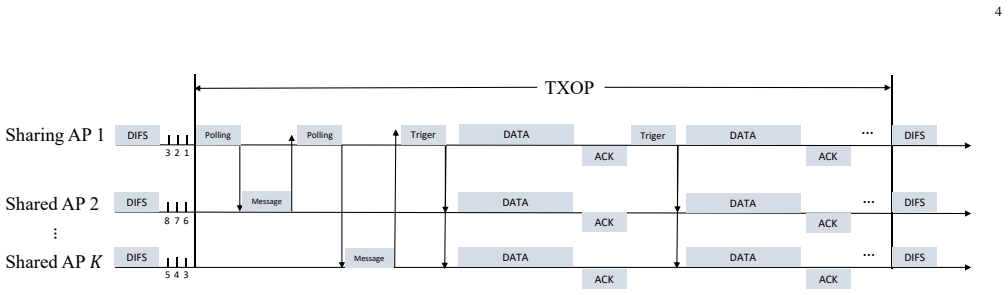
The load-bearing mechanism is the two-phase transmission-opportunity (TXOP) procedure combined with a hierarchical proximal-policy-optimization agent. In the polling phase, the TXOP-winning 'sharing' AP compresses each participant's observation through a small encoder network (two fully connected layers with 16 and 8 neurons), concatenates the compressed messages, and broadcasts them. In the decision phase, each shared AP draws a high-level option—which station to serve for the whole TXOP—and then per-packet low-level actions specifying transmit power from a discrete set that includes zero power. Training uses PPO with separate replay buffers and a multi-critic single-policy advantage that balances the total throughput reward $\log(1/u_t^i)$ against an individual collision penalty proportional to transmit power. The hierarchy keeps the joint action space tractable, and the broadcast information mitigates the environmental non-stationarity that would otherwise arise when agents act only on local observations.
What would settle it
Run the same four topologies in an 802.11-grade simulator or testbed that models poll frames, trigger frames, ACK timing, backoff, and legacy stations, and compare end-to-end throughput and delay against the paper's SINR-based results; if the throughput gain over CSMA/CA falls below the reported roughly 0.50–0.95, or mean delay is not cut by the reported factor, the central claim is not supported.
Extended reading notes
Core claim
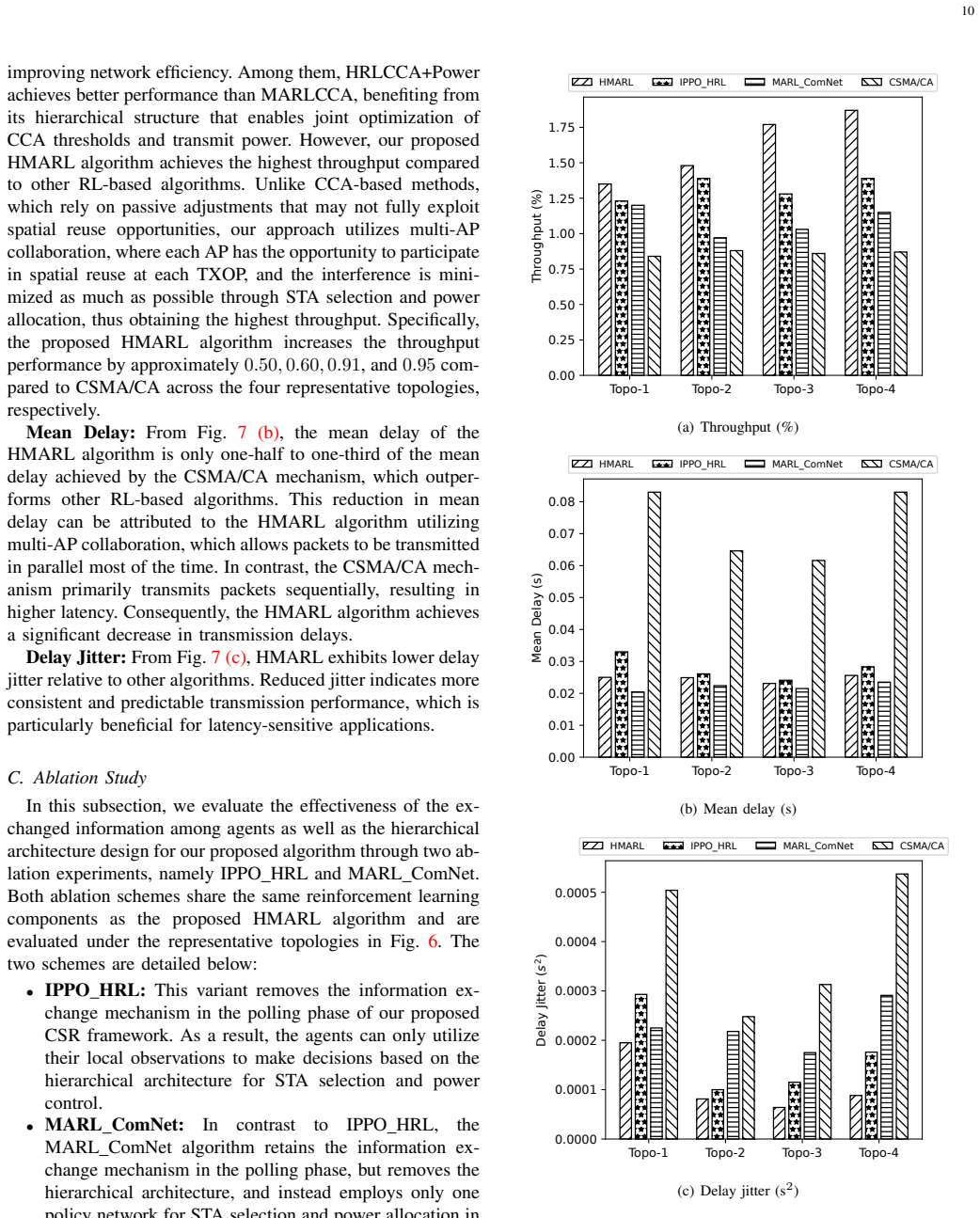
The central claim is that jointly learned station selection and transmit-power control, done hierarchically and fully distributed, gives coordinated spatial reuse a decisive advantage over passive CCA-threshold adjustments. Each AP maintains a high-level policy that commits to one of its associated stations for the whole transmission opportunity and a low-level policy that sets transmit power per packet; the AP that wins the channel polls the others, aggregates their encoded observations, and broadcasts a trigger frame so all can transmit concurrently. The combined policy wins because it exploits the spatial topology of stations, not just interference power, and because the reward function couples aggregate throughput with per-agent penalties that keep high-power transmitters from starving disadvantaged APs. In the paper's simulations this makes throughput about 0.50, 0.60, 0.91, and 0.95 higher than CSMA/CA across the four representative topologies, with mean delay one-half to one-third of CSMA/CA and lower delay jitter.
Load-bearing premise
The gain depends on the assumption that every AP with a non-empty buffer promptly answers the poll and then transmits simultaneously after the trigger frame, with the polling, trigger, and ACK exchanges costing negligible airtime; if real 802.11 control overhead or missed polls consume more of the TXOP, the simulated throughput and delay gains shrink.
Editorial extensions
If this is right
- In the four tested topologies, replacing passive CCA-threshold tuning with the hierarchical CSR policy raises throughput by about 0.50, 0.60, 0.91, and 0.95 relative to CSMA/CA.
- Mean packet delay falls to roughly one-half to one-third of CSMA/CA, and delay jitter is lower, which matters for latency-sensitive applications.
- Both components of the design—the polling-phase broadcast of encoded observations and the two-level policy—contribute to the gains; removing either lowers throughput.
- The combined throughput-plus-fairness reward preserves transmission opportunities for an AP in a high-interference position, at some cost in total throughput.
- Trained policies transfer to modestly different topologies but degrade when the topology changes significantly, so retraining is needed after large changes.
Reading between the lines
- If the idealized polling and trigger exchange survives real control-frame overhead, the same decentralized hierarchy could extend to uplink OBSS coordination, which the paper lists as future work.
- The privacy-conscious information sharing—broadcasting station indices rather than raw locations—suggests a general pattern for multi-agent RL where agents need topological context without exposing sensitive position data.
- The fairness-versus-throughput tradeoff could be made a tunable operator parameter, letting deployments decide explicitly how much total throughput they will sacrifice to protect disadvantaged APs.
- A direct testable extension would replace the fixed MCS assumption with per-link rate adaptation, since the SINR threshold currently treats all successful transmissions as equally valuable.
Signed reviews
Editorial analysis
A structured set of objections, weighed in public.
Referee Report
Summary. This paper studies downlink coordinated spatial reuse (CSR) in overlapping-BSS WLANs. It proposes a two-phase CSR protocol consisting of a polling phase and a decision phase, and a fully decentralized hierarchical multi-agent reinforcement learning algorithm, HMARL, in which a high-level policy selects which station an AP transmits to during a TXOP and a low-level policy controls transmit power on a per-packet basis. APs exchange compressed observations through the sharing AP, and PPO with two critic networks is used for training. Simulations on four residential topologies report higher throughput and lower delay/jitter than CSMA/CA and two MARL baselines, and the paper includes ablation studies, cross-topology robustness tests, a legacy-coexistence test, and a fairness analysis.
Significance. If the performance numbers are reliable, the paper makes a useful contribution: it casts CSR as a decentralized hierarchical MARL problem with joint station selection and power control, and it provides a concrete protocol sketch compatible with CSMA/CA. The ablation experiments (IPPO HRL and MARL ComNet) and the legacy-coexistence test are valuable and go beyond many RL networking papers. However, the central quantitative claims rest on a simplified timing model and on single-run point estimates; the absence of a specified control-frame overhead model, statistical uncertainty quantification, and code/simulator release limits the strength of the conclusions. The framework is plausible, but the evidence does not yet establish the headline gains.
major comments (4)
- [Section II-A, Fig. 3, Table I, Section V-A] The quantitative claims in Section V-B (throughput increases of approximately 0.50, 0.60, 0.91, and 0.95 relative to CSMA/CA, and mean delay reductions to one-half or one-third) are obtained from a model in which the polling message, trigger frame, and ACK exchanges shown in Fig. 3 are not accounted for. Table I lists only the time slot, packet length, and ACK length, and the metrics in Section V-A are defined on 'successful transmission slots' and total time slots; Eq. (3) likewise counts only successful transmission slots. Because every TXOP in the CSR protocol includes at least a polling exchange and a trigger frame, omitting these durations biases the comparison in favor of HMARL. The magnitude of the bias could be material: with E0=3 packets per TXOP and a packet length of 1080 microseconds, an extra few hundred microseconds of control overhead per TXOP would reduce the useful data fraction noticeably. This is not an internal inconsistency, but it makes the headline quantitative claim contingent on an unverified idealization. I ask the authors to include explicit polling/trigger/ACK timing in the slot accounting, or to state and justify an assumption that these costs are negligible, and to re-run the simulations with the overhead included.
- [Section V-B, Tables III-V] All performance claims are based on single point estimates. Figures 7 and 8 report one throughput/delay/jitter value per topology, and Tables III-V report single numbers for cross-topology and coexistence experiments. No standard deviations, confidence intervals, or number of random seeds are provided, so the reader cannot assess whether the differences between HMARL and the baselines, which are sometimes small (e.g., throughput 1.31 vs 1.39 vs 0.97 in Table III), are statistically meaningful. The claim that HMARL 'consistently outperforms' baselines is therefore not supported at the level of statistical evidence. Please provide repeated-seed results with error bars and, ideally, a release of the simulator/code to make the experiments reproducible.
- [Section V-E, Eq. (19), Eq. (3), Eq. (5)] The fairness analysis in Section V-E is qualitative. The optimization problem in Eq. (3) contains a fairness constraint with a throughput floor beta_min, but beta_min is never given a numerical value and the constraint is never checked in the reported experiments; no fairness index (e.g., Jain's index) or per-AP throughput table for the converged policy is provided. Furthermore, the combined reward in Eq. (19) uses weights omega_1 and omega_2 whose values are not reported, and the individual reward in Eq. (5) is an ad hoc construction whose scaling for colliding vs non-colliding APs should be clarified: as written, APs not in the collision set receive a more negative reward, -(a_i/P_max)|C_t|, than APs in the collision set, -(a_i/P_max)(|C_t|-1). Because the paper's fairness conclusion is substantially driven by this reward, the authors should specify the weights, justify or correct Eq. (5), and report a quantitative fairness measure for the converged policies.
- [Section II-A, Section V-A] The model assumes that all APs with non-empty buffers respond to the polling phase and then transmit concurrently after the trigger frame, and that CSMA/CA contention is retried until exactly one AP wins the TXOP. This removes polling failures, hidden-node effects, and the time consumed by collisions during contention. These are not internal inconsistencies, but they are optimistic simplifications that further support the need for an explicit overhead model and sensitivity analysis before the quantitative gains can be accepted.
minor comments (5)
- [Fig. 3 caption] The caption contains a typo: 'Triger' should be 'Trigger'.
- [Section V-A, hyperparameters] The text refers to 'the hyperparameters of the MAHRL algorithm'; this should be 'HMARL' for consistency.
- [Section V-A, MARLCCA benchmark] The formula 'P = -82 - CCA dBm' should be clarified: for the stated CCA range [-82, -62] dBm, this gives powers from 0 to -20 dBm, which do not match the transmit power set [20, 15, 10, 5, -100] dBm in Table I. Please verify the intended mapping between CCA threshold and transmit power.
- [Section III, Eq. (4)] The total reward log(1/u_i^t) is undefined if u_i^t = 0, which can occur for an AP with no prior successful transmissions; please specify how this case is handled in the implementation.
- [Algorithm 1] The condition 'if t mod N_c = 0' uses a variable N_c that is not defined; Table II gives an update interval of 20 TXOPs, so please state the relationship between N_c and that interval.
Circularity Check
No significant circularity: the HMARL results are an empirical simulation comparison, not a derivation that reduces to its inputs or to self-cited results.
full rationale
The paper's derivation chain is a standard MARL pipeline: an SINR-based system model (Eq. (2)), an optimization objective (Eq. (3)), a Dec-POMDP formulation, reward functions (Eqs. (4) and (5)), PPO training, and simulation-based evaluation. None of the reported gains are obtained by fitting a parameter and then re-predicting that same parameter; the throughput and delay figures are measured in a simulator that implements the same SINR model used for training, which is normal for an RL performance study and is not circular. The fairness result is explicitly tested against reward-function ablations in Fig. 10, so it is an empirical claim about a specific reward design rather than a conclusion that is true by definition of Eq. (5). The cross-topology experiments and legacy-AP coexistence tests provide external checks beyond the training configuration. The paper itself includes a limitation note in Section V-D that robustness should be taken with a grain of salt and that retraining may be needed for significant topology changes, which further indicates the authors are not claiming that the trained policy is valid everywhere by construction. There are no load-bearing self-citations: the cited references are prior work by other groups, and no uniqueness theorem or prior result by these authors is invoked to force the design. The idealized protocol timing in Fig. 3 and Section II-A is a correctness/validity risk for the quantitative gains, but it is an unverified modeling assumption, not a circularity. Overall, the central claim is an empirical comparison of learning algorithms, and the paper does not reduce to its own inputs.
Assumptions & free parameters
free parameters (2)
- Reward weights omega_1 and omega_2 in Eq. (19) =
not reported
- Fairness throughput floor beta_min in Eq. (3) =
not specified
assumptions (4)
- domain assumption A transmission is successful iff the received SINR exceeds a fixed MCS threshold, with a fixed MCS across all APs.
- domain assumption Each AP knows the relative positions of its associated STAs via Wi-Fi sensing technologies.
- domain assumption All APs with non-empty buffers participate in the CSR polling and decision phases.
- domain assumption The custom simulator accurately represents CSMA/CA contention, polling, trigger frames, ACKs, and channel propagation.
Cite this review
Pith. "Pith review of Hierarchical Multi-Agent Reinforcement Learning-based Coordinated Spatial Reuse for Next Generation WLANs." pith.science (2026). https://pith.science/paper/F6G2K6BH
@misc{pith2026250614187,
  author       = {Pith},
  title        = {Pith review of: Hierarchical Multi-Agent Reinforcement Learning-based Coordinated Spatial Reuse for Next Generation WLANs},
  year         = {2026},
  howpublished = {\url{https://pith.science/paper/F6G2K6BH}},
  note         = {Machine review of arXiv:2506.14187}
}
read the original abstract
High-density Wi-Fi deployments often result in significant co-channel interference, which degrades overall network performance. To address this issue, coordination of multi access points (APs) has been considered to enable coordinated spatial reuse (CSR) in next generation wireless local area networks. This paper tackles the challenge of downlink spatial reuse in Wi-Fi networks, specifically in scenarios involving overlapping basic service sets, by employing hierarchical multi-agent reinforcement learning (HMARL). We decompose the CSR process into two phases, i.e., a polling phase and a decision phase, and introduce the HMARL algorithm to enable efficient CSR. To enhance training efficiency, the proposed HMARL algorithm employs a hierarchical structure, where station selection and power control are determined by a high- and low-level policy network, respectively. Simulation results demonstrate that this approach consistently outperforms baseline methods in terms of throughput and latency across various network topologies. Moreover, the algorithm exhibits robust performance when coexisting with legacy APs. Additional experiments in a representative topology further reveal that the carefully designed reward function not only maximizes the overall network throughput, but also improves fairness in transmission opportunities for APs in high-interference regions.
Figures


Figures from the paper (8 more)




Reference graph
Works this paper leans on
-
[27]
IEEE 802.11 bn multi-ap coordinated spatial reuse with hierarchical multi-armed bandits,
M. Wojnar, W. Ciezobka, K. Kosek-Szott, K. Rusek, S. Szott, D. Nunez, and B. Bellalta, “IEEE 802.11 bn multi-ap coordinated spatial reuse with hierarchical multi-armed bandits,”IEEE Commun. Lett., 2024
work page 2024
-
[1]
A tutorial on IEEE 802.11 ax high efficiency WLANs,
E. Khorov, A. Kiryanov, A. Lyakhov, and G. Bianchi, “A tutorial on IEEE 802.11 ax high efficiency WLANs,”IEEE Commun. Surv. Tut., vol. 21, no. 1, pp. 197–216, 1st Quart. 2019
work page 2019
-
[2]
IEEE 802.11 be Wi-Fi 7: New challenges and opportunities,
C. Deng, X. Fang, X. Han, X. Wang, L. Yan, R. He, Y . Long, and Y . Guo, “IEEE 802.11 be Wi-Fi 7: New challenges and opportunities,” IEEE Commun. Surv. Tut., vol. 22, no. 4, pp. 2136–2166, 4th Quart. 2020
work page 2020
-
[3]
Future directions for Wi-Fi 8 and beyond,
E. Reshef and C. Cordeiro, “Future directions for Wi-Fi 8 and beyond,” IEEE Commun. Mag., vol. 60, no. 10, pp. 50–55, Oct. 2022
work page 2022
-
[4]
What will Wi-Fi 8 be? a primer on IEEE 802.11 bn ultra high reliability,
L. Galati-Giordano, G. Geraci, M. Carrascosa, and B. Bellalta, “What will Wi-Fi 8 be? a primer on IEEE 802.11 bn ultra high reliability,” IEEE Commun. Mag., vol. 62, no. 8, pp. 126–132, Aug. 2024
work page 2024
-
[5]
Per-node throughput enhancement in Wi-Fi densenets,
K. Shin, I. Park, J. Hong, D. Har, and D.-h. Cho, “Per-node throughput enhancement in Wi-Fi densenets,”IEEE Commun. Mag., vol. 53, no. 1, pp. 118–125, Jan. 2015
work page 2015
-
[6]
M. Iwata, K. Yamamoto, B. Yin, T. Nishio, M. Morikura, and H. Abey- sekera, “Analysis of inversely proportional carrier sense threshold and transmission power setting based on received power for IEEE 802.11 ax,” inProc. IEEE Annu. Consum. Commun. Netw. Conf. (CCNC), 2019, pp. 1–6
work page 2019
-
[7]
Performance evaluation of IEEE 802.11 n WLAN in dense deployment scenarios,
F. M. Abinader, E. P. Almeida, S. Choudhury, V . A. Sousa, A. M. Cavalcante, F. S. Chaves, E. Tuomaala, R. D. Vieira, and K. Doppler, “Performance evaluation of IEEE 802.11 n WLAN in dense deployment scenarios,” inProc. IEEE V eh. Technol. Conf. (VTC-Fall), 2014, pp. 1–5
work page 2014
Show all 36 references
-
[8]
AP association optimization and CCA threshold adjustment in dense WLANs,
P. B. Oni and S. D. Blostein, “AP association optimization and CCA threshold adjustment in dense WLANs,” inProc. IEEE Global Commun. Conf. Workshops, 2015, pp. 1–6
2015
-
[9]
Spatial reuse in IEEE 802.11 ax WLANs,
F. Wilhelmi, S. Barrachina-Mu ˜noz, C. Cano, I. Selinis, and B. Bellalta, “Spatial reuse in IEEE 802.11 ax WLANs,”Comput. Commun., vol. 170, no. 15, pp. 65–83, Mar. 2021
2021
-
[10]
“IEEE standard for information technology–telecommunications and information exchange between systems local and metropolitan area networks–specific requirements part 11: Wireless lan medium access control (MAC) and physical layer (PHY) specifications amendment 1: Enhancements ...
2021
-
[11]
TXOP sharing with coordinated spatial reuse in multi-AP cooperative IEEE 802.11 be WLANs,
D. Nunez, F. Wilhelmi, S. Avallone, M. Smith, and B. Bellalta, “TXOP sharing with coordinated spatial reuse in multi-AP cooperative IEEE 802.11 be WLANs,” inProc. IEEE Annu. Consum. Commun. Netw. Conf. (CCNC). IEEE, 2022, pp. 864–870
2022
-
[12]
Improving QoS mechanisms for IEEE 802.11 ax with overlapping basic service sets,
Y .-P. Tuan, L.-A. Chen, T.-Y . Lin, T.-Y . Lin, Y .-T. Wang, S.-I. Sou, and M.-H. Tsai, “Improving QoS mechanisms for IEEE 802.11 ax with overlapping basic service sets,”Wireless Netw., vol. 29, no. 1, pp. 387– 401, Jan. 2023
2023
-
[13]
A Bayesian optimization algorithm to improve the spatial reuse in the Next- Generation WLANs,
J. Liu, Y . Liu, J. Zhang, X. Ge, A. Xu, and M. Zhao, “A Bayesian optimization algorithm to improve the spatial reuse in the Next- Generation WLANs,” inProc. IEEE Int. Wireless Commun. Mobile Comput. (IWCMC), 2024, pp. 1048–1053
2024
-
[14]
Meta-bandit: Spatial reuse adaptation via meta-learning in distributed Wi-Fi 802.11 ax,
P. E. Iturria Rivera, M. Chenier, B. Herscovici, B. Kantarci, and M. Erol- Kantarci, “Meta-bandit: Spatial reuse adaptation via meta-learning in distributed Wi-Fi 802.11 ax,”IEEE Netw. Lett., vol. 5, no. 4, pp. 179– 183, Dec. 2023
2023
-
[15]
Cooperate or not cooperate: Transfer learning with multi- armed bandit for spatial reuse in Wi-Fi,
P. E. Iturria-Rivera, M. Chenier, B. Herscovici, B. Kantarci, and M. Erol- Kantarci, “Cooperate or not cooperate: Transfer learning with multi- armed bandit for spatial reuse in Wi-Fi,”IEEE Trans. Mach. Learn. Commun. Netw., vol. 2, pp. 351–369, Feb. 2024
2024
-
[16]
Multiaccess point coordination for next-gen Wi-Fi networks aided by deep reinforcement learning,
L. Zhang, H. Yin, S. Roy, and L. Cao, “Multiaccess point coordination for next-gen Wi-Fi networks aided by deep reinforcement learning,” IEEE Syst. J., vol. 17, no. 1, pp. 904–915, Mar. 2022
2022
-
[17]
Deep reinforcement learning-based channel allocation for wireless LANs with graph convolutional networks,
K. Nakashima, S. Kamiya, K. Ohtsu, K. Yamamoto, T. Nishio, and M. Morikura, “Deep reinforcement learning-based channel allocation for wireless LANs with graph convolutional networks,”IEEE Access, vol. 8, pp. 31 823–31 834, Feb. 2020
2020
-
[18]
DDPG-based multi-AP cooperative access control in dense Wi-Fi networks,
H. Zhang, R. He, X. Fang, and L. Zhou, “DDPG-based multi-AP cooperative access control in dense Wi-Fi networks,” inProc. IEEE V eh. Technol. Conf. (VTC-Fall), 2023, pp. 1–6
2023
-
[19]
Continuous control with deep reinforcement learning,
T. P. Lillicrap, J. J. Hunt, A. Pritzel, N. Heess, T. Erez, Y . Tassa, D. Silver, and D. Wierstra, “Continuous control with deep reinforcement learning,”arXiv preprint arXiv:1509.02971, 2015
2015 arXiv
-
[20]
Multi- agent reinforcement learning based channel access optimization for IEEE 802.11 bn,
R. Yan, Z. Guo, P. Liu, Q. Lan, X.-P. Zhang, and Y . Dong, “Multi- agent reinforcement learning based channel access optimization for IEEE 802.11 bn,”IEEE Trans. Green Commun. Netw., early access, Nov, 2024, doi:10.1109/TGCN.2024.3495236
2024
-
[21]
Human-level control through deep reinforcement learning,
V . Mnih, K. Kavukcuoglu, D. Silver, A. A. Rusu, J. Veness, M. G. Bellemare, A. Graves, M. Riedmiller, A. K. Fidjeland, G. Ostrovski et al., “Human-level control through deep reinforcement learning,” nature, vol. 518, no. 7540, pp. 529–533, Feb. 2015
2015
-
[22]
A deep Q-network approach to optimize spatial reuse in Wi-Fi networks,
Y . Huang and K.-W. Chin, “A deep Q-network approach to optimize spatial reuse in Wi-Fi networks,”IEEE Trans. V eh. Technol., vol. 71, no. 6, pp. 6636–6646, Jun. 2022
2022
-
[23]
A hierarchical deep learning approach for optimizing CCA threshold and transmit power in Wi-Fi networks,
Y . Huang and K.-W. Chin, “A hierarchical deep learning approach for optimizing CCA threshold and transmit power in Wi-Fi networks,”IEEE Trans. Cognit. Commun. Netw., vol. 9, no. 5, pp. 1296–1307, Oct. 2023
2023
-
[24]
A survey on multi-AP coordination approaches over emerging WLANs: Future directions and open challenges,
S. Verma, T. K. Rodrigues, Y . Kawamoto, M. M. Fouda, and N. Kato, “A survey on multi-AP coordination approaches over emerging WLANs: Future directions and open challenges,”IEEE Commun. Surv. Tut., vol. 26, no. 2, pp. 858–889, 2nd Quart. 2024
2024
-
[25]
Two enhanced schemes for coordinated spatial reuse in IEEE 802.11 be: Adaptive and distributed approaches,
D. Zhu, L. Wang, G. Pan, and S. Luan, “Two enhanced schemes for coordinated spatial reuse in IEEE 802.11 be: Adaptive and distributed approaches,”Comput. Netw., vol. 258, pp. 111 060–111 070, 2025
2025
-
[26]
Research on Next-Generation Wi-Fi spatial reuse power control based on federated reinforcement learning,
J. Wang and X. Fang, “Research on Next-Generation Wi-Fi spatial reuse power control based on federated reinforcement learning,” inProc. IEEE V eh. Technol. Conf. (VTC-Spring), 2024, pp. 1–6
2024
-
[28]
Coor- dinated spatial reuse scheduling with machine learning in IEEE 802.11 MAPC networks,
M. Wojnar, A. Tomaszewski, K. Rusek, K. Kosek-Szott, J. Haxhibeqiri, J. Hoebeke, B. Bellalta, A. Zubow, F. Dressler, S. Szottet al., “Coor- dinated spatial reuse scheduling with machine learning in IEEE 802.11 MAPC networks,”arXiv preprint arXiv:2505.07278, 2025
2025 arXiv
-
[29]
Rate control with spatial reuse for Wi-Fi 6 dense deployments,
A. Krotov, A. Kiryanov, and E. Khorov, “Rate control with spatial reuse for Wi-Fi 6 dense deployments,”IEEE Access, vol. 8, pp. 168 898– 168 909, Sep. 2020
2020
-
[30]
Wi-Fi sensing for joint gesture recognition and human identification from few samples in human-computer interaction,
R. Zhang, C. Jiang, S. Wu, Q. Zhou, X. Jing, and J. Mu, “Wi-Fi sensing for joint gesture recognition and human identification from few samples in human-computer interaction,”IEEE J. Sel. Areas Commun., vol. 40, no. 7, pp. 2193–2205, Jul. 2022
2022
-
[31]
Optimal preprocessing of WiFi CSI for sensing applications,
V . V . Ratnam, H. Chen, H. H. Chang, A. Sehgal, and J. Zhang, “Optimal preprocessing of WiFi CSI for sensing applications,”IEEE Trans. Wireless Commun., vol. 23, no. 9, pp. 10 820–10 833, Sep. 2024
2024
-
[32]
An overview on IEEE 802.11 bf: WLAN sensing,
R. Du, H. Hua, H. Xie, X. Song, Z. Lyu, M. Hu, Y . Xin, S. McCann, M. Montemurro, T. X. Hanet al., “An overview on IEEE 802.11 bf: WLAN sensing,”IEEE Commun. Surv. Tut., vol. 27, no. 1, pp. 184–217, Feb. 2025
2025
-
[33]
Prox- imal policy optimization algorithms,
J. Schulman, F. Wolski, P. Dhariwal, A. Radford, and O. Klimov, “Prox- imal policy optimization algorithms,”arXiv preprint arXiv:1707.06347, 2017
2017 arXiv
-
[34]
Multi-agent reinforce- ment learning based uplink OFDMA for IEEE 802.11 ax networks,
M. Han, X. Sun, W. Zhan, Y . Gao, and Y . Jiang, “Multi-agent reinforce- ment learning based uplink OFDMA for IEEE 802.11 ax networks,” IEEE Trans. Wireless Commun., vol. 23, no. 8, pp. 8868–8882, Aug. 2024
2024
-
[35]
A prioritized objective actor-critic method for deep reinforcement learning,
N. D. Nguyen, T. T. Nguyen, P. Vamplew, R. Dazeley, and S. Nahavandi, “A prioritized objective actor-critic method for deep reinforcement learning,”Neural Comput. and Appl., vol. 33, pp. 10 335–10 349, Aug. 2021
2021
-
[36]
Available: https://mentor.ieee.org/ 802.11/dcn/14/11-14-0980-16-00ax-simulation-scenarios.docx
TGax Simulation Scenarios, [Online]. Available: https://mentor.ieee.org/ 802.11/dcn/14/11-14-0980-16-00ax-simulation-scenarios.docx
Reviewed August 7, 2026 · model on record in the stance chip above.
Discussion (0). Continue with ORCID to comment.