REVIEW 3 major objections 6 minor 31 references
Barrier Method for Inequality Constrained Factor Graph Optimization with Application to Model Predictive Control
T0 review · 3 major / 6 minor · reviewed 2026-08-07 · deepseek-v4-flash
Pith's one-line read The paper introduces an inequality factor node that encodes a logarithmic barrier, letting factor graph solvers handle inequality-constrained model predictive control directly.
desk verdict A clean, honest adaptation of the primal barrier method to g2o factor graphs, with a genuinely useful factor node encoding—but the warm-start feasibility gap and thin benchmarking keep it from being fully convincing. read the letter →
The pith
A machine-rendered reading of the paper's core claim, the machinery that carries it, and where it could break.
The reading
What carries the argument
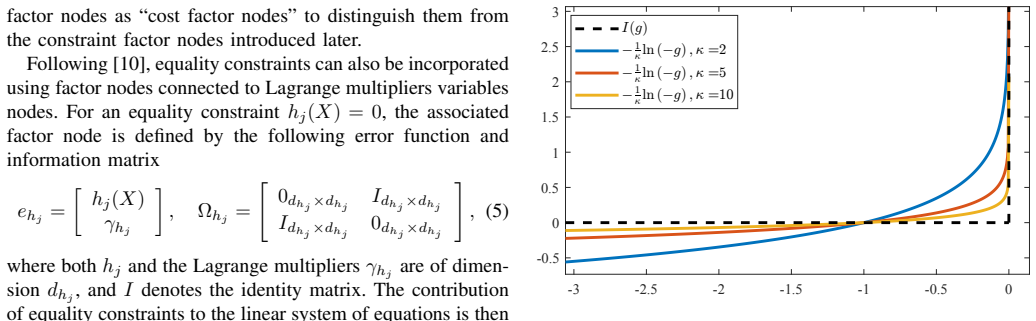
The load-bearing object is the inequality factor node, defined by error $e_{g_j}(X) = g_j(X)$, information matrix $\Omega_{g_j} = \kappa^{-1} \operatorname{diag}([g_j(X)]^{-2})$, and residual $b_{g_j} = J_{g_j}^T \Omega_{g_j} e_{g_j}$. The sign flip in the residual is the key identity: it changes the factor's contribution from the conventional squared-error gradient to the gradient of the logarithmic barrier, so that the sparse Gauss-Newton linear system built by a factor-graph solver is exactly the barrier subproblem's Newton system. A backtracking line search that shrinks the step until $g(X+\zeta\Delta X) < 0$ keeps iterates strictly feasible, and the outer loop multiplies $\kappa$ by $\nu > 1$ to approach the ideal barrier.
What would settle it
Run the closed-loop MPC from a warm start that exactly saturates one inequality (for example, a zero slack variable or a velocity at the newly lowered speed limit) and observe whether the backtracking line search ever fails to find a strictly feasible step; a single call that stalls, loops, or returns a boundary point would contradict the method's feasibility guarantee.
Extended reading notes
Core claim
The central discovery is an identity that lets a non-quadratic barrier term be represented as a standard weighted least-squares factor. For a constraint $g_j(X) \le 0$, define the factor error $e_{g_j}(X) = g_j(X)$ and the state-dependent information matrix $\Omega_{g_j} = \kappa^{-1} \operatorname{diag}([g_j(X)]^{-2})$. Inserting this factor into the Gauss-Newton system with residual $b_{g_j} = J_{g_j}^T \Omega_{g_j} e_{g_j}$ (note the opposite sign from an ordinary cost factor) reproduces the linear system obtained by minimizing $-(1/\kappa)\sum_j \ln(-g_j(X))$. Thus the logarithmic barrier of an interior-point method can be evaluated and differentiated through the same modular factor-graph machinery used for nonlinear least squares, with $\kappa$ increased across outer iterations to sharpen the barrier. The paper claims this is the first direct integration of a barrier interior-point method into factor-graph-based control, and reports that it outperforms an augmented-Lagrangian baseline on a multi-objective adaptive-cruise-control MPC benchmark.
Load-bearing premise
The load-bearing premise is that every optimization solve starts from a point strictly inside all inequality constraints, because the logarithmic barrier is undefined at the constraint boundary and the algorithm gives no procedure for producing such a point from a warm start that may touch a limit.
Editorial extensions
If this is right
- Inequality-constrained MPC can be solved with the same sparse factor-graph machinery as perception problems, so a single backend can handle costs, equality constraints, and inequality limits.
- The factor applies to any smooth $g_j(X) \le 0$, so safety, comfort, and actuator-limit constraints can be added as modular factors without a separate constraint solver.
- Across outer iterations only $\kappa$ and the factor information matrices change, so the same graph structure and sparse factorization can be reused for each barrier step.
- Reported scaling across horizons $N=3,6,20$ indicates the iteration-count advantage over the augmented-Lagrangian baseline grows with problem size, with BIPM using roughly 29% fewer average iterations at $N=20$.
- Because the line search keeps every iterate strictly feasible, all intermediate MPC solutions satisfy the inequality constraints, which matters for safety-critical online control.
Reading between the lines
- A test the paper does not perform is warm-starting from an infeasible or active-set point; since the convergence and feasibility claims rely on a strictly feasible starting point for each MPC call, perturbing the warm start onto a constraint boundary would probe the practical robustness of the method.
- The same sign-flipped, state-dependent information-matrix construction could encode other non-quadratic penalties in a factor graph (for instance collision-avoidance distance barriers), an extension the paper leaves implicit.
- The benchmark uses one driving scenario and one set of tuned parameters per method; a broader comparison across driving cycles and randomly chosen tuning values would show whether the robustness advantage is structural or scenario-specific.
- If the barrier information matrices can be updated without refactorizing the whole sparse system, the approach might plug into incremental smoothing frameworks for online MPC, an avenue the authors mention as future work.
Signed reviews
Editorial analysis
A structured set of objections, weighed in public.
Referee Report
Summary. The paper proposes a Barrier Interior Point Method (BIPM) for factor-graph optimization by introducing inequality factor nodes whose error is the constraint value g_j(X) and whose information matrix is κ^{-1} diag([g_j(X)]^{-2}). It derives the Gauss-Newton contribution of these nodes, implements the method as a g2o extension, and evaluates it on a multi-objective adaptive cruise control (MACC) MPC benchmark against an Augmented Lagrangian (AL) baseline. The central claims are that this is the first direct BIPM integration into factor-graph-based control and that the BIPM solver consistently outperforms AL in iteration count and computation time across prediction horizons N = 3, 6, 20.
Significance. The algebraic derivation in Section IV.B is self-contained and correctly reproduces the log-barrier Gauss-Newton system; the sign difference in the residual (Eq. 20b) is explicitly flagged, which is important for implementers. The open-source g2o extension and the shared front-end for BIPM and AL are concrete reproducibility strengths. If the strict-feasibility initialization issue is resolved and the empirical claims are supported by repeated trials, the method would be a useful backend for inequality-constrained factor-graph MPC and would broaden the scope of factor-graph optimization beyond perception. The current evaluation, however, rests on an unverified feasibility assumption for every MPC warm start and on a single simulation run per configuration.
major comments (3)
- [§IV-C, Algorithm 1; §V-B] Algorithm 1 takes a strictly feasible X as input and the backtracking loop (lines 15–17) only reduces the step size ζ; it cannot turn an infeasible warm start into a feasible one. The MPC loop warm-starts every one of the approximately 4000 solves from the previous optimal solution (§V.B). For constraints (21m)–(21n), the optimum drives δFt,i to |Ft,i - Ft,i-1| and δFb,i to |Fb,i - Fb,i-1|, so the warm start lies on the boundary g = 0 for these constraints, while a newly lowered speed limit (21k) can make the previous velocity profile outright infeasible. Because Eq. (10) and Eq. (19) are defined only for g < 0, the first barrier-factor evaluation can be undefined, and the claimed convergence and feasibility guarantees do not follow. Please provide the restoration mechanism used in the released code (e.g., a perturbation rule, a phase-I procedure, or a projection step) and report evidence that all warm-started calls satisfied g < 0, together with a finite termination condition for the backtracking loop.
- [§V-C, Table I; §V-D, Tables II–III] The central comparative claim that BIPM 'consistently outperforms' AL is supported by a single simulation run per configuration. No number of independent runs, standard errors, or statistical tests are reported; the 'SD' columns in Tables II and III imply multiple runs but the run count is never given. In addition, the stopping tolerances ϵx, ϵg, ϵh and the line-search parameter α are not reported anywhere, so it is impossible to judge whether the two solvers were actually compared under identical stopping criteria as claimed in §V.B. Please repeat the experiments over several independent runs, report all solver parameters, and provide dispersion measures for both iteration counts and computation times.
- [§V.C, Section V.D] The robustness comparison is based on iteration counts and computation times only; no closed-loop performance metrics (e.g., tracking error, constraint violations, comfort indices) are reported for the parameter variations in Tables II and III. As a result, the conclusion that BIPM is 'more robust to hyperparameter tuning' is not fully supported: a configuration with lower iteration count could conceivably produce worse closed-loop constraint satisfaction. Please report closed-loop metrics for the tuning cases, or restrict the robustness claim to solver-internal convergence behavior.
minor comments (6)
- [§V-C, Table I] The column header 'Iterations Number ; Calculation time (ms)' is ambiguous; the avg/max/min values for iteration count and time should be presented in separate columns with explicit units.
- [§IV.B, Eq. (12)] The attempted naive factor definition contains a typo ('e. (X)') and the discussion of the square-root expression is not needed for the final construction; consider removing it or correcting the notation.
- [§IV.C, Algorithm 1] After the backtracking line search enforces g(X) < 0, the inequality feasibility criterion ∥max(g,0)∥∞ < ϵg is automatically satisfied and therefore vacuous; consider replacing it with a barrier-feasibility check based on the actual slack values.
- [§V.B, §V.D] The text says 'the standard deviation (SD) reflects the variability in the total number of iterations across multiple runs', but the number of runs is never stated; please specify it explicitly.
- [§V.A, constraints (21m)–(21n)] The absolute-value constraints are nonsmooth at |Ft,i - Ft,i-1| = 0 and |Fb,i - Fb,i-1| = 0; the paper does not describe how the Jacobians are computed at these kinks or whether a smooth approximation is used.
- [References, [18]] Reference [18] has a malformed author list ('Zhang, Yetongand Dellaert'); it should be corrected to 'Y. Zhang and F. Dellaert' or the equivalent.
Circularity Check
No significant circularity: the inequality-factor derivation is self-contained, and self-citations are confined to benchmarking setup.
full rationale
The central construction in Eqs. (14)-(20) is derived directly from the logarithmic barrier objective (10)-(11). Starting from f(X) = -1/κ Σ ln(-ĝ_j(X)), the paper forms the Gauss-Newton system (17) and then defines the factor error e_gj = g_j(X), information matrix Ω_gj = κ^-1 diag([g_j(X)]^-2), and residual b = J^T Ω e (20a,b). This is an algebraic transcription of the barrier objective into factor-graph form; no quantity is fitted to data and no result is assumed as an input. The comparisons against AL rely on the authors' own tutorial and MACC setup, but those are benchmark choices, not premises of the derivation. Even if one worried about parameter-tuning fairness or strict-feasibility initialization (Algorithm 1 requires a feasible X and has no phase-I), those are correctness or robustness concerns, not circularity: the paper's claims are not equivalent to its inputs by construction. The self-citations to [9], [10], [29], and [30] support the experimental framework and prior equality-constraint work, but the log-barrier factor node stands on the paper's own equations.
Assumptions & free parameters
free parameters (5)
- Initial barrier parameter kappa_0 =
0.5
- Barrier update factor nu =
8
- Final barrier parameter kappa_final =
1500
- AL baseline penalty parameters rho_0, rho_max, rho_nu =
0.5, 5e5, 20
- MACC cost weights and model coefficients =
not reported in this paper
assumptions (5)
- domain assumption Equality constraints are handled by the KKT factor of the authors' ecg2o work [10], producing an indefinite saddle-point system
- standard math Gauss-Newton approximation of the barrier Hessian drops the curvature term of g
- ad hoc to paper Strictly feasible initial point exists and backtracking preserves feasibility
- domain assumption MACC vehicle and resistance model from prior work [30]
- domain assumption The MACC problem is convex, so Boyd's barrier convergence theory applies
invented entities (1)
-
BIPM inequality factor node
independent evidence
Cite this review
Pith. "Pith review of Barrier Method for Inequality Constrained Factor Graph Optimization with Application to Model Predictive Control." pith.science (2026). https://pith.science/paper/Z4VW3RSK
@misc{pith2026250614341,
  author       = {Pith},
  title        = {Pith review of: Barrier Method for Inequality Constrained Factor Graph Optimization with Application to Model Predictive Control},
  year         = {2026},
  howpublished = {\url{https://pith.science/paper/Z4VW3RSK}},
  note         = {Machine review of arXiv:2506.14341}
}
read the original abstract
Factor graphs have demonstrated remarkable efficiency for robotic perception tasks, particularly in localization and mapping applications. However, their application to optimal control problems -- especially Model Predictive Control (MPC) -- has remained limited due to fundamental challenges in constraint handling. This paper presents a novel integration of the Barrier Interior Point Method (BIPM) with factor graphs, implemented as an open-source extension to the widely adopted g2o framework. Our approach introduces specialized inequality factor nodes that encode logarithmic barrier functions, thereby overcoming the quadratic-form limitations of conventional factor graph formulations. To the best of our knowledge, this is the first g2o-based implementation capable of efficiently handling both equality and inequality constraints within a unified optimization backend. We validate the method through a multi-objective adaptive cruise control application for autonomous vehicles. Benchmark comparisons with state-of-the-art constraint-handling techniques demonstrate faster convergence and improved computational efficiency. (Code repository: https://github.com/snt-arg/bipm_g2o)
Figures


Reference graph
Works this paper leans on
-
[1]
Factor graphs for robot perception,
F. Dellaert and M. Kaess, “Factor graphs for robot perception,” Foun- dations and Trends® in Robotics , vol. 6, no. 1-2, pp. 1–139, 2017
work page 2017
-
[2]
S-graphs+: Real-time localization and mapping leveraging hierarchical representations,
H. Bavle, J. L. Sanchez-Lopez, M. Shaheer, J. Civera, and H. V oos, “S-graphs+: Real-time localization and mapping leveraging hierarchical representations,” IEEE Robotics and Automation Letters , 2022
work page 2022
-
[3]
Model predictive control design: New trends and tools,
A. Bemporad, “Model predictive control design: New trends and tools,” in Proceedings of the 45th IEEE Conference on Decision and Control . IEEE, 2006, pp. 6678–6683
work page 2006
-
[4]
A. Abdelkarim, “Development of numerical solvers for online opti- mization with application to mpc-based energy-optimal adaptive cruise control,” master thesis, Technische Universit ¨at Kaiserslautern, 2020. Available online at http://dx.doi.org/10.13140/RG.2.2.11897.28000, ac- cessed: 2025-05-15
-
[5]
How-to augmented la- grangian on factor graphs,
B. Bazzana, H. Andreasson, and G. Grisetti, “How-to augmented la- grangian on factor graphs,” IEEE Robotics and Automation Letters , 2024
work page 2024
-
[6]
Casadi: a software framework for nonlinear optimization and optimal control,
J. A. Andersson, J. Gillis, G. Horn, J. B. Rawlings, and M. Diehl, “Casadi: a software framework for nonlinear optimization and optimal control,” Mathematical Programming Computation , vol. 11, pp. 1–36, 2019
work page 2019
-
[7]
A. Abdelkarim and P. Zhang, “Optimal scheduling of preventive main- tenance for safety instrumented systems based on mixed-integer pro- gramming,” in Model-Based Safety and Assessment: 7th International Symposium, IMBSA 2020, Lisbon, Portugal, September 14–16, 2020, Proceedings 7. Springer, 2020, pp. 83–96
work page 2020
-
[8]
Optimization of vehicle-to-grid profiles for peak shaving in microgrids considering battery health,
A. Abdelkarim, Y . Jia, and D. Gorges, “Optimization of vehicle-to-grid profiles for peak shaving in microgrids considering battery health,” in IECON 2023-49th Annual Conference of the IEEE Industrial Electronics Society. IEEE, 2023, pp. 1–6
work page 2023
Show all 31 references
-
[9]
Factor graphs in optimization- based robotic control-a tutorial and review,
A. Abdelkarim, H. V oos, and D. G ¨orges, “Factor graphs in optimization- based robotic control-a tutorial and review,” IEEE Access, 2025
2025
-
[10]
ecg2o: A seamless extension of g2o for equality-constrained factor graph optimization,
——, “ecg2o: A seamless extension of g2o for equality-constrained factor graph optimization,” arXiv preprint arXiv:2503.01311 , 2025
2025 arXiv
-
[11]
D. P. Bertsekas, Constrained optimization and Lagrange multiplier methods. Academic press, 2014
2014
-
[12]
S. P. Boyd and L. Vandenberghe, Convex optimization . Cambridge university press, 2004
2004
-
[13]
Interior methods for nonlinear optimization,
A. Forsgren, P. E. Gill, and M. H. Wright, “Interior methods for nonlinear optimization,” SIAM review, vol. 44, no. 4, pp. 525–597, 2002
2002
-
[14]
Advances in the simulation of viscoplastic fluid flows using interior-point methods,
J. Bleyer, “Advances in the simulation of viscoplastic fluid flows using interior-point methods,” Computer Methods in Applied Mechanics and Engineering, vol. 330, pp. 368–394, 2018
2018
-
[15]
A tutorial on graph-based slam,
G. Grisetti, R. K ¨ummerle, C. Stachniss, and W. Burgard, “A tutorial on graph-based slam,” IEEE Intelligent Transportation Systems Magazine , vol. 2, no. 4, pp. 31–43, 2010
2010
-
[16]
Factor graphs: Exploiting structure in robotics,
F. Dellaert, “Factor graphs: Exploiting structure in robotics,” Annual Review of Control, Robotics, and Autonomous Systems , vol. 4, pp. 141– 166, 2021
2021
-
[17]
isam2: Incremental smoothing and mapping using the bayes tree,
M. Kaess, H. Johannsson, R. Roberts, V . Ila, J. J. Leonard, and F. Dellaert, “isam2: Incremental smoothing and mapping using the bayes tree,” The International Journal of Robotics Research, vol. 31, no. 2, pp. 216–235, 2012
2012
-
[18]
Lqr control using fac- tor graphs,
G. Chen and F. Zhang, Yetongand Dellaert, “Lqr control using fac- tor graphs,” 2019, available online at: https://gtsam.org/2019/11/07/ lqr-control.html,accessed: 2024-06-15
2019
-
[19]
Equality constrained linear optimal control with factor graphs,
S. Yang, G. Chen, Y . Zhang, H. Choset, and F. Dellaert, “Equality constrained linear optimal control with factor graphs,” in 2021 IEEE International Conference on Robotics and Automation (ICRA) . IEEE, 2021, pp. 9717–9723
2021
-
[20]
Gtgraffiti: Spray painting graffiti art from human painting motions with a cable driven parallel robot,
G. Chen, S. Baek, J.-D. Florez, W. Qian, S.-w. Leigh, S. Hutchinson, and F. Dellaert, “Gtgraffiti: Spray painting graffiti art from human painting motions with a cable driven parallel robot,” in 2022 International Conference on Robotics and Automation (ICRA) . IEEE, 2022, pp. ...
2022
-
[21]
Flow control of wireless mesh networks using lqr and factor graphs,
R. Darnley, “Flow control of wireless mesh networks using lqr and factor graphs,” master thesis, Carnegie Mellon University, 2021
2021
-
[22]
A factor-graph approach for optimization problems with dynamics constraints,
M. Xie, A. Escontrela, and F. Dellaert, “A factor-graph approach for optimization problems with dynamics constraints,” arXiv preprint arXiv:2011.06194, 2020
2011 arXiv
-
[23]
Simultaneous control and trajectory estimation for collision avoidance of autonomous robotic spacecraft systems,
M. King-Smith, P. Tsiotras, and F. Dellaert, “Simultaneous control and trajectory estimation for collision avoidance of autonomous robotic spacecraft systems,” in 2022 International Conference on Robotics and Automation (ICRA). IEEE, 2022, pp. 257–264
2022
-
[24]
Tightly joining positioning and control for trustworthy unmanned aerial vehicles based on factor graph optimization in urban transportation,
P. Yang and W. Wen, “Tightly joining positioning and control for trustworthy unmanned aerial vehicles based on factor graph optimization in urban transportation,” in 2023 IEEE 26th International Conference on Intelligent Transportation Systems (ITSC). IEEE, 2023, pp. 3589–3596
2023
-
[25]
Tightly joined positioning and control model for unmanned aerial vehicles based on factor graph optimization,
P. Yang, W. Wen, S. Bai, and L.-T. Hsu, “Tightly joined positioning and control model for unmanned aerial vehicles based on factor graph optimization,” arXiv preprint arXiv:2404.14724 , 2024
2024 arXiv
-
[26]
Ics: In- cremental constrained smoothing for state estimation,
P. Sodhi, S. Choudhury, J. G. Mangelson, and M. Kaess, “Ics: In- cremental constrained smoothing for state estimation,” in 2020 IEEE International Conference on Robotics and Automation (ICRA) . IEEE, 2020, pp. 279–285
2020
-
[27]
Incopt: Incremental constrained optimization using the bayes tree,
M. Qadri, P. Sodhi, J. G. Mangelson, F. Dellaert, and M. Kaess, “Incopt: Incremental constrained optimization using the bayes tree,” in 2022 IEEE/RSJ International Conference on Intelligent Robots and Systems (IROS). IEEE, 2022, pp. 6381–6388
2022
-
[28]
Lagrange multiplier methods for constrained optimization and variational problems in banach spaces,
D. Steck, “Lagrange multiplier methods for constrained optimization and variational problems in banach spaces,” Ph.D. dissertation, Universit ¨at W¨urzburg, 2018
2018
-
[29]
An accelerated interior-point method for convex optimization leveraging backtracking mitigation,
A. Abdelkarim, Y . Jia, and D. G ¨orges, “An accelerated interior-point method for convex optimization leveraging backtracking mitigation,” in IECON 2023-49th Annual Conference of the IEEE Industrial Electronics Society. IEEE, 2023, pp. 1–6
2023
-
[30]
Performance evaluation of energy-optimal adaptive cruise control in simulation and on a test track,
Y . Jia, A. Abdelkarim, X. Klingbeil, R. Savelsberg, and D. G ¨orges, “Performance evaluation of energy-optimal adaptive cruise control in simulation and on a test track,” IFAC-PapersOnLine, vol. 56, no. 2, pp. 4994–5000, 2023
2023
-
[31]
Commission regulation (eu) no 2016/427,
European Commission, “Commission regulation (eu) no 2016/427,” Official Journal of the European Union , vol. L 82, pp. 1–98, 2016. [Online]. Available: https://eur-lex.europa.eu/eli/reg/2016/427/oj
2016
Reviewed August 7, 2026 · model on record in the stance chip above.
Discussion (0). Continue with ORCID to comment.