REVIEW 3 major objections 5 minor 1 cited by
Structured Moral Reasoning in Language Models: A Value-Grounded Evaluation Framework
T0 review · 3 major / 5 minor · reviewed 2026-08-07 · deepseek-v4-flash
Pith's one-line read Prompting with first-principles moral reasoning lifts LLM classification accuracy by 7.3 percent.
desk verdict The paper's main result looks like a label-leakage artifact: the First-Principles prompt already contains the correct answer. read the letter →
The pith
A machine-rendered reading of the paper's core claim, the machinery that carries it, and where it could break.
The reading
What carries the argument
The carrying object is a prompting taxonomy that converts moral classification into a guided deliberation. It has three layers: value systems (Moral Foundations Theory, Schwartz's value system, Hofstede's cultural dimensions, Rokeach's value survey), normative ethical theories (care ethics, deontology, utilitarianism, and others), and cognitive reasoning strategies (first-principles reasoning, step-by-step evaluation, stakeholder analysis, harm-benefit analysis, counterfactual reasoning, consequentialist analysis). Each prompt pairs a value system with an ethical theory or applies a single cognitive strategy, and the model must return a support/oppose label with a structured justification. The gains are measured by an OLS regression of accuracy on prompt type with model and dataset held fixed. For distillation, the mechanism is a sequence-level language-modeling loss augmented with a semantic-consistency term, trained on teacher-generated reasoning-label pairs via $L_{\text{total}} = L_{\text{distill}} + \lambda L_{\text{consistency}}$, where the second term enforces semantic alignment between teacher and student reasoning.
What would settle it
Re-run the same 12 models with the same prompts on a moral benchmark whose gold labels come from a different cultural or demographic annotator pool, and check whether first-principles reasoning still beats label-only prompting. If the +7.3% gain shrinks, reverses, or reorders the prompt-strategy ranking, the claimed improvement would be an artifact of one label community rather than a general property of structured moral prompting.
Extended reading notes
Core claim
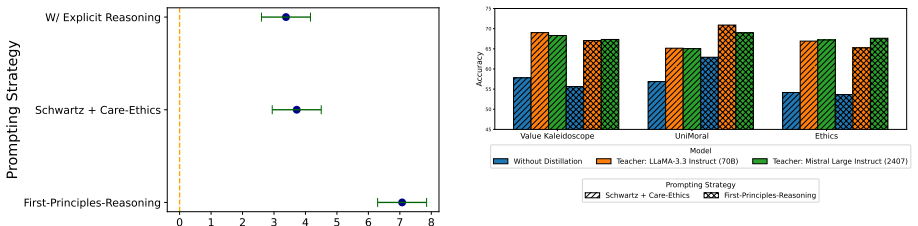
The paper's central claim is that the normative structure of the prompt, not model scale alone, determines the quality of an LLM's moral judgment. Across 12 open-source models and four datasets, an OLS regression of accuracy on prompt type explains 92.3% of the variance, and first-principles reasoning—deriving the conclusion from the scenario's fundamental truths about the value at stake—produces the largest improvement over label-only prompting at +7.3 percentage points (p < 0.001), a pattern the authors report holds across architectures and datasets. The paper also claims that pairing a psychological value system with a normative ethical theory improves accuracy and coherence over shallow reasoning, with Schwartz's value system plus care ethics as the best-tested configuration, and that supervised distillation of teacher-generated reasoning into LLaMA-3.2 3B consistently improves performance under both prompt types, transferring moral competence into a smaller, cheaper model.
Load-bearing premise
The load-bearing premise is that the gold labels of the four English, annotator-written datasets count as correct moral answers, so that higher accuracy means better moral reasoning rather than better mimicry of one annotator community.
Editorial extensions
If this is right
- Prompt engineering becomes a documented lever for moral alignment: a one-line change from label-only to first-principles framing moves accuracy more than several billion parameters do.
- Small and mid-size models can narrow the gap with much larger models through structured prompting, so morally better behavior does not require the largest available weights.
- Value and ethics scaffolds such as Schwartz plus care ethics can be selected empirically rather than by intuition, since the grid search ranks combinations with a clear winner.
- Reasoning distillation gives deployment teams a path to interpretable moral justification at low inference cost: the 3B student inherits structured reasoning, not just labels.
- The framework is portable: the same prompt templates transfer across four datasets with different label semantics, suggesting a unified evaluation recipe for moral benchmarks.
Reading between the lines
- The paper measures agreement with the annotator community that produced each dataset's gold labels; if labels from a different cultural community reverse the prompt-strategy ranking, the measured improvements would be better described as alignment with one normative stance.
- Because every prompt supplies the scenario and the value together, the marginal contribution of the ethical framework versus mere restatement of the value could be isolated by an ablation that omits the framework text.
- The distillation result used one student architecture at one size; whether reasoning transfers to other small models is a direct, untested extension.
- The +7.3% figure is averaged over a binary Support/Oppose task; a natural extension is to test whether structured prompts also improve ranking or grading of multiple options.
Editorial analysis
A structured set of objections, weighed in public.
Referee Report
Summary. The paper proposes a value-grounded prompting taxonomy for evaluating and improving moral reasoning in large language models. It benchmarks 12 open-source models on four moral datasets across four research questions: whether reasoning prompts beat direct classification (RQ1), which value/ethical scaffolds help most (RQ2), which cognitive reasoning strategies help most (RQ3), and whether distillation transfers moral reasoning to smaller models (RQ4). The central claims are that structured prompts improve accuracy and coherence, that First-Principles Reasoning yields the largest gain (+7.3% over label-only prompting), and that supervised distillation from large teachers consistently improves a small student model.
Significance. If the empirical claims held, the framework would be a useful, interpretable contribution to moral reasoning evaluation and to scalable alignment via distillation. The paper provides detailed prompt templates, per-model performance tables, and a distillation recipe, which are valuable resources. However, the label leakage in the First-Principles Reasoning prompt directly threatens the headline gain, so the current evidence does not support the framework's central conclusion until the evaluation is corrected.
major comments (3)
- [Appendix A.9, Section 4.4, Figure 5] The First-Principles Reasoning template in Appendix A.9 includes the ground-truth label in the prompt ('Consider the Scenario, the Value, and the provided Label {Label}'; Step 4: 'ensuring that the Value {Value} {Label} the Scenario'). Since RQ3 is described as a strict zero-shot setting (Section 4, first paragraph), this leaks the correct answer into the model input. The headline result that First-Principles Reasoning yields +7.3% over label-only (Section 4.4, Figure 5) is therefore likely an artifact of label leakage rather than evidence of improved moral reasoning. The paper's own Appendix A.10 states that 'Unlike zero-shot settings (RQ1-RQ3), where the model must infer both the label and the reasoning,' directly contradicting the template in A.9. The authors must remove the label from the RQ3 prompt and re-run all affected experiments.
- [Section 4.5, Figure 6, Appendix A.10] The RQ4 evaluation protocol is ambiguous: if the distilled student LLaMA-3.2 (3B) is evaluated with the label-provided prompts in A.10, then the reported post-distillation accuracy measures how well the model reproduces a label already present in the input, which is not a valid test of transferred moral competence. If instead the student is evaluated with label-free zero-shot prompts, the paper must say so explicitly and specify which template was used, because the current text and A.10 suggest the label is always provided in the distillation setting. Please clarify and, if necessary, re-evaluate the student under label-free conditions.
- [Section 4.2, Figure 3, Section 4.4] The Schwartz + Care-Ethics scaffold is selected as the best among 32 value-system/ethical-theory combinations based on its average accuracy on two models (LLaMA-3.1 Instruct 8B and Mistral-Nemo 12.2B) over the test sets. The same two models then contribute to the OLS estimate of the +3.7% gain for this prompt in Section 4.4, so the reported improvement is partly a result of selection on the evaluation data. Please report the full grid results for all models, hold out a model pair for selection, or otherwise account for the multiple-comparisons selection.
minor comments (5)
- [Appendix A.10] The sentence in Appendix A.10 directly contradicts the RQ3 template in A.9; this internal inconsistency should be resolved.
- [Section 3.5, Equation (2)] Equation (2) introduces L_consistency and λ=0.5, but the paper never specifies how L_consistency is computed (e.g., which NLI model, entailment scoring) or provides an ablation for λ; please add details.
- [Figure 3] The color intensity in the heatmap is not defined in the caption; please explain what the colors encode.
- [Section 4.5, Figure 6] The model naming is inconsistent: 'Mistral Large Instruct (2407)' in Figure 6 and Section 4.5 versus 'Mistral Large Instruct (123B)' elsewhere; please unify.
- [Section 4.4] Phi-4 is described as a 'larger model' although it is in the medium tier (14.7B) per Section 4; please correct this inconsistency.
Circularity Check
The RQ3 First-Principles template includes the ground-truth label as a prompt input, so the headline +7.3% gain is an instruction-following artifact; the winning RQ2 scaffold is also selected on the test data later used to report its +3.7% gain.
-
self definitional
[Appendix A.9 (RQ3 First-Principles template) and Section 4.4 (OLS gain)]
"Consider the ‘{Scenario}’, the Value ‘{Value}’, and the provided Label ‘{Label}’. Use first-principles reasoning to analyze the Scenario logically. ... Step 4: Summarize the analysis from Step 3 into a clear and concise reasoning, ensuring that the Value ‘{Value}’ {Label} the Scenario ‘{Scenario}’."
The only RQ3 First-Principles template in the appendix makes the ground-truth label a literal prompt input and instructs the model to 'ensure' that the Value takes that label. The Section 4.4 claim that 'First-Principles Reasoning achieves the largest boost at +7.3%' is therefore not a prediction of the label from reasoning; it measures whether the model echoes a label already supplied in the prompt. Appendix A.10 even states that 'Unlike zero-shot settings (RQ1-RQ3), where the model must infer both the label and the reasoning,' the label is provided only for distillation, which directly contradicts A.9. The headline effect reduces by construction to copying the input label, not to improved moral reasoning.
-
fitted input called prediction
[Section 4.2 (grid search) and Section 4.4 (OLS regression)]
"we conducted a grid search across all combinations using two diverse models, LLaMA-3.1 Instruct (8B) and Mistral-Nemo (12.2B)... Based on these findings, we select Schwartz’s Value Systemwith Care Ethics to conduct experiments on the remaining models. ... Schwartz’s + Care-Ethics provides a +3.7% gain."
The winning RQ2 scaffold is chosen as the maximum of a grid search evaluated on the test sets of two of the twelve models, and those same two models’ test-set accuracies are then included in the OLS regression that reports a +3.7% gain for the selected prompt. The reported effect is thus a selected maximum, not an independent estimate: the prompt choice was fitted to the very accuracy values later treated as evidence for its advantage. This is a fitted input presented as a predicted outcome, inflating the strength of the finding.
full rationale
The paper’s central claim that First-Principles Reasoning yields the largest gain over label-only prompting is compromised by label leakage: the RQ3 prompt template in Appendix A.9 provides the ground-truth label and tells the model to 'ensure' that the Value labels the Scenario, so the measured +7.3% effect reflects prompt compliance rather than moral inference. The same appendix explicitly says that in RQ1-RQ3 'the model must infer both the label and the reasoning,' revealing an internal contradiction that cannot be resolved from the available text. The RQ2 result is also inflated by selecting Schwartz’s + Care Ethics on test-set performance of two models and then reporting the same test-set performance as evidence in the OLS regression. The other strategies (With Explicit Reasoning and the non-selected value-ethics pairs) may retain independent content, and the datasets are external benchmarks rather than derived from the paper’s own definitions, so the circularity is substantial but not total. The self-citation to UniMoral is not load-bearing here because the benchmark labels are fixed external data. Overall, the headline empirical result reduces by construction to label-following, which warrants a high circularity score.
Assumptions & free parameters
free parameters (3)
- lambda (L_consistency weight) =
0.5
- temperature =
0.7
- VK distillation training subset size =
40,000 instances
assumptions (3)
- domain assumption The gold labels of the four benchmarks are valid ground truth for moral correctness.
- domain assumption Zero-shot prompting produces reasoning that can be meaningfully scored by label accuracy without contamination from training data.
- domain assumption Teacher-generated reasoning is coherent enough to serve as supervision for distillation.
Cite this review
Pith. "Pith review of Structured Moral Reasoning in Language Models: A Value-Grounded Evaluation Framework." pith.science (2026). https://pith.science/paper/SWZEYATZ
@misc{pith2026250614948,
  author       = {Pith},
  title        = {Pith review of: Structured Moral Reasoning in Language Models: A Value-Grounded Evaluation Framework},
  year         = {2026},
  howpublished = {\url{https://pith.science/paper/SWZEYATZ}},
  note         = {Machine review of arXiv:2506.14948}
}
read the original abstract
Large language models (LLMs) are increasingly deployed in domains requiring moral understanding, yet their reasoning often remains shallow, and misaligned with human reasoning. Unlike humans, whose moral reasoning integrates contextual trade-offs, value systems, and ethical theories, LLMs often rely on surface patterns, leading to biased decisions in morally and ethically complex scenarios. To address this gap, we present a value-grounded framework for evaluating and distilling structured moral reasoning in LLMs. We benchmark 12 open-source models across four moral datasets using a taxonomy of prompts grounded in value systems, ethical theories, and cognitive reasoning strategies. Our evaluation is guided by four questions: (1) Does reasoning improve LLM decision-making over direct prompting? (2) Which types of value/ethical frameworks most effectively guide LLM reasoning? (3) Which cognitive reasoning strategies lead to better moral performance? (4) Can small-sized LLMs acquire moral competence through distillation? We find that prompting with explicit moral structure consistently improves accuracy and coherence, with first-principles reasoning and Schwartz's + care-ethics scaffolds yielding the strongest gains. Furthermore, our supervised distillation approach transfers moral competence from large to small models without additional inference cost. Together, our results offer a scalable path toward interpretable and value-grounded models.
Figures


Figures from the paper (4 more)


Forward citations
Cited by 1 Pith paper
-
D2VBench: Benchmarking Large Language Models with Value Dilemmas in Daily Scenarios
D2VBench provides 10,000 LLM-human-built everyday multi-value dilemmas and an open-ended answer score based on judge-model mapping to options plus five-dimension reasoning coverage.
Reference graph
Works this paper leans on
-
[1]
Marah Abdin, Jyoti Aneja, Harkirat Behl, S \'e bastien Bubeck, Ronen Eldan, Suriya Gunasekar, Michael Harrison, Russell J Hewett, Mojan Javaheripi, Piero Kauffmann, and 1 others. Phi-4 technical report
-
[2]
Larry Alexander and Michael Moore. 2007. Deontological ethics
work page 2007
-
[3]
Maryam Amirizaniani, Elias Martin, Maryna Sivachenko, Afra Mashhadi, and Chirag Shah. 2024. Can llms reason like humans? assessing theory of mind reasoning in llms for open-ended questions. In Proceedings of the 33rd ACM International Conference on Information and Knowledge Management, pages 34--44
work page 2024
-
[4]
Edmond Awad, Sohan Dsouza, Richard Kim, Jonathan Schulz, Joseph Henrich, Azim Shariff, Jean-Fran c ois Bonnefon, and Iyad Rahwan. 2018. The moral machine experiment. Nature, 563(7729):59--64
2018
-
[5]
Maciej Besta, Nils Blach, Ales Kubicek, Robert Gerstenberger, Michal Podstawski, Lukas Gianinazzi, Joanna Gajda, Tomasz Lehmann, Hubert Niewiadomski, Piotr Nyczyk, and 1 others. 2024. Graph of thoughts: Solving elaborate problems with large language models. In Proceedings of the AAAI Conference on Artificial Intelligence, volume 38, pages 17682--17690
2024
-
[6]
Tom Brown, Benjamin Mann, Nick Ryder, Melanie Subbiah, Jared D Kaplan, Prafulla Dhariwal, Arvind Neelakantan, Pranav Shyam, Girish Sastry, Amanda Askell, and 1 others. 2020. Language models are few-shot learners. Advances in neural information processing systems, 33:1877--1901
2020
-
[7]
Karl Cobbe, Vineet Kosaraju, Mohammad Bavarian, Mark Chen, Heewoo Jun, Lukasz Kaiser, Matthias Plappert, Jerry Tworek, Jacob Hilton, Reiichiro Nakano, and 1 others. 2021. Training verifiers to solve math word problems. arXiv preprint arXiv:2110.14168
arXiv 2021
-
[8]
Fiery Cushman. 2013. Action, outcome, and value: A dual-system framework for morality. Personality and social psychology review, 17(3):273--292
work page 2013
Show all 66 references
-
[9]
John Dewey and James Hayden Tufts. 2022. Ethics. DigiCat
2022
-
[10]
Ronald Dworkin. 2013. Taking rights seriously. A&C Black
2013
-
[11]
Denis Emelin, Ronan Le Bras, Jena D Hwang, Maxwell Forbes, and Yejin Choi. 2021. Moral stories: Situated reasoning about norms, intents, actions, and their consequences. In Proceedings of the 2021 Conference on Empirical Methods in Natural Language Processing, pages 698--718
2021
-
[12]
Shangbin Feng, Taylor Sorensen, Yuhan Liu, Jillian Fisher, Chan Young Park, Yejin Choi, and Yulia Tsvetkov. 2024. Modular pluralism: Pluralistic alignment via multi-llm collaboration. In Proceedings of the 2024 Conference on Empirical Methods in Natural Language Processing, pa...
2024
-
[13]
Alec Fisher. 2004. The logic of real arguments. Cambridge University Press
2004
-
[14]
Maxwell Forbes, Jena D Hwang, Vered Shwartz, Maarten Sap, and Yejin Choi. 2020. Social chemistry 101: Learning to reason about social and moral norms. arXiv preprint arXiv:2011.00620
2020 arXiv
-
[15]
R Edward Freeman. 2010. Strategic management: A stakeholder approach. Cambridge university press
2010
-
[16]
Carol Gilligan. 1993. In a different voice: Psychological theory and women’s development. Harvard university press
1993
-
[17]
Jesse Graham, Jonathan Haidt, Sena Koleva, Matt Motyl, Ravi Iyer, Sean P Wojcik, and Peter H Ditto. 2013. Moral foundations theory: The pragmatic validity of moral pluralism. In Advances in experimental social psychology, volume 47, pages 55--130. Elsevier
2013
-
[18]
Aaron Grattafiori, Abhimanyu Dubey, Abhinav Jauhri, Abhinav Pandey, Abhishek Kadian, Ahmad Al-Dahle, Aiesha Letman, Akhil Mathur, Alan Schelten, Alex Vaughan, and 1 others. 2024. The llama 3 herd of models. arXiv preprint arXiv:2407.21783
2024 arXiv
-
[19]
Joshua D Greene, R Brian Sommerville, Leigh E Nystrom, John M Darley, and Jonathan D Cohen. 2001. An fmri investigation of emotional engagement in moral judgment. Science, 293(5537):2105--2108
2001
-
[20]
Dirk Groeneveld, Iz Beltagy, Evan Walsh, Akshita Bhagia, Rodney Kinney, Oyvind Tafjord, Ananya Jha, Hamish Ivison, Ian Magnusson, Yizhong Wang, and 1 others. 2024. Olmo: Accelerating the science of language models. In Proceedings of the 62nd Annual Meeting of the Association f...
2024
-
[21]
Katharina Haemmerl, Bjoern Deiseroth, Patrick Schramowski, Jind r ich Libovick \`y , Constantin Rothkopf, Alexander Fraser, and Kristian Kersting. 2023. Speaking multiple languages affects the moral bias of language models. In Findings of the Association for Computational Ling...
2023
-
[22]
Jonathan Haidt. 2001. The emotional dog and its rational tail: a social intuitionist approach to moral judgment. Psychological review, 108(4):814
2001
-
[23]
Jonathan Haidt. 2007. The new synthesis in moral psychology. science, 316(5827):998--1002
2007
-
[24]
Shibo Hao, Yi Gu, Haodi Ma, Joshua Hong, Zhen Wang, Daisy Wang, and Zhiting Hu. 2023. Reasoning with language model is planning with world model. In Proceedings of the 2023 Conference on Empirical Methods in Natural Language Processing, pages 8154--8173
2023
-
[25]
Dan Hendrycks, Collin Burns, Steven Basart, Andrew Critch, Jerry Li, Dawn Song, and Jacob Steinhardt. 2020. Aligning ai with shared human values. arXiv preprint arXiv:2008.02275
2020 arXiv
-
[26]
Dan Hendrycks, Collin Burns, Saurav Kadavath, Akul Arora, Steven Basart, Eric Tang, Dawn Song, and Jacob Steinhardt. 2021. Measuring mathematical problem solving with the math dataset. arXiv preprint arXiv:2103.03874
2021 arXiv
-
[27]
Geoffrey Hinton, Oriol Vinyals, and Jeff Dean. 2015. Distilling the knowledge in a neural network. arXiv preprint arXiv:1503.02531
2015 arXiv
-
[28]
Geert Hofstede. 2001. Culture's consequences: Comparing values, behaviors, institutions and organizations across nations. International Educational and Professional
2001
-
[29]
David Hume. 2000. A treatise of human nature. Oxford University Press
2000
-
[30]
Alon Jacovi, Yonatan Bitton, Bernd Bohnet, Jonathan Herzig, Or Honovich, Michael Tseng, Michael Collins, Roee Aharoni, and Mor Geva. 2024. A chain-of-thought is as strong as its weakest link: A benchmark for verifiers of reasoning chains. arXiv preprint arXiv:2402.00559
2024 arXiv
-
[31]
Jianchao Ji, Yutong Chen, Mingyu Jin, Wujiang Xu, Wenyue Hua, and Yongfeng Zhang. 2024. Moralbench: Moral evaluation of llms. arXiv preprint arXiv:2406.04428
2024 arXiv
-
[32]
Albert Q. Jiang, Alexandre Sablayrolles, Arthur Mensch, Chris Bamford, Devendra Singh Chaplot, Diego de las Casas, Florian Bressand, Gianna Lengyel, Guillaume Lample, Lucile Saulnier, Lélio Renard Lavaud, Marie-Anne Lachaux, Pierre Stock, Teven Le Scao, Thibaut Lavril, Thomas ...
2023 arXiv
-
[33]
Liwei Jiang, Jena D Hwang, Chandra Bhagavatula, Ronan Le Bras, Jenny Liang, Jesse Dodge, Keisuke Sakaguchi, Maxwell Forbes, Jon Borchardt, Saadia Gabriel, and 1 others. 2021. Can machines learn morality? the delphi experiment. arXiv preprint arXiv:2110.07574
2021 arXiv
-
[34]
Liwei Jiang, Jena D Hwang, Chandra Bhagavatula, Ronan Le Bras, Jenny T Liang, Sydney Levine, Jesse Dodge, Keisuke Sakaguchi, Maxwell Forbes, Jack Hessel, and 1 others. 2025. Investigating machine moral judgement through the delphi experiment. Nature Machine Intelligence, pages 1--16
2025
-
[35]
Tushar Khot, Harsh Trivedi, Matthew Finlayson, Yao Fu, Kyle Richardson, Peter Clark, and Ashish Sabharwal. 2022. Decomposed prompting: A modular approach for solving complex tasks. arXiv preprint arXiv:2210.02406
2022 arXiv
-
[36]
Takeshi Kojima, Shixiang Shane Gu, Machel Reid, Yutaka Matsuo, and Yusuke Iwasawa. 2022. Large language models are zero-shot reasoners. Advances in neural information processing systems, 35:22199--22213
2022
-
[37]
Olya Kudina, Brian Ballsun-Stanton, and Mark Alfano. 2025. The use of large language models as scaffolds for proleptic reasoning. Asian Journal of Philosophy, 4(1):1--18
2025
-
[38]
Shivani Kumar and David Jurgens. 2025. Are rules meant to be broken? understanding multilingual moral reasoning as a computational pipeline with unimoral. arXiv preprint arXiv:2502.14083
2025 arXiv
-
[39]
Andrew K Lampinen, Nicholas Roy, Ishita Dasgupta, Stephanie CY Chan, Allison Tam, James Mcclelland, Chen Yan, Adam Santoro, Neil C Rabinowitz, Jane Wang, and 1 others. 2022. Tell me why! explanations support learning relational and causal structure. In International Conference...
2022
-
[40]
Mike Lewis, Yinhan Liu, Naman Goyal, Marjan Ghazvininejad, Abdelrahman Mohamed, Omer Levy, Veselin Stoyanov, and Luke Zettlemoyer. 2020. Bart: Denoising sequence-to-sequence pre-training for natural language generation, translation, and comprehension. In Proceedings of the 58t...
2020
-
[41]
Xian Li, Ping Yu, Chunting Zhou, Timo Schick, Omer Levy, Luke Zettlemoyer, Jason Weston, and Mike Lewis. 2024. Self-alignment with instruction backtranslation. In ICLR
2024
-
[42]
Aman Madaan, Niket Tandon, Prakhar Gupta, Skyler Hallinan, Luyu Gao, Sarah Wiegreffe, Uri Alon, Nouha Dziri, Shrimai Prabhumoye, Yiming Yang, and 1 others. 2023. Self-refine: Iterative refinement with self-feedback. Advances in Neural Information Processing Systems, 36:46534--46594
2023
-
[43]
John Stuart Mill. 2016. Utilitarianism. In Seven masterpieces of philosophy, pages 329--375. Routledge
2016
-
[44]
Swaroop Mishra, Daniel Khashabi, Chitta Baral, Yejin Choi, and Hannaneh Hajishirzi. 2021. Reframing instructional prompts to gptk's language. arXiv preprint arXiv:2109.07830
2021 arXiv
-
[45]
Swaroop Mishra and Elnaz Nouri. 2023. Help me think: A simple prompting strategy for non-experts to create customized content with models. In Findings of the Association for Computational Linguistics: ACL 2023, pages 11834--11890
2023
-
[46]
Maxwell Nye, Anders Johan Andreassen, Guy Gur-Ari, Henryk Michalewski, Jacob Austin, David Bieber, David Dohan, Aitor Lewkowycz, Maarten Bosma, David Luan, and 1 others. 2021. Show your work: Scratchpads for intermediate computation with language models
2021
-
[47]
Team OLMo, Pete Walsh, Luca Soldaini, Dirk Groeneveld, Kyle Lo, Shane Arora, Akshita Bhagia, Yuling Gu, Shengyi Huang, Matt Jordan, Nathan Lambert, Dustin Schwenk, Oyvind Tafjord, Taira Anderson, David Atkinson, Faeze Brahman, Christopher Clark, Pradeep Dasigi, Nouha Dziri, an...
2024 arXiv
-
[48]
Long Ouyang, Jeffrey Wu, Xu Jiang, Diogo Almeida, Carroll Wainwright, Pamela Mishkin, Chong Zhang, Sandhini Agarwal, Katarina Slama, Alex Ray, and 1 others. 2022. Training language models to follow instructions with human feedback. Advances in neural information processing sys...
2022
-
[49]
Arkil Patel, Satwik Bhattamishra, and Navin Goyal. 2021. Are nlp models really able to solve simple math word problems? arXiv preprint arXiv:2103.07191
2021 arXiv
-
[50]
Rafael Rafailov, Archit Sharma, Eric Mitchell, Christopher D Manning, Stefano Ermon, and Chelsea Finn. 2023. Direct preference optimization: Your language model is secretly a reward model. Advances in Neural Information Processing Systems, 36:53728--53741
2023
-
[51]
John Rawls. 2017. A theory of justice. In Applied ethics, pages 21--29. Routledge
2017
-
[52]
Milton Rokeach. 1973. The nature of human values. Free press
1973
-
[53]
William David Ross. 2002. The right and the good. Oxford University Press
2002
-
[54]
Shalom H Schwartz. 1992. Universals in the content and structure of values: Theoretical advances and empirical tests in 20 countries. In Advances in experimental social psychology, volume 25, pages 1--65. Elsevier
1992
-
[55]
Taylor Sorensen, Liwei Jiang, Jena D Hwang, Sydney Levine, Valentina Pyatkin, Peter West, Nouha Dziri, Ximing Lu, Kavel Rao, Chandra Bhagavatula, and 1 others. 2024. Value kaleidoscope: Engaging ai with pluralistic human values, rights, and duties. In Proceedings of the AAAI C...
2024
-
[56]
Qwen Team. 2024. https://qwenlm.github.io/blog/qwen2.5/ Qwen2.5: A party of foundation models
2024
-
[57]
George Tovstiga. 2023. What is first principles thinking? In Strategy Praxis: Insight-Driven, First Principles-Based Strategic Thinking, Analysis, and Decision-Making, pages 41--65. Springer
2023
-
[58]
Yufei Wang, Wanjun Zhong, Liangyou Li, Fei Mi, Xingshan Zeng, Wenyong Huang, Lifeng Shang, Xin Jiang, and Qun Liu. 2023. Aligning large language models with human: A survey. arXiv preprint arXiv:2307.12966
2023 arXiv
-
[59]
Jason Wei, Xuezhi Wang, Dale Schuurmans, Maarten Bosma, Fei Xia, Ed Chi, Quoc V Le, Denny Zhou, and 1 others. 2022. Chain-of-thought prompting elicits reasoning in large language models. Advances in neural information processing systems, 35:24824--24837
2022
-
[60]
Xiaohan Xu, Ming Li, Chongyang Tao, Tao Shen, Reynold Cheng, Jinyang Li, Can Xu, Dacheng Tao, and Tianyi Zhou. 2024. A survey on knowledge distillation of large language models. arXiv preprint arXiv:2402.13116
2024 arXiv
-
[61]
Shunyu Yao, Dian Yu, Jeffrey Zhao, Izhak Shafran, Tom Griffiths, Yuan Cao, and Karthik Narasimhan. 2023. Tree of thoughts: Deliberate problem solving with large language models. Advances in neural information processing systems, 36:11809--11822
2023
-
[62]
Meilan Zhang. 2013. Prompts-based scaffolding for online inquiry: Design intentions and classroom realities. Journal of Educational Technology & Society, 16(3):140--151
2013
-
[63]
Denny Zhou, Nathanael Sch \"a rli, Le Hou, Jason Wei, Nathan Scales, Xuezhi Wang, Dale Schuurmans, Claire Cui, Olivier Bousquet, Quoc Le, and 1 others. 2022. Least-to-most prompting enables complex reasoning in large language models. arXiv preprint arXiv:2205.10625
2022 arXiv
-
[64]
Wenhao Zhu, Hongyi Liu, Qingxiu Dong, Jingjing Xu, Shujian Huang, Lingpeng Kong, Jiajun Chen, and Lei Li. 2023. Multilingual machine translation with large language models: Empirical results and analysis. arXiv preprint arXiv:2304.04675
2023 arXiv
-
[65]
online" 'onlinestring :=
ENTRY address archivePrefix author booktitle chapter edition editor eid eprint eprinttype howpublished institution journal key month note number organization pages publisher school series title type volume year doi pubmed url lastchecked label extra.label sort.label short.list...
-
[66]
write newline
" write newline "" before.all 'output.state := FUNCTION n.dashify 't := "" t empty not t #1 #1 substring "-" = t #1 #2 substring "--" = not "--" * t #2 global.max substring 't := t #1 #1 substring "-" = "-" * t #2 global.max substring 't := while if t #1 #1 substring * t #2 gl...
Reviewed August 7, 2026 · model on record in the stance chip above.
Discussion (0). Sign in to comment.