REVIEW 2 major objections 6 minor 2 cited by
Metasurfaces-Integrated Doubly-Dispersive MIMO: Channel Modeling and Optimization
T0 review · 2 major / 6 minor · reviewed 2026-08-15 · deepseek-v4-flash
Pith's one-line read The paper claims that a metasurface-parametrized doubly dispersive MIMO channel model, with stacked intelligent metasurfaces at both ends and arbitrary RISs in the environment, lets optimized SIM phases improve BER and radar estimation…
desk verdict Useful unified model for SIM-assisted doubly-dispersive MIMO, but the headline BER/RPE gains are compromised by an ambiguous normalization that may cancel the very power gain the SIM optimizer targets. read the letter →
The pith
A machine-rendered reading of the paper's core claim, the machinery that carries it, and where it could break.
The reading
What carries the argument
The load-bearing object is the metasurface-parametrized channel matrix $\mathbf{H}(\mathcal{Z},\tilde{\mathcal{Z}},\mathcal{F},t,\tau)$ of Eq. (15), assembled from the SIM transfer matrices $\mathbf{U}_T(\mathcal{Z}) = \prod_{q=1}^{Q} \boldsymbol{\Psi}_{Q-q+1} \boldsymbol{\Gamma}_{Q-q+1}$ and the analogous $\mathbf{U}_R(\tilde{\mathcal{Z}})$, where each $\boldsymbol{\Psi}_q$ is a diagonal layer of tunable phase shifts and each $\boldsymbol{\Gamma}_q$ is a fixed diffraction matrix from Rayleigh-Sommerfeld theory; sub-wavelength coupling of the outer SIM layers enters through sinc-correlation matrices $\mathbf{R}_{TX}$ and $\mathbf{R}_{RX}$. For RIS paths, Eq. (22) reduces every TX-SIM to RIS to RX-SIM route to a single effective path whose normalized delay and Doppler are the sums of the two hops, and the effective channels for OFDM, OTFS, and AFDM all take the shared form $\bar{\mathbf{H}} = \sum_p \check{\mathbf{H}}_p \otimes \mathbf{G}_p$. This shared structure is what lets a single gradient-ascent optimizer, one Gaussian belief propagation (GaBP) detector, and one probabilistic data association (PDA) estimator serve all three waveforms.
What would settle it
Construct a single multi-layer SIM, set all layers to known phases, measure the through response, then change only one layer's phase vector and re-measure: the product model in Eq. (11) predicts the change is exactly the action of that diagonal phase matrix against fixed diffraction matrices, so any observed inter-layer coupling or phase-dependent diffraction beyond the sinc spatial correlation would show that the optimized phases of Algorithm 1 cannot produce the claimed BER and MSE gains. A companion simulation check is to run a full-wave solver with inter-layer reflections and compare the two-hop effective path, with summed delay and Doppler, against the exact cascaded response for large delay spreads.
Extended reading notes
Core claim
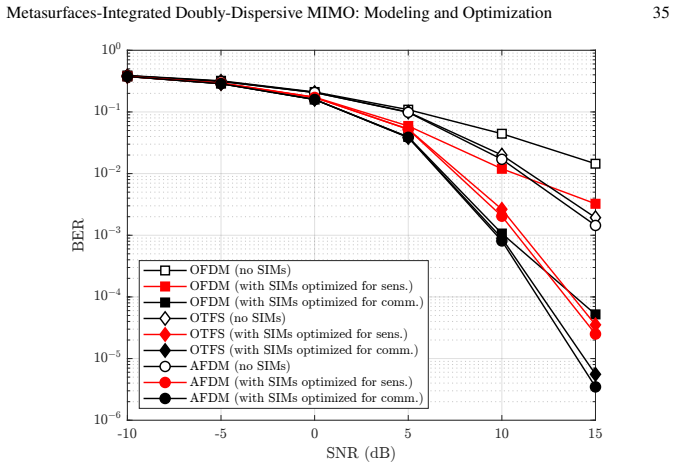
The central claim is that the doubly-dispersive MIMO channel can be written as a function of the phase configurations of the SIMs and RISs, $\mathbf{H}(\mathcal{Z},\tilde{\mathcal{Z}},\mathcal{F},t,\tau) = \mathbf{U}_R(\tilde{\mathcal{Z}}) \mathbf{R}_{RX}^{1/2} \tilde{\mathbf{H}}(\mathcal{F},t,\tau) \mathbf{R}_{TX}^{1/2} \mathbf{U}_T(\mathcal{Z})$, where each SIM transfer matrix is a cascade of diagonal phase layers separated by fixed Rayleigh-Sommerfeld diffraction matrices, and the RIS-parametrized middle term is a direct path plus one-hop reflected paths. On top of this model, the paper derives effective channel matrices for OFDM, OTFS, and AFDM that share the same Kronecker structure, so the same optimization and detection machinery applies to all three. The optimization objective is the total received power across paths for communication, or the weakest path's power for sensing, both tuned by closed-form gradients. Simulation results claim that optimized SIMs substantially reduce BER compared with SIM-free operation and bring OFDM close to OTFS and AFDM, while sensing-optimized SIMs push range and velocity MSE toward the delay-Doppler grid resolution limit with only a modest communication penalty.
Load-bearing premise
The load-bearing assumption is that each SIM layer acts as an independent diagonal phase screen with fixed diffraction between layers and no multiple reflections or mutual coupling, and that each TX-SIM-to-RIS-to-RX-SIM route collapses to a single path with summed delay and Doppler; if a real SIM couples layers or its diffraction changes with phase, the optimized phases will not deliver the predicted gains.
Editorial extensions
If this is right
- With optimized SIM phases, OFDM's BER in doubly dispersive channels approaches that of OTFS and AFDM, so a conventional waveform plus wave-domain processing can substitute for more complex delay-Doppler schemes.
- One effective-channel expression describes OFDM, OTFS, and AFDM, so channel estimation and detection can be designed once and instantiated per waveform.
- Because the same model covers TX-SIM, RX-SIM, and any number of RISs, performance optimization can treat the whole metasurface-enhanced link as a single programmable system rather than separate components.
- Switching the SIM objective from total received power to weakest-path power yields large radar range and velocity MSE gains toward the grid resolution limit, while the communication BER penalty remains relatively small, showing one hardware configuration can serve both ISAC functions.
- All special cases, including SIM-only, RIS-only, conventional MIMO, and SISO doubly dispersive channels, collapse out of the same equations, giving a unified reference model for subsequent metasurface-aided work.
Reading between the lines
- Beyond the paper, the layer-by-layer phase cascade could be trained end-to-end as a wave-domain linear transform, so part of delay-Doppler estimation happens inside the SIM before digital processing; the paper stops at power-based objectives and does not test this.
- Beyond the paper, one could sweep the trade-off between the communication objective (total received power) and the sensing objective (weakest-path power) to trace the ISAC Pareto frontier explicitly; the paper reports two endpoints but not the curve.
- Beyond the paper, because the model treats an arbitrary number of RISs, a natural extension is joint optimization of SIM phases and RIS reflection coefficients, which the gradients in Section 5.1 do not currently include.
- Beyond the paper, the two-hop single-effective-path approximation in Eq. (22) should be stress-tested against a full wave simulation with multiple reflections; if it fails at large delay spreads, a rank-augmented version preserving the Kronecker form would still fit the framework.
Signed reviews
Editorial analysis
A structured set of objections, weighed in public.
Referee Report
Summary. The paper proposes a metasurfaces-parametrized doubly-dispersive (MPDD) MIMO channel model that integrates stacked intelligent metasurfaces (SIM) at both the transmitter and receiver together with an arbitrary number of reconfigurable intelligent surfaces (RISs) in the environment. It derives discrete-time input-output relations and effective channel matrices for OFDM, OTFS, and AFDM, then formulates SIM phase-optimization problems for communication and sensing, and evaluates the resulting BER and radar-parameter-estimation performance using GaBP and PDA detectors. The central claim is that optimized SIM phases yield significant performance gains for all three waveforms in high-mobility and ISAC scenarios.
Significance. If the performance claims hold, this would provide a useful unified framework for modeling, optimizing, and detecting doubly-dispersive MIMO links enhanced by stacked intelligent metasurfaces. The structural derivation of the effective channel matrices for OFDM, OTFS, and AFDM within a common model, and the closed-form gradient expressions for SIM optimization, are valuable and go beyond a purely conceptual treatment. The paper also explicitly builds on prior published work on DD waveform modeling and SIM-MIMO, so the novelty is incremental but concrete. However, the quantitative evidence for the headline gains is currently weakened by the normalization procedure in Section 5.3 and by a scaling inconsistency in the RIS path of Eq. (22), both of which need to be resolved before the numerical claims can be fully interpreted.
major comments (2)
- [Section 5.3, Figs. 3-4] The normalization statement "the complete channels are normalized such that ||H_OFDM||_F^2 = ||H_OTFS||_F^2 = ||H_AFDM||_F^2 = ||H_MIMO||_F^2 for all the cases" equalizes the total received power across the SIM and no-SIM cases. Since the SIM optimization in Eq. (43) maximizes exactly the total received power (the sum of per-path Frobenius norms), this normalization removes the power gain that the optimization is designed to produce. The BER gains in Figs. 3-4 would then reflect only secondary structural changes (which paths are emphasized, delay-Doppler reshaping) that the objective in Eq. (43) does not directly target and that the paper does not analyze. The manuscript must state whether the normalization is applied before or after the SIM optimization, define the SNR axis (transmit SNR vs. post-normalization receive SNR), and report results both with and without the cross-case normalization so that the power gain and any structural gain are separated. This is load-bearing because the central claim of significant performance gains rests on these figures. The RPE results in Fig. 5 should also state whether the same normalization is applied, since without this information the absolute gains cannot be interpreted.
- [Eq. (22)] The scaling factor for the RIS-reflected path is written as J / sqrt(Mtilde M Pbar Ptilde). From the definitions in Eqs. (19)-(20), the product Htilde_RX,k Phi_k Htilde_k,TX carries a factor J sqrt(Mtilde M / (Pbar Ptilde)) when the unit-norm UPA steering vectors are taken into account. As written, the RIS path is suppressed by a factor of Mtilde M in power relative to the direct path, which is inconsistent with the component models and would make the RIS contributions negligible for the typical M=100, J=100 parameters used in Section 4.5. Please correct the coefficient and verify its propagation into Eqs. (28), (34), (40), and (41). This error does not directly alter the numerical results in Sections 5-6 because those simulations set K=0, but it affects the correctness of the claimed general MPDD model.
minor comments (6)
- [Section 4.5] The statement that "unoptimized SIM have no effect onto the DD channels" is not clearly justified: with Z = I the transfer matrices Upsilon_T and Upsilon_R in Eqs. (11)-(12) still contain the non-identity diffraction matrices Gamma and Xi, so the channel is not identical to the no-SIM case used in [8]. Please clarify whether "unoptimized" means only that all phase shifts are unity, and discuss whether the comparison in Fig. 2 accounts for the diffraction-induced spatial transformation.
- [Section 4.4] The equation numbering in Section 4.4 reuses numbers (39), (40), and (41) that were already assigned to the OTFS equations in Section 4.3; please renumber the AFDM equations sequentially.
- [Section 5.3] The phrase "no power advantage other than the effect of the parametrized SIM is provided" is contradictory, because Eq. (43) is specifically a power-maximizing objective. Please rephrase to describe what is actually being normalized and how the SNR axis is defined.
- [Algorithm 2] The loop "for p=1 to P+1" appears to be an off-by-one error; if the intent is to greedily optimize each of the P paths in turn, the loop should likely run to P. Please check and correct.
- [Figure 5] Fig. 5 does not include a no-SIM baseline, which makes it difficult to quantify the absolute gain in radar parameter estimation due to the SIM; adding such a curve (or explaining why it is omitted) would improve interpretability.
- [General presentation] There are several typos and minor notation issues: "chaper" in the Introduction, "exhbits" in Section 6.4, "wlg" in Section 2.1, and the use of "N_bar = M_bar = N d_s x N d_s" in Section 5.2 where scalar dimensions are intended. These should be corrected in a final revision.
Circularity Check
No significant circularity: the MPDD derivation is a self-contained composition of published DD, RIS, and SIM models; the SIM phases are optimized rather than fitted, and no equation reduces to its own input.
full rationale
The derivation chain is self-contained. Section 3 defines the MPDD channel as a composition of the standard DD MIMO model (Eq. (7)) with the RIS phase matrix (Eq. (8)) and the Rayleigh-Sommerfeld SIM cascade (Eqs. (9)-(13)); Eqs. (15)-(20) are explicit algebraic compositions rather than hidden identities. The effective OFDM/OTFS/AFDM matrices (Eqs. (34), (40), (41)) are obtained by applying the waveform-specific unitary transforms to the common G_p block, and the 'MIMO extension' Eq. (42) is explicitly labeled as a conventional baseline. No parameter is fitted to the evaluation data: the SIM phases in problems (43) and (71) are optimized via gradient ascent with closed-form gradients (Eqs. (44)-(55)), and the BER/RPE curves are then simulated under those optimized phases. The self-citations to [8] and [65] supply prior SISO waveform algebra and a prior MIMO-SIM model, but the paper re-derives the needed expressions within its own framework; those citations are not used as an unverified uniqueness theorem or as the sole support for the central claim. The Sec. 5.3 normalization (equal Frobenius norms across complete channels) is a legitimate evaluation-fairness concern, since it may cancel the total-power gain targeted by Eq. (43), but it is a simulation methodology issue rather than a circularity, because the reported BER is not equal to the optimization objective by construction. Overall, no load-bearing step reduces to its own input.
Assumptions & free parameters
assumptions (6)
- domain assumption The DD channel is represented by a finite sum of P resolvable paths with constant delays and Doppler shifts (Eq. (1), Remark 1).
- domain assumption Each RIS behaves as a diagonal phase-only reflector with no mutual coupling (Eq. (8)).
- domain assumption Each SIM layer is an independently tunable diagonal phase mask, and inter-layer propagation is described by the Rayleigh-Sommerfeld diffraction coefficients of Eq. (10) with no multiple reflections between layers.
- domain assumption Spatial correlation at the SIM outermost layers follows sinc(d) correlation (Section 3, R_TX and R_RX).
- domain assumption The cascade of a TX-SIM-to-RIS path and a RIS-to-RX-SIM path collapses to one effective path with summed delay and Doppler and multiplied complex gain (Eq. (22)).
- domain assumption Perfect or near-perfect knowledge of channel parameters (AoAs/AoDs, path powers) is available for SIM optimization (Remark 3 and Section 5.1).
Cite this review
Pith. "Pith review of Metasurfaces-Integrated Doubly-Dispersive MIMO: Channel Modeling and Optimization." pith.science (2026). https://pith.science/paper/4A3SPVLC
@misc{pith2026250614985,
  author       = {Pith},
  title        = {Pith review of: Metasurfaces-Integrated Doubly-Dispersive MIMO: Channel Modeling and Optimization},
  year         = {2026},
  howpublished = {\url{https://pith.science/paper/4A3SPVLC}},
  note         = {Machine review of arXiv:2506.14985}
}
read the original abstract
The doubly-dispersive (DD) channel structure has played a pivotal role in wireless communications, particularly in high-mobility scenarios and integrated sensing and communications (ISAC), due to its ability to capture the key fading effects experienced by a transmitted signal as it propagates through a dynamic medium. However, extending the DD framework to multiple-input multiple-output (MIMO) systems, especially in environments artificially enhanced by reconfigurable intelligent surfaces (RISs) and stacked intelligent metasurfaces (SIM), remains a challenging open problem. In this chapter, a novel metasurfaces-parametrized DD (MPDD) channel model that integrates an arbitrary number of RISs, while also incorporating SIM at both the transmitter and receiver is introduced. Next, the application of this model to some key waveforms optimized for DD environments -- namely orthogonal frequency division multiplexing (OFDM), orthogonal time frequency space (OTFS), and affine frequency division multiplexing (AFDM) -- is discussed. Finally, the programmability of the proposed model is highlighted through an illustrative application, demonstrating its potential for enhancing waveform performance in SIM-assisted wireless systems.
Figures


Figures from the paper (3 more)


Forward citations
Cited by 2 Pith papers
-
Bistatic Integrated Sensing and Communications with Flexible Intelligent Metasurfaces
FIM shape optimization is shown in simulation to improve ISAC achievable rate and AoA sensing for OFDM, OTFS, and AFDM in doubly-dispersive MIMO channels.
-
Flexible Intelligent Metasurfaces in High-Mobility MIMO Integrated Sensing and Communications
A flexible-intelligent-metasurface-parameterized doubly dispersive MIMO channel model is proposed, and optimizing the surface shape at both link ends is shown by simulation to improve achievable rate and angle-of-arri...
Reference graph
Works this paper leans on
-
[1]
Vehicle-to-Everything (V2X) Services Supported by LTE-Based Systems and 5G,
S. Chen, J. Hu, Y. Shi, Y. Peng, J. Fang, R. Zhao, and L. Zhao, “Vehicle-to-Everything (V2X) Services Supported by LTE-Based Systems and 5G,”IEEE Commun. Stand. Mag., vol. 1, no. 2, 2017
2017
-
[2]
6G Internet of Things: A Comprehensive Survey,
D. C. Nguyen, M. Ding, P. N. Pathirana, A. Seneviratne, J. Li, D. Niyato, O. Dobre, and H. V. Poor, “6G Internet of Things: A Comprehensive Survey,”IEEE Internet Things J., vol. 9, no. 1, 2022
2022
-
[3]
OTFS Enabled LEO Satellite Communications: A Promising Solution to Severe Doppler Effects,
J. Shi, Z. Li, J. Hu, Z. Tie, S. Li, W. Liang, and Z. Ding, “OTFS Enabled LEO Satellite Communications: A Promising Solution to Severe Doppler Effects,”IEEE Network, vol. 38, no. 1, 2024
2024
-
[4]
Mobility Support for Millimeter Wave Communications: Opportunities and Challenges,
J. Li, Y. Niu, H. Wu, B. Ai, S. Chen, Z. Feng, Z. Zhong, and N. Wang, “Mobility Support for Millimeter Wave Communications: Opportunities and Challenges,”IEEE Commun. Surveys Tuts., vol. 24, no. 3, 2022
2022
-
[5]
Performance Degradation of OFDM Systems due to Doppler Spreading,
T. Wang, J. Proakis, E. Masry, and J. Zeidler, “Performance Degradation of OFDM Systems due to Doppler Spreading,”IEEE Trans. Wireless Commun., vol. 5, no. 6, 2006
2006
-
[6]
Orthogonal Time-Frequency Signaling over Doubly Dispersive Channels,
K. Liu, T. Kadous, and A. Sayeed, “Orthogonal Time-Frequency Signaling over Doubly Dispersive Channels,”IEEE Trans. Inf. Theory, vol. 50, no. 11, 2004
2004
-
[7]
D. W. Bliss and S. Govindasamy,Dispersive and Doubly Dispersive Channels, Cambridge University Press, 2013
2013
-
[8]
H. S. Rou, G. T. F. de Abreu, J. Choi, D. Gonz ´alez G., M. Kountouris, Y. L. Guan, and O. Gonsa, “From Orthogonal Time–Frequency Space to Affine Frequency-Division Multi- plexing: A Comparative Study of Next-Generation Waveforms for Integrated Sensing and Communications in Doubly Dispersive Channels,”IEEE Signal Process. Mag., vol. 41, no. 5, 2024
work page 2024
Show all 87 references
-
[9]
On the Diversity of Uncoded OTFS Modulation in Doubly-Dispersive Channels,
G. D. Surabhi, R. M. Augustine, and A. Chockalingam, “On the Diversity of Uncoded OTFS Modulation in Doubly-Dispersive Channels,”IEEE Trans. Wireless Commun., vol. 18, no. 6, 2019
2019
-
[10]
A Robust Baseband Transceiver Design for Doubly-Dispersive Channels,
R. Bomfin, M. Chafii, A. Nimr, and G. Fettweis, “A Robust Baseband Transceiver Design for Doubly-Dispersive Channels,”IEEE Trans. Wireless Commun., vol. 20, no. 8, 2021
2021
-
[11]
Estimation of Doubly-Dispersive Channels in Linearly Precoded Multicarrier Systems using Smoothness Regularization,
A. Pfadler, T. Szollmann, P. Jung, and S. Sta´nczak, “Estimation of Doubly-Dispersive Channels in Linearly Precoded Multicarrier Systems using Smoothness Regularization,”IEEE Trans. Wireless Commun., vol. 23, no. 2, 2024
2024
-
[12]
Two-Dimensional Delay-Doppler Pilots and Channel Estimation for Multi-Antenna OTFS in Doubly Dispersive Channels,
Y. Liang, P. Fan, Q. Wang, and X. He, “Two-Dimensional Delay-Doppler Pilots and Channel Estimation for Multi-Antenna OTFS in Doubly Dispersive Channels,”IEEE Trans. Wireless Commun., vol. 23, no. 7, 2024
2024
-
[13]
Novel OCDM Transceiver Design for Doubly-Dispersive Channels,
H. Haif, S. E. Zegrar, and H. Arslan, “Novel OCDM Transceiver Design for Doubly-Dispersive Channels,”IEEE Trans. Veh. Technol., vol. 73, no. 8, 2024
2024
-
[14]
Multiuser Association and Localization over Doubly Dispersive Multipath Channels for Integrated Sensing and Communications,
H. Zhang, S. Chen, W. Meng, J. Yuan, and C. Li, “Multiuser Association and Localization over Doubly Dispersive Multipath Channels for Integrated Sensing and Communications,” IEEE J. Sel. Areas Commun., vol. 42, no. 10, 2024
2024
-
[15]
Integrated Sensing and Communications: Toward Dual-Functional Wireless Networks for 6G and Beyond,
F. Liu, Y. Cui, C. Masouros, J. Xu, T. X. Han, Y. C. Eldar, and S. Buzzi, “Integrated Sensing and Communications: Toward Dual-Functional Wireless Networks for 6G and Beyond,”IEEE J. Sel. Areas Commun., vol. 40, no. 6, 2022
2022
-
[16]
Integrated Sensing and Communications with Reconfigurable Intelligent Surfaces: From Signal Modeling to Processing,
S. P. Chepuri, N. Shlezinger, F. Liu, G. C. Alexandropoulos, S. Buzzi, and Y. C. Eldar, “Integrated Sensing and Communications with Reconfigurable Intelligent Surfaces: From Signal Modeling to Processing,”IEEE Signal Process. Mag., vol. 40, no. 6, Sep. 2023
2023
-
[17]
The Integrated Sensing and Communication Revolution for 6G: Vision, Techniques, and Applications,
N. Gonz ´alez-Prelcic, M. F. Keskin, O. Kaltiokallio, M. Valkama, D. Dardari, X. Shen, Y. Shen, M. Bayraktar, and H. Wymeersch, “The Integrated Sensing and Communication Revolution for 6G: Vision, Techniques, and Applications,”Proc. IEEE, early access, 2024
2024
-
[18]
In-Band Full-Duplex MIMO Systems for Simultaneous Communications and Sensing: Challenges, Methods, and Future Perspectives,
B. Smida, G. C. Alexandropoulos, T. Riihonen, and M. A. Islam, “In-Band Full-Duplex MIMO Systems for Simultaneous Communications and Sensing: Challenges, Methods, and Future Perspectives,”IEEE Signal Process. Mag., vol. 41, no. 5, Sep. 2024. Metasurfaces-Integrated Doubly-Disp...
2024
-
[19]
Integrated Sensing and Com- munications for 3D Object Imaging via Bilinear Inference,
H. S. Rou, G. T. F. de Abreu, D. Gonz ´alez G., and O. Gonsa, “Integrated Sensing and Com- munications for 3D Object Imaging via Bilinear Inference,”IEEE Trans. Wireless Commun., vol. 23, no. 8, 2024
2024
-
[20]
Asymmetric Bilinear Inference for Joint Communications and Environment Sensing,
H. S. Rou, G. T. Freitas de Abreu, D. G. G and O. Gonsa, “Asymmetric Bilinear Inference for Joint Communications and Environment Sensing,”2022 56th Asilomar Conference on Signals, Systems, and Computers, Pacific Grove, CA, USA, 2022, pp. 1111-1115
2022
-
[21]
On the Effectiveness of OTFS for Joint Radar Parameter Estimation and Communication,
L. Gaudio, M. Kobayashi, G. Caire, and G. Colavolpe, “On the Effectiveness of OTFS for Joint Radar Parameter Estimation and Communication,”IEEE Trans. Wireless Commun., vol. 19, no. 9, 2020
2020
-
[22]
OTFS—A Mathematical Foundation for Communication and Radar Sensing in the Delay-Doppler Domain,
S. K. Mohammed, R. Hadani, A. Chockalingam, and R. Calderbank, “OTFS—A Mathematical Foundation for Communication and Radar Sensing in the Delay-Doppler Domain,”IEEE Inf. Theory Mag., vol. 2, no. 2, 2022
2022
-
[23]
An Affine Precoded Superimposed Pilot based mmWave MIMO-OFDM ISAC System,
A. Gupta, M. Jafri, S. Srivastava, A. K. Jagannatham, and L. Hanzo, “An Affine Precoded Superimposed Pilot based mmWave MIMO-OFDM ISAC System,”IEEE Open J. Commun. Soc., vol. 5, 2024
2024
-
[24]
Fast and Efficient Sequential Radar Parameter Estimation in MIMO-OTFS Systems,
K. R. R. Ranasinghe, H. S. Rou, and G. T. F. de Abreu, “Fast and Efficient Sequential Radar Parameter Estimation in MIMO-OTFS Systems,” inProc. IEEE International Conference on Acoustics, Speech and Signal Processing (ICASSP), Seoul, South Korea, 2024
2024
-
[25]
Joint Channel, Data and Radar Parameter Estimation for AFDM Systems in Doubly-Dispersive Channels,
K. R. R. Ranasinghe, H. S. Rou, G. T. F. De Abreu, T. Takahashi, and K. Ito, “Joint Channel, Data and Radar Parameter Estimation for AFDM Systems in Doubly-Dispersive Channels,” IEEE Trans. Wireless Commun., early access, 2024
2024
-
[26]
Integrated Sensing and Communications with Affine Frequency Division Multiplexing,
A. Bemani, N. Ksairi, and M. Kountouris, “Integrated Sensing and Communications with Affine Frequency Division Multiplexing,”IEEE Wireless Commun. Lett., vol. 13, no. 5, May 2024, 2024
2024
-
[27]
Bilinear Generalized Approximate Message Pass- ing—Part I: Derivation,
J. T. Parker, P. Schniter, and V. Cevher, “Bilinear Generalized Approximate Message Pass- ing—Part I: Derivation,”IEEE Trans. Signal Process., vol. 62, no. 22, 2014
2014
-
[28]
Grant-Free Access via Bilinear Inference for Cell-Free MIMO with Low-Coherence Pilots,
H. Iimori, T. Takahashi, K. Ishibashi, G. T. F. de Abreu, and W. Yu, “Grant-Free Access via Bilinear Inference for Cell-Free MIMO with Low-Coherence Pilots,”IEEE Trans. Wireless Commun., vol. 20, no. 11, 2021
2021
-
[29]
Bayesian Receiver Design via Bilinear Inference for Cell-Free Massive MIMO with Low-Resolution ADCs,
T. Takahashi, H. Iimori, K. Ando, K. Ishibashi, S. Ibi, and G. T. F. de Abreu, “Bayesian Receiver Design via Bilinear Inference for Cell-Free Massive MIMO with Low-Resolution ADCs,”IEEE Trans. Wireless Commun., vol. 22, no. 7, 2023
2023
-
[30]
Blind Detection for Primary User based on the Sample Covariance Matrix in Cognitive Radio,
X. Yang, K. Lei, S. Peng, and X. Cao, “Blind Detection for Primary User based on the Sample Covariance Matrix in Cognitive Radio,”IEEE Commun. Lett., vol. 15, no. 1, 2011
2011
-
[31]
Improved Blind Spectrum Sensing by Covariance Matrix Cholesky Decomposition and RBF-SVM Decision Classification at Low SNRs,
J. Bao, J. Nie, C. Liu, B. Jiang, F. Zhu, and J. He, “Improved Blind Spectrum Sensing by Covariance Matrix Cholesky Decomposition and RBF-SVM Decision Classification at Low SNRs,”IEEE Access, vol. 7, 2019
2019
-
[32]
Blind Bistatic Radar Parameter Estimation in Doubly-Dispersive Channels,
K. R. R. Ranasinghe, K. Ando, H. S. Rou, G. T. F. de Abreu, and A. Bathelt, “Blind Bistatic Radar Parameter Estimation in Doubly-Dispersive Channels,” to appear inProc. IEEE Wireless Communications and Networking Conference (WCNC), Milan, Italy, 2025
2025
-
[33]
An AFDM-based Integrated Sensing and Communi- cations,
Y. Ni, Z. Wang, P. Yuan, and Q. Huang, “An AFDM-based Integrated Sensing and Communi- cations,” inProc. International Symposium on Wireless Communication Systems, Hangzhou, China, 2022
2022
-
[34]
Affine Frequency Division Multiplexing for Next Generation Wireless Communications,
A. Bemani, N. Ksairi, and M. Kountouris, “Affine Frequency Division Multiplexing for Next Generation Wireless Communications,”IEEE Trans. Wireless Commun., vol. 22, no. 11, 2023
2023
-
[35]
AFDM Chirp- Permutation-Index Modulation with Quantum-Accelerated Codebook Design,
H. S. Rou, K. Yukiyoshi, T. Mikuriya, G. T. F. de Abreu, and N. Ishikawa, “AFDM Chirp- Permutation-Index Modulation with Quantum-Accelerated Codebook Design,” to appear in Proc. IEEE 57th Asilomar Conference on Signals, Systems, and Computers (Asilomar CSSC), Pacific Grove, CA...
2024
-
[36]
Joint MIMO Com- munications and Sensing with Hybrid Beamforming Architecture and OFDM Waveform Optimization,
S. D. Liyanaarachchi, T. Riihonen, C. B. Barneto, and M. Valkama, “Joint MIMO Com- munications and Sensing with Hybrid Beamforming Architecture and OFDM Waveform Optimization,”IEEE Trans. Wireless Commun., vol. 23, no. 2, 2024
2024
-
[37]
OTFS vs. OFDM in the Presence of Sparsity: A Fair Comparison,
L. Gaudio, G. Colavolpe, and G. Caire, “OTFS vs. OFDM in the Presence of Sparsity: A Fair Comparison,”IEEE Trans. Wireless Commun., vol. 21, no. 6, 2022. 38 Ranasinghe et al
2022
-
[38]
5GHz Chirp Signal Generator for Broadband FMCW Radar Applications,
S. Srivastava and P. Hobden, “5GHz Chirp Signal Generator for Broadband FMCW Radar Applications,” inProc. IEEE International Symposium on Smart Electronic Systems (iSES), 2018
2018
-
[39]
Orthogonal Chirp Division Multiplexing,
X. Ouyang and J. Zhao, “Orthogonal Chirp Division Multiplexing,”IEEE Trans. Commun., vol. 64, no. 9, 2016
2016
-
[40]
Orthogonal Delay-Doppler Division Multiplexing (ODDM) over General Physical Channels,
J. Tong, J. Yuan, H. Lin, and J. Xi, “Orthogonal Delay-Doppler Division Multiplexing (ODDM) over General Physical Channels,”IEEE Trans. Commun., vol. 72, no. 12, 2024
2024
-
[41]
A Tutorial on Extremely Large-Scale MIMO for 6G: Fundamentals, Signal Processing, and Applications,
Z. Wanget al., “A Tutorial on Extremely Large-Scale MIMO for 6G: Fundamentals, Signal Processing, and Applications,”IEEE Commun. Surveys Tuts., vol. 26, no. 3, 2024
2024
-
[42]
Near-Field Beam Tracking with Extremely Massive Dynamic Metasurface Antennas,
P. Gavriilidis and G. C. Alexandropoulos, “Near-Field Beam Tracking with Extremely Massive Dynamic Metasurface Antennas,”IEEE Trans. Wireless Commun., early access, 2025
2025
-
[43]
Towards distributed and intelligent integrated sensing and communications for 6G networks,
E. Calvanese Strinati, G. C. Alexandropoulos, N. Amani, M. Crozzoli, G. Madhusudan, S. Mekki, F. Rivet, V. Sciancalepore, P. Sehier, M. Stark, and H. Wymeersch, “Towards distributed and intelligent integrated sensing and communications for 6G networks,”IEEE Wireless Commun., v...
2025
-
[44]
Recon- figurable Intelligent Surfaces for Wireless Communications: Overview of Hardware Designs, Channel Models, and Estimation Techniques,
M. Jian, G. C. Alexandropoulos, E. Basar, C. Huang, R. Liu, Y. Liu, and C. Yuen, “Recon- figurable Intelligent Surfaces for Wireless Communications: Overview of Hardware Designs, Channel Models, and Estimation Techniques,”Intell. Converged Netw., vol. 3, no. 1, 2022
2022
-
[45]
On the rate-exponent region of integrated sensing and communications with variable-length coding,
I. Papoutsidakis and G. C. Alexandropoulos, “On the rate-exponent region of integrated sensing and communications with variable-length coding,” inProc. IEEE Wireless Commun. Netw. Conf., Milan, Italy, 2025
2025
-
[46]
Integrated sensing and communication with millimeter wave full duplex hybrid beamforming,
M. A. Islam, G. C. Alexandropoulos, and B. Smida, “Integrated sensing and communication with millimeter wave full duplex hybrid beamforming,” inProc. IEEE Int. Conf. Commun., Seoul, South Korea, 2022
2022
-
[47]
Full duplex holographic MIMO for near-field integrated sensing and communications,
I. Gavras, M. A. Islam, B. Smida, and G. C. Alexandropoulos, “Full duplex holographic MIMO for near-field integrated sensing and communications,” inProc. European Signal Process. Conf., Helsinki, Finland, 2023
2023
-
[48]
Position aided beam alignment for millimeter wave backhaul systems with large phased arrays,
G. C. Alexandropoulos, “Position aided beam alignment for millimeter wave backhaul systems with large phased arrays,” inProc. IEEE Workshop Comput. Adv. in Multi-Sensor Adaptive Process., Curac ¸ao, Dutch Antilles, 2017
2017
-
[49]
Reconfigurable Intelligent Surfaces for 6G: Emerging Hardware Architectures, Applications, and Open Challenges,
E. Basar, G. C. Alexandropoulos, Y. Liu, Q. Wu, S. Jin, C. Yuen, O. A. Dobre, and R. Schober, “Reconfigurable Intelligent Surfaces for 6G: Emerging Hardware Architectures, Applications, and Open Challenges,”IEEE Veh. Technol. Mag., vol. 19, no. 3, 2024
2024
-
[50]
Reconfigurable Intelligent Surfaces: Principles and Opportunities,
Y. Liu, X. Liu, X. Mu, T. Hou, J. Xu, M. Di Renzo, and N. Al-Dhahir, “Reconfigurable Intelligent Surfaces: Principles and Opportunities,”IEEE Commun. Surveys Tuts., vol. 23, no. 3, 2021
2021
-
[51]
Cascaded Metasurfaces for Complete Phase and Polarization Con- trol,
C. Pfeiffer and A. Grbic, “Cascaded Metasurfaces for Complete Phase and Polarization Con- trol,”Appl. Phys. Lett., vol. 102, no. 23, 2013
2013
-
[52]
Multilayer Noninteracting Dielectric Metasurfaces for Multiwavelength Metaoptics,
Y. Zhou, I. I. Kravchenko, H. Wang, J. R. Nolen, G. Gu, and J. Valentine, “Multilayer Noninteracting Dielectric Metasurfaces for Multiwavelength Metaoptics,”Nano. Lett., vol. 18, no. 12, 2018
2018
-
[53]
3D-Integrated Metasurfaces for Full-Colour Holography,
Y. Hu, X. Luo, Y. Chen, Q. Liu, X. Li, Y. Wang, N. Liu, and H. Duan, “3D-Integrated Metasurfaces for Full-Colour Holography,”Light Sci. Appl., vol. 8, no. 1, 2019
2019
-
[54]
Bliss and S
D. Bliss and S. Govindasamy,Dispersive and Doubly-Dispersive Channels. Cambridge Uni- versity Press, 2013
2013
-
[55]
Orthogonal time-frequency space modulation: A promising next-generation waveform,
Z. Weiet al.,“Orthogonal time-frequency space modulation: A promising next-generation waveform,”IEEE Wireless Communications, vol. 28, no. 4, pp. 136–144, 2021
2021
-
[56]
J. J. Healy, M. A. Kutay, H. M. Ozaktas, and J. T. Sheridan,Linear Canonical Transforms: Theory and Applications. Springer, 2015, vol. 198
2015
-
[57]
Y. Hong, T. Thaj, and E. Viterbo,Delay-Doppler Communications: Principles and Applica- tions. Academic Press, 2022
2022
-
[58]
OTFS Transceiver Design and Sparse Doubly-Selective CSI Estimation in Analog and Hybrid Beam- forming aided mmWave MIMO Systems,
S. Srivastava, R. K. Singh, A. K. Jagannatham, A. Chockalingam, and L. Hanzo, “OTFS Transceiver Design and Sparse Doubly-Selective CSI Estimation in Analog and Hybrid Beam- forming aided mmWave MIMO Systems,”IEEE Trans. Wireless Commun., vol. 21, no. 12, 2022. Metasurfaces-Int...
2022
-
[59]
Stacked Intelligent Metasurface-aided MIMO Transceiver Design,
J. An, C. Yuen, C. Xu, H. Li, D. W. K. Ng, M. Di Renzo, M. Debbah, and L. Hanzo, “Stacked Intelligent Metasurface-aided MIMO Transceiver Design,”IEEE Wireless Commun., vol. 31, no. 4, 2024
2024
-
[60]
Two- Dimensional Direction-of-Arrival Estimation using Stacked Intelligent Metasurfaces,
J. An, C. Yuen, Y. L. Guan, M. Di Renzo, M. Debbah, H. V. Poor, and L. Hanzo, “Two- Dimensional Direction-of-Arrival Estimation using Stacked Intelligent Metasurfaces,”IEEE J. Sel. Areas Commun., vol. 42, no. 10, 2024
2024
-
[61]
Stacked Intelligent Metasurfaces for Efficient Holographic MIMO Communications in 6G,
J. An, C. Xu, D. W. K. Ng, G. C. Alexandropoulos, C. Huang, C. Yuen, and L. Hanzo, “Stacked Intelligent Metasurfaces for Efficient Holographic MIMO Communications in 6G,”IEEE J. Sel. Areas Commun., vol. 41, no. 8, 2023
2023
-
[62]
Beyond Diagonal Reconfigurable Intelligent Surfaces utilizing Graph Theory: Modeling, Architecture Design, and Optimization,
M. Nerini, S. Shen, H. Li, and B. Clerckx, “Beyond Diagonal Reconfigurable Intelligent Surfaces utilizing Graph Theory: Modeling, Architecture Design, and Optimization,”IEEE Trans. Wireless Commun., vol. 23, no. 8, 2024
2024
-
[63]
Physically-Consistent Modeling and Optimization of non-local RIS-Assisted Multi-User MIMO Communication Systems,
D. Wijekoon, A. Mezghani, G. C. Alexandropoulos, and E. Hossain, “Physically-Consistent Modeling and Optimization of non-local RIS-Assisted Multi-User MIMO Communication Systems,”arXiv preprint:2406.05617, 2024
2024 arXiv
-
[64]
Holographic metasurfaces enabling wave computing for 6G: Status overview, challenges, and future research trends,
Z. R. Omam, H. Taghvaee, A. Araghi, M. Garc ´ıa-Fernandez, G. ´Alvarez-Narciandi, G. C. Alexandropoulos, O. Yurduseven, and M. Khalily, “Holographic metasurfaces enabling wave computing for 6G: Status overview, challenges, and future research trends,”arXiv preprint:2501.05173, 2025
2025
-
[65]
A doubly-dispersive MIMO channel model with stacked intelligent metasurfaces,
K. R. R. Ranasinghe, H. S. Rou, I. A. M. Sandoval, G. T. F. de Abreu, “A doubly-dispersive MIMO channel model with stacked intelligent metasurfaces,”arXiv preprint:2501.07724, 2025
2025 arXiv
-
[66]
Over-the-air edge inference via end-to-end metasurfaces-integrated artificial neural networks,
K. Stylianopoulos, P. Di Lorenzo, and G. C. Alexandropoulos, “Over-the-air edge inference via end-to-end metasurfaces-integrated artificial neural networks,”arXiv preprint:2504.00233, 2025
2025 arXiv
-
[67]
Extremely large full duplex MIMO for simulta- neous downlink communications and monostatic sensing at sub-THz frequencies,
G. C. Alexandropoulos and I. Gavras, “Extremely large full duplex MIMO for simulta- neous downlink communications and monostatic sensing at sub-THz frequencies,”arXiv preprint:2502.10693, 2025
2025 arXiv
-
[68]
Analytic framework for the effective rate of MISO fading channels,
M. Matthaiou, G. C. Alexandropoulos, H. Q. Ngo, and E. G. Larsson, “Analytic framework for the effective rate of MISO fading channels,”IEEE Trans. Commun., vol. 60, no. 6, pp. 1741–1751, 2012
2012
-
[69]
New results for the multivariate Nakagami-m fading model with arbitrary correlation matrix and applications,
G. C. Alexandropoulos, N. C. Sagias, F. I. Lazarakis, and K. Berberidis, “New results for the multivariate Nakagami-m fading model with arbitrary correlation matrix and applications,” IEEE Trans. Wireless Commun., vol. 8, no. 1, pp. 245–255, 2009
2009
-
[70]
Multivariate Gamma-Gamma distribution with exponential correlation and its applications in RF and optical wireless communications,
K. P. Peppas, G. C. Alexandropoulos, C. K. Datsikas, and F. I. Lazarakis, “Multivariate Gamma-Gamma distribution with exponential correlation and its applications in RF and optical wireless communications,”IET Microwaves, Ant. & Prop., vol. 5, no. 3, pp. 364–371, 2011
2011
-
[71]
G. C. Alexandropoulos, D.-T. Phan-Huy, K. D. Katsanos, M. Crozzoli, H. Wymeersch, P. Popovski, P. Ratajczak, Y. B ´en´edic, M.-H. Hamon, S. Herraiz Gonzalez, P. Mursia, M. Rossanese, V. Sciancalepore, J.-B. Gros, S. Terranova, G. Gradoni, P. Di Lorenzo, M. Rahal, B. Denis, R. ...
2023
-
[72]
Joint Channel Estimation and Data Detection for AFDM Receivers With Oversampling,
K. R. R. Ranasinghe, Y. Ge, G. T. F. de Abreu, and Y. L. Guan, “Joint Channel Estimation and Data Detection for AFDM Receivers With Oversampling,” to appear inProc. International Conference on Computing, Networking and Communications (ICNC), Honolulu, HI, USA, 2025
2025
-
[73]
Orthogonal Time Frequency Space Modulation,
R. Hadani, S. Rakib, M. Tsatsanis, A. Monk, A. J. Goldsmith, A. F. Molisch, and R. Calder- bank, “Orthogonal Time Frequency Space Modulation,” inProc. IEEE Wireless Communica- tions and Networking Conference (WCNC), San Francisco, USA, 2017
2017
-
[74]
Interference Cancellation and Iterative De- tection for Orthogonal Time Frequency Space Modulation,
P. Raviteja, K. T. Phan, Y. Hong, and E. Viterbo, “Interference Cancellation and Iterative De- tection for Orthogonal Time Frequency Space Modulation,”IEEE Trans. Wireless Commun., vol. 17, no. 10, 2018. 40 Ranasinghe et al
2018
-
[75]
A Low-Complexity Radar System based on Affine Frequency Division Multiplexing Modulation,
J. Zhu, Y. Tang, X. Wei, H. Yin, J. Du, Z. Wang, and Y. Liu, “A Low-Complexity Radar System based on Affine Frequency Division Multiplexing Modulation,”arXiv preprint arXiv:2312.11125, 2023
2023 arXiv
-
[76]
Pre-Chirp-Domain Index Modulation for Affine Fre- quency Division Multiplexing,
G. Liu, T. Mao, R. Liu, and Z. Xiao, “Pre-Chirp-Domain Index Modulation for Affine Fre- quency Division Multiplexing,”arXiv preprint arXiv:2402.15185, 2024
2024 arXiv
-
[77]
Diversity-Multiplexing Tradeoff in Multiple-Access Channels,
D. Tse, P. Viswanath, and L. Zheng, “Diversity-Multiplexing Tradeoff in Multiple-Access Channels,”IEEE Trans. Inf. Theory, vol. 50, no. 9, 2004
2004
-
[78]
Hybrid Beamforming for Massive MIMO: A Survey,
A. F. Molisch, V. V. Ratnam, S. Han, Z. Li, S. L. H. Nguyen, L. Li, and K. Haneda, “Hybrid Beamforming for Massive MIMO: A Survey,”IEEE Commun. Mag., vol. 55, no. 9, 2017
2017
-
[79]
Multi-RIS-empowered multiple access: A distributed sum-rate maximization approach,
K. D. Katsanos, P. Di Lorenzo, and G. C. Alexandropoulos, “Multi-RIS-empowered multiple access: A distributed sum-rate maximization approach,”IEEE J. Sel. Topics Signal Process., vol. 18, no. 7, pp. 1324–1338, 2024
2024
-
[80]
Reconfigurable intelligent surfaces for energy efficiency in wireless communication,
C. Huang, A. Zappone, G. C. Alexandropoulos, M. Debbah, and C. Yuen, “Reconfigurable intelligent surfaces for energy efficiency in wireless communication,”IEEE Trans. Wireless Commun., vol. 18, no. 8, pp. 4157–4170, 2019
2019
-
[81]
Shlezinger, G
N. Shlezinger, G. C. Alexandropoulos, M. F. Imani, Y. C. Eldar, and D. R. Smith, ”Dynamic metasurface antennas for 6G extreme massive MIMO communications,”IEEE Wireless Com- mun., vol. 28, no. 2, pp. 106–113, 2021
2021
-
[82]
L. You, J. Xu, G. C. Alexandropoulos, J. Wang, W. Wang, and X. Gao, ”Energy efficiency maximization of massive MIMO communications with dynamic metasurface antennas,”IEEE Trans. Wireless Commun., vol. 22, no. 1, pp. 393–407, 2023
2023
-
[83]
Tri-polarized holographic MIMO surface in near-field: Channel modeling and precoding design,
L. Wei, C. Huang, G. C. Alexandropoulos, Z. Yang, J. Yang, W. E. I. Sha, Z. Zhang, M. Debbah, and C. Yuen, “Tri-polarized holographic MIMO surface in near-field: Channel modeling and precoding design,”IEEE Trans. Wireless Commun., vol. 22, no. 12, pp. 8828–8842, 2023
2023
-
[84]
Sum-Rate Maximization and Leakage Minimization for Multi-User Cell-Free Massive MIMO Systems,
I. A. M. Sandoval, K. Ando, O. Taghizadeh, and G. T. F. De Abreu, “Sum-Rate Maximization and Leakage Minimization for Multi-User Cell-Free Massive MIMO Systems,”IEEE Access, vol. 11, 2023
2023
-
[85]
Stacked Intelligent Metasurface performs a 2D DFT in the Wave Domain for DOA Estimation,
J. An, C. Yuen, Y. L. Guan, M. Di Renzo, M. Debbah, H. V. Poor, and L. Hanzo, “Stacked Intelligent Metasurface performs a 2D DFT in the Wave Domain for DOA Estimation,” in Proc. IEEE International Conference on Communications (ICC), Denver, CO, USA, 2024
2024
-
[86]
Design of Adaptively Scaled Belief in Multi-Dimensional Signal Detection for Higher-Order Modulation,
T. Takahashi, S. Ibi, and S. Sampei, “Design of Adaptively Scaled Belief in Multi-Dimensional Signal Detection for Higher-Order Modulation,”IEEE Trans. Commun., vol. 67, no. 3, 2019
2019
-
[87]
On Convergence Conditions of Gaussian Belief Propagation,
Q. Su and Y.-C. Wu, “On Convergence Conditions of Gaussian Belief Propagation,”IEEE Trans. Signal Process., vol. 63, no. 5, 2015
2015
Reviewed August 15, 2026 · model on record in the stance chip above.
Discussion (0). Continue with ORCID to comment.