REVIEW 3 major objections 4 minor 53 references
Studying the diffusion mechanism of cosmic-ray particles
T0 review · 3 major / 4 minor · reviewed 2026-08-15 · deepseek-v4-flash
Pith's one-line read Magnetic mirrors confine cosmic rays more strongly than scattering does.
desk verdict A useful numerical survey of CR diffusion in MHD turbulence, but the headline mirror-diffusion claim rests on an unmatched pitch-angle comparison and should not be taken at face value. read the letter →
The pith
A machine-rendered reading of the paper's core claim, the machinery that carries it, and where it could break.
The reading
What carries the argument
The load-bearing object is mirror diffusion, defined by nonresonant reflection of cosmic rays from turbulent magnetic mirrors under conservation of the magnetic moment and the condition that the mirror scale exceed the Larmor radius while the pitch-angle cosine stays below a critical value. It is contrasted with gyroresonant scattering, and the two are studied together by injecting test particles into $512^{3}$ ideal MHD turbulence snapshots, decomposing the fields into Alfvén, slow, and fast modes by wavelet and Fourier transforms, and extracting parallel and perpendicular mean free paths from diffusion coefficients in the global frame.
What would settle it
Recompute the parallel and perpendicular mean free paths by injecting particles into the full, undecomposed R1 turbulent field and compare them with the single-mode runs: if the full-field parallel diffusion is not bracketed by the fast- and slow-mode results, or the full-field perpendicular diffusion is not dominated by the Alfvén-mode result, the mode-dominance claim fails because cross-mode coupling changes transport.
Extended reading notes
Core claim
On its own terms, the paper's central discovery is that mirror diffusion is not a minor correction to scattering but the dominant confining mechanism. Test particles started with large pitch angles spread slower than scattering particles in the superdiffusive phase, and the two populations only converge once normal diffusion is reached, so the initial pitch angle does not set the final mean free path. In the developed normal-diffusion stage the measured mean free paths obey $\lambda_\perp \propto R_g^{2/3}$ and $\lambda_\parallel \propto R_g^{1/3}$ in strong sub-Alfvénic turbulence and $\lambda_\perp \simeq \lambda_\parallel \propto R_g$ in super-Alfvénic turbulence, with $\lambda_\parallel \propto R_g^2$ and a plateau in $\lambda_\perp$ in weak or hydrodynamic regimes. Mode-decomposed runs assign parallel diffusion to the magnetosonic (fast plus slow) modes and perpendicular diffusion to the Alfvén mode, tying the anisotropy of transport to the compressibility and anisotropy of MHD turbulence.
Load-bearing premise
Each MHD mode contributes to cosmic-ray transport independently, so the mode that dominates when simulated alone is also the one that dominates when all modes coexist in the real turbulent field.
Editorial extensions
If this is right
- The same magnetized turbulence that makes magnetic mirrors can produce cosmic-ray diffusion coefficients near sources that are far below the interstellar average, without extra source physics.
- Initial pitch-angle population does not matter for the final mean free path, so transport models can use one diffusion coefficient per turbulence regime once normal diffusion is reached.
- The power laws $\lambda_\perp \propto R_g^{2/3}$, $\lambda_\parallel \propto R_g^{1/3}$ (sub-Alfvénic) and $\lambda_\perp \simeq \lambda_\parallel \propto R_g$ (super-Alfvénic) convert cosmic-ray transport from a free parameter into a function of turbulence regime.
- Parallel transport is set by compressible magnetosonic modes and perpendicular transport by the Alfvén mode, so the anisotropy of cosmic-ray diffusion mirrors the anisotropy of MHD turbulence.
Reading between the lines
- If the mode ordering survives cross-mode coupling, propagation codes should weight compressible-mode energy for parallel transport and Alfvénic energy for perpendicular transport, rather than total magnetic energy.
- The fitted power laws give testable predictions for heliospheric or solar-wind cosmic rays, where turbulence properties and particle transport can be measured independently.
- Because superdiffusion precedes normal diffusion, single-zone diffusion models of sources should only be applied after the transition time; before it, the mean square displacement grows faster than linearly and standard diffusion coefficients are not defined.
Signed reviews
Editorial analysis
A structured set of objections, weighed in public.
Referee Report
Summary. The paper presents test-particle simulations of cosmic-ray transport in numerically generated MHD turbulence, using three models that span super-Alfvénic and sub-Alfvénic regimes. It reports a transition from superdiffusion to normal diffusion, compares ensembles labeled 'initially mirroring' (mu0 in [0.1,0.2]) and 'initially scattering' (mu0 in [0.8,0.9]), measures parallel and perpendicular mean free paths as functions of Larmor radius, and studies the effect of isolated Alfvén, slow, and fast modes on transport using wavelet-decomposed fields. The main claims are that mirror diffusion confines CRs more effectively than scattering diffusion, that MFPs follow power laws such as lambda_perp ~ Rg^(2/3) and lambda_par ~ Rg^(1/3) in the sub-Alfvénic strong-turbulence range and lambda_par ~ Rg^2 with a plateau in lambda_perp at high energies, and that magnetosonic modes dominate parallel diffusion while the Alfvén mode dominates perpendicular diffusion.
Significance. If the quantitative scalings and mode-dominance ordering survive scrutiny, the paper would provide useful numerical benchmarks for CR transport theory and for interpreting slow diffusion near sources. The work benefits from direct integration of test-particle orbits in 3D MHD data cubes, wavelet mode decomposition following established methods, and explicit comparison with earlier theoretical predictions (e.g., Cohet & Marcowith 2016; Lazarian & Xu 2021). The MFP-energy relations are falsifiable, and the mode-decomposition setup is a valuable diagnostic. However, the headline claim comparing mirror and scattering diffusion is currently not established because the two ensembles differ in initial pitch-angle cosine as well as in the mechanism under study; the quantitative fits also need uncertainty estimates and robustness checks before the scalings can be taken as measured.
major comments (3)
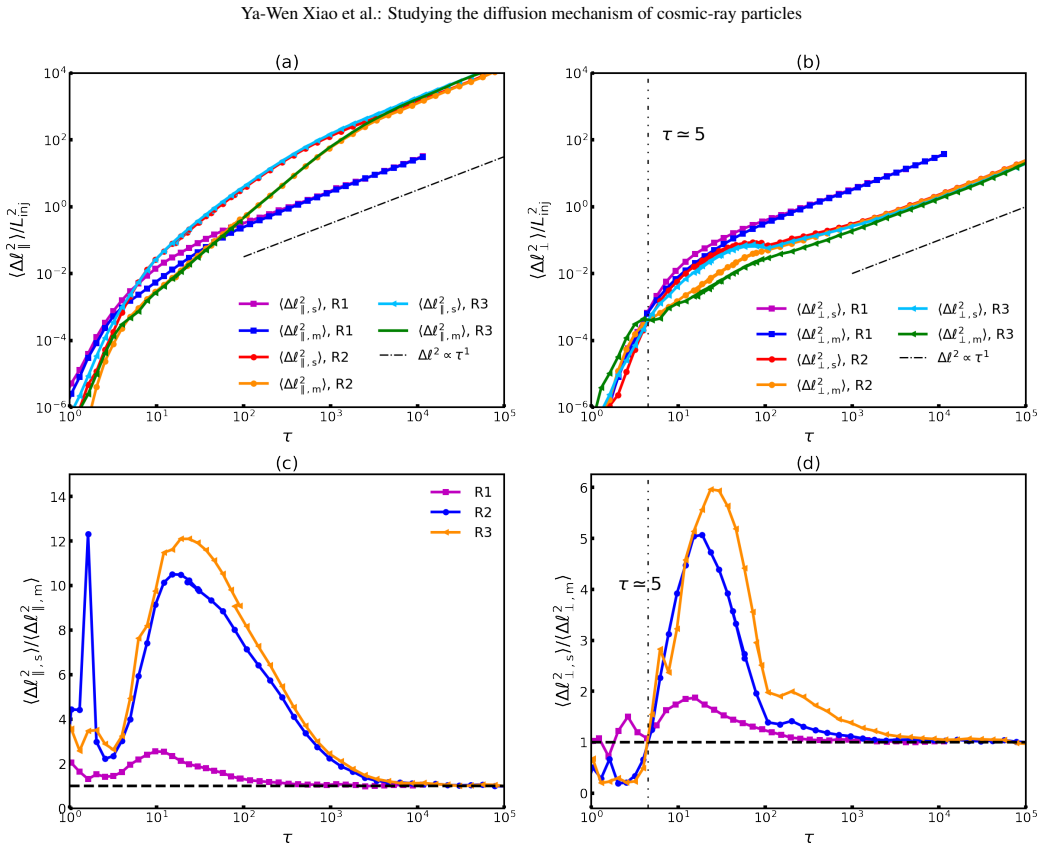
- [Sec. 4.2, Fig. 3; Abstract] The comparison between 'initially mirroring' (mu0 in [0.1,0.2]) and 'initially scattering' (mu0 in [0.8,0.9]) ensembles is confounded by the difference in initial parallel velocity. In the ballistic stage, <Delta_l_parallel^2> ~ (u*mu0)^2*t^2, so the observed factor-of-about-25 difference in early-time parallel MSD is expected even in a uniform field with no mirrors. The paper does not include a matched-mu control, nor does it normalize by the initial mu0-dependent free-streaming term. The later convergence in Fig. 3 and the independence of the asymptotic MFP from initial mu in Fig. 5 indicate that the stronger early confinement is an initial-condition effect rather than evidence that mirror diffusion is intrinsically more confining. The abstract claim that 'mirror diffusion is more important than scattering diffusion in confining CRs' therefore needs either a revised interpretation or additional simulations with matched initial mu (or a dynamically defined mirroring/scattering partition based on mu relative to mu_c).
- [Sec. 4.4, Fig. 7] The mode-dominance conclusion rests on injecting particles into individually decomposed Alfvén, slow, and fast fields from only the super-Alfvénic model R1. This assumes that linear superposition of modes preserves the transport contribution of each mode when all modes coexist; cross-mode coupling or nonlinear mode interactions in the full field could change the ordering. The manuscript does not report a control run in which particles are propagated in the full R1 field and compared with the sum of the three single-mode simulations (or another explicit test of the superposition assumption). The conclusion may also be regime-dependent, since only one M_A/M_s combination is used. A test in the full field, and ideally also in a sub-Alfvénic model, is needed before claiming that magnetosonic modes dominate parallel diffusion and the Alfvén mode dominates perpendicular diffusion as a general result.
- [Sec. 4.3, Fig. 5] The reported power-law indices (e.g., lambda_perp ~ Rg^(2/3), lambda_par ~ Rg^(1/3), and lambda_par ~ Rg^2 in the high-energy range) are obtained from least-squares fits whose uncertainties are not reported. The figures show scatter, only three turbulence models are used, and the measured high-energy exponents in the text are 1.85, 1.89, and 1.63 rather than exactly 2. Without fit uncertainties, the claimed agreement with theoretical predictions such as lambda_par ~ Rg^(1/3) cannot be assessed. The authors should provide confidence intervals for all fitted slopes and, ideally, a resolution or particle-number convergence test to support the quantitative MFP-Rg relations, since the current simulations use 512^3 resolution and 2000 particles per ensemble.
minor comments (4)
- [Sec. 2, Eq. (3)] The definition of mu_mir in Eq. (3) uses delta_B_f, whereas the preceding paragraph defines mu_mir approximately as sqrt(delta_B/(B0+delta_B)); please clarify the notation for the fast-mode fluctuation field and the total fluctuation field.
- [Sec. 4.2] The statement that 'the main factor affecting parallel diffusion is M_A rather than M_s' is stronger than the three models can support, since R1, R2, and R3 differ in M_A, M_s, and beta simultaneously; please soften the claim or add a controlled parameter scan.
- [Sec. 5, Discussion] The sentence 'After testing the influence of local and global reference frames on the measurement results...' refers to a test that is not shown or quantified anywhere in the paper; please include the supporting figure/table or state that the test is not shown.
- [Sec. 4.3, Fig. 5] The fitted constant in 'lambda_par ~ lambda_perp = 5.12 R_g^(1.04)' is stated without units; since everything is in code units, please state the normalization convention explicitly or remove the constant.
Circularity Check
Mirror-diffusion confinement claim is pre-determined by the initial pitch-angle split; MFP scalings and mode analysis are independent.
-
self definitional
[Section 4.2 (Fig. 3), with Eq. (19)]
"We set µ0∈[0.1,0.2] and µ0∈[0.8,0.9] for the initially mirroring and scattering particles with the same Larmor radius Rg=0.03Linj, respectively. ... we can see ⟨∆ℓ2∥,m⟩<⟨∆ℓ2∥,s⟩ for three cases from panel (c), which means the diffusive displacement of the initially mirroring particles is smaller than that of the initially scattering particles during the same time. This is because the initially mirroring particles are more effectively confined, compared to initially scattering particles."
Eq. (19) defines Δℓ∥ = x−x0, and during the initial free-streaming phase x−x0 ≈ u µ0 t, so ⟨Δℓ∥²⟩ ∝ (u µ0)² t². The two ensembles are defined by µ0∈[0.1,0.2] versus µ0∈[0.8,0.9]; therefore the parallel MSD ratio is ∼(0.15/0.85)²≈0.03 even in a uniform magnetic field with no mirrors. The observed inequality ⟨∆ℓ2∥,m⟩<⟨∆ℓ2∥,s⟩ and the inference that 'mirror diffusion is more important than scattering diffusion in confining CRs' are thus built into the initial-condition labels, not measured as a property of mirror reflection. No matched-µ0 control is presented, and the paper itself states that the initially scattering particle 'simply travels along field lines' (Sec. 4.1), confirming the early difference is dominated by free streaming rather than by the confining action of mirrors.
full rationale
The paper's MFP power laws (λ⊥∝Rg^{2/3}, λ∥∝Rg^{1/3} in sub-Alfvénic; λ⊥≈λ∥∝Rg in super-Alfvénic) and the mode-decomposition result (magnetosonic modes dominate parallel transport, Alfvén mode perpendicular) are direct test-particle measurements in simulated fields; they are not derived from the theory being tested and are not circular. The circularity is confined to the headline comparison of mirror versus scattering diffusion. The 'initially mirroring' and 'initially scattering' ensembles are defined by choosing µ0∈[0.1,0.2] and µ0∈[0.8,0.9], respectively. Because the early parallel displacement is Δℓ∥≈uµ0t, the lower-µ0 sample necessarily has a smaller parallel MSD by a factor ∼(0.15/0.85)², independent of any mirror physics. The paper's inference that mirror diffusion has a stronger confining effect therefore reduces to the construction of the ensembles. The premise of slower mirror diffusion originates from Lazarian & Xu (2021), which shares an author with this paper, and the attempted numerical confirmation is degenerate for the reason above. This is a partial circularity: the central claim is affected, while the other numerical results stand as independent content.
Assumptions & free parameters
free parameters (5)
- Power-law index for parallel MFP, sub-Alfvénic strong turbulence =
≈0.35 (λ∥ ∝ Rg^{0.35} ≈ Rg^{1/3})
- Power-law index for perpendicular MFP, sub-Alfvénic strong turbulence =
≈0.7 (λ⊥ ∝ Rg^{0.7} ≈ Rg^{2/3})
- Power-law index for parallel MFP, high-energy (hydrodynamic/weak) range =
1.85 (R1), 1.89 (R2), 1.63 (R3), reported as λ∥ ∝ Rg^2
- Amplitude of super-Alfvénic MFP relation =
5.12 in λ∥≃λ⊥ = 5.12 Rg^{1.04}
- Amplitude of high-energy parallel MFP relation =
16.59 in λ∥ = 16.59 Rg^{1.85}
assumptions (5)
- domain assumption Test-particle approximation: cosmic rays do not perturb the magnetic turbulence and are traced in a fixed background field.
- domain assumption The 512^3 solenoidal-forced MHD cubes are representative of astrophysical turbulence in the inertial range.
- domain assumption Wavelet/Fourier decomposition (CL02, KL10) separates MHD turbulence into three independent modes whose individual transport contributions can be studied in isolation.
- domain assumption The condition µ < µc with µc from Lazarian & Xu (2021) correctly discriminates mirror-confined from scattering particles.
- domain assumption CR diffusion coefficients measured in the global mean-field frame suffice for the reported power laws.
Cite this review
Pith. "Pith review of Studying the diffusion mechanism of cosmic-ray particles." pith.science (2026). https://pith.science/paper/2S3PT6TO
@misc{pith2026250615031,
  author       = {Pith},
  title        = {Pith review of: Studying the diffusion mechanism of cosmic-ray particles},
  year         = {2026},
  howpublished = {\url{https://pith.science/paper/2S3PT6TO}},
  note         = {Machine review of arXiv:2506.15031}
}
abstract
More and more observations have indicated the existence of slow diffusion phenomena in astrophysical environments, such as around the supernova remnants and pulsar $\gamma$-ray halos, where the diffusion coefficient of cosmic rays (CRs) near the source region is significantly smaller than that far away from the source region. The inhomogeneous diffusion indicates the existence of multiple diffusion mechanisms.Comparing the CR mirror diffusion with the scattering one, we aim to explore their diffusion characteristics in different magnetohydrodynamic (MHD) turbulence regimes and understand the effect of different MHD modes on mirror and scattering diffusion. We perform numerical simulations with the test particle method. Within the global frame of reference, we first measure parallel and perpendicular CR diffusion and then determine the mean free path of CRs with varying energies.Our main results demonstrate that: (1) CRs experience a transition from superdiffusion to normal diffusion; (2) mirror diffusion is more important than scattering diffusion in confining CRs; (3) CR diffusion strongly depends on the properties of MHD turbulence; and (4) magnetosonic and Alfv\'en modes dominate the parallel and perpendicular diffusion of CR particles, respectively. The diffusion of CRs is a complex problem of mixing the mirror diffusion and scattering diffusion. The property of turbulent magnetic fields influences CR diffusion. The CR slow diffusion due to the presence of magnetic mirrors in turbulence has important implications for explaining observations near a CR source.
Figures


Figures from the paper (4 more)


Reference graph
Works this paper leans on
-
[1]
U., Albert, A., Alfaro, R., et al
Abeysekara, A. U., Albert, A., Alfaro, R., et al. 2017, Science, 358, 911
2017
-
[2]
2014, International Journal of Modern Physics D, 23, 1430013
Amato, E. 2014, International Journal of Modern Physics D, 23, 1430013
2014
-
[3]
Amato, E. & Casanova, S. 2021, Journal of Plasma Physics, 87, 845870101
work page 2021
-
[4]
Barreto-Mota, L., de Gouveia Dal Pino, E. M., Xu, S., & Lazarian, A. 2024, arXiv e-prints, arXiv:2405.12146
arXiv 2024
- [5]
-
[6]
2019, Living Reviews in Computational Astrophysics, 5, 2
Beresnyak, A. 2019, Living Reviews in Computational Astrophysics, 5, 2
work page 2019
- [7]
- [8]
Show all 53 references
-
[9]
W., Smith, C
Bieber, J. W., Smith, C. W., & Matthaeus, W. H. 1988, ApJ, 334, 470
1988
-
[10]
& Lazarian, A
Brunetti, G. & Lazarian, A. 2007, MNRAS, 378, 245
2007
-
[11]
Cesarsky, C. J. & Kulsrud, R. M. 1973, ApJ, 185, 153
1973
-
[12]
& Lazarian, A
Cho, J. & Lazarian, A. 2002, Phys. Rev. Lett., 88, 245001
2002
-
[13]
& Lazarian, A
Cho, J. & Lazarian, A. 2003, MNRAS, 345, 325
2003
-
[14]
& Marcowith, A
Cohet, R. & Marcowith, A. 2016, A&A, 588, A73
2016
-
[15]
2018, Phys
Evoli, C., Linden, T., & Morlino, G. 2018, Phys. Rev. D, 98, 063017
2018
-
[16]
2019, MNRAS, 488, 4074 Article number, page 10 of 11 Ya-Wen Xiao et al.: Studying the diffusion mechanism of cosmic-ray particles
Fang, K., Bi, X.-J., & Yin, P.-F. 2019, MNRAS, 488, 4074 Article number, page 10 of 11 Ya-Wen Xiao et al.: Studying the diffusion mechanism of cosmic-ray particles
2019
-
[17]
2018, ApJ, 863, 30
Fang, K., Bi, X.-J., Yin, P.-F., & Yuan, Q. 2018, ApJ, 863, 30
2018
-
[18]
1949, Physical Review, 75, 1169
Fermi, E. 1949, Physical Review, 75, 1169
1949
-
[19]
& Zhang, J.-F
Gao, N.-N. & Zhang, J.-F. 2024, ApJ, 961, 80
2024
-
[20]
& Zhang, J.-F
Gao, N.-N. & Zhang, J.-F. 2025, A&A, 694, A201
2025
-
[21]
& Jokipii, J
Giacalone, J. & Jokipii, J. R. 1999, ApJ, 520, 204
1999
-
[22]
& Sridhar, S
Goldreich, P. & Sridhar, S. 1995, ApJ, 438, 763
1995
-
[23]
2022, MNRAS, 512, 2111
Hu, Y ., Lazarian, A., & Xu, S. 2022, MNRAS, 512, 2111
2022
-
[24]
C., & Shalchi, A
Hussein, M., Tautz, R. C., & Shalchi, A. 2015, Journal of Geophysical Research (Space Physics), 120, 4095
2015
-
[25]
Jokipii, J. R. 1966, ApJ, 146, 480
1966
-
[26]
& Lazarian, A
Kowal, G. & Lazarian, A. 2010, ApJ, 720, 742
2010
-
[27]
R., Crocker, R
Krumholz, M. R., Crocker, R. M., Xu, S., et al. 2020, MNRAS, 493, 2817
2020
-
[28]
& Pearce, W
Kulsrud, R. & Pearce, W. P. 1969, ApJ, 156, 445
1969
-
[29]
& Vishniac, E
Lazarian, A. & Vishniac, E. T. 1999, ApJ, 517, 700
1999
-
[30]
T., & Cho, J
Lazarian, A., Vishniac, E. T., & Cho, J. 2004, ApJ, 603, 180
2004
-
[31]
Lazarian, A. & Xu, S. 2021, ApJ, 923, 53
2021
-
[32]
& Yan, H
Lazarian, A. & Yan, H. 2014, ApJ, 784, 38
2014
-
[33]
2019, Phys
Liu, R.-Y ., Yan, H., & Zhang, H. 2019, Phys. Rev. Lett., 123, 221103
2019
-
[34]
2022, ApJ, 926, 94
Maiti, S., Makwana, K., Zhang, H., & Yan, H. 2022, ApJ, 926, 94
2022
-
[35]
H., Goldstein, M
Matthaeus, W. H., Goldstein, M. L., & Roberts, D. A. 1990, J. Geophys. Res., 95, 20673
1990
-
[36]
H., Qin, G., Bieber, J
Matthaeus, W. H., Qin, G., Bieber, J. W., & Zank, G. P. 2003, ApJ, 590, L53
2003
-
[37]
H., Flannery, B
Press, W. H., Flannery, B. P., & Teukolsky, S. A. 1986, Numerical recipes. The art of scientific computing
1986
-
[38]
2002, PhD thesis, University of Delaware
Qin, G. 2002, PhD thesis, University of Delaware
2002
-
[39]
M., Downes, T
Rodgers-Lee, D., Taylor, A. M., Downes, T. P., & Ray, T. P. 2020, MNRAS, 491, 4742
2020
-
[40]
L., Beattie, J
Sampson, M. L., Beattie, J. R., Krumholz, M. R., et al. 2023, MNRAS, 519, 1503
2023
-
[41]
2002, Cosmic Ray Astrophysics
Schlickeiser, R. 2002, Cosmic Ray Astrophysics
2002
-
[42]
A., Kravtsov, A
Semenov, V . A., Kravtsov, A. V ., & Caprioli, D. 2021, ApJ, 910, 126
2021
-
[43]
2009, Nonlinear Cosmic Ray Diffusion Theories, V ol
Shalchi, A. 2009, Nonlinear Cosmic Ray Diffusion Theories, V ol. 362 V oelk, H. J. 1975, Reviews of Geophysics and Space Physics, 13, 547
2009
-
[44]
& Lazarian, A
Xu, S. & Lazarian, A. 2018, ApJ, 868, 36
2018
-
[45]
& Lazarian, A
Xu, S. & Lazarian, A. 2020, ApJ, 894, 63
2020
-
[46]
& Yan, H
Xu, S. & Yan, H. 2013, ApJ, 779, 140
2013
-
[47]
2015, in Astrophysics and Space Science Library, V ol
Yan, H. 2015, in Astrophysics and Space Science Library, V ol. 407, Magnetic Fields in Di ffuse Media, ed. A. Lazarian, E. M. de Gouveia Dal Pino, & C. Melioli, 253
2015
-
[48]
& Lazarian, A
Yan, H. & Lazarian, A. 2002, Phys. Rev. Lett., 89, 281102
2002
-
[49]
& Lazarian, A
Yan, H. & Lazarian, A. 2008, ApJ, 673, 942
2008
-
[50]
2012, ApJ, 745, 140
Yan, H., Lazarian, A., & Schlickeiser, R. 2012, ApJ, 745, 140
2012
-
[51]
Zhang, C. & Xu, S. 2023, ApJ, 959, L8
2023
-
[52]
Zhang, C. & Xu, S. 2024, ApJ, 975, 65
2024
-
[53]
& Xiang, F.-Y
Zhang, J.-F. & Xiang, F.-Y . 2021, ApJ, 922, 209 Article number, page 11 of 11
2021
Reviewed August 15, 2026 · model on record in the stance chip above.
Discussion (0). Continue with ORCID to comment.