REVIEW 4 major objections 6 minor 73 references
The investigation of 84 TESS totally eclipsing contact binaries
T0 review · 4 major / 6 minor · reviewed 2026-08-06 · deepseek-v4-flash
Pith's one-line read The paper derives homogeneous orbital and physical parameters for 84 TESS totally eclipsing contact binaries and identifies 15 low-mass-ratio deep systems as plausible pre-merger contact binaries.
desk verdict A useful homogeneous catalog of 84 TESS contact binaries, with a real but fixable weakness in how absolute parameters are scaled from a period-separation relation. read the letter →
The pith
A machine-rendered reading of the paper's core claim, the machinery that carries it, and where it could break.
The reading
What carries the argument
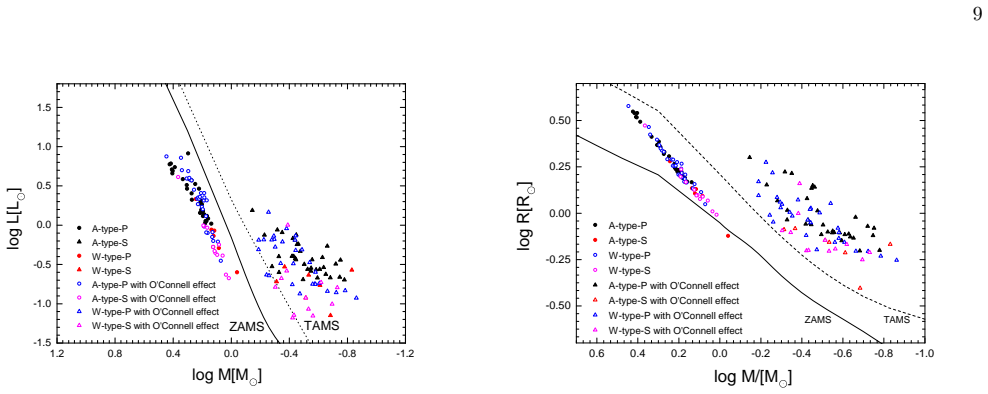
The analysis runs on a chain of standard tools: TESS 2-minute PDCSAP light curves are phase-folded and binned to 200 normal points, then fitted with a physics-based eclipsing-binary light-curve model driven by a Markov Chain Monte Carlo sampler, with starting values from a grid search or a genetic algorithm. Asymmetric light curves are handled by adding cool star-spots, with spot parameters included in the fit. The step that turns orbital parameters into physical ones is the empirical relation $\log a = 0.864\log P + 0.783$, calibrated on 168 contact binaries with both radial-velocity and light-curve solutions; it converts each orbital period to a semi-major axis, and Kepler's third law then gives masses, radii, and luminosities. Evolutionary status is read from mass-radius and mass-luminosity diagrams with zero-age and terminal-age main-sequence lines, while orbital angular momentum and initial masses come from published formulas.
What would settle it
Take double-lined radial-velocity spectra for a subset of the 84 systems, especially the 15 low-mass-ratio merger candidates, and compare the dynamical masses and semi-major axes with Table 3. If the measured masses disagree with the period-derived values by more than the quoted uncertainties in a systematic way, the period-semi-major axis calibration is biased and the absolute parameters, evolutionary states, and merger-candidate status would need revision.
Extended reading notes
Core claim
The paper's central claim is that a homogeneous re-analysis of 84 TESS totally eclipsing contact binaries gives reliable orbital and absolute parameters, and that 15 low-mass-ratio deep systems among them are plausible contact-binary merger candidates. The 15 candidates satisfy $q<0.25$ and $f>50\%$, and as a group they sit near the low-angular-momentum edge of the $J_{\rm orb}$-$M_T$ diagram, which the paper interprets as late-stage evolution toward a single rapidly rotating star. The paper also claims that A-subtype and W-subtype contact binaries follow different evolutionary paths: at a given mass, A-subtype components have larger radii and higher luminosities and lower orbital angular momentum, placing them at a later evolutionary stage. These conclusions follow from photometric solutions alone, with absolute parameters depending on a period-semi-major axis calibration rather than on direct radial-velocity masses.
Load-bearing premise
Every absolute mass, radius, and luminosity in this paper comes from a single empirical relation between orbital period and semi-major axis that was calibrated on a different set of contact binaries, and the paper does not test that relation with radial velocities for the 84 targets.
Editorial extensions
If this is right
- The 84-system parameter set gives a homogeneous sample for studying how contact binaries evolve from shallow to deep contact and eventually merge.
- The 15 low-mass-ratio deep systems are concrete targets for follow-up period and eclipse-timing monitoring; if they are pre-merger, their periods should show measurable changes.
- The systematic differences between A-subtype and W-subtype components in luminosity, radius, and orbital angular momentum support separate evolutionary tracks for the two subtypes.
- The comparison with 44 previously studied targets indicates that mass ratios from machine-learning pipelines need per-target verification, while fillout factors from older studies are generally the least consistent parameter.
Reading between the lines
- A radial-velocity campaign on even a few of the 84 systems would directly test the period-semi-major axis calibration; without it, the absolute masses rest on a single empirical relation and could carry a systematic bias.
- The 15 merger candidates can be checked in later TESS sectors for period decrease, eclipse-timing variations, or a brightening that would signal the onset of coalescence.
- The star-spot interpretation of the O'Connell effect is degenerate; multi-band photometry or spectroscopic surface imaging could distinguish cool spots from hot accretion-related regions and alter the derived inclinations.
- If the period-semi-major axis relation is internally tied to the same kind of systems, comparison with Gaia parallax-based luminosities and radii would provide an independent check of the absolute parameters.
Signed reviews
Editorial analysis
A structured set of objections, weighed in public.
Referee Report
Summary. This manuscript presents a homogeneous photometric study of 84 totally eclipsing contact binaries selected from the TESS eclipsing binary catalog of Prša et al. (2022). The authors model the TESS light curves with the PHOEBE code and MCMC, obtaining mass ratios, inclinations, fillout factors, temperature ratios, and spot parameters. They classify the sample into 18 deep, 39 moderate, and 27 shallow contact binaries, identify 43 systems showing the O'Connell effect, and single out 15 low-mass ratio deep contact binaries as potential merger candidates. Absolute masses, radii, and luminosities are derived by converting each orbital period to a semi-major axis via an empirical period–semi-major axis relation and applying Kepler's third law. The evolutionary states are discussed using mass–luminosity and mass–radius diagrams, and the photometric solutions are compared with historical studies for 44 targets.
Significance. If the stated results hold, the paper provides a useful, uniform sample of photometric orbital parameters for 84 TESS contact binaries and a candidate list of 15 late-stage merger systems. Strengths include the use of a standard, well-tested modeling code with MCMC uncertainty estimates, a documented and reproducible target-selection procedure, and a broad comparison with previously published solutions, including a re-analysis of two radial velocity curves. The principal weakness is that all absolute parameters—masses, radii, luminosities, orbital angular momenta, and initial masses—rely on a single empirical period–semi-major axis relation whose calibration scatter is not propagated and whose applicability to the TESS sample is not validated. This limits the weight that can be placed on the evolutionary conclusions, although the directly fitted photometric quantities and the merger-candidate classification based on q and f are not affected by this issue.
major comments (4)
- [§4, Eq. (3), Table 3] The absolute masses, radii, and luminosities in Table 3 are obtained by converting each period to a semi-major axis with the relation log a = 0.864 log P + 0.783 from Li et al. (2021b), but the calibration scatter of this relation is not propagated into any of the derived quantities. The quoted uncertainties (e.g., 0.02–0.07 M_sun on M1) reflect only the PHOEBE/MCMC light-curve fitting. Because the evolutionary conclusions in §4 (M-L and M-R positions, initial masses, J_orb) are built on these absolute values, the reader cannot tell how much of the claimed precision is real. Please propagate the slope/intercept uncertainties and the intrinsic scatter of the P-a relation, or at least quantify the resulting systematic uncertainty and add it to the quoted errors.
- [§4, M-L diagram] The paper states that most primary stars fall below the ZAMS and attributes this to systematic temperature errors that affect luminosity. Since the luminosities also depend on the P-a relation and on the adopted T_mean values, the systematic error budget is not fully characterized. A concrete test, such as varying T_mean by ±100 K and recomputing the positions in the M-L diagram, would show whether the ZAMS offset is robust, or the authors should soften the evolutionary-status statements accordingly.
- [§4, Eq. (3)] The P-a relation was fitted by Li et al. (2021b), a paper with overlapping authorship, using systems with radial-velocity measurements. Its applicability to the present TESS sample is not tested: the comparison in Table 4 covers only q, i, T2/T1, L2/L1, and f, not absolute parameters, and only two of the 84 targets have re-analyzed radial velocities (TIC 267043786 and TIC 207174531). Please validate the relation on the subset of targets with available RV-based absolute parameters, or explicitly state the assumption and add a systematic caveat to all absolute parameters in Table 3 and to the derived evolutionary discussions.
- [§3, Table 2, §4] The division into A-subtype and W-subtype contact binaries is used to interpret the M-L, M-R, and J_orb diagrams, but the operational criterion by which each of the 84 targets is assigned to a subtype is never defined. It is not clear whether the subtype is based on the temperature ratio, the mass ratio, the light-curve morphology, or the relative temperatures of the components. Please state the definition explicitly before drawing evolutionary conclusions from the two subgroups.
minor comments (6)
- [§3, Eq. (1)] Equation (1) contains an extra opening parenthesis and reads awkwardly; also, the radius ratio k is used in the equation before it is defined. Please define k = r2/r1 immediately before the equation and clean up the parentheses.
- [§4, first paragraph] The sentence 'By examining the 168 contact binaries ... we derived the relationship between the semi-major axis a and the period P' attributes the fit to the present authors, but the relation is taken from Yu et al. (2022) and Li et al. (2021b). Please correct the attribution.
- [§4, text after Eq. (3)] The phrase 'Phoebe was used to calculate the absolute parameters' is vague: the absolute parameters are computed from the semi-major axis via Kepler's third law and the light-curve-derived q, r1, r2, and T2/T1, not by PHOEBE itself. Please describe the derivation more precisely.
- [Table 3] The log J_orb column is quoted without uncertainties. Either state explicitly that no error propagation was performed for this quantity, or provide uncertainties that include the P-a calibration scatter.
- [Table A1] Some spot temperature entries have clearly erroneous error ranges, e.g., TIC 117978580 lists 0.954^{+0.955}_{-1.058}, which is internally inconsistent. Please check and correct all entries in Table A1.
- [§2.1, fourth criterion] The selection criterion 'the light curves do not change with time' is described only qualitatively. Please state whether stability was assessed by a quantitative metric (e.g., inspection of time-resolved light curves, scatter statistics) or was purely visual, so the reader can judge the reproducibility of the sample selection.
Circularity Check
No significant circularity: photometric parameters are fitted directly; absolute parameters use an external empirical P–a calibration rather than re-fitting these targets.
full rationale
The paper's central pipeline is not circular. The photometric elements q, i, f, T2, and L1/LT are obtained by PHOEBE plus MCMC fits directly to the TESS light curves, and the 15 merger-candidate classification depends only on q and f from those fits. The absolute masses, radii, and luminosities are derived from Kepler's third law using the semi-major axis a obtained from the empirical relation log a = 0.864 log P + 0.783 (Eq. 3), which was fitted to 168 contact binaries with radial-velocity and light-curve solutions from Li et al. (2021b), not to the 84 TESS targets in this paper. This is therefore an external calibration applied to new targets, not a fitted parameter renamed as a prediction. The overlapping authorship of Li et al. (2021b) is a self-citation, but the calibration is drawn from a distinct sample and is externally falsifiable, so it does not reduce the present derivation to its own inputs. The lack of propagation of the scatter in Eq. (3) into the quoted mass uncertainties, and the paper's own admission that systematic temperature errors affect luminosities, are legitimate correctness and robustness concerns, but they are not circularity. No step in the derivation is equivalent by construction to the quantity it claims to predict.
Assumptions & free parameters
free parameters (4)
- P-a relation intercept =
0.783 +/- 0.008
- P-a relation slope =
0.864 +/- 0.020
- gamma in initial mass equation =
0.64
- spot latitude =
90 degrees
assumptions (4)
- domain assumption The P-a relation of Li et al. (2021b) for contact binaries applies to the 84 selected targets.
- domain assumption The mean of TESS, Gaia, and LAMOST temperatures represents the primary effective temperature.
- domain assumption The Yildiz & Doğan (2013) initial-mass relations (Eqs. 5-6) are valid for these contact binaries with gamma=0.64.
- domain assumption The star-spot model is a valid interpretation of the O'Connell effect for these systems.
Cite this review
Pith. "Pith review of The investigation of 84 TESS totally eclipsing contact binaries." pith.science (2026). https://pith.science/paper/X5FSIMLK
@misc{pith2026250615989,
  author       = {Pith},
  title        = {Pith review of: The investigation of 84 TESS totally eclipsing contact binaries},
  year         = {2026},
  howpublished = {\url{https://pith.science/paper/X5FSIMLK}},
  note         = {Machine review of arXiv:2506.15989}
}
abstract
Based on the eclipsing binary catalog provided by \cite{2022ApJS..258...16P}, 84 totally eclipsing contact binaries with stable light curves were selected. The TESS light curves of these 84 targets were studied using the Physics Of Eclipsing Binaries code. The results indicate that there are 18 deep contact binaries, 39 moderate contact binaries, and 27 shallow contact binaries. Among them, 43 targets exhibit the O'Connell effect, which is attributed to the presence of star-spot on the component's surface. 15 targets are low-mass ratio deep contact binaries and may be contact binary merging candidates. Based on the relationship between the period and semi-major axis of contact binaries, their absolute physical parameters such as mass, radius, and luminosity were derived. The evolutionary status of these 84 targets was studied using the mass-luminosity and mass-radius relation diagrams. Their initial masses were also estimated. Our results are compared with those of targets that have been historically studied. Among the 84 targets, 44 targets have been studied before, and 21 of these have mass ratios $q$ that are consistent with historical values within a 10\% difference. For the inconsistent targets, we conducted a detailed investigation and found that the main reasons are poor quality of historical data, or the fact that the machine learning methods used in historical studies might not accurately determine the physical parameters for individual targets.
Figures


Figures from the paper (3 more)


Reference graph
Works this paper leans on
-
[1]
2014, NewA, 31, 1, doi: 10.1016/j.newast.2014.01.013
Acerbi, F., Barani, C., & Martignoni, M. 2014, NewA, 31, 1, doi: 10.1016/j.newast.2014.01.013
-
[2]
2007, MNRAS, 377, 1635, doi: 10.1111/j.1365-2966.2007.11723.x —
Arbutina, B. 2007, MNRAS, 377, 1635, doi: 10.1111/j.1365-2966.2007.11723.x —. 2009, MNRAS, 394, 501, doi: 10.1111/j.1365-2966.2008.14332.x
arXiv 2007
-
[3]
2024, Serbian Astronomical Journal, 208, 1, doi: 10.2298/SAJ2408001A
Arbutina, B., & Wadhwa, S. 2024, Serbian Astronomical Journal, 208, 1, doi: 10.2298/SAJ2408001A
-
[4]
1970, Vistas in Astronomy, 12, 217, doi: 10.1016/0083-6656(70)90041-3
Binnendijk, L. 1970, Vistas in Astronomy, 12, 217, doi: 10.1016/0083-6656(70)90041-3
-
[5]
J., Koch, D., Basri, G., et al
Borucki, W. J., Koch, D., Basri, G., et al. 2010, Science, 327, 977, doi: 10.1126/science.1185402
-
[6]
H., & Guinan, E
Bradstreet, D. H., & Guinan, E. F. 1994, in Astronomical Society of the Pacific Conference Series, Vol. 56, Interacting Binary Stars, ed. A. W. Shafter, 228
1994
-
[7]
Castelli, F., & Kurucz, R. L. 2004, A&A, 419, 725, doi: 10.1051/0004-6361:20040079
-
[8]
Caton, D., Gentry, D. R., Samec, R. G., et al. 2019, PASP, 131, 054203, doi: 10.1088/1538-3873/aafb8f
Show all 73 references
-
[9]
2020, ApJS, 249, 18, doi: 10.3847/1538-4365/ab9cae 12
Chen, X., Wang, S., Deng, L., et al. 2020, ApJS, 249, 18, doi: 10.3847/1538-4365/ab9cae 12
2020 doi
-
[10]
J., Pribulla, T., & Grygar, J
Chochol, D., van Houten, C. J., Pribulla, T., & Grygar, J. 2001, Contributions of the Astronomical Observatory Skalnate Pleso, 31, 5
2001
-
[11]
E., & Papageorgiou, A
Christopoulou, P. E., & Papageorgiou, A. 2013, AJ, 146, 157, doi: 10.1088/0004-6256/146/6/157
2013 doi
-
[12]
2023, MNRAS, 525, 4596, doi: 10.1093/mnras/stad2565
Ding, X., Ji, K., Li, X., et al. 2023, MNRAS, 525, 4596, doi: 10.1093/mnras/stad2565
2023 doi
-
[13]
W., & Rucinski, S
Duerbeck, H. W., & Rucinski, S. M. 2007, AJ, 133, 169, doi: 10.1086/509764
2007 doi
-
[14]
P., & Kiseleva-Eggleton, L
Eggleton, P. P., & Kiseleva-Eggleton, L. 2002, ApJ, 575, 461, doi: 10.1086/341215
2002 doi
-
[16]
W., Lang, D., & Goodman, J
Foreman-Mackey, D., Hogg, D. W., Lang, D., & Goodman, J. 2013, PASP, 125, 306, doi: 10.1086/670067 Gaia Collaboration, Brown, A. G. A., Vallenari, A., et al. 2018, A&A, 616, A1, doi: 10.1051/0004-6361/201833051 —. 2021, A&A, 649, A1, doi: 10.1051/0004-6361/202039657
2013 doi
-
[17]
2008, MNRAS, 390, 1577, doi: 10.1111/j.1365-2966.2008.13844.x Gezer, İ., & Bozkurt, Z
Gazeas, K., & St¸ epień, K. 2008, MNRAS, 390, 1577, doi: 10.1111/j.1365-2966.2008.13844.x Gezer, İ., & Bozkurt, Z. 2016, NewA, 44, 40, doi: 10.1016/j.newast.2015.09.009
2008
-
[18]
F., & Bradstreet, D
Guinan, E. F., & Bradstreet, D. H. 1988, in NATO Advanced Study Institute (ASI) Series C, Vol. 241, Formation and Evolution of Low Mass Stars, ed. A. K. Dupree & M. T. V. T. Lago, 345, doi: 10.1007/978-94-009-3037-7_23
1988 doi
-
[19]
W., & King, D
Hilditch, R. W., & King, D. J. 1986, MNRAS, 223, 581, doi: 10.1093/mnras/223.3.581
1986 doi
-
[20]
Holland, J. H. 1992, Scientific American, 267, 66, doi: 10.1038/scientificamerican0792-66
1992 doi
-
[21]
R., Tout, C
Hurley, J. R., Tout, C. A., & Pols, O. R. 2002, MNRAS, 329, 897, doi: 10.1046/j.1365-8711.2002.05038.x
2002
-
[22]
2010, MNRAS, 405, 2485, doi: 10.1111/j.1365-2966.2010.16615.x
Jiang, D., Han, Z., Wang, J., Jiang, T., & Li, L. 2010, MNRAS, 405, 2485, doi: 10.1111/j.1365-2966.2010.16615.x
2010
-
[23]
G., Borucki, W
Koch, D. G., Borucki, W. J., Basri, G., et al. 2010, ApJL, 713, L79, doi: 10.1088/2041-8205/713/2/L79
2010 doi
-
[24]
1980, AJ, 85, 1098, doi: 10.1086/112774
Lapasset, E. 1980, AJ, 85, 1098, doi: 10.1086/112774
1980 doi
-
[25]
W., Hinse, T
Lee, J. W., Hinse, T. C., & Park, J.-H. 2013, AJ, 145, 100, doi: 10.1088/0004-6256/145/4/100
2013 doi
-
[26]
W., Kim, S.-L., Lee, C.-U., & Youn, J.-H
Lee, J. W., Kim, S.-L., Lee, C.-U., & Youn, J.-H. 2009, PASP, 121, 1366, doi: 10.1086/649230
2009 doi
-
[27]
Y., Hu, S
Li, K., Gao, D. Y., Hu, S. M., et al. 2016, Ap&SS, 361, 63, doi: 10.1007/s10509-016-2649-8
2016 doi
-
[28]
2022, AJ, 164, 202, doi: 10.3847/1538-3881/ac8ff2
Li, K., Gao, X., Liu, X.-Y., et al. 2022, AJ, 164, 202, doi: 10.3847/1538-3881/ac8ff2
2022 doi
-
[29]
2015, NewA, 41, 17, doi: 10.1016/j.newast.2015.04.010
Li, K., Hu, S., Guo, D., et al. 2015, NewA, 41, 17, doi: 10.1016/j.newast.2015.04.010
2015 doi
-
[30]
M., Jiang, Y
Li, K., Hu, S. M., Jiang, Y. G., Chen, X., & Ren, D. Y. 2014, NewA, 30, 64, doi: 10.1016/j.newast.2014.01.004
2014 doi
-
[31]
Li, K., & Qian, S. B. 2013, NewA, 22, 57, doi: 10.1016/j.newast.2013.01.006
2013 doi
-
[32]
2021a, ApJ, 922, 122, doi: 10.3847/1538-4357/ac242f
Li, K., Xia, Q.-Q., Kim, C.-H., et al. 2021a, ApJ, 922, 122, doi: 10.3847/1538-4357/ac242f
-
[33]
2019, MNRAS, 485, 4588, doi: 10.1093/mnras/stz715
Li, K., Xia, Q.-Q., Michel, R., et al. 2019, MNRAS, 485, 4588, doi: 10.1093/mnras/stz715
2019 doi
-
[34]
2021b, AJ, 162, 13, doi: 10.3847/1538-3881/abfc53
Li, K., Xia, Q.-Q., Kim, C.-H., et al. 2021b, AJ, 162, 13, doi: 10.3847/1538-3881/abfc53
-
[35]
2006, MNRAS, 369, 2001, doi: 10.1111/j.1365-2966.2006.10462.x Lightkurve Collaboration, Cardoso, J
Li, L., & Zhang, F. 2006, MNRAS, 369, 2001, doi: 10.1111/j.1365-2966.2006.10462.x Lightkurve Collaboration, Cardoso, J. V. d. M., Hedges, C., et al. 2018, Lightkurve: Kepler and TESS time series analysis in Python, Astrophysics Source Code Library, record ascl:1812.013. http:/...
2006
-
[36]
1996, A&AS, 118, 453
Liu, Q., Soonthornthum, B., Yang, Y., et al. 1996, A&AS, 118, 453
1996
-
[37]
2003, ChJA&A, 3, 142, doi: 10.1088/1009-9271/3/2/142
Liu, Q.-Y., & Yang, Y.-L. 2003, ChJA&A, 3, 142, doi: 10.1088/1009-9271/3/2/142
2003 doi
-
[38]
2023, MNRAS, 519, 5760, doi: 10.1093/mnras/stad026
Liu, X.-Y., Li, K., Michel, R., et al. 2023, MNRAS, 519, 5760, doi: 10.1093/mnras/stad026
2023 doi
-
[39]
L., Zhao, Y.-H., Zhao, G., et al
Luo, A. L., Zhao, Y.-H., Zhao, G., et al. 2015, Research in Astronomy and Astrophysics, 15, 1095, doi: 10.1088/1674-4527/15/8/002
2015 doi
-
[40]
1985, MNRAS, 217, 843, doi: 10.1093/mnras/217.4.843
Maceroni, C., Milano, L., & Russo, G. 1985, MNRAS, 217, 843, doi: 10.1093/mnras/217.4.843
1985 doi
-
[41]
1996, A&A, 311, 523
Maceroni, C., & van’t Veer, F. 1996, A&A, 311, 523
1996
-
[42]
M., Prince, T
Marsh, F. M., Prince, T. A., Mahabal, A. A., et al. 2017, MNRAS, 465, 4678, doi: 10.1093/mnras/stw2110 Matijevič, G., Prša, A., Orosz, J. A., et al. 2012, AJ, 143, 123, doi: 10.1088/0004-6256/143/5/123
2017 doi
-
[43]
H., Robb, R
Nelson, R. H., Robb, R. M., Kaiser, D. H., & Billings, G. B. 2002, Information Bulletin on Variable Stars, 5285, 1 O’Connell, D. J. K. 1951, Publications of the Riverview College Observatory, 2, 85
2002
- [44]
-
[45]
2024, PASP, 136, 024201, doi: 10.1088/1538-3873/ad1ed3 Prša, A., Conroy, K
Poro, A., Tanriver, M., Michel, R., & Paki, E. 2024, PASP, 136, 024201, doi: 10.1088/1538-3873/ad1ed3 Prša, A., Conroy, K. E., Horvat, M., et al. 2016, ApJS, 227, 29, doi: 10.3847/1538-4365/227/2/29 Prša, A., Kochoska, A., Conroy, K. E., et al. 2022, ApJS, 258, 16, doi: 10.384...
2024 doi
-
[46]
M., DeBond, H., et al
Pych, W., Rucinski, S. M., DeBond, H., et al. 2004, AJ, 127, 1712, doi: 10.1086/382105 13
2004 doi
-
[47]
2003, MNRAS, 342, 1260, doi: 10.1046/j.1365-8711.2003.06627.x
Qian, S. 2003, MNRAS, 342, 1260, doi: 10.1046/j.1365-8711.2003.06627.x
2003
-
[48]
2006, Ap&SS, 304, 25, doi: 10.1007/s10509-006-9114-z
Qian, S., Yang, Y., Zhu, L., He, J., & Yuan, J. 2006, Ap&SS, 304, 25, doi: 10.1007/s10509-006-9114-z
2006 doi
-
[49]
2017, Research in Astronomy and Astrophysics, 17, 087, doi: 10.1088/1674-4527/17/8/87
Qian, S.-B., He, J.-J., Zhang, J., et al. 2017, Research in Astronomy and Astrophysics, 17, 087, doi: 10.1088/1674-4527/17/8/87
2017 doi
-
[50]
B., Yuan, J
Qian, S. B., Yuan, J. Z., Soonthornthum, B., et al. 2007, ApJ, 671, 811, doi: 10.1086/522421
2007 doi
-
[51]
B., Zhu, L
Qian, S. B., Zhu, L. Y., Soonthornthum, B., et al. 2005, AJ, 130, 1206, doi: 10.1086/432544
2005 doi
-
[52]
B., Wang, J
Qian, S. B., Wang, J. J., Zhu, L. Y., et al. 2014, ApJS, 212, 4, doi: 10.1088/0067-0049/212/1/4
2014 doi
-
[53]
2000, PASP, 112, 123, doi: 10.1086/316485
Rahman, A. 2000, PASP, 112, 123, doi: 10.1086/316485
2000 doi
-
[54]
Rasio, F. A. 1995, ApJL, 444, L41, doi: 10.1086/187855
1995 doi
- [55]
-
[56]
R., Winn, J
Ricker, G. R., Winn, J. N., Vanderspek, R., et al. 2015, Journal of Astronomical Telescopes, Instruments, and Systems, 1, 014003, doi: 10.1117/1.JATIS.1.1.014003 Ruciński, S. M. 1969, AcA, 19, 245
2015 doi
-
[57]
Faulkner, D. R. 2017, JAAVSO, 45, 3
2017
-
[58]
G., Norris, C
Samec, R. G., Norris, C. L., Van Hamme, W., Faulkner, D. R., & Hill, R. L. 2016, AJ, 152, 219, doi: 10.3847/0004-6256/152/6/219
2016 doi
-
[59]
S., Guinan, E
Shaw, J. S., Guinan, E. F., & Garasi, C. J. 1990, in Bulletin of the American Astronomical Society, Vol. 22, 1296
1990
- [60]
-
[61]
2022, Research in Astronomy and Astrophysics, 22, 035009, doi: 10.1088/1674-4527/ac4705 Ulaş, B., & Ulusoy, C
Tang, Y.-K., Guo, Y.-N., Li, K., Gai, N., & Li, Z.-K. 2022, Research in Astronomy and Astrophysics, 22, 035009, doi: 10.1088/1674-4527/ac4705 Ulaş, B., & Ulusoy, C. 2015, NewA, 41, 1, doi: 10.1016/j.newast.2015.05.001 von Zeipel, H. 1924, MNRAS, 84, 665, doi: 10.1093/mnras/84.9.665
2022 doi
-
[62]
Wadhwa, S. S. 2006, Ap&SS, 301, 195, doi: 10.1007/s10509-006-2062-9
2006 doi
-
[63]
S., De Horta, A., Filipović, M
Wadhwa, S. S., De Horta, A., Filipović, M. D., et al. 2021, MNRAS, 501, 229, doi: 10.1093/mnras/staa3637
2021 doi
-
[64]
Wang, J. M. 1994, ApJ, 434, 277, doi: 10.1086/174725
1994 doi
-
[65]
1995, AJ, 110, 782, doi: 10.1086/117563
Wang, J.-M. 1995, AJ, 110, 782, doi: 10.1086/117563
1995 doi
-
[66]
2024, ApJ, 976, 223, doi: 10.3847/1538-4357/ad7f4b
Wang, L.-H., Li, K., Guo, Y.-N., et al. 2024, ApJ, 976, 223, doi: 10.3847/1538-4357/ad7f4b
2024 doi
-
[67]
Wilson, R. E. 1978, ApJ, 224, 885, doi: 10.1086/156438 Yıldız, M. 2014, MNRAS, 437, 185, doi: 10.1093/mnras/stt1874
1978 doi
-
[68]
2013, MNRAS, 430, 2029, doi: 10.1093/mnras/stt028
Yildiz, M., & Doğan, T. 2013, MNRAS, 430, 2029, doi: 10.1093/mnras/stt028
2013 doi
-
[69]
2022, NewA, 91, 101695, doi: 10.1016/j.newast.2021.101695
Yu, Y.-X., Li, Q., Huang, H.-P., Hu, K., & Xiang, F.-Y. 2022, NewA, 91, 101695, doi: 10.1016/j.newast.2021.101695
2022
-
[70]
2020, MNRAS, 492, 4112, doi: 10.1093/mnras/staa079
Zhang, X.-D., Qian, S.-B., & Liao, W.-P. 2020, MNRAS, 492, 4112, doi: 10.1093/mnras/staa079
2020 doi
-
[71]
B., Essam, A., He, J
Zhou, X., Qian, S. B., Essam, A., He, J. J., & Zhang, B. 2016a, NewA, 47, 3, doi: 10.1016/j.newast.2015.12.012
2015 doi
-
[72]
B., Zhang, J., Zhang, B., & Kreiner, J
Zhou, X., Qian, S. B., Zhang, J., Zhang, B., & Kreiner, J. 2016b, AJ, 151, 67, doi: 10.3847/0004-6256/151/3/67
-
[73]
2016, Research in Astronomy and Astrophysics, 16, 68, doi: 10.1088/1674-4527/16/4/068
Zhu, L.-Y., Zhao, E.-G., & Zhou, X. 2016, Research in Astronomy and Astrophysics, 16, 68, doi: 10.1088/1674-4527/16/4/068
2016 doi
-
[74]
M., et al
Zwitter, T., Munari, U., Marrese, P. M., et al. 2003, A&A, 404, 333, doi: 10.1051/0004-6361:20030446 14 APPENDIX Figure A1.The possible posterior distributions ofq,a,V γ and fitting curve of radial velocity of TIC 267043786.Vγ represents the radial velocity of the system. Figu...
2003 doi
Reviewed August 6, 2026 · model on record in the stance chip above.
Discussion (0). Continue with ORCID to comment.