REVIEW 3 major objections 3 minor 34 references
Multigroup Multicast Design for Pinching-Antenna Systems: Waveguide-Division or Waveguide-Multiplexing?
T0 review · 3 major / 3 minor · reviewed 2026-08-06 · deepseek-v4-flash
Pith's one-line read Pinching-antenna arrays with movable elements can outperform fixed MIMO in multigroup multicast, with the best architecture set by user geography.
desk verdict The first PASS multigroup multicast formulation with a WD/WM architecture comparison is genuinely new, but the signal model double-counts transmit power and the headline rate gains are not credible until that is fixed. read the letter →
The pith
A machine-rendered reading of the paper's core claim, the machinery that carries it, and where it could break.
The reading
What carries the argument
The load-bearing machinery is the pinching beamformer: the vector of positions $x_{m,n}$ at which antennas are activated along each dielectric waveguide, optimized by an element-wise sequential search over a discrete candidate grid $\mathcal{S}_x$. Power allocation across waveguides is handled by a log-sum-exp smoothed projected gradient descent (LSE-PGD), which replaces the non-differentiable min-rate objective with a smooth surrogate. For the multiplexing architecture, a majorization-minimization (MM) surrogate minorizes each user's rate, the optimal transmit beamformer structure is derived from the Lagrange dual as $w_g^\star = \left(\sum_i\sum_{k\in\mathcal{K}_i} \delta_{i,k} b_{i,k} \hat{h}_{i,k}\hat{h}_{i,k}^H + \nu I\right)^{-1} \sum_{k\in\mathcal{K}_g} \delta_{g,k} a_{g,k}\hat{h}_{g,k}$, and the dual variables are updated by projected adaptive gradient descent. The physical model adds two ingredients that make the results concrete: an in-waveguide propagation-loss factor $\kappa_{m,n} = 10^{-\varepsilon|x_{m,n}-x_{m,n-1}|/10}$ and a power radiation coefficient $a_{m,n}$, together determining how emitted power decays along the waveguide.
What would settle it
A direct test would be to run the same multicast optimization in a measured or standardized non-line-of-sight channel (e.g., indoor 28 GHz with reflections) and compare PASS against a fixed half-wavelength-spaced array with the same number of radiating elements; if the fixed array matches or beats PASS, the central claim fails. A cheaper check is a sensitivity simulation: add zero-mean Gaussian position errors with standard deviation above, say, $\lambda/8$ to each pinching antenna and see whether the multicast-rate gain over MIMO collapses before the $0.1$ dB/m waveguide-loss assumption is stressed.
Extended reading notes
Core claim
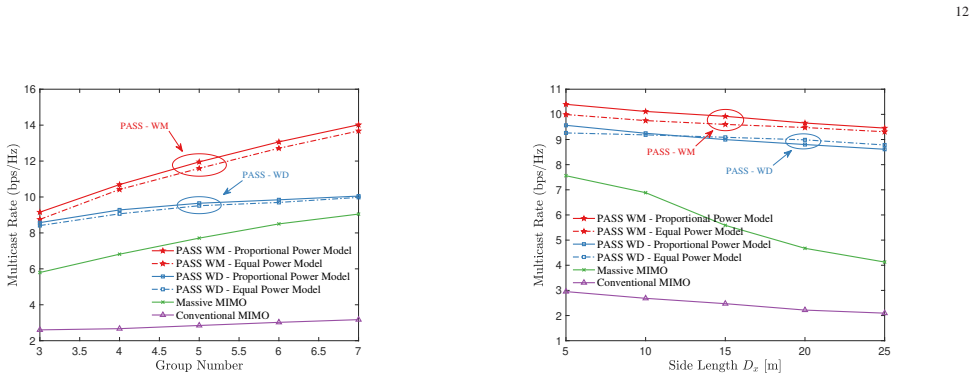
On its own terms, the paper's central claim is a comparative one: for multigroup multicast in free-space line-of-sight channels, a pinching-antenna system using either of two architectures achieves significantly higher sum-of-minimum-user rates than fixed-location MIMO and massive MIMO baselines, and the gap widens as the service region grows. The second claim is architectural: waveguide-multiplexing, which applies baseband transmit beamforming across all waveguides, is more robust to dense user deployments and growing group counts, while waveguide-division, which simply allocates one waveguide per group and optimizes antenna locations, wins when the multicast groups occupy geographically separated clusters. The system model attaches each group's rate to its worst user, so the improvements come precisely from the pinching mechanism's ability to shorten every user's line-of-sight distance to some antenna element, rather than from added spectral degrees of freedom alone.
Load-bearing premise
The results rest on a free-space line-of-sight channel model with perfect channel knowledge and ideal antenna placement; if rich multipath, imperfect CSI, or positioning errors reduce the advantage of moving antennas close to users, both the rate gain over fixed MIMO and the ordering between waveguide-division and waveguide-multiplexing could shrink or reverse.
Editorial extensions
If this is right
- Multicast services can be supported with far fewer RF chains than massive MIMO: the simulations use $M$ waveguides and $N$ pinching antennas per waveguide but only $M$ RF chains, and still beat an $MN$-antenna massive MIMO baseline.
- Deployers can pick an architecture from geography: use waveguide-division when user groups form well-separated clusters, and waveguide-multiplexing when users of different groups are densely interleaved.
- As the service area grows, PASS multicast rates degrade much more slowly than fixed arrays, so the technology is positioned for wide-area or cell-edge multicast delivery.
- Increasing the number of waveguides or pinching antennas per waveguide directly increases multicast rate, with the gap between architectures narrowing as the pinching gain dominates.
Reading between the lines
- The LoS-only assumption means the paper does not test indoor rich-scattering scenarios; I expect the absolute gain over fixed MIMO to shrink in such channels, and the WD-versus-WM ordering to depend on how much spatial decorrelation multipath provides.
- A practical deployment rule could be derived from the figures: estimate the spatial overlap of user groups and set a separation threshold above which WD always wins; the paper suggests such a threshold exists but does not compute it.
- The element-wise grid search over $L=10^3$ candidate positions is a discrete approximation; a continuous placement with gradient-based refinement would likely improve rates slightly, at the cost of more computation.
- The $0.1$ dB/m waveguide loss and perfect placement are best-case hardware parameters; experimental PASS prototypes would be needed to confirm the rates survive real loss, mutual coupling, and attachment jitter.
Editorial analysis
A structured set of objections, weighed in public.
Referee Report
Summary. The paper studies downlink multigroup multicast in a pinching-antenna system (PASS) with M waveguides and N pinching antennas per waveguide. It formulates a sum-of-minimum-rates maximization problem and develops algorithms for two architectures: waveguide-division (WD), where each waveguide carries one group's stream, and waveguide-multiplexing (WM), where baseband beamforming combines streams across waveguides. For WD, the paper proposes log-sum-exp projected gradient descent for power allocation and an element-wise sequential search for pinching-antenna positions. For WM, it constructs an MM surrogate, derives a beamformer structure via Lagrange duality, and proposes a projected adaptive gradient descent algorithm together with element-wise pinching-beamforming updates. Numerical results claim that PASS significantly outperforms conventional MIMO and massive MIMO multicast, with WM more robust in dense deployments and WD preferable when user groups are spatially separated.
Significance. If the results were based on a physically consistent signal model, the paper would provide a useful architecture comparison and a set of low-complexity algorithms for an underexplored PASS multicast scenario. The algorithmic ingredients are clearly exposed, with per-iteration complexity statements, convergence discussions, and verification over 1000 random channel realizations, which are strengths. However, the current numerical claims are compromised by a power-normalization error in the signal model and by a mismatch between the original rate objective and the WD pinching-beamforming subproblem. These issues affect the scaling of the reported rates and the fairness of the comparison against MIMO baselines, so the headline PASS gains and the WD/WM ordering are not established by the manuscript as written.
major comments (3)
- [Sections II-A, II-B; Eqs. (3), (4), (10), (17), (27)] Eq. (3) sets [ψ(x_m)]_n = sqrt(P_{m,n}) e^{-jk_g x_{m,n}}, with P_{m,n} defined in Eq. (4) as the physical power radiated by the n-th PA, and the simulations set P_{L,m} = 0.9P_m. At the same time, the beamformer w_g is constrained by Tr(W^H W) ≤ Pt, and in WD it is written as w_g = sqrt(P_g) e^{-jφ_g}. The received signal in Eq. (10) therefore contains h^T Ψ w, whose squared magnitude includes P_{m,n}|w_g|^2 ≈ P_{m,n}P_g. Since P_{m,n} is already a power or a fraction of P_m, the SINR expressions in Eqs. (17) and (27) scale as P_m^2 instead of P_m, and the total radiated power per waveguide is inflated by an extra factor Σ_n P_{m,n}. This violates power conservation and gives PASS an artificial advantage over the MIMO baselines, which have only a single power weighting. Figures 4-9 are therefore not a valid test of the PASS gain or of the WD/WM ordering. The model should be normalized so that Ψ contains only phase and attenuation (or dimensionless radiation coefficients) and all transmit power enters once through W; the figures should then be regenerated.
- [Section III-B; Eq. (26) and Section III-C] The pinching-beamforming subproblem P2 is stated as max_X Σ_g min_k SINR_{g,k}(X), but the original objective in Eq. (14) is Σ_g min_k log_2(1+SINR_{g,k}) = Σ_g log_2(1 + min_k SINR_{g,k}). Replacing the sum of log-rates by the sum of minimum SINRs is not a monotone-equivalent transformation; it changes the ranking of candidate PA positions and can favor high-SINR groups at the expense of the multicast rate. Consequently, the convergence claim in Section III-C that each element-wise update yields non-decreasing values of the original objective (14) is not justified by the algorithm as described. The authors should either use log(1+SINR) in the element-wise update or provide a proof that the SINR objective is a valid surrogate for the rate objective in the relevant regime.
- [Section III-A; Eq. (15b) and Eq. (25)] The text defines p = [P_1, ..., P_G]^T with P_g denoting the power allocated to group g, and Eq. (17) uses P_g directly in the SINR. The total-power constraint in Eq. (15b) is then Σ_g P_g ≤ Pt, not ‖p‖_2 ≤ Pt. The stated l2 constraint permits total power up to sqrt(G)Pt and therefore over-allocates power in the WD architecture. Since the projection in Eq. (25) is onto the set defined by (15b), the algorithm solves a different, looser optimization problem, which biases the WD results and the comparisons in Figs. 4 and 6-9. Please correct the constraint and the projection to the l1 form, or alternatively define p as an amplitude vector and rewrite the SINR expressions accordingly.
minor comments (3)
- [Section IV-C, Eq. (70)] The subscripts in Eq. (70) appear inconsistent: C1_{i,k} and C3_{i,k} should presumably be C1_{g,k} and C3_{g,k}, since the expression is for the g-th group; please clarify the index convention.
- [Section V, Figs. 3-9] Several figure legends appear to mix the descriptive labels (e.g., 'PASS WM - Proportional Power Model') with the shorter legend entries (e.g., 'PASS - WM'), making it difficult to map curves to architectures and power models; please make the legends consistent.
- [Section IV-A, Eq. (32)] The MM minorizer is stated without derivation, and the proof is only described as similar to [28]; because the constants in Eq. (33) are central to the convergence argument, please include the derivation or give a precise equation-level reference.
Circularity Check
No significant circularity: the central algorithms and comparisons are self-contained; the PASS gains and WD/WM ordering are not reduced to fitted inputs or self-citation.
full rationale
The paper's claimed results are produced by optimizing the stated multicast objective under an explicit system model and are benchmarked against conventional MIMO and massive MIMO baselines (Sec. V). No parameter is fitted to a target rate, and no 'prediction' is a renamed input: the LSE-PGD, MM-PAGD, and element-wise pinching searches all maximize the same F(W,X) from Eq. (14). The WD/WM ordering is a numerical outcome of different architectural constraints (diagonal W vs. full W), not an imported uniqueness theorem. The model does inherit the PASS radiation model (Eqs. (3)-(7)) and LoS channel from prior work, including papers with overlapping authorship ([8], [13]-[15], [17]), but these are modeling inputs, not the paper's claimed contribution, and the comparison against fixed-location baselines does not reduce to them. The skeptic's power double-counting point (sqrt(P_{m,n}) in Eq. (3) combined with Tr(W^H W) <= Pt in Eq. (14b)) is a modeling consistency/correctness concern, not a circularity step, so it does not affect this verdict.
Assumptions & free parameters
free parameters (5)
- Per-waveguide radiated power ratio PL,m/Pm =
0.9
- LSE smoothing parameter tau =
100
- PAGD step-size constants rho_c, rho_mu, rho_p, rho_t, rho_eta =
1, 0.02, 1, 10, 0.01
- Grid resolution L for PA positions =
1000
- In-waveguide attenuation epsilon =
0.1 dB/m
assumptions (5)
- domain assumption Free-space LoS channel model with no fading or blockage (Eq. (9)).
- domain assumption Power radiation model in Eqs. (4)-(7), including equal and proportional power radiation coefficients with PL,m <= Pm.
- domain assumption Perfect CSI and known user positions at the base station.
- standard math MM minorization in Eq. (32) is valid; proof is omitted and cited to [28].
- domain assumption Discrete candidate set Sx and minimum PA spacing Delta_min = lambda/2.
Cite this review
Pith. "Pith review of Multigroup Multicast Design for Pinching-Antenna Systems: Waveguide-Division or Waveguide-Multiplexing?." pith.science (2026). https://pith.science/paper/EXMLACQ2
@misc{pith2026250616184,
  author       = {Pith},
  title        = {Pith review of: Multigroup Multicast Design for Pinching-Antenna Systems: Waveguide-Division or Waveguide-Multiplexing?},
  year         = {2026},
  howpublished = {\url{https://pith.science/paper/EXMLACQ2}},
  note         = {Machine review of arXiv:2506.16184}
}
read the original abstract
This article addresses the design of multigroup multicast communications in the pinching-antenna system (PASS). A PASS-enabled multigroup transmission framework is proposed to maximize multicast rates under a couple of transmission architectures: waveguide-division (WD) and waveguide-multiplexing (WM). 1) For WD, an element-wise sequential optimization strategy is proposed for pinching beamforming, i.e., optimizing the activated positions of pinching antennas along dielectric waveguides. Meanwhile, a log-sum-exp projected gradient descent algorithm is proposed for transmit power allocation across waveguides. 2) For WM, a majorization-minimization (MM)-based framework is proposed to tackle the problem's non-smoothness and non-convexity. On this basis, a low-complexity element-wise sequential optimization method is developed for pinching beamforming using the MM surrogate objective. Furthermore, the optimal transmit beamformer structure is derived from the MM surrogate objective using the Lagrange duality, with an efficient transmit beamforming algorithm proposed using projected adaptive gradient descent. Numerical results demonstrate that: i) both WD and WM architectures in PASS achieve significant multicast rate improvements over conventional MIMO techniques, especially for systems with large service areas; ii) WM is more robust than WD in dense deployments, while WD excels when user groups are spatially separated.
Figures


Figures from the paper (4 more)



Reference graph
Works this paper leans on
-
[28]
Int elligent reflecting surface aided multigroup multicast MISO communi cation systems,
G. Zhou, C. Pan, H. Ren, K. Wang, and A. Nallanathan, “Int elligent reflecting surface aided multigroup multicast MISO communi cation systems,” IEEE Trans. Signal Process. , vol. 68, pp. 3236–3251, 2020
work page 2020
-
[1]
Joint spati al division and multiplexing—the large-scale array regime,
A. Adhikary, J. Nam, J.-Y . Ahn, and G. Caire, “Joint spati al division and multiplexing—the large-scale array regime,” IEEE Trans. Inf. Theory , vol. 59, no. 10, pp. 6441–6463, 2013
work page 2013
-
[2]
Reconfigurable intelligent surfaces: Principles and oppo rtunities,
Y . Liu, X. Liu, X. Mu, T. Hou, J. Xu, M. Di Renzo, and N. Al-Dh ahir, “Reconfigurable intelligent surfaces: Principles and oppo rtunities,” IEEE Commun. Surv. Tutor ., vol. 23, no. 3, pp. 1546–1577, 2021
2021
-
[3]
W. K. New, K.-K. Wong, H. Xu, C. Wang, F. R. Ghadi, J. Zhang, J. Rao, R. Murch, P . Ram´ ırez-Espinosa, D. Morales-Jimenez , C.-B. Chae, and K.-F. Tong, “A tutorial on fluid antenna system for 6 G networks: Encompassing communication theory, optimizati on methods and hardware designs,” IEEE Commun. Surv. Tutor ., early access, 2024
work page 2024
-
[4]
Fl uid antenna systems,
K.-K. Wong, A. Shojaeifard, K.-F. Tong, and Y . Zhang, “Fl uid antenna systems,” IEEE Trans. Wirel. Commun. , vol. 20, no. 3, pp. 1950–1962, 2021
1950
-
[5]
Movable antennas for wireles s commu- nication: Opportunities and challenges,
L. Zhu, W. Ma, and R. Zhang, “Movable antennas for wireles s commu- nication: Opportunities and challenges,” IEEE Commun. Mag. , vol. 62, no. 6, pp. 114–120, 2024
2024
-
[6]
A tutorial on movable antennas for wi reless networks,
L. Zhu, W. Ma, W. Mei, Y . Zeng, Q. Wu, B. Ning, Z. Xiao, X. Sha o, J. Zhang, and R. Zhang, “A tutorial on movable antennas for wi reless networks,” IEEE Commun. Surv. Tutor ., early access, 2025
work page 2025
-
[7]
Pinching antenna: Using a dielectric waveguide as an anten na,
A. Fukuda, H. Y amamoto, H. Okazaki, Y . Suzuki, and K. Kawa i, “Pinching antenna: Using a dielectric waveguide as an anten na,” NTT DOCOMO Tech. J. , vol. 23, no. 3, pp. 5–12, 2022
work page 2022
Show all 34 references
-
[8]
Pinching ante nna systems (PASS): Architecture designs, opportunities, and outlook,
Y . Liu, Z. Wang, X. Mu, C. Ouyang, and X. Xu, “Pinching ante nna systems (PASS): Architecture designs, opportunities, and outlook,” arXiv preprint, arXiv: 2501.18409 , 2025
2025 arXiv
-
[9]
Flexible-ante nna systems: A pinching-antenna perspective,
Z. Ding, R. Schober, and H. Vincent Poor, “Flexible-ante nna systems: A pinching-antenna perspective,” IEEE Trans. Commun. , early access, 2025
2025
-
[10]
A vision to smart radio environment: Surface wave communication superhighw ays,
K.-K. Wong, K.-F. Tong, Z. Chu, and Y . Zhang, “A vision to smart radio environment: Surface wave communication superhighw ays,” IEEE Wirel. Commun., vol. 28, no. 1, pp. 112–119, 2021
2021
-
[11]
Path loss and surface impedance models for surfac e wave- assisted wireless communication system,
H. Liu, W. K. New, H. Xu, Z. Chu, K.-F. Tong, K.-K. Wong, an d Y . Zhang, “Path loss and surface impedance models for surfac e wave- assisted wireless communication system,” IEEE Access , vol. 12, pp. 125 786–125 799, 2024
2024
-
[12]
On propagation characteristics of reconfigurable surface wav e platform: Simulation and experimental verification,
Z. Chu, K.-F. Tong, K.-K. Wong, C.-B. Chae, and C. Hou Cha n, “On propagation characteristics of reconfigurable surface wav e platform: Simulation and experimental verification,” IEEE Access , vol. 12, pp. 168 744–168 754, 2024
2024
-
[13]
Modeling a nd beam- forming optimization for pinching-antenna systems,
Z. Wang, C. Ouyang, X. Mu, Y . Liu, and Z. Ding, “Modeling a nd beam- forming optimization for pinching-antenna systems,” arXiv preprint, arXiv: 2502.05917 , 2025
2025 arXiv
-
[14]
Pin ching- antenna systems (PASS): Power radiation model and optimal b eamform- ing design,
X. Xu, X. Mu, Z.-J. Wang, Y . Liu, and A. Nallanathan, “Pin ching- antenna systems (PASS): Power radiation model and optimal b eamform- ing design,” arXiv preprint, arXiv: 2505.00218 , 2025
2025 arXiv
-
[15]
Antenna activation fo r NOMA assisted pinching-antenna systems,
K. Wang, Z. Ding, and R. Schober, “Antenna activation fo r NOMA assisted pinching-antenna systems,” IEEE Commun. Lett. , vol. 14, no. 5, pp. 1526–1530, 2025
2025
-
[16]
Performance analysis of pinching- antenna systems,
D. Tyrovolas, S. A. Tegos, P . D. Diamantoulakis, S. Ioan nidis, C. K. Liaskos, and G. K. Karagiannidis, “Performance analysis of pinching- antenna systems,” IEEE Trans. Cogn. Commun. Netw. , early access, 2025
2025
-
[17]
Array gain for pi nching- antenna systems (PASS),
C. Ouyang, Z. Wang, Y . Liu, and Z. Ding, “Array gain for pi nching- antenna systems (PASS),” IEEE Commun. Lett., vol. 29, no. 6, pp. 1471– 1475, 2025
2025
-
[18]
Minimum data rate maximization for uplink pinching-anten na systems,
S. A. Tegos, P . D. Diamantoulakis, Z. Ding, and G. K. Kara giannidis, “Minimum data rate maximization for uplink pinching-anten na systems,” IEEE Commun. Lett. , vol. 14, no. 5, pp. 1516–1520, 2025
2025
-
[19]
On the performance o f uplink pinching antenna systems (PASS),
T. Hou, Y . Liu, and A. Nallanathan, “On the performance o f uplink pinching antenna systems (PASS),” arXiv preprint, arXiv: 2502.12365 , 2025
2025 arXiv
-
[20]
Rate maximizat ion for downlink pinching-antenna systems,
Y . Xu, Z. Ding, and G. K. Karagiannidis, “Rate maximizat ion for downlink pinching-antenna systems,” IEEE Commun. Lett. , vol. 14, no. 5, pp. 1431–1435, 2025
2025
-
[21]
A low-complexity p lacement design of pinching-antenna systems,
X. Xie, F. Fang, Z. Ding, and X. Wang, “A low-complexity p lacement design of pinching-antenna systems,” IEEE Commun. Lett. , early access, 2025
2025
-
[22]
Downlink beamforming with pinching-antenna assisted MIMO systems,
A. Bereyhi, S. Asaad, C. Ouyang, Z. Ding, and H. V . Poor, “ Downlink beamforming with pinching-antenna assisted MIMO systems, ” in Proc. IEEE ICC W orkshops, 2025
2025
-
[23]
GPASS: Deep learnin g for beam- forming in pinching-antenna systems (PASS),
J. Guo, Y . Liu, and A. Nallanathan, “GPASS: Deep learnin g for beam- forming in pinching-antenna systems (PASS),” arXiv preprint, arXiv: 2502.01438, 2025
2025 arXiv
-
[24]
Joint transmit and pinching beamforming for pinching antenna systems (PASS): Optimiza tion-based or learning-based?
X. Xu, X. Mu, Y . Liu, and A. Nallanathan, “Joint transmit and pinching beamforming for pinching antenna systems (PASS): Optimiza tion-based or learning-based?” arXiv preprint, arXiv: 2502.08637 , 2025
2025 arXiv
-
[25]
Waveguide division multiple access for pinching-antenna systems (PASS),
J. Zhao, X. Mu, K. Cai, Y . Zhu, and Y . Liu, “Waveguide division multiple access for pinching-antenna systems (PASS),” arXiv preprint, arXiv: 2502.17781, 2025
2025 arXiv
-
[26]
Y eh and F
C. Y eh and F. I. Shimabukuro, The Essence of Dielectric W aveguides . New Y ork, NY , USA: Springer, 2008
2008
-
[27]
Smoothing method for minimax problems,
S. Xu, “Smoothing method for minimax problems,” Computational Optimization and Applications , vol. 20, no. 3, pp. 267–279, 2001
2001
-
[29]
20, 2015, 2015, ve rsion 7.1 (revision 28)
MOSEK ApS, The MOSEK Optimization Toolbox for MATLAB Manual , http://mosek.com, Online; accessed Mar. 20, 2015, 2015, ve rsion 7.1 (revision 28)
2015
-
[30]
Optimal beamforming structure and e fficient opti- mization algorithms for generalized multi-group multicas t beamforming optimization,
T. Fang and Y . Mao, “Optimal beamforming structure and e fficient opti- mization algorithms for generalized multi-group multicas t beamforming optimization,” arXiv preprint, arXiv: 2312.16559 , 2023
2023 arXiv
-
[31]
Incremental subgradien t methods for nondifferentiable optimization,
A. Nedi´ c and D. P . Bertsekas, “Incremental subgradien t methods for nondifferentiable optimization,” SIAM J. Optim. , vol. 12, no. 1, pp. 109– 138, 2001
2001
-
[32]
A finite algorithm for finding the projecti on of a point onto the canonical simplex of Rn,
C. Michelot, “A finite algorithm for finding the projecti on of a point onto the canonical simplex of Rn,” J. Optim. Theory Appl. , vol. 50, no. 1, pp. 195–200, 1986
1986
-
[33]
Distributed subgradient methods for multi-agent optimization,
A. Nedi´ c and A. E. Ozdaglar, “Distributed subgradient methods for multi-agent optimization,” IEEE Trans. Autom. Control , vol. 54, no. 1, pp. 48–61, 2009
2009
-
[34]
D. M. Pozar, Microwave Engineering, 4th ed. New Y ork, US: Wiley, 1998
1998
Reviewed August 6, 2026 · model on record in the stance chip above.
Discussion (0). Sign in to comment.