REVIEW 3 major objections 5 minor 113 references
Quantum disordered ground state and relative proximity to an exactly solvable model in the frustrated magnet CeMgAl$_{11}$O$_{19}$
T0 review · 3 major / 5 minor · reviewed 2026-08-06 · deepseek-v4-flash
Pith's one-line read This paper establishes that the disordered ground state of the triangular magnet CeMgAl11O19 is not primarily a quantum spin liquid induced by proximity to the exactly solvable XXZ point, and it points to structural disorder as the…
desk verdict Solid magnetization/DMRG study that revises CeMgAl11O19's Jz/J⊥ to about -0.22, but the fitted ratio lacks an uncertainty and neglects J_c, so the exact distance from the QCP is not pinned down. read the letter →
The pith
A machine-rendered reading of the paper's core claim, the machinery that carries it, and where it could break.
The reading
What carries the argument
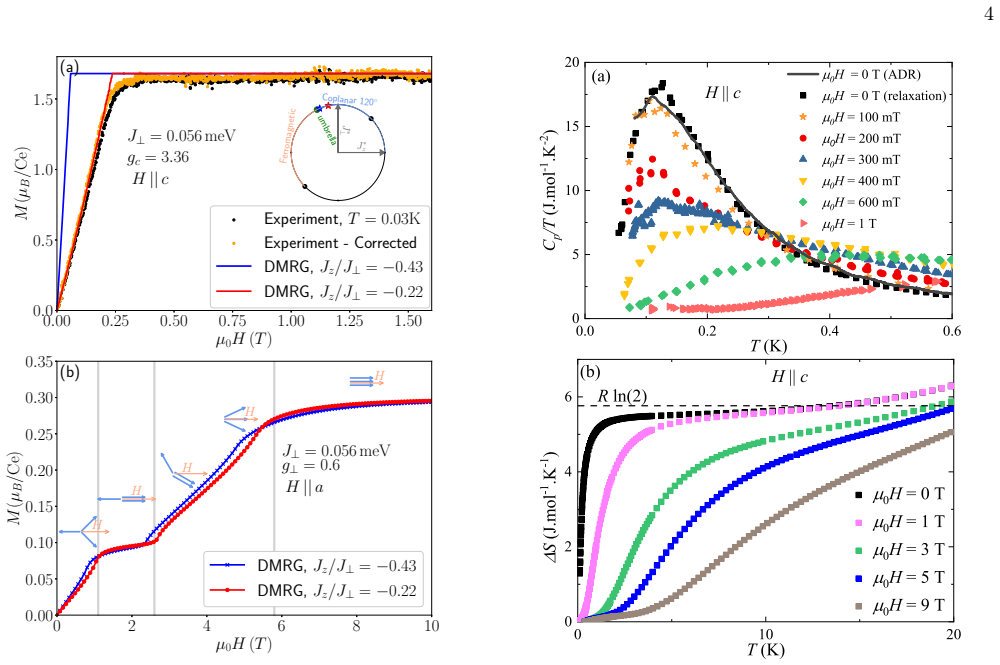
The machinery is the anisotropic XXZ Hamiltonian on the triangular lattice, $\hat{H}=\sum_{\langle i,j\rangle} J_\perp(S^x_iS^x_j+S^y_iS^y_j)+J_z S^z_iS^z_j$, with an exactly solvable spin-liquid point at $J_z/J_\perp=-0.5$ where the ground state is a superposition of umbrella states. The comparison is made through zero-temperature DMRG magnetization curves on a $12 \times 9$ cylindrical lattice, matched to the 0.03 K data along the $c$ axis with the in-plane exchange fixed at $J_\perp=0.056$ meV, $g_c=3.36$, and a demagnetization correction. DMRG structure factors at $J_z/J_\perp=-0.22$ predict a 120-degree coplanar order at zero field evolving into ferromagnetic order along $c$ and an up-up-down plateau near 1.8 T for fields in the $ab$ plane. Single-crystal X-ray diffraction supplies the three structural disorder sources that the clean-lattice calculation cannot capture.
What would settle it
A decisive check would be to grow a stoichiometric, structurally ordered crystal of CeMgAl11O19 and measure its magnetization to dilution temperatures: if the best DMRG fit then returns near $J_z/J_\perp = -0.43$, or if long-range magnetic order appears below 30 mK, the paper's central conclusion fails. On the current crystals, observing the predicted 1/3 magnetization plateau near 1.8 T for fields in the $ab$ plane would support the fitted ratio.
Extended reading notes
Core claim
On the paper's own terms, the central claim is that a quantitative comparison of the low-temperature magnetization of CeMgAl11O19 with DMRG ground-state calculations for the nearest-neighbor XXZ Hamiltonian determines the exchange anisotropy ratio to be $J_z/J_\perp = -0.22$, assuming $J_\perp = 0.056$ meV from the earlier neutron study. This ratio still has the same sign structure proposed before, antiferromagnetic in-plane coupling and ferromagnetic out-of-plane coupling, but it is sufficiently far from the quantum critical point at $J_z/J_\perp = -0.5$ that the exactly solvable spin-liquid point cannot be the origin of the observed quantum disordered state. The authors therefore state that the results exclude a quantum spin liquid state induced mainly by magnetic quantum criticality and instead point to the central role of structural disorder, which they document as cerium deficiency, magnesium/aluminium site mixing, and splitting of the Al(5) site. The absence of magnetic order down to 0.03 K is then attributed to the combination of frustration, proximity to quantum criticality, and structural disorder, with short-range 120-degree order suggested as a plausible realization.
Load-bearing premise
The fitted ratio $J_z/J_\perp = -0.22$ depends on accepting the earlier neutron value $J_\perp = 0.056$ meV, the measured $g_c = 3.36$, the demagnetization correction, and the assumption that disorder and the bond-dependent coupling $J_c$ (set to zero) do not reshape the magnetization curve; if any of those move, the conclusion that the material sits away from the quantum critical point moves with it.
Editorial extensions
If this is right
- If the fitted ratio is correct, the material is not a quantum-critical spin liquid, and the excitation continuum reported by the neutron study needs a different explanation than proximity to the solvable point.
- At $J_z/J_\perp=-0.22$ the clean model predicts 120-degree order, so the discrepancy with the absence of order becomes a direct measure of how strongly structural disorder perturbs the triangular lattice.
- The predicted 1/3 magnetization plateau at $\mu_0H\approx1.8$ T for fields in the $ab$ plane is a testable signature of the fitted ratio, although the small $g_{ab}$ currently prevents measuring it.
- The material can be used for adiabatic demagnetization cooling to below 0.1 K, as demonstrated by self-cooling from 2 K to 0.09 K.
- A random-singlet state is judged unlikely because susceptibility and $C_p/T$ do not show the power-law divergence predicted for such states, leaving short-range 120-degree order or another disorder-induced state as the candidate.
Reading between the lines
- If structural disorder is indeed the controlling variable, crystals with different cerium deficiency or Al/Mg mixing should show a tunable ordering temperature or correlation length, which is a testable prediction the paper does not make.
- The discrepancy between the magnetization fit and the neutron fit might be reduced by including the bond-dependent coupling $J_c$ that the paper sets to zero, so refitting both datasets with the full Hamiltonian would test whether the two probes are actually inconsistent.
- The same disorder-sensitive physics may apply to the isostructural Pr and Nd analogs already studied, making the LnMgAl11O19 family a systematic platform for separating frustration from disorder.
- A structurally ordered, near-stoichiometric sample would be the decisive experiment: if it orders magnetically, disorder is the dominant mechanism, and if it stays disordered, intrinsic quantum fluctuations are stronger than this fit suggests.
Editorial analysis
A structured set of objections, weighed in public.
Referee Report
Summary. This manuscript reports single-crystal magnetization and specific heat measurements on the triangular-lattice magnet CeMgAl11O19 down to T = 0.03 K, together with DFT crystal-field calculations and DMRG simulations of the XXZ model in Eq. (1). The authors confirm an effective S = 1/2 ground doublet, a strongly anisotropic g-tensor, and the absence of magnetic order down to 0.03 K. Comparing the c-axis magnetization with zero-temperature DMRG results, they extract an exchange ratio Jz/J⊥ = -0.22 (fixing J⊥ = 0.056 meV from the prior INS study), and conclude that the material is farther from the ferromagnetic-to-antiferromagnetic quantum critical point at Jz/J⊥ = -0.5 than suggested by the INS-derived value -0.43. They propose that the absence of order is most probably caused by structural disorder identified in single-crystal X-ray diffraction (10% Ce deficiency, Mg/Al mixing, Al(5) splitting), rather than by proximity to the exactly solvable spin-liquid point.
Significance. If the extracted ratio Jz/J⊥ = -0.22 is robust, the manuscript materially revises the interpretation of CeMgAl11O19 from a quantum-critical spin liquid to a disordered magnet, a distinction that matters for the triangular-lattice QSL debate. The study adds value through the low-temperature magnetization and specific heat data, the DMRG finite-size scaling in the Supplemental Material, the explicit numerical settings for reproducibility, and the detailed structural disorder analysis. The paper also makes a falsifiable prediction: the clean XXZ model at the fitted ratio orders into 120-degree order, which is not observed experimentally, and it predicts a 1/3 magnetization plateau for in-plane fields that could be tested in future experiments.
major comments (3)
- [Fig. 3(a) and main text, 'Our best fit value...'] The headline result Jz/J⊥ = -0.22 is presented as a single best-fit value without any uncertainty or robustness analysis. The fit fixes J⊥ = 0.056 meV from Ref. [12], uses gc = 3.36 inferred from saturation (which is 8-11% lower than the ESR values 3.66-3.74 quoted in the manuscript), applies an approximate demagnetization correction with N ≈ 0.32, and compares T = 0 DMRG curves to T = 0.03 K data. Since the saturation field and low-field slope are the main constraints, a systematic shift in gc or J⊥ changes the field-to-energy conversion and can move the inferred ratio toward or away from the quantum critical point at Jz/J⊥ = -0.5. The authors should provide confidence intervals and a parameter-robustness table, for example fitting with gc = 3.66-3.74 and with J⊥ varied within the uncertainty of Ref. [12], to support the claim of a weaker proximity to the QCP.
- [Supplemental Material, Section V (Hamiltonian S5 and Jc = 0)] The bond-dependent exchange Jc is set to zero because the minimal model 'fits well' the experimental data. This is not sufficient for the main conclusion, because the exactly solvable spin-liquid point and the QCP at Jz/J⊥ = -0.5 apply to the XXZ Hamiltonian without Jc. If Jc is non-negligible, as analyzed in Ref. [12], then the fitted value of Jz/J⊥ is an effective parameter that can absorb parts of Jc, and the comparison to the exactly solvable point is not apples-to-apples. The authors should either quantify Jc in their model (e.g., by fitting DMRG with finite Jc and showing that M(H) is insensitive to it) or explicitly state the estimated upper bound on Jc and its effect on the inferred ratio.
- [Final paragraph and Conclusion] The attribution of the absence of magnetic order to structural disorder is presented as the most probable explanation, but the manuscript offers no quantitative test. The observed disorder (10% Ce deficiency, Mg/Al site mixing, Al(5) splitting) is qualitatively linked to known disorder effects in YbMgGaO4 and NaYbSe2, but the paper does not show that this level of bond or site randomness is sufficient to suppress 120-degree order in the XXZ triangular-lattice model at Jz/J⊥ = -0.22. A disorder-strength estimate (e.g., from local structural variations and the exchange sensitivity) and a comparison with predicted disorder-driven order suppression would turn this proposal into a substantive claim; alternatively, the claim should be explicitly softened to a speculation.
minor comments (5)
- [Title and Abstract] There is a typo in the title and abstract: 'a n exactly solvable model' should read 'an exactly solvable model'.
- [Main text, DMRG fitting paragraph] The text states that the strongest interaction is kept at 'J⊥ = -0.056 meV', while the Hamiltonian in Eq. (1) and Fig. 3 use J⊥ = 0.056 meV; the sign is inconsistent and should be corrected.
- [Fig. 4 cross-reference] The text describing Cp/T refers to 'Fig. 4(b)' when discussing the data shown in the top panel; the figure panels should be cross-checked and referenced correctly.
- [Supplemental Material, Eq. (S5)] The notation for the bond-dependent term Jc(Si·eij)(Sj·eij) is ambiguous because eij is not defined; please define the bond unit vectors and the sign convention.
- [Demagnetization correction] The demagnetization factor N ≈ 0.32 is described as an average for a nearly cubic crystal, but the correction is applied only to the c-axis magnetization; it would be helpful to state explicitly the assumed sample dimensions and whether the same correction is used for the in-plane curves.
Circularity Check
No significant circularity: the fitted Jz/J_perp ratio is openly a fit to magnetization data, and the DMRG 120-degree order statement is an independent model output, not a repackaged input.
full rationale
The paper's central quantitative claim is an openly labeled fit: experimental M(H) at T = 0.03 K is compared with DMRG ground-state magnetization curves for the XXZ Hamiltonian (Eq. 1), with J_perp fixed at 0.056 meV from the prior INS study (Ref. [12]) and g_c = 3.36 from saturation magnetization. The text states 'Our best fit value, Jz/J_perp = -0.22' and explicitly contrasts it with the INS-derived value -0.43. No equation in the paper makes the fitted ratio equal to the input data by construction; the ratio is a parameter extracted from the data, not a quantity claimed to be derived from first principles. The later statement that DMRG 'predict[s] the formation of a 120 degree' order for Jz/J_perp = -0.22 is a genuine model output computed from the fitted Hamiltonian, and it is not equivalent to the experimental observation of no ordering; the authors explicitly treat the discrepancy as evidence for structural disorder, which is an additional interpretation rather than a circular repackaging. The only imported numerical coupling, J_perp, comes from an external INS paper by a different group, not from the present authors, so no load-bearing self-citation or uniqueness-imported-from-authors pattern is present. Parameter sensitivity, neglected J_c, and g_c uncertainty are legitimate experimental/modeling concerns, but they concern robustness, not circularity. The derivation chain is therefore self-contained and non-circular.
Assumptions & free parameters
free parameters (3)
- Jz/J⊥ ratio =
-0.22
- J⊥ exchange scale =
0.056 meV
- DFT orbital-dependent shift Δ =
20 eV for O-2s, 8 eV for O-2p
assumptions (4)
- domain assumption The magnetic Hamiltonian is the nearest-neighbor XXZ model (Eq. 1) with no bond-dependent exchange or Dzyaloshinskii-Moriya terms.
- domain assumption Zero-temperature DMRG results are directly comparable to the T = 0.03 K magnetization data.
- ad hoc to paper The absence of magnetic order, despite the clean-model DMRG prediction of 120-degree order, is attributed to structural disorder.
- domain assumption The DFT/Wannier crystal-field calculation reliably determines the ground doublet as Jz = ±5/2.
Cite this review
Pith. "Pith review of Quantum disordered ground state and relative proximity to an exactly solvable model in the frustrated magnet CeMgAl$_{11}$O$_{19}$." pith.science (2026). https://pith.science/paper/FKCKZMQP
@misc{pith2026250616207,
  author       = {Pith},
  title        = {Pith review of: Quantum disordered ground state and relative proximity to an exactly solvable model in the frustrated magnet CeMgAl$_11$O$_19$},
  year         = {2026},
  howpublished = {\url{https://pith.science/paper/FKCKZMQP}},
  note         = {Machine review of arXiv:2506.16207}
}
abstract
The magnetic properties of the triangular magnet CeMgAl$_{11}$O$_{19}$ were investigated by magnetization and specific heat measurements down to $T=0.03\,$K on single crystals grown by the floating zone method. The formation of effective spins $S_\mathrm{eff}= 1/2$ below $T < 10$\,K was confirmed both by DFT calculations and specific heat measurements. No magnetic order was found down to $T=0.03\,$K despite the formation of magnetic correlations observed in specific heat. The measured magnetization was compared with DMRG computation and their agreement supports the proposal of a strongly anisotropic magnetic interaction antiferromagnetically coupling the spin components in the $ab$ plane and ferromagnetically coupling the spin component along the $c$ axis. However, our quantitative study of the magnetization indicates a weaker proximity to quantum criticality between ferromagnetism and antiferromagnetism than the previous inelastic neutron scattering study. Finally, we propose that the absence of magnetic order in CeMgAl$_{11}$O$_{19}$ would most probably be related to the structural disorder revealed by single-crystal X-ray diffraction.
Figures


Reference graph
Works this paper leans on
- [12]
-
[2]
Savary and L
L. Savary and L. Balents, Quantum spin liquids: a re- view, Reports on Progress in Physics 80, 016502 (2016)
2016
-
[3]
V. R. Shaginyan, V. Stephanovich, A. Msezane, G. Japaridze, J. Clark, M. Y. Amusia, and E. Kirichenko, Theoretical and experimental developments in quantum spin liquid in geometrically frustrated magnets: a review, Journal of Materials Science 55, 2257 (2020)
2020
-
[4]
Y. Li, P. Gegenwart, and A. A. Tsirlin, Spin liquids in geometrically perfect triangular antiferromagnets, Journal of Physics: Condensed Matter 32, 224004 (2020)
2020
-
[5]
M. R. Norman, N. J. Laurita, and D. Hsieh, Valence bond phases of herbertsmithite and related copper kagome ma- terials, Phys. Rev. Res. 2, 013055 (2020)
2020
-
[6]
Pustogow, Thirty-year anniversary of κ-(bedt-ttf) 2cu2 (cn) 3: reconciling the spin gap in a spin-liquid candidate, Solids 3, 93 (2022)
A. Pustogow, Thirty-year anniversary of κ-(bedt-ttf) 2cu2 (cn) 3: reconciling the spin gap in a spin-liquid candidate, Solids 3, 93 (2022)
2022
-
[7]
Y. Li, D. Adroja, R. I. Bewley, D. Voneshen, A. A. Tsir- lin, P. Gegenwart, and Q. Zhang, Crystalline electric- field randomness in the triangular lattice spin-liquid ybmggao4, Phys. Rev. Lett. 118, 107202 (2017)
2017
-
[8]
Kimchi, A
I. Kimchi, A. Nahum, and T. Senthil, Valence bonds in random quantum magnets: Theory and application to ybmggao4, Phys. Rev. X 8, 031028 (2018)
2018
Show all 113 references
-
[9]
Takagi, T
H. Takagi, T. Takayama, G. Jackeli, G. Khaliullin, and S. E. Nagler, Concept and realization of kitaev quantum spin liquids, Nature Reviews Physics 1, 264 (2019)
2019
-
[10]
Trebst and C
S. Trebst and C. Hickey, Kitaev materials, Physics Re- ports 950, 1 (2022)
2022
-
[11]
Momoi and M
T. Momoi and M. Suzuki, Ground-state properties and phase diagram of the quantum xxz antiferromagnet on a triangular lattice, Journal of the Physical Society of Japan 61, 3732 (1992)
1992
-
[13]
Miyashita, The ground state and thermodynamic 6 properties of generalized heisenberg models on the trian- gular lattice, Progress of Theoretical Physics Supplement 87, 112 (1986)
S. Miyashita, The ground state and thermodynamic 6 properties of generalized heisenberg models on the trian- gular lattice, Progress of Theoretical Physics Supplement 87, 112 (1986)
1986
-
[14]
Yamamoto, G
D. Yamamoto, G. Marmorini, and I. Danshita, Quantum Phase Diagram of the Triangular-Lattice XXZ Model in a Magnetic Field, Physical Review Letters 112, 127203 (2014)
2014
-
[15]
Sellmann, X.-F
D. Sellmann, X.-F. Zhang, and S. Eggert, Phase diagram of the antiferromagnetic xxz model on the triangular lat- tice, Physical Review B 91, 081104 (2015)
2015
-
[16]
S. Pal, P. Sharma, H. J. Changlani, and S. Pujari, Col- orful points in the xy regime of xxz quantum magnets, Physical Review B 103, 144414 (2021)
2021
-
[19]
T. Xie, N. Zhao, S. Gozel, J. Xing, S. M. A vdoshenko, K. M. Taddei, A. I. Kolesnikov, L. D. Sanjeewa, P. Ma, N. Harrison, C. dela Cruz, L. Wu, A. S. Sefat, A. L. Chernyshev, A. M. Läuchli, A. Podlesnyak, and S. E. Nikitin, Stripe magnetic order and field-induced quan- tum crit...
2024
-
[20]
Ashtar, X
M. Ashtar, X. Liu, Z. Zhou, S. Zhang, J. Li, W. Tong, J. Xiang, Z. Tian, and P. Sun, Two new ce-based triangu- lar lattice antiferromagnets cezna l 11 o 19 and cet a 7 o 19 with distinct magnetocaloric effects, Physical Review Materials 9, 034405 (2025)
2025
-
[22]
A. A. Kulbakov, S. M. A vdoshenko, I. Puente-Orench, M. Deeb, M. Doerr, P. Schlender, T. Doert, and D. S. Inosov, Stripe-yz magnetic order in the triangular-lattic e antiferromagnet kces2, Journal of Physics: Condensed Matter 33, 425802 (2021)
2021
-
[23]
S. M. A vdoshenko, A. A. Kulbakov, E. Häußler, P. Schlender, T. Doert, J. Ollivier, and D. S. Inosov, Spin-wave dynamics in the kces2 delafossite: A theo- retical description of powder inelastic neutron-scatteri ng data, Phys. Rev. B 106, 214431 (2022)
2022
-
[24]
T. Xie, S. Gozel, J. Xing, N. Zhao, S. M. A v- doshenko, L. Wu, A. S. Sefat, A. L. Chernyshev, A. M. Läuchli, A. Podlesnyak, and S. E. Nikitin, Quantum spin dynamics due to strong kitaev interac- tions in the triangular-lattice antiferromagnet cscese2, Phys. Rev. Lett. 133, 09...
2024
-
[25]
Verstegen and A
J. Verstegen and A. Stevels, The relation between crystal structure and luminescence in β-alumina and magneto- plumbite phases, J. Luminescence 9, 406 (1974)
1974
-
[26]
Haberey, R
F. Haberey, R. Leckebusch, M. Rosenberg, and K. Sahl, Zur einkristallzüchtung von selten-erd-hexaaluminaten, Naturwissenschaften 68, 376 (1981)
1981
-
[27]
Ashtar, Y
M. Ashtar, Y. X. Gao, C. L. Wang, Y. Qiu, W. Tong, Y. M. Zou, X. W. Zhang, M. A. Marwat, S. L. Yuan, and Z. M. Tian, Synthesis, structure and mag- netic properties of rare-earth remgal11o19 (re = pr, nd) compounds with two-dimensional triangular lattice, Journal of Alloys and ...
2019
-
[28]
Bastien, Q
G. Bastien, Q. Courtade, A. Eliáš, T. Haidamak, P. Proschek, M. Dušek, J. Priessnitz, P. Baláž, and R. Colman, Quasi-two-dimensional ferromagnetism in the triangular magnet eual 12 o 19, Physical Review B 110, 094436 (2024)
2024
-
[29]
Doležal, L
V. Doležal, L. Nádhern` y, K. Rubešová, V. Jakeš, A. Michalcová, O. Jankovsk` y, and M. Poupon, Lam- gal11o19 synthesis using non-hydrolytic sol-gel methods, Ceramics International 45, 11233 (2019)
2019
-
[30]
Nádhern` y, V
L. Nádhern` y, V. Doležal, D. Sedmidubsk` y, J. Cajzl, R. Kučerková, M. Nikl, V. Jakeš, and K. Rubešová, Op- tical and magnetic properties of nanostructured cerium- doped lamgal 11 o 19, Journal of Materials Research 35, 1672 (2020)
2020
-
[31]
Kumar, M
S. Kumar, M. Klicpera, A. Eliáš, M. Kra- tochvílová, A. Kancko, C. Correa, K. Załęski, M. Śliwi ńska Bartkowiak, R. H. Colman, and G. Bastien, Induced quantum magnetism on a tri- angular lattice of non-kramers ions in prmgal11o19, Phys. Rev. B 111, 174444 (2025)
2025
-
[32]
See supplemental materials for results of compositional analysis and single crystal X-ray diffraction and for com- putational details of DFT and DMRG calculations
-
[33]
Flanders, A hall sensing magnetometer for measuring magnetization, anisotropy, rotational loss and time ef- fects, IEEE Transactions on Magnetics 21, 1584 (1985)
P. Flanders, A hall sensing magnetometer for measuring magnetization, anisotropy, rotational loss and time ef- fects, IEEE Transactions on Magnetics 21, 1584 (1985)
1985
-
[34]
Aharoni, Demagnetizing factors for rectangular fer- romagnetic prisms, Journal of applied physics 83, 3432 (1998)
A. Aharoni, Demagnetizing factors for rectangular fer- romagnetic prisms, Journal of applied physics 83, 3432 (1998)
1998
-
[35]
Tokiwa, S
Y. Tokiwa, S. Bachus, K. Kavita, A. Jesche, A. A. Tsirlin, and P. Gegenwart, Frustrated magnet for adiabatic de- magnetization cooling to milli-kelvin temperatures, Com- munications Materials 2, 42 (2021)
2021
-
[36]
T. Treu, M. Klinger, N. Oefele, P. Telang, A. Jesche, and P. Gegenwart, Utilizing frustration in gd-and yb-based oxides for milli-kelvin adiabatic demagnetization refrig er- ation, Journal of Physics: Condensed Matter 37, 013001 (2024)
2024
-
[38]
Clark and J
R. Clark and J. Reid, The analytical calculation of ab- sorption in multifaceted crystals, Foundations of Crystal - lography 51, 887 (1995)
1995
-
[39]
Momma and F
K. Momma and F. Izumi, VESTA: a three-dimensional visualization system for electronic and structural analy- sis, J. Appl. Cryst. 41, 653 (2008)
2008
-
[40]
Palatinus and G
L. Palatinus and G. Chapuis, SUPERFLIP–a computer program for the solution of crystal structures by charge flipping in arbitrary dimensions, J. Appl. Cryst. 40, 786 (2007)
2007
-
[41]
Petříček, L
V. Petříček, L. Palatinus, J. Plášil, and M. Dušek, Jana2020–a new version of the crystallographic com- puting system jana, Zeitschrift für Kristallographie- Crystalline Materials (2023)
2023
-
[42]
Abrahams, P
S. Abrahams, P. Marsh, and C. D. Brandle, Laser and phosphor host la1- xmgal11+ xo19 (x= 0.050): Crystal structure at 295 k, The Journal of chemical physics 86, 4221 (1987). 7
1987
-
[43]
Bastien, D
G. Bastien, D. Repček, A. Eliáš, A. Kancko, Q. Cour- tade, T. Haidamak, M. Savinov, V. Bovtun, M. Kempa, K. Carva, et al. , A frustrated antipolar phase analogous to classical spin liquids, Advanced Materials , 2410282 (2024)
2024
-
[45]
Gasperin, M
M. Gasperin, M. Saine, A. Kahn, F. Laville, and A. Lejus, Influence of m2+ ions substitution on the structure of lanthanum hexaaluminates with magnetoplumbite struc- ture, Journal of Solid State Chemistry 54, 61 (1984)
1984
-
[46]
Kresse and J
G. Kresse and J. Furthmuller, Efficient iterative schemes for ab initio total-energy calculations using a plane-wave basis set, Physical Review B 54, 11169 (1996)
1996
-
[47]
Blaha, K
P. Blaha, K. Schwarz, G. Madsen, D. Kvasnicka, and J. Luitz, WIEN2k, An Augmented Plane Wave + Lo- cal Orbitals Program for Calculating Crystal Properties (Springer, Austria, 2001)
2001
-
[48]
Perdew, K
J. Perdew, K. Burke, and M. Ernzerhof, Gen- eralized gradient approximation made simple, Physical Review Letters 77, 3865 (1996)
1996
-
[49]
Kuneš, R
J. Kuneš, R. Arita, P. Wissgott, A. Toschi, H. Ikeda, and K. Held, Wien2wannier: From linearized augmented plane waves to maximally localized Wannier functions, Computer Physics Communications 181, 1888 (2010)
2010
-
[50]
Mostofi, J
A. Mostofi, J. Yates, Y.-S. Lee, I. Souza, D. Van- derbilt, and N. Marzari, wannier90: A tool for obtaining maximally-localised wannier functions, Computer Physics Communications 178, 685 (2008)
2008
-
[51]
Viana, G
B. Viana, G. Aka, D. Vivien, A. Lejus, J. Thery, A. Derory, J. Bernier, C. Garapon, and G. Boulon, Ab- sorption, fluorescence, and electron spin resonance inves- tigation of tervalent cerium activated lamgal11o19, Jour- nal of applied physics 64, 1398 (1988)
1988
-
[52]
Kawamura and S
H. Kawamura and S. Miyashita, Phase transition of the heisenberg antiferromagnet on the triangular lattice in a magnetic field, J. Phys. Soc. Jpn. 54, 4530 (1985)
1985
-
[53]
Hauschild, J
J. Hauschild, J. Unfried, S. Anand, B. Andrews, M. Bintz, U. Borla, S. Divic, M. Drescher, J. Geiger, M. Hefel, K. Hemery, W. Kadow, J. Kemp, N. Kirch- ner, V. S. Liu, G. Möller, D. Parker, M. Rader, A. Romen, S. Scalet, L. Schoonderwoerd, M. Schulz, T. Soejima, P. Thoma, Y. W...
2024
-
[54]
Maryasin and M
V. Maryasin and M. Zhitomirsky, Triangular antiferro- magnet with nonmagnetic impurities, Physical review letters 111, 247201 (2013)
2013
-
[55]
S. Dey, E. C. Andrade, and M. Vojta, Destruction of long-range order in noncollinear two-dimensional antifer - romagnets by random-bond disorder, Physical Review B 101, 020411 (2020)
2020
-
[56]
Z. Zhu, P. A. Maksimov, S. R. White, and A. L. Chernyshev, Disorder-induced mimicry of a spin liquid in ybmggao4, Phys. Rev. Lett. 119, 157201 (2017)
2017
-
[58]
Kimchi, J
I. Kimchi, J. P. Sheckelton, T. M. McQueen, and P. A. Lee, Scaling and data collapse from local moments in frustrated disordered quantum spin systems, Nature communications 9, 4367 (2018)
2018
-
[59]
Y. Cao, H. Bu, Z. Fu, J. Zhao, J. S. Gardner, Z. Ouyang, Z. Tian, Z. Li, and H. Guo, Synthesis, disorder and ising anisotropy in a new spin liquid candidate prmgal11o19, Materials Futures 3, 035201 (2024)
2024
-
[60]
O. A. Starykh, Unusual ordered phases of highly frustrated magnets: a review, Reports on Progress in Physics 78, 052502 (2015) . 8 SUPPLEMENT AL MATERIAL I. COMPOSITION ANALYSIS BY X-RAY FLUORESCENCE (XRF) SPECTR OSCOPY The floating-zone grown oligocrystal ingot was sliced by t...
2015
-
[61]
Balents, Spin liquids in frustrated magnets, Nature 464, 199 (2010)
L. Balents, Spin liquids in frustrated magnets, Nature 464, 199 (2010)
2010
-
[62]
Savary and L
L. Savary and L. Balents, Quantum spin liquids: a review, Rep orts on Progress in Physics 80, 016502 (2016)
2016
-
[63]
V. R. Shaginyan, V. Stephanovich, A. Msezane, G. Japaridze, J. Clark, M. Y. Amusia, and E. Kirichenko, Theoretical and experimental developments in quantum spin liquid in geo metrically frustrated magnets: a review, Journal of Materi als Science 55, 2257 (2020)
2020
-
[64]
Y. Li, P. Gegenwart, and A. A. Tsirlin, Spin liquids in geomet rically perfect triangular antiferromagnets, Journal of Physics: Condensed Matter 32, 224004 (2020)
2020
-
[65]
M. R. Norman, N. J. Laurita, and D. Hsieh, Valence bond phases of herbertsmithite and related copper kagome materials, Phys. Rev. Res. 2, 013055 (2020)
2020
-
[66]
Pustogow, Thirty-year anniversary of κ-(bedt-ttf) 2cu2 (cn) 3: reconciling the spin gap in a spin-l iquid candidate, Solids 3, 93 (2022)
A. Pustogow, Thirty-year anniversary of κ-(bedt-ttf) 2cu2 (cn) 3: reconciling the spin gap in a spin-l iquid candidate, Solids 3, 93 (2022)
2022
-
[67]
Y. Li, D. Adroja, R. I. Bewley, D. Voneshen, A. A. Tsirlin, P. G egenwart, and Q. Zhang, Crystalline electric-field randomn ess in the triangular lattice spin-liquid ybmggao4, Phys. Rev. Lett. 118, 107202 (2017)
2017
-
[68]
Kimchi, A
I. Kimchi, A. Nahum, and T. Senthil, Valence bonds in random q uantum magnets: Theory and application to ybmggao4, Phys. Rev. X 8, 031028 (2018)
2018
-
[69]
Takagi, T
H. Takagi, T. Takayama, G. Jackeli, G. Khaliullin, and S. E. N agler, Concept and realization of kitaev quantum spin liquids, Nature Reviews Physics 1, 264 (2019)
2019
-
[70]
Trebst and C
S. Trebst and C. Hickey, Kitaev materials, Physics Reports 950, 1 (2022)
2022
-
[71]
Momoi and M
T. Momoi and M. Suzuki, Ground-state properties and phase di agram of the quantum xxz antiferromagnet on a triangular lattice, Journal of the Physical Society of Japan 61, 3732 (1992)
1992
-
[72]
B. Gao, T. Chen, C. Liu, M. L. Klemm, S. Zhang, Z. Ma, X. Xu, C. Wo n, G. T. McCandless, N. Murai, et al. , Spin excitation continuum in the exactly solvable triangular-l attice spin liquid cemgal11o19, arXiv preprint arXiv:2408 .15957 (2024)
2024
-
[73]
Miyashita, The ground state and thermodynamic propertie s of generalized heisenberg models on the triangular lattic e, Progress of Theoretical Physics Supplement 87, 112 (1986)
S. Miyashita, The ground state and thermodynamic propertie s of generalized heisenberg models on the triangular lattic e, Progress of Theoretical Physics Supplement 87, 112 (1986)
1986
-
[74]
Yamamoto, G
D. Yamamoto, G. Marmorini, and I. Danshita, Quantum Phase Di agram of the Triangular-Lattice XXZ Model in a Magnetic Field, Physical Review Letters 112, 127203 (2014)
2014
-
[75]
Sellmann, X.-F
D. Sellmann, X.-F. Zhang, and S. Eggert, Phase diagram of the antiferromagnetic xxz model on the triangular lattice, Physical Review B 91, 081104 (2015)
2015
-
[76]
S. Pal, P. Sharma, H. J. Changlani, and S. Pujari, Colorful po ints in the xy regime of xxz quantum magnets, Physical Review B 103, 144414 (2021)
2021
-
[77]
Y. Liu, S. Zhang, J. Lv, S. Su, T. Dong, G. Chen, and N. Wang, Rev ealing a triangular lattice ising antiferromagnet in a single-crystal cecd _ 3 as _ 3, arXiv preprint arXiv:1612.03720 (2016)
2016 arXiv
-
[78]
Bastien, B
G. Bastien, B. Rubrecht, E. Häußler, P. Schlender, Z. Zangen eh, S. A vdoshenko, R. Sarkar, A. Alfonsov, S. Luther, Y. A. Onykiienko, H. C. Walker, H. Kühne, V. Grinenko, Z. Guguchia , V. Kataev, H.-H. Klauss, L. Hozoi, J. van den Brink, D. S. Inosov, B. Büchner, A. Wolter-Gir...
2020 doi
-
[79]
T. Xie, N. Zhao, S. Gozel, J. Xing, S. M. A vdoshenko, K. M. Tadd ei, A. I. Kolesnikov, L. D. Sanjeewa, P. Ma, N. Harrison, C. dela Cruz, L. Wu, A. S. Sefat, A. L. Chernyshev , A. M. Läuchli, A. Podlesnyak, and S. E. Nikitin, Stripe magnetic order and field-induced quantum crit...
2024
-
[80]
Ashtar, X
M. Ashtar, X. Liu, Z. Zhou, S. Zhang, J. Li, W. Tong, J. Xiang, Z . Tian, and P. Sun, Two new ce-based triangular lattice antiferromagnets cezna l 11 o 19 and cet a 7 o 19 with distinct m agnetocaloric effects, Physical Review Materials 9, 034405 (2025)
2025
-
[81]
Y. Cao, A. Koda, M. Le, V. Pomjakushin, B. Liu, Z. Fu, Z. Li, J. Z hao, Z. Tian, and H. Guo, U (1) dirac quantum spin liquid candidate in triangular-lattice antiferromagnet c emgal _{ 11} o _{ 19}, arXiv preprint arXiv:2502.19259 (2025)
2025 arXiv
-
[82]
A. A. Kulbakov, S. M. A vdoshenko, I. Puente-Orench, M. Deeb, M. Doerr, P. Schlender, T. Doert, and D. S. Inosov, Stripe-yz magnetic order in the triangular-lattice antife rromagnet kces2, Journal of Physics: Condensed Matter 33, 425802 (2021)
2021
-
[83]
S. M. A vdoshenko, A. A. Kulbakov, E. Häußler, P. Schlender, T . Doert, J. Ollivier, and D. S. Inosov, Spin- wave dynamics in the kces2 delafossite: A theoretical description of powder inelasti c neutron-scattering data, Phys. Rev. B 106, 214431 (2022)
2022
-
[84]
T. Xie, S. Gozel, J. Xing, N. Zhao, S. M. A vdoshenko, L. Wu, A. S . Sefat, A. L. Chernyshev, A. M. Läuchli, A. Podlesnyak, and S. E. Nikitin, Quantum spin dynamics due to strong kitaev interactions in the triangular-lattice antiferromagnet cscese2, Phys. Rev. Lett. 133, 096703 (2024)
2024
-
[85]
Verstegen and A
J. Verstegen and A. Stevels, The relation between crystal st ructure and luminescence in β-alumina and magnetoplumbite phases, J. Luminescence 9, 406 (1974)
1974
-
[86]
Haberey, R
F. Haberey, R. Leckebusch, M. Rosenberg, and K. Sahl, Zur ein kristallzüchtung von selten-erd-hexaaluminaten, Naturw is- senschaften 68, 376 (1981)
1981
-
[87]
Ashtar, Y
M. Ashtar, Y. X. Gao, C. L. Wang, Y. Qiu, W. Tong, Y. M. Zou, X. W. Zhang, M. A. Marwat, S. L. Yuan, and Z. M. Tian, Synthesis, structure and magnetic properties of rare-eart h remgal11o19 (re = pr, nd) compounds with two-dimensional 16 triangular lattice, Journal of Alloys an...
2019
-
[88]
Bastien, Q
G. Bastien, Q. Courtade, A. Eliáš, T. Haidamak, P. Proschek, M. Dušek, J. Priessnitz, P. Baláž, and R. Colman, Quasi- two-dimensional ferromagnetism in the triangular magnet e ual 12 o 19, Physical Review B 110, 094436 (2024)
2024
-
[89]
Doležal, L
V. Doležal, L. Nádhern` y, K. Rubešová, V. Jakeš, A. Michalco vá, O. Jankovsk` y, and M. Poupon, Lamgal11o19 synthesis using non-hydrolytic sol-gel methods, Ceramics Internati onal 45, 11233 (2019)
2019
-
[90]
Nádhern` y, V
L. Nádhern` y, V. Doležal, D. Sedmidubsk` y, J. Cajzl, R. Kuče rková, M. Nikl, V. Jakeš, and K. Rubešová, Optical and magnetic properties of nanostructured cerium-doped lamga l 11 o 19, Journal of Materials Research 35, 1672 (2020)
2020
-
[91]
Kumar, M
S. Kumar, M. Klicpera, A. Eliáš, M. Kratochvílová, A. Kancko , C. Correa, K. Załęski, M. Śliwi ńska Bartkowiak, R. H. Colman, and G. Bastien, Induced quantum magnetism on a t riangular lattice of non-kramers ions in prmgal11o19, Phys. Rev. B 111, 174444 (2025)
2025
-
[92]
See supplemental materials for results of compositional an alysis and single crystal X-ray diffraction and for computat ional details of DFT and DMRG calculations
-
[93]
Flanders, A hall sensing magnetometer for measuring magn etization, anisotropy, rotational loss and time effects, IEEE Transactions on Magnetics 21, 1584 (1985)
P. Flanders, A hall sensing magnetometer for measuring magn etization, anisotropy, rotational loss and time effects, IEEE Transactions on Magnetics 21, 1584 (1985)
1985
-
[94]
Aharoni, Demagnetizing factors for rectangular ferroma gnetic prisms, Journal of applied physics 83, 3432 (1998)
A. Aharoni, Demagnetizing factors for rectangular ferroma gnetic prisms, Journal of applied physics 83, 3432 (1998)
1998
-
[95]
Tokiwa, S
Y. Tokiwa, S. Bachus, K. Kavita, A. Jesche, A. A. Tsirlin, and P. Gegenwart, Frustrated magnet for adiabatic demagneti- zation cooling to milli-kelvin temperatures, Communicati ons Materials 2, 42 (2021)
2021
-
[96]
T. Treu, M. Klinger, N. Oefele, P. Telang, A. Jesche, and P. Ge genwart, Utilizing frustration in gd-and yb-based oxides for milli-kelvin adiabatic demagnetization refrigeratio n, Journal of Physics: Condensed Matter 37, 013001 (2024)
2024
-
[97]
CrysAlisPro, Oxford Diffraction, Agilent Technologies UK L td, England
-
[98]
Clark and J
R. Clark and J. Reid, The analytical calculation of absorpti on in multifaceted crystals, Foundations of Crystallograp hy 51, 887 (1995)
1995
-
[99]
Momma and F
K. Momma and F. Izumi, VESTA: a three-dimensional visualiza tion system for electronic and structural analysis, J. Appl . Cryst. 41, 653 (2008)
2008
-
[100]
Palatinus and G
L. Palatinus and G. Chapuis, SUPERFLIP–a computer program f or the solution of crystal structures by charge flipping in arbitrary dimensions, J. Appl. Cryst. 40, 786 (2007)
2007
-
[101]
Petříček, L
V. Petříček, L. Palatinus, J. Plášil, and M. Dušek, Jana2020 –a new version of the crystallographic computing system jan a, Zeitschrift für Kristallographie-Crystalline Materials (2023)
2023
-
[102]
Abrahams, P
S. Abrahams, P. Marsh, and C. D. Brandle, Laser and phosphor h ost la1- xmgal11+ xo19 (x= 0.050): Crystal structure at 295 k, The Journal of chemical physics 86, 4221 (1987)
1987
-
[103]
Bastien, D
G. Bastien, D. Repček, A. Eliáš, A. Kancko, Q. Courtade, T. Ha idamak, M. Savinov, V. Bovtun, M. Kempa, K. Carva, et al. , A frustrated antipolar phase analogous to classical spin l iquids, Advanced Materials , 2410282 (2024)
2024
-
[104]
Kumar, J
S. Kumar, J. Prokleška, K. Załęski, A. Kancko, C. Correa, M. Ś liwińska-Bartkowiak, G. Bastien, and R. H. Colman, Magnetic anisotropy and absence of long-range order in the t riangular magnet ndmgal _{ 11} o _{ 19}, arXiv preprint arXiv:2505.18898 (2025)
2025
-
[105]
Gasperin, M
M. Gasperin, M. Saine, A. Kahn, F. Laville, and A. Lejus, Influ ence of m2+ ions substitution on the structure of lanthanum hexaaluminates with magnetoplumbite structure, Journal o f Solid State Chemistry 54, 61 (1984)
1984
-
[106]
Kresse and J
G. Kresse and J. Furthmuller, Efficient iterative schemes for ab initio total-energy calculations using a plane-wave bas is set, Physical Review B 54, 11169 (1996)
1996
-
[107]
Blaha, K
P. Blaha, K. Schwarz, G. Madsen, D. Kvasnicka, and J. Luitz, WIEN2k, An Augmented Plane Wave + Local Orbitals Program for Calculating Crystal Properties (Springer, Austria, 2001)
2001
-
[108]
Perdew, K
J. Perdew, K. Burke, and M. Ernzerhof, Generalized gradient approximation made simple, Physical Review Letters 77, 3865 (1996)
1996
-
[109]
Kuneš, R
J. Kuneš, R. Arita, P. Wissgott, A. Toschi, H. Ikeda, and K. He ld, Wien2wannier: From linearized augmented plane waves to maximally localized Wannier functions, Computer Physics Communications 181, 1888 (2010)
2010
-
[110]
Mostofi, J
A. Mostofi, J. Yates, Y.-S. Lee, I. Souza, D. Vanderbilt, and N . Marzari, wannier90: A tool for obtaining maximally- localised wannier functions, Computer Physics Communications 178, 685 (2008)
2008
-
[111]
Viana, G
B. Viana, G. Aka, D. Vivien, A. Lejus, J. Thery, A. Derory, J. B ernier, C. Garapon, and G. Boulon, Absorption, fluores- cence, and electron spin resonance investigation of terval ent cerium activated lamgal11o19, Journal of applied physi cs 64, 1398 (1988)
1988
-
[112]
Kawamura and S
H. Kawamura and S. Miyashita, Phase transition of the heisen berg antiferromagnet on the triangular lattice in a magneti c field, J. Phys. Soc. Jpn. 54, 4530 (1985)
1985
-
[113]
Hauschild, J
J. Hauschild, J. Unfried, S. Anand, B. Andrews, M. Bintz, U. B orla, S. Divic, M. Drescher, J. Geiger, M. Hefel, K. Hemery, W. Kadow, J. Kemp, N. Kirchner, V. S. Liu, G. Möller, D. Parker , M. Rader, A. Romen, S. Scalet, L. Schoonderwoerd, M. Schulz, T. Soejima, P. Thoma, Y. W...
2024
-
[114]
Maryasin and M
V. Maryasin and M. Zhitomirsky, Triangular antiferromagne t with nonmagnetic impurities, Physical review letters 111, 247201 (2013)
2013
-
[115]
S. Dey, E. C. Andrade, and M. Vojta, Destruction of long-rang e order in noncollinear two-dimensional antiferromagnets by random-bond disorder, Physical Review B 101, 020411 (2020)
2020
-
[116]
Z. Zhu, P. A. Maksimov, S. R. White, and A. L. Chernyshev, Diso rder-induced mimicry of a spin liquid in ybmggao4, Phys. Rev. Lett. 119, 157201 (2017)
2017
-
[117]
L. P. Cairns, Y. Lyu, C. Liu, J. Rodriguez, K. Ng, J. Singleton , and J. G. Analytis, Gapped low energy excitations across an entanglement percolation transition in the quantum spin liquid candidate naybse _ 2, arXiv preprint arXiv:2407.04695 17 (2024)
2024 arXiv
-
[118]
Kimchi, J
I. Kimchi, J. P. Sheckelton, T. M. McQueen, and P. A. Lee, Scal ing and data collapse from local moments in frustrated disordered quantum spin systems, Nature communications 9, 4367 (2018)
2018
-
[119]
Y. Cao, H. Bu, Z. Fu, J. Zhao, J. S. Gardner, Z. Ouyang, Z. Tian, Z. Li, and H. Guo, Synthesis, disorder and ising anisotropy in a new spin liquid candidate prmgal11o19, Mate rials Futures 3, 035201 (2024)
2024
-
[120]
O. A. Starykh, Unusual ordered phases of highly frustrated m agnets: a review, Reports on Progress in Physics 78, 052502 (2015)
2015
Reviewed August 6, 2026 · model on record in the stance chip above.
Discussion (0). Sign in to comment.