Coevolution of Intracluster Light and Brightest Cluster Galaxies
Pith reviewed 2026-05-19 08:18 UTC · model grok-4.3
The pith
Intracluster light and brightest cluster galaxies coevolve yet draw stars from different galaxy populations.
A machine-rendered reading of the paper's core claim, the machinery that carries it, and where it could break.
Core claim
Although the ICL and BCG coevolve, they have distinct formation histories and properties. The ICL is generally composed of material from stripped or merged intermediate mass galaxies, with a smaller in-situ component, while the BCG is composed of more massive merged galaxies and has a larger in-situ fraction. The ICL mass fraction increases weakly with cluster mass, declines with concentration and increases with time since the BCGs most recent major merger. The ICL is bluer and more metal-poor than the BCG, but there is no significant difference in the age of the material. Universally, BCG+ICL systems have negative colour and metallicity gradients. The ICL and BCG share a high fraction ofpro
What carries the argument
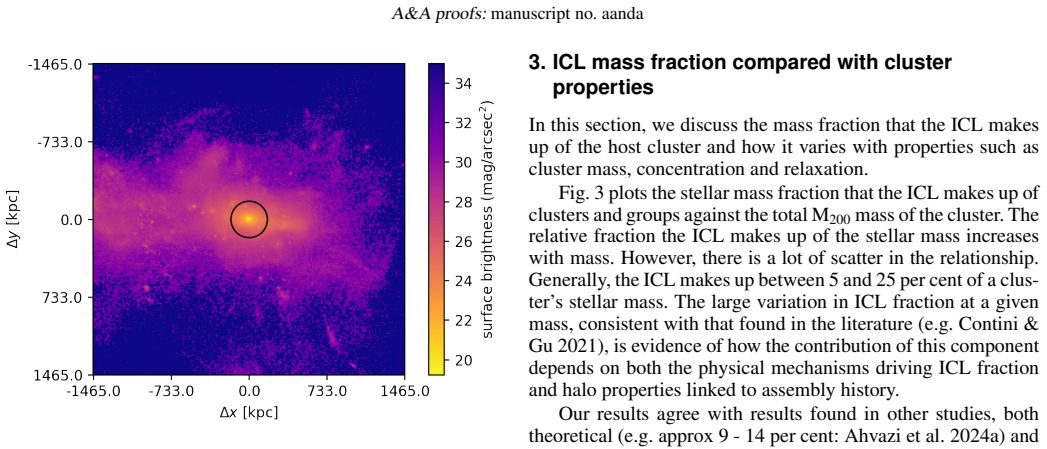
The surface brightness cut of 26.5 mag/arcsec² at the Holmberg radius that assigns stars inside the cut to the brightest cluster galaxy and stars outside the cut to the intracluster light.
If this is right
- The fraction of cluster light in the ICL grows slowly with total cluster mass and with the time elapsed since the central galaxy's last major merger.
- More concentrated clusters contain a smaller share of their stars in the ICL.
- The combined BCG plus ICL system always shows negative gradients in both color and metallicity.
- The ICL and BCG draw from many of the same progenitor galaxies but their single largest contributor is usually different.
Where Pith is reading between the lines
- Observations that adopt a slightly brighter or fainter surface brightness limit could reassign stars between the two components and reduce or erase the reported differences in progenitor mass and in-situ fraction.
- The link between ICL fraction and time since last merger implies that clusters with recent major activity should show less extended light at fixed mass.
- Because properties are tied to each system's specific history, average relations across many clusters may mask large object-to-object scatter in real data.
Load-bearing premise
The fixed surface brightness cut of 26.5 mag/arcsec² at the Holmberg radius cleanly separates BCG-attached stars from ICL stars without significant misclassification or sensitivity to the exact threshold choice.
What would settle it
Deep imaging of real clusters that measures the color and metallicity difference between the central galaxy and surrounding light at the same surface brightness limit and finds no systematic offset with the outer component being bluer and more metal-poor.
Figures



read the original abstract
Context. Intracluster Light (ICL) is a faint stellar component of galaxy groups and clusters bound to the cluster potential, and making up a significant fraction of the cluster mass. ICL formation and evolution is strongly linked to the Brightest Cluster Galaxies of clusters. Aims. To compare the properties and progenitor galaxies of the Intracluster Light (ICL) and Brightest Cluster Galaxies (BCGs) of clusters and groups at redshift z = 0, and determine how they coevolve. Methods. We select 127 clusters and groups in the hydrodynamic Illustris-TNG100 simulation above a mass of $10^{13} M_\odot$. We divide the ICL from the BCG by applying a surface brightness cut at the Holmberg radius of 26.5 mag/arcsec$^{-2}$, where star particles within this radius are defined as being attached to the BCG, and outside, the ICL. We then study the properties and formation history of the ICL and BCG. Results. We find the ICL is generally composed of material from stripped or merged intermediate mass galaxies, with a smaller in-situ component, while the BCG is composed of more massive merged galaxies and has a larger in-situ fraction. The ICL mass fraction increases weakly with cluster mass, declines with concentration and increases with time since the BCGs most recent major merger. The ICL is bluer and more metal-poor than the BCG, but there is no significant difference in the age of the material. Universally, BCG+ICL systems have negative colour and metallicity gradients. The ICL and BCG share a high fraction of progenitor galaxies, but the most significant progenitor is frequently not shared. Conclusions. ICL properties and formation are tied to the formation histories of the host cluster and BCG, and thus their properties are individual to each system. Although the ICL and BCG coevolve, they have distinct formation histories and properties.
Editorial analysis
A structured set of objections, weighed in public.
Referee Report
Summary. The manuscript analyzes the coevolution of intracluster light (ICL) and brightest cluster galaxies (BCGs) in 127 clusters and groups with M > 10^13 M_⊙ selected from the Illustris-TNG100 hydrodynamic simulation. Star particles are partitioned into BCG (inside the Holmberg radius at a fixed surface-brightness threshold of 26.5 mag arcsec^{-2}) and ICL (outside) components. Direct particle tracking is used to determine progenitor galaxy contributions, in-situ fractions, merger histories, and photometric properties. The central result is that ICL is assembled mainly from stripped or merged intermediate-mass galaxies with a modest in-situ component, while BCGs incorporate more massive mergers and exhibit a higher in-situ fraction; the two components share many but not all progenitors and display distinct mass-fraction trends with cluster properties.
Significance. If the classification is robust, the work supplies a statistically useful sample of individual cluster formation histories and demonstrates that ICL and BCGs, while coevolving, retain distinguishable assembly channels. Credit is due for the use of a public simulation, direct particle tracking rather than fitted quantities, and the emphasis on system-to-system variation instead of ensemble averages.
major comments (1)
- [Methods (component separation)] The separation of ICL from BCG is performed with a single fixed surface-brightness threshold of 26.5 mag arcsec^{-2} evaluated at the Holmberg radius (described in the Methods section on component definition). This operational cut directly determines which star particles are attributed to each component and therefore controls the reported differences in median progenitor masses, in-situ fractions, and merger histories across the 127 systems. No tests of sensitivity to the precise threshold value, to projection effects, or to cluster concentration are presented, leaving open the possibility that the claimed distinctions are partly methodological.
minor comments (2)
- [Abstract] The abstract states the sample size and simulation but could usefully include a one-sentence summary of the robustness checks performed on the surface-brightness cut.
- [Throughout] Notation for the surface-brightness threshold is given as 26.5 mag/arcsec^{-2}; consistency with standard units (mag arcsec^{-2}) should be checked throughout the text and figures.
Simulated Author's Rebuttal
We thank the referee for their positive assessment of our work and for the constructive comment on the robustness of our ICL/BCG separation. We address the major comment below and have revised the manuscript to include additional sensitivity tests.
read point-by-point responses
-
Referee: The separation of ICL from BCG is performed with a single fixed surface-brightness threshold of 26.5 mag arcsec^{-2} evaluated at the Holmberg radius (described in the Methods section on component definition). This operational cut directly determines which star particles are attributed to each component and therefore controls the reported differences in median progenitor masses, in-situ fractions, and merger histories across the 127 systems. No tests of sensitivity to the precise threshold value, to projection effects, or to cluster concentration are presented, leaving open the possibility that the claimed distinctions are partly methodological.
Authors: We agree that a fixed threshold is a methodological choice whose impact should be quantified. In the revised manuscript we have added a dedicated subsection (Section 2.3) and Appendix A that test variations of the surface-brightness threshold at 25.5 and 27.5 mag arcsec^{-2}. While the absolute ICL mass fractions shift as expected, the relative differences in median progenitor mass, in-situ fraction, and merger history between ICL and BCG remain qualitatively unchanged. We have also added a brief discussion of projection effects, noting that the Holmberg radius is computed in projection to match observational practice and that repeating the analysis with a 3D spherical radius produces consistent trends. Finally, we bin the sample by cluster concentration and show that the reported distinctions persist across concentration quartiles. These additions directly address the concern and strengthen the robustness of the conclusions. revision: yes
Circularity Check
No significant circularity in the derivation chain
full rationale
The paper selects 127 clusters from the public Illustris-TNG100 simulation and classifies star particles into BCG versus ICL components via a fixed operational surface-brightness threshold (26.5 mag/arcsec² at the Holmberg radius). All reported fractions, progenitor-mass distributions, in-situ fractions, and gradients are obtained by direct particle tracking and counting within that simulation. No equations reduce these quantities to parameters fitted from the same data, no self-citations supply load-bearing uniqueness theorems, and the separation criterion is not defined in terms of the final results. The analysis is therefore self-contained against external benchmarks.
Axiom & Free-Parameter Ledger
free parameters (2)
- Surface brightness threshold =
26.5 mag/arcsec^{2}
- Cluster mass threshold =
10^13 M_⊙
axioms (1)
- domain assumption The Illustris-TNG100 simulation produces realistic stellar populations and merger histories for clusters above 10^13 solar masses.
Reference graph
Works this paper leans on
-
[1]
Ahvazi, N., Sales, L. V ., Navarro, J. F., et al. 2024b, arXiv e-prints, arXiv:2403.04839 Aldás, F., Zenteno, A., Gómez, F. A., et al. 2023, MNRAS, 525, 1769–1778 Alonso Asensio, I., Dalla Vecchia, C., Bahé, Y . M., Barnes, D. J., & Kay, S. T. 2020, MNRAS, 494, 1859–1864
-
[2]
Anbajagane, D., Evrard, A. E., & Farahi, A. 2021, MNRAS, 509, 3441–3461
work page 2021
-
[3]
Aragon-Salamanca, A., Baugh, C. M., & Kau ffmann, G. 1998, MNRAS, 297, 427
work page 1998
- [4]
-
[5]
Brown, H., Martin, G., Pearce, F., et al. 2024, MNRAS, 534, 431
work page 2024
- [6]
-
[7]
Chun, K., Shin, J., Smith, R., Ko, J., & Yoo, J. 2023, ApJ, 943, 148
work page 2023
- [8]
-
[9]
Contini, E., De Lucia, G., Villalobos, Á., & Borgani, S. 2014, MNRAS, 437, 3787
work page 2014
-
[10]
Contini, E. & Gu, Q. 2021, The Astrophysical Journal, 915, 106
work page 2021
-
[11]
Contini, E., Yi, S. K., & Jeon, S. 2024, arXiv e-prints, arXiv:2404.01560
- [12]
- [13]
-
[14]
Cooper, A. P., Gao, L., Guo, Q., et al. 2015, MNRAS, 451, 2703
work page 2015
-
[15]
Cui, W., Knebe, A., Yepes, G., et al. 2018, MNRAS, 480, 2898–2915
work page 2018
-
[16]
Davis, M., Efstathiou, G., Frenk, C. S., & White, S. D. M. 1985, ApJ, 292, 371 de Oliveira, N. O. L., Jiménez-Teja, Y ., & Dupke, R. 2022, MNRAS, 512, 1916
work page 1985
-
[17]
DeMaio, T., Gonzalez, A. H., Zabludoff, A., et al. 2020, MNRAS, 491, 3751
work page 2020
-
[18]
H., Zabludo ff, A., Zaritsky, D., & Brada ˇc, M
DeMaio, T., Gonzalez, A. H., Zabludo ff, A., Zaritsky, D., & Brada ˇc, M. 2015, MNRAS, 448, 1162
work page 2015
-
[19]
DeMaio, T., Gonzalez, A. H., Zabludoff, A., et al. 2018, MNRAS, 474, 3009
work page 2018
-
[20]
Dolag, K., Borgani, S., Murante, G., & Springel, V . 2009, MNRAS, 399, 497
work page 2009
-
[21]
Furnell, K. E., Collins, C. A., Kelvin, L. S., et al. 2021, MNRAS, 502, 2419–2437
work page 2021
-
[22]
Genel, S., V ogelsberger, M., Springel, V ., et al. 2014, MNRAS, 445, 175–200
work page 2014
-
[23]
Golden-Marx, J. B., Zhang, Y ., Ogando, R. L. C., et al. 2023, MNRAS, 521, 478–496
work page 2023
-
[24]
Guo, Q., White, S., Boylan-Kolchin, M., et al. 2011, MNRAS, 413, 101
work page 2011
-
[25]
Haggar, R., De Luca, F., De Petris, M., et al. 2024, MNRAS, 532, 1031–1048
work page 2024
-
[26]
Harris, K. A., Debattista, V . P., Governato, F., et al. 2017, MNRAS, 467, 4501–4513
work page 2017
-
[27]
1958, Lund astronomical observatory, Lund, Sweden, 1
Holmberg, E. 1958, Lund astronomical observatory, Lund, Sweden, 1
work page 1958
-
[28]
2017, The Astrophysical Journal, 851, 75
Iodice, E., Spavone, M., Cantiello, M., et al. 2017, The Astrophysical Journal, 851, 75
work page 2017
-
[29]
Jiang, F. & van den Bosch, F. C. 2017, MNRAS, 472, 657–674 Jiménez-Teja, Y ., Dupke, R. A., Lopes de Oliveira, R., et al. 2019, A&A, 622, A183 Jiménez-Teja, Y ., Dupke, R., Benítez, N., et al. 2018, The Astrophysical Journal, 857, 79 Jiménez-Teja, Y ., Dupke, R. A., Lopes, P. A. A., & Vílchez, J. M. 2023, Astron- omy & Astrophysics, 676, A39
work page 2017
- [30]
- [31]
-
[32]
2023, Astronomy & As- trophysics, 677, A89
Khoperskov, S., Minchev, I., Libeskind, N., et al. 2023, Astronomy & As- trophysics, 677, A89
work page 2023
- [33]
-
[34]
Kluge, M., Neureiter, B., Riffeser, A., et al. 2020, ApJS, 247, 43
work page 2020
-
[35]
2018, Astronomy Letters, 44, 8
Kravtsov, A., Vikhlinin, A., & Meshcheryakov, A. 2018, Astronomy Letters, 44, 8
work page 2018
-
[36]
Lidman, C., Suherli, J., Muzzin, A., et al. 2012, MNRAS, 427, 550
work page 2012
-
[37]
F., Faucher-Giguère, C.-A., et al
Ma, X., Hopkins, P. F., Faucher-Giguère, C.-A., et al. 2015, MNRAS, 456, 2140–2156
work page 2015
-
[38]
Marinacci, F., V ogelsberger, M., Pakmor, R., et al. 2018, MNRAS, 480, 5113
work page 2018
-
[39]
Marini, I., Borgani, S., Saro, A., et al. 2022, MNRAS, 514, 3082–3096
work page 2022
- [40]
-
[41]
Melnick, J., Giraud, E., Toledo, I., Selman, F., & Quintana, H. 2012, MNRAS, 427, 850–858
work page 2012
-
[42]
Mihos, J. C. 2015, Proceedings of the International Astronomical Union, 11, 27–34
work page 2015
-
[43]
Mihos, J. C., Harding, P., Feldmeier, J. J., et al. 2017, ApJ, 834, 16
work page 2017
-
[44]
Monaco, P., Murante, G., Borgani, S., & Fontanot, F. 2006, ApJ, 652, L89
work page 2006
-
[45]
Montenegro-Taborda, D., Rodriguez-Gomez, V ., Pillepich, A., et al. 2023, MN- RAS, 521, 800–817
work page 2023
- [46]
- [47]
-
[48]
Morishita, T., Abramson, L. E., Treu, T., et al. 2017, ApJ, 846, 139
work page 2017
-
[49]
Murante, G., Giovalli, M., Gerhard, O., et al. 2007, MNRAS, 377, 2
work page 2007
-
[50]
P., Pillepich, A., Springel, V ., et al
Naiman, J. P., Pillepich, A., Springel, V ., et al. 2018, MNRAS, 477, 1206
work page 2018
-
[51]
2015, Astronomy and Computing, 13, 12–37
Nelson, D., Pillepich, A., Genel, S., et al. 2015, Astronomy and Computing, 13, 12–37
work page 2015
-
[52]
Nelson, D., Pillepich, A., Springel, V ., et al. 2018, MNRAS, 475, 624
work page 2018
-
[53]
2019, Computational Astrophysics and Cosmology, 6, 2
Nelson, D., Springel, V ., Pillepich, A., et al. 2019, Computational Astrophysics and Cosmology, 6, 2
work page 2019
-
[54]
Oliva-Altamirano, P., Brough, S., Lidman, C., et al. 2014, MNRAS, 440, 762
work page 2014
-
[55]
Pillepich, A., Nelson, D., Hernquist, L., et al. 2018, MNRAS, 475, 648
work page 2018
-
[56]
Pillepich, A., Nelson, D., Springel, V ., et al. 2019, MNRAS, 490, 3196
work page 2019
- [57]
-
[58]
Puchwein, E., Springel, V ., Sijacki, D., & Dolag, K. 2010, MNRAS, 406, 936
work page 2010
-
[59]
2021, Astronomy & Astro- physics, 647, A95
Pulsoni, C., Gerhard, O., Arnaboldi, M., et al. 2021, Astronomy & Astro- physics, 647, A95
work page 2021
-
[60]
2023, Astronomy & Astro- physics, 670, L20
Ragusa, R., Iodice, E., Spavone, M., et al. 2023, Astronomy & Astro- physics, 670, L20
work page 2023
-
[61]
2021, Astronomy & Astro- physics, 651, A39
Ragusa, R., Spavone, M., Iodice, E., et al. 2021, Astronomy & Astro- physics, 651, A39
work page 2021
-
[62]
2020, Astronomy & Astrophysics, 640
Raj, M., Iodice, E., Napolitano, N., et al. 2020, Astronomy & Astrophysics, 640
work page 2020
- [63]
-
[64]
Rodriguez-Gomez, V ., Pillepich, A., Sales, L. V ., et al. 2016, MNRAS, 458, 2371
work page 2016
-
[65]
Rudick, C. S., Mihos, J. C., Frey, L. H., & McBride, C. K. 2009, ApJ, 699, 1518
work page 2009
-
[66]
Rudick, C. S., Mihos, J. C., & McBride, C. K. 2011, The Astrophysical Journal, 732, 48
work page 2011
-
[67]
Shaw, L. D., Weller, J., Ostriker, J. P., & Bode, P. 2006, The Astrophysical Jour- nal, 646, 815–833
work page 2006
-
[68]
Somerville, R. S., Hopkins, P. F., Cox, T. J., Robertson, B. E., & Hernquist, L. 2008, MNRAS, 391, 481
work page 2008
- [69]
-
[70]
Springel, V ., Pakmor, R., Pillepich, A., et al. 2018, MNRAS, 475, 676
work page 2018
-
[71]
Springel, V ., White, S. D. M., Tormen, G., & Kau ffmann, G. 2001, MNRAS, 328, 726
work page 2001
- [72]
-
[73]
Torrey, P., Snyder, G. F., V ogelsberger, M., et al. 2015, MNRAS, 447, 2753–2771 V ogelsberger, M., Genel, S., Sijacki, D., et al. 2013, MNRAS, 436, 3031
work page 2015
- [74]
- [75]
- [76]
-
[77]
1951, PASP, 63, 61 Article number, page 16 of 16
Zwicky, F. 1951, PASP, 63, 61 Article number, page 16 of 16
work page 1951
discussion (0)
Sign in with ORCID, Apple, or X to comment. Anyone can read and Pith papers without signing in.