REVIEW 4 major objections 5 minor 17 references
eSapiens: A Real-World NLP Framework for Multimodal Document Understanding and Enterprise Knowledge Processing
T0 review · 4 major / 5 minor · reviewed 2026-08-06 · deepseek-v4-flash
Pith's one-line read A hybrid retrieval pipeline with citation checks beats vector-only search on enterprise QA.
desk verdict A well-described enterprise RAG/T2S system whose own Table 3 contradicts the abstract's factual-grounding claim — the architecture is worth a look, the headline needs revision. read the letter →
The pith
A machine-rendered reading of the paper's core claim, the machinery that carries it, and where it could break.
The reading
What carries the argument
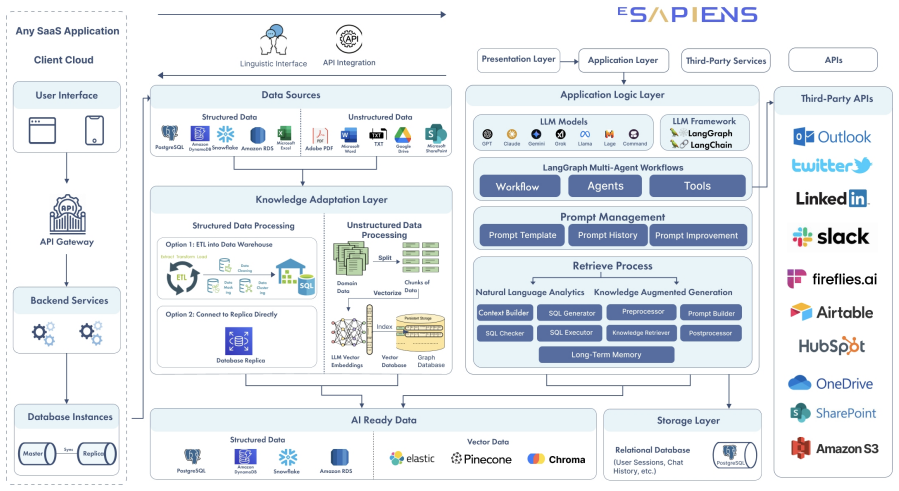
The load-bearing machinery is the hybrid retrieval and grounding pipeline: a stateful execution graph in which a supervisor agent routes each query, an index combining HNSW dense vectors and BM25 sparse keyword search returns the top 200 candidate passages, a commercial reranker narrows these to the top 50 snippets, and a citation-verification loop checks every generated sentence against the retrieved snippets, triggering regeneration when a cited statement is unsupported. The T2S module contributes a bounded retry loop that reads SQL error messages and regenerates queries, which the paper credits for recovering from schema and syntax failures.
What would settle it
Re-run the comparison on a large, publicly fixed sample of RAGTruth questions with multiple annotators, pre-registered scoring, and confidence intervals; the claim is settled if eSapiens no longer shows higher context relevance and accuracy, or if its hallucination rate is not higher than FAISS. A negative result would also follow if removing the citation-verification loop leaves answer quality unchanged.
Extended reading notes
Core claim
On its own terms, the paper demonstrates that eSapiens' hybrid retrieval pipeline—dense vector search plus sparse keyword search, reranked by a commercial model—and its citation-verification loop supply the generation stage with more semantically targeted passages, and that this translates into higher context-relevance scores and higher human-rated accuracy than a FAISS top-k pipeline on the RAGTruth question set across GPT-4o, GPT-4o-mini, Claude 3.7, Gemini 1.5 Pro, and DeepSeek R1. The paper also reports that the FAISS baseline exhibits lower hallucination, and positions eSapiens' optional strict-grounding mode as the remedy for that tradeoff.
Load-bearing premise
The evaluation assumes that the RAGTruth question subset and the TRACe metrics—including human accuracy ratings and the hallucination measure—are reliable and representative of real enterprise workloads, but the paper reports point estimates without confidence intervals, annotator agreement, or the number of test questions.
Editorial extensions
If this is right
- If eSapiens works as claimed, enterprise users can get more contextually relevant answers from the same underlying LLM simply by changing the retrieval and verification pipeline.
- The strict-grounding preset gives a compliance-mode answer generation that refuses to produce unsupported sentences, potentially making RAG usable in regulated industries.
- The hybrid retrieval design is reported to generalize across five different LLMs, suggesting the pipeline gains do not depend on a single model.
- The T2S self-healing loop implies that many natural-language SQL failures can be recovered automatically without human intervention.
Reading between the lines
- The citation-verification loop could in principle be extracted and used as a standalone hallucination checker for any RAG system, independent of eSapiens.
- The reported tradeoff (lower hallucination for FAISS, higher relevance and accuracy for eSapiens) suggests a controllable fidelity-fluency dial; whether that dial can be tuned without losing relevance is a testable question.
- Because the paper compares pipelines with the same LLM held fixed, its results imply retrieval design and post-processing matter as much as model choice for enterprise answer quality.
- The legal-domain retrieval tables suggest chunk size interacts with document structure, so a document-type-aware chunking policy could extend eSapiens beyond fixed 1000-token windows.
Editorial analysis
A structured set of objections, weighed in public.
Referee Report
Summary. The paper introduces eSapiens, an enterprise question-answering system that combines a Text-to-SQL module for structured databases with a hybrid retrieval-augmented generation (RAG) module for unstructured documents. The RAG pipeline uses dense HNSW and sparse BM25 retrieval, a commercial reranker, and a citation verification loop intended to enforce grounded generation. The authors evaluate retrieval quality on four LegalBench datasets at two chunk sizes, compare answer quality against a FAISS baseline on the RAGTruth benchmark across five LLMs using TRACe-style metrics, and include an appendix with seven anecdotal Text-to-SQL queries. The central reported findings are that eSapiens improves contextual relevance and human-rated accuracy/fluency, while the FAISS baseline has lower hallucination rates and generally higher completeness. The paper concludes, however, that eSapiens outperforms FAISS in 'relevance, fluency, and factual grounding,' a claim that conflicts with the paper's own Table 3.
Significance. A production-oriented system that unifies structured and unstructured enterprise data access and provides citation-aware generation is a useful engineering contribution, and the paper deserves credit for evaluating across five LLMs and using external benchmarks (LegalBench and RAGTruth) rather than only self-reported examples. The explicit reporting of hallucination and completeness numbers, even when unfavorable, is a strength in transparency. That said, the core comparative claim of factual-grounding superiority is contradicted by the paper's own quantitative results, and the absence of statistical detail (confidence intervals, annotator agreement, question counts) makes the remaining positive claims difficult to assess. The paper is best read as a system description with preliminary evaluation; in its current form it does not support the stronger conclusions stated in the abstract and conclusion.
major comments (4)
- [Table 3 and Conclusion] The conclusion that eSapiens outperforms FAISS 'in relevance, fluency, and factual grounding' is contradicted by Table 3. For every LLM, the eSapiens pipeline reports higher hallucination (lower is better) than the corresponding FAISS baseline; for example, eSapiens-gpt4o has hallucination 0.1823 versus 0.0875 for faiss+top-2+short+gpt4o, and the same pattern holds for all five models. Completeness is also lower for eSapiens in four of five rows. The TRACe Evaluation section itself acknowledges that FAISS has 'consistently lower hallucination rates' and 'stricter factuality guarantees.' The factual-grounding component of the conclusion must be removed or replaced with results from the 'strict grounding' preset, which is mentioned but never evaluated.
- [TRACe Evaluation, Table 3] The TRACe evaluation reports only point estimates with no confidence intervals, no annotator agreement statistics, and no number of test questions. The text describes the question set as 'consistent and representative' but does not specify its size, sampling method, or relation to the full RAGTruth benchmark. Without this information, the observed differences in contextual relevance and human-rated accuracy between eSapiens and FAISS cannot be distinguished from noise, especially given that hallucination and completeness favor the baseline.
- [RAG Module Architecture] The paper states that the citation verification loop 'ensures factual integrity and traceability' and that the system regenerates until all cited statements are supported, yet Table 3 shows that eSapiens has higher hallucination than a simple FAISS baseline across all five LLMs. This indicates that the verification loop either does not operate as described or is ineffective at preventing unsupported claims. The authors should report the verification loop's pass/fail statistics or an ablation comparing eSapiens with and without the loop; currently the architecture's central grounding mechanism is unsupported by the presented evidence.
- [Retrieval Performance on Long-form Legal QA] The LegalBench retrieval analysis (Tables 1 and 2) reports recall and precision for eSapiens alone, without any baseline or downstream QA evaluation. The absolute numbers are low, especially for MAUD (Recall@50 of 22.60% at chunk 500 and 13.60% at chunk 1000), which undermines the claim that the results 'affirm that the design of the eSapiens RAG module ensures robust and generalizable performance.' A comparison against at least one standard retrieval baseline, or a task-level metric such as answer accuracy, is needed before drawing conclusions about robustness.
minor comments (5)
- [Experiment] The text lists 'citation faithfulness, contextual relevance, factual correctness, and information completeness' as the four key metrics, but Table 3 reports 'completeness, utilization, context relevance, hallucination, and accuracy.' The metric names should be aligned.
- [Tables 1-3] The benchmark name is written inconsistently as 'RAGtruth' in Table 3 and 'RAGTruth' elsewhere; please standardize.
- [Appendix A] The T2S evaluation is based on only seven hand-picked queries with anonymized baselines and no quantitative success/failure counts; it should be labeled as a case study or pilot rather than an evaluation.
- [RAG Module Architecture] The 'large-scale embedding model' and 'commercial reranking model' are never named, which prevents reproducibility; please provide model names or versions.
- [Retrieval Performance on Long-form Legal QA] The abstract and architecture describe 'approximately 1000 tokens' chunks, and the experiments compare chunk sizes 500 and 1000, but the exact tokenization and overlap settings are not stated; please specify them.
Circularity Check
No circularity: the central comparison is against external benchmarks and no load-bearing step reduces to its own inputs.
full rationale
I examined the paper's derivation chain for circularity. The central claim is that eSapiens outperforms a FAISS baseline on RAGTruth. This is an external-benchmark comparison: RAGTruth and LegalBench are used as ground truth, and the FAISS baseline is an independent retrieval pipeline, not a reparameterization of eSapiens' own outputs. No fitted parameter is renamed as a prediction, no uniqueness theorem is imported from the authors' prior work, and the paper contains no self-citations that carry argumentative weight. The citation verification loop is described architecturally and is then evaluated indirectly through reported metrics; it is not defined in terms of those metrics by construction. The retrieval configuration choices (chunk size 500 vs. 1000, top-k depths) are ablations, not fitted values that directly produce the headline result. The notable problem is internal inconsistency rather than circularity: Table 3 and the TRACe section state that the FAISS baseline has 'consistently lower hallucination rates' and higher completeness in most rows, which contradicts the Conclusion's claim of outperforming FAISS in 'factual grounding.' That contradiction undermines the factual-grounding claim's support, but it is not a case of a derivation reducing to its inputs. Therefore the appropriate circularity score is 0.
Assumptions & free parameters
free parameters (3)
- chunk_size =
1000 tokens
- top_k_after_rerank =
50
- candidate_pool_size =
200
assumptions (4)
- domain assumption RAGTruth and TRACe annotations provide valid ground truth for hallucination, completeness, context relevance, and accuracy.
- domain assumption LegalBench datasets (PrivacyQA, CUAD, MAUD, ContractNLI) are representative of enterprise legal question answering.
- domain assumption The commercial reranker and embedding model are treated as black boxes with adequate quality.
- domain assumption Large language model outputs are deterministic enough for single-run evaluation.
Cite this review
Pith. "Pith review of eSapiens: A Real-World NLP Framework for Multimodal Document Understanding and Enterprise Knowledge Processing." pith.science (2026). https://pith.science/paper/3U4Q3DVU
@misc{pith2026250616768,
  author       = {Pith},
  title        = {Pith review of: eSapiens: A Real-World NLP Framework for Multimodal Document Understanding and Enterprise Knowledge Processing},
  year         = {2026},
  howpublished = {\url{https://pith.science/paper/3U4Q3DVU}},
  note         = {Machine review of arXiv:2506.16768}
}
read the original abstract
We introduce eSapiens, a unified question-answering system designed for enterprise settings, which bridges structured databases and unstructured textual corpora via a dual-module architecture. The system combines a Text-to-SQL planner with a hybrid Retrieval-Augmented Generation (RAG) pipeline, enabling natural language access to both relational data and free-form documents. To enhance answer faithfulness, the RAG module integrates dense and sparse retrieval, commercial reranking, and a citation verification loop that ensures grounding consistency. We evaluate eSapiens on the RAGTruth benchmark across five leading large language models (LLMs), analyzing performance across key dimensions such as completeness, hallucination, and context utilization. Results demonstrate that eSapiens outperforms a FAISS baseline in contextual relevance and generation quality, with optional strict-grounding controls for high-stakes scenarios. This work provides a deployable framework for robust, citation-aware question answering in real-world enterprise applications.
Figures
Reference graph
Works this paper leans on
-
[1]
Xuemei Dong, Chao Zhang, Yuhang Chen, Jie Chen, Xinyun Chen, and Jian-Guang Lou. 2023. https://arxiv.org/abs/2307.07306 C3: Zero-shot text-to-sql with chatgpt . In arXiv preprint arXiv:2307.07306
arXiv 2023
-
[2]
Dawei Gao, Haibin Wang, Yaliang Li, Xiuyu Sun, Yichen Qian, Bolin Ding, and Jingren Zhou. 2023. https://arxiv.org/abs/2308.15363 Text-to-sql empowered by large language models: A benchmark evaluation . Preprint, arXiv:2308.15363
arXiv 2023
-
[3]
Jiaqi Guo, Zhen Zhan, Yan Gao, Taolan Yan, Jian-Guang Lou, and Ting Liu. 2019. https://aclanthology.org/P19-1444 Towards complex text-to-sql in cross-domain database with intermediate representation . In ACL
work page 2019
-
[4]
Kelvin Guu, Kenton Lee, Zora Tung, Panupong Pasupat, and Mingwei Chang. 2020. https://proceedings.mlr.press/v119/guu20a.html Retrieval augmented language model pre-training . In Proceedings of the 37th International Conference on Machine Learning, volume 119 of Proceedings of Machine Learning Research, pages 3929--3938. PMLR
2020
-
[5]
Gautier Izacard, Patrick Lewis, Maria Lomeli, Lucas Hosseini, Fabio Petroni, Timo Schick, Jane Dwivedi-Yu, Armand Joulin, Sebastian Riedel, and Edouard Grave. 2023. http://jmlr.org/papers/v24/23-0037.html Atlas: Few-shot learning with retrieval augmented language models . Journal of Machine Learning Research, 24(251):1--43
work page 2023
-
[6]
Vladimir Karpukhin, Barlas Oguz, Sewon Min, Patrick Lewis, Ledell Wu, Sergey Edunov, Danqi Chen, and Wen-tau Yih. 2020. https://aclanthology.org/2020.emnlp-main.550 Dense passage retrieval for open-domain question answering . In EMNLP
work page 2020
-
[7]
Omar Khattab and Matei Zaharia. 2020. https://dl.acm.org/doi/10.1145/3397271.3401075 Colbert: Efficient and effective passage search via contextualized late interaction over bert . In SIGIR
arXiv 2020
-
[8]
Patrick Lewis, Ethan Perez, Aleksandra Piktus, Fabio Petroni, Vladimir Karpukhin, Naman Goyal, Heinrich Küttler, Mike Lewis, Wen-tau Yih, Tim Rocktäschel, and 1 others. 2020. https://proceedings.neurips.cc/paper/2020/hash/6b493230205f780e1bc26945df7481e5-Abstract.html Retrieval-augmented generation for knowledge-intensive nlp tasks . In NeurIPS
work page 2020
Show all 17 references
-
[9]
Fabio Petroni, Aleksandra Piktus, Angela Fan, Patrick Lewis, Majid Yazdani, Mostafa Dehghani, Armand Joulin, and Sebastian Riedel. 2021. https://aclanthology.org/2021.naacl-main.200 Kilt: a benchmark for knowledge intensive language tasks . In NAACL
2021
-
[10]
Mohammadreza Pourreza and Davood Rafiei. 2023. https://proceedings.neurips.cc/paper_files/paper/2023/file/72223cc66f63ca1aa59edaec1b3670e6-Paper-Conference.pdf Din-sql: Decomposed in-context learning of text-to-sql with self-correction . In Advances in Neural Information Proce...
2023
-
[11]
Bailin Wang, Richard Shin, Xiaodong Liu, Oleksandr Polozov, and Matthew Richardson. 2019. Rat-sql: Relation-aware schema encoding and linking for text-to-sql parsers. arXiv preprint arXiv:1911.04942
2019 arXiv
-
[12]
Xiaojun Xu, Chang Liu, and Dawn Song. 2017. https://arxiv.org/abs/1711.04436 Sqlnet: Generating structured queries from natural language without reinforcement learning . In arXiv preprint arXiv:1711.04436
2017 arXiv
-
[13]
Tao Yu, Michihiro Yasunaga, Kai Yang, Rui Zhang, Danqi Wang, Zifan Li, and Dragomir Radev. 2018 a . https://aclanthology.org/D18-1193 Syntaxsqlnet: Syntax tree networks for complex and cross-domain text-to-sql task . In EMNLP
2018
-
[14]
Tao Yu, Rui Zhang, Kai Yang, Michihiro Yasunaga, Danqi Wang, Zifan Li, James Ma, Irene Li, Qingning Yao, Zelle Roman, and 1 others. 2018 b . https://aclanthology.org/D18-1425 Spider: A large-scale human-labeled dataset for complex and cross-domain semantic parsing and text-to-...
2018
-
[15]
Victor Zhong, Caiming Xiong, and Richard Socher. 2017. https://arxiv.org/abs/1709.00103 Seq2sql: Generating structured queries from natural language using reinforcement learning . In arXiv preprint arXiv:1709.00103
2017 arXiv
-
[16]
online" 'onlinestring :=
ENTRY address archivePrefix author booktitle chapter edition editor eid eprint eprinttype howpublished institution journal key month note number organization pages publisher school series title type volume year doi pubmed url lastchecked label extra.label sort.label short.list...
-
[17]
write newline
" write newline "" before.all 'output.state := FUNCTION n.dashify 't := "" t empty not t #1 #1 substring "-" = t #1 #2 substring "--" = not "--" * t #2 global.max substring 't := t #1 #1 substring "-" = "-" * t #2 global.max substring 't := while if t #1 #1 substring * t #2 gl...
Reviewed August 6, 2026 · model on record in the stance chip above.
Discussion (0). Continue with ORCID to comment.