REVIEW 4 major objections 6 minor 39 references
Comparison of substructured non-overlapping domain decomposition and overlapping additive Schwarz methods for large-scale Helmholtz problems with multiple sources
T0 review · 4 major / 6 minor · reviewed 2026-08-06 · deepseek-v4-flash
Pith's one-line read On a 630-million-unknown seismic problem, a non-overlapping substructured solver beats the overlapping preconditioner by about 2x in time.
desk verdict A credible and useful engineering comparison that gives OSM a real factor-of-two edge on large multi-source Helmholtz problems, but the unreported tuning parameters and single-run timings need attention before the numbers become doctrine. read the letter →
The pith
A machine-rendered reading of the paper's core claim, the machinery that carries it, and where it could break.
The reading
What carries the argument
The load-bearing object is the substructured interface problem $(I - T)g = b$, a Schur complement of the coupled subdomain Helmholtz systems with respect to the interface fields $g$, on which GMRES is applied directly without a preconditioner. The operator $T$ is the exchange operator that maps incoming waves on each interface to outgoing waves, with local solves built in, and the right-hand side $b$ encodes the sources. For both methods the second-order transmission operator $S = \alpha + \beta\Delta_{\Sigma}$, with complex coefficients $\alpha$ and $\beta$ tuned numerically to minimize Krylov iterations, is the main convergence lever; in ORAS the same transmission conditions appear inside the preconditioner $M^{-1}_{\mathrm{ORAS}} = \sum_i R_i^T D_i A_i^{-1} R_i$.
What would settle it
Run the 6.25 Hz, 16,384-subdomain case with both methods and compare the true L2 error of the final solution against a reference obtained on a coarser grid or with a different solver. If OSM's solution error is more than a small factor worse than ORAS's at the same 1e-4 residual tolerance, the reported time comparison is biased; alternatively, if ORAS with matched true accuracy and a large enough batch size finishes no slower than OSM, the central claim fails.
Extended reading notes
Core claim
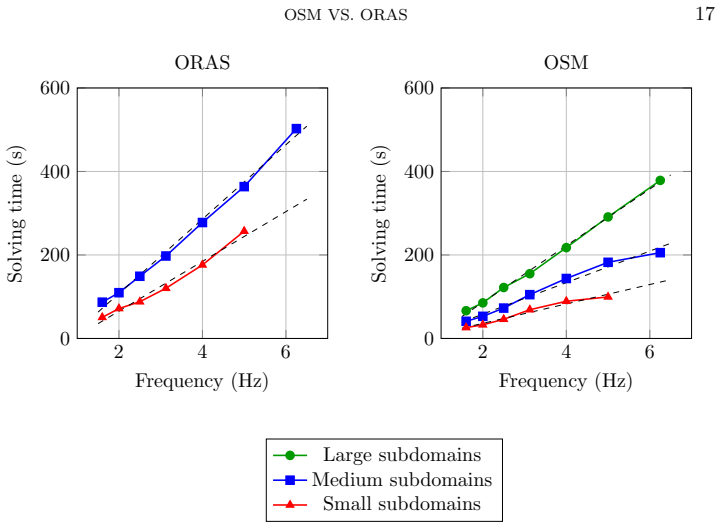
On a realistic geophysical benchmark with up to 630.1 million degrees of freedom and 64 simultaneous sources, the non-overlapping substructured Optimized Schwarz Method with numerically optimized second-order transmission conditions $S = \alpha + \beta\Delta_{\Sigma}$ outperforms the Optimized Restricted Additive Schwarz preconditioner by roughly a factor of two in total wall time (205.5 s vs 502.6 s for the largest case) while consuming substantially less memory. The advantage comes from three compounding effects: smaller subdomains (no overlap), a substructured interface problem over which GMRES iterates (typically 5 to 10 times fewer unknowns), and replacement of the global sparse matrix-vector product by local interface operations. The paper also shows that with basic zeroth-order conditions ORAS converges faster, but the second-order conditions shrink that gap enough that OSM's cheaper iterations dominate.
Load-bearing premise
The optimized transmission coefficients and the relationship between residual and true L2 error are calibrated on a 2 Hz, 256-subdomain case; the entire large-scale comparison assumes those settings transfer to every frequency, mesh, and partitioning, and that the same 1e-4 relative GMRES tolerance gives both methods equal true accuracy.
Editorial extensions
If this is right
- On the tested GO 3D OBS configuration, OSM's total solve time stays below half of ORAS's up to 6.25 Hz and 16,384 subdomains; the factor-of-two gap persists across the whole weak-scaling sweep.
- Memory per process is low enough with OSM that a 20-million-unknown problem fits on two LUMI nodes, and the largest 630-million-unknown case fits in the available per-process budget, whereas ORAS requires finer partitioning or smaller batches.
- The substructured formulation makes batch solves of 64 right-hand sides affordable: OSM can use the full batch, while ORAS memory constraints force smaller batches, widening the time gap further.
- For very large problems the remaining bottleneck is one-level scalability; the authors expect two-level (coarse-space) extensions to be needed beyond the tested sizes.
- A direct solver (MUMPS with BLR) on the 1.6 Hz case takes 74 s factorization plus 6 s for 64 sources versus 41 s for OSM with the same resources; the paper estimates the break-even point near 150 sources, beyond which direct solves lose on this problem size.
Reading between the lines
- The residual-to-L2-error calibration was only checked at 2 Hz with 256 subdomains; if the OSM error-to-residual curve drifts at higher frequencies, the same 1e-4 GMRES tolerance may give OSM a looser effective accuracy, so the timing advantage could be partially an accuracy advantage. A direct L2-error comparison at 6.25 Hz would settle this.
- Since OSM's savings come from smaller subdomains and interface-sized Krylov spaces, the same qualitative advantage should appear for Maxwell and elasticity equations, provided optimized transmission conditions keep the iteration gap small; the paper notes this extension is open.
- The memory headroom OSM frees could be reinvested in larger GMRES restarts or a coarse space rather than just larger batches; the paper does not test this trade, and it may be the fastest path to a two-level OSM.
- The break-even with direct solvers depends on source count and factorization reuse; in FWI loops with many adjoint solves, direct solves may win at low frequencies, so hybrid strategies remain attractive.
Editorial analysis
A structured set of objections, weighed in public.
Referee Report
Summary. The paper compares two domain decomposition strategies for large-scale 3D Helmholtz problems with multiple right-hand sides: the overlapping ORAS preconditioner and the non-overlapping substructured Optimized Schwarz Method (OSM) with second-order transmission conditions S = α + βΔΣ. Using the GO 3D OBS geophysical benchmark and meshes discretized with third-order finite elements, the authors calibrate transmission parameters and a common stopping criterion in Section 4, then report memory and timing experiments up to 630.1 million unknowns and 64 sources in Section 5. The central claim is that, once appropriately tuned, OSM reduces the convergence gap relative to ORAS and consistently outperforms ORAS by roughly a factor of two in wall-clock time while using substantially less memory. The paper also discusses weak scaling, batch-size effects, and a comparison with a direct solver.
Significance. If the reported comparison is robust, the paper provides practically important evidence for choosing non-overlapping substructured methods over overlapping preconditioners for frequency-domain full-waveform inversion workloads, where many right-hand sides must be solved on very large 3D meshes. The strengths of the work are its realistic test case, the systematic weak-scaling study, the explicit memory and time breakdowns, the pseudo-block GMRES treatment of multiple sources, and the availability of source code via the reproducibility section. The main qualifications are that the numerically optimized transmission coefficients are never reported, the two methods are compared with different batch sizes in the headline timing tables, and the accuracy equivalence between the two stopping criteria is only calibrated at 256 subdomains and low frequency. These issues do not undermine the plausibility of the qualitative conclusion, but they currently prevent the quantitative factor-of-two claim from being fully reproducible and unambiguous.
major comments (4)
- [Section 4, Eq. (3.1)] The optimized complex coefficients α and β are never reported, and the numerical optimization procedure is not described. Since the entire conclusion that OSM can close the convergence gap relies on these choices, the paper is not self-contained: a reader cannot tell whether the reported speedup is a property of the methods or of the particular tuning in the provided implementation. Please report the optimized values of α and β for the frequencies and partitionings used, the search space and objective (e.g., GMRES iteration count versus transmission parameter), and whether the same values are used for OSM and ORAS.
- [Section 5.2, Tables 4 and 5] The headline timing comparison uses an asymmetric batch-size setting: OSM is run with a full batch of 64 sources while ORAS is run with a batch size of 16, and Figure 8 shows that batch size affects the per-iteration time. The factor-of-two speedup is therefore partly attributable to a more favorable batching choice for OSM rather than to the method itself. Please provide a same-batch-size comparison for both methods, or otherwise quantify and remove the batch-size contribution, before claiming that OSM is intrinsically faster by about a factor of two.
- [Section 4.2 and Section 5] The common stopping criterion is calibrated from the residual-versus-L2-error curves of Figures 4 and 6 only at 256 subdomains, at 1 Hz for the homogeneous case and 2 Hz for the heterogeneous case, in double precision. The large-scale runs in Section 5 use a relative residual tolerance of 1e-4 in single precision over a much wider range of frequencies, partition counts, and subdomain sizes. The manuscript does not report the actual L2 errors achieved in the large runs, so it is not verified that OSM and ORAS stop at equal accuracy in those runs. Please report L2 errors, or at least a representative subset, for the large-scale cases, or verify with a stricter tolerance that the relative timings are unchanged.
- [Section 3.4] The OSM implementation exploits a block-triangular 2x2 structure of the local problem using a fieldsplit preconditioner, while the ORAS implementation is not described as using an analogous optimization. If ORAS solves the full local system without this optimization, part of the measured OSM advantage could be implementation-specific rather than intrinsic to the non-overlapping substructured formulation. Please clarify whether ORAS local solves use an equivalent optimized treatment, and if not, estimate the contribution of this implementation choice to the measured speedup.
minor comments (6)
- [Figure 5] The caption of Figure 5 says "homogeneous medium," but Section 4.2 describes a heterogeneous medium; the caption should be corrected.
- [Section 1] There is a typo: "One the one hand" should read "On the one hand."
- [Section 3.4] The text says "More details are available in section 7," but Section 7 is a short reproducibility note and contains no implementation details; either add the details or rephrase the reference.
- [Tables 4 and 5] The header "MDOFs indiciates" contains a typo; it should read "MDOFs indicates."
- [Section 5.2, direct solver comparison] The statement that OSM and MUMPS solve "with the same resources" would benefit from explicit node/process/thread counts for both runs; as written, the comparison is difficult to verify.
- [Section 7] The reproducibility link would be more durable if it included a version number, commit hash, or DOI.
Circularity Check
The measured OSM-vs-ORAS performance comparison is self-contained: the optimized transmission coefficients are tuning inputs, not fitted predictions, and no load-bearing step reduces to the authors' own prior results.
full rationale
The paper's central claim is an experimentally measured performance comparison between two domain decomposition methods on large-scale Helmholtz systems. There is no derivation chain in which an output equals an input by construction. The transmission coefficients α and β in S = α + βΔΣ (Section 4) are numerically optimized to minimize Krylov iterations, but this is a legitimate tuning of both methods, and the headline comparison is reported wall-clock time and memory usage, not a quantity predicted from the tuning. The residual-to-L2-error calibration (Figures 4 and 6) is empirical and is used to justify a common tolerance; using the same 1e-4 relative residual tolerance for both methods is a methodological fairness choice, not a fitted parameter renamed as a prediction. The only self-citations are to the authors' own GmshFEM and GmshDDM software (refs [35,34]) and to general DDM references; these are implementation tooling and background, not load-bearing evidence for the convergence advantage. No uniqueness theorem or ansatz is imported from prior work by the same authors to force the conclusion. The manuscript's reproducibility gaps—the optimized α and β values are never reported, and Section 3.4 points to 'section 7' for implementation details that Section 7 does not actually contain—are omissions that affect reproducibility and fair auditing of the factor-of-two speedup, but they are not circularity. Accordingly, no circular step is identified and the score is 0.
Assumptions & free parameters
free parameters (2)
- α =
not reported
- β =
not reported
assumptions (5)
- domain assumption Trilinear interpolation of the velocity model and projection of 1/c produces an adequately accurate discrete Helmholtz operator.
- domain assumption The Robin condition ∂nu - i k u = 0 is a sufficiently accurate approximation of the Sommerfeld radiation condition on the truncated boundary.
- ad hoc to paper A relative GMRES residual tolerance of 1e-4 yields the same accuracy for OSM and ORAS across all test cases.
- domain assumption Single precision complex scalars are sufficient to reach the 1e-4 stopping criterion.
- ad hoc to paper Numerically optimized α and β are near-optimal for both methods across the range of frequencies and partitionings in Section 5.
Cite this review
Pith. "Pith review of Comparison of substructured non-overlapping domain decomposition and overlapping additive Schwarz methods for large-scale Helmholtz problems with multiple sources." pith.science (2026). https://pith.science/paper/MYMVMDI6
@misc{pith2026250616875,
  author       = {Pith},
  title        = {Pith review of: Comparison of substructured non-overlapping domain decomposition and overlapping additive Schwarz methods for large-scale Helmholtz problems with multiple sources},
  year         = {2026},
  howpublished = {\url{https://pith.science/paper/MYMVMDI6}},
  note         = {Machine review of arXiv:2506.16875}
}
read the original abstract
Solving large-scale Helmholtz problems discretized with high-order finite elements is notoriously difficult, especially in 3D where direct factorization of the system matrix is very expensive and memory demanding, and robust convergence of iterative methods is difficult to obtain. Domain decomposition methods (DDM) constitute one of the most promising strategy so far, by combining direct and iterative approaches: using direct solvers on overlapping or non-overlapping subdomains, as a preconditioner for a Krylov subspace method on the original Helmholtz system or as an iterative solver on a substructured problem involving field values or Lagrange multipliers on the interfaces between the subdomains. In this work we compare the computational performance of non-overlapping substructured DDM and Optimized Restricted Additive Schwarz (ORAS) preconditioners for solving large-scale Helmholtz problems with multiple sources, as is encountered, e.g., in frequency-domain Full Waveform Inversion. We show on a realistic geophysical test-case that, when appropriately tuned, the non-overlapping methods can reduce the convergence gap sufficiently to significantly outperform the overlapping methods.
Figures


Figures from the paper (7 more)



Reference graph
Works this paper leans on
-
[1]
P. Amestoy, C. Ashcraft, O. Boiteau, A. Buttari, J.-Y. L’Excellent, and C. Weis- becker, Improving multifrontal methods by means of block low-rank representations, Re- search Report RR-8199, INRIA, 2013, https://inria.hal.science/hal-00776859
work page 2013
-
[2]
P. Amestoy, R. Brossier, A. Buttari, J.-Y. L’Excellent, T. Mary, L. M ´etivier, M. Alain, and S. Operto , Fast 3D frequency-domain full waveform inversion with a parallel Block Low-Rank multifrontal direct solver: application to OBC data from the North Sea, Geophysics, 81 (2016), https://doi.org/10.1190/geo2016-0052.1
-
[3]
P. Amestoy, A. Buttari, J.-Y. L’Excellent, and T. Mary , Performance and scalability of the Block Low-Rank multifrontal factorization on multicore architectures, ACM Transac- tions on Mathematical Software, 45 (2019), pp. 1–23, https://doi.org/10.1145/3242094
doi:10.1145/3242094 2019
-
[4]
P. R. Amestoy, I. S. Duff, J. Koster, and J.-Y. L’Excellent , A fully asynchronous multifrontal solver using distributed dynamic scheduling, SIAM Journal on Matrix Analysis and Applications, 23 (2001), pp. 15–41
2001
-
[5]
P. R. Amestoy, A. Guermouche, J.-Y. L’Excellent, and S. Pralet , Hybrid scheduling for the parallel solution of linear systems, Parallel Computing, 32 (2006), pp. 136–156
work page 2006
-
[6]
X. Antoine and C. Geuzaine, Optimized Schwarz Domain Decomposition Methods for Scalar and Vector Helmholtz Equations, Springer, 03 2017, pp. 189–213, https://doi.org/10.1007/ 978-3-319-28832-1 8
work page 2017
-
[7]
Balay, S
S. Balay, S. Abhyankar, M. F. Adams, S. Benson, J. Brown, P. Brune, K. Buschelman, E. M. Constantinescu, L. Dalcin, A. Dener, V. Eijkhout, J. F aibussowitsch, W. D. Gropp, V. Hapla, T. Isaac, P. Jolivet, D. Karpeev, D. Kaushik, M. G. Knepley, F. Kong, S. Kruger, D. A. May, L. C. McInnes, R. T. Mills, L. Mitchell, T. Munson, J. E. Roman, K. Rupp, P. Sanan,...
2025
-
[8]
N. Bootland, S. Borzooei, V. Dolean, and P.-H. Tournier , Numerical assessment of PML Transmission Conditions in a Domain Decomposition Method for the Helmholtz equation, in Domain Decomposition Methods in Science and Engineering XXVII, Z. Dost´ al, T. Kozubek, A. Klawonn, U. Langer, L. F. Pavarino, J. ˇS ´ ıstek, and O. B. Widlund, eds., Cham, 2024, Spri...
work page 2024
Show all 39 references
-
[9]
Bootland, V
N. Bootland, V. Dolean, P. Jolivet, and P.-H. Tournier , A comparison of coarse spaces for Helmholtz problems in the high frequency regime, Computers & Mathematics with Applications, 98 (2021), pp. 239–253
2021
-
[10]
Boubendir, X
Y. Boubendir, X. Antoine, and C. Geuzaine , A quasi-optimal non-overlapping domain decomposition algorithm for the Helmholtz equation, Journal of Computational Physics, 231 (2012), pp. 262–280, https://doi.org/10.1016/j.jcp.2011.08.007
2012 doi
-
[11]
Conen, V
L. Conen, V. Dolean, R. Krause, and F. Nataf, A coarse space for heterogeneous Helmholtz problems based on the Dirichlet-to-Neumann operator, Journal of Computational and Ap- plied Mathematics, 271 (2014), pp. 83–99, https://doi.org/10.1016/j.cam.2014.03.031
2014 doi
-
[12]
B. Despr´es, M´ ethodesde d´ ecompositionde domaine pour les probl` emesde propagation d’ondes en r´ egimeharmonique : Le th´ eor` emede Borg pour l’´ equationde Hill vectorielle, Ph.D. thesis, Universit´ e Paris IX – Dauphine, Paris, France, 1991
1991
-
[13]
Dolean, M
V. Dolean, M. Fry, I. G. Graham, and M. Langer, Schwarz preconditioner with Hk-GenEO coarse space for the indefinite Helmholtz problem, 2024, https://arxiv.org/abs/2406.06283, https://arxiv.org/abs/2406.06283
2024 arXiv
-
[14]
Dolean, M
V. Dolean, M. J. Gander, E. Veneros, and H. Zhang , Optimized Schwarz methods for heterogeneous Helmholtz and Maxwell’s equations, in Domain Decomposition Methods in Science and Engineering XXIII, Springer, 2017, pp. 145–152
2017
-
[15]
Dolean, P
V. Dolean, P. Jolivet, and F. Nataf , An Introduction to Domain Decomposition Methods, Society for Industrial and Applied Mathematics, Philadelphia, PA, 2015, https://doi.org/ 10.1137/1.9781611974065
2015 doi
-
[16]
O. G. Ernst and M. J. Gander, Why it is difficult to solve Helmholtz problems with classical iterative methods, in Numerical Analysis of Multiscale Problems, I. G. Graham, T. Y. Hou, O. Lakkis, and R. Scheichl, eds., vol. 83 of Lecture Notes in Computational Science and Engine...
2012
-
[17]
T. Gabriel, Acceleration of frequency-domain full wave inversion through Krylov reuse, mas- ter’s thesis, Universit´ e de Li` ege, Li` ege, Belgique, 2023, https://matheo.uliege.be/handle/ 2268.2/18323
2023
-
[18]
M. J. Gander, F. Magoul `es, and F. Nataf , Optimized Schwarz methods without overlap 20 B. MARTIN, P. JOLIVET AND C. GEUZAINE for the Helmholtz equation, SIAM Journal on Scientific Computing, 24 (2002), pp. 38–60, https://doi.org/10.1137/S1064827501387012
2002 doi
-
[19]
M. J. Gander and H. Zhang , Optimized Schwarz Methods with overlap for the Helmholtz equation, SIAM Journal on Scientific Computing, 38 (2016), pp. A3195–A3219, https: //doi.org/10.1137/15M1021659
2016 doi
-
[20]
Geuzaine and J.-F
C. Geuzaine and J.-F. Remacle, Gmsh: A 3-D finite element mesh generator with built-in pre- and post-processing facilities, International Journal for Numerical Methods in Engineering, 79 (2009), pp. 1309–1331, https://doi.org/10.1002/nme.2579
2009 doi
-
[21]
S. Gong, M. J. Gander, I. G. Graham, and E. A. Spence , A variational interpretation of restricted additive Schwarz with impedance transmission condition for the Helmholtz problem, in Domain Decomposition Methods in Science and Engineering XXVI, S. C. Brenner, E. Chung, A. Kla...
2022
-
[22]
G ´orszczyk and S
A. G ´orszczyk and S. Operto , GO 3D OBS: the multi-parameter benchmark geomodel for seismic imaging method assessment and next-generation 3d survey design (version 1.0), Geoscientific Model Development, 14 (2021), pp. 1773–1799, https://doi.org/10.5194/ gmd-14-1773-2021
2021
-
[23]
Jolivet, J
P. Jolivet, J. E. Roman, and S. Zampini , KSPHPDDM and PCHPDDM: Extending PETSc with advanced krylov methods and robust multilevel overlapping schwarz preconditioners, Computers & Mathematics with Applications, 84 (2021), pp. 277–295, https://doi.org/10. 1016/j.camwa.2021.01.003
2021
-
[24]
Jolivet and P.-H
P. Jolivet and P.-H. Tournier, Block iterative methods and recycling for improved scalability of linear solvers, in SC16 - International Conference for High Performance Computing, Networking, Storage and Analysis, Proceedings of SC16: International Conference for High Performa...
2016
-
[25]
Karypis and V
G. Karypis and V. Kumar, METIS: A Software Package for Partitioning Unstructured Graphs, Partitioning Meshes, and Computing Fill-Reducing Orderings of Sparse Matrices, Septem- ber 1998
1998
-
[26]
T. Mary, Solveurs multifrontaux exploitant des blocs de rang faible : complexit´ e,performance et parall´ elisme, PhD thesis, Universit´ e Toulouse 3, Toulouse, France, 2017, http://www. theses.fr/2017TOU30305/document
2017
-
[27]
M ´etivier, R
L. M ´etivier, R. Brossier, S. Operto, and J. Virieux , Second-order adjoint state methods for Full Waveform Inversion, in EAGE 2012 - 74th European Association of Geoscientists and Engineers Conference and Exhibition, Copenhagen, Denmark, June 2012, https://hal.science/hal-00826614
2012
-
[28]
Modave, A
A. Modave, A. Royer, X. Antoine, and C. Geuzaine , A non-overlapping domain decomposition method with high-order transmission conditions and cross-point treatment for Helmholtz problems, Computer Methods in Applied Mechanics and Engineering, 368 (2020), p. 113162, https://doi....
2020
-
[29]
Nataf, Interface connections in domain decomposition methods, Springer Netherlands, Dor- drecht, 2002, pp
F. Nataf, Interface connections in domain decomposition methods, Springer Netherlands, Dor- drecht, 2002, pp. 323–364, https://doi.org/10.1007/978-94-010-0510-4 9
2002 doi
-
[30]
Nies and M
R. Nies and M. Hoelzl, Testing performance with and without Block Low Rank Compression in MUMPS and the new PaStiX 6.0 for JOREK nonlinear MHD simulations, July 2019, http://arxiv.org/abs/1907.13442 (accessed 2023-11-04)
2019 arXiv
-
[31]
Operto, P
S. Operto, P. Amestoy, S. Beller, A. Buttari, L. Combe, V. Dolean, M. Gerest, G. Guo, P. Jolivet, J.-Y. L’Excellent, F. Mamfoumbi, T. Mary, C. Puglisi, A. Ri- bodetti, and P.-H. Tournier , Is 3D frequency-domain FWI of full-azimuth/long-offset OBN data feasible? The Gorgon cas...
2023 doi
-
[32]
R. G. Pratt , Seismic waveform inversion in the frequency domain, part 1: Theory and verification in a physical scale model, Geophysics, 64 (1999), pp. 888–901, https://doi. org/10.1190/1.1444597
1999 doi
-
[33]
Roux and A
F.-X. Roux and A. Barka , Block Krylov recycling algorithms for FETI-2LM applied to three-dimensional electromagnetic wave scattering and radiation, IEEE Transactions on Antennas and Propagation, PP (2017), pp. 1–1, https://doi.org/10.1109/TAP.2017. 2670541
2017 doi
-
[34]
A. Royer, Efficient finite element methods for solving high-frequency time-harmonic acoustic wave problems in heterogeneous media, PhD thesis, ULi` ege - Universit´ e de Li` ege [Facult´ e des Sciences Appliqu´ ees], Belgique, Belgium, 2023
2023
-
[35]
Royer, E
A. Royer, E. B´echet, and C. Geuzaine , Gmsh-fem: An efficient finite element library based on Gmsh, in 14th World Congress on Computational Mechanics (WCCM), ECCOMAS OSM VS. ORAS 21 Congress 2020, Scipedia, 11 March 2021, https://doi.org/10.23967/wccm-eccomas.2020. 161
2020 doi
-
[36]
Royer, C
A. Royer, C. Geuzaine, E. B ´echet, and A. Modave , A non-overlapping domain decomposition method with perfectly matched layer transmission conditions for the Helmholtz equation, Computer Methods in Applied Mechanics and Engineering, 395 (2022), p. 115006, https://doi.org/10.1...
2022
-
[37]
Solin, K
P. Solin, K. Segeth, and I. Dolezel , Higher-Order Finite Element Methods, Chapman and Hall/CRC, 1st ed., 2003, https://doi.org/10.1201/9780203488041
2003 doi
-
[38]
St-Cyr, M
A. St-Cyr, M. J. Gander, and S. J. Thomas, Optimized restrictive additive Schwarz methods, in Domain Decomposition Methods in Science and Engineering XVI, O. B. Widlund and D. E. Keyes, eds., vol. 55 of Lecture Notes in Computational Science and Engineering, Springer-Verlag, B...
2007 doi
-
[39]
Tournier, P
P.-H. Tournier, P. Jolivet, V. Dolean, H. Aghamiry, S. Operto, and S. Riffo , Three-dimensional finite-difference finite-element frequency-domain wave simulation with multi-level optimized additive Schwarz domain-decomposition preconditioner: A tool for FWI of sparse node data...
2022
Reviewed August 6, 2026 · model on record in the stance chip above.
Discussion (0). Continue with ORCID to comment.