REVIEW 4 major objections 5 minor 25 references
Performance studies of thin gas gap Resistive Plate Chamber prototypes with low Global Warming Potential gases for the ANUBIS experiment
T0 review · 4 major / 5 minor · reviewed 2026-08-15 · deepseek-v4-flash
Pith's one-line read Thin 1 mm RPC chambers can run on Freon-based gas with up to 30% CO2 and isobutane cut from 5% to 3% without losing efficiency.
desk verdict Useful engineering data for a real detector upgrade, but the headline 30% CO2 threshold is softer than the text implies. read the letter →
The pith
A machine-rendered reading of the paper's core claim, the machinery that carries it, and where it could break.
The reading
What carries the argument
The load-bearing object is the 50 cm × 50 cm, 1 mm single-gap HPL RPC prototype with 1.2 mm electrodes and orthogonal 2.5 cm strip readout. The argument is carried by efficiency-versus-voltage plateau curves measured with a scintillator-triggered cosmic-ray setup for each gas mixture; the plateau height and the voltage at which it is reached are the indicators used to judge mixture viability. The microscopic mechanism invoked is the balance between electron multiplication (first Townsend coefficient $\alpha$) and electron attachment (coefficient $\eta$): CO2 reduces $\alpha$, and SF6 enhances $\eta$, which explains both the tolerated CO2 window and the higher critical voltage of the standard mixture.
What would settle it
Run one 1 mm RPC on the 30% CO2, 3% isobutane mixture across ten days spanning normal temperature and pressure swings, measuring the full efficiency plateau each day with the scintillator trigger; if the plateau efficiency falls below the ~98% per-layer target at the nominal voltage on any day, or the knee shifts by more than a few hundred volts, the claimed CO2 tolerance is not robust.
Extended reading notes
Core claim
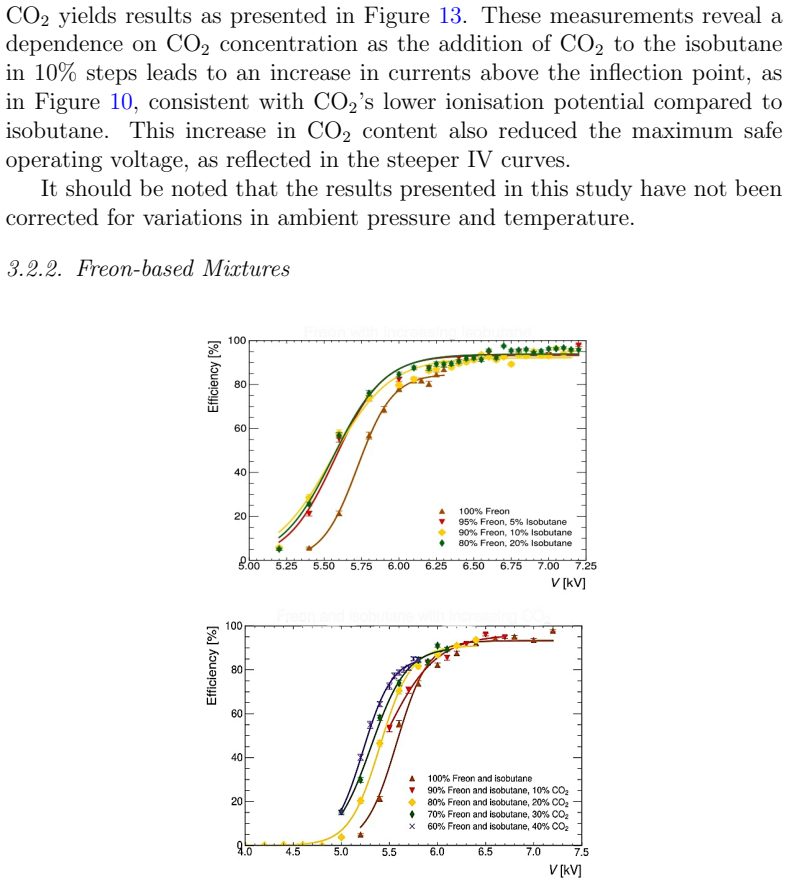
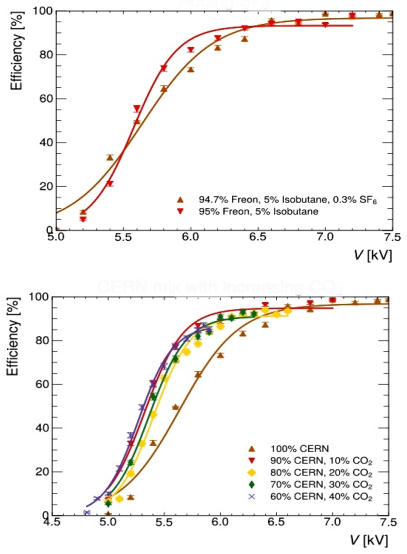
On the paper's own terms, the central discovery is that the efficiency plateau of a thin 1 mm RPC is insensitive to moderate CO2 substitution: efficiency remains high for CO2 concentrations up to 30%, with a significant drop only beyond 40%, and the isobutane plateau saturates at 3%, so the standard 5% isobutane is more than needed. The paper argues this is consistent with CO2 lowering the electron multiplication rate (the first Townsend coefficient) and the ionization yield, while SF6, at 0.3%, stabilizes the avalanche regime but raises the critical voltage. It further reports that the standard reference mixture (95.2% Freon, 4.5% isobutane, 0.3% SF6) tolerates CO2 up to 40% before efficiency degrades, whereas the SF6-free 95% Freon, 5% isobutane mixture starts dropping after 30%.
Load-bearing premise
The results are single, short-duration measurements with no error bars and no correction for ambient pressure and temperature; if day-to-day environmental shifts move the efficiency curves by more than the observed margins, the 30% CO2 and 3% isobutane thresholds could change.
Editorial extensions
If this is right
- ANUBIS can operate its 9.8 m$^3$ gas volume with up to 30% CO2 in the Freon-based mixture, keeping the efficiency plateau needed for its ~98%-per-layer hit requirement.
- The isobutane fraction can be lowered from 5% to 3%, cutting both flammability and the mixture's environmental impact.
- Large LHC RPC systems using similar Freon/isobutane/SF6 recipes could adopt the same CO2 substitution, but the tolerated CO2 fraction depends on the SF6 content, so each system needs its own scan.
- CO2 cannot replace Freon beyond roughly 40%, so this is a short- to medium-term mitigation, not a fully eco-friendly replacement.
- Long-term ageing studies are required before the 30% CO2 and 3% isobutane setpoints are deployed in a running experiment.
Reading between the lines
- Beyond the paper's direct claims, the CO2 tolerance is likely a monotonic function of SF6 concentration; a dedicated SF6 scan (0% to 1%) at fixed 30% CO2 could reveal whether more SF6 buys a higher CO2 ceiling.
- A missing control in the paper is day-to-day reproducibility; repeating the 30% CO2 scan under monitored pressure and temperature would show whether the claimed threshold is stable or an artefact of a single run.
- If the 3% isobutane plateau holds up, the same plateau-scan technique could be reused as a fast screening method for fully eco-friendly gases such as HFOs, which is ANUBIS's longer-term goal.
- The environmental gain is concentrated in the Freon fraction: replacing 30% of Freon (GWP 1430) with CO2 (GWP 1) in a 9.8 m$^3$ volume constitutes a large fractional cut in detector gas emissions, although leak rates and total volume dominate the absolute footprint.
Signed reviews
Editorial analysis
A structured set of objections, weighed in public.
Referee Report
Summary. The paper reports performance measurements of 50 cm × 50 cm, 1 mm single-gap High-Pressure Laminate Resistive Plate Chamber prototypes for the proposed ANUBIS experiment. Using cosmic-ray muons with a scintillator trigger, the authors measure IV characteristics and detection efficiency versus applied voltage for gas mixtures based on isobutane, Freon (R-134a), CO2, and SF6. The central claims are that (i) the isobutane fraction in Freon-based mixtures can be reduced from 5% to 3% without efficiency loss, (ii) CO2 can be added up to 30% to a 95% Freon + 5% isobutane mixture while maintaining efficiency, and (iii) the standard CERN mixture (95.2% Freon, 4.5% isobutane, 0.3% SF6) remains efficient up to 40% CO2. These results are presented as a short- to medium-term low-GWP strategy for ANUBIS and other LHC RPC systems. The paper explicitly states that results are not corrected for ambient pressure and temperature, and the efficiency plots show single scans without error bars.
Significance. If the claims are robust, the measurements provide directly useful guidance for ANUBIS and for other large RPC systems seeking to reduce greenhouse-gas emissions: modest CO2 substitution and a small reduction in isobutane concentration would lower the GWP of a 9.8 m^3 active volume without a demonstrated performance penalty. The experimental setup is described in useful detail, including the scintillator calibration and the gas-mixing limitations, and the qualitative trends agree with prior RPC studies using eco-friendly mixtures. However, the central threshold claims rest on single, uncorrected scans without statistical or systematic uncertainties, and the proposed low-GWP mixture was not measured as a single gas composition. The paper is a preliminary feasibility study, not yet a quantitative operational specification.
major comments (4)
- [Section 3.2 and Figures 13–15] The efficiency-versus-voltage curves in Figures 13, 14, and 15 are single scans with no error bars, and the text does not state the number of events per point or the run-to-run reproducibility of the efficiency at a fixed voltage. Without this information, the reader cannot determine whether the reported differences between, for example, 0% and 30% CO2 are statistically significant or within scatter. This directly affects the central claim that efficiency remains high up to 30% CO2.
- [Section 3.2.1, statement before Section 3.2.2] The manuscript explicitly states that results are not corrected for variations in ambient pressure and temperature. RPC avalanche gain depends on gas density, and the observed efficiency plateaus span only a few hundred volts; an uncontrolled environmental change between runs could shift an efficiency curve by an amount comparable to the plateau width. Therefore the observed efficiency drop beyond 30% or 40% CO2 could be partly environmental, and the reported CO2 threshold is not established as a property of the gas mixture alone.
- [Section 3.2.2, Figure 14] The proposed low-GWP configuration, namely 3% isobutane combined with up to 30% CO2, is never measured as a single gas mixture. The isobutane scan (Figure 14 top) is performed without CO2, and the CO2 scan (Figure 14 bottom) uses a fixed 5% isobutane fraction. The recommendation to operate with 3% isobutane and 30% CO2 therefore relies on extrapolating across two independently varied gas components, with no direct measurement of the combined effect on efficiency.
- [Section 3.2.2, Figure 15] The text claims that 'a significant efficiency drop is observed beyond 40% CO2' for the Freon-isobutane mixture and that the CERN mixture 'begins to drop off significantly beyond this point.' However, Figure 15 (bottom) shows CO2 fractions only up to 40%, and no data beyond 40% are presented for either mixture. The claimed threshold behaviour beyond 40% is therefore not supported by the shown measurements.
minor comments (5)
- [General figures] The efficiency plots (Figures 13–15) would benefit from clearly labeled axes including units for voltage and from error bars or an explicit statement of the per-point statistical uncertainty; currently several figures lack axis labels entirely.
- [Section 2.2] The gas mixing setup uses a rotameter for Freon because the mass flow controllers are incompatible with Freon; the resulting uncertainty in the Freon fraction is not quantified. Since Freon is the dominant component, a short paragraph discussing the accuracy of the rotameter would help the reader judge mixture reproducibility.
- [Figure 9 caption] The caption contains the typo 'separated vertically by ∼ 30 cm’s' and should read '30 cm'.
- [Section 1, first paragraph] The phrase 'an unprecedently large active decay volume' should be 'an unprecedentedly large active decay volume'.
- [Section 3.2.2, Discussion] The sentence 'This opens the possibility of reducing the isobutane fraction from 5% to 3% by increasing the CO2 content' is not directly supported by the displayed scans, since the 3% isobutane point was measured without CO2; this should be rephrased as a suggestion for future work unless a combined measurement is added.
Circularity Check
No significant circularity: the paper is a direct empirical measurement study with no fitted model, no derived prediction, and no load-bearing self-citation.
full rationale
The paper's claims are direct readings of efficiency-versus-voltage scans for defined gas mixtures. The statement 'efficiency remains high for CO2 concentrations up to 30%' (Sec. 3.2.2) and the conclusion that isobutane can be reduced from 5% to 3% are empirical comparisons of measured curves, not outputs of a model whose parameters were fitted to those same curves. No equation in the paper derives a quantity from another measured quantity by construction; the only quantitative inputs are the raw efficiency and current data. The self-references (Refs. [1] and [2]) are used only to motivate the ANUBIS requirements and are not load-bearing for the gas-mixture conclusions. The acknowledged lack of ambient pressure/temperature correction (Sec. 3.2.1) is a measurement-validity limitation and a possible source of systematic error, but it is not circularity: the conclusions are not defined in terms of the inputs, and no fitted parameter is renamed as a prediction. Therefore the paper is self-contained with respect to the circularity criteria and receives score 0.
Assumptions & free parameters
assumptions (3)
- domain assumption RPC avalanche multiplication follows exponential growth with applied voltage.
- domain assumption The two-scintillator OR trigger provides a largely unbiased sample of cosmic muons.
- domain assumption The gas mixture delivered to the chamber matches the fractions set by the flow controllers.
Cite this review
Pith. "Pith review of Performance studies of thin gas gap Resistive Plate Chamber prototypes with low Global Warming Potential gases for the ANUBIS experiment." pith.science (2026). https://pith.science/paper/BYLUROOR
@misc{pith2026250616948,
  author       = {Pith},
  title        = {Pith review of: Performance studies of thin gas gap Resistive Plate Chamber prototypes with low Global Warming Potential gases for the ANUBIS experiment},
  year         = {2026},
  howpublished = {\url{https://pith.science/paper/BYLUROOR}},
  note         = {Machine review of arXiv:2506.16948}
}
abstract
Resistive Plate Chambers (RPCs) have traditionally operated with high Global Warming Potential (GWP) gas mixtures, adding to the environmental footprint of large-scale physics experiments. In response, efforts are underway to explore environmentally friendly alternatives as a long-term solution and low-GWP as a feasible short- to medium-term replacement for standard RPC gases. This study tests a few mixtures in 50 cm $\times$ 50 cm, 1 mm single-gap High-Pressure Laminate (HPL) RPC prototypes, as part of ongoing efforts for the ANUBIS experiment, which will operate with a 9.8 m$^{3}$ active gas volume. Measurements of performance metrics, including current and efficiency, are conducted with both standard and modified mixtures to assess their viability in sustaining detector performance. The results are also relevant for large RPC systems in other experiments at the LHC, such as ATLAS and CMS, as well as in applications beyond the LHC, supporting a shift toward environmentally sustainable gas mixtures in particle physics detectors.
Figures


Figures from the paper (12 more)


Reference graph
Works this paper leans on
-
[1]
Martin Bauer, Oleg Brandt, Lawrence Lee, and Christian Ohm. ANU- BIS: Proposal to search for long-lived neutral particles in CERN ser- vice shafts, arXiv:1909.13022. 9 2019. https://arxiv.org/abs/1909. 13022
arXiv 1909
-
[2]
Searches for long-lived particles with the ANUBIS exper- iment
Aashaq Shah. Searches for long-lived particles with the ANUBIS exper- iment. PoS, EPS-HEP2023:051, 2024. https://doi.org/10.22323/1. 449.0051
doi:10.22323/1 2024
-
[3]
R. Santonico and R. Cardarelli. Development of Resistive Plate Coun- ters. Nucl. Instrum. and Meth. , 187:377–380, 1981. https://doi.org/ 10.1016/0029-554X(81)90363-3
-
[4]
Performance of the ATLAS Resistive Plate Cham- bers
Giordano Cattani. Performance of the ATLAS Resistive Plate Cham- bers. Nucl. Instrum. and Meth. A , 661:S6–S9, 2012. https://doi.org/ 10.1016/j.nima.2010.07.073
-
[5]
The ATLAS Experiment at the CERN Large Hadron Col- lider
G Aad et al. The ATLAS Experiment at the CERN Large Hadron Col- lider. JINST, 3:S08003, 2008. https://doi.org/10.1088/1748-0221/ 3/08/S08003
- [6]
-
[7]
The ATLAS RPC System for the LHC Run-3
Davide Boscherini. The ATLAS RPC System for the LHC Run-3. Tech- nical report, CERN, Geneva, 2023. https://cds.cern.ch/record/ 2850856
work page 2023
-
[8]
The CMS RPC system readiness for LHC Run-3 data taking
M Shopova et al. The CMS RPC system readiness for LHC Run-3 data taking. Nucl. Instrum. Meth. A , 1052:168272, 2023. https://cds. cern.ch/record/2856419
Show all 25 references
-
[9]
Solomon et al
S. Solomon et al. Climate Change 2007: The Physical Science Basis. Working Group I Contribution to the Fourth Assessment Report of the 20 IPCC. 2007. https://www.ipcc.ch/site/assets/uploads/2020/02/ ar4-wg1-sum_vol_en.pdf
2007
-
[10]
Schulz and D
M. Schulz and D. Kourkoulas. Regulation (EU) no 517/2014 of the European parliament and of the council of 16 April 2014 on fluorinated greenhouse gases and repealing regulation (EC) no 842/2006. Official J. Eur. Union, L 150:195–230, 2014. https://eur-lex.europa.eu/eli/ reg/20...
2014
-
[11]
Studies on RPC detectors operated with environmentally friendly gas mixtures in LHC-like conditions
Gianluca Rigoletti, Roberto Guida, and Beatrice Mandelli. Studies on RPC detectors operated with environmentally friendly gas mixtures in LHC-like conditions. Eur. Phys. J. Plus , 138(9):841, 2023. https: //cds.cern.ch/record/2875180
2023
-
[12]
Performance of new generation of Resistive Plate Chambers operating with alternative gas mixtures
Giorgia Proto et al. Performance of new generation of Resistive Plate Chambers operating with alternative gas mixtures. Nucl. In- strum. Meth. A , 1066:169580, 2024. https://doi.org/10.1016/j. nima.2024.169580
2024
-
[13]
Abbrescia et al
M. Abbrescia et al. Performance of thin-RPC detectors for high rate applications with eco-friendly gas mixtures. Eur. Phys. J. C , 84(6):605,
-
[14]
Fabrication and Characterisation of Oil-Free Large High Pressure Laminate Resistive Plate Chamber
Rajesh Ganai et al. Fabrication and Characterisation of Oil-Free Large High Pressure Laminate Resistive Plate Chamber. JINST, 11(04):P04026, 2016. http://dx.doi.org/10.1088/1748-0221/11/ 04/P04026
2016 doi
-
[15]
Pizzimento
L. Pizzimento. Performance of the BIS78 RPC detectors: a new concept of electronics and detector integration for high-rate and fast timing large size RPCs. JINST, 15(11):C11010, 11 2020
2020
-
[16]
Premier Control Technologies
Ltd. Premier Control Technologies. Premier Control Technologies. https://www.pctflow.com
-
[17]
General purpose plastic scintillator: Ej-200, ej- 204, ej-208, ej-212, 2021
ELJEN Technology. General purpose plastic scintillator: Ej-200, ej- 204, ej-208, ej-212, 2021. https://eljentechnology.com/products/ plastic-scintillators/ej-200-ej-204-ej-208-ej-212 . 21
2021
-
[18]
AFBR-S4N33C013 NUV-HD Single Silicon Photo Multi- plier, 2022
Broadcom. AFBR-S4N33C013 NUV-HD Single Silicon Photo Multi- plier, 2022. https://uk.rs-online.com/web/p/photomultipliers/ 2028730
2022
-
[19]
Navas et al
S. Navas et al. Review of Particle Physics. Phys. Rev. D , 110:535, 8 2024
2024
-
[20]
Von Engel
A. Von Engel. Ionized gases / A. von Engel. American Vacuum Society classics. AIP Press, Woodbury, NY, 1994 - 1965. https: //link.springer.com/book/9781563962721
1994
-
[21]
Auriemma, P
G. Auriemma, P. Camarri, A. Colaleo, et al. Experimental deter- mination of the Townsend coefficient for Argon–CO 2 gas mixtures at high fields. Nuclear Instrum. and Meth. A , 513:484 – 489, 2003. https://doi.org/10.1016/S0168-9002(03)02074-6
2003 doi
-
[22]
Sharma and F
A. Sharma and F. Sauli. First Townsend coefficient measured in argon based mixtures at high fields. Nucl. Instrum. and Meth. A , 334:420–424,
-
[23]
Pulse height measurements and electron at- tachment in drift chambers operated with Xe, CO 2 mixtures cham- bers
ALICE Collaboration. Pulse height measurements and electron at- tachment in drift chambers operated with Xe, CO 2 mixtures cham- bers. Technical Report arXiv:physics/0303059, CERN, 2003. https: //cds.cern.ch/record/609142/. 22
2003 arXiv
-
[1993]
https://doi.org/10.1016/0168-9002(93)90802-O
-
[2024]
https://doi.org/10.1140/epjc/s10052-024-12907-2
Reviewed August 15, 2026 · model on record in the stance chip above.
Discussion (0). Continue with ORCID to comment.